

ABB’s Terra AC Wallbox advisory republished by CISA on May 21, 2026, warns that three medium-severity memory-corruption flaws affect Terra AC wallbox JP firmware up to version 1.8.33 and are fixed in version 1.8.36. The flaws are not the kind of internet-scale emergency that sends defenders racing to disconnect fleets overnight. They are more interesting than that: a reminder that the EV charger is now part appliance, part industrial endpoint, part firmware supply-chain problem. The wallbox in the garage has joined the same security conversation as the router, the camera, and the programmable controller.
The ABB advisory is narrow on paper. It names the Terra AC wallbox JP variant, three CVEs, a vendor fix, and a CVSS 3.1 base score of 6.1 for each issue. The attack path described by ABB is constrained: an attacker would need to hijack Bluetooth first before sending crafted messages, and ABB argues that the BLE-to-charger communication is encrypted.
That is the comforting reading. It is also the incomplete one.
A modern wallbox is not just a power socket with better branding. It speaks Bluetooth to apps, may integrate with backend charging platforms, understands OCPP-style operational logic, receives firmware updates, and often sits at the border between a home or facility network and a high-power electrical system. The attack surface is local or adjacent in many cases, but local no longer means trivial or irrelevant. In apartment garages, fleet depots, workplace charging lots, and shared residential installations, proximity is a weaker defense than vendors like to imply.
The three vulnerabilities map to familiar old enemies: heap-based buffer overflow, classic buffer overflow, and stack-based buffer overflow. These are not exotic cryptographic failures or speculative side channels. They are memory-safety bugs of the sort that security engineering has been trying to stamp out for decades, now appearing in the firmware of devices that owners expect to behave like electrical infrastructure.
But CVSS is a scoring system, not a business-impact model. It tells you something useful about exploitation conditions and technical effect, but it does not fully describe where the device sits, who depends on it, or how painful failure becomes when charging infrastructure is part of daily operations.
ABB’s own description is more consequential than the score suggests. A successful exploit could pollute memory, potentially take remote control of the product, and perform a write operation to flash memory to alter firmware behavior. That phrase should slow every operator down. Firmware persistence is where an ordinary bug starts to look like a control problem.
The advisory does not claim public exploitation, and it does not present a turnkey remote attack. That matters. There is no need to inflate this into a panic story. But defenders should not confuse “medium” with “unimportant,” especially when integrity and availability impacts are rated high.
That sentence deserves scrutiny. “In theory” is doing the work that risk managers usually want testing, telemetry, and compensating controls to do.
Encrypted BLE communication is a meaningful barrier. It reduces the probability of casual exploitation and makes drive-by attacks less plausible. But encryption does not automatically eliminate every implementation flaw around pairing, session handling, mobile app behavior, device authorization, backend provisioning, or malicious-but-authenticated clients. The vulnerabilities themselves appear to involve malformed or unexpected field lengths reaching firmware logic. That implies the dangerous condition occurs after some communication path has already been accepted.
The practical lesson is not that every Terra AC Wallbox is exposed to anyone standing nearby with a phone. The lesson is that embedded security cannot stop at “the channel is encrypted.” Once trusted messages reach firmware, the firmware still has to validate lengths, enforce bounds, reject malformed payloads, and fail safely. Encryption protects the envelope. It does not sanitize the letter inside.
That spread is revealing. The issue is not a single sloppy copy operation in an isolated command handler. The advisory suggests a pattern: input arriving through app, Bluetooth, firmware-update-adjacent, or backend configuration paths can exceed what the firmware expects.
For WindowsForum readers, this should sound familiar. The PC world has spent years hardening parsers, protocol handlers, installers, drivers, and update paths because attackers love the seam between “trusted management input” and “unsafe low-level code.” EV charging hardware is walking through the same maturity curve, only with more amps and less operational visibility.
The reference to OCPP is especially important. Open Charge Point Protocol is widely used to connect charging stations with management backends. Even when a specific flaw requires special conditions, the presence of backend-driven configuration in the vulnerability story shows why charging infrastructure belongs in the broader operational technology risk register. It is no longer just a local device administered with a phone app.
ABB says version 1.8.36 corrects the problems for the affected Terra AC wallbox JP line. That is the right remedy, and owners should apply it. But firmware updates in the real world are not as simple as issuing a sentence in an advisory.
Some chargers sit in private garages and are maintained by owners who may not know how to check a firmware version. Some sit in managed estates where the electrical contractor installed them, a facilities team owns the hardware, an IT team owns the network, and a third-party charging platform owns the management portal. In that environment, “apply the update at earliest convenience” can dissolve into organizational ambiguity.
This is where IoT and operational technology repeatedly fail: not because nobody knows patches matter, but because nobody is clearly responsible for proving that the patch landed. A wallbox is often bought as infrastructure but managed like a gadget. Security advisories expose that mismatch.
That process matters because many defenders do not monitor every vendor PSIRT page, especially for devices that sit outside traditional IT procurement. CISA’s ICS advisories are often the point at which a niche product warning becomes visible to asset owners, insurers, consultants, and security teams who maintain vulnerability management workflows.
There is a catch, though. CISA also makes clear that the republication is provided as-is and that CISA is not responsible for the vendor advisory’s editorial or technical accuracy. In plain English: the federal notice amplifies the warning, but it does not independently transform ABB’s assertions into a government-validated exploit analysis.
That distinction is worth keeping. The right response is neither blind trust nor reflexive alarmism. Treat the advisory as credible enough to act on, but do not overread it as proof of active exploitation or broad exposure beyond the named affected products.
Organizations should resist the temptation to decide from the product name alone. The correct move is to inventory actual model variants and firmware versions. In many environments, the charger faceplate, procurement record, mobile app, and backend portal may not all use exactly the same naming. That is how “not applicable” becomes “missed patch.”
For individual owners, the task is simpler but still easy to postpone. If you have a Terra AC Wallbox, check the product variant and firmware version through the official app or management method provided by ABB. If the unit is managed by an installer, landlord, employer, charging service provider, or facilities team, ask them to confirm whether the device is in the affected JP line and whether firmware 1.8.36 or later has been applied.
The advisory does not say that every Terra AC Wallbox worldwide is vulnerable. It says specific JP versions are affected. The difference matters. But uncertainty should trigger verification, not assumption.
That is an untenable model. If a device has firmware, network connectivity, identity, remote management, and a vendor update channel, it belongs in an asset inventory. If it can affect the availability of workplace charging, fleet dispatch, or building energy use, it belongs in a risk register. If it communicates with mobile apps or backend services, it belongs in a vulnerability-management process.
The old split between “IT equipment” and “facilities equipment” is becoming less useful every year. A charger may be bolted to a wall, but its security posture looks more like a managed embedded Linux box or microcontroller ecosystem than a breaker panel. That means patching, segmentation, credential control, logging, and lifecycle ownership all need to be explicit.
This is not about turning every home EV owner into a security engineer. It is about organizations accepting that connected energy devices are now part of the digital estate. The sooner that becomes boring routine, the fewer surprises will arrive through advisories like this one.
It is boilerplate for a reason. Most compromises do not respect neat product boundaries. A device with a local-only flaw may become reachable through a compromised phone, a poorly secured management tablet, a shared facilities network, a vendor remote-support path, or a flat internal network where one foothold becomes many.
Segmentation is not magic, but it buys time and reduces blast radius. If chargers are on a dedicated VLAN, managed through limited administrative paths, and separated from ordinary corporate endpoints, a flaw in one class of device is less likely to become a stepping stone. If firmware updates are tracked centrally, the organization can answer “are we exposed?” in hours rather than weeks.
For small businesses and home users, the equivalent is less grand but still useful. Avoid exposing management interfaces unnecessarily. Keep the mobile app and charger firmware current. Do not share administrative access casually. Replace default or weak credentials where the product allows it. Treat the charger as a smart device attached to critical household or operational function, not as a dumb outlet.
That is a very vendor-shaped paragraph. It acknowledges the bug while narrowing the scenario. It tells customers to update while simultaneously implying the practical risk is close to nonexistent. Security teams have seen this style before in routers, cameras, PLCs, VPN appliances, printers, and medical devices.
The right reading is pragmatic. Vendors are often correct that exploitation requires preconditions not captured in a dramatic headline. They are also motivated to avoid overstating danger, especially in products attached to physical infrastructure. Defenders should extract the actionable facts: affected versions, fixed version, attack vector, required privileges, potential impact, and compensating controls.
Everything else belongs in the “positioning” column. That does not mean ABB is wrong. It means the operator, not the vendor, owns the local risk decision.
Every one of those features adds software. Every software feature adds inputs. Every input needs validation.
The industry’s challenge is not to make chargers less smart. Dumb infrastructure will not satisfy the energy transition’s operational requirements. The challenge is to make smart charging boringly maintainable: clear firmware channels, signed updates, visible version reporting, secure pairing, documented lifecycle support, and advisories that tell owners exactly what to do without euphemism.
The Windows ecosystem learned this lesson painfully. Patch Tuesday, driver signing, update telemetry, vulnerability disclosure norms, and enterprise management tooling did not emerge because software vendors were naturally tidy. They emerged because unmanaged complexity became intolerable. EV charging infrastructure is approaching its own version of that moment.
This is the point at which security becomes inventory work. Find the chargers. Identify the variant. Read the firmware version. Determine who can update it. Apply the update. Record the result. If the device is operated by a third party, require confirmation rather than accepting “we think it is current.”
That record matters because advisory timelines can shift. In this case, the revision history includes multiple updates after the initial September 2025 release, including CVSS, CVE, and fixed-version changes. If your vulnerability-management system captured an early version of the advisory and nobody revisited it, your internal record may not match the latest remediation state.
The fix version is also a boundary for support conversations. “Are our chargers secure?” is vague. “Are all Terra AC wallbox JP units at firmware 1.8.36 or later?” is answerable.
That fragmentation is the real vulnerability class behind many device advisories. The technical flaw has a CVE. The organizational flaw rarely does.
A mature response assigns ownership before the next advisory arrives. That means chargers should have a named system owner, an update procedure, an escalation path, and a documented dependency map. It should be clear whether the device is managed locally, through ABB tooling, through an installer, or through a charging-service backend. It should be clear how firmware version evidence is collected.
These are not glamorous controls, but they are the difference between reading an advisory and reducing risk. In the embedded world, discipline beats drama.
Most individual wallboxes will never become national-security incidents. But aggregated devices, shared platforms, and fleet charging hubs can matter. Availability failures can disrupt operations. Integrity failures can affect billing, charging behavior, load management, or trust in infrastructure. Firmware tampering, even if hard to pull off, is not a theoretical concern when devices are numerous and long-lived.
This is where security language needs to be precise. The ABB advisory does not mean an attacker can sit across the street and instantly rewrite every Terra charger. It does mean that memory-safety bugs exist in a device class increasingly tied to energy operations. That is enough to justify attention.
The energy transition is adding millions of intelligent endpoints to homes, garages, depots, curbs, and workplaces. Their security will be uneven. Advisories like this are early signals of a long maintenance burden, not isolated curiosities.
ABB’s fix gives affected customers a clear destination: firmware 1.8.36. The harder journey is cultural. As charging infrastructure spreads, the industry will need to stop treating these devices as electrical accessories that occasionally need software attention and start treating them as software-defined energy endpoints that happen to move electrons. The next advisory will be easier to handle for organizations that make that shift now.
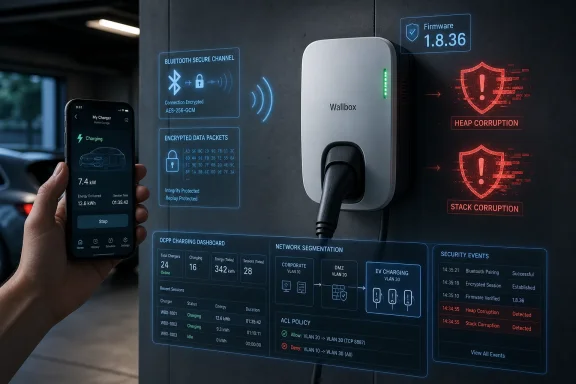 The EV Charger Has Become an Endpoint, Whether Owners Think So or Not
The ABB advisory is narrow on paper. It names the Terra AC wallbox JP variant, three CVEs, a vendor fix, and a CVSS 3.1 base score of 6.1 for each issue. The attack path described by ABB is constrained: an attacker would need to hijack Bluetooth first before sending crafted messages, and ABB argues that the BLE-to-charger communication is encrypted.That is the comforting reading. It is also the incomplete one.
A modern wallbox is not just a power socket with better branding. It speaks Bluetooth to apps, may integrate with backend charging platforms, understands OCPP-style operational logic, receives firmware updates, and often sits at the border between a home or facility network and a high-power electrical system. The attack surface is local or adjacent in many cases, but local no longer means trivial or irrelevant. In apartment garages, fleet depots, workplace charging lots, and shared residential installations, proximity is a weaker defense than vendors like to imply.
The three vulnerabilities map to familiar old enemies: heap-based buffer overflow, classic buffer overflow, and stack-based buffer overflow. These are not exotic cryptographic failures or speculative side channels. They are memory-safety bugs of the sort that security engineering has been trying to stamp out for decades, now appearing in the firmware of devices that owners expect to behave like electrical infrastructure.
A Medium Score Can Still Describe a High-Value Failure
CVSS 6.1 is the sort of number that tempts organizations to defer action. It is not critical. It is not remotely exploitable over the open internet according to the advisory’s vector. It requires high privileges and adjacent access. On a dashboard crowded with ransomware exposure, identity compromise, and emergency browser updates, a medium-severity EV charger advisory can look like background noise.But CVSS is a scoring system, not a business-impact model. It tells you something useful about exploitation conditions and technical effect, but it does not fully describe where the device sits, who depends on it, or how painful failure becomes when charging infrastructure is part of daily operations.
ABB’s own description is more consequential than the score suggests. A successful exploit could pollute memory, potentially take remote control of the product, and perform a write operation to flash memory to alter firmware behavior. That phrase should slow every operator down. Firmware persistence is where an ordinary bug starts to look like a control problem.
The advisory does not claim public exploitation, and it does not present a turnkey remote attack. That matters. There is no need to inflate this into a panic story. But defenders should not confuse “medium” with “unimportant,” especially when integrity and availability impacts are rated high.
The Bluetooth Caveat Is Doing a Lot of Work
ABB’s mitigation language leans heavily on the Bluetooth prerequisite. To attack with this kind of message, the advisory says, hackers must hijack Bluetooth first and then send messages, because communication between BLE and the charger is encrypted. The vendor’s conclusion is notably strong: in theory, there is no way to attack the charger.That sentence deserves scrutiny. “In theory” is doing the work that risk managers usually want testing, telemetry, and compensating controls to do.
Encrypted BLE communication is a meaningful barrier. It reduces the probability of casual exploitation and makes drive-by attacks less plausible. But encryption does not automatically eliminate every implementation flaw around pairing, session handling, mobile app behavior, device authorization, backend provisioning, or malicious-but-authenticated clients. The vulnerabilities themselves appear to involve malformed or unexpected field lengths reaching firmware logic. That implies the dangerous condition occurs after some communication path has already been accepted.
The practical lesson is not that every Terra AC Wallbox is exposed to anyone standing nearby with a phone. The lesson is that embedded security cannot stop at “the channel is encrypted.” Once trusted messages reach firmware, the firmware still has to validate lengths, enforce bounds, reject malformed payloads, and fail safely. Encryption protects the envelope. It does not sanitize the letter inside.
Memory Corruption Is the Old Bug in the New Infrastructure
The three CVEs each describe a different memory-corruption shape. CVE-2025-10504 involves a potential heap memory pollution risk when apps communicate with the charger using a self-defined protocol and do not strictly follow field lengths that firmware fails to validate. CVE-2025-12142 involves BSS memory pollution when apps communicate via Bluetooth and configure an unexpected length of binary files. CVE-2025-12143 involves stack memory pollution through a customized OCPP key named “Ran-domDelay” when an unexpected number is configured.That spread is revealing. The issue is not a single sloppy copy operation in an isolated command handler. The advisory suggests a pattern: input arriving through app, Bluetooth, firmware-update-adjacent, or backend configuration paths can exceed what the firmware expects.
For WindowsForum readers, this should sound familiar. The PC world has spent years hardening parsers, protocol handlers, installers, drivers, and update paths because attackers love the seam between “trusted management input” and “unsafe low-level code.” EV charging hardware is walking through the same maturity curve, only with more amps and less operational visibility.
The reference to OCPP is especially important. Open Charge Point Protocol is widely used to connect charging stations with management backends. Even when a specific flaw requires special conditions, the presence of backend-driven configuration in the vulnerability story shows why charging infrastructure belongs in the broader operational technology risk register. It is no longer just a local device administered with a phone app.
Firmware Is Where the Real Stakes Live
The advisory’s most serious line is the possibility of writing to flash memory to alter firmware behavior. In consumer tech, firmware compromise is bad because it can survive reboots, evade ordinary inspection, and place the attacker below the level at which users normally manage the system. In industrial and energy-adjacent devices, those same concerns apply with an added operational dimension: firmware defines how the device enforces safety, charging limits, communication, authorization, and recovery.ABB says version 1.8.36 corrects the problems for the affected Terra AC wallbox JP line. That is the right remedy, and owners should apply it. But firmware updates in the real world are not as simple as issuing a sentence in an advisory.
Some chargers sit in private garages and are maintained by owners who may not know how to check a firmware version. Some sit in managed estates where the electrical contractor installed them, a facilities team owns the hardware, an IT team owns the network, and a third-party charging platform owns the management portal. In that environment, “apply the update at earliest convenience” can dissolve into organizational ambiguity.
This is where IoT and operational technology repeatedly fail: not because nobody knows patches matter, but because nobody is clearly responsible for proving that the patch landed. A wallbox is often bought as infrastructure but managed like a gadget. Security advisories expose that mismatch.
CISA’s Republication Makes a Small Advisory Harder to Ignore
CISA’s May 21, 2026 republication is not the first appearance of the underlying ABB advisory. The revision history points back to an initial vendor release on September 16, 2025, followed by document, CVSS, CVE, and fixed-version updates through late 2025. CISA describes the item as a verbatim republication of ABB’s CSAF advisory, provided to increase visibility.That process matters because many defenders do not monitor every vendor PSIRT page, especially for devices that sit outside traditional IT procurement. CISA’s ICS advisories are often the point at which a niche product warning becomes visible to asset owners, insurers, consultants, and security teams who maintain vulnerability management workflows.
There is a catch, though. CISA also makes clear that the republication is provided as-is and that CISA is not responsible for the vendor advisory’s editorial or technical accuracy. In plain English: the federal notice amplifies the warning, but it does not independently transform ABB’s assertions into a government-validated exploit analysis.
That distinction is worth keeping. The right response is neither blind trust nor reflexive alarmism. Treat the advisory as credible enough to act on, but do not overread it as proof of active exploitation or broad exposure beyond the named affected products.
Japan-Specific Firmware Does Not Mean Global Operators Can Ignore It
The affected product line is listed as Terra AC wallbox JP up to version 1.8.33, with version 1.8.36 named as the corrected release. The advisory also says deployment is worldwide and identifies the critical infrastructure sector as Energy. That combination creates the usual asset-management headache: a product variant may be geographically labeled, while the vendor footprint, installed base, and supply paths are broader.Organizations should resist the temptation to decide from the product name alone. The correct move is to inventory actual model variants and firmware versions. In many environments, the charger faceplate, procurement record, mobile app, and backend portal may not all use exactly the same naming. That is how “not applicable” becomes “missed patch.”
For individual owners, the task is simpler but still easy to postpone. If you have a Terra AC Wallbox, check the product variant and firmware version through the official app or management method provided by ABB. If the unit is managed by an installer, landlord, employer, charging service provider, or facilities team, ask them to confirm whether the device is in the affected JP line and whether firmware 1.8.36 or later has been applied.
The advisory does not say that every Terra AC Wallbox worldwide is vulnerable. It says specific JP versions are affected. The difference matters. But uncertainty should trigger verification, not assumption.
The Charger Belongs in the Same Inventory as the Switch
For sysadmins and IT pros, the operational lesson is bigger than ABB. EV chargers increasingly sit in places where IT, facilities, and energy management overlap. They may connect to Wi-Fi, Ethernet, cellular backhaul, Bluetooth apps, building management systems, and cloud dashboards. They may be administered by people who do not think of themselves as endpoint managers.That is an untenable model. If a device has firmware, network connectivity, identity, remote management, and a vendor update channel, it belongs in an asset inventory. If it can affect the availability of workplace charging, fleet dispatch, or building energy use, it belongs in a risk register. If it communicates with mobile apps or backend services, it belongs in a vulnerability-management process.
The old split between “IT equipment” and “facilities equipment” is becoming less useful every year. A charger may be bolted to a wall, but its security posture looks more like a managed embedded Linux box or microcontroller ecosystem than a breaker panel. That means patching, segmentation, credential control, logging, and lifecycle ownership all need to be explicit.
This is not about turning every home EV owner into a security engineer. It is about organizations accepting that connected energy devices are now part of the digital estate. The sooner that becomes boring routine, the fewer surprises will arrive through advisories like this one.
The Network Advice Is Generic Because the Pattern Is Familiar
CISA’s recommended practices are the standard ICS playbook: minimize network exposure, keep control-system devices off the public internet, put control networks behind firewalls, isolate them from business networks, and use secure remote access such as updated VPNs when remote access is required. For a Bluetooth-mediated wallbox issue, that guidance may sound broad to the point of boilerplate.It is boilerplate for a reason. Most compromises do not respect neat product boundaries. A device with a local-only flaw may become reachable through a compromised phone, a poorly secured management tablet, a shared facilities network, a vendor remote-support path, or a flat internal network where one foothold becomes many.
Segmentation is not magic, but it buys time and reduces blast radius. If chargers are on a dedicated VLAN, managed through limited administrative paths, and separated from ordinary corporate endpoints, a flaw in one class of device is less likely to become a stepping stone. If firmware updates are tracked centrally, the organization can answer “are we exposed?” in hours rather than weeks.
For small businesses and home users, the equivalent is less grand but still useful. Avoid exposing management interfaces unnecessarily. Keep the mobile app and charger firmware current. Do not share administrative access casually. Replace default or weak credentials where the product allows it. Treat the charger as a smart device attached to critical household or operational function, not as a dumb outlet.
Vendor Language Should Not Be the Final Risk Assessment
ABB’s advisory contains an awkward tension. On one hand, it describes memory pollution that could potentially enable remote control and flash writes. On the other, it states that because Bluetooth communication is encrypted, there is theoretically no way to attack the charger.That is a very vendor-shaped paragraph. It acknowledges the bug while narrowing the scenario. It tells customers to update while simultaneously implying the practical risk is close to nonexistent. Security teams have seen this style before in routers, cameras, PLCs, VPN appliances, printers, and medical devices.
The right reading is pragmatic. Vendors are often correct that exploitation requires preconditions not captured in a dramatic headline. They are also motivated to avoid overstating danger, especially in products attached to physical infrastructure. Defenders should extract the actionable facts: affected versions, fixed version, attack vector, required privileges, potential impact, and compensating controls.
Everything else belongs in the “positioning” column. That does not mean ABB is wrong. It means the operator, not the vendor, owns the local risk decision.
The Smart-Garage Era Needs Boring Patch Discipline
The Terra AC Wallbox advisory lands in a market where connected charging is becoming ordinary. Homeowners want scheduling, solar integration, energy tariffs, app control, and usage data. Businesses want authentication, billing, load management, fleet reporting, and uptime. Utilities and grid planners want smarter demand behavior.Every one of those features adds software. Every software feature adds inputs. Every input needs validation.
The industry’s challenge is not to make chargers less smart. Dumb infrastructure will not satisfy the energy transition’s operational requirements. The challenge is to make smart charging boringly maintainable: clear firmware channels, signed updates, visible version reporting, secure pairing, documented lifecycle support, and advisories that tell owners exactly what to do without euphemism.
The Windows ecosystem learned this lesson painfully. Patch Tuesday, driver signing, update telemetry, vulnerability disclosure norms, and enterprise management tooling did not emerge because software vendors were naturally tidy. They emerged because unmanaged complexity became intolerable. EV charging infrastructure is approaching its own version of that moment.
The Firmware Number Is the Story Operators Can Actually Act On
For all the nuance, the concrete action is not complicated. ABB identifies the affected Terra AC wallbox JP firmware line as versions up to 1.8.33 and identifies 1.8.36 as the corrected version. Anything else is secondary until asset owners know where they stand.This is the point at which security becomes inventory work. Find the chargers. Identify the variant. Read the firmware version. Determine who can update it. Apply the update. Record the result. If the device is operated by a third party, require confirmation rather than accepting “we think it is current.”
That record matters because advisory timelines can shift. In this case, the revision history includes multiple updates after the initial September 2025 release, including CVSS, CVE, and fixed-version changes. If your vulnerability-management system captured an early version of the advisory and nobody revisited it, your internal record may not match the latest remediation state.
The fix version is also a boundary for support conversations. “Are our chargers secure?” is vague. “Are all Terra AC wallbox JP units at firmware 1.8.36 or later?” is answerable.
The Wallbox Patch Is a Test of Ownership
The most revealing part of this advisory may be how difficult it is for some organizations to route. Security may see CISA and assume facilities owns the chargers. Facilities may see firmware and assume IT owns it. The installer may have the app credentials. The charging-network provider may control the backend. Procurement may be the only team with the exact model records.That fragmentation is the real vulnerability class behind many device advisories. The technical flaw has a CVE. The organizational flaw rarely does.
A mature response assigns ownership before the next advisory arrives. That means chargers should have a named system owner, an update procedure, an escalation path, and a documented dependency map. It should be clear whether the device is managed locally, through ABB tooling, through an installer, or through a charging-service backend. It should be clear how firmware version evidence is collected.
These are not glamorous controls, but they are the difference between reading an advisory and reducing risk. In the embedded world, discipline beats drama.
The Garage Door to the Energy Network Is Open Just Enough
The ABB case also shows how consumer and industrial categories are blurring. A home wallbox may look like consumer gear, but CISA treats the advisory as relevant to the Energy sector. That is not bureaucratic overreach. Distributed charging infrastructure is becoming part of how electricity demand is shaped, measured, and controlled.Most individual wallboxes will never become national-security incidents. But aggregated devices, shared platforms, and fleet charging hubs can matter. Availability failures can disrupt operations. Integrity failures can affect billing, charging behavior, load management, or trust in infrastructure. Firmware tampering, even if hard to pull off, is not a theoretical concern when devices are numerous and long-lived.
This is where security language needs to be precise. The ABB advisory does not mean an attacker can sit across the street and instantly rewrite every Terra charger. It does mean that memory-safety bugs exist in a device class increasingly tied to energy operations. That is enough to justify attention.
The energy transition is adding millions of intelligent endpoints to homes, garages, depots, curbs, and workplaces. Their security will be uneven. Advisories like this are early signals of a long maintenance burden, not isolated curiosities.
The Practical Reading for ABB Owners
The immediate response should be calm, specific, and documented. This is not a reason to stop using EV charging infrastructure wholesale, and the advisory does not describe confirmed exploitation in the wild. It is, however, a reason to verify firmware rather than assume a wall-mounted charger updates itself correctly.- Owners of ABB Terra AC wallbox JP units should confirm whether their firmware is version 1.8.36 or later.
- Organizations should inventory all ABB Terra AC Wallbox deployments instead of relying on product names or procurement assumptions.
- Administrators should treat Bluetooth and app-based management as real attack surfaces even when the communication channel is encrypted.
- Facilities and IT teams should decide who owns charger firmware updates before the next advisory forces the issue.
- Networked charging infrastructure should be segmented and managed like other operational technology endpoints.
- Medium-severity ICS advisories should be triaged by operational impact, not dismissed by score alone.
ABB’s fix gives affected customers a clear destination: firmware 1.8.36. The harder journey is cultural. As charging infrastructure spreads, the industry will need to stop treating these devices as electrical accessories that occasionally need software attention and start treating them as software-defined energy endpoints that happen to move electrons. The next advisory will be easier to handle for organizations that make that shift now.
References
- Primary source: CISA
Published: 2026-05-21T12:00:00+00:00
ABB Terra AC Wallbox | CISA
www.cisa.gov
- Related coverage: cve.imfht.com

Terra AC wallbox Vulnerabilities (3 CVEs) | Shenlong CVE Platform
All 3 CVE vulnerabilities found in Terra AC wallbox, with AI-generated Chinese analysis, references, and POCs.
cve.imfht.com
- Related coverage: manuals.plus
- Related coverage: resources.news.e.abb.com
PG2_Logo_Print_4C_160823
3d Illustration of White Futuristic Architecture Designresources.news.e.abb.com
