

CISA republished ABB’s AWIN Gateways advisory on April 30, 2026, warning that three vulnerabilities in ABB AWIN GW100 rev.2 and GW120 firmware can expose configuration data or let an unauthenticated adjacent attacker reboot affected industrial gateway devices. The word adjacent does a lot of work here: this is not a mass Internet worm story. But it is still a serious industrial-control story, because the devices at issue sit in the uncomfortable space where operational technology meets ordinary networking assumptions.
The lesson is not that every ABB AWIN gateway is suddenly a public-facing crisis. The lesson is that even “not remotely exploitable” ICS flaws can matter when a plant network has already been flattened by convenience, vendor access, weak segmentation, or years of exceptions nobody wants to revisit. In that environment, a gateway that leaks configuration details or accepts a reboot command without proper authentication becomes less a standalone bug than a pressure point in the wider architecture.
The advisory covers three CVEs: CVE-2025-13777, CVE-2025-13778, and CVE-2025-13779. ABB AWIN Firmware 2.0-0 and 2.0-1 on ABB AWIN GW100 rev.2 are affected, as are AWIN Firmware 1.2-0 and 1.2-1 on ABB AWIN GW120. ABB lists fixed versions as AWIN Firmware 2.1-0 for GW100 rev.2 and AWIN Firmware 2.0-0 for GW120.
The highest-rated issues carry CVSS 3.1 scores of 8.3, with attack vector marked as adjacent network, low complexity, no privileges required, and no user interaction required. That is the industrial-security version of a locked room problem: the attacker is not supposed to be in the room, but if they are, the lock on the cabinet is not enough.
CVE-2025-13777 is described as an authentication bypass caused by improper session validation, with unauthenticated queries revealing data. CVE-2025-13779 similarly allows unauthenticated access to system configuration, including sensitive details. CVE-2025-13778 is narrower but still operationally meaningful: an unauthenticated query can reboot the device, creating a denial-of-service condition.
The advisory notes that there is no known public exploitation specifically targeting these vulnerabilities, and that they are not exploitable remotely in the Internet-facing sense. That should lower panic. It should not lower discipline.
This guidance is sensible, but it is also where many industrial environments quietly fail. The problem is not that asset owners have never heard of segmentation. The problem is that real plants accumulate exceptions faster than they retire them.
A temporary vendor tunnel becomes permanent. A maintenance laptop crosses zones because production is down and nobody wants to wait. A firewall rule opened for commissioning survives the commissioning project by five years. A network diagram exists, but it describes the network that should exist rather than the one that actually does.
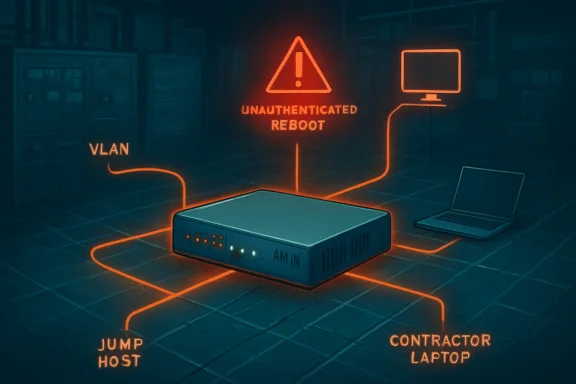
That is why adjacent-network vulnerabilities in ICS equipment deserve more attention than their phrasing suggests. In an ideal architecture, an attacker needs a foothold inside a restricted segment before these bugs become useful. In a messy architecture, “adjacent” may mean the same VLAN as a jump host, an engineering workstation, a wireless bridge, or a contractor access path.
But the configuration-disclosure bugs may be more useful to an attacker over time. System configuration is not just trivia. It can reveal network structure, device roles, naming conventions, addressing patterns, operational relationships, and sometimes sensitive deployment details that help an intruder move from opportunistic access to targeted action.
Attackers rarely begin with perfect knowledge. They build it. A flaw that answers unauthenticated queries can become a reconnaissance engine inside a supposedly trusted network.
This is especially important in OT because many environments still rely on obscurity as a thin supplement to segmentation. Device names, IP schemes, protocol choices, and gateway roles can expose the shape of the process. Once an attacker understands that shape, the next move becomes easier to plan and harder to detect.
That difference is why OT vulnerability management cannot simply mirror enterprise patch management. In IT, a vulnerable system is often patched quickly because downtime can be scheduled, redundancy is assumed, and rollback paths are familiar. In OT, patching may require maintenance windows, vendor coordination, validation against process safety requirements, and confidence that firmware changes will not destabilize equipment that has been running reliably for years.
This is the paradox that attackers exploit. The systems most resistant to casual patching are often the ones where reliability matters most. The same conservatism that keeps plants stable also leaves known flaws alive longer than anyone would tolerate in a conventional enterprise application stack.
So the right question is not merely, “What is the CVSS score?” The better question is, “Where is this gateway, what can reach it, what depends on it, and what happens if it is queried or rebooted at the wrong moment?”
This is where the real work begins. The security action is not just “apply the update.” It is identify the device, confirm the model and revision, verify the firmware version, map the network path to it, assess operational dependency, plan the maintenance window, test the upgrade path, and document the result.
For a single facility with mature asset management, that is manageable. For a multinational manufacturing footprint with mixed-age equipment, uneven documentation, and vendor-managed components, it becomes a campaign.
The advisory also implicitly tests whether organizations have integrated supplier security notices into their operational workflow. If a CISA ICS advisory is the first time the asset owner hears about a vendor issue, the process is already lagging. ABB’s PSIRT advisory was the source; CISA’s republication amplifies it. Mature programs should catch both, correlate them to asset inventory, and turn the notice into a site-specific decision.
Plants need remote access. Vendors need to diagnose equipment. Engineers need to respond after hours. Centralized teams need visibility across sites. The old model of perfectly isolated plants is often more mythology than reality.
The danger is treating a VPN as a magic boundary. A VPN can protect traffic in transit and limit who gets into a network, but it does not automatically enforce least privilege, device posture, session recording, just-in-time access, or segmentation once inside. A vendor connected through a VPN may be “remote” in geography but “adjacent” in vulnerability terms.
That matters for this ABB advisory because the attack vector is adjacent network. If a remote-access path lands a user, contractor machine, or compromised credential inside the same reachable segment as the AWIN gateway, then the difference between remote and adjacent becomes semantic rather than practical.
A better model treats remote access as a controlled workflow, not a tunnel. Access should be brokered, time-limited, logged, constrained by role, and routed only to the systems required for the task. Anything else turns remote support into a permanent expansion of the attack surface.
The ABB AWIN issue fits that broader pattern. Missing authentication and improper session validation are not exotic vulnerability classes. They are familiar web and network security failures appearing in industrial equipment where the consequences are more physical and less forgiving.
The industry has spent years saying that OT is different, and it is. But the uncomfortable truth is that many OT vulnerabilities are painfully ordinary. Authentication must be enforced. Sessions must be validated. Sensitive configuration must not be disclosed to unauthenticated callers. Critical functions must not be callable without proof of authority.
What makes the situation difficult is not the conceptual novelty of the bugs. It is the environment into which they land. A flaw that would be embarrassing in a consumer router can become materially significant in a gateway tied to production operations.
Engineering workstations are commonly Windows machines. Jump boxes are commonly Windows servers. Vendor access may terminate on Windows hosts. Monitoring dashboards, historian clients, and remote-support tooling often live inside the Microsoft ecosystem. The “adjacent network” that matters to an OT device may be reachable because of choices made in ordinary enterprise infrastructure.
That makes this advisory relevant beyond the plant floor. If Windows credentials are phished, if a remote desktop server is misconfigured, if an engineering workstation is reused as a general-purpose browsing machine, or if a flat network allows enterprise systems to see OT devices, then an adjacent-network ICS bug becomes part of the Windows estate’s risk story.
This is why IT and OT security cannot be separated by organizational chart. Attackers do not respect reporting lines. They follow reachability.
The best Windows administrators already understand this from ransomware incidents. The same lateral movement discipline that protects file servers and backup infrastructure also helps protect industrial segments: isolate administrative paths, reduce standing privileges, monitor unusual access, and treat jump systems as high-value assets rather than convenience boxes.
But “no known exploitation” is not the same as “no risk.” It often means defenders have a window in which to act before proof-of-concept code, opportunistic scanning, or targeted tradecraft catches up. In industrial security, those windows can be precious because remediation cycles are slow.
There is also a detection problem. If an attacker queried a gateway for configuration data, would the organization know? If a gateway rebooted unexpectedly, would the event be treated as a cyber indicator, a device hiccup, a power issue, or a maintenance artifact? Many OT environments are improving rapidly, but logging and security telemetry around embedded devices still lag behind enterprise endpoints.
That is why defenders should treat the lack of known exploitation as permission to be methodical, not permission to defer. The absence of smoke does not mean the wiring is sound.
The harder part belongs to asset owners. They must decide whether firmware upgrades can be deployed immediately, whether compensating controls are needed first, and whether the current network architecture violates the assumptions under which these gateways should operate.
That decision should not be made by security teams alone. Operations must weigh downtime. Engineering must validate compatibility. Network teams must confirm segmentation. Risk owners must understand what happens if the gateway is unavailable or if its configuration is exposed.
This is where industrial cybersecurity becomes organizational rather than technical. The patch may be a file, but the mitigation is a process.
Source: CISA ABB AWIN Gateways | CISA
The lesson is not that every ABB AWIN gateway is suddenly a public-facing crisis. The lesson is that even “not remotely exploitable” ICS flaws can matter when a plant network has already been flattened by convenience, vendor access, weak segmentation, or years of exceptions nobody wants to revisit. In that environment, a gateway that leaks configuration details or accepts a reboot command without proper authentication becomes less a standalone bug than a pressure point in the wider architecture.
 The Vulnerability Is Local, but the Failure Mode Is Operational
The advisory covers three CVEs: CVE-2025-13777, CVE-2025-13778, and CVE-2025-13779. ABB AWIN Firmware 2.0-0 and 2.0-1 on ABB AWIN GW100 rev.2 are affected, as are AWIN Firmware 1.2-0 and 1.2-1 on ABB AWIN GW120. ABB lists fixed versions as AWIN Firmware 2.1-0 for GW100 rev.2 and AWIN Firmware 2.0-0 for GW120.The highest-rated issues carry CVSS 3.1 scores of 8.3, with attack vector marked as adjacent network, low complexity, no privileges required, and no user interaction required. That is the industrial-security version of a locked room problem: the attacker is not supposed to be in the room, but if they are, the lock on the cabinet is not enough.
CVE-2025-13777 is described as an authentication bypass caused by improper session validation, with unauthenticated queries revealing data. CVE-2025-13779 similarly allows unauthenticated access to system configuration, including sensitive details. CVE-2025-13778 is narrower but still operationally meaningful: an unauthenticated query can reboot the device, creating a denial-of-service condition.
The advisory notes that there is no known public exploitation specifically targeting these vulnerabilities, and that they are not exploitable remotely in the Internet-facing sense. That should lower panic. It should not lower discipline.
“Not Internet Facing” Is a Requirement, Not a Defense
ABB’s own posture is straightforward: AWIN gateways should not be exposed to the Internet or other insecure networks, and should be installed behind firewalls. CISA echoes the familiar ICS guidance: minimize exposure, keep control systems off the public Internet, isolate operational networks from business networks, and use secure remote access when remote access is necessary.This guidance is sensible, but it is also where many industrial environments quietly fail. The problem is not that asset owners have never heard of segmentation. The problem is that real plants accumulate exceptions faster than they retire them.
A temporary vendor tunnel becomes permanent. A maintenance laptop crosses zones because production is down and nobody wants to wait. A firewall rule opened for commissioning survives the commissioning project by five years. A network diagram exists, but it describes the network that should exist rather than the one that actually does.
That is why adjacent-network vulnerabilities in ICS equipment deserve more attention than their phrasing suggests. In an ideal architecture, an attacker needs a foothold inside a restricted segment before these bugs become useful. In a messy architecture, “adjacent” may mean the same VLAN as a jump host, an engineering workstation, a wireless bridge, or a contractor access path.
The Reboot Bug Is the Loud One, but the Data Leak May Be the Quietly Dangerous One
It is tempting to focus on the reboot issue because availability is the sacred word in industrial control. If an attacker can reboot a gateway, they can interrupt communications, disrupt monitoring, or force operators into a degraded mode. In some environments, even a brief outage can create cascading consequences: alarms go stale, upstream systems lose visibility, or maintenance teams must investigate what looks like hardware instability.But the configuration-disclosure bugs may be more useful to an attacker over time. System configuration is not just trivia. It can reveal network structure, device roles, naming conventions, addressing patterns, operational relationships, and sometimes sensitive deployment details that help an intruder move from opportunistic access to targeted action.
Attackers rarely begin with perfect knowledge. They build it. A flaw that answers unauthenticated queries can become a reconnaissance engine inside a supposedly trusted network.
This is especially important in OT because many environments still rely on obscurity as a thin supplement to segmentation. Device names, IP schemes, protocol choices, and gateway roles can expose the shape of the process. Once an attacker understands that shape, the next move becomes easier to plan and harder to detect.
CVSS Captures Severity, Not Plant Reality
The 8.3 CVSS score on CVE-2025-13777 and CVE-2025-13779 is high enough to get attention, and the 6.5 score on CVE-2025-13778 is moderate enough to risk being underestimated. But CVSS was never a substitute for operational context. A reboot command against a device in a lab is nuisance behavior. A reboot command against a gateway bridging critical equipment during a production run is a very different thing.That difference is why OT vulnerability management cannot simply mirror enterprise patch management. In IT, a vulnerable system is often patched quickly because downtime can be scheduled, redundancy is assumed, and rollback paths are familiar. In OT, patching may require maintenance windows, vendor coordination, validation against process safety requirements, and confidence that firmware changes will not destabilize equipment that has been running reliably for years.
This is the paradox that attackers exploit. The systems most resistant to casual patching are often the ones where reliability matters most. The same conservatism that keeps plants stable also leaves known flaws alive longer than anyone would tolerate in a conventional enterprise application stack.
So the right question is not merely, “What is the CVSS score?” The better question is, “Where is this gateway, what can reach it, what depends on it, and what happens if it is queried or rebooted at the wrong moment?”
The Patch Is Necessary, but Inventory Is the Gatekeeper
ABB has provided fixed firmware versions. For affected GW100 rev.2 deployments, the fixed version is AWIN Firmware 2.1-0. For affected GW120 deployments, the fixed version is AWIN Firmware 2.0-0. That sounds simple until one remembers that many industrial operators cannot immediately say, with confidence, every firmware revision deployed across every site.This is where the real work begins. The security action is not just “apply the update.” It is identify the device, confirm the model and revision, verify the firmware version, map the network path to it, assess operational dependency, plan the maintenance window, test the upgrade path, and document the result.
For a single facility with mature asset management, that is manageable. For a multinational manufacturing footprint with mixed-age equipment, uneven documentation, and vendor-managed components, it becomes a campaign.
The advisory also implicitly tests whether organizations have integrated supplier security notices into their operational workflow. If a CISA ICS advisory is the first time the asset owner hears about a vendor issue, the process is already lagging. ABB’s PSIRT advisory was the source; CISA’s republication amplifies it. Mature programs should catch both, correlate them to asset inventory, and turn the notice into a site-specific decision.
Remote Access Remains the Weak Link Everyone Knows About
CISA’s recommendation to use VPNs for remote access is standard, but even the advisory text includes the caveat that VPNs may have vulnerabilities and are only as secure as the devices connected through them. That caveat is not boilerplate. It is the central tension of modern OT support.Plants need remote access. Vendors need to diagnose equipment. Engineers need to respond after hours. Centralized teams need visibility across sites. The old model of perfectly isolated plants is often more mythology than reality.
The danger is treating a VPN as a magic boundary. A VPN can protect traffic in transit and limit who gets into a network, but it does not automatically enforce least privilege, device posture, session recording, just-in-time access, or segmentation once inside. A vendor connected through a VPN may be “remote” in geography but “adjacent” in vulnerability terms.
That matters for this ABB advisory because the attack vector is adjacent network. If a remote-access path lands a user, contractor machine, or compromised credential inside the same reachable segment as the AWIN gateway, then the difference between remote and adjacent becomes semantic rather than practical.
A better model treats remote access as a controlled workflow, not a tunnel. Access should be brokered, time-limited, logged, constrained by role, and routed only to the systems required for the task. Anything else turns remote support into a permanent expansion of the attack surface.
Configuration Disclosure Is an Argument for Network Humility
Industrial networks often contain devices that were designed under older assumptions about trust. Some were built for closed environments. Some inherited web interfaces that were meant for convenience rather than hostility. Some expose management functions that make sense only if every neighbor on the network is presumed legitimate.The ABB AWIN issue fits that broader pattern. Missing authentication and improper session validation are not exotic vulnerability classes. They are familiar web and network security failures appearing in industrial equipment where the consequences are more physical and less forgiving.
The industry has spent years saying that OT is different, and it is. But the uncomfortable truth is that many OT vulnerabilities are painfully ordinary. Authentication must be enforced. Sessions must be validated. Sensitive configuration must not be disclosed to unauthenticated callers. Critical functions must not be callable without proof of authority.
What makes the situation difficult is not the conceptual novelty of the bugs. It is the environment into which they land. A flaw that would be embarrassing in a consumer router can become materially significant in a gateway tied to production operations.
Windows Shops Should Read This as a Segmentation Story
For WindowsForum readers, the connection may not be obvious at first. ABB AWIN gateways are not Windows endpoints. They are not domain controllers, Exchange servers, Intune-managed laptops, or Azure workloads. But the practical blast radius of an OT vulnerability often depends on systems that Windows administrators do manage.Engineering workstations are commonly Windows machines. Jump boxes are commonly Windows servers. Vendor access may terminate on Windows hosts. Monitoring dashboards, historian clients, and remote-support tooling often live inside the Microsoft ecosystem. The “adjacent network” that matters to an OT device may be reachable because of choices made in ordinary enterprise infrastructure.
That makes this advisory relevant beyond the plant floor. If Windows credentials are phished, if a remote desktop server is misconfigured, if an engineering workstation is reused as a general-purpose browsing machine, or if a flat network allows enterprise systems to see OT devices, then an adjacent-network ICS bug becomes part of the Windows estate’s risk story.
This is why IT and OT security cannot be separated by organizational chart. Attackers do not respect reporting lines. They follow reachability.
The best Windows administrators already understand this from ransomware incidents. The same lateral movement discipline that protects file servers and backup infrastructure also helps protect industrial segments: isolate administrative paths, reduce standing privileges, monitor unusual access, and treat jump systems as high-value assets rather than convenience boxes.
The Absence of Known Exploitation Is Good News, Not a Strategy
CISA says it has no known reports of public exploitation specifically targeting these vulnerabilities. That is important, and it should temper sensationalism. There is no evidence in the advisory of an active campaign abusing ABB AWIN gateways in the wild.But “no known exploitation” is not the same as “no risk.” It often means defenders have a window in which to act before proof-of-concept code, opportunistic scanning, or targeted tradecraft catches up. In industrial security, those windows can be precious because remediation cycles are slow.
There is also a detection problem. If an attacker queried a gateway for configuration data, would the organization know? If a gateway rebooted unexpectedly, would the event be treated as a cyber indicator, a device hiccup, a power issue, or a maintenance artifact? Many OT environments are improving rapidly, but logging and security telemetry around embedded devices still lag behind enterprise endpoints.
That is why defenders should treat the lack of known exploitation as permission to be methodical, not permission to defer. The absence of smoke does not mean the wiring is sound.
ABB’s Fixes Are the Easy Part of a Harder Governance Problem
The vendor response appears clear: fixed firmware exists, and the affected versions are explicitly listed. The vulnerability researcher, Fred Alvarez, is credited for reporting the issues. CISA’s republication adds the government distribution channel and reinforces defensive guidance.The harder part belongs to asset owners. They must decide whether firmware upgrades can be deployed immediately, whether compensating controls are needed first, and whether the current network architecture violates the assumptions under which these gateways should operate.
That decision should not be made by security teams alone. Operations must weigh downtime. Engineering must validate compatibility. Network teams must confirm segmentation. Risk owners must understand what happens if the gateway is unavailable or if its configuration is exposed.
This is where industrial cybersecurity becomes organizational rather than technical. The patch may be a file, but the mitigation is a process.
The ABB Advisory Shrinks to Five Concrete Jobs
For all the complexity around OT, this advisory reduces to a small number of concrete actions. The organizations that handle it well will be the ones that can translate a vendor notice into a verified change in the field.- Organizations should identify whether ABB AWIN GW100 rev.2 devices are running firmware 2.0-0 or 2.0-1, and whether ABB AWIN GW120 devices are running firmware 1.2-0 or 1.2-1.
- Affected GW100 rev.2 devices should be planned for upgrade to AWIN Firmware 2.1-0, and affected GW120 devices should be planned for upgrade to AWIN Firmware 2.0-0.
- Network teams should verify that AWIN gateways are not reachable from the Internet, business networks, guest wireless, broad VPN pools, or general-purpose administrative segments.
- Remote access paths should be reviewed to ensure that vendor or engineering connections do not accidentally place users on the same reachable network as these gateways without strict controls.
- Security teams should treat unexpected gateway reboots and unusual unauthenticated queries as investigation triggers, not merely operational noise.
- Asset owners should document compensating controls where immediate firmware updates are not possible, including firewall rules, access restrictions, monitoring, and maintenance-window plans.
Source: CISA ABB AWIN Gateways | CISA
