

CVE-2026-53045 is a Linux kernel vulnerability disclosed on June 24, 2026, affecting the NVIDIA Tegra124 external memory controller driver, where a reversed DLL-enable check in drivers/memory/tegra/tegra124-emc.c can leave affected ARM-based systems exposed until their kernel is updated. The oddity for WindowsForum readers is not the bug itself, but where many people will encounter it: in Microsoft’s Security Update Guide, sitting beside the familiar Windows and Office entries. That placement is a useful reminder that the modern Microsoft estate no longer ends at Win32, Active Directory, and Patch Tuesday. It includes Linux kernels in cloud images, appliance-like devices, developer environments, and security scanners that increasingly treat “Microsoft” as a portfolio rather than an operating system.
For a Windows administrator skimming vulnerability alerts, CVE-2026-53045 looks almost comically misplaced. The title reads like a kernel mailing-list subject line: “memory: tegra124-emc: Fix dll_change check.” There is no Internet Explorer, no NTLM relay, no Exchange transport service, no Office preview pane, and no obvious Windows component to blame.
That is precisely why the entry matters. Microsoft’s security surface has expanded into spaces where the company is not the original author of the code but is still part of the delivery, support, or visibility chain. Azure runs Linux at scale. Microsoft ships Linux-based infrastructure services. Developers use Windows machines to manage containers, WSL instances, embedded boards, CI runners, and cloud workloads. A Linux kernel CVE appearing in a Microsoft feed is not a contradiction; it is the new operating model.
The vulnerability itself is narrow. It concerns the Tegra124 EMC driver, a memory-controller driver for NVIDIA’s Tegra 124 system-on-chip family. The bug description says the code checking whether a memory timing configuration enables DLL in the EMRS register was reversed, and that DLL is enabled when bit A0 is low. That sounds like the kind of tiny conditional mistake that should live and die quietly in a Git commit.
But modern vulnerability management does not allow quiet fixes to stay quiet. Once a kernel bug receives a CVE, it enters scanners, dashboards, compliance reports, ticket queues, and customer risk registers. A one-line logic correction can become a weekly patching argument because the tooling does not ask whether your business owns a Tegra124 board before it raises its hand.
Tegra124 is associated with ARM-based NVIDIA Tegra hardware, not mainstream Intel or AMD Windows desktops. The affected file path points to a Linux kernel driver, not a Windows subsystem DLL. That means ordinary Windows 10 and Windows 11 endpoints are not the natural blast radius. Nor is a typical x86 Windows Server estate.
The catch is that enterprise estates are rarely ordinary anymore. A security team may own a mixed fleet that includes Azure Linux virtual machines, edge appliances, development boards, container hosts, lab hardware, and embedded systems used for manufacturing or video processing. A Windows administrator may never log into those devices directly, yet the vulnerability may still appear in a Microsoft-oriented dashboard because the organization centralizes vulnerability reporting through Microsoft Defender, Azure, Intune-adjacent tooling, or third-party scanners integrated into a Microsoft workflow.
That is where CVE-2026-53045 becomes more than a trivia question. It exposes the gap between package vulnerability and system exploitability. A scanner can know that a kernel source package is associated with a CVE; it may not know whether the affected driver is built, loaded, reachable, or even relevant to the hardware in front of it. The risk team sees “Linux kernel” and a severity score. The platform team sees “Tegra124” and shrugs. Both reactions can be incomplete.
This is not the same genre as a browser sandbox escape or a remote-code-execution flaw in an exposed service. There is no obvious story in which an attacker sends a packet from the Internet and instantly owns every Windows machine in the building. The more plausible impact is local or device-specific: a user or process with the right foothold, running on the right hardware and kernel, may be able to trigger a condition that compromises availability.
That distinction matters because the CVE ecosystem often flattens very different risks into the same dashboard view. A flaw in a memory-controller driver on a particular ARM SoC and a wormable network service bug can both appear as red entries in a compliance tool. Without context, teams overreact to the former and underreact to the latter.
The uncomfortable part is that “niche” is not the same as “irrelevant.” Embedded and edge devices tend to live a long time, receive updates irregularly, and sit near operational processes that administrators prefer not to touch. If the affected kernel appears on a device that controls cameras, displays, industrial equipment, or lab hardware, the business risk may come less from attacker sophistication and more from the fragility of the update path.
That distinction is worth spelling out because security work is full of false associations. A CVE page fails to load, the browser says the network is blocked, and the human brain stitches the two together. In reality, CVE-2026-53045 is not a Chromium networking bug, not a router problem, and not something fixed by adding a browser to a firewall allow list.
The likely story is mundane: the Microsoft Security Update Guide page did not load in the browser session, perhaps because of connectivity, filtering, authentication, cached policy, or a transient service issue. The vulnerability content behind that page concerns Linux kernel memory-controller logic. Those are separate problems sharing a screen.
For administrators, the lesson is not “ignore browser errors.” It is to preserve the chain of evidence. Browser connectivity errors can block access to advisories and patches, but they do not define the technical nature of the vulnerability being researched. Treat the network error as a workstation or access issue; treat the CVE as a kernel inventory issue.
For CVE-2026-53045, the specific bug description points toward local, hardware-dependent impact rather than a universal remote compromise. A distribution may therefore rate it according to how realistic exploitation is on supported platforms. A broader vulnerability database may emphasize theoretical impact or inherit generic kernel assumptions. Neither view substitutes for local context.
This is where Windows admins have an advantage if they resist the dashboard panic. They already know that not every “critical” Windows issue matters equally to every deployment. A remote desktop gateway exposed to the Internet is not the same as a disabled optional component. The same logic applies here: an affected driver compiled into a kernel for relevant ARM hardware is materially different from a source-package match on an x86 VM where the code path will never execute.
The problem is that compliance regimes often reward binary answers. Is the CVE present? Is the package version fixed? Is the ticket closed? Those are useful questions, but they are not the only questions. The mature answer is to patch where applicable, suppress with justification where not applicable, and document why the distinction is real.
CVE-2026-53045 sits in that second category. It is specific enough that most WindowsForum readers will never see the affected hardware in production. Yet it is also real enough that ignoring it categorically would be sloppy. Somewhere, a supported distribution, device vendor, or cloud image may carry the affected code and need a patched kernel.
The right response is neither panic nor dismissal. It is triage. Identify whether any systems in your estate run Linux kernels that include the Tegra124 EMC driver. Determine whether the hardware makes that driver relevant. Check the fixed kernel versions from your distribution or vendor, not just the upstream commit. Then schedule the update through the same change process you would use for any kernel patch.
That last step is easy to understate. Kernel updates usually require reboots. Reboots require maintenance windows. Maintenance windows require service owners who may not care that a driver they have never heard of has a CVE. In mixed Windows-Linux shops, the political challenge is often harder than the technical one.
Even so, CVE-2026-53045 does not look like a typical WSL concern. WSL 2 is designed for Windows-hosted Linux workloads on mainstream PC hardware, not Tegra124 ARM boards. The vulnerable code path is tied to a specific memory controller driver. Unless Microsoft’s WSL kernel configuration somehow includes and exposes irrelevant Tegra platform code in a meaningful way, the practical risk to ordinary WSL users appears remote.
The broader point is more interesting than this particular CVE. WSL has trained Windows users to think of Linux kernel updates as part of the Windows experience. That is good. It also means CVE names that once belonged to another administrative tribe now land in Windows-centric feeds, chats, and forums. The boundary between “Windows patching” and “Linux patching” is no longer clean.
For IT departments, that means ownership needs to be explicit. If developers run WSL images, who monitors the WSL kernel version? If Azure-hosted Linux VMs are provisioned by an app team, who owns kernel CVEs? If Microsoft Defender reports a Linux kernel issue, who decides whether it is exploitable or just present in a package database? CVE-2026-53045 is small, but the governance problem it represents is large.
That is the operational significance of niche CVEs. They test whether the inventory is real. A vulnerability in a famous product tests patch velocity; a vulnerability in an obscure driver tests asset intelligence. If you cannot determine whether you own the affected class of system, the problem is not CVE-2026-53045. The problem is that your security process cannot distinguish a burning building from a streetlight.
The Windows world has its own version of this. Optional features, print drivers, legacy components, installed-but-unused services, and bundled runtimes can all generate vulnerability findings whose relevance depends on configuration. Administrators have spent years learning that “installed” does not always mean “reachable,” and “reachable” does not always mean “business critical.” Linux kernel drivers bring the same logic into a different stack.
The ideal workflow is boring: inventory hardware, map kernels to distributions, compare vendor-fixed versions, patch affected systems, and document non-applicability for the rest. The bad workflow is equally familiar: open tickets for every scanner finding, assign them to whichever team name sounds closest, close them with vague comments, and repeat next month.
That distinction matters because responsibility in modern software supply chains is layered. The original code may be upstream. The kernel package may come from a distribution. The image may be published through a cloud marketplace. The workload may be operated by a customer. The alert may come from Microsoft tooling. Every layer can truthfully say it is only part of the story, and yet the customer still needs a patched system.
Security teams should resist vendor-name shorthand. A “Microsoft CVE” in a dashboard may mean a Windows flaw, an Edge flaw, an Azure-hosted dependency, a Linux package in a Microsoft-maintained image, or simply a vulnerability displayed through Microsoft’s guide. Treat the product field and affected component as first-class facts. The logo at the top of the page is not enough.
The upside is that centralized visibility can reduce blind spots. If Microsoft’s ecosystem helps administrators notice Linux kernel exposure they otherwise would have missed, that is useful. The downside is alert fatigue. The same centralization that catches real issues also drags obscure platform bugs into queues where the first responder may lack the hardware context to judge them.
That is why embedded vulnerability management so often lags behind server vulnerability management. A cloud VM can be replaced with a new image. A Kubernetes node can be drained and rebooted. A Windows endpoint can be patched in waves. An edge box bolted into a facility, attached to cameras or industrial equipment, may have no clean maintenance story at all.
The Tegra124 family is not new hardware, which adds another wrinkle. Older platforms may be running long-term vendor kernels rather than current upstream releases. The fix may exist upstream while the deployable update depends on a board vendor, appliance maker, integrator, or internal platform team. “Update to a fixed kernel” is technically correct, but in embedded environments it can be the beginning of the work, not the end.
Administrators should therefore separate remediation from mitigation. Remediation means running a kernel with the corrected driver logic. Mitigation may mean confirming the affected driver is not present, disabling unused hardware paths, restricting local access, limiting who can load or modify kernel components, or isolating devices whose update path is blocked. Those measures are not substitutes for a fix, but they may be the practical risk reduction available before a vendor image arrives.
The human editor’s job is to add context without turning context into denial. If the system is x86_64 and does not build or load the Tegra124 EMC driver, that should be documented. If the system is an ARM board using a vendor kernel derived from an affected branch, that deserves attention. If the distribution has published a fixed kernel, the patch path should be clear. If the vendor has not, the risk exception should name the dependency and the next review date.
This is where Windows administrators can bring hard-earned discipline from years of Patch Tuesday triage. Not every CVE with a scary score is equally urgent, but every CVE deserves a disposition. The goal is not to close tickets quickly; it is to make the ticket history useful six months later when an auditor, incident responder, or replacement engineer asks why the finding was accepted.
A good disposition for this CVE should include the kernel version, architecture, hardware platform, driver relevance, vendor update status, and reboot plan. That sounds bureaucratic until you compare it with the alternative: a recurring vulnerability finding that nobody trusts, nobody owns, and nobody can confidently suppress.
For WindowsForum readers, the temptation is to file this under “Linux problem” and move on. That may be correct for a home Windows PC. It may even be correct for a conventional Windows-heavy business. But it is less safe as a reflex in organizations that use Azure, WSL, Linux build agents, edge hardware, or cross-platform security tooling.
Microsoft’s presence in the advisory path is the signal. The company’s ecosystem now touches enough Linux infrastructure that Windows professionals cannot treat Linux kernel CVEs as foreign objects. They do not need to become kernel maintainers. They do need to know when to ask the next question.
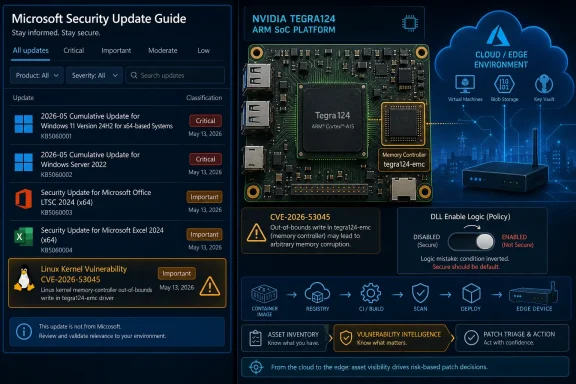 Microsoft’s Security Map Now Extends Well Beyond Windows
For a Windows administrator skimming vulnerability alerts, CVE-2026-53045 looks almost comically misplaced. The title reads like a kernel mailing-list subject line: “memory: tegra124-emc: Fix dll_change check.” There is no Internet Explorer, no NTLM relay, no Exchange transport service, no Office preview pane, and no obvious Windows component to blame.That is precisely why the entry matters. Microsoft’s security surface has expanded into spaces where the company is not the original author of the code but is still part of the delivery, support, or visibility chain. Azure runs Linux at scale. Microsoft ships Linux-based infrastructure services. Developers use Windows machines to manage containers, WSL instances, embedded boards, CI runners, and cloud workloads. A Linux kernel CVE appearing in a Microsoft feed is not a contradiction; it is the new operating model.
The vulnerability itself is narrow. It concerns the Tegra124 EMC driver, a memory-controller driver for NVIDIA’s Tegra 124 system-on-chip family. The bug description says the code checking whether a memory timing configuration enables DLL in the EMRS register was reversed, and that DLL is enabled when bit A0 is low. That sounds like the kind of tiny conditional mistake that should live and die quietly in a Git commit.
But modern vulnerability management does not allow quiet fixes to stay quiet. Once a kernel bug receives a CVE, it enters scanners, dashboards, compliance reports, ticket queues, and customer risk registers. A one-line logic correction can become a weekly patching argument because the tooling does not ask whether your business owns a Tegra124 board before it raises its hand.
A Tiny Kernel Check Becomes a Big Inventory Problem
The first practical question is not “Can someone exploit this against my Windows laptop?” In most environments, the answer will be no. The better question is whether the vulnerability appears anywhere in the software inventory that your organization claims to manage.Tegra124 is associated with ARM-based NVIDIA Tegra hardware, not mainstream Intel or AMD Windows desktops. The affected file path points to a Linux kernel driver, not a Windows subsystem DLL. That means ordinary Windows 10 and Windows 11 endpoints are not the natural blast radius. Nor is a typical x86 Windows Server estate.
The catch is that enterprise estates are rarely ordinary anymore. A security team may own a mixed fleet that includes Azure Linux virtual machines, edge appliances, development boards, container hosts, lab hardware, and embedded systems used for manufacturing or video processing. A Windows administrator may never log into those devices directly, yet the vulnerability may still appear in a Microsoft-oriented dashboard because the organization centralizes vulnerability reporting through Microsoft Defender, Azure, Intune-adjacent tooling, or third-party scanners integrated into a Microsoft workflow.
That is where CVE-2026-53045 becomes more than a trivia question. It exposes the gap between package vulnerability and system exploitability. A scanner can know that a kernel source package is associated with a CVE; it may not know whether the affected driver is built, loaded, reachable, or even relevant to the hardware in front of it. The risk team sees “Linux kernel” and a severity score. The platform team sees “Tegra124” and shrugs. Both reactions can be incomplete.
The Bug Is Boring in Exactly the Way Kernel Bugs Usually Are Not
The vulnerability description is short because the bug is simple: the driver’s logic for deciding whether DLL is enabled was backwards. In memory-controller code, that sort of mistake is not glamorous, but it is not harmless. Memory timing is part of the machinery that keeps hardware stable under changing frequency and power conditions. If driver logic selects the wrong path, the consequences can include instability, data corruption, or denial of service.This is not the same genre as a browser sandbox escape or a remote-code-execution flaw in an exposed service. There is no obvious story in which an attacker sends a packet from the Internet and instantly owns every Windows machine in the building. The more plausible impact is local or device-specific: a user or process with the right foothold, running on the right hardware and kernel, may be able to trigger a condition that compromises availability.
That distinction matters because the CVE ecosystem often flattens very different risks into the same dashboard view. A flaw in a memory-controller driver on a particular ARM SoC and a wormable network service bug can both appear as red entries in a compliance tool. Without context, teams overreact to the former and underreact to the latter.
The uncomfortable part is that “niche” is not the same as “irrelevant.” Embedded and edge devices tend to live a long time, receive updates irregularly, and sit near operational processes that administrators prefer not to touch. If the affected kernel appears on a device that controls cameras, displays, industrial equipment, or lab hardware, the business risk may come less from attacker sophistication and more from the fragility of the update path.
The Chrome Error Text Is a Red Herring, Not a Symptom
The user-submitted material includes Chromium’s familiar network advice: check cables, reboot routers, and allow Chromium through the firewall or antivirus. That text is almost certainly incidental. It reads like a browser error page shown while trying to reach Microsoft’s advisory, not like evidence of the vulnerability’s behavior.That distinction is worth spelling out because security work is full of false associations. A CVE page fails to load, the browser says the network is blocked, and the human brain stitches the two together. In reality, CVE-2026-53045 is not a Chromium networking bug, not a router problem, and not something fixed by adding a browser to a firewall allow list.
The likely story is mundane: the Microsoft Security Update Guide page did not load in the browser session, perhaps because of connectivity, filtering, authentication, cached policy, or a transient service issue. The vulnerability content behind that page concerns Linux kernel memory-controller logic. Those are separate problems sharing a screen.
For administrators, the lesson is not “ignore browser errors.” It is to preserve the chain of evidence. Browser connectivity errors can block access to advisories and patches, but they do not define the technical nature of the vulnerability being researched. Treat the network error as a workstation or access issue; treat the CVE as a kernel inventory issue.
Severity Scores Tell the First Draft, Not the Final Story
One complication with Linux kernel CVEs is that severity can look inconsistent across sources. Some databases may present a medium rating, while others ingest or display a more alarming CVSS vector. That does not necessarily mean one source is lying. It often means the scoring model, affected package view, or downstream distribution assessment differs.For CVE-2026-53045, the specific bug description points toward local, hardware-dependent impact rather than a universal remote compromise. A distribution may therefore rate it according to how realistic exploitation is on supported platforms. A broader vulnerability database may emphasize theoretical impact or inherit generic kernel assumptions. Neither view substitutes for local context.
This is where Windows admins have an advantage if they resist the dashboard panic. They already know that not every “critical” Windows issue matters equally to every deployment. A remote desktop gateway exposed to the Internet is not the same as a disabled optional component. The same logic applies here: an affected driver compiled into a kernel for relevant ARM hardware is materially different from a source-package match on an x86 VM where the code path will never execute.
The problem is that compliance regimes often reward binary answers. Is the CVE present? Is the package version fixed? Is the ticket closed? Those are useful questions, but they are not the only questions. The mature answer is to patch where applicable, suppress with justification where not applicable, and document why the distinction is real.
Linux Kernel CVEs Are Becoming Operational Noise — and Operational Signal
The Linux kernel project’s more aggressive CVE assignment practices have changed the rhythm of vulnerability management. Bugs that once would have appeared only as stable-branch fixes now arrive with CVE identifiers attached. That improves transparency, but it also increases volume. Security teams now see a steady stream of kernel CVEs that range from obviously dangerous to deeply platform-specific.CVE-2026-53045 sits in that second category. It is specific enough that most WindowsForum readers will never see the affected hardware in production. Yet it is also real enough that ignoring it categorically would be sloppy. Somewhere, a supported distribution, device vendor, or cloud image may carry the affected code and need a patched kernel.
The right response is neither panic nor dismissal. It is triage. Identify whether any systems in your estate run Linux kernels that include the Tegra124 EMC driver. Determine whether the hardware makes that driver relevant. Check the fixed kernel versions from your distribution or vendor, not just the upstream commit. Then schedule the update through the same change process you would use for any kernel patch.
That last step is easy to understate. Kernel updates usually require reboots. Reboots require maintenance windows. Maintenance windows require service owners who may not care that a driver they have never heard of has a CVE. In mixed Windows-Linux shops, the political challenge is often harder than the technical one.
WSL Is Probably Not the Story, but It Explains the Confusion
Because this is a Microsoft-linked CVE entry, some Windows users will naturally wonder about Windows Subsystem for Linux. WSL 2 uses a real Linux kernel, and Microsoft updates that kernel through its own distribution mechanism. That makes WSL a legitimate part of Microsoft’s Linux security story.Even so, CVE-2026-53045 does not look like a typical WSL concern. WSL 2 is designed for Windows-hosted Linux workloads on mainstream PC hardware, not Tegra124 ARM boards. The vulnerable code path is tied to a specific memory controller driver. Unless Microsoft’s WSL kernel configuration somehow includes and exposes irrelevant Tegra platform code in a meaningful way, the practical risk to ordinary WSL users appears remote.
The broader point is more interesting than this particular CVE. WSL has trained Windows users to think of Linux kernel updates as part of the Windows experience. That is good. It also means CVE names that once belonged to another administrative tribe now land in Windows-centric feeds, chats, and forums. The boundary between “Windows patching” and “Linux patching” is no longer clean.
For IT departments, that means ownership needs to be explicit. If developers run WSL images, who monitors the WSL kernel version? If Azure-hosted Linux VMs are provisioned by an app team, who owns kernel CVEs? If Microsoft Defender reports a Linux kernel issue, who decides whether it is exploitable or just present in a package database? CVE-2026-53045 is small, but the governance problem it represents is large.
The Real Risk Is an Asset Database That Cannot Answer a Simple Question
Ask a mature organization whether it has affected Tegra124 systems, and the answer should take minutes. Ask a less mature one, and the answer becomes a week-long archaeology project involving procurement records, network scans, CMDB exports, stale spreadsheets, and one engineer who “might know about the old NVIDIA boards.”That is the operational significance of niche CVEs. They test whether the inventory is real. A vulnerability in a famous product tests patch velocity; a vulnerability in an obscure driver tests asset intelligence. If you cannot determine whether you own the affected class of system, the problem is not CVE-2026-53045. The problem is that your security process cannot distinguish a burning building from a streetlight.
The Windows world has its own version of this. Optional features, print drivers, legacy components, installed-but-unused services, and bundled runtimes can all generate vulnerability findings whose relevance depends on configuration. Administrators have spent years learning that “installed” does not always mean “reachable,” and “reachable” does not always mean “business critical.” Linux kernel drivers bring the same logic into a different stack.
The ideal workflow is boring: inventory hardware, map kernels to distributions, compare vendor-fixed versions, patch affected systems, and document non-applicability for the rest. The bad workflow is equally familiar: open tickets for every scanner finding, assign them to whichever team name sounds closest, close them with vague comments, and repeat next month.
Microsoft’s Role Is Visibility, Not Ownership of the Bug
It would be easy to misread the MSRC listing as Microsoft “having” a Tegra memory-controller vulnerability. That is not quite right. The vulnerable code is in the Linux kernel. The fix is an upstream kernel fix that distributions and vendors must carry into their supported kernels. Microsoft’s role, depending on the product surface involved, is to surface, consume, package, or communicate the issue.That distinction matters because responsibility in modern software supply chains is layered. The original code may be upstream. The kernel package may come from a distribution. The image may be published through a cloud marketplace. The workload may be operated by a customer. The alert may come from Microsoft tooling. Every layer can truthfully say it is only part of the story, and yet the customer still needs a patched system.
Security teams should resist vendor-name shorthand. A “Microsoft CVE” in a dashboard may mean a Windows flaw, an Edge flaw, an Azure-hosted dependency, a Linux package in a Microsoft-maintained image, or simply a vulnerability displayed through Microsoft’s guide. Treat the product field and affected component as first-class facts. The logo at the top of the page is not enough.
The upside is that centralized visibility can reduce blind spots. If Microsoft’s ecosystem helps administrators notice Linux kernel exposure they otherwise would have missed, that is useful. The downside is alert fatigue. The same centralization that catches real issues also drags obscure platform bugs into queues where the first responder may lack the hardware context to judge them.
Embedded Hardware Turns Patch Management Into a Negotiation
If CVE-2026-53045 affects you, it likely affects you in a place where patching is less convenient than on a laptop. Embedded Linux devices are often tied to vendor images, custom kernels, peripheral drivers, and certification constraints. Updating the kernel may mean updating the whole device firmware. Updating the firmware may mean retesting the application. Retesting may require physical access or coordination with operations teams.That is why embedded vulnerability management so often lags behind server vulnerability management. A cloud VM can be replaced with a new image. A Kubernetes node can be drained and rebooted. A Windows endpoint can be patched in waves. An edge box bolted into a facility, attached to cameras or industrial equipment, may have no clean maintenance story at all.
The Tegra124 family is not new hardware, which adds another wrinkle. Older platforms may be running long-term vendor kernels rather than current upstream releases. The fix may exist upstream while the deployable update depends on a board vendor, appliance maker, integrator, or internal platform team. “Update to a fixed kernel” is technically correct, but in embedded environments it can be the beginning of the work, not the end.
Administrators should therefore separate remediation from mitigation. Remediation means running a kernel with the corrected driver logic. Mitigation may mean confirming the affected driver is not present, disabling unused hardware paths, restricting local access, limiting who can load or modify kernel components, or isolating devices whose update path is blocked. Those measures are not substitutes for a fix, but they may be the practical risk reduction available before a vendor image arrives.
The Scanner Finding Needs a Human Editor
The worst way to handle CVE-2026-53045 is to let the scanner write the story. A scanner can identify package versions, map CVEs, and produce a severity. It cannot reliably understand why an NVIDIA Tegra memory-controller driver matters to one device and not another. It also cannot know whether a seemingly affected source package produces a running kernel on the system being assessed.The human editor’s job is to add context without turning context into denial. If the system is x86_64 and does not build or load the Tegra124 EMC driver, that should be documented. If the system is an ARM board using a vendor kernel derived from an affected branch, that deserves attention. If the distribution has published a fixed kernel, the patch path should be clear. If the vendor has not, the risk exception should name the dependency and the next review date.
This is where Windows administrators can bring hard-earned discipline from years of Patch Tuesday triage. Not every CVE with a scary score is equally urgent, but every CVE deserves a disposition. The goal is not to close tickets quickly; it is to make the ticket history useful six months later when an auditor, incident responder, or replacement engineer asks why the finding was accepted.
A good disposition for this CVE should include the kernel version, architecture, hardware platform, driver relevance, vendor update status, and reboot plan. That sounds bureaucratic until you compare it with the alternative: a recurring vulnerability finding that nobody trusts, nobody owns, and nobody can confidently suppress.
The Small Tegra Fix Carries a Bigger Microsoft-Era Lesson
CVE-2026-53045 is not likely to be the vulnerability that defines 2026. It is too specific, too hardware-bound, and too dependent on local conditions. Yet it is exactly the kind of CVE that defines the daily reality of security operations: obscure, real, noisy, and impossible to handle well without accurate inventory.For WindowsForum readers, the temptation is to file this under “Linux problem” and move on. That may be correct for a home Windows PC. It may even be correct for a conventional Windows-heavy business. But it is less safe as a reflex in organizations that use Azure, WSL, Linux build agents, edge hardware, or cross-platform security tooling.
Microsoft’s presence in the advisory path is the signal. The company’s ecosystem now touches enough Linux infrastructure that Windows professionals cannot treat Linux kernel CVEs as foreign objects. They do not need to become kernel maintainers. They do need to know when to ask the next question.
The Practical Reading of CVE-2026-53045 Is Narrow, but Not Optional
The concrete response to this advisory is refreshingly limited once the noise is stripped away. It is not a Chromium firewall problem, not a router problem, and not a Windows desktop emergency. It is a Linux kernel driver fix that should be mapped against real systems before anyone spends a weekend rebooting machines that cannot possibly be affected.- Ordinary Windows desktops and typical x86 Windows servers are not the natural target of this Tegra124 Linux kernel driver vulnerability.
- Systems running Linux on NVIDIA Tegra124-class hardware should be checked against vendor or distribution kernel updates that include the corrected DLL-enable logic.
- Scanner findings should be validated against hardware architecture, kernel configuration, loaded drivers, and vendor package status before being escalated as urgent incidents.
- WSL users should keep their Microsoft-provided Linux kernel updated, but this specific driver issue appears unlikely to be a practical WSL exposure for mainstream PCs.
- The Chromium network message in the submitted material should be treated as an access problem while viewing the advisory, not as a symptom or mitigation for the CVE.
- Organizations should document non-applicability with evidence, because unsupported dismissals tend to return as recurring audit noise.
References
- Primary source: MSRC
Published: 2026-07-03T01:04:20-07:00
Security Update Guide - Microsoft Security Response Center
 msrc.microsoft.com
- Related coverage: sentinelone.com
CVE-2026-53045: Linux Kernel Tegra124-EMC DLL Vulnerability
CVE-2026-53045 is a memory controller vulnerability in Linux kernel Tegra124-EMC. Learn about its impact, affected versions, and mitigation methods.www.sentinelone.com
- Related coverage: endorlabs.com
- Security advisory: nvd.nist.gov
NVD - CVE-2026-53045
 nvd.nist.gov
- Related coverage: osv.dev

OSV - Open Source Vulnerabilities
Comprehensive vulnerability database for your open source projects and dependencies.
osv.dev

