

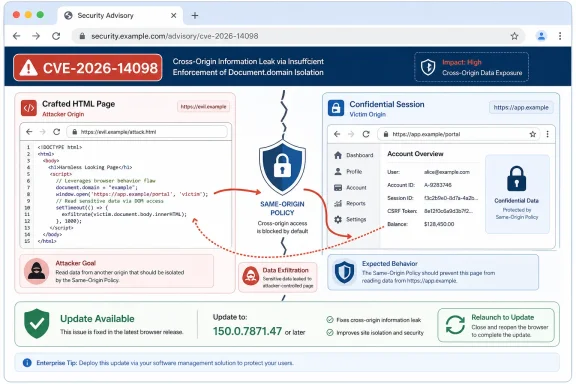
Google Chrome before version 150.0.7871.47 contained a CSS implementation flaw, CVE-2026-14098, disclosed on June 30, 2026, that could let a remote attacker leak cross-origin data through a crafted HTML page on affected desktop platforms. The bug is officially rated “Low” by Chromium, but CISA’s enrichment gives it a medium CVSS 3.1 score because the confidentiality impact can be high. That tension is the story: this is not a panic-grade browser emergency, but it is another reminder that modern browser security often fails at the seams between features that were never meant to behave like security boundaries.
The vulnerability surfaced in Google’s June 30 Stable Channel update for desktop, the same release train that pushed Chrome 150.0.7871.46/.47 to Windows and macOS and 150.0.7871.46 to Linux. NVD’s entry, sourced from Chrome and later enriched by CISA-ADP, describes the issue in spare language: “inappropriate implementation in CSS” allowed cross-origin data leakage via crafted HTML. That wording sounds almost bureaucratic, but for Windows users and enterprise administrators, it lands in one of the browser’s most sensitive zones: whether one site can infer anything useful about another.
Chrome’s security model is built around a simple promise that is brutally hard to keep: hostile web pages should not be able to read, infer, or extract data from other sites a user is signed into. The same-origin policy is old web plumbing, but it remains one of the load-bearing walls of everyday computing. When a Gmail tab, a banking session, an intranet dashboard, and an attacker-controlled page all coexist inside the same browser profile, the browser is the referee.
CVE-2026-14098 sits in that referee’s rulebook. The reported attack path requires a crafted HTML page and user interaction, according to CISA’s vector, which is why this is not being framed like a zero-click catastrophe. But the claimed impact is confidentiality, and CISA’s ADP scoring marks that confidentiality impact as high, even while Chromium’s own severity label says low.
That mismatch is not necessarily a contradiction. Chromium’s internal severity ratings often consider exploitability, bug class, sandboxing context, and practical weaponization. CVSS, by contrast, tries to flatten a vulnerability into a scoring vector: network reachable, low complexity, no privileges required, user interaction required, unchanged scope, high confidentiality impact, no integrity or availability impact. One system asks, “How bad is this in the Chrome security program?” The other asks, “What could happen if the attack works?”
For users, the distinction matters less than the update. A low-severity Chrome bug that leaks cross-origin data is still a bug in the boundary that keeps websites from spying on one another. That is the boundary that makes password managers, SSO portals, corporate webmail, SaaS dashboards, and private browsing habits tolerable risks rather than absurd ones.
Modern CSS is a sprawling browser subsystem with selectors, containment behavior, animations, layout engines, media queries, font loading, visited-link protections, rendering side effects, and interactions with nearly every other part of the document lifecycle. It is not just paint. It is observable behavior.
That is why CSS has a long history as a side-channel surface. A malicious page may not be allowed to read another site’s response directly, but the browser can accidentally reveal information through timing, layout differences, rendering behavior, cache state, resource loading, selector matching, or error handling. Attackers do not always need a clean file read. Sometimes an answer to a yes-or-no question, repeated enough times, becomes data leakage.
CVE-2026-14098 does not yet have public technical details in the Chromium issue tracker, which is common immediately after a Chrome security release. Google routinely restricts bug details until most users have received the fix, and sometimes longer if related projects inherit the same issue. That means defenders should resist the temptation to over-explain the exploit mechanics from the one-line CVE description.
Still, the broad shape is familiar. A crafted HTML page, CSS behavior, and cross-origin leakage form a pattern that browser vendors have spent years trying to grind down. The bug does not need to be spectacular to be worth patching; it only needs to let an attacker learn something the browser promised to keep opaque.
That bundling is normal for Chrome, but it changes how administrators should think about the risk. The question is not whether CVE-2026-14098 alone justifies emergency downtime across the business. The better question is whether there is any good reason to keep browsers behind a release that fixes dozens or hundreds of defects in the most exposed application on the machine.
Browsers are now the default runtime for enterprise work. They terminate identity sessions, render untrusted content, expose hardware acceleration, execute JavaScript, mediate local file uploads, and host line-of-business applications that used to be native Windows clients. Calling Chrome “just an app” in 2026 is like calling Active Directory “just a directory.” It is technically true and operationally misleading.
The CPE configuration NVD added on July 1 is also worth reading carefully. It lists Google Chrome versions up to, but excluding, 150.0.7871.46 in one part of the configuration, while the CVE description and affected-version statement point to prior to 150.0.7871.47. That kind of version-edge ambiguity is exactly why administrators should target the fixed channel version or later rather than trying to interpret database deltas too literally.
That is useful data, but it is not a finished risk decision. A 6.5 browser vulnerability may matter more than a higher-scored flaw buried in an internal component that is unreachable from the internet. Conversely, a bug requiring user interaction and with no known exploitation may not deserve the same treatment as a Chrome zero-day being used in the wild.
Security teams often want a single ordering principle because patch queues are endless. CVSS gives them one. EPSS gives them another. Vendor severity gives them a third. SSVC tries to make the decision more operational. None of them replaces judgment.
Here the judgment should be straightforward: push the update, verify the version, and do not overstate the single CVE. The most defensible posture is neither “drop everything” nor “ignore it because Chromium said low.” It is to treat Chrome’s June 30 desktop update as a routine-but-important browser security baseline.
But cross-origin data can still be valuable. Depending on the bug mechanics, leakage might reveal whether a user is logged into a service, whether a private resource exists, what state an application is in, or whether a sensitive page contains a particular condition. In enterprise settings, those tiny facts can become reconnaissance.
The modern web is full of authenticated dashboards with predictable URLs and stateful responses. A crafted page that can infer something about those responses may help profile users, identify internal tools, target phishing, or confirm access to privileged systems. Not every leak becomes a breach, but many breaches begin with seemingly modest information disclosure.
That is why the “Low” label should not seduce defenders into thinking CSS-origin bugs are trivia. Browser vendors have spent enormous effort reducing side channels because side channels are cumulative. A leak here, a timing primitive there, and a separate renderer or GPU bug elsewhere can combine into a chain that looks obvious only after the incident report is written.
Still, the operational lesson carries across the platform. Windows endpoints increasingly depend on auto-updating user-space applications to close security gaps faster than monthly OS patch cycles. That is a major improvement over the old days of quarterly browser rollouts, but it creates blind spots when organizations disable auto-update, freeze versions for compatibility, or rely on golden images that age quietly.
Microsoft Edge adds another wrinkle because many Windows shops treat it as part of the operating environment rather than a third-party application. Edge’s Chromium base means security teams need to watch both Microsoft’s release notes and upstream Chromium advisories. A Chrome CVE can be a signal to check Edge, even when the official affected-product line names only Google.
For unmanaged Windows users, the path is simpler. Open Chrome’s About page, let the browser check for updates, and restart it. The restart is not ceremonial. Chrome can download an update and still leave old code running until the browser process is relaunched.
That creates restart debt: the gap between an update being available and the fixed code actually running. In a browser security release, that gap is often where exposure lives. A management console can show that a package has been staged, but the user may still be operating in the vulnerable build.
Enterprise administrators should treat browser restarts as a first-class control. Chrome enterprise policies can enforce relaunch notification windows, set update cadence, and report browser versions. The point is not to nag users for its own sake; it is to shorten the period where a known web-exposed vulnerability remains active after a fix exists.
There is also a testing balance to strike. Large organizations should not blindly detonate every browser update across critical workflows without validation, especially when web apps, extensions, and identity plugins are business-critical. But the validation window for mainstream browser security updates should be measured in hours or days, not weeks.
The Chrome 150.0.7871.47 release also appears to have generated some user complaints around extension behavior and media playback in public forums, which is a reminder that updates can carry compatibility consequences. That does not argue against patching. It argues for browser fleet discipline: rings, telemetry, rollback planning where appropriate, and a clear escalation path when a security update collides with a line-of-business dependency.
But the alternative is worse. Publishing a working recipe for a cross-origin leak before most users have updated would turn a low- or medium-priority patch into an attacker enablement document. Browser vendors operate at consumer scale, where the slowest update cohort is enormous. Delayed technical disclosure is not secrecy for secrecy’s sake; it is a race-management tool.
The downside is that defenders must act without exploit details. That is uncomfortable for teams accustomed to reproducing bugs before prioritizing them. Browser security breaks that habit because the exposed attack surface is universal and the exploit delivery mechanism is simply the web.
The right response is to focus on what is known. The bug is fixed in Chrome 150.0.7871.47. It is reachable remotely through crafted HTML. It requires user interaction under CISA’s scoring. It affects confidentiality, not integrity or availability, according to the current vector. There is no known exploitation signal in the SSVC data reflected by CISA-ADP. That is enough to prioritize a controlled, prompt rollout.
That context matters because users can become numb to Chrome advisories. If every week brings a new CVE, every CVE starts to sound interchangeable. The danger is not that people panic; it is that they stop listening.
A better framing is to see browser updates as continuous hardening rather than episodic crisis response. Some releases close active exploitation. Some remove primitives that might become part of future chains. Some fix memory corruption, some UI spoofing, some policy bypasses, and some information leaks. The security value comes from staying current across the whole stream.
For Windows administrators, this is where browser management should resemble endpoint detection or identity hygiene. It is not a once-a-month compliance ritual. It is a standing operational practice tied to one of the most attacked pieces of software in the environment.
The vulnerability surfaced in Google’s June 30 Stable Channel update for desktop, the same release train that pushed Chrome 150.0.7871.46/.47 to Windows and macOS and 150.0.7871.46 to Linux. NVD’s entry, sourced from Chrome and later enriched by CISA-ADP, describes the issue in spare language: “inappropriate implementation in CSS” allowed cross-origin data leakage via crafted HTML. That wording sounds almost bureaucratic, but for Windows users and enterprise administrators, it lands in one of the browser’s most sensitive zones: whether one site can infer anything useful about another.
 A Low-Severity Chrome Bug Still Lives in a High-Value Boundary
Chrome’s security model is built around a simple promise that is brutally hard to keep: hostile web pages should not be able to read, infer, or extract data from other sites a user is signed into. The same-origin policy is old web plumbing, but it remains one of the load-bearing walls of everyday computing. When a Gmail tab, a banking session, an intranet dashboard, and an attacker-controlled page all coexist inside the same browser profile, the browser is the referee.CVE-2026-14098 sits in that referee’s rulebook. The reported attack path requires a crafted HTML page and user interaction, according to CISA’s vector, which is why this is not being framed like a zero-click catastrophe. But the claimed impact is confidentiality, and CISA’s ADP scoring marks that confidentiality impact as high, even while Chromium’s own severity label says low.
That mismatch is not necessarily a contradiction. Chromium’s internal severity ratings often consider exploitability, bug class, sandboxing context, and practical weaponization. CVSS, by contrast, tries to flatten a vulnerability into a scoring vector: network reachable, low complexity, no privileges required, user interaction required, unchanged scope, high confidentiality impact, no integrity or availability impact. One system asks, “How bad is this in the Chrome security program?” The other asks, “What could happen if the attack works?”
For users, the distinction matters less than the update. A low-severity Chrome bug that leaks cross-origin data is still a bug in the boundary that keeps websites from spying on one another. That is the boundary that makes password managers, SSO portals, corporate webmail, SaaS dashboards, and private browsing habits tolerable risks rather than absurd ones.
CSS Keeps Becoming More Powerful Than Its Name Suggests
The phrase “inappropriate implementation in CSS” can make the vulnerability sound almost cosmetic. CSS, after all, is still widely understood as the technology that makes text blue, buttons rounded, and layouts responsive. That view is years out of date.Modern CSS is a sprawling browser subsystem with selectors, containment behavior, animations, layout engines, media queries, font loading, visited-link protections, rendering side effects, and interactions with nearly every other part of the document lifecycle. It is not just paint. It is observable behavior.
That is why CSS has a long history as a side-channel surface. A malicious page may not be allowed to read another site’s response directly, but the browser can accidentally reveal information through timing, layout differences, rendering behavior, cache state, resource loading, selector matching, or error handling. Attackers do not always need a clean file read. Sometimes an answer to a yes-or-no question, repeated enough times, becomes data leakage.
CVE-2026-14098 does not yet have public technical details in the Chromium issue tracker, which is common immediately after a Chrome security release. Google routinely restricts bug details until most users have received the fix, and sometimes longer if related projects inherit the same issue. That means defenders should resist the temptation to over-explain the exploit mechanics from the one-line CVE description.
Still, the broad shape is familiar. A crafted HTML page, CSS behavior, and cross-origin leakage form a pattern that browser vendors have spent years trying to grind down. The bug does not need to be spectacular to be worth patching; it only needs to let an attacker learn something the browser promised to keep opaque.
The Version Number Is the Policy
For WindowsForum readers, the practical dividing line is stark: Chrome prior to 150.0.7871.47 is affected, and Chrome 150.0.7871.47 or later is the fix path for Windows and macOS. Google’s Stable Channel post for June 30 places this issue inside a large desktop security update rather than a standalone emergency bulletin. Malwarebytes, covering the same release, noted that the update addressed hundreds of security fixes across Chrome, which makes CVE-2026-14098 one entry in a much larger patch bundle.That bundling is normal for Chrome, but it changes how administrators should think about the risk. The question is not whether CVE-2026-14098 alone justifies emergency downtime across the business. The better question is whether there is any good reason to keep browsers behind a release that fixes dozens or hundreds of defects in the most exposed application on the machine.
Browsers are now the default runtime for enterprise work. They terminate identity sessions, render untrusted content, expose hardware acceleration, execute JavaScript, mediate local file uploads, and host line-of-business applications that used to be native Windows clients. Calling Chrome “just an app” in 2026 is like calling Active Directory “just a directory.” It is technically true and operationally misleading.
The CPE configuration NVD added on July 1 is also worth reading carefully. It lists Google Chrome versions up to, but excluding, 150.0.7871.46 in one part of the configuration, while the CVE description and affected-version statement point to prior to 150.0.7871.47. That kind of version-edge ambiguity is exactly why administrators should target the fixed channel version or later rather than trying to interpret database deltas too literally.
NVD’s Awkward Metadata Is a Warning Against Checkbox Security
The user-facing NVD entry for CVE-2026-14098 is a small case study in why vulnerability management cannot be reduced to scraping a score and sorting a spreadsheet. NVD had not yet provided its own CVSS assessment at the time reflected in the entry. CISA-ADP supplied a CVSS 3.1 score of 6.5, mapped the weakness to CWE-200, and added SSVC context indicating no known exploitation, not automatable, and partial technical impact.That is useful data, but it is not a finished risk decision. A 6.5 browser vulnerability may matter more than a higher-scored flaw buried in an internal component that is unreachable from the internet. Conversely, a bug requiring user interaction and with no known exploitation may not deserve the same treatment as a Chrome zero-day being used in the wild.
Security teams often want a single ordering principle because patch queues are endless. CVSS gives them one. EPSS gives them another. Vendor severity gives them a third. SSVC tries to make the decision more operational. None of them replaces judgment.
Here the judgment should be straightforward: push the update, verify the version, and do not overstate the single CVE. The most defensible posture is neither “drop everything” nor “ignore it because Chromium said low.” It is to treat Chrome’s June 30 desktop update as a routine-but-important browser security baseline.
Cross-Origin Leaks Are Small Doors Into Large Rooms
A cross-origin leak is not the same thing as arbitrary code execution. It does not automatically mean an attacker can install malware, escape the sandbox, or take over Windows. That distinction matters because browser vulnerability coverage often collapses every flaw into the same “update now” siren.But cross-origin data can still be valuable. Depending on the bug mechanics, leakage might reveal whether a user is logged into a service, whether a private resource exists, what state an application is in, or whether a sensitive page contains a particular condition. In enterprise settings, those tiny facts can become reconnaissance.
The modern web is full of authenticated dashboards with predictable URLs and stateful responses. A crafted page that can infer something about those responses may help profile users, identify internal tools, target phishing, or confirm access to privileged systems. Not every leak becomes a breach, but many breaches begin with seemingly modest information disclosure.
That is why the “Low” label should not seduce defenders into thinking CSS-origin bugs are trivia. Browser vendors have spent enormous effort reducing side channels because side channels are cumulative. A leak here, a timing primitive there, and a separate renderer or GPU bug elsewhere can combine into a chain that looks obvious only after the incident report is written.
Windows Users Inherit Chrome’s Security Posture Even Outside Chrome
The immediate affected product is Google Chrome, but the Windows ecosystem is broader than the Chrome icon. Chromium is the engine family behind Microsoft Edge, Brave, Vivaldi, Opera, and many embedded browser experiences. The specific CVE entry is for Chrome, and administrators should not assume every Chromium-based browser was vulnerable or fixed on the same date without checking each vendor’s release notes.Still, the operational lesson carries across the platform. Windows endpoints increasingly depend on auto-updating user-space applications to close security gaps faster than monthly OS patch cycles. That is a major improvement over the old days of quarterly browser rollouts, but it creates blind spots when organizations disable auto-update, freeze versions for compatibility, or rely on golden images that age quietly.
Microsoft Edge adds another wrinkle because many Windows shops treat it as part of the operating environment rather than a third-party application. Edge’s Chromium base means security teams need to watch both Microsoft’s release notes and upstream Chromium advisories. A Chrome CVE can be a signal to check Edge, even when the official affected-product line names only Google.
For unmanaged Windows users, the path is simpler. Open Chrome’s About page, let the browser check for updates, and restart it. The restart is not ceremonial. Chrome can download an update and still leave old code running until the browser process is relaunched.
Enterprise IT Should Measure Restart Debt, Not Just Patch Availability
The hardest part of Chrome patching is rarely downloading the update. It is getting users to close a browser that contains their entire workday. Tabs become task lists, session state becomes memory, and restart prompts become background noise.That creates restart debt: the gap between an update being available and the fixed code actually running. In a browser security release, that gap is often where exposure lives. A management console can show that a package has been staged, but the user may still be operating in the vulnerable build.
Enterprise administrators should treat browser restarts as a first-class control. Chrome enterprise policies can enforce relaunch notification windows, set update cadence, and report browser versions. The point is not to nag users for its own sake; it is to shorten the period where a known web-exposed vulnerability remains active after a fix exists.
There is also a testing balance to strike. Large organizations should not blindly detonate every browser update across critical workflows without validation, especially when web apps, extensions, and identity plugins are business-critical. But the validation window for mainstream browser security updates should be measured in hours or days, not weeks.
The Chrome 150.0.7871.47 release also appears to have generated some user complaints around extension behavior and media playback in public forums, which is a reminder that updates can carry compatibility consequences. That does not argue against patching. It argues for browser fleet discipline: rings, telemetry, rollback planning where appropriate, and a clear escalation path when a security update collides with a line-of-business dependency.
The Public Bug Silence Is Part of the Defense
Security readers often dislike restricted Chromium issues because they leave defenders with thin public information. In this case, the referenced Chromium issue requires permissions, which means the public CVE entry and Google’s release post are the main official breadcrumbs. That can feel unsatisfying.But the alternative is worse. Publishing a working recipe for a cross-origin leak before most users have updated would turn a low- or medium-priority patch into an attacker enablement document. Browser vendors operate at consumer scale, where the slowest update cohort is enormous. Delayed technical disclosure is not secrecy for secrecy’s sake; it is a race-management tool.
The downside is that defenders must act without exploit details. That is uncomfortable for teams accustomed to reproducing bugs before prioritizing them. Browser security breaks that habit because the exposed attack surface is universal and the exploit delivery mechanism is simply the web.
The right response is to focus on what is known. The bug is fixed in Chrome 150.0.7871.47. It is reachable remotely through crafted HTML. It requires user interaction under CISA’s scoring. It affects confidentiality, not integrity or availability, according to the current vector. There is no known exploitation signal in the SSVC data reflected by CISA-ADP. That is enough to prioritize a controlled, prompt rollout.
The Patch Story Is Bigger Than One CSS CVE
CVE-2026-14098 arrived amid a particularly noisy stretch of Chrome security activity. Earlier June coverage focused on a Chrome 149 zero-day in V8, CVE-2026-11645, that Google said had an exploit in the wild. The June 30 Chrome 150 update then landed with a large batch of fixes, including more serious issues than this CSS leak.That context matters because users can become numb to Chrome advisories. If every week brings a new CVE, every CVE starts to sound interchangeable. The danger is not that people panic; it is that they stop listening.
A better framing is to see browser updates as continuous hardening rather than episodic crisis response. Some releases close active exploitation. Some remove primitives that might become part of future chains. Some fix memory corruption, some UI spoofing, some policy bypasses, and some information leaks. The security value comes from staying current across the whole stream.
For Windows administrators, this is where browser management should resemble endpoint detection or identity hygiene. It is not a once-a-month compliance ritual. It is a standing operational practice tied to one of the most attacked pieces of software in the environment.
The June 30 Chrome Fix Leaves a Clear Operational Trail
CVE-2026-14098 is a small entry in a large release, but it leaves concrete work behind. The patch is not ambiguous in spirit even if some database metadata needs careful interpretation. Systems should be moved to Chrome 150.0.7871.47 or later where that channel applies, and administrators should verify running versions rather than assuming silent updates have completed.- Chrome users on versions before 150.0.7871.47 should update because CVE-2026-14098 can leak cross-origin data through a crafted HTML page.
- CISA’s enrichment scores the flaw as CVSS 3.1 6.5 medium, even though Chromium labels the security severity as low.
- The known impact is confidentiality exposure, not code execution, system compromise, data modification, or denial of service.
- The current CISA SSVC data indicates no known exploitation, no automation, and partial technical impact.
- Enterprise teams should track successful browser relaunches, because a downloaded Chrome update does not fully protect users until the old browser process exits.
- Chromium-based browsers other than Google Chrome should be checked against their own vendor advisories rather than assumed safe or affected from the Chrome CVE alone.
References
- Primary source: NVD / Chromium
Published: 2026-07-03T07:00:26-07:00
NVD - CVE-2026-14098
 nvd.nist.gov
- Security advisory: MSRC
Published: 2026-07-03T07:00:26-07:00
Original feed URL
Security Update Guide - Microsoft Security Response Center
 msrc.microsoft.com
- Related coverage: cvefeed.io
CVE-2026-14098 - Google Chrome CSS Cross-Origin Data Leak
Inappropriate implementation in CSS in Google Chrome prior to 150.0.7871.47 allowed a remote attacker to leak cross-origin data via a crafted HTML page. (Chromium security severity: Low)cvefeed.io