

Google Chrome before version 150.0.7871.47 contains CVE-2026-14079, a low-severity Chromium Network flaw disclosed on June 30, 2026, that can let a remote attacker bypass same-origin policy protections through a crafted HTML page. That is the plain version, and it is enough to justify updating. But the more interesting story is not that Chrome had another browser bug; it is that a “low” Chromium severity still touches one of the browser’s most important security boundaries. As documented by NVD, CISA’s ADP enrichment, and Google’s Chrome Releases notice, this is the sort of small-looking issue that enterprise patch programs ignore at their peril.
CVE-2026-14079 is not being described as a remote-code-execution flaw, a sandbox escape, or an actively exploited zero-day. CISA’s ADP scoring gives it a CVSS 3.1 base score of 4.3, with network attack vector, low attack complexity, no privileges required, and required user interaction. The listed impact is limited to integrity, not confidentiality or availability.
That scoring matters. Security teams drowning in vulnerability noise need severity systems, and a browser bug with no known exploitation and only partial technical impact should not be treated as if it were a wormable domain-controller flaw. Yet Chrome vulnerabilities are not ordinary application bugs, because Chrome is the place where untrusted code, identity sessions, enterprise SaaS, browser extensions, device APIs, and corporate policy all collide.
The phrase that should slow administrators down is not “low severity.” It is same-origin policy. The same-origin policy is one of the web’s central containment rules: content from one origin should not be able to freely interfere with content from another. If that boundary becomes porous, even in a narrow way, the bug deserves attention out of proportion to its score.
Google’s own advisory language is spare, as usual. The vulnerability is described as “insufficient policy enforcement in Network,” affecting Chrome versions before 150.0.7871.47 and requiring a crafted HTML page. NVD’s change history shows the CVE arriving from Chrome on June 30, 2026, followed by CISA enrichment and then NIST’s initial analysis on July 1, when the affected Chrome CPE was added.
For many users, Chrome is the front end to the company. Email, SSO, HR, CRM, collaboration, file storage, privileged admin consoles, customer records, and AI tools all live behind tabs. A browser-origin boundary is therefore not some academic web-platform abstraction. It is a policy wall separating one logged-in world from another.
Same-origin policy bugs occupy an awkward middle ground. They may not give an attacker code execution on the endpoint, but they can undermine assumptions that developers, SaaS vendors, and identity architects have built into their systems. A malicious page does not need to own the machine to cause trouble if it can manipulate or bypass a web security rule in a way the target application never expected.
That is why CVE-2026-14079 is worth more than a line item in a scanner report. It reminds us that browser security is layered, and some of the most consequential layers are not visible to the user. When the browser’s Network component misapplies policy, the failure sits below the web app and above the operating system — precisely where many defenders have the least visibility.
That scale creates a paradox. On one hand, a large patch batch is reassuring: Google is closing a lot of defects. On the other hand, a single low-severity CVE can become invisible inside the noise. Vulnerability management dashboards are not designed for narrative context; they are designed to sort, color, assign, and close.
CVE-2026-14079 does not compete well in that environment. It is not tagged as critical. It is not described as exploited in the wild. It does not have a complete NVD CVSS assessment at the time reflected in the submitted data. It is the kind of finding that can slide into “next regular maintenance window” without anyone feeling irresponsible.
But Chrome is updated differently from traditional enterprise software for a reason. The attack surface changes quickly, the browser is exposed to hostile content by design, and details of many security bugs remain restricted until most users have updated. A quiet CVE today can become a better-understood primitive tomorrow, especially if researchers later connect it with other browser behavior.
CPE data drives scanners, asset systems, compliance reports, and ticket queues. If a vulnerability record is missing or lagging in its affected-product metadata, a scanner may not map the issue cleanly to installed software. The result is not merely cosmetic. It can mean a security team believes it has no exposure when the underlying product is still vulnerable.
This is a recurring weakness in the CVE ecosystem. Vendor advisories often move first, CISA or other enrichment sources add practical scoring and weakness information, and NVD fills in configurations as analysis catches up. During that gap, the most accurate source is usually the vendor’s release note, not the vulnerability database entry.
For CVE-2026-14079, the practical answer is straightforward: yes, the relevant Chrome CPE appears to have been added by NIST after initial publication, matching Chrome versions before 150.0.7871.47. But the deeper lesson is that defenders should not wait for every database field to look complete before acting on a browser update from Google.
The modern web is an interaction machine. Users click links in email, open SaaS dashboards, follow chat messages, preview documents, visit supplier portals, and search for troubleshooting answers. If a crafted HTML page is the trigger, an attacker’s job is not necessarily difficult; it is to place that page somewhere a target is likely to go.
That does not mean CVE-2026-14079 should be panic material. The available public data does not say exploitation is occurring, and CISA’s SSVC fields reportedly list exploitation as “none,” automatable as “no,” and technical impact as “partial.” Those are calming indicators.
Still, defenders should avoid the lazy mental shortcut that “UI:R” means “low priority.” For browsers, user interaction is part of the normal operating environment. The relevant question is whether vulnerable browsers remain in front of sensitive web sessions, and for most organizations, the answer is yes.
At a high level, an origin is defined by scheme, host, and port. A page from one origin should not be able to freely read or alter the protected contents of another. Other mechanisms, including CORS, cookies, site isolation, content security policy, and storage partitioning, complicate the picture, but same-origin policy remains foundational.
That is why an “origin validation error,” the CWE category CISA associated with this CVE, is worth noticing. It suggests the browser failed to enforce an expected trust boundary correctly. Even if the impact is limited, the class of bug sits near the architecture of web isolation.
The word “Network” also matters. Chromium’s network stack is not a decorative subsystem; it is where requests, responses, redirects, caching, credentials, headers, fetch behavior, and policy checks intersect. A policy bypass there can produce subtle consequences that are not obvious from a one-sentence CVE description.
For CVE-2026-14079, the linked Chromium issue is marked as requiring permission, according to the NVD reference metadata. That means the public gets the CVE summary, severity, affected version boundary, and release note, but not the full technical discussion. This is normal for Chrome security fixes.
The absence of detail should not be confused with absence of risk. It simply means defenders have to make decisions from the available signals: component, weakness class, severity, version boundary, exploit status, and vendor patch availability. Those signals point to an ordinary but necessary Chrome update, not an emergency rebuild of the security program.
There is also a healthy discipline here. If an organization needs private exploit details to justify patching Chrome, its browser patch policy is probably already too slow. The web’s attack surface is too exposed for every decision to wait on proof-of-concept code.
Chrome’s automatic update mechanism does much of the work for unmanaged users. In enterprises, however, update behavior can be altered by policy, delayed by maintenance controls, complicated by virtual images, or blocked by users who never restart the browser. The version number matters: the submitted NVD data identifies 150.0.7871.47 as the exclusion threshold for the vulnerable Chrome range.
Administrators should also remember that Chrome is not the only Chromium-based browser in many environments. Microsoft Edge, Brave, Vivaldi, Opera, Electron applications, embedded WebView runtimes, and vendor-bundled Chromium components may carry related code, though each product has its own release process and vulnerability mapping. CVE-2026-14079 is specifically recorded here against Google Chrome, so defenders should avoid overclaiming while still checking adjacent Chromium exposure.
The practical workflow is familiar. Verify Chrome versions through endpoint management. Force browser relaunch where needed. Review update deferral policies. Confirm that vulnerability scanners have current plugin data and that the CPE mapping is now recognized. Then look for the systems that always fall through the cracks.
CVE-2026-14079’s public profile is restrained. CISA’s ADP data shows no known exploitation at the time of enrichment. The attack requires user interaction. The impact is partial. Chromium’s own severity is low.
Those facts should prevent alarmism. They should not prevent action. Browser patching is one of the few security controls where the right response is usually simple, cheap, and fast: update to the fixed build and restart.
The real risk is organizational complacency. Teams become numb to Chrome advisories because they arrive constantly. The cadence that makes Chrome safer also makes each advisory feel routine, and routine is where patch debt accumulates.
Version confusion is common in Chrome advisories because Google often ships slightly different patch numbers across platforms. The Chrome Releases notice for the June 30 Stable Channel update used the 150.0.7871.46/.47 notation for Windows and macOS, while the CVE record supplied here uses 150.0.7871.47 as the cutoff for CVE-2026-14079. That is precisely why administrators should rely on the vendor advisory and the CVE’s affected-version language rather than guessing from memory.
For individual users, the path is mundane: open Chrome’s settings, check the About Chrome page, let the updater run, and relaunch. For managed fleets, the path is audit and enforcement. A browser that has downloaded an update but not restarted is still running the old code.
That last point deserves emphasis. Chrome’s update UX is intentionally quiet, but quiet does not mean complete. If users keep sessions open for days, the fixed binaries may be present on disk while the vulnerable process remains alive.
A mature process does not need a crisis label before it moves. It identifies that Chrome shipped a security update, checks fleet version state, prioritizes exposed users and unmanaged pockets, and closes the gap. It also understands that CVE databases are useful but lagging abstractions over vendor reality.
This is especially important in hybrid and BYOD-heavy environments. A company may manage Windows updates well while leaving browsers to users, assuming Chrome will take care of itself. Chrome usually does, but “usually” is not an asset inventory strategy.
The better model treats browsers as tier-one security software. They deserve the same operational attention as endpoint protection agents, VPN clients, identity brokers, and remote-management tools. If a browser mediates access to critical data, its patch state is part of the security perimeter.
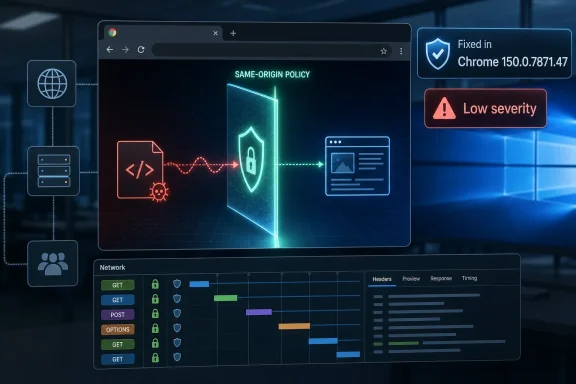 A Low-Severity Bug Lands on a High-Value Boundary
CVE-2026-14079 is not being described as a remote-code-execution flaw, a sandbox escape, or an actively exploited zero-day. CISA’s ADP scoring gives it a CVSS 3.1 base score of 4.3, with network attack vector, low attack complexity, no privileges required, and required user interaction. The listed impact is limited to integrity, not confidentiality or availability.That scoring matters. Security teams drowning in vulnerability noise need severity systems, and a browser bug with no known exploitation and only partial technical impact should not be treated as if it were a wormable domain-controller flaw. Yet Chrome vulnerabilities are not ordinary application bugs, because Chrome is the place where untrusted code, identity sessions, enterprise SaaS, browser extensions, device APIs, and corporate policy all collide.
The phrase that should slow administrators down is not “low severity.” It is same-origin policy. The same-origin policy is one of the web’s central containment rules: content from one origin should not be able to freely interfere with content from another. If that boundary becomes porous, even in a narrow way, the bug deserves attention out of proportion to its score.
Google’s own advisory language is spare, as usual. The vulnerability is described as “insufficient policy enforcement in Network,” affecting Chrome versions before 150.0.7871.47 and requiring a crafted HTML page. NVD’s change history shows the CVE arriving from Chrome on June 30, 2026, followed by CISA enrichment and then NIST’s initial analysis on July 1, when the affected Chrome CPE was added.
The Browser Is the New Perimeter, Whether IT Likes It or Not
The old enterprise security model treated the browser as a client application. Patch it, harden it, maybe manage extensions, and move on. That model never really matched reality, and in 2026 it is almost quaint.For many users, Chrome is the front end to the company. Email, SSO, HR, CRM, collaboration, file storage, privileged admin consoles, customer records, and AI tools all live behind tabs. A browser-origin boundary is therefore not some academic web-platform abstraction. It is a policy wall separating one logged-in world from another.
Same-origin policy bugs occupy an awkward middle ground. They may not give an attacker code execution on the endpoint, but they can undermine assumptions that developers, SaaS vendors, and identity architects have built into their systems. A malicious page does not need to own the machine to cause trouble if it can manipulate or bypass a web security rule in a way the target application never expected.
That is why CVE-2026-14079 is worth more than a line item in a scanner report. It reminds us that browser security is layered, and some of the most consequential layers are not visible to the user. When the browser’s Network component misapplies policy, the failure sits below the web app and above the operating system — precisely where many defenders have the least visibility.
Chrome 150’s Giant Patch Train Makes One CVE Look Smaller Than It Is
Google’s June 30 Stable Channel update moved Chrome desktop to the 150.0.7871.46/.47 line on Windows and macOS, with Linux on 150.0.7871.46, according to the Chrome Releases blog. Reporting by outlets including Born’s IT and Windows Blog noted the unusually large number of fixes in the release, while other security roundups tracked hundreds of addressed issues across Chrome’s desktop and mobile channels.That scale creates a paradox. On one hand, a large patch batch is reassuring: Google is closing a lot of defects. On the other hand, a single low-severity CVE can become invisible inside the noise. Vulnerability management dashboards are not designed for narrative context; they are designed to sort, color, assign, and close.
CVE-2026-14079 does not compete well in that environment. It is not tagged as critical. It is not described as exploited in the wild. It does not have a complete NVD CVSS assessment at the time reflected in the submitted data. It is the kind of finding that can slide into “next regular maintenance window” without anyone feeling irresponsible.
But Chrome is updated differently from traditional enterprise software for a reason. The attack surface changes quickly, the browser is exposed to hostile content by design, and details of many security bugs remain restricted until most users have updated. A quiet CVE today can become a better-understood primitive tomorrow, especially if researchers later connect it with other browser behavior.
The CPE Question Is Boring Until It Breaks Your Patch Program
The submitted NVD record asks, “Are we missing a CPE here?” and shows that NIST added the Chrome CPE configuration on July 1: Google Chrome versions up to, but excluding, 150.0.7871.47. That looks like administrative plumbing, but for enterprises it is the difference between seeing a risk and missing it.CPE data drives scanners, asset systems, compliance reports, and ticket queues. If a vulnerability record is missing or lagging in its affected-product metadata, a scanner may not map the issue cleanly to installed software. The result is not merely cosmetic. It can mean a security team believes it has no exposure when the underlying product is still vulnerable.
This is a recurring weakness in the CVE ecosystem. Vendor advisories often move first, CISA or other enrichment sources add practical scoring and weakness information, and NVD fills in configurations as analysis catches up. During that gap, the most accurate source is usually the vendor’s release note, not the vulnerability database entry.
For CVE-2026-14079, the practical answer is straightforward: yes, the relevant Chrome CPE appears to have been added by NIST after initial publication, matching Chrome versions before 150.0.7871.47. But the deeper lesson is that defenders should not wait for every database field to look complete before acting on a browser update from Google.
User Interaction Does Not Make a Web Bug Harmless
CISA’s ADP vector marks user interaction as required. That is often interpreted too generously by risk owners. In browser security, “user interaction required” frequently means the user must visit or load attacker-controlled web content, not that the user must approve a terrifying prompt while ignoring a red warning screen.The modern web is an interaction machine. Users click links in email, open SaaS dashboards, follow chat messages, preview documents, visit supplier portals, and search for troubleshooting answers. If a crafted HTML page is the trigger, an attacker’s job is not necessarily difficult; it is to place that page somewhere a target is likely to go.
That does not mean CVE-2026-14079 should be panic material. The available public data does not say exploitation is occurring, and CISA’s SSVC fields reportedly list exploitation as “none,” automatable as “no,” and technical impact as “partial.” Those are calming indicators.
Still, defenders should avoid the lazy mental shortcut that “UI:R” means “low priority.” For browsers, user interaction is part of the normal operating environment. The relevant question is whether vulnerable browsers remain in front of sensitive web sessions, and for most organizations, the answer is yes.
Same-Origin Policy Is a Contract the Whole Web Assumes
The same-origin policy is one of those technologies that disappears when it works. Users do not see it, and most administrators do not configure it directly. Developers, however, rely on it constantly, whether they are building banking portals, intranet tools, document editors, identity flows, or admin dashboards.At a high level, an origin is defined by scheme, host, and port. A page from one origin should not be able to freely read or alter the protected contents of another. Other mechanisms, including CORS, cookies, site isolation, content security policy, and storage partitioning, complicate the picture, but same-origin policy remains foundational.
That is why an “origin validation error,” the CWE category CISA associated with this CVE, is worth noticing. It suggests the browser failed to enforce an expected trust boundary correctly. Even if the impact is limited, the class of bug sits near the architecture of web isolation.
The word “Network” also matters. Chromium’s network stack is not a decorative subsystem; it is where requests, responses, redirects, caching, credentials, headers, fetch behavior, and policy checks intersect. A policy bypass there can produce subtle consequences that are not obvious from a one-sentence CVE description.
Google’s Silence Is Part of the Patch Strategy
Google often withholds detailed bug information until a majority of users have received fixes. That policy frustrates researchers and administrators who want to understand exact exploitability, but it also reflects the browser ecosystem’s reality. Publishing a precise recipe too early can turn a patched vulnerability into an attack guide for slower-moving environments.For CVE-2026-14079, the linked Chromium issue is marked as requiring permission, according to the NVD reference metadata. That means the public gets the CVE summary, severity, affected version boundary, and release note, but not the full technical discussion. This is normal for Chrome security fixes.
The absence of detail should not be confused with absence of risk. It simply means defenders have to make decisions from the available signals: component, weakness class, severity, version boundary, exploit status, and vendor patch availability. Those signals point to an ordinary but necessary Chrome update, not an emergency rebuild of the security program.
There is also a healthy discipline here. If an organization needs private exploit details to justify patching Chrome, its browser patch policy is probably already too slow. The web’s attack surface is too exposed for every decision to wait on proof-of-concept code.
Windows Administrators Should Treat This as a Fleet Hygiene Test
For WindowsForum.com readers, the immediate operational question is not whether CVE-2026-14079 is terrifying. It is whether all managed Chrome installations have reached the fixed channel, and whether exceptions are visible. That includes desktops, laptops, virtual desktops, developer workstations, kiosk systems, and any server-side environments where Chrome or Chromium is used for automation.Chrome’s automatic update mechanism does much of the work for unmanaged users. In enterprises, however, update behavior can be altered by policy, delayed by maintenance controls, complicated by virtual images, or blocked by users who never restart the browser. The version number matters: the submitted NVD data identifies 150.0.7871.47 as the exclusion threshold for the vulnerable Chrome range.
Administrators should also remember that Chrome is not the only Chromium-based browser in many environments. Microsoft Edge, Brave, Vivaldi, Opera, Electron applications, embedded WebView runtimes, and vendor-bundled Chromium components may carry related code, though each product has its own release process and vulnerability mapping. CVE-2026-14079 is specifically recorded here against Google Chrome, so defenders should avoid overclaiming while still checking adjacent Chromium exposure.
The practical workflow is familiar. Verify Chrome versions through endpoint management. Force browser relaunch where needed. Review update deferral policies. Confirm that vulnerability scanners have current plugin data and that the CPE mapping is now recognized. Then look for the systems that always fall through the cracks.
The “Low” Label Is a Signal, Not a Permission Slip
Severity labels are useful, but they are not governance. They compress many factors into one word, and compression loses context. A low-severity bug in a rarely used local utility is not equivalent to a low-severity bug in a browser enforcing web isolation for every signed-in employee.CVE-2026-14079’s public profile is restrained. CISA’s ADP data shows no known exploitation at the time of enrichment. The attack requires user interaction. The impact is partial. Chromium’s own severity is low.
Those facts should prevent alarmism. They should not prevent action. Browser patching is one of the few security controls where the right response is usually simple, cheap, and fast: update to the fixed build and restart.
The real risk is organizational complacency. Teams become numb to Chrome advisories because they arrive constantly. The cadence that makes Chrome safer also makes each advisory feel routine, and routine is where patch debt accumulates.
The Version Boundary Is the Only Line That Matters
For this CVE, the most important operational detail is the version boundary. Google Chrome prior to 150.0.7871.47 is the vulnerable range reflected in the NVD record. Systems at or above the fixed build line are the target state for this specific issue.Version confusion is common in Chrome advisories because Google often ships slightly different patch numbers across platforms. The Chrome Releases notice for the June 30 Stable Channel update used the 150.0.7871.46/.47 notation for Windows and macOS, while the CVE record supplied here uses 150.0.7871.47 as the cutoff for CVE-2026-14079. That is precisely why administrators should rely on the vendor advisory and the CVE’s affected-version language rather than guessing from memory.
For individual users, the path is mundane: open Chrome’s settings, check the About Chrome page, let the updater run, and relaunch. For managed fleets, the path is audit and enforcement. A browser that has downloaded an update but not restarted is still running the old code.
That last point deserves emphasis. Chrome’s update UX is intentionally quiet, but quiet does not mean complete. If users keep sessions open for days, the fixed binaries may be present on disk while the vulnerable process remains alive.
Security Teams Should Read This CVE as a Process Check
CVE-2026-14079 is not the vulnerability that will define 2026. It is too small, too narrow, and too lightly described for that. But it is an excellent test of whether an organization’s browser-security process is mature.A mature process does not need a crisis label before it moves. It identifies that Chrome shipped a security update, checks fleet version state, prioritizes exposed users and unmanaged pockets, and closes the gap. It also understands that CVE databases are useful but lagging abstractions over vendor reality.
This is especially important in hybrid and BYOD-heavy environments. A company may manage Windows updates well while leaving browsers to users, assuming Chrome will take care of itself. Chrome usually does, but “usually” is not an asset inventory strategy.
The better model treats browsers as tier-one security software. They deserve the same operational attention as endpoint protection agents, VPN clients, identity brokers, and remote-management tools. If a browser mediates access to critical data, its patch state is part of the security perimeter.
The Quiet Chrome Fix That Still Deserves a Ticket
CVE-2026-14079 is a modest vulnerability with a serious address. It lives in the Network component, touches same-origin policy, and was fixed in Chrome 150.0.7871.47 after disclosure through Google’s Chrome security process. The right response is not panic; it is disciplined patch confirmation.- Organizations should verify that Google Chrome installations have moved beyond the vulnerable pre-150.0.7871.47 range identified in the CVE record.
- Administrators should not rely solely on initial NVD completeness, because CPE and scoring fields can lag vendor advisories and CISA enrichment.
- Security teams should treat same-origin policy bypasses as meaningful even when the vendor severity is low, because origin boundaries protect web sessions that users depend on every day.
- Help desks and endpoint teams should force or prompt browser restarts where Chrome has updated on disk but old processes remain active.
- Enterprises using Chromium-based software beyond Google Chrome should check vendor-specific advisories rather than assuming every Chromium downstream product has already inherited the fix.
- Risk owners should read the absence of known exploitation as a reason to patch calmly, not as a reason to defer indefinitely.
References
- Primary source: NVD / Chromium
Published: 2026-07-03T07:00:04-07:00
NVD - CVE-2026-14079
 nvd.nist.gov
- Security advisory: MSRC
Published: 2026-07-03T07:00:04-07:00
Original feed URL
Security Update Guide - Microsoft Security Response Center
 msrc.microsoft.com
- Related coverage: cvefeed.io
CVE-2026-14079 - Google Chrome Same Origin Policy Bypass
Insufficient policy enforcement in Network in Google Chrome prior to 150.0.7871.47 allowed a remote attacker to bypass same origin policy via a crafted HTML page. (Chromium security severity: Low)cvefeed.io