

Google Chrome CVE-2026-14065 was published by NVD on June 30, 2026, and describes a PageInfo input-validation flaw fixed before Chrome 150.0.7871.47 that could let an attacker with an already-compromised renderer bypass navigation restrictions through a crafted HTML page. That is the plain answer, but it is not the whole story. The interesting part is the way this “Low” Chromium bug becomes a medium-scored enterprise vulnerability once it passes through NVD, CISA enrichment, CPE modeling, and scanner interpretation. For Windows admins, the lesson is less “panic over PageInfo” than “understand how browser bugs become inventory problems.”
The vulnerability record says the flaw sits in Chrome’s PageInfo component, the part of the browser experience that helps represent site identity, permissions, and security context to the user. Google’s description frames the bug narrowly: insufficient validation of untrusted input, a crafted HTML page, and a requirement that the attacker has already compromised the renderer process. Chromium rated the issue Low, according to the NVD entry and Chrome’s own metadata.
CISA’s ADP scoring tells a sharper story. The agency assigned CVSS 3.1 score 6.5, with network attack vector, low attack complexity, no privileges required, required user interaction, unchanged scope, no confidentiality impact, high integrity impact, and no availability impact. That scoring does not mean the bug suddenly became a remote-code-execution monster. It means the outcome being modeled — bypassing navigation restrictions — can matter materially once an attacker already has code running in the renderer.
That distinction is where many vulnerability dashboards go sideways. A browser vendor’s severity rating often reflects exploitability in the context of Chrome’s layered architecture. A CVSS score tries to describe technical impact in a more abstract, product-agnostic way. Both can be true, and neither is sufficient on its own.
Google’s Chrome Releases blog, referenced by NVD, ties the fix to the late-June Stable Channel update for desktop. NVD lists Chrome versions prior to 150.0.7871.47 as affected, while its change history shows NIST adding a CPE configuration on July 1, 2026. That matters because scanners, patch dashboards, and compliance engines often key off the CPE faster than they absorb the nuance in the description.
The description of CVE-2026-14065 says the attacker must already have compromised the renderer process. That is an important constraint. Chrome’s multiprocess architecture is designed around the assumption that renderer processes are exposed to hostile web content and therefore heavily sandboxed. A flaw that requires renderer compromise is generally a post-compromise primitive, not a first step.
But post-compromise primitives are not useless. Real browser attacks are often chains: a memory corruption bug to gain execution in the renderer, a sandbox escape or policy bypass to widen control, and then a persistence, credential, or lateral movement path after the browser boundary falls. A navigation restriction bypass may not sound dramatic, but it can become a useful link if it lets hostile content move where it should not, present misleading browser state, or defeat a policy assumption.
That is why “Low” should not be read as “irrelevant.” It means the bug is unlikely to be the whole attack by itself. It does not mean it is impossible to weaponize inside a broader exploit chain.
Renderer compromise usually implies another vulnerability, malicious content execution path, or a serious browser exploit already succeeded. Chrome’s security architecture assumes the renderer is a dangerous place and tries to contain it. Bugs like this are concerning because they may weaken containment or policy enforcement after the first breach.
CISA’s SSVC data in the NVD record is sober rather than sensational. It lists exploitation as none, automatable as no, and technical impact as partial. That is the kind of metadata enterprise teams should actually use when triaging, because it separates known weaponization from theoretical impact.
The absence of known exploitation is not a reason to ignore the patch. It is a reason to schedule the work intelligently. If Chrome is updating automatically across your fleet and users are relaunching regularly, this bug should be absorbed by normal browser hygiene. If your environment pins browser versions, blocks background updates, or lets users defer relaunches indefinitely, then even “Low” browser bugs become accumulated attack surface.
That structure can look odd if you are expecting a single affected-product row. NVD often models applications with platform constraints, so a Chrome vulnerability may appear as an application CPE paired with operating-system CPEs. The intent is to describe Chrome running on supported desktop platforms, not to say Windows, Linux, or macOS themselves are vulnerable in the operating-system sense.
There is a practical wrinkle, though. Chrome 150.0.7871.47 appears as the fixed boundary in the CVE record, while Chrome release channels sometimes publish slightly different build numbers by platform. Search results and related reports around the same release indicate Windows and macOS builds may be represented as 150.0.7871.46/.47 in some contexts, with Linux also appearing at 150.0.7871.46. That is exactly the kind of versioning detail that makes CPE-based detection noisy.
For administrators, the safer operational rule is to trust the vendor update channel and confirm that Chrome has moved past the vulnerable release line for the installed platform. Do not overfit on one string if your management tooling reports a platform-specific build that Google considers current. Do investigate if endpoints remain below the fixed desktop stable build after the rollout window.
This is not scandal; it is vulnerability data being assembled in public. CVE records now move through multiple hands: the assigning CNA, NVD enrichment, CISA’s ADP process, vendor release notes, and downstream security vendors. Each layer adds value, but each layer can also create temporary inconsistency.
For defenders, the temptation is to treat the CVE page as a fixed legal document. It is closer to a living dossier. The “Modified After Enrichment” banner is NVD’s way of warning that earlier enrichment may need amendment because the record changed after NVD had already processed it.
That matters for automation. A scanner may ingest one version of the record, a GRC platform another, and a ticketing workflow a third. If your security team sees CVE-2026-14065 flip categories, lose or gain a CWE, or show a different severity depending on the feed, the right response is not to assume one tool is broken. The right response is to identify which field drives your remediation SLA and whether that field reflects the real exposure.
But enterprise Windows environments are rarely that clean. Chrome may be managed through Group Policy, Intune, third-party patch tools, VDI base images, application-control rules, or browser version pinning for legacy web apps. The more control an organization exerts over the browser, the more responsibility it takes for update latency.
CVE-2026-14065 is a good test of whether that control is disciplined or merely bureaucratic. If Chrome stable updates land within days and relaunch compliance is monitored, this vulnerability is noise inside a normal patch cycle. If endpoint reports show stale Chrome versions weeks after release, the organization has a browser governance problem that will matter much more when the next exploited zero-day arrives.
The broader June 2026 Chrome security context makes that point sharper. Earlier June reporting from outlets such as Malwarebytes and TechRadar covered an actively exploited Chrome vulnerability in the 149 branch, CVE-2026-11645. CVE-2026-14065 is not described as exploited, but it lands in the same ecosystem: a browser that is constantly patched because the web is constantly hostile.
That distinction matters in patch ownership. The remediation is not a Windows Update action unless your organization distributes Chrome through a managed package tied to Windows servicing. It is a Chrome update, a relaunch, and a verification step.
On unmanaged endpoints, the usual path is Chrome’s built-in updater and the About Chrome page. In managed environments, it is whatever policy stack controls Google Update, browser relaunch notifications, update deferrals, and version targeting. The endpoint is not remediated merely because an update was downloaded; the running browser process must actually restart into the fixed version.
That last step is where many organizations quietly fail. Users keep browser sessions alive for days. Kiosks stay logged in. Shared workstations suspend instead of rebooting. VDI pools refresh from images that were patched once but not maintained. A CVE like this should push admins to measure active version state, not just package availability.
That is not a contradiction so much as a reminder that browser vulnerabilities do not behave like simple server bugs. A server-side unauthenticated RCE may map cleanly to one exposure and one impact. Browser bugs live inside sandboxing, site isolation, user interaction, exploit mitigations, and UI trust boundaries. Their practical severity can rise or fall depending on what else an attacker has.
Navigation restrictions are especially chain-friendly. If a renderer compromise lets malicious content escape a navigation rule, the attacker may be able to reach browser states, surfaces, or flows that were supposed to be inaccessible. That does not automatically mean data theft or code execution, but it can undermine the assumptions that make other defenses work.
This is why mature patch triage should treat “requires prior compromise” as a reducer, not a dismissal. The right question is not “Can this CVE pop a machine by itself?” The better question is “Would this CVE make a browser exploit chain more reliable, more convincing, or more damaging?”
CVE-2026-14065 deserves calmer treatment. The fix is straightforward: update Chrome to the stable release containing the patch, verify the active version, and force or encourage relaunch where necessary. The operational challenge is coverage, not complexity.
The CPE modeling issue is worth watching, but it should not paralyze remediation. If your scanner says Chrome before 150.0.7871.47 is vulnerable on Windows, that is broadly aligned with the NVD record. If it flags machines that are already on a platform-specific current build, compare the scanner’s detection logic against the installed Chrome version and Google’s release notes before opening a false-positive exception.
Security teams should also avoid treating this one CVE as a standalone emergency if their browser fleet is otherwise healthy. Bundle it into the Chrome 150 stable update push, confirm completion, and reserve escalation for endpoints that cannot update or business units that have pinned vulnerable versions.
Attackers care about that surface because users make decisions based on it. If a site can confuse navigation state, permission context, or browser-provided identity cues, it can turn a technical foothold into a social-engineering advantage. Modern attacks are rarely pure memory corruption or pure phishing; they are hybrids.
That does not mean CVE-2026-14065 is a phishing superweapon. The renderer-compromise prerequisite still narrows the field. But it does show why seemingly mundane UI-adjacent validation bugs receive CVE treatment. In a browser, the boundary between interface and security control is thin.
This also explains why Chrome and Chromium advisories often keep bug details restricted until most users have updated. Publishing exact mechanics too early can help exploit developers reproduce chains before the patch has reached enough systems. Administrators may dislike the opacity, but for client-side software at Chrome scale, staged disclosure is part of the defense.
Then look at runtime. A machine can have an updated installer cache and still run an old browser process. Browser relaunch compliance is a security control, and Chrome’s own relaunch notification policies exist because update delivery without restart is incomplete.
Finally, map exceptions. If a legacy application requires an old Chrome build, that exception should have an owner, an expiration date, and compensating controls. “The app breaks on current Chrome” is not a patch strategy; it is a risk acceptance request.
For most Windows environments, CVE-2026-14065 should close quietly. The endpoints that do not close quietly are the ones telling you something more important than this one CVE.
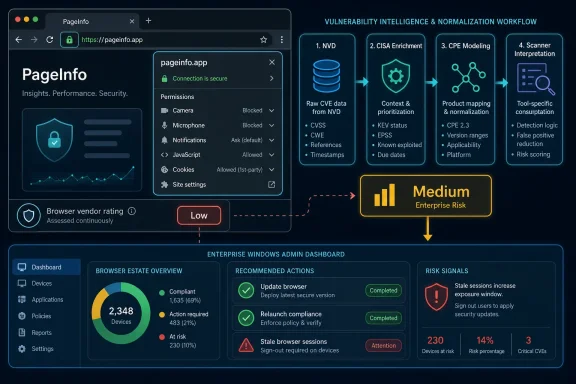 A Low-Severity Chrome Bug Becomes a Medium-Severity Workflow Problem
The vulnerability record says the flaw sits in Chrome’s PageInfo component, the part of the browser experience that helps represent site identity, permissions, and security context to the user. Google’s description frames the bug narrowly: insufficient validation of untrusted input, a crafted HTML page, and a requirement that the attacker has already compromised the renderer process. Chromium rated the issue Low, according to the NVD entry and Chrome’s own metadata.CISA’s ADP scoring tells a sharper story. The agency assigned CVSS 3.1 score 6.5, with network attack vector, low attack complexity, no privileges required, required user interaction, unchanged scope, no confidentiality impact, high integrity impact, and no availability impact. That scoring does not mean the bug suddenly became a remote-code-execution monster. It means the outcome being modeled — bypassing navigation restrictions — can matter materially once an attacker already has code running in the renderer.
That distinction is where many vulnerability dashboards go sideways. A browser vendor’s severity rating often reflects exploitability in the context of Chrome’s layered architecture. A CVSS score tries to describe technical impact in a more abstract, product-agnostic way. Both can be true, and neither is sufficient on its own.
Google’s Chrome Releases blog, referenced by NVD, ties the fix to the late-June Stable Channel update for desktop. NVD lists Chrome versions prior to 150.0.7871.47 as affected, while its change history shows NIST adding a CPE configuration on July 1, 2026. That matters because scanners, patch dashboards, and compliance engines often key off the CPE faster than they absorb the nuance in the description.
PageInfo Is Small Until It Becomes the Trust Boundary
PageInfo sounds like a user-interface corner of Chrome, and in many ways it is. Users see it when they inspect the lock icon, site permissions, connection security, and related browser-provided signals. But browser UI is not merely decoration; it is part of the security model because it tells the user and the browser what a page is allowed to do.The description of CVE-2026-14065 says the attacker must already have compromised the renderer process. That is an important constraint. Chrome’s multiprocess architecture is designed around the assumption that renderer processes are exposed to hostile web content and therefore heavily sandboxed. A flaw that requires renderer compromise is generally a post-compromise primitive, not a first step.
But post-compromise primitives are not useless. Real browser attacks are often chains: a memory corruption bug to gain execution in the renderer, a sandbox escape or policy bypass to widen control, and then a persistence, credential, or lateral movement path after the browser boundary falls. A navigation restriction bypass may not sound dramatic, but it can become a useful link if it lets hostile content move where it should not, present misleading browser state, or defeat a policy assumption.
That is why “Low” should not be read as “irrelevant.” It means the bug is unlikely to be the whole attack by itself. It does not mean it is impossible to weaponize inside a broader exploit chain.
The Renderer Requirement Is the Key Risk Reducer
The most important phrase in the CVE description is not “crafted HTML page.” It is “who had compromised the renderer process.” Without that condition, this would be a very different advisory. With it, defenders should treat CVE-2026-14065 as a secondary risk that increases the value of patching but does not justify apocalyptic messaging.Renderer compromise usually implies another vulnerability, malicious content execution path, or a serious browser exploit already succeeded. Chrome’s security architecture assumes the renderer is a dangerous place and tries to contain it. Bugs like this are concerning because they may weaken containment or policy enforcement after the first breach.
CISA’s SSVC data in the NVD record is sober rather than sensational. It lists exploitation as none, automatable as no, and technical impact as partial. That is the kind of metadata enterprise teams should actually use when triaging, because it separates known weaponization from theoretical impact.
The absence of known exploitation is not a reason to ignore the patch. It is a reason to schedule the work intelligently. If Chrome is updating automatically across your fleet and users are relaunching regularly, this bug should be absorbed by normal browser hygiene. If your environment pins browser versions, blocks background updates, or lets users defer relaunches indefinitely, then even “Low” browser bugs become accumulated attack surface.
The CPE Entry Is Probably Not Missing — It Is Just Awkward
The user-facing NVD page asks, “Are we missing a CPE here?” That boilerplate appears on many NVD entries and does not necessarily mean the record lacks a Chrome CPE. In this case, the change history shows NIST added a CPE configuration for Google Chrome versions up to, but excluding, 150.0.7871.47, combined with operating-system CPEs for Windows, Linux, and macOS.That structure can look odd if you are expecting a single affected-product row. NVD often models applications with platform constraints, so a Chrome vulnerability may appear as an application CPE paired with operating-system CPEs. The intent is to describe Chrome running on supported desktop platforms, not to say Windows, Linux, or macOS themselves are vulnerable in the operating-system sense.
There is a practical wrinkle, though. Chrome 150.0.7871.47 appears as the fixed boundary in the CVE record, while Chrome release channels sometimes publish slightly different build numbers by platform. Search results and related reports around the same release indicate Windows and macOS builds may be represented as 150.0.7871.46/.47 in some contexts, with Linux also appearing at 150.0.7871.46. That is exactly the kind of versioning detail that makes CPE-based detection noisy.
For administrators, the safer operational rule is to trust the vendor update channel and confirm that Chrome has moved past the vulnerable release line for the installed platform. Do not overfit on one string if your management tooling reports a platform-specific build that Google considers current. Do investigate if endpoints remain below the fixed desktop stable build after the rollout window.
NVD’s Change History Shows the Messy Middle of Modern Vulnerability Data
The NVD entry’s change history is unusually instructive. Chrome submitted the CVE on June 30. CISA-ADP added CVSS 3.1, CWE-20, and SSVC data on July 1. NIST then added the CPE configuration and reference typing. Later the same day, CISA-ADP removed the CWE entry it had added, while the Chrome-supplied CWE-20 remained visible in the record.This is not scandal; it is vulnerability data being assembled in public. CVE records now move through multiple hands: the assigning CNA, NVD enrichment, CISA’s ADP process, vendor release notes, and downstream security vendors. Each layer adds value, but each layer can also create temporary inconsistency.
For defenders, the temptation is to treat the CVE page as a fixed legal document. It is closer to a living dossier. The “Modified After Enrichment” banner is NVD’s way of warning that earlier enrichment may need amendment because the record changed after NVD had already processed it.
That matters for automation. A scanner may ingest one version of the record, a GRC platform another, and a ticketing workflow a third. If your security team sees CVE-2026-14065 flip categories, lose or gain a CWE, or show a different severity depending on the feed, the right response is not to assume one tool is broken. The right response is to identify which field drives your remediation SLA and whether that field reflects the real exposure.
Chrome’s Fast Release Machine Is Both the Fix and the Friction
Chrome’s update model is built to make most of this boring. The browser updates quickly, silently where policy allows, and broadly across consumer and enterprise machines. That is why Chrome can ship hundreds of security fixes in rapid cadence without every CVE becoming a household name.But enterprise Windows environments are rarely that clean. Chrome may be managed through Group Policy, Intune, third-party patch tools, VDI base images, application-control rules, or browser version pinning for legacy web apps. The more control an organization exerts over the browser, the more responsibility it takes for update latency.
CVE-2026-14065 is a good test of whether that control is disciplined or merely bureaucratic. If Chrome stable updates land within days and relaunch compliance is monitored, this vulnerability is noise inside a normal patch cycle. If endpoint reports show stale Chrome versions weeks after release, the organization has a browser governance problem that will matter much more when the next exploited zero-day arrives.
The broader June 2026 Chrome security context makes that point sharper. Earlier June reporting from outlets such as Malwarebytes and TechRadar covered an actively exploited Chrome vulnerability in the 149 branch, CVE-2026-11645. CVE-2026-14065 is not described as exploited, but it lands in the same ecosystem: a browser that is constantly patched because the web is constantly hostile.
Windows Admins Should Read This as a Browser Fleet Story
For WindowsForum readers, the operating-system CPE in the NVD record can be misleading at first glance. This is not a Windows vulnerability. Windows appears because Chrome runs on Windows, and NVD’s configuration models the vulnerable application in relation to the host platform.That distinction matters in patch ownership. The remediation is not a Windows Update action unless your organization distributes Chrome through a managed package tied to Windows servicing. It is a Chrome update, a relaunch, and a verification step.
On unmanaged endpoints, the usual path is Chrome’s built-in updater and the About Chrome page. In managed environments, it is whatever policy stack controls Google Update, browser relaunch notifications, update deferrals, and version targeting. The endpoint is not remediated merely because an update was downloaded; the running browser process must actually restart into the fixed version.
That last step is where many organizations quietly fail. Users keep browser sessions alive for days. Kiosks stay logged in. Shared workstations suspend instead of rebooting. VDI pools refresh from images that were patched once but not maintained. A CVE like this should push admins to measure active version state, not just package availability.
The Severity Debate Is Really About Chains
Security teams often argue over whether a CVE is “really” low, medium, or high. In this case, the answer depends on whether you assess the bug as a standalone flaw or as a component in an exploit chain. Google appears to be rating the former; CISA’s CVSS vector captures a specific impact if the attacker has the necessary foothold.That is not a contradiction so much as a reminder that browser vulnerabilities do not behave like simple server bugs. A server-side unauthenticated RCE may map cleanly to one exposure and one impact. Browser bugs live inside sandboxing, site isolation, user interaction, exploit mitigations, and UI trust boundaries. Their practical severity can rise or fall depending on what else an attacker has.
Navigation restrictions are especially chain-friendly. If a renderer compromise lets malicious content escape a navigation rule, the attacker may be able to reach browser states, surfaces, or flows that were supposed to be inaccessible. That does not automatically mean data theft or code execution, but it can undermine the assumptions that make other defenses work.
This is why mature patch triage should treat “requires prior compromise” as a reducer, not a dismissal. The right question is not “Can this CVE pop a machine by itself?” The better question is “Would this CVE make a browser exploit chain more reliable, more convincing, or more damaging?”
Scanner Noise Should Not Obscure the Simple Fix
There is a familiar pattern after Chrome CVEs land in NVD. Vulnerability scanners light up. Some tools report the CVSS score. Others inherit Chromium’s severity. Some key off CPEs. Others inspect installed binaries. A few produce alarming language that implies every affected endpoint is one click away from full compromise.CVE-2026-14065 deserves calmer treatment. The fix is straightforward: update Chrome to the stable release containing the patch, verify the active version, and force or encourage relaunch where necessary. The operational challenge is coverage, not complexity.
The CPE modeling issue is worth watching, but it should not paralyze remediation. If your scanner says Chrome before 150.0.7871.47 is vulnerable on Windows, that is broadly aligned with the NVD record. If it flags machines that are already on a platform-specific current build, compare the scanner’s detection logic against the installed Chrome version and Google’s release notes before opening a false-positive exception.
Security teams should also avoid treating this one CVE as a standalone emergency if their browser fleet is otherwise healthy. Bundle it into the Chrome 150 stable update push, confirm completion, and reserve escalation for endpoints that cannot update or business units that have pinned vulnerable versions.
The PageInfo Bug Is a Small Warning About Trust UI
The most interesting part of CVE-2026-14065 may be where it lives. PageInfo is part of the trust conversation between browser and user. Browser vendors have spent years reducing confusing security indicators, hiding noisy certificate details, tightening permission prompts, and trying to prevent websites from spoofing trusted UI.Attackers care about that surface because users make decisions based on it. If a site can confuse navigation state, permission context, or browser-provided identity cues, it can turn a technical foothold into a social-engineering advantage. Modern attacks are rarely pure memory corruption or pure phishing; they are hybrids.
That does not mean CVE-2026-14065 is a phishing superweapon. The renderer-compromise prerequisite still narrows the field. But it does show why seemingly mundane UI-adjacent validation bugs receive CVE treatment. In a browser, the boundary between interface and security control is thin.
This also explains why Chrome and Chromium advisories often keep bug details restricted until most users have updated. Publishing exact mechanics too early can help exploit developers reproduce chains before the patch has reached enough systems. Administrators may dislike the opacity, but for client-side software at Chrome scale, staged disclosure is part of the defense.
The Patch Is Easy; Proving the Patch Is the Work
The concrete administrative work starts with inventory. Find Chrome installations, including user-installed copies outside standard software catalogs. Confirm whether Chrome is managed, whether automatic updates are enabled, and whether policy allows prompt movement to the fixed stable channel.Then look at runtime. A machine can have an updated installer cache and still run an old browser process. Browser relaunch compliance is a security control, and Chrome’s own relaunch notification policies exist because update delivery without restart is incomplete.
Finally, map exceptions. If a legacy application requires an old Chrome build, that exception should have an owner, an expiration date, and compensating controls. “The app breaks on current Chrome” is not a patch strategy; it is a risk acceptance request.
For most Windows environments, CVE-2026-14065 should close quietly. The endpoints that do not close quietly are the ones telling you something more important than this one CVE.
Chrome 150 Turns a Minor CVE Into a Fleet Hygiene Test
The practical reading of CVE-2026-14065 is narrow, but useful. It is not a known exploited zero-day, not a standalone sandbox escape, and not a Windows flaw. It is a reminder that Chrome patching is now a continuous operational discipline.- Chrome versions before 150.0.7871.47 are the affected line identified in the NVD record for CVE-2026-14065.
- The attacker model requires an already-compromised renderer process, which reduces standalone urgency but preserves chain value.
- Chromium rates the issue Low, while CISA-ADP assigns a CVSS 3.1 score of 6.5 Medium because the modeled integrity impact is high.
- The NVD CPE configuration is not obviously missing Chrome; it models Google Chrome on desktop operating systems including Windows, Linux, and macOS.
- Windows administrators should remediate through Chrome update and relaunch enforcement, not through Windows Update alone.
- Scanner findings should be validated against the active Chrome version and the vendor release channel before being dismissed as false positives.