

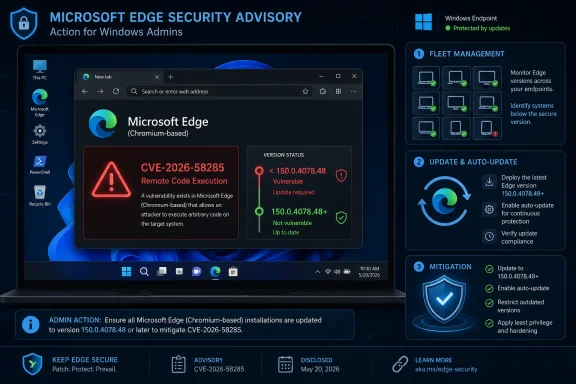
Microsoft disclosed CVE-2026-58285 on July 3, 2026, as a remote code execution vulnerability in Chromium-based Microsoft Edge affecting versions before 150.0.4078.48, with public vulnerability databases mirroring Microsoft’s advisory and assigning it a CVSS 3.1 score of 8.3. The uncomfortable part is not merely that Edge has another browser-class RCE; it is that the advisory sits in the familiar gray zone where the vendor confirms the flaw but withholds the implementation detail that defenders instinctively want. For administrators, that makes this less a mystery to solve than a patch-management test: can the browser fleet move faster than attacker triage?
The Microsoft Security Response Center entry identifies CVE-2026-58285 as a Microsoft Edge, Chromium-based remote code execution vulnerability. Third-party mirrors including Vulners and NVD picked up the record shortly after publication, with Vulners showing a July 3 timestamp and an affected range ending before Edge 150.0.4078.48.
That version boundary matters more than the short description. Microsoft’s modern browser security model is built around rapid, evergreen updates; the practical remediation is not a registry workaround or a Group Policy contortion, but getting Edge to a fixed build. If an endpoint still reports an Edge version below 150.0.4078.48, it belongs in the “not done” column.
The CVSS 3.1 score of 8.3 places the issue in high-severity territory, even though some vulnerability intelligence platforms may label operational risk differently. That split is common: CVSS describes technical severity under a standardized model, while vendor or platform risk scores often blend exploit availability, exposure, asset criticality, and observed activity.
The user-supplied MSRC metric text points to the heart of the story: report confidence. Microsoft’s acknowledgement gives defenders confidence that the vulnerability exists, but the sparse technical disclosure limits confidence about the exact bug class, trigger, and exploit path. That is not an argument for waiting; it is the reason browser patching has to be boringly automatic.
Edge inherits Chromium’s enormous security investment, but it also inherits Chromium’s attack surface. Microsoft’s version of the browser adds enterprise controls, Microsoft account integration, SmartScreen, IE mode compatibility for holdout line-of-business apps, and Windows integration points that make Edge more than a simple Chromium repackaging. That integration is useful, but it also means Edge is treated as infrastructure in many Windows environments.
The phrase “remote code execution” does not automatically mean a drive-by compromise on every unpatched machine. The missing details matter: user interaction, sandbox escape requirements, renderer versus browser process impact, memory corruption primitive, and exploit reliability can change the real-world risk dramatically. But defenders rarely get those details on day one, and attackers do not need press-release clarity to begin diffing patches.
That is why the version number is the operational fact. If the fixed Edge build is present, the exposed code path is presumably remediated. If it is absent, the organization is betting that attackers cannot convert public metadata and binary changes into a working exploit before the fleet catches up.
In this case, the vendor has acknowledged the issue through MSRC, and the CVE has propagated through major vulnerability databases. That pushes confidence in the existence of the vulnerability high. What remains limited is confidence in the unpublished mechanics: the exact component, root cause, exploit preconditions, and whether the bug is easily reachable from ordinary browsing.
That distinction matters for communication. A security team should not tell executives that “no details are public, so the issue is speculative.” The better framing is that Microsoft has confirmed the vulnerability, but defenders do not yet have enough public detail to build reliable compensating controls beyond updating the browser and reducing exposure to risky web content.
It also matters for attackers. Sparse advisories slow casual exploit development, but they do not stop competent vulnerability teams from analyzing the patched and unpatched binaries. Once a fixed build is available, the clock starts for patch-diffing, proof-of-concept development, and eventual commodity scanner or exploit-kit adoption if the bug proves practical.
In practice, enterprise reality is messier. Some organizations pin browser versions for compatibility testing, block automatic updates through network controls, delay updates for VDI images, or treat browsers as part of a golden-image pipeline that moves slower than the threat landscape. Those choices may be defensible for stability, but they convert an evergreen browser into a semi-managed application with a very public attack surface.
The most dangerous machines are not always the unmanaged ones. They are often the partially managed ones: endpoints that have Edge installed, appear compliant in a broad Windows Update dashboard, but are not being checked against the browser’s actual runtime version. A Windows build number does not prove that Edge is current.
For admins, CVE-2026-58285 is a reminder to inventory Edge directly. Query the installed version, compare it against 150.0.4078.48 or later, and verify that update services are not blocked by proxy policy, endpoint hardening, or stale management baselines. If Edge is present but not the primary browser, it still needs patching; dormant browsers have a way of becoming active when a file association, help link, embedded web view, or user habit says so.
Without more technical detail, it would be reckless to claim that Chrome, Brave, Opera, Vivaldi, or other Chromium-derived browsers are affected by this specific CVE. Microsoft’s advisory is scoped to Edge. But the Chromium ecosystem has a long history of shared vulnerability classes, shared rendering components, and parallel patch cycles.
This is where browser monoculture becomes a security paradox. Chromium’s shared foundation means fixes can propagate quickly across vendors, and the engineering weight behind the platform is formidable. It also means that a bug in a shared component may have enormous reach, especially when attackers can adapt one exploit strategy across multiple browsers with vendor-specific adjustments.
For Windows shops, the practical policy is straightforward: do not treat Edge patching as a substitute for Chrome patching, or vice versa. Inventory all installed browsers and update them on their own channels. Users may have three Chromium-family browsers installed, and the least-used one may be the least-updated one.
The early period after disclosure is often when defenders have the best odds. Attackers are still deciding whether the bug is worth the engineering time. Enterprises are deciding whether to treat the browser as a first-class patch target or let it wait behind server maintenance windows and application testing committees.
A high CVSS score does not guarantee mass exploitation, and many high-severity browser flaws never become headline incidents. But the cost of patching Edge is usually lower than the cost of explaining why a browser update was delayed after the vendor had already shipped a fix. The asymmetry is obvious: defenders need a predictable update process; attackers need one neglected population.
The lack of root-cause disclosure also limits detection. Security teams should not expect clean network indicators or simple endpoint rules for this CVE at disclosure time. If exploitation eventually appears, useful detections may center on browser crash telemetry, suspicious child processes, post-exploitation behavior, and known malicious infrastructure rather than the original vulnerability trigger.
The second step is policy validation. Microsoft Edge Update should be allowed to reach its update endpoints, scheduled tasks and services should not be disabled, and enterprise update rings should not be paused indefinitely for browser builds. If an organization uses Configuration Manager, Intune, third-party patching, or VDI image management, Edge needs to appear as a tracked application with its own compliance state.
The third step is exception hunting. Kiosks, shared workstations, lab systems, developer boxes, jump hosts, and non-persistent desktops are where browser version drift tends to hide. These systems may not look important until someone remembers they authenticate to internal portals, cloud admin consoles, ticketing systems, or privileged management tools.
The fourth step is user-risk reduction while updates land. SmartScreen, site isolation, exploit protection, and least-privilege user accounts are not substitutes for patching, but they can reduce blast radius. Organizations with high-risk users should consider temporarily tightening access to untrusted sites, especially where browser update compliance is uncertain.
Microsoft’s advisory gives the ecosystem a confirmed vulnerability name, product scope, and fixed-version boundary. Vulnerability databases add indexing, scoring, and cross-references. None of that updates a single endpoint. The actual security outcome depends on mundane telemetry: installed version, last update time, update channel, policy state, and restart behavior.
For WindowsForum readers, this is where the story becomes less about Microsoft and more about Windows administration culture. Many organizations have become competent at tracking Windows cumulative updates because Patch Tuesday forced the habit. Browser patching requires the same discipline on a faster clock, with less ceremony and fewer excuses.
The irony is that Edge’s rapid update model can make risk less visible. A monthly server patch creates meetings, tickets, maintenance windows, and reports. A browser update that silently succeeds leaves almost no drama. But when it silently fails, the absence of drama becomes the problem.
That last caveat is not pedantic. Windows machines can carry multiple Edge-related components, including WebView2 runtimes, side-by-side browser channels, and remnants from older deployment methods. Administrators should verify the stable channel used by ordinary users and review whether WebView2 or other embedded Chromium runtimes have separate update requirements in their environment.
Microsoft’s naming also deserves attention. “Microsoft Edge (Chromium-based)” distinguishes the modern browser from the legacy EdgeHTML era, but it can also lull admins into thinking this is just another Chromium patch. It is a Microsoft-supported Windows application with Microsoft enterprise policy hooks, and it should be managed as such.
The fixed-build threshold should be folded into vulnerability management scanners as a hard compliance check. If a scanner only reports the CVE name without confirming the executable version, it is giving the security team a headline rather than an answer.
What defenders should not say is equally important. They should not claim a known exploit chain unless new evidence appears. They should not claim all Chromium browsers are affected by this Microsoft CVE. They should not infer the bug’s root cause from the RCE label alone.
The most honest internal advisory would be blunt: Microsoft has confirmed a high-severity Edge RCE; public technical detail is limited; update Edge to the fixed build or later; verify compliance directly; monitor for browser exploitation signals and post-exploitation behavior. That message is less dramatic than a panic bulletin, but it is much more useful.
Security communication often fails when it tries to convert uncertainty into certainty. CVE-2026-58285 does not need embellishment. A confirmed browser RCE with a fixed build available is already enough.
 Microsoft’s Edge Advisory Says Enough to Act, Not Enough to Reverse-Engineer
The Microsoft Security Response Center entry identifies CVE-2026-58285 as a Microsoft Edge, Chromium-based remote code execution vulnerability. Third-party mirrors including Vulners and NVD picked up the record shortly after publication, with Vulners showing a July 3 timestamp and an affected range ending before Edge 150.0.4078.48.That version boundary matters more than the short description. Microsoft’s modern browser security model is built around rapid, evergreen updates; the practical remediation is not a registry workaround or a Group Policy contortion, but getting Edge to a fixed build. If an endpoint still reports an Edge version below 150.0.4078.48, it belongs in the “not done” column.
The CVSS 3.1 score of 8.3 places the issue in high-severity territory, even though some vulnerability intelligence platforms may label operational risk differently. That split is common: CVSS describes technical severity under a standardized model, while vendor or platform risk scores often blend exploit availability, exposure, asset criticality, and observed activity.
The user-supplied MSRC metric text points to the heart of the story: report confidence. Microsoft’s acknowledgement gives defenders confidence that the vulnerability exists, but the sparse technical disclosure limits confidence about the exact bug class, trigger, and exploit path. That is not an argument for waiting; it is the reason browser patching has to be boringly automatic.
Browser RCE Is the Oldest Modern Emergency
Remote code execution in a browser is a loaded phrase because the browser is the universal untrusted-content parser. It ingests JavaScript, images, fonts, media, WebAssembly, PDFs, GPU commands, and a rotating cast of compression and rendering formats, often from sites the user never consciously chose to trust.Edge inherits Chromium’s enormous security investment, but it also inherits Chromium’s attack surface. Microsoft’s version of the browser adds enterprise controls, Microsoft account integration, SmartScreen, IE mode compatibility for holdout line-of-business apps, and Windows integration points that make Edge more than a simple Chromium repackaging. That integration is useful, but it also means Edge is treated as infrastructure in many Windows environments.
The phrase “remote code execution” does not automatically mean a drive-by compromise on every unpatched machine. The missing details matter: user interaction, sandbox escape requirements, renderer versus browser process impact, memory corruption primitive, and exploit reliability can change the real-world risk dramatically. But defenders rarely get those details on day one, and attackers do not need press-release clarity to begin diffing patches.
That is why the version number is the operational fact. If the fixed Edge build is present, the exposed code path is presumably remediated. If it is absent, the organization is betting that attackers cannot convert public metadata and binary changes into a working exploit before the fleet catches up.
The Confidence Metric Cuts Both Ways
The report confidence language in Microsoft’s guidance is often misunderstood. It is not a vibes-based severity field, and it is not the same as exploit maturity. It measures how sure the ecosystem is that the vulnerability and the described technical details are real.In this case, the vendor has acknowledged the issue through MSRC, and the CVE has propagated through major vulnerability databases. That pushes confidence in the existence of the vulnerability high. What remains limited is confidence in the unpublished mechanics: the exact component, root cause, exploit preconditions, and whether the bug is easily reachable from ordinary browsing.
That distinction matters for communication. A security team should not tell executives that “no details are public, so the issue is speculative.” The better framing is that Microsoft has confirmed the vulnerability, but defenders do not yet have enough public detail to build reliable compensating controls beyond updating the browser and reducing exposure to risky web content.
It also matters for attackers. Sparse advisories slow casual exploit development, but they do not stop competent vulnerability teams from analyzing the patched and unpatched binaries. Once a fixed build is available, the clock starts for patch-diffing, proof-of-concept development, and eventual commodity scanner or exploit-kit adoption if the bug proves practical.
Edge’s Evergreen Model Is a Security Feature Only If It Actually Runs
Microsoft’s Edge update story is supposed to be the antidote to browser vulnerability panic. Edge updates frequently, silently, and independently of the monthly Windows cumulative update cycle in most consumer and enterprise configurations. In theory, that means a high-severity browser flaw can be closed without waiting for Patch Tuesday.In practice, enterprise reality is messier. Some organizations pin browser versions for compatibility testing, block automatic updates through network controls, delay updates for VDI images, or treat browsers as part of a golden-image pipeline that moves slower than the threat landscape. Those choices may be defensible for stability, but they convert an evergreen browser into a semi-managed application with a very public attack surface.
The most dangerous machines are not always the unmanaged ones. They are often the partially managed ones: endpoints that have Edge installed, appear compliant in a broad Windows Update dashboard, but are not being checked against the browser’s actual runtime version. A Windows build number does not prove that Edge is current.
For admins, CVE-2026-58285 is a reminder to inventory Edge directly. Query the installed version, compare it against 150.0.4078.48 or later, and verify that update services are not blocked by proxy policy, endpoint hardening, or stale management baselines. If Edge is present but not the primary browser, it still needs patching; dormant browsers have a way of becoming active when a file association, help link, embedded web view, or user habit says so.
The Chromium Connection Makes Attribution Messy
Microsoft labels this an Edge vulnerability, but the “Chromium-based” qualifier leaves open the possibility that the root cause sits in shared Chromium code rather than Microsoft-only Edge code. That is not a minor editorial detail. It affects who else might be exposed, how quickly related patches appear, and whether security teams should look beyond Edge.Without more technical detail, it would be reckless to claim that Chrome, Brave, Opera, Vivaldi, or other Chromium-derived browsers are affected by this specific CVE. Microsoft’s advisory is scoped to Edge. But the Chromium ecosystem has a long history of shared vulnerability classes, shared rendering components, and parallel patch cycles.
This is where browser monoculture becomes a security paradox. Chromium’s shared foundation means fixes can propagate quickly across vendors, and the engineering weight behind the platform is formidable. It also means that a bug in a shared component may have enormous reach, especially when attackers can adapt one exploit strategy across multiple browsers with vendor-specific adjustments.
For Windows shops, the practical policy is straightforward: do not treat Edge patching as a substitute for Chrome patching, or vice versa. Inventory all installed browsers and update them on their own channels. Users may have three Chromium-family browsers installed, and the least-used one may be the least-updated one.
The Absence of Public Exploit Detail Is Not a Comfort Blanket
There is no public indication in the available advisory mirrors that CVE-2026-58285 is being actively exploited in the wild. That is useful information, but it is not a reason to downgrade urgency. Browser RCEs move through a familiar lifecycle: terse advisory, patch availability, patch diffing, private reproduction, public proof of concept, and then either quiet disappearance or operationalization.The early period after disclosure is often when defenders have the best odds. Attackers are still deciding whether the bug is worth the engineering time. Enterprises are deciding whether to treat the browser as a first-class patch target or let it wait behind server maintenance windows and application testing committees.
A high CVSS score does not guarantee mass exploitation, and many high-severity browser flaws never become headline incidents. But the cost of patching Edge is usually lower than the cost of explaining why a browser update was delayed after the vendor had already shipped a fix. The asymmetry is obvious: defenders need a predictable update process; attackers need one neglected population.
The lack of root-cause disclosure also limits detection. Security teams should not expect clean network indicators or simple endpoint rules for this CVE at disclosure time. If exploitation eventually appears, useful detections may center on browser crash telemetry, suspicious child processes, post-exploitation behavior, and known malicious infrastructure rather than the original vulnerability trigger.
Security Teams Should Treat This as a Fleet Hygiene Drill
The right response begins with version verification. Edge installations below 150.0.4078.48 should be considered exposed according to the affected range visible in public vulnerability records. The fixed build threshold gives administrators a measurable target, not just a generic instruction to “apply updates.”The second step is policy validation. Microsoft Edge Update should be allowed to reach its update endpoints, scheduled tasks and services should not be disabled, and enterprise update rings should not be paused indefinitely for browser builds. If an organization uses Configuration Manager, Intune, third-party patching, or VDI image management, Edge needs to appear as a tracked application with its own compliance state.
The third step is exception hunting. Kiosks, shared workstations, lab systems, developer boxes, jump hosts, and non-persistent desktops are where browser version drift tends to hide. These systems may not look important until someone remembers they authenticate to internal portals, cloud admin consoles, ticketing systems, or privileged management tools.
The fourth step is user-risk reduction while updates land. SmartScreen, site isolation, exploit protection, and least-privilege user accounts are not substitutes for patching, but they can reduce blast radius. Organizations with high-risk users should consider temporarily tightening access to untrusted sites, especially where browser update compliance is uncertain.
The Real Risk Is the Gap Between Disclosure and Verification
CVE-2026-58285 is exactly the kind of vulnerability that exposes the gap between “we patch browsers automatically” and “we can prove every browser is patched.” Those are different maturity levels. The first is a policy statement; the second is an operational capability.Microsoft’s advisory gives the ecosystem a confirmed vulnerability name, product scope, and fixed-version boundary. Vulnerability databases add indexing, scoring, and cross-references. None of that updates a single endpoint. The actual security outcome depends on mundane telemetry: installed version, last update time, update channel, policy state, and restart behavior.
For WindowsForum readers, this is where the story becomes less about Microsoft and more about Windows administration culture. Many organizations have become competent at tracking Windows cumulative updates because Patch Tuesday forced the habit. Browser patching requires the same discipline on a faster clock, with less ceremony and fewer excuses.
The irony is that Edge’s rapid update model can make risk less visible. A monthly server patch creates meetings, tickets, maintenance windows, and reports. A browser update that silently succeeds leaves almost no drama. But when it silently fails, the absence of drama becomes the problem.
The Edge 150.0.4078.48 Line in the Sand
For now, the clearest dividing line is version 150.0.4078.48. Systems running Edge below that threshold fall inside the affected range reported by public vulnerability intelligence sources. Systems at or above that threshold should be treated as remediated for this CVE, assuming the installed build is the active browser binary users actually launch.That last caveat is not pedantic. Windows machines can carry multiple Edge-related components, including WebView2 runtimes, side-by-side browser channels, and remnants from older deployment methods. Administrators should verify the stable channel used by ordinary users and review whether WebView2 or other embedded Chromium runtimes have separate update requirements in their environment.
Microsoft’s naming also deserves attention. “Microsoft Edge (Chromium-based)” distinguishes the modern browser from the legacy EdgeHTML era, but it can also lull admins into thinking this is just another Chromium patch. It is a Microsoft-supported Windows application with Microsoft enterprise policy hooks, and it should be managed as such.
The fixed-build threshold should be folded into vulnerability management scanners as a hard compliance check. If a scanner only reports the CVE name without confirming the executable version, it is giving the security team a headline rather than an answer.
What Defenders Can Safely Say Today
The facts are limited but actionable. Microsoft has published CVE-2026-58285 for Chromium-based Edge, third-party vulnerability databases have mirrored the record, and the affected range points to Edge builds before 150.0.4078.48. The public record describes remote code execution and carries a high CVSS score.What defenders should not say is equally important. They should not claim a known exploit chain unless new evidence appears. They should not claim all Chromium browsers are affected by this Microsoft CVE. They should not infer the bug’s root cause from the RCE label alone.
The most honest internal advisory would be blunt: Microsoft has confirmed a high-severity Edge RCE; public technical detail is limited; update Edge to the fixed build or later; verify compliance directly; monitor for browser exploitation signals and post-exploitation behavior. That message is less dramatic than a panic bulletin, but it is much more useful.
Security communication often fails when it tries to convert uncertainty into certainty. CVE-2026-58285 does not need embellishment. A confirmed browser RCE with a fixed build available is already enough.
The Patch Window Is Where This Edge Bug Will Be Won or Lost
This advisory’s practical lesson is not that Edge is uniquely unsafe. It is that browsers have become operating-system-adjacent infrastructure, and infrastructure-grade software deserves infrastructure-grade verification. The organizations that come out clean will be the ones that can answer a simple version question quickly.- Microsoft disclosed CVE-2026-58285 on July 3, 2026, as a remote code execution vulnerability in Chromium-based Microsoft Edge.
- Public vulnerability records show Edge versions before 150.0.4078.48 as affected, making that build the immediate remediation threshold.
- The available public detail confirms the vulnerability’s existence but does not yet expose enough root-cause information to support precise compensating controls.
- Security teams should verify Edge versions directly rather than relying only on Windows Update compliance dashboards.
- The lack of public exploitation reports should reduce panic, not urgency, because browser flaws can become more dangerous after patches reveal what changed.
- Organizations should inventory all installed browsers and Chromium-based runtimes rather than assuming the default browser is the only relevant exposure.
References
- Primary source: MSRC
Published: 2026-07-03T07:00:00-07:00
Security Update Guide - Microsoft Security Response Center
 msrc.microsoft.com
- Related coverage: www2.gov.bc.ca
- Related coverage: hivepro.com
- Related coverage: ws.buildingsbt.stage.honeywell.com
- Official source: microsoft.com
MSRC - Microsoft Security Response Center
The Microsoft Security Response Center is part of the defender community and on the front line of security response evolution. For over twenty years, we have been engaged with security researchers working to protect customers and the broader ecosystem.www.microsoft.com
- Official source: learn.microsoft.com
Security Advisories and Bulletins | Microsoft Learn
learn.microsoft.com
- Official source: github.com
GitHub - microsoft/MSRC-Microsoft-Security-Updates-API: Repo with getting started projects for the Microsoft Security Updates API (msrc.microsoft.com/update-guide) · GitHub
Repo with getting started projects for the Microsoft Security Updates API (msrc.microsoft.com/update-guide) - microsoft/MSRC-Microsoft-Security-Updates-API github.com