

Microsoft published CVE-2026-58290 on July 3, 2026, as an Important remote code execution vulnerability in Chromium-based Microsoft Edge, fixed in Edge version 150.0.4078.48 and tied to a type confusion flaw that requires user interaction. The advisory, issued through the Microsoft Security Response Center, is not a five-alarm zero-day bulletin; Microsoft says it was not publicly disclosed or exploited when published. But it is still the kind of browser bug that deserves fast patching because “remote code execution” in a default enterprise browser is never just another line item. The real story is the gap between the scary category and the constrained exploitation path.
CVE-2026-58290 lands in an awkward middle ground that Windows administrators know well. It is rated Important rather than Critical, carries a CVSS 3.1 base score of 7.5, and has Microsoft’s own exploitability assessment of “Exploitation Unlikely.” That combination sounds calming until one remembers that browsers are where untrusted code meets authenticated users, corporate identity, saved state, and increasingly complex platform features.
Microsoft’s advisory describes the root weakness as CWE-843, “Access of Resource Using Incompatible Type,” better known as type confusion. In browser terms, that usually means the software interprets a resource or object as something it is not, potentially opening a path from malformed content to unexpected memory behavior. Microsoft’s summary says the flaw allows an unauthorized attacker to execute code over a network.
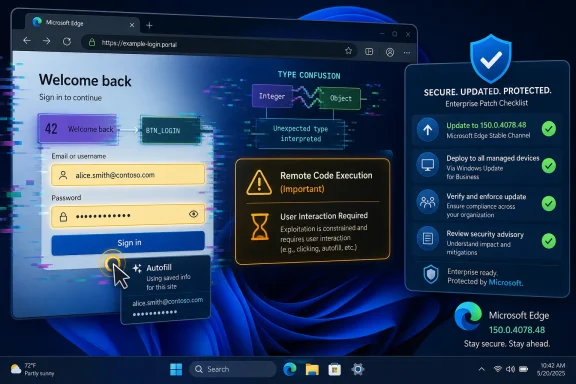
The details matter because this is not described as a drive-by, no-click compromise. Microsoft says user interaction is required, attack complexity is high, and exploitation depends on a user visiting attacker-controlled content and performing specific actions. In the advisory’s FAQ, Microsoft says the attacker would need to craft deceptive or invisible form elements and get the user to perform two sequential taps that cause autofill to activate.
That description makes CVE-2026-58290 less like a wormable network service bug and more like a carefully staged browser exploitation scenario. It is still dangerous, but the operational burden shifts from “block everything immediately” to “patch quickly, reduce exposure, and watch for targeted lures.”
That is a mouthful, but it says something specific. The attacker does not need an account on the victim’s system or service, which is why the vulnerability deserves attention. The attack can be delivered over the network, such as through a malicious website or content delivered by email or instant message, which is exactly the browser threat model defenders have spent two decades trying to harden.
At the same time, the high attack complexity and required interaction are meaningful constraints. Microsoft’s advisory says the attacker cannot force a user to view attacker-controlled content. The attacker must persuade the victim to open the page or file, then cause the right interaction sequence.
The scope-change marker is also important. In CVSS terms, it means the exploit can affect resources beyond the security authority of the vulnerable component. In browser language, that is the line administrators care about: a bug in the browser can become a problem for information and actions that live outside the narrow sandbox boundary users imagine when they “just open a webpage.”
Microsoft says exploitation requires the user to visit an attacker-controlled webpage and perform two tap gestures that cause autofill to activate. That is more specific than the usual “open a specially crafted file” boilerplate, and it hints at a class of interaction bugs where the interface, the document model, and browser-managed data collide. The danger is not just memory corruption in the abstract; it is memory corruption reachable through a feature designed to streamline trust.
For consumers, that means phishing-style delivery remains the most likely path. A malicious link, a fake login page, a document lure, or an instant message can provide the stage. For enterprises, the threat model widens because corporate users live inside managed browsers all day, often with single sign-on sessions, password managers, autofill policies, and line-of-business web apps all coexisting in the same workspace.
This is why “user interaction required” should never be treated as “safe.” Modern attacks are built around interaction. Clicking, tapping, approving, scanning, downloading, and opening are not exceptional events; they are the normal working day.
Microsoft’s temporal metrics list exploit code maturity as Unproven. The advisory also says the vulnerability was not publicly disclosed and not exploited at the time of original publication. In plain English: Microsoft says this is a real bug, Microsoft shipped an official fix, but Microsoft is not saying that public exploit code or active exploitation exists.
That distinction matters for patch prioritization. A confirmed vendor advisory should not be ignored, especially when the affected product is Edge. But an unexploited, high-complexity browser issue is not the same emergency as an actively exploited zero-day in a perimeter-facing service.
Administrators should resist both bad instincts. The first bad instinct is complacency: “Exploitation unlikely” becomes an excuse to wait. The second is theater: treating every RCE as if the building is on fire. The right answer is disciplined urgency.
CVE-2026-58290 is explicitly listed by Microsoft as affecting Microsoft Edge Chromium-based. The fix is documented as Edge 150.0.4078.48, released July 3, 2026, based on Chromium version 150.0.7871.47. For administrators, the actionable unit is not an abstract Chromium build; it is the deployed Edge version on Windows endpoints and any managed platforms in scope.
That distinction becomes important in environments with staggered browser update rings. Many organizations allow Edge to update automatically but still control timing through policy, testing, or network restrictions. If Edge auto-update is blocked, delayed, or broken, the presence of a vendor fix does not protect the endpoint.
The browser has become a managed runtime in its own right. It deserves the same inventory discipline organizations apply to operating system builds, Office channels, and endpoint agents. If the security team cannot answer which Edge versions are deployed, CVE-2026-58290 is not the only problem.
For unmanaged home users, the practical advice is simple: let Edge update and restart the browser. Edge updates often sit in the background until a restart completes the handoff. Users who keep browser windows open for weeks can be technically “updated” in policy terms while still running an older process in practice.
For enterprises, the control points are familiar. Confirm Edge Update is functioning, verify the target version, check whether update policies pin or defer the browser, and monitor whether the patched build reaches high-risk user populations. Administrators should pay particular attention to shared devices, kiosk-like systems, virtual desktop images, and machines that are frequently offline.
The advisory’s exploit path also makes user training relevant, but only as a secondary layer. Telling users not to click suspicious links is not a patch strategy. It is a weak control around a strong habit attackers already know how to manipulate.
CVE-2026-58290 fits that pattern. The vulnerability has a high enough CVSS score to merit attention, but Microsoft’s own scoring says exploitation is unlikely at publication. The bug is real, the fix is available, and the exploitation path requires choreography.
That is exactly the class of vulnerability enterprises are tempted to defer. It is not making headlines as an exploited zero-day, and it does not obviously threaten servers in the data center. Yet browser vulnerabilities are exploited where users work, not where firewall diagrams are drawn.
The browser is now the front door to identity, SaaS, internal apps, and cloud administration. A remote code execution issue in that surface should be treated as endpoint risk, identity risk, and data risk at the same time.
That is not necessarily a contradiction. Browser vulnerabilities often have multiple delivery paths, and advisory language is written to cover scenarios without handing attackers a recipe. It does mean defenders should avoid overfitting their response to a single imagined lure.
The common thread is more useful: attacker-controlled content, user interaction, Edge, autofill-related behavior, and a type confusion flaw. That is enough for prioritization and user-risk messaging without pretending the public advisory gives a full exploit chain.
Security teams should also remember that advisories evolve. Microsoft’s revision history currently shows version 1.0 with information published on July 3, 2026. If exploitability changes, if public proof-of-concept code appears, or if Microsoft updates the FAQ, the operational priority should change with it.
Start with exposure. Which machines run Edge? Which are managed? Which are in delayed update rings? Which user groups handle sensitive data in browser sessions? Those questions produce a better patch plan than a raw CVSS number.
Then move to verification. The fixed Edge build is 150.0.4078.48. It is not enough to assume that because Microsoft published a fix, endpoints have consumed it. Asset inventory, endpoint management telemetry, or browser reporting should confirm the patched version is present.
Finally, treat user interaction as a detection and prevention clue. Email and messaging lures that push users toward unfamiliar pages, attachments, or form interactions are the likely delivery fabric for this class of issue. That does not mean blocking the web; it means tuning defenses around the behaviors the advisory actually describes.
Autofill is a perfect example. It exists to reduce friction, and in doing so it becomes part of the security boundary whether product teams describe it that way or not. When a malicious page can manipulate form elements and user gestures around autofill, the browser’s helpfulness becomes something defenders must model.
This is not an argument to disable autofill everywhere by reflex. Heavy-handed controls can create workarounds that are worse than the feature. It is an argument to understand which browser features are enabled, how they interact with password managers and identity systems, and whether high-risk users need tighter policy.
Administrators often focus on the operating system because Windows has historically been the main patching battlefield. But the daily exploit surface has shifted upward. Edge, Chrome, WebView2, extensions, identity brokers, and SaaS sessions are now part of the endpoint security perimeter.
The presence of an official fix lowers the tolerance for delay. If an organization can patch Edge quickly and verify the result, there is little strategic value in waiting. Browser updates are among the least defensible patches to postpone because attackers can deliver content at internet scale and users bring the browser into nearly every workflow.
The absence of known exploitation lowers the need for panic. There is no public signal from Microsoft that this was under active attack when disclosed. That should shape communications and triage, especially in environments already juggling more urgent exploited vulnerabilities.
The correct administrative posture is boring and effective: update Edge, confirm the version, watch for advisory revisions, and reinforce controls against malicious links and crafted web content. Boring is good. Boring is what mature patch management is supposed to look like.
 Microsoft’s Edge Warning Is Serious, But Not a Panic Button
CVE-2026-58290 lands in an awkward middle ground that Windows administrators know well. It is rated Important rather than Critical, carries a CVSS 3.1 base score of 7.5, and has Microsoft’s own exploitability assessment of “Exploitation Unlikely.” That combination sounds calming until one remembers that browsers are where untrusted code meets authenticated users, corporate identity, saved state, and increasingly complex platform features.Microsoft’s advisory describes the root weakness as CWE-843, “Access of Resource Using Incompatible Type,” better known as type confusion. In browser terms, that usually means the software interprets a resource or object as something it is not, potentially opening a path from malformed content to unexpected memory behavior. Microsoft’s summary says the flaw allows an unauthorized attacker to execute code over a network.
The details matter because this is not described as a drive-by, no-click compromise. Microsoft says user interaction is required, attack complexity is high, and exploitation depends on a user visiting attacker-controlled content and performing specific actions. In the advisory’s FAQ, Microsoft says the attacker would need to craft deceptive or invisible form elements and get the user to perform two sequential taps that cause autofill to activate.
That description makes CVE-2026-58290 less like a wormable network service bug and more like a carefully staged browser exploitation scenario. It is still dangerous, but the operational burden shifts from “block everything immediately” to “patch quickly, reduce exposure, and watch for targeted lures.”
The CVSS Vector Tells a More Nuanced Story Than the Headline
The headline phrase “remote code execution” tends to flatten every vulnerability into the same mental category. CVE-2026-58290 is a useful reminder that RCE is an outcome, not a complete threat model. Microsoft’s vector string says the attack is network-based, high complexity, requires no privileges, requires user interaction, changes scope, and has low confidentiality, high integrity, and low availability impact.That is a mouthful, but it says something specific. The attacker does not need an account on the victim’s system or service, which is why the vulnerability deserves attention. The attack can be delivered over the network, such as through a malicious website or content delivered by email or instant message, which is exactly the browser threat model defenders have spent two decades trying to harden.
At the same time, the high attack complexity and required interaction are meaningful constraints. Microsoft’s advisory says the attacker cannot force a user to view attacker-controlled content. The attacker must persuade the victim to open the page or file, then cause the right interaction sequence.
The scope-change marker is also important. In CVSS terms, it means the exploit can affect resources beyond the security authority of the vulnerable component. In browser language, that is the line administrators care about: a bug in the browser can become a problem for information and actions that live outside the narrow sandbox boundary users imagine when they “just open a webpage.”
Autofill Turns Convenience Into Attack Surface
The most interesting detail in Microsoft’s advisory is not merely that the bug is type confusion. It is the exploit choreography around deceptive or invisible form elements and autofill activation. Autofill is one of those features that exists because users hate typing the same information repeatedly, and attackers love any feature that lets the browser make decisions on the user’s behalf.Microsoft says exploitation requires the user to visit an attacker-controlled webpage and perform two tap gestures that cause autofill to activate. That is more specific than the usual “open a specially crafted file” boilerplate, and it hints at a class of interaction bugs where the interface, the document model, and browser-managed data collide. The danger is not just memory corruption in the abstract; it is memory corruption reachable through a feature designed to streamline trust.
For consumers, that means phishing-style delivery remains the most likely path. A malicious link, a fake login page, a document lure, or an instant message can provide the stage. For enterprises, the threat model widens because corporate users live inside managed browsers all day, often with single sign-on sessions, password managers, autofill policies, and line-of-business web apps all coexisting in the same workspace.
This is why “user interaction required” should never be treated as “safe.” Modern attacks are built around interaction. Clicking, tapping, approving, scanning, downloading, and opening are not exceptional events; they are the normal working day.
“Confirmed” Does Not Mean “Exploit Is Circulating”
The user-supplied metric language around report confidence is worth dwelling on because it explains why CVE-2026-58290 is simultaneously credible and not necessarily being exploited. Microsoft marks the report confidence as Confirmed, which means the vendor accepts the existence of the vulnerability and the technical basis is credible. That is different from saying attackers already have working exploit code.Microsoft’s temporal metrics list exploit code maturity as Unproven. The advisory also says the vulnerability was not publicly disclosed and not exploited at the time of original publication. In plain English: Microsoft says this is a real bug, Microsoft shipped an official fix, but Microsoft is not saying that public exploit code or active exploitation exists.
That distinction matters for patch prioritization. A confirmed vendor advisory should not be ignored, especially when the affected product is Edge. But an unexploited, high-complexity browser issue is not the same emergency as an actively exploited zero-day in a perimeter-facing service.
Administrators should resist both bad instincts. The first bad instinct is complacency: “Exploitation unlikely” becomes an excuse to wait. The second is theater: treating every RCE as if the building is on fire. The right answer is disciplined urgency.
Edge’s Chromium Base Does Not Make This Someone Else’s Problem
Because Edge is Chromium-based, some users assume the important security work happens “upstream” and Microsoft simply receives the benefit. That is only partly true. Chromium provides the engine foundation, but Edge adds Microsoft-specific integration, policies, services, identity plumbing, sync behavior, enterprise management hooks, and release packaging.CVE-2026-58290 is explicitly listed by Microsoft as affecting Microsoft Edge Chromium-based. The fix is documented as Edge 150.0.4078.48, released July 3, 2026, based on Chromium version 150.0.7871.47. For administrators, the actionable unit is not an abstract Chromium build; it is the deployed Edge version on Windows endpoints and any managed platforms in scope.
That distinction becomes important in environments with staggered browser update rings. Many organizations allow Edge to update automatically but still control timing through policy, testing, or network restrictions. If Edge auto-update is blocked, delayed, or broken, the presence of a vendor fix does not protect the endpoint.
The browser has become a managed runtime in its own right. It deserves the same inventory discipline organizations apply to operating system builds, Office channels, and endpoint agents. If the security team cannot answer which Edge versions are deployed, CVE-2026-58290 is not the only problem.
The Patch Is Available, Which Changes the Risk Equation
Microsoft lists the remediation level as Official Fix. That is the most important operational fact in the advisory. There is no need to wait for a workaround, no need to disable half the browser, and no need to invent compensating controls as a substitute for patching.For unmanaged home users, the practical advice is simple: let Edge update and restart the browser. Edge updates often sit in the background until a restart completes the handoff. Users who keep browser windows open for weeks can be technically “updated” in policy terms while still running an older process in practice.
For enterprises, the control points are familiar. Confirm Edge Update is functioning, verify the target version, check whether update policies pin or defer the browser, and monitor whether the patched build reaches high-risk user populations. Administrators should pay particular attention to shared devices, kiosk-like systems, virtual desktop images, and machines that are frequently offline.
The advisory’s exploit path also makes user training relevant, but only as a secondary layer. Telling users not to click suspicious links is not a patch strategy. It is a weak control around a strong habit attackers already know how to manipulate.
“Important” Is Microsoft’s Way of Saying “Do the Work”
Microsoft’s severity labels can be misunderstood outside patch-management circles. Important does not mean optional. It generally means exploitation could compromise confidentiality, integrity, or availability, but the path is constrained by factors such as user interaction, exploit complexity, or mitigations.CVE-2026-58290 fits that pattern. The vulnerability has a high enough CVSS score to merit attention, but Microsoft’s own scoring says exploitation is unlikely at publication. The bug is real, the fix is available, and the exploitation path requires choreography.
That is exactly the class of vulnerability enterprises are tempted to defer. It is not making headlines as an exploited zero-day, and it does not obviously threaten servers in the data center. Yet browser vulnerabilities are exploited where users work, not where firewall diagrams are drawn.
The browser is now the front door to identity, SaaS, internal apps, and cloud administration. A remote code execution issue in that surface should be treated as endpoint risk, identity risk, and data risk at the same time.
The Advisory Leaves Room for Ambiguity, and That Is Normal
Microsoft’s FAQ contains two exploitation descriptions that sit somewhat awkwardly together. One says the attack requires a user to open a specially crafted file from the attacker to initiate remote code execution. Another says an attacker could host a specially crafted website and convince the user to view it. A third detail says the user must visit the attacker-controlled webpage and perform two tap gestures that cause autofill to activate.That is not necessarily a contradiction. Browser vulnerabilities often have multiple delivery paths, and advisory language is written to cover scenarios without handing attackers a recipe. It does mean defenders should avoid overfitting their response to a single imagined lure.
The common thread is more useful: attacker-controlled content, user interaction, Edge, autofill-related behavior, and a type confusion flaw. That is enough for prioritization and user-risk messaging without pretending the public advisory gives a full exploit chain.
Security teams should also remember that advisories evolve. Microsoft’s revision history currently shows version 1.0 with information published on July 3, 2026. If exploitability changes, if public proof-of-concept code appears, or if Microsoft updates the FAQ, the operational priority should change with it.
Security Teams Should Think in Rings, Not Headlines
The best response to CVE-2026-58290 is not a dramatic all-hands incident call. It is a fast, verifiable browser update campaign. The distinction matters because organizations burn credibility when every advisory becomes an emergency and then struggle to mobilize when a truly exploited vulnerability appears.Start with exposure. Which machines run Edge? Which are managed? Which are in delayed update rings? Which user groups handle sensitive data in browser sessions? Those questions produce a better patch plan than a raw CVSS number.
Then move to verification. The fixed Edge build is 150.0.4078.48. It is not enough to assume that because Microsoft published a fix, endpoints have consumed it. Asset inventory, endpoint management telemetry, or browser reporting should confirm the patched version is present.
Finally, treat user interaction as a detection and prevention clue. Email and messaging lures that push users toward unfamiliar pages, attachments, or form interactions are the likely delivery fabric for this class of issue. That does not mean blocking the web; it means tuning defenses around the behaviors the advisory actually describes.
The Enterprise Lesson Is Bigger Than One Edge Build
CVE-2026-58290 is a small case study in modern browser risk. The most important vulnerabilities are not always the ones with the cleanest exploit story. Sometimes they live at the intersection of memory safety, user interface behavior, and convenience features that users barely notice.Autofill is a perfect example. It exists to reduce friction, and in doing so it becomes part of the security boundary whether product teams describe it that way or not. When a malicious page can manipulate form elements and user gestures around autofill, the browser’s helpfulness becomes something defenders must model.
This is not an argument to disable autofill everywhere by reflex. Heavy-handed controls can create workarounds that are worse than the feature. It is an argument to understand which browser features are enabled, how they interact with password managers and identity systems, and whether high-risk users need tighter policy.
Administrators often focus on the operating system because Windows has historically been the main patching battlefield. But the daily exploit surface has shifted upward. Edge, Chrome, WebView2, extensions, identity brokers, and SaaS sessions are now part of the endpoint security perimeter.
The Practical Reading of CVE-2026-58290
CVE-2026-58290 should be treated as a credible, fixed, high-severity browser vulnerability with constrained exploitation conditions rather than as either a crisis or a footnote. Microsoft’s advisory gives enough detail to act without enough detail to reverse-engineer the exploit path. That is by design.The presence of an official fix lowers the tolerance for delay. If an organization can patch Edge quickly and verify the result, there is little strategic value in waiting. Browser updates are among the least defensible patches to postpone because attackers can deliver content at internet scale and users bring the browser into nearly every workflow.
The absence of known exploitation lowers the need for panic. There is no public signal from Microsoft that this was under active attack when disclosed. That should shape communications and triage, especially in environments already juggling more urgent exploited vulnerabilities.
The correct administrative posture is boring and effective: update Edge, confirm the version, watch for advisory revisions, and reinforce controls against malicious links and crafted web content. Boring is good. Boring is what mature patch management is supposed to look like.
The Edge Build Number That Should Matter This Week
For WindowsForum readers managing their own systems or fleets, the concrete details are straightforward and worth pinning down.- Microsoft published CVE-2026-58290 on July 3, 2026, for Chromium-based Microsoft Edge.
- The fixed Edge version listed by Microsoft is 150.0.4078.48.
- Microsoft rates the vulnerability Important with a CVSS 3.1 base score of 7.5 and a temporal score of 6.5.
- Microsoft says the flaw is confirmed, but exploit code maturity is unproven and exploitation was not observed at publication.
- Successful exploitation requires user interaction, including visiting attacker-controlled content and triggering an autofill-related gesture sequence.
- The safest operational response is to update Edge promptly and verify that the patched build is actually running.
References
- Primary source: MSRC
Published: 2026-07-03T07:00:00-07:00
Security Update Guide - Microsoft Security Response Center
 msrc.microsoft.com