

Microsoft published CVE-2026-58294 on July 3, 2026, as a high-severity remote code execution vulnerability in Chromium-based Microsoft Edge, fixed in Edge 150.0.4078.48 for affected Stable and Extended Stable installations. The important detail is not just that Edge had another browser RCE; it is that Microsoft’s advisory gives defenders enough confidence to treat the bug as real while still withholding the kind of technical detail that would make exploitation easier. In vulnerability-management terms, this is the uncomfortable middle ground: credible, vendor-confirmed, network-reachable, user-assisted, and urgent, but not yet a public exploit story.
That combination is precisely why the “confidence” metric matters. A CVE with thin public details can look less dramatic than a proof-of-concept exploit splashed across GitHub, but vendor acknowledgement changes the calculus. For Windows admins, the practical answer is simple: if Edge is below 150.0.4078.48, update it; if update controls or browser pinning are delaying that build, treat the delay as exposure rather than housekeeping.
The Microsoft Security Response Center entry for CVE-2026-58294 identifies the product, the impact, the severity, and the security update path. Third-party vulnerability trackers, reflecting the MSRC record, list the issue as a use-after-free vulnerability in Chromium-based Edge with a CVSS 3.1 score of 7.5, requiring network access and user interaction, with high impacts to confidentiality, integrity, and availability. Microsoft’s Edge release ecosystem separately shows 150.0.4078.48 as the current Stable Channel build, and Microsoft Update Catalog listings show that build distributed for Edge Stable and Extended Stable on July 2, 2026.
That is not the same as a full root-cause disclosure. We do not yet have, from Microsoft’s public advisory, a neat component name, a commit reference, a repro case, or an exploitation write-up. But that absence is normal in browser security, especially when the bug class is dangerous and the patch is fresh. The public record is often intentionally asymmetric: defenders get enough to patch, attackers are denied a convenient map.
This is where organizations too often misread sparse CVE pages. “Few details” does not mean “low confidence.” In this case, the vulnerability exists in Microsoft’s own Security Update Guide, has a CVE identifier, has an affected-version boundary, and has an available fixed version. That is a very different animal from a rumor, a lab-only crash, or an untriaged social-media claim.
The user-provided description of the confidence metric gets to the heart of the issue. Confidence measures whether the vulnerability is known to exist and whether the public technical details are credible. CVE-2026-58294 scores high on the existence side because Microsoft has acknowledged it; it scores more cautiously on technical transparency because the public details stop short of an exploit narrative.
That familiarity breeds bad instincts. Admins see another Chromium-based Edge advisory and file it under the endless churn of browser maintenance. But browser RCE remains one of the most valuable primitives in client-side exploitation because it sits directly on the path between an attacker-controlled web page and a user’s workstation.
The phrase remote code execution also needs careful handling here. This does not mean an unauthenticated attacker can necessarily reach into any Edge installation from the internet and run code without the user doing anything. The public scoring reflected by vulnerability trackers indicates user interaction is required and attack complexity is high. In plain English, exploitation likely depends on getting a user to visit or interact with malicious content and then satisfying technical conditions that are not trivial.
That still leaves plenty of risk. Phishing emails, poisoned ads, compromised legitimate sites, messaging links, SaaS collaboration tools, and helpdesk impersonation all exist to generate user interaction at scale. A high-complexity browser bug can become operationally useful once an exploit developer turns the fragile path into a repeatable chain.
That may sound like low-level plumbing, but it is central to why browser security is so hard. Browser engines constantly create and destroy objects as pages load, scripts run, tabs sleep, frames navigate, media starts and stops, and GPU-backed rendering paths hand work between processes. A single lifecycle mistake can become a security boundary problem.
Chromium’s multi-process architecture, sandboxing, site isolation, and hardening layers are designed to make such bugs harder to exploit. They do not make them irrelevant. A browser RCE bug may first gain execution inside a renderer or another constrained process, and a separate sandbox escape may be required for full system compromise. But defenders should not take comfort in that architecture alone, because attackers routinely chain client-side flaws when the target is valuable enough.
For WindowsForum readers, the architectural lesson is blunt. The browser sandbox buys time and raises cost, but patching closes the known hole. Treating sandboxing as a substitute for updates is like treating a seat belt as a substitute for brakes.
That does not mean every Edge CVE is simply “a Chrome bug with a Microsoft label.” Microsoft ships its own browser features, enterprise policies, update channels, PDF behavior, identity integrations, sidebar experiences, management hooks, and Windows-specific integrations. A Chromium-based browser is still a Microsoft product when it lands on a managed Windows endpoint.
This distinction matters in enterprise patching. Many organizations think of Chrome as the high-velocity browser and Edge as the Windows component that comes along for the ride. In reality, Edge has its own update cadence, its own stable and extended stable channels, its own WebView2 implications in some environments, and its own policy surface. If Edge is present but not primary, it still parses web content when invoked by links, embedded experiences, help content, application flows, or user choice.
The Microsoft Edge WebDriver page showing Stable Channel at 150.0.4078.48 is a small but useful confirmation of the operational state of the release. So are Microsoft Update Catalog entries that show the build being distributed through Microsoft’s update machinery. The fix is not theoretical; it is in the release stream.
CVE-2026-58294 is a good example of a vulnerability that does not need public exploit code to deserve action. The confidence in existence is high because Microsoft has published the CVE and shipped a fix. The confidence in detailed exploit mechanics is lower because the public record does not yet disclose the exact attack path. That mix should lead to patching, not paralysis.
There is a recurring failure mode in enterprise risk meetings: teams wait for more detail before authorizing remediation, even when the vendor has already provided the only detail that matters for immediate defense. More detail often arrives after attackers, researchers, and reverse engineers have had time to diff the patch. By then, the operational advantage has moved away from defenders.
The better model is to separate two questions. First, do we have enough confidence that the vulnerability exists and affects our environment? For CVE-2026-58294, yes, if affected Edge versions are deployed. Second, do we have enough detail to hunt for exploitation? Not fully, based on the current public record. The first answer drives patching; the second drives monitoring and later detection engineering.
High attack complexity means successful exploitation depends on conditions beyond mere reachability. It does not mean impossible. Browser exploitation is full of techniques for grooming memory, shaping object lifetimes, and turning unreliable crashes into repeatable primitives. The difference between “hard” and “weaponized” can be one skilled exploit team and a few days with a patch diff.
Required user interaction is similarly misunderstood. A browser vulnerability almost always needs the user to encounter content. Attackers are very good at arranging that encounter. Email, Teams messages, fake invoices, malvertising, SEO poisoning, compromised websites, and watering-hole campaigns all convert human curiosity or routine work into the click an exploit chain needs.
The more interesting point is that the CVSS score lands at high rather than critical. That seems appropriate for what is publicly known: network attack vector, no privileges required, user interaction required, high complexity, unchanged scope, and high impact across confidentiality, integrity, and availability. But high-severity browser bugs are still among the most time-sensitive client updates an enterprise will handle.
The weak point is not usually Microsoft’s ability to ship. It is the organization’s ability to know what actually happened. Devices sleep, travel, fail update checks, sit behind broken proxies, run with restrictive policies, or exist in management blind spots. VDI images, kiosk systems, lab machines, jump boxes, and rarely used admin workstations are especially good at preserving old browser builds.
Extended Stable complicates the picture in a different way. It exists for organizations that value a slower feature cadence, but security fixes still need to land promptly. The catalog entries showing Edge 150.0.4078.48 for Extended Stable are a reminder that “extended” should not become a euphemism for “stale.”
For admins, the immediate task is inventory. Check Edge version reporting in Intune, Configuration Manager, Defender for Endpoint, your RMM platform, or whatever endpoint management stack actually reflects reality. A policy that says Edge should update is less useful than telemetry proving that Edge has updated.
That absence should be described carefully. “No public evidence of exploitation” is not the same as “not exploited.” It means defenders should avoid fearmongering while still closing the exposure. Browser bugs can be used selectively, and targeted exploitation may leave limited traces on endpoints.
Detection is hard because successful browser exploitation may look like a transient renderer crash, a suspicious child process, credential theft in a later stage, or nothing obvious at all if the chain is quiet. Endpoint detection tools can help, but they generally detect behavior around exploitation rather than the memory corruption bug itself. Process trees, unusual Edge-spawned processes, script interpreters launched from user contexts, unexpected downloads, and post-exploitation network traffic remain more useful than a CVE-specific signature that may not yet exist.
Security teams should preserve the basic evidence they will wish they had later: browser crash telemetry, endpoint alerts, web proxy logs, DNS data, email-click telemetry, and timestamps for when each device crossed into the fixed build. If public exploit details emerge later, that timeline becomes the difference between informed scoping and guesswork.
This is why Edge patching belongs in the baseline, not in a “primary browser only” exception process. If an application can launch Edge, if a user can open it, or if a file association can send content there, then the browser is part of the attack surface. Security programs that inventory only the browser employees claim to use are measuring preference, not exposure.
The same logic applies to privileged workstations. Admins often browse less on those systems, but “less” is not “never.” A single vendor portal, documentation page, identity prompt, or emergency search from a privileged desktop can create the user interaction a browser exploit needs. The correct policy is to keep browsers patched on high-value systems even when browsing is discouraged.
There is also a developer angle. Edge WebDriver, automated testing environments, CI workstations, and browser-based QA rigs may lag behind because teams pin versions for reproducibility. Version pinning can be legitimate, but pinning a vulnerable browser build after a security release turns a testing convenience into a security exception. Exceptions need owners, expiration dates, and compensating controls.
The dangerous period is the interval after a patch ships but before patch adoption is complete. Attackers know a fix exists, and in many cases the patch itself becomes a roadmap. Even when the original report was responsibly disclosed, the release of updated binaries starts a race between enterprise deployment and exploit reconstruction.
Microsoft is not unique here. Google, Mozilla, Apple, and every major browser vendor live with the same disclosure tension. Too much detail too early can accelerate exploitation; too little detail can frustrate defenders trying to assess exposure. CVE-2026-58294 sits squarely in that tradeoff.
For most organizations, the right response is not to demand perfect detail before acting. It is to use the vendor-confirmed advisory as a trigger, deploy the fixed build, and revisit detection as more information becomes public. Patch first, enrich later.
That combination is precisely why the “confidence” metric matters. A CVE with thin public details can look less dramatic than a proof-of-concept exploit splashed across GitHub, but vendor acknowledgement changes the calculus. For Windows admins, the practical answer is simple: if Edge is below 150.0.4078.48, update it; if update controls or browser pinning are delaying that build, treat the delay as exposure rather than housekeeping.
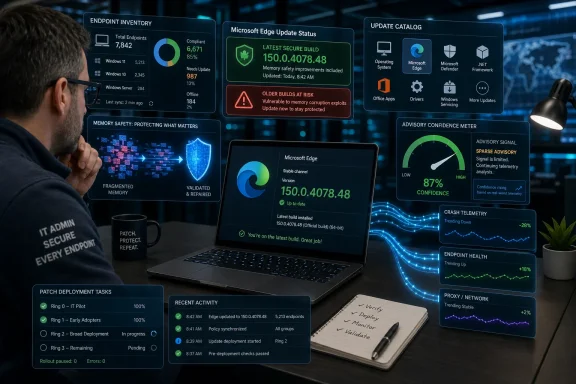 Microsoft’s Sparse Advisory Is the Signal, Not the Weakness
The Microsoft Security Response Center entry for CVE-2026-58294 identifies the product, the impact, the severity, and the security update path. Third-party vulnerability trackers, reflecting the MSRC record, list the issue as a use-after-free vulnerability in Chromium-based Edge with a CVSS 3.1 score of 7.5, requiring network access and user interaction, with high impacts to confidentiality, integrity, and availability. Microsoft’s Edge release ecosystem separately shows 150.0.4078.48 as the current Stable Channel build, and Microsoft Update Catalog listings show that build distributed for Edge Stable and Extended Stable on July 2, 2026.That is not the same as a full root-cause disclosure. We do not yet have, from Microsoft’s public advisory, a neat component name, a commit reference, a repro case, or an exploitation write-up. But that absence is normal in browser security, especially when the bug class is dangerous and the patch is fresh. The public record is often intentionally asymmetric: defenders get enough to patch, attackers are denied a convenient map.
This is where organizations too often misread sparse CVE pages. “Few details” does not mean “low confidence.” In this case, the vulnerability exists in Microsoft’s own Security Update Guide, has a CVE identifier, has an affected-version boundary, and has an available fixed version. That is a very different animal from a rumor, a lab-only crash, or an untriaged social-media claim.
The user-provided description of the confidence metric gets to the heart of the issue. Confidence measures whether the vulnerability is known to exist and whether the public technical details are credible. CVE-2026-58294 scores high on the existence side because Microsoft has acknowledged it; it scores more cautiously on technical transparency because the public details stop short of an exploit narrative.
Browser RCE Has Become Routine, Which Is Why It Is Dangerous
Remote code execution in a browser no longer carries the shock value it once did. Chrome, Edge, Safari, and Firefox all sit on enormous codebases that parse hostile content all day: JavaScript, WebAssembly, fonts, images, video, PDF-like experiences, compression formats, GPU calls, extension APIs, enterprise identity flows, and sync plumbing. The modern browser is less an “app” than a semi-operating system with a URL bar.That familiarity breeds bad instincts. Admins see another Chromium-based Edge advisory and file it under the endless churn of browser maintenance. But browser RCE remains one of the most valuable primitives in client-side exploitation because it sits directly on the path between an attacker-controlled web page and a user’s workstation.
The phrase remote code execution also needs careful handling here. This does not mean an unauthenticated attacker can necessarily reach into any Edge installation from the internet and run code without the user doing anything. The public scoring reflected by vulnerability trackers indicates user interaction is required and attack complexity is high. In plain English, exploitation likely depends on getting a user to visit or interact with malicious content and then satisfying technical conditions that are not trivial.
That still leaves plenty of risk. Phishing emails, poisoned ads, compromised legitimate sites, messaging links, SaaS collaboration tools, and helpdesk impersonation all exist to generate user interaction at scale. A high-complexity browser bug can become operationally useful once an exploit developer turns the fragile path into a repeatable chain.
The Use-After-Free Pattern Keeps Returning Because Memory Is the Browser’s Oldest Debt
Securityvulnerability.io’s summary of the CVE describes CVE-2026-58294 as a use-after-free issue. If that characterization accurately reflects Microsoft’s advisory data, the bug belongs to one of the oldest and most stubborn families of browser memory-safety vulnerabilities. A use-after-free occurs when software continues to reference memory after it has been released, opening the door to crashes, data corruption, or carefully shaped code execution.That may sound like low-level plumbing, but it is central to why browser security is so hard. Browser engines constantly create and destroy objects as pages load, scripts run, tabs sleep, frames navigate, media starts and stops, and GPU-backed rendering paths hand work between processes. A single lifecycle mistake can become a security boundary problem.
Chromium’s multi-process architecture, sandboxing, site isolation, and hardening layers are designed to make such bugs harder to exploit. They do not make them irrelevant. A browser RCE bug may first gain execution inside a renderer or another constrained process, and a separate sandbox escape may be required for full system compromise. But defenders should not take comfort in that architecture alone, because attackers routinely chain client-side flaws when the target is valuable enough.
For WindowsForum readers, the architectural lesson is blunt. The browser sandbox buys time and raises cost, but patching closes the known hole. Treating sandboxing as a substitute for updates is like treating a seat belt as a substitute for brakes.
Edge’s Chromium Foundation Cuts Both Ways
Microsoft’s move to Chromium gave Edge the benefit of a massive upstream security ecosystem. Bugs found in Chromium can be fixed across multiple browsers, exploit mitigations improve at web scale, and enterprises get a browser that behaves predictably with the modern web. The downside is equally obvious: Edge inherits exposure to a class of bugs that travels through the Chromium world.That does not mean every Edge CVE is simply “a Chrome bug with a Microsoft label.” Microsoft ships its own browser features, enterprise policies, update channels, PDF behavior, identity integrations, sidebar experiences, management hooks, and Windows-specific integrations. A Chromium-based browser is still a Microsoft product when it lands on a managed Windows endpoint.
This distinction matters in enterprise patching. Many organizations think of Chrome as the high-velocity browser and Edge as the Windows component that comes along for the ride. In reality, Edge has its own update cadence, its own stable and extended stable channels, its own WebView2 implications in some environments, and its own policy surface. If Edge is present but not primary, it still parses web content when invoked by links, embedded experiences, help content, application flows, or user choice.
The Microsoft Edge WebDriver page showing Stable Channel at 150.0.4078.48 is a small but useful confirmation of the operational state of the release. So are Microsoft Update Catalog entries that show the build being distributed through Microsoft’s update machinery. The fix is not theoretical; it is in the release stream.
The Confidence Metric Should Change the Patch Conversation
The user’s quoted metric is often buried inside CVSS discussions, but it deserves more attention from security teams. Vulnerability urgency is not just severity. It is the product of exploitability, exposure, asset value, availability of fixes, public knowledge, and confidence that the issue is real.CVE-2026-58294 is a good example of a vulnerability that does not need public exploit code to deserve action. The confidence in existence is high because Microsoft has published the CVE and shipped a fix. The confidence in detailed exploit mechanics is lower because the public record does not yet disclose the exact attack path. That mix should lead to patching, not paralysis.
There is a recurring failure mode in enterprise risk meetings: teams wait for more detail before authorizing remediation, even when the vendor has already provided the only detail that matters for immediate defense. More detail often arrives after attackers, researchers, and reverse engineers have had time to diff the patch. By then, the operational advantage has moved away from defenders.
The better model is to separate two questions. First, do we have enough confidence that the vulnerability exists and affects our environment? For CVE-2026-58294, yes, if affected Edge versions are deployed. Second, do we have enough detail to hunt for exploitation? Not fully, based on the current public record. The first answer drives patching; the second drives monitoring and later detection engineering.
High Attack Complexity Is Not a Permission Slip
The reported CVSS vector for CVE-2026-58294 includes high attack complexity and required user interaction. Those two fields will tempt some organizations to downgrade the fix behind flashier server-side flaws. That may be reasonable in a constrained patch window, but it should be a conscious risk decision, not a reflex.High attack complexity means successful exploitation depends on conditions beyond mere reachability. It does not mean impossible. Browser exploitation is full of techniques for grooming memory, shaping object lifetimes, and turning unreliable crashes into repeatable primitives. The difference between “hard” and “weaponized” can be one skilled exploit team and a few days with a patch diff.
Required user interaction is similarly misunderstood. A browser vulnerability almost always needs the user to encounter content. Attackers are very good at arranging that encounter. Email, Teams messages, fake invoices, malvertising, SEO poisoning, compromised websites, and watering-hole campaigns all convert human curiosity or routine work into the click an exploit chain needs.
The more interesting point is that the CVSS score lands at high rather than critical. That seems appropriate for what is publicly known: network attack vector, no privileges required, user interaction required, high complexity, unchanged scope, and high impact across confidentiality, integrity, and availability. But high-severity browser bugs are still among the most time-sensitive client updates an enterprise will handle.
The Edge Update Path Is Better Than It Used to Be, But Drift Still Wins
Microsoft has done a great deal to make Edge update silently and quickly. Consumer machines often move to patched builds with little drama. Many business devices receive Edge updates independently of the monthly Windows cumulative update rhythm, and Microsoft’s update infrastructure can push browser fixes faster than the traditional Patch Tuesday cadence.The weak point is not usually Microsoft’s ability to ship. It is the organization’s ability to know what actually happened. Devices sleep, travel, fail update checks, sit behind broken proxies, run with restrictive policies, or exist in management blind spots. VDI images, kiosk systems, lab machines, jump boxes, and rarely used admin workstations are especially good at preserving old browser builds.
Extended Stable complicates the picture in a different way. It exists for organizations that value a slower feature cadence, but security fixes still need to land promptly. The catalog entries showing Edge 150.0.4078.48 for Extended Stable are a reminder that “extended” should not become a euphemism for “stale.”
For admins, the immediate task is inventory. Check Edge version reporting in Intune, Configuration Manager, Defender for Endpoint, your RMM platform, or whatever endpoint management stack actually reflects reality. A policy that says Edge should update is less useful than telemetry proving that Edge has updated.
The Patch Is the Easy Part; The Detection Story Is Thinner
Once a browser RCE is fixed, the natural next question is whether it was exploited before patching. For CVE-2026-58294, the public information currently does not establish known exploitation in the wild. Searches of public reporting and vulnerability listings at the time of writing do not show a CISA Known Exploited Vulnerabilities entry for this CVE, and Microsoft’s publicly reachable advisory shell does not, by itself, provide an exploit narrative.That absence should be described carefully. “No public evidence of exploitation” is not the same as “not exploited.” It means defenders should avoid fearmongering while still closing the exposure. Browser bugs can be used selectively, and targeted exploitation may leave limited traces on endpoints.
Detection is hard because successful browser exploitation may look like a transient renderer crash, a suspicious child process, credential theft in a later stage, or nothing obvious at all if the chain is quiet. Endpoint detection tools can help, but they generally detect behavior around exploitation rather than the memory corruption bug itself. Process trees, unusual Edge-spawned processes, script interpreters launched from user contexts, unexpected downloads, and post-exploitation network traffic remain more useful than a CVE-specific signature that may not yet exist.
Security teams should preserve the basic evidence they will wish they had later: browser crash telemetry, endpoint alerts, web proxy logs, DNS data, email-click telemetry, and timestamps for when each device crossed into the fixed build. If public exploit details emerge later, that timeline becomes the difference between informed scoping and guesswork.
The Real Enterprise Risk Is the Browser Nobody Thinks They Use
Many Windows shops standardize on Chrome, Firefox, or a hardened enterprise browser and still have Edge installed everywhere. That creates a familiar blind spot. Users may not think of Edge as their browser, but Windows, Microsoft 365, help links, embedded flows, and application defaults can still hand content to it.This is why Edge patching belongs in the baseline, not in a “primary browser only” exception process. If an application can launch Edge, if a user can open it, or if a file association can send content there, then the browser is part of the attack surface. Security programs that inventory only the browser employees claim to use are measuring preference, not exposure.
The same logic applies to privileged workstations. Admins often browse less on those systems, but “less” is not “never.” A single vendor portal, documentation page, identity prompt, or emergency search from a privileged desktop can create the user interaction a browser exploit needs. The correct policy is to keep browsers patched on high-value systems even when browsing is discouraged.
There is also a developer angle. Edge WebDriver, automated testing environments, CI workstations, and browser-based QA rigs may lag behind because teams pin versions for reproducibility. Version pinning can be legitimate, but pinning a vulnerable browser build after a security release turns a testing convenience into a security exception. Exceptions need owners, expiration dates, and compensating controls.
Public Detail Will Grow, and So Will Attacker Understanding
Fresh browser CVEs often begin as sparse advisories. Then the ecosystem fills in the blanks. Researchers compare binaries, Chromium commits surface clues, crash cases get rediscovered, exploit developers test hypotheses, and security vendors publish summaries. Some of that work helps defenders. Some of it helps attackers.The dangerous period is the interval after a patch ships but before patch adoption is complete. Attackers know a fix exists, and in many cases the patch itself becomes a roadmap. Even when the original report was responsibly disclosed, the release of updated binaries starts a race between enterprise deployment and exploit reconstruction.
Microsoft is not unique here. Google, Mozilla, Apple, and every major browser vendor live with the same disclosure tension. Too much detail too early can accelerate exploitation; too little detail can frustrate defenders trying to assess exposure. CVE-2026-58294 sits squarely in that tradeoff.
For most organizations, the right response is not to demand perfect detail before acting. It is to use the vendor-confirmed advisory as a trigger, deploy the fixed build, and revisit detection as more information becomes public. Patch first, enrich later.
Redmond’s Browser Patch Leaves a Short Checklist
The operational story of CVE-2026-58294 is mercifully direct: Microsoft has identified a high-severity RCE in Chromium-based Edge, and the fixed build line is 150.0.4078.48. The strategic story is more useful: sparse technical disclosure can still represent high-confidence risk when the vendor has confirmed the vulnerability and shipped the update.- Organizations should verify that Microsoft Edge Stable and Extended Stable installations are at 150.0.4078.48 or later.
- Security teams should treat older Edge builds as exposed even if Edge is not the organization’s default browser.
- Administrators should confirm update success with endpoint inventory rather than relying only on policy intent.
- Detection teams should preserve browser crash, endpoint, proxy, DNS, and email-click telemetry for the period before patch completion.
- Version-pinned test systems, kiosks, VDI images, and privileged workstations should be checked explicitly because they are common sources of browser drift.
- The lack of public exploit details should reduce speculation, not urgency, because Microsoft’s acknowledgement supplies the confidence needed to patch.
References
- Primary source: MSRC
Published: 2026-07-03T07:00:00-07:00
Loading…
msrc.microsoft.com - Related coverage: securityvulnerability.io
CVE-2026-58294 : Remote Code Execution Vulnerability in Microsoft Edge by Microsoft
Learn about the remote code execution vulnerability affecting Microsoft Edge. Stay informed about CVE-2026-58294 and enhance your cybersecurity measures.securityvulnerability.io - Related coverage: thehackerwire.com
CVE-2026-45495: Microsoft Edge (Chromium-based) Remote Code Execution Vul… – TheHackerWire
{ "title": "Microsoft Edge (Chromium) RCE via CVE-2026-45495", "content": "SummaryCVE-2026-45495 details a Remote Code Execution (RCE) vulnerability affectin...www.thehackerwire.com
- Related coverage: www2.gov.bc.ca
- Related coverage: mphasis.com
- Related coverage: hivepro.com
Loading…
www.hivepro.com
- Official source: learn.microsoft.com
Microsoft Edge release notes for Stable Channel | Microsoft Learn
Microsoft Edge release note for the Stable Channellearn.microsoft.com - Official source: developer.microsoft.com
Microsoft Edge WebDriver | Microsoft Edge Developer
 developer.microsoft.com
- Related coverage: techspot.com
Microsoft Edge Download Free - 150.0.4078.48 | TechSpot
Download Microsoft Edge - Edge browser lets you enjoy extended battery life and get to what you are looking for quickly.www.techspot.com - Official source: catalog.update.microsoft.com
Microsoft Update Catalog
www.catalog.update.microsoft.com - Related coverage: softexia.com
Microsoft Edge 150.0.4078.48 | Download Free
Discover the browsing experience across all your devices with Microsoft Edge - the advanced AI web browser for Windows, macOS, Android, iOS.www.softexia.com
- Related coverage: helpnetsecurity.com
Microsoft Defender vulnerabilities exploited in the wild (CVE-2026-41091, CVE-2026-45498) - Help Net Security
Attackers are actively exploiting two Microsoft Defender vulnerabilities (CVE-2026-41091 and CVE-2026-45498), Microsoft acknowledged.www.helpnetsecurity.com - Related coverage: labs.cloudsecurityalliance.org
CISA KEV Alert: Fortinet, Adobe, and Microsoft Under Attack
PDF documentlabs.cloudsecurityalliance.org