

Google’s Chrome 150.0.7871.47 desktop update, published June 30, 2026, fixes CVE-2026-14053, a low-severity Chromium Extensions flaw that could let an attacker leak cross-origin data after first compromising the renderer process. That is the plain version; the more useful version is that this is not a “drop everything” zero-day, but it is exactly the sort of browser bug that rewards fast patch hygiene. The National Vulnerability Database entry, Chrome’s release notes, and CISA’s ADP enrichment all point to a narrow but real confidentiality issue. For Windows users and administrators, the right response is not panic — it is verification.
CVE-2026-14053 sits in the Extensions component, which is why it deserves more attention than its “Low” Chromium severity might suggest. Extensions are not just browser ornaments anymore; they are password managers, SSO helpers, endpoint controls, coupon injectors, corporate DLP agents, PDF tools, and sometimes abandoned code with privileged access to everything users do online.
The bug description is short but dense. Google says insufficient policy enforcement in Extensions in Chrome versions before 150.0.7871.47 allowed a remote attacker, after compromising the renderer process, to leak cross-origin data through a crafted HTML page. CISA’s ADP enrichment maps the issue to CWE-346, an origin validation error, and gives it a CVSS 3.1 score of 4.3 with low confidentiality impact and no integrity or availability impact.
That split between “Low” and “Medium” is not a contradiction so much as a difference in lens. Chromium’s severity language is often anchored in exploitability inside Chrome’s own threat model. CVSS, meanwhile, mechanically scores network reachability, user interaction, privileges, scope, and impact. The practical truth is between them: this is not a standalone browser takeover, but it is a useful post-compromise primitive.
Chrome’s renderer is the process that handles web content. Modern browsers assume hostile pages will attack it constantly, so Chrome uses sandboxing, site isolation, origin checks, and process separation to keep one site from reading another. A renderer compromise means the attacker has already broken through a major layer of that design.
That is why this bug is best understood as a chain amplifier. It becomes more valuable when paired with another vulnerability — for example, a memory corruption bug that gives an attacker code execution in the renderer but not yet a full sandbox escape. In that context, a policy enforcement error in Extensions could help extract data the compromised renderer should not be able to see.
This is also why the bug’s low severity should not be confused with irrelevance. Browser exploitation is rarely a single spectacular flaw anymore. It is a sequence: lure, render, execute, bypass, read, persist, exfiltrate. CVE-2026-14053 appears to live in the “read more than you should” stage, not the “get in” stage.
The same-origin policy is not a single switch. It is a large family of rules around documents, frames, storage, cookies, fetches, redirects, extension contexts, permissions, and process assignment. When a CVE says “leak cross-origin data,” it signals that some boundary between those compartments did not hold under a specific set of conditions.
The extension angle complicates this. Extensions often have host permissions, content scripts, background contexts, and APIs that bridge user activity across sites. That power is useful, but it also creates more places where policy enforcement must be precise. If Chrome misapplies those rules after a renderer is compromised, the browser may accidentally help an attacker cross a line that web security is designed to make impassable.
For most users, that does not mean an attacker can instantly read every logged-in site. The public description does not say that, and Google’s restricted Chromium issue is not enough to infer it. But it does mean administrators should treat the update as a confidentiality fix, particularly in environments where browser sessions expose internal applications.
That context matters because browser patching is not normally a one-CVE decision. Users do not update Chrome because every individual vulnerability is catastrophic; they update because the browser is a permanently exposed attack surface and the cumulative risk of lagging behind is ugly. A low-severity extension policy bug becomes one more reason to avoid sitting on an old build.
The NVD change history says the CVE was received from Chrome on June 30, 2026, modified by CISA-ADP on July 1, and then enriched by NIST with the vulnerable CPE configuration later that day. That sequence is typical for browser disclosures: the vendor ships first, public databases catch up, and security teams then reconcile what applies to their fleets.
There is a small data-quality wrinkle in the user-supplied NVD text: the affected version object appears to list version 150.0.7871.47 while also saying “lessThan 150.0.7871.47.” In practice, the human-readable description and CPE configuration are clearer: Chrome prior to 150.0.7871.47 is affected. The fixed line is 150.0.7871.47 or later on the relevant desktop channels.
That does not mean every scanner, SBOM pipeline, or endpoint inventory will immediately reflect it. CPE matching for browsers is notoriously plain on paper and messy in practice. Chrome can update per user, per machine, through enterprise policy, through offline installers, through package managers on Linux, and through embedded Chromium derivatives that do not necessarily inherit Google Chrome’s CPE.
For Windows administrators, the immediate inventory question is less “does NVD have the CPE?” and more “does my tooling correctly distinguish Chrome from Chromium-based browsers and report the actual installed channel and version?” Edge, Brave, Vivaldi, Electron apps, embedded WebViews, and third-party Chromium builds may share code lineage but not identical release cadence or advisories.
This is where vulnerability management dashboards can become performative. A scanner may show a clean CPE match for Google Chrome while missing stale portable installs, user-profile installs, or locked-down kiosks. Conversely, it may flag a Chromium-family product that is not actually vulnerable to the same code path. The database record is only the beginning of the operational work.
Enterprise Chrome policies can allowlist, blocklist, force-install, pin, and restrict extensions. That machinery exists because extension risk is not theoretical. A malicious or compromised extension can observe browsing, modify pages, inject scripts, steal tokens, or weaken the browser’s own protections. CVE-2026-14053 is not described as a malicious-extension bug, but its location in the Extensions component is a reminder that this surface is central to browser trust.
Chrome’s Manifest V3 transition has also kept extension architecture in the spotlight. Google has argued that the newer model improves security and privacy by changing background execution and network request handling. Critics have countered that it also weakens some content-blocking and user-control models. Whatever side one takes, the broader point is clear: extension policy enforcement is now a security boundary that affects both consumers and managed fleets.
That makes “low severity” less comforting than it would be in a dead corner of the UI. A low-severity bug in a high-privilege broker can still matter when combined with another flaw. Security teams should not exaggerate this CVE, but they should understand why it is worth patching promptly.
The likely exploitation shape is more familiar: a user lands on or is directed to a crafted HTML page, while the attacker already has a renderer compromise in play. That could happen through a separate bug, a malicious ad chain, a compromised site, or a targeted lure. The CVE does not prove any of those campaigns exist; it only describes the conditions under which the flaw could be abused.
There is also no public indication from the NVD text, Chrome release entry, or CISA enrichment that CVE-2026-14053 has been exploited in the wild. CISA’s SSVC field lists exploitation as “none.” That is materially different from Chrome zero-day advisories where Google explicitly says it is aware of active exploitation.
Still, defenders should be careful with the word “none.” It means no known exploitation in the available record, not mathematical proof that nobody has used it. Browser attackers are patient, and extension-adjacent bugs are not always obvious in telemetry unless they cause a crash, trigger a policy violation, or appear in a larger incident investigation.
The unhappy path is the one IT pros know too well. Browsers stay open for weeks. Users dismiss relaunch prompts. Enterprise rings delay updates. VDI images drift. Servers used as jump boxes run old browsers because “nobody browses from them,” until someone does. Packaged apps include stale Chromium runtimes that are outside Chrome’s normal update stream.
For individual users, the verification step is simple: open Chrome’s About page and confirm the browser is at 150.0.7871.47 or later on Windows or Mac. For administrators, the better answer is policy-driven reporting through Chrome Browser Cloud Management, endpoint management tooling, or whatever inventory platform can reliably capture installed browser versions.
The update also matters for users of other Chromium-based browsers, but not in a copy-and-paste way. A Chromium fix does not automatically mean every downstream browser is patched the same day. Edge, Brave, Opera, Vivaldi, and others maintain their own channels and release notes. The practical rule is to check the vendor’s current build, not assume that “Chromium” equals “fixed.”
That restriction is a source of frustration for researchers and administrators who want to understand exact exploit mechanics. It is also part of the browser security bargain. Publishing a working explanation of an origin leak too early can help attackers target users who have not yet restarted into the fixed build.
The lack of detail should discipline analysis. We should not claim this bug leaks cookies, tokens, DOM contents, local files, or extension secrets unless Google or researchers say so. “Cross-origin data” is a broad category, and the exact object of the leak is not public in the supplied record.
What we can say is enough for patch priority. A crafted HTML page plus renderer compromise plus extension policy enforcement failure equals a browser confidentiality boundary that did not behave as intended. That belongs in the patch queue, even if it does not belong in the emergency-war-room queue.
CVE-2026-14053 appears to nick one of those layers. By itself, it does not describe arbitrary code execution, sandbox escape, privilege escalation, or persistence. In a chain, however, it could help convert a renderer foothold into useful data theft.
That is why the CVSS score should be read as a floor, not the full story. CVSS is useful for sorting, but it struggles with composability. A vulnerability that requires another vulnerability can score modestly while still being attractive to sophisticated attackers who already have the missing first stage.
This is especially true for targeted environments. An attacker aiming at a corporate webmail session, SaaS admin console, internal wiki, or cloud dashboard may care less about full machine compromise than about reading a specific cross-origin response. If a renderer bug gives script execution and an extension policy bug gives a leak path, the chain may accomplish the mission without ever touching the Windows kernel.
Managed Windows fleets should already have a browser update policy that keeps Stable builds moving quickly unless a specific compatibility issue justifies delay. Chrome’s rapid release model is not friendly to long testing cycles, but the alternative is worse. A browser that sits unpatched for weeks is effectively an exposed application runtime with a giant attack surface and a user base trained to open links.
Extension controls deserve the same discipline. Organizations should know which extensions are force-installed, which are allowed, which are blocked, and which permissions are granted. They should also know which business processes depend on extensions that may break across Chrome updates, because panic exceptions are how stale and risky configurations become permanent.
There is an uncomfortable tradeoff here. Tight extension policy reduces attack surface but can frustrate users who rely on productivity tools. Loose policy keeps support tickets down but expands the blast radius of every browser bug, malicious extension, and supply-chain incident. CVE-2026-14053 is another reminder that “let users install whatever they want” is not a security model.
The extension audit for a consumer machine takes five minutes and is often revealing. If an extension has not been used in months, remove it. If it comes from an unknown developer and wants to read or change data on all websites, ask whether it is worth the risk. If it duplicates a feature now built into the browser or operating system, it probably does not deserve privileged access.
Password managers and security tools are not automatically suspect; many are essential. The point is not to fear all extensions. The point is to reduce the number of privileged browser components that can interact with sensitive pages, because every one of them becomes part of the browser’s trust boundary.
Users should also remember that restarting matters. Chrome can download an update and still run the old vulnerable code until the browser relaunches. The little “Update” or relaunch indicator is not decoration; it is the handoff between having a patch available and actually running it.
Chrome’s security model is built on the assumption that individual layers will fail and the system must still contain the damage. CVE-2026-14053 shows one of those containment layers being tightened after Google found it wanting. The practical path forward is boring by design: update the browser, restart it, verify the fleet, and keep extension sprawl under control. The attackers chain small failures into large outcomes; defenders should be just as disciplined about chaining small maintenance habits into real resilience.
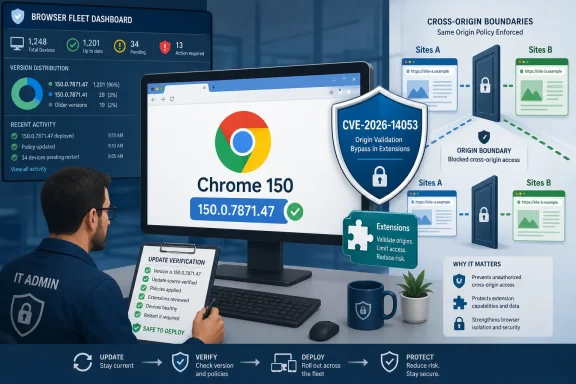 A Low-Severity Chrome Bug Still Lands in a High-Value Part of the Browser
CVE-2026-14053 sits in the Extensions component, which is why it deserves more attention than its “Low” Chromium severity might suggest. Extensions are not just browser ornaments anymore; they are password managers, SSO helpers, endpoint controls, coupon injectors, corporate DLP agents, PDF tools, and sometimes abandoned code with privileged access to everything users do online.The bug description is short but dense. Google says insufficient policy enforcement in Extensions in Chrome versions before 150.0.7871.47 allowed a remote attacker, after compromising the renderer process, to leak cross-origin data through a crafted HTML page. CISA’s ADP enrichment maps the issue to CWE-346, an origin validation error, and gives it a CVSS 3.1 score of 4.3 with low confidentiality impact and no integrity or availability impact.
That split between “Low” and “Medium” is not a contradiction so much as a difference in lens. Chromium’s severity language is often anchored in exploitability inside Chrome’s own threat model. CVSS, meanwhile, mechanically scores network reachability, user interaction, privileges, scope, and impact. The practical truth is between them: this is not a standalone browser takeover, but it is a useful post-compromise primitive.
The Renderer Compromise Requirement Changes Everything
The most important phrase in the CVE is not “cross-origin data.” It is “who had compromised the renderer process.” That condition means an attacker cannot simply send a normal web page to an up-to-date Chrome user and expect this particular bug, by itself, to spill data across site boundaries.Chrome’s renderer is the process that handles web content. Modern browsers assume hostile pages will attack it constantly, so Chrome uses sandboxing, site isolation, origin checks, and process separation to keep one site from reading another. A renderer compromise means the attacker has already broken through a major layer of that design.
That is why this bug is best understood as a chain amplifier. It becomes more valuable when paired with another vulnerability — for example, a memory corruption bug that gives an attacker code execution in the renderer but not yet a full sandbox escape. In that context, a policy enforcement error in Extensions could help extract data the compromised renderer should not be able to see.
This is also why the bug’s low severity should not be confused with irrelevance. Browser exploitation is rarely a single spectacular flaw anymore. It is a sequence: lure, render, execute, bypass, read, persist, exfiltrate. CVE-2026-14053 appears to live in the “read more than you should” stage, not the “get in” stage.
Cross-Origin Data Is the Browser’s Crown Jewel
Cross-origin protections are one of the quiet miracles of the web. They are what let a user keep a banking tab, a work mail tab, an admin dashboard, and a random news article open in the same browser without letting the news article read the bank balance or admin console.The same-origin policy is not a single switch. It is a large family of rules around documents, frames, storage, cookies, fetches, redirects, extension contexts, permissions, and process assignment. When a CVE says “leak cross-origin data,” it signals that some boundary between those compartments did not hold under a specific set of conditions.
The extension angle complicates this. Extensions often have host permissions, content scripts, background contexts, and APIs that bridge user activity across sites. That power is useful, but it also creates more places where policy enforcement must be precise. If Chrome misapplies those rules after a renderer is compromised, the browser may accidentally help an attacker cross a line that web security is designed to make impassable.
For most users, that does not mean an attacker can instantly read every logged-in site. The public description does not say that, and Google’s restricted Chromium issue is not enough to infer it. But it does mean administrators should treat the update as a confidentiality fix, particularly in environments where browser sessions expose internal applications.
Chrome 150’s Patch Volume Makes the Single CVE Look Smaller Than It Is
CVE-2026-14053 arrived as part of a larger Chrome 150 stable update. Google’s Stable Channel Update for Desktop listed Chrome 150.0.7871.46 and 150.0.7871.47 for Windows and Mac, with the Linux build at 150.0.7871.46. Security coverage from Malwarebytes noted that the release carried hundreds of fixes, including more serious issues elsewhere in the browser.That context matters because browser patching is not normally a one-CVE decision. Users do not update Chrome because every individual vulnerability is catastrophic; they update because the browser is a permanently exposed attack surface and the cumulative risk of lagging behind is ugly. A low-severity extension policy bug becomes one more reason to avoid sitting on an old build.
The NVD change history says the CVE was received from Chrome on June 30, 2026, modified by CISA-ADP on July 1, and then enriched by NIST with the vulnerable CPE configuration later that day. That sequence is typical for browser disclosures: the vendor ships first, public databases catch up, and security teams then reconcile what applies to their fleets.
There is a small data-quality wrinkle in the user-supplied NVD text: the affected version object appears to list version 150.0.7871.47 while also saying “lessThan 150.0.7871.47.” In practice, the human-readable description and CPE configuration are clearer: Chrome prior to 150.0.7871.47 is affected. The fixed line is 150.0.7871.47 or later on the relevant desktop channels.
The CPE Is There, but the Inventory Problem Remains
The NVD entry’s change history says NIST added a CPE configuration for Google Chrome versions up to, but excluding, 150.0.7871.47. So if the question is literally whether the CVE is missing a CPE, the current answer appears to be no: NVD has associated the vulnerability with the Chrome application CPE.That does not mean every scanner, SBOM pipeline, or endpoint inventory will immediately reflect it. CPE matching for browsers is notoriously plain on paper and messy in practice. Chrome can update per user, per machine, through enterprise policy, through offline installers, through package managers on Linux, and through embedded Chromium derivatives that do not necessarily inherit Google Chrome’s CPE.
For Windows administrators, the immediate inventory question is less “does NVD have the CPE?” and more “does my tooling correctly distinguish Chrome from Chromium-based browsers and report the actual installed channel and version?” Edge, Brave, Vivaldi, Electron apps, embedded WebViews, and third-party Chromium builds may share code lineage but not identical release cadence or advisories.
This is where vulnerability management dashboards can become performative. A scanner may show a clean CPE match for Google Chrome while missing stale portable installs, user-profile installs, or locked-down kiosks. Conversely, it may flag a Chromium-family product that is not actually vulnerable to the same code path. The database record is only the beginning of the operational work.
Extension Security Is Now Enterprise Security
For years, browser extensions were treated like personal preference: ad blocker here, password manager there, a screenshot tool, a grammar checker, maybe a tab manager for the chronically overloaded. In 2026, that attitude is untenable. Extensions have become a privileged application layer inside the most-used application on the endpoint.Enterprise Chrome policies can allowlist, blocklist, force-install, pin, and restrict extensions. That machinery exists because extension risk is not theoretical. A malicious or compromised extension can observe browsing, modify pages, inject scripts, steal tokens, or weaken the browser’s own protections. CVE-2026-14053 is not described as a malicious-extension bug, but its location in the Extensions component is a reminder that this surface is central to browser trust.
Chrome’s Manifest V3 transition has also kept extension architecture in the spotlight. Google has argued that the newer model improves security and privacy by changing background execution and network request handling. Critics have countered that it also weakens some content-blocking and user-control models. Whatever side one takes, the broader point is clear: extension policy enforcement is now a security boundary that affects both consumers and managed fleets.
That makes “low severity” less comforting than it would be in a dead corner of the UI. A low-severity bug in a high-privilege broker can still matter when combined with another flaw. Security teams should not exaggerate this CVE, but they should understand why it is worth patching promptly.
User Interaction Keeps This Out of Worm Territory
CISA’s CVSS vector includes user interaction required, and its SSVC enrichment says exploitation is not automatable. That is good news. It means the public scoring does not view CVE-2026-14053 as a self-propagating or hands-off remote compromise.The likely exploitation shape is more familiar: a user lands on or is directed to a crafted HTML page, while the attacker already has a renderer compromise in play. That could happen through a separate bug, a malicious ad chain, a compromised site, or a targeted lure. The CVE does not prove any of those campaigns exist; it only describes the conditions under which the flaw could be abused.
There is also no public indication from the NVD text, Chrome release entry, or CISA enrichment that CVE-2026-14053 has been exploited in the wild. CISA’s SSVC field lists exploitation as “none.” That is materially different from Chrome zero-day advisories where Google explicitly says it is aware of active exploitation.
Still, defenders should be careful with the word “none.” It means no known exploitation in the available record, not mathematical proof that nobody has used it. Browser attackers are patient, and extension-adjacent bugs are not always obvious in telemetry unless they cause a crash, trigger a policy violation, or appear in a larger incident investigation.
Why Windows Users Should Care Even When Chrome Updates Itself
Chrome’s auto-update system is one of the better security mechanisms in mainstream consumer software. On a normal Windows machine, most users will receive the update without downloading anything manually, and the browser will apply it after restart. That is the happy path.The unhappy path is the one IT pros know too well. Browsers stay open for weeks. Users dismiss relaunch prompts. Enterprise rings delay updates. VDI images drift. Servers used as jump boxes run old browsers because “nobody browses from them,” until someone does. Packaged apps include stale Chromium runtimes that are outside Chrome’s normal update stream.
For individual users, the verification step is simple: open Chrome’s About page and confirm the browser is at 150.0.7871.47 or later on Windows or Mac. For administrators, the better answer is policy-driven reporting through Chrome Browser Cloud Management, endpoint management tooling, or whatever inventory platform can reliably capture installed browser versions.
The update also matters for users of other Chromium-based browsers, but not in a copy-and-paste way. A Chromium fix does not automatically mean every downstream browser is patched the same day. Edge, Brave, Opera, Vivaldi, and others maintain their own channels and release notes. The practical rule is to check the vendor’s current build, not assume that “Chromium” equals “fixed.”
The Public Bug Is Restricted, and That Is Normal
The Chromium issue linked from NVD requires permission, which is standard for many browser security bugs immediately after disclosure. Google often restricts details until enough users have updated, and it may keep restrictions longer if the issue affects third-party libraries or downstream projects.That restriction is a source of frustration for researchers and administrators who want to understand exact exploit mechanics. It is also part of the browser security bargain. Publishing a working explanation of an origin leak too early can help attackers target users who have not yet restarted into the fixed build.
The lack of detail should discipline analysis. We should not claim this bug leaks cookies, tokens, DOM contents, local files, or extension secrets unless Google or researchers say so. “Cross-origin data” is a broad category, and the exact object of the leak is not public in the supplied record.
What we can say is enough for patch priority. A crafted HTML page plus renderer compromise plus extension policy enforcement failure equals a browser confidentiality boundary that did not behave as intended. That belongs in the patch queue, even if it does not belong in the emergency-war-room queue.
The Real Risk Is the Chain, Not the CVE in Isolation
Modern browser defense is layered because modern browser offense is chained. Site isolation limits what a compromised renderer can touch. The sandbox limits what that renderer can do to the operating system. Extension policies limit how privileged browser add-ons interact with pages. Permissions prompts and enterprise policies try to keep user-granted power from becoming attacker-granted power.CVE-2026-14053 appears to nick one of those layers. By itself, it does not describe arbitrary code execution, sandbox escape, privilege escalation, or persistence. In a chain, however, it could help convert a renderer foothold into useful data theft.
That is why the CVSS score should be read as a floor, not the full story. CVSS is useful for sorting, but it struggles with composability. A vulnerability that requires another vulnerability can score modestly while still being attractive to sophisticated attackers who already have the missing first stage.
This is especially true for targeted environments. An attacker aiming at a corporate webmail session, SaaS admin console, internal wiki, or cloud dashboard may care less about full machine compromise than about reading a specific cross-origin response. If a renderer bug gives script execution and an extension policy bug gives a leak path, the chain may accomplish the mission without ever touching the Windows kernel.
Administrators Should Patch Chrome and Audit Extensions in the Same Motion
The fix is straightforward: update Chrome. The more durable lesson is broader: treat extension governance as part of endpoint security, not as a browser customization setting.Managed Windows fleets should already have a browser update policy that keeps Stable builds moving quickly unless a specific compatibility issue justifies delay. Chrome’s rapid release model is not friendly to long testing cycles, but the alternative is worse. A browser that sits unpatched for weeks is effectively an exposed application runtime with a giant attack surface and a user base trained to open links.
Extension controls deserve the same discipline. Organizations should know which extensions are force-installed, which are allowed, which are blocked, and which permissions are granted. They should also know which business processes depend on extensions that may break across Chrome updates, because panic exceptions are how stale and risky configurations become permanent.
There is an uncomfortable tradeoff here. Tight extension policy reduces attack surface but can frustrate users who rely on productivity tools. Loose policy keeps support tickets down but expands the blast radius of every browser bug, malicious extension, and supply-chain incident. CVE-2026-14053 is another reminder that “let users install whatever they want” is not a security model.
Consumers Get the Same Advice, Without the Dashboard
Home users do not need to become browser security engineers to respond sensibly. They need to keep Chrome updated, restart it when prompted, and be skeptical of extensions that ask for broad access to every site they visit.The extension audit for a consumer machine takes five minutes and is often revealing. If an extension has not been used in months, remove it. If it comes from an unknown developer and wants to read or change data on all websites, ask whether it is worth the risk. If it duplicates a feature now built into the browser or operating system, it probably does not deserve privileged access.
Password managers and security tools are not automatically suspect; many are essential. The point is not to fear all extensions. The point is to reduce the number of privileged browser components that can interact with sensitive pages, because every one of them becomes part of the browser’s trust boundary.
Users should also remember that restarting matters. Chrome can download an update and still run the old vulnerable code until the browser relaunches. The little “Update” or relaunch indicator is not decoration; it is the handoff between having a patch available and actually running it.
The Chrome 150 Fix Is Small, but the Operational Lesson Is Not
This CVE gives defenders a compact set of concrete actions rather than a dramatic incident narrative.- Chrome users on Windows and Mac should verify they are running 150.0.7871.47 or later, because the public record identifies versions before that build as affected.
- Administrators should confirm browser versions through inventory rather than assuming auto-update has completed across every endpoint.
- Security teams should treat the “renderer compromise required” condition as a risk reducer, not as a reason to ignore the patch.
- Extension allowlists, blocklists, and forced installs should be reviewed because extension policy enforcement is part of the browser’s security boundary.
- Users of Chromium-based browsers should check their own vendor’s update status instead of assuming Google Chrome’s release automatically protects them.
- Vulnerability scanners may show the Chrome CPE now, but teams still need to account for portable installs, stale profiles, unmanaged devices, and embedded Chromium runtimes.
Chrome’s security model is built on the assumption that individual layers will fail and the system must still contain the damage. CVE-2026-14053 shows one of those containment layers being tightened after Google found it wanting. The practical path forward is boring by design: update the browser, restart it, verify the fleet, and keep extension sprawl under control. The attackers chain small failures into large outcomes; defenders should be just as disciplined about chaining small maintenance habits into real resilience.
References
- Primary source: NVD / Chromium
Published: 2026-07-03T07:00:36-07:00
NVD - CVE-2026-14053
 nvd.nist.gov
- Security advisory: MSRC
Published: 2026-07-03T07:00:36-07:00
Original feed URL
Security Update Guide - Microsoft Security Response Center
 msrc.microsoft.com
- Related coverage: cvefeed.io
CVE-2026-14053 - Google Chrome: Insecure Policy Enforcement in Extensions
Insufficient policy enforcement in Extensions in Google Chrome prior to 150.0.7871.47 allowed a remote attacker who had compromised the renderer process to leak cross-origin data via a crafted HTML page. (Chromium security severity: Low)cvefeed.io - Related coverage: encyb.com