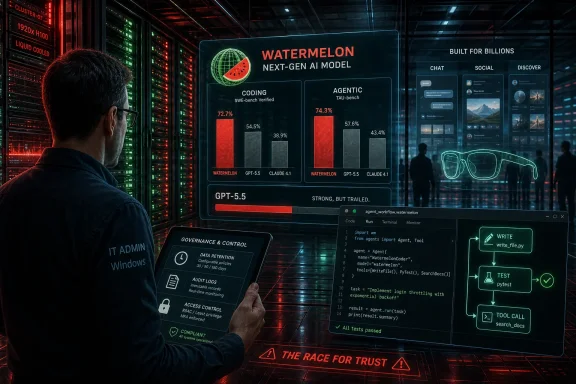
Meta’s superintelligence chief Alexandr Wang told employees on July 2, 2026, that Meta’s in-training Watermelon model has caught up with OpenAI’s GPT-5.5 on closely watched AI benchmarks, according to Business Insider, while promising near-term gains in coding and agentic capabilities. That is not the same thing as catching OpenAI in the market, and it is certainly not the same thing as winning enterprise trust. But it is the clearest signal yet that Meta’s immense spending on compute, talent, and infrastructure may be converting into a model that can credibly sit in the frontier conversation. For Windows users, developers, and IT departments, the claim matters less as corporate chest-thumping than as a preview of a more crowded, more expensive, and more politically constrained AI platform race.
The AI industry has spent the past three years pretending it does not worship benchmarks while carefully arranging every launch around them. Meta’s internal claim about Watermelon is classic frontier-lab messaging: the model is still training, the cited tests are not public, and the most important comparison point is a rival’s flagship system. It is less a product announcement than a declaration that Meta no longer wants to be treated as a second-tier model shop.
That distinction matters because Meta’s recent AI story has been oddly split. On the consumer side, the company has distribution few rivals can match: WhatsApp, Instagram, Facebook, Messenger, Threads, and its growing line of AI-enabled glasses. On the model side, however, Meta has often been judged by developers against OpenAI, Anthropic, and Google, and the verdict has not always favored Menlo Park.
Muse Spark, the model family Meta launched in April under the internal codename Avocado, was pitched as the first major output of Meta Superintelligence Labs under Wang. It was a reset after Llama 4 failed to deliver the kind of industry-shaking moment Meta wanted. Muse Spark performed well enough to show progress, but not well enough to end the perception that Meta was still chasing the true frontier rather than defining it.
Watermelon is supposed to change that story. Wang reportedly told employees that it uses an order of magnitude more compute than Avocado, which is exactly the kind of phrase that makes investors nervous and AI researchers curious. In frontier AI, more compute does not guarantee a better model, but it does reveal the size of the bet.
That is why the comparison is powerful. If Watermelon really is at GPT-5.5 level, Meta can claim it has crossed an important psychological line: not “good for an open-ish Meta model,” not “impressive given its deployment constraints,” but competitive with OpenAI’s flagship from this spring. In a market where perception drives developer experimentation, that is a meaningful jump.
But the comparison is also a trap. OpenAI has already previewed GPT-5.6, with Sol, Terra, and Luna variants, though broad access has reportedly been limited after requests from the U.S. government. That means the model Meta says it has caught may no longer be OpenAI’s internal ceiling, even if it remains the most relevant broadly available OpenAI yardstick for many customers.
This is the central asymmetry of frontier AI news in 2026. Companies are increasingly compared against models that are either not fully public, not fully documented, or not equally available to customers. A benchmark lead can be real in the lab and still slippery in the market.
That is why Wang’s public comments about coding and agentic capabilities are important. Coding models are not just prestige projects for AI labs. They are among the clearest ways to turn frontier AI into paid, repeat usage by developers, software teams, and enterprise customers.
If Meta can produce a coding model that developers take seriously, it gets a route into workflows where OpenAI, Anthropic, Microsoft, and Google have been collecting mindshare. A model that writes, edits, debugs, tests, and coordinates code across repositories is not a novelty feature for the people reading WindowsForum. It is a daily tool that can change how Windows admins script automation, how developers maintain .NET and Python projects, and how help desks generate repeatable remediation steps.
The word agentic does even more work. In 2024 and 2025, agents were often demos wrapped in optimism. By mid-2026, the best systems are increasingly expected to use tools, manage multi-step tasks, inspect files, call APIs, reason across logs, and operate inside development environments. If Watermelon narrows the gap there, Meta is not merely catching up on chat; it is trying to compete for the automation layer above the operating system.
A model can look excellent on coding tests and still fail when asked to reason through a 10-year-old PowerShell estate with undocumented registry changes. It can ace math exams and still invent a nonexistent Group Policy setting. It can impress on agentic benchmarks and still be too expensive, too slow, too unpredictable, or too hard to govern for a managed enterprise environment.
The benchmark uncertainty is sharper here because the Business Insider report says it is not clear which benchmarks Wang cited. That caveat does real work. HumanEval, SWE-bench, GPQA, MMLU-style tests, cyber ranges, browser-use tasks, internal evals, and agentic tool-use suites all measure different things. A model can “catch” another on one family of tests while trailing badly on another.
The industry has also learned that benchmark progress compresses quickly. A model that seems shockingly capable in April can feel merely current by July. The pace is so fast that the phrase “caught up” is almost always a timestamp, not a permanent status.
That does not automatically translate into developer trust. The people who choose models for coding agents, enterprise assistants, and internal automation often care less about Instagram distribution than about API stability, privacy guarantees, data retention terms, auditability, cost controls, and support. Meta has to win on those boring details if Watermelon is to become more than a consumer-assistant upgrade.
Still, distribution changes the economics. If Meta can run a strong model across its own properties, it can collect feedback loops at a scale few companies can match. A better assistant in WhatsApp or Instagram can become training signal, retention feature, ad product, and hardware differentiator all at once.
That is why Watermelon should be understood as part of a stack, not a standalone model. Meta is building the model, the apps, the glasses, the ranking systems, the advertising tools, and the infrastructure underneath. The company does not want to rent the AI layer from someone else.
For years, Meta’s core business was a magnificent cash machine: sell ads against attention, optimize endlessly, and use the proceeds to fund long-term bets. The metaverse era tested investor patience because the spending did not map cleanly to near-term product traction. AI is different because the competitive threat is immediate, but the spending still demands proof.
Watermelon is the kind of proof Zuckerberg needs. If the model is genuinely at GPT-5.5 level, Meta can argue that the spending is producing frontier-class capability rather than merely buying GPUs because everyone else is. The talent blitz, the Scale AI-linked Wang hire, the Superintelligence Labs rebrand, and the data center buildout all become parts of a coherent story.
That story is still expensive. Frontier AI does not merely require one heroic training run. It requires repeated training runs, inference capacity, safety work, product integration, data pipelines, custom infrastructure, and a willingness to eat costs while usage ramps. Catching up once is costly; staying caught up is the business model.
That is where Wang’s role is significant. His background at Scale AI sits at the intersection of data, evaluation, and the industrialization of model development. Meta’s decision to put him in charge of Superintelligence Labs was a statement that the company wanted operational intensity as much as academic prestige.
The “TBD” team he oversees, according to the report, represents Meta’s effort to build an elite internal group focused on frontier progress. Big companies often struggle to make such groups work. They can become isolated labs, political power centers, or expensive hiring trophies unless their work lands in products.
Watermelon is therefore a management test as much as a research test. If Meta can move from Avocado to Watermelon quickly, scale compute by an order of magnitude, and produce meaningful gains in coding and agents, it suggests the new organization is functioning. If the model slips, underwhelms, or arrives too late, the spending will look more like panic than strategy.
Windows is now surrounded by AI systems. Developers use coding assistants inside Visual Studio Code, JetBrains IDEs, terminals, GitHub workflows, and cloud dashboards. Administrators use AI to draft PowerShell, explain event logs, summarize security alerts, troubleshoot Intune policies, and build remediation scripts. Security teams use models to triage suspicious activity, but attackers can also use models to scale reconnaissance and exploit development.
In that world, another frontier-grade model matters even if it never ships as a native Windows feature. It can pressure pricing. It can force rivals to improve context windows, tool integrations, and code reliability. It can create new choices for organizations that do not want every AI workflow tied to a single vendor’s cloud or identity stack.
The risk is fragmentation. Every new model family brings different APIs, safety behaviors, context limits, tool protocols, pricing tiers, and data policies. For individual enthusiasts, that is exciting. For enterprise IT, it is another governance problem wearing a productivity badge.
For Windows administrators, this can be transformative. A strong coding model can help modernize brittle batch files, translate old VBScript into PowerShell, explain why a Windows Update deployment failed, or generate a detection query for Microsoft Sentinel. It can also make dangerous mistakes with great confidence.
That duality is why model quality matters beyond benchmark scores. A mediocre assistant wastes time. A powerful but poorly governed assistant can make a bad change faster than a human could. As AI agents gain permission to run commands, open pull requests, and call production APIs, the difference between suggestion and action becomes a security boundary.
Meta’s promise of major coding and agentic gains should be read against that operational reality. The winning model will not simply be the one that writes the prettiest function. It will be the one that can operate inside messy enterprise constraints without turning every task into a trust fall.
This is an awkward but important distinction. A restricted model can shape perception without shaping everyday developer experience. If only a small number of approved customers can use GPT-5.6 Sol, then GPT-5.5 remains the practical baseline for much of the market, even if OpenAI’s internal frontier has moved on.
For competitors, that creates a strange opportunity. If Meta can ship a GPT-5.5-class model broadly while OpenAI’s stronger system is gated, Meta may win usage not by being the absolute best model in a lab, but by being the best powerful model that many people can actually access. Availability has always been a feature; in 2026, it may become a regulatory advantage.
But Meta will face the same scrutiny if Watermelon’s capabilities raise similar concerns. Cybersecurity competence, agent autonomy, and code-generation power are precisely the areas governments now care about. The more Meta succeeds, the less it can pretend release strategy is purely a product decision.
The Muse and Watermelon era looks more complicated. As models become more expensive and potentially more capable in cyber-relevant domains, the gap between “open enough for developers” and “safe enough for regulators” becomes harder to manage. Meta has not fully resolved that tension because the whole industry has not resolved it.
The practical question for IT leaders is not ideological. It is whether Meta’s best models will be available in forms that enterprises can govern. Can they run in a private cloud? Can they be deployed with data residency guarantees? Can logs be audited? Can tool use be constrained? Can administrators define policies that survive model upgrades?
If Watermelon is only a consumer-facing Meta AI brain, its enterprise impact will be indirect. If it becomes an API or deployable model family with serious tooling, it becomes part of the procurement conversation. That is where the open-versus-closed debate stops being philosophical and starts affecting budgets.
The second question will be control. Enterprises want to know what data is retained, how prompts are logged, whether customer content is used for training, how access is segmented, and how the vendor handles abuse. Meta’s consumer-advertising heritage means it may face more skepticism here than vendors already embedded in enterprise software procurement.
The third question will be integration. Microsoft can put AI into Windows, Microsoft 365, GitHub, Defender, Azure, and Intune. Google can do the same across Workspace, Android, Cloud, and Search. Meta must either offer compelling standalone value or find routes through communication, advertising, social commerce, hardware, and developer APIs.
The fourth question will be reliability under constraint. IT departments do not need a model that dazzles once. They need a model that behaves predictably across policy, identity, logging, escalation, and compliance requirements. That is not the part of AI competition that gets the flashiest launch videos, but it is where enterprise adoption is won.
That does not mean enterprises should panic. It does mean policy needs to catch up. Many organizations still treat AI as a browser destination: block a few domains, approve a few vendors, and call the job done. AI embedded inside everyday communication apps is harder to classify and harder to monitor.
Smart glasses sharpen the issue. If Meta’s AI hardware becomes more capable, workers may be able to capture, query, and summarize the physical workplace in ways that are useful and risky at the same time. A field technician could benefit from hands-free troubleshooting. A regulated office could see sensitive information move into channels it cannot audit.
This is where Meta’s distribution becomes a governance challenge. The same reach that makes Meta a serious AI competitor makes it harder for IT departments to keep AI usage neatly contained.
If Meta produces a coding model that developers love, Microsoft cannot assume GitHub Copilot’s position is unassailable. Developers are unusually willing to route around default tools if an alternative produces better patches, understands large codebases more deeply, or handles agentic workflows more reliably. In 2026, a coding assistant is not a sidebar; it is becoming part of the development environment’s core value.
The same pressure applies to OpenAI. GPT-5.5’s availability made it a baseline. GPT-5.6’s restricted rollout may protect against misuse, but it also gives rivals room to make “available now” part of their pitch. In fast-moving developer markets, the best model is not always the one with the highest internal score; it is the one people can integrate today without waiting for a policy gate to open.
For WindowsForum readers, the lesson is simple: do not treat AI vendor alignment as settled. The stack around Windows will remain Microsoft-heavy, but the models powering real work may become more heterogeneous than the branding suggests.
Yet infrastructure alone does not solve the product problem. AI labs can train extraordinary systems and still struggle to package them in ways people trust. The industry is littered with impressive demos that became confusing product tiers, awkward enterprise pilots, or tools that users admired but did not rely on daily.
Meta’s product problem is especially interesting because it has both too many surfaces and not enough enterprise muscle. It can reach billions of users overnight, but it cannot simply drop a model into Excel, Teams, Windows, or GitHub. It has to translate model progress into places where Meta already has leverage.
That may push Meta toward consumer AI, advertising automation, creator tools, business messaging, smart glasses, and APIs rather than a direct Office-style productivity suite. If Watermelon is real, the next question is not whether Meta can build a strong model. It is whether Meta can build the right products around it.
The messier version is also plausible. Internal benchmarks may flatter the model. OpenAI may already be ahead with GPT-5.6, even if access is restricted. Anthropic and Google may move again before Watermelon ships. Meta may deliver a capable system that still lacks the developer trust, enterprise packaging, or API maturity needed to change buying decisions.
Both versions can be true in sequence. In AI, a company can make genuine progress and still find the goalposts moving faster than its launch calendar. That is why the Watermelon report should be taken seriously but not treated as a coronation.
The strongest evidence will come when outside users can test the model across real work: large codebases, Windows troubleshooting, security analysis, document-heavy enterprise workflows, multilingual support, and long-running agent tasks. Until then, Watermelon is a powerful claim sitting inside a very expensive strategy.
 Meta Wants the Benchmark Race to Become a Credibility Race
The AI industry has spent the past three years pretending it does not worship benchmarks while carefully arranging every launch around them. Meta’s internal claim about Watermelon is classic frontier-lab messaging: the model is still training, the cited tests are not public, and the most important comparison point is a rival’s flagship system. It is less a product announcement than a declaration that Meta no longer wants to be treated as a second-tier model shop.That distinction matters because Meta’s recent AI story has been oddly split. On the consumer side, the company has distribution few rivals can match: WhatsApp, Instagram, Facebook, Messenger, Threads, and its growing line of AI-enabled glasses. On the model side, however, Meta has often been judged by developers against OpenAI, Anthropic, and Google, and the verdict has not always favored Menlo Park.
Muse Spark, the model family Meta launched in April under the internal codename Avocado, was pitched as the first major output of Meta Superintelligence Labs under Wang. It was a reset after Llama 4 failed to deliver the kind of industry-shaking moment Meta wanted. Muse Spark performed well enough to show progress, but not well enough to end the perception that Meta was still chasing the true frontier rather than defining it.
Watermelon is supposed to change that story. Wang reportedly told employees that it uses an order of magnitude more compute than Avocado, which is exactly the kind of phrase that makes investors nervous and AI researchers curious. In frontier AI, more compute does not guarantee a better model, but it does reveal the size of the bet.
The OpenAI Comparison Is the Point, and Also the Trap
By comparing Watermelon to GPT-5.5, Meta is choosing a very specific target. OpenAI released GPT-5.5 in April 2026 and made it broadly available across ChatGPT and the API for paying users, with GPT-5.5 Pro reserved for higher-tier customers. That model became a practical benchmark not just because of scores, but because developers, enterprises, and power users could actually build around it.That is why the comparison is powerful. If Watermelon really is at GPT-5.5 level, Meta can claim it has crossed an important psychological line: not “good for an open-ish Meta model,” not “impressive given its deployment constraints,” but competitive with OpenAI’s flagship from this spring. In a market where perception drives developer experimentation, that is a meaningful jump.
But the comparison is also a trap. OpenAI has already previewed GPT-5.6, with Sol, Terra, and Luna variants, though broad access has reportedly been limited after requests from the U.S. government. That means the model Meta says it has caught may no longer be OpenAI’s internal ceiling, even if it remains the most relevant broadly available OpenAI yardstick for many customers.
This is the central asymmetry of frontier AI news in 2026. Companies are increasingly compared against models that are either not fully public, not fully documented, or not equally available to customers. A benchmark lead can be real in the lab and still slippery in the market.
Watermelon Is a Product Story Disguised as a Research Story
The tempting read is that Watermelon is about raw model quality. That is only half right. Meta does not need Watermelon merely to post a leaderboard score; it needs the model to anchor a platform strategy that stretches across consumer apps, smart glasses, enterprise agents, ad tools, coding workflows, and possibly cloud-style compute offerings.That is why Wang’s public comments about coding and agentic capabilities are important. Coding models are not just prestige projects for AI labs. They are among the clearest ways to turn frontier AI into paid, repeat usage by developers, software teams, and enterprise customers.
If Meta can produce a coding model that developers take seriously, it gets a route into workflows where OpenAI, Anthropic, Microsoft, and Google have been collecting mindshare. A model that writes, edits, debugs, tests, and coordinates code across repositories is not a novelty feature for the people reading WindowsForum. It is a daily tool that can change how Windows admins script automation, how developers maintain .NET and Python projects, and how help desks generate repeatable remediation steps.
The word agentic does even more work. In 2024 and 2025, agents were often demos wrapped in optimism. By mid-2026, the best systems are increasingly expected to use tools, manage multi-step tasks, inspect files, call APIs, reason across logs, and operate inside development environments. If Watermelon narrows the gap there, Meta is not merely catching up on chat; it is trying to compete for the automation layer above the operating system.
Benchmarks Still Matter, But Nobody Should Trust Them Blindly
The problem with Wang’s reported claim is not that benchmarks are useless. They are useful, especially when they are difficult, current, and resistant to contamination. The problem is that “caught up on benchmarks” does not tell administrators, developers, or CIOs enough about the conditions that matter in production.A model can look excellent on coding tests and still fail when asked to reason through a 10-year-old PowerShell estate with undocumented registry changes. It can ace math exams and still invent a nonexistent Group Policy setting. It can impress on agentic benchmarks and still be too expensive, too slow, too unpredictable, or too hard to govern for a managed enterprise environment.
The benchmark uncertainty is sharper here because the Business Insider report says it is not clear which benchmarks Wang cited. That caveat does real work. HumanEval, SWE-bench, GPQA, MMLU-style tests, cyber ranges, browser-use tasks, internal evals, and agentic tool-use suites all measure different things. A model can “catch” another on one family of tests while trailing badly on another.
The industry has also learned that benchmark progress compresses quickly. A model that seems shockingly capable in April can feel merely current by July. The pace is so fast that the phrase “caught up” is almost always a timestamp, not a permanent status.
Meta’s Real Advantage Is Distribution, Not Just Intelligence
OpenAI has the most famous chatbot. Microsoft has Windows, Office, GitHub, Azure, and a deep enterprise channel. Google has Search, Android, Workspace, Cloud, and TPU infrastructure. Anthropic has become the favored premium reasoning brand for many developers and enterprises. Meta’s unusual advantage is that it can inject AI into the social and communication layer used by billions of people.That does not automatically translate into developer trust. The people who choose models for coding agents, enterprise assistants, and internal automation often care less about Instagram distribution than about API stability, privacy guarantees, data retention terms, auditability, cost controls, and support. Meta has to win on those boring details if Watermelon is to become more than a consumer-assistant upgrade.
Still, distribution changes the economics. If Meta can run a strong model across its own properties, it can collect feedback loops at a scale few companies can match. A better assistant in WhatsApp or Instagram can become training signal, retention feature, ad product, and hardware differentiator all at once.
That is why Watermelon should be understood as part of a stack, not a standalone model. Meta is building the model, the apps, the glasses, the ranking systems, the advertising tools, and the infrastructure underneath. The company does not want to rent the AI layer from someone else.
Zuckerberg’s Spending Spree Finally Has a Model-Shaped Justification
Meta’s AI ambition has been backed by one of the most aggressive capital-spending plans in the industry. The company raised its 2026 capital expenditure guidance to between $125 billion and $145 billion, citing infrastructure demands, component costs, and data center spending. That number is so large it changes the character of the company.For years, Meta’s core business was a magnificent cash machine: sell ads against attention, optimize endlessly, and use the proceeds to fund long-term bets. The metaverse era tested investor patience because the spending did not map cleanly to near-term product traction. AI is different because the competitive threat is immediate, but the spending still demands proof.
Watermelon is the kind of proof Zuckerberg needs. If the model is genuinely at GPT-5.5 level, Meta can argue that the spending is producing frontier-class capability rather than merely buying GPUs because everyone else is. The talent blitz, the Scale AI-linked Wang hire, the Superintelligence Labs rebrand, and the data center buildout all become parts of a coherent story.
That story is still expensive. Frontier AI does not merely require one heroic training run. It requires repeated training runs, inference capacity, safety work, product integration, data pipelines, custom infrastructure, and a willingness to eat costs while usage ramps. Catching up once is costly; staying caught up is the business model.
The Talent War Has Become a Balance Sheet Strategy
Meta has reportedly offered enormous compensation packages to recruit elite AI researchers, and that has made for irresistible Silicon Valley theater. But the talent war is not just about celebrity scientists and eye-popping pay. It is about whether a company can assemble enough model-building experience to turn compute into capability.That is where Wang’s role is significant. His background at Scale AI sits at the intersection of data, evaluation, and the industrialization of model development. Meta’s decision to put him in charge of Superintelligence Labs was a statement that the company wanted operational intensity as much as academic prestige.
The “TBD” team he oversees, according to the report, represents Meta’s effort to build an elite internal group focused on frontier progress. Big companies often struggle to make such groups work. They can become isolated labs, political power centers, or expensive hiring trophies unless their work lands in products.
Watermelon is therefore a management test as much as a research test. If Meta can move from Avocado to Watermelon quickly, scale compute by an order of magnitude, and produce meaningful gains in coding and agents, it suggests the new organization is functioning. If the model slips, underwhelms, or arrives too late, the spending will look more like panic than strategy.
The Windows Angle Is Not Meta AI in the Start Menu
For Windows users, the immediate impact is not that Watermelon will suddenly replace Copilot on the desktop. Microsoft’s relationship with OpenAI and its own integration strategy make that unlikely in the near term. The more important Windows angle is competition at the developer and automation layer.Windows is now surrounded by AI systems. Developers use coding assistants inside Visual Studio Code, JetBrains IDEs, terminals, GitHub workflows, and cloud dashboards. Administrators use AI to draft PowerShell, explain event logs, summarize security alerts, troubleshoot Intune policies, and build remediation scripts. Security teams use models to triage suspicious activity, but attackers can also use models to scale reconnaissance and exploit development.
In that world, another frontier-grade model matters even if it never ships as a native Windows feature. It can pressure pricing. It can force rivals to improve context windows, tool integrations, and code reliability. It can create new choices for organizations that do not want every AI workflow tied to a single vendor’s cloud or identity stack.
The risk is fragmentation. Every new model family brings different APIs, safety behaviors, context limits, tool protocols, pricing tiers, and data policies. For individual enthusiasts, that is exciting. For enterprise IT, it is another governance problem wearing a productivity badge.
Coding Models Are Becoming the New Office Suites
The race to match Claude Opus, GPT-5.5, and other top coding systems is not vanity. Coding assistants are becoming a primary interface to enterprise knowledge. They read documentation, infer architecture, propose patches, generate tests, and increasingly execute tasks through agents.For Windows administrators, this can be transformative. A strong coding model can help modernize brittle batch files, translate old VBScript into PowerShell, explain why a Windows Update deployment failed, or generate a detection query for Microsoft Sentinel. It can also make dangerous mistakes with great confidence.
That duality is why model quality matters beyond benchmark scores. A mediocre assistant wastes time. A powerful but poorly governed assistant can make a bad change faster than a human could. As AI agents gain permission to run commands, open pull requests, and call production APIs, the difference between suggestion and action becomes a security boundary.
Meta’s promise of major coding and agentic gains should be read against that operational reality. The winning model will not simply be the one that writes the prettiest function. It will be the one that can operate inside messy enterprise constraints without turning every task into a trust fall.
The Government Gate Around GPT-5.6 Changes the Competitive Field
The reported restriction around OpenAI’s GPT-5.6 rollout adds a new variable to the race. OpenAI has previewed a more capable model series, but access is limited while U.S. government review processes catch up to frontier-model risk. That means Meta may be comparing Watermelon against GPT-5.5 in a market where GPT-5.6 exists but is not broadly available.This is an awkward but important distinction. A restricted model can shape perception without shaping everyday developer experience. If only a small number of approved customers can use GPT-5.6 Sol, then GPT-5.5 remains the practical baseline for much of the market, even if OpenAI’s internal frontier has moved on.
For competitors, that creates a strange opportunity. If Meta can ship a GPT-5.5-class model broadly while OpenAI’s stronger system is gated, Meta may win usage not by being the absolute best model in a lab, but by being the best powerful model that many people can actually access. Availability has always been a feature; in 2026, it may become a regulatory advantage.
But Meta will face the same scrutiny if Watermelon’s capabilities raise similar concerns. Cybersecurity competence, agent autonomy, and code-generation power are precisely the areas governments now care about. The more Meta succeeds, the less it can pretend release strategy is purely a product decision.
Open Models, Closed Models, and the Vanishing Middle
Meta’s earlier Llama strategy helped define the modern open-weight AI boom. Developers could download models, run them locally or in private infrastructure, fine-tune them, and build without depending entirely on a proprietary API. That mattered deeply to researchers, startups, and privacy-sensitive organizations.The Muse and Watermelon era looks more complicated. As models become more expensive and potentially more capable in cyber-relevant domains, the gap between “open enough for developers” and “safe enough for regulators” becomes harder to manage. Meta has not fully resolved that tension because the whole industry has not resolved it.
The practical question for IT leaders is not ideological. It is whether Meta’s best models will be available in forms that enterprises can govern. Can they run in a private cloud? Can they be deployed with data residency guarantees? Can logs be audited? Can tool use be constrained? Can administrators define policies that survive model upgrades?
If Watermelon is only a consumer-facing Meta AI brain, its enterprise impact will be indirect. If it becomes an API or deployable model family with serious tooling, it becomes part of the procurement conversation. That is where the open-versus-closed debate stops being philosophical and starts affecting budgets.
Enterprise IT Will Ask the Questions Benchmarks Avoid
The first enterprise question will be boring: what does it cost? Frontier inference is expensive, and agentic workloads can multiply token use through planning, tool calls, retries, and verification. A model that looks efficient in a demo can become costly when thousands of employees use it all day.The second question will be control. Enterprises want to know what data is retained, how prompts are logged, whether customer content is used for training, how access is segmented, and how the vendor handles abuse. Meta’s consumer-advertising heritage means it may face more skepticism here than vendors already embedded in enterprise software procurement.
The third question will be integration. Microsoft can put AI into Windows, Microsoft 365, GitHub, Defender, Azure, and Intune. Google can do the same across Workspace, Android, Cloud, and Search. Meta must either offer compelling standalone value or find routes through communication, advertising, social commerce, hardware, and developer APIs.
The fourth question will be reliability under constraint. IT departments do not need a model that dazzles once. They need a model that behaves predictably across policy, identity, logging, escalation, and compliance requirements. That is not the part of AI competition that gets the flashiest launch videos, but it is where enterprise adoption is won.
Meta’s Consumer AI Could Become the Biggest Shadow IT Story
If Meta ships Watermelon-powered capabilities across its apps, the enterprise exposure may arrive through employees before it arrives through procurement. Workers already use consumer AI tools to summarize text, draft messages, analyze screenshots, and debug code. Put a much stronger assistant inside WhatsApp, Instagram, Messenger, or smart glasses, and the boundary between personal convenience and workplace data leakage gets thinner.That does not mean enterprises should panic. It does mean policy needs to catch up. Many organizations still treat AI as a browser destination: block a few domains, approve a few vendors, and call the job done. AI embedded inside everyday communication apps is harder to classify and harder to monitor.
Smart glasses sharpen the issue. If Meta’s AI hardware becomes more capable, workers may be able to capture, query, and summarize the physical workplace in ways that are useful and risky at the same time. A field technician could benefit from hands-free troubleshooting. A regulated office could see sensitive information move into channels it cannot audit.
This is where Meta’s distribution becomes a governance challenge. The same reach that makes Meta a serious AI competitor makes it harder for IT departments to keep AI usage neatly contained.
Microsoft Should Be Watching the Developer Mindshare Shift
Microsoft remains one of the best-positioned companies in enterprise AI because it controls so many surfaces that professionals already use. Windows, Azure, Microsoft 365, GitHub, Visual Studio, Defender, Entra, and Intune give Microsoft a distribution advantage that rivals can envy. But developer mindshare is fickle when model quality shifts.If Meta produces a coding model that developers love, Microsoft cannot assume GitHub Copilot’s position is unassailable. Developers are unusually willing to route around default tools if an alternative produces better patches, understands large codebases more deeply, or handles agentic workflows more reliably. In 2026, a coding assistant is not a sidebar; it is becoming part of the development environment’s core value.
The same pressure applies to OpenAI. GPT-5.5’s availability made it a baseline. GPT-5.6’s restricted rollout may protect against misuse, but it also gives rivals room to make “available now” part of their pitch. In fast-moving developer markets, the best model is not always the one with the highest internal score; it is the one people can integrate today without waiting for a policy gate to open.
For WindowsForum readers, the lesson is simple: do not treat AI vendor alignment as settled. The stack around Windows will remain Microsoft-heavy, but the models powering real work may become more heterogeneous than the branding suggests.
The AI Race Is Becoming an Infrastructure Race With a Product Problem
Meta’s spending highlights a broader truth: frontier AI is now a capital expenditure contest. The companies competing at the top need chips, power, land, cooling, networking, data pipelines, and enough money to absorb failed experiments. That favors giants and narrows the field.Yet infrastructure alone does not solve the product problem. AI labs can train extraordinary systems and still struggle to package them in ways people trust. The industry is littered with impressive demos that became confusing product tiers, awkward enterprise pilots, or tools that users admired but did not rely on daily.
Meta’s product problem is especially interesting because it has both too many surfaces and not enough enterprise muscle. It can reach billions of users overnight, but it cannot simply drop a model into Excel, Teams, Windows, or GitHub. It has to translate model progress into places where Meta already has leverage.
That may push Meta toward consumer AI, advertising automation, creator tools, business messaging, smart glasses, and APIs rather than a direct Office-style productivity suite. If Watermelon is real, the next question is not whether Meta can build a strong model. It is whether Meta can build the right products around it.
The Next Few Months Will Separate Signal From Theater
The cleanest version of Meta’s story is compelling. Avocado became Muse Spark in April. Watermelon is training with much more compute. Wang says it has caught GPT-5.5 on important benchmarks. A Muse Spark update is coming soon with better coding and agentic behavior. Zuckerberg’s AI spending, hiring, and infrastructure push are beginning to produce results.The messier version is also plausible. Internal benchmarks may flatter the model. OpenAI may already be ahead with GPT-5.6, even if access is restricted. Anthropic and Google may move again before Watermelon ships. Meta may deliver a capable system that still lacks the developer trust, enterprise packaging, or API maturity needed to change buying decisions.
Both versions can be true in sequence. In AI, a company can make genuine progress and still find the goalposts moving faster than its launch calendar. That is why the Watermelon report should be taken seriously but not treated as a coronation.
The strongest evidence will come when outside users can test the model across real work: large codebases, Windows troubleshooting, security analysis, document-heavy enterprise workflows, multilingual support, and long-running agent tasks. Until then, Watermelon is a powerful claim sitting inside a very expensive strategy.
The Watermelon Claim Gives IT a New Vendor to Watch, Not a New Standard to Trust
Meta’s reported progress is important because it suggests the frontier race is widening again after a period when OpenAI, Anthropic, and Google dominated most serious conversations. But the practical takeaway is not to crown Meta; it is to prepare for a market where model choice, governance, and release restrictions become more complicated.- Meta’s Watermelon claim is based on internal benchmark comparisons, and the specific benchmarks have not been publicly identified.
- GPT-5.5 remains a meaningful comparison point because it has been broadly available, while GPT-5.6 is reportedly stronger but still access-limited.
- Coding and agentic performance are the areas Windows developers, sysadmins, and security teams should watch most closely.
- Meta’s enormous 2026 infrastructure spending makes more sense if Watermelon proves that the company can produce frontier-class models repeatedly.
- Enterprise adoption will depend less on leaderboard claims than on pricing, data controls, auditability, API stability, and integration.
- The biggest near-term risk for IT may be consumer AI leakage through Meta’s apps and hardware before formal enterprise procurement ever begins.
References
- Primary source: Business Insider
Published: Thu, 02 Jul 2026 23:52:00 GMT
Meta's Watermelon AI Model Has Caught up to GPT-5.5, Alexandr Wang Says - Business Insider
Meta's superintelligence chief says its upcoming Watermelon model now matches GPT-5.5 on key AI benchmarks.www.businessinsider.com - Related coverage: axios.com
OpenAI releases powerful new GPT-5.6 model
The company agreed to limit the rollout after a request from the Trump administration, which cited national security concerns.www.axios.com
- Related coverage: tomshardware.com
OpenAI's ChatGPT-5.6 gets the same banhammer treatment as Anthropic’s Mythos from the federal government — source says that Washington cautioned OpenAI against releasing the model without receiving approval | Tom's Hardware
The U.S. government wants to ensure that its latest, most advanced AI tools can't be used against it.www.tomshardware.com - Related coverage: techradar.com
'We don’t believe this kind of government access process should become the long-term default': OpenAI unveils big GPT-5.6 upgrades for ChatGPT, but you can't use them yet | TechRadar
Only select partners for nowwww.techradar.com - Related coverage: techcrunch.com
Meta debuts the Muse Spark model in a 'ground-up overhaul' of its AI | TechCrunch
This is the first model Meta has released under its Superintelligence Labs, led by former Scale AI CEO Alexandr Wang.techcrunch.com - Official source: openai.com
Introducing GPT-5.5 | OpenAI
Introducing GPT-5.5, our smartest model yet—faster, more capable, and built for complex tasks like coding, research, and data analysis across tools.openai.com
- Related coverage: fortune.com
Meta unveils Muse Spark, its first new AI model since hiring Alexandr Wang | Fortune
Meta says the model’s performance matches frontier AI models from rivals. But Muse Spark won’t be easily accessible outside Meta’s own product ecosystem.fortune.com
- Related coverage: roborhythms.com
Meta Launched Muse Spark in April 2026. Here Is What Changed.
Meta launched Muse Spark on April 8, 2026, its first proprietary AI model under Alexandr Wang. Here is what changed and what it means for you.www.roborhythms.com - Related coverage: nogentech.org
Meta Builds New Muse Spark with New AI Infrastructure
Meta Superintelligence Labs debuts Muse Spark, a proprietary AI model built from a ground-up rebuild of the company's entire AI stack under leader Alexandr Wang.www.nogentech.org - Related coverage: about.fb.com
Introducing Muse Spark: Meta's Most Powerful Model Yet
Muse Spark powers a smarter and faster Meta AI assistant, and will be rolling out to WhatsApp, Instagram, Facebook, Messenger, and AI glasses in the coming weeks.about.fb.com - Related coverage: buildfastwithai.com
Meta Muse Spark: Benchmarks, Review & Comparison (2026)
Meta Muse Spark scores 52 on the Intelligence Index and beats every model on health AI. Here's the full benchmark breakdown vs GPT-5.4, Claude Opus 4.6 &www.buildfastwithai.com - Related coverage: fastai.news
Meta Launches Muse Spark, Its First Model From New Superintelligence Labs - fastai.news
Meta announced on April 8, 2026 the launch of Muse Spark, its first AI model developed under Meta Superintelligence Labs, the unit overseen by Alexandr Wang following Meta’s $14.3 billion investment in Scale AI. The model is described as small and fast by design, built for reasoning tasks...fastai.news - Related coverage: winbuzzer.com
Meta Launches Muse Spark, Its First AI Model Under Alexandr Wang
Meta has launched Muse Spark, its first AI model built under Alexandr Wang, with multimodal reasoning, health features, and API access plans. winbuzzer.com
- Related coverage: scbx.com
- Related coverage: androidcentral.com
Meta's Muse Spark arrives on AI Glasses Gen 1, Ray-Ban Display waits for now | Android Central
Muse Spark is also receiving an update for mobile users this week.www.androidcentral.com - Related coverage: tomsguide.com
The Trump administration just quietly changed how OpenAI will launch its next model | Tom's Guide
The Trump administration reportedly asked OpenAI to limit GPT-5.6's launch to government-approved partners. It could mark the beginning of a new era for frontier AI.www.tomsguide.com - Related coverage: techxplore.com
- Related coverage: finance.yahoo.com
Meta Q1 2026 earnings: AI capex raised to $145B
The company beat revenue estimates and posted strong profit growth, but an upgraded capital expenditure outlook rattled investorsfinance.yahoo.com - Related coverage: fool.com
Meta (META) Q1 2026 Earnings Call Transcript | The Motley Fool
Meta (META) Q1 2026 Earnings Call Transcriptwww.fool.com - Related coverage: themarketcontext.com
Meta Raises 2026 Capex Guidance to $125-145B as Q1 Revenue Hits $56.3B (META) – The Market Context
Meta Platforms reported Q1 2026 revenue of $56.31 billion, up 33% year over year, in a Form 8-K Item 2.02 filing on April 29, 2026, with diluted earnings per share of $10.44. themarketcontext.com
- Related coverage: aifrontierreview.com
Meta lifts 2026 AI capex to $125–$145 billion and cuts 8,000 jobs — AI Frontier Review
The compute spend is the largest single-year capital plan in Meta's history. The headcount reduction, announced the same week, lands at the layers of the org that the new capex will not save.aifrontierreview.com - Related coverage: moccet.ai
Meta Raises 2026 Capex to $145B as AI Costs Surge | Moccet Tech News
Meta raised its 2026 capital expenditure guidance to $145 billion amid AI infrastructure costs. Stock fell 6% despite a strong Q1 2026 earnings beat.moccet.ai - Related coverage: krasa.ai
Meta Raises 2026 AI Capex to $145B: More Than Its Last Two Years | Krasa.ai
Meta bumped its 2026 AI infrastructure spending to $125-145B after Q1 earnings, signaling that the race for AI dominance is accelerating—costs be damned. www.krasa.ai
- Related coverage: stocktitan.net
Meta posts $56.3B quarter as ads get pricier and more frequent
Q2 revenue outlook is $58B-$61B while 2026 capital spending rises to $125B-$145B, reflecting higher component pricing and more data center costs.www.stocktitan.net