

On July 2, 2026, Cognizant said it is applying OpenAI’s GPT-5.5 with Trusted Access for Cyber through its Frontier AI Cyber Defense services to help enterprise customers move from vulnerability discovery to validated, tested software fixes. The announcement, carried by Cognizant’s newsroom and summarized by The Fast Mode and ROI-NJ, is less about another AI security demo than about who gets to operationalize powerful cyber-capable models. The wager is that large services firms can turn frontier AI from a scanner into a remediation engine. The risk is that the hardest part of security has never been finding flaws; it has been proving, prioritizing, patching, and governing the fix without breaking the business.
The headline version is simple: Cognizant gets access to OpenAI’s GPT-5.5 cyber capability, wraps it in consulting and managed-services muscle, and points it at enterprise security backlogs. That is the version vendors like because it sounds clean, fast, and inevitable.
The more interesting version is messier. Enterprises are already drowning in vulnerability findings from scanners, bug bounty reports, software composition tools, cloud posture products, endpoint telemetry, and incident queues. Adding a more capable model to the front of that pipeline may help, but it can also produce a new kind of overload if it does not improve the middle of the workflow.
Cognizant’s pitch is aimed precisely at that middle. The company says its teams will use GPT-5.5 with Trusted Access for Cyber across secure code review, threat modeling, vulnerability discovery and validation, detection engineering, threat hunting, and incident investigation. It also says the model will augment deterministic controls rather than replace them, with human validation and oversight at each step.
That framing matters. The enterprise buyer is not being asked to believe that GPT-5.5 is a magic patch machine. The buyer is being asked to believe that a large integrator with 5,000-plus security professionals can insert frontier AI into existing defensive workflows and shorten the distance between “we found something” and “we safely fixed it.”
Cognizant’s announcement leans into that reality. The company’s own language emphasizes that discovery is only the beginning, and that protection depends on validating whether findings are real, understanding their impact, developing and testing a patch, and landing the fix before attackers can act. That is not accidental wording. It is the product-market fit problem for AI in security.
A model that finds a bug but cannot help validate exploitability, reason about blast radius, propose a safe code change, generate tests, review a pull request, and document the risk decision is only partially useful. In a small engineering shop, a strong developer may bridge those steps manually. In a regulated enterprise, those steps cross teams, ticketing systems, code owners, change windows, compliance controls, and production-risk committees.
That is where Cognizant wants to stand. Its “Frontier AI Cyber Defense” branding is not just a model-access story; it is a process story. The company is effectively saying that the new defensible unit of cybersecurity value is not the alert, the report, or even the patch suggestion, but the validated remediation workflow.
According to OpenAI’s own Daybreak materials, GPT-5.5 with Trusted Access for Cyber is aimed at verified defensive workflows such as vulnerability triage, malware analysis, detection engineering, and patch validation. OpenAI distinguishes this from more specialized cyber access for higher-risk workflows such as red teaming, exploit development, reverse engineering, and controlled validation.
That creates a new kind of trust architecture around AI security tooling. Instead of simply selling an API and relying on universal safety filters, OpenAI is pushing a tiered model: ordinary access for general use, trusted defensive access for vetted users and organizations, and more permissive specialized access for narrowly scoped security teams.
For enterprises, this is both reassuring and awkward. It is reassuring because the model provider is acknowledging that cyber work needs different guardrails from ordinary office automation. It is awkward because critical security operations may increasingly depend on a vendor-mediated access regime that decides which teams, partners, and workflows are trusted enough to use the most capable tools.
Cognizant’s role in this structure is important. As a Daybreak Cyber Partner, it becomes not only a services provider but also a conduit through which OpenAI’s frontier cyber capabilities reach customers. That gives Cognizant leverage, but it also makes governance part of the product. Customers will need to know not just what the model can do, but who approved its use, what logs exist, what data is exposed, and where the boundary sits between authorized defense and prohibited behavior.
But “Client Zero” can mean many things. It can mean a disciplined internal deployment across real repositories, production security queues, pull-request reviews, CI/CD controls, and incident workflows. It can also mean a limited internal pilot that proves the demo but not the operating model.
Cognizant’s announcement says its security teams are using the technology across internal secure code review, vulnerability triage and validation, and pull-request and CI/CD security review. That is a meaningful set of workflows if deployed deeply. It touches the software delivery chain where remediation either becomes real or dies in backlog triage.
Still, customers should press for evidence. How many repositories are in scope? Which languages and frameworks are covered? What false-positive and false-negative measurements exist? How often are model-suggested fixes accepted, modified, or rejected? How are regressions caught? How are sensitive code, secrets, telemetry, and customer data protected?
These are not gotcha questions. They are the difference between a frontier AI story and a production security program. If Cognizant can answer them with operational data, the announcement becomes more than a partnership press release. If it cannot, buyers should treat the offering as promising but immature.
A model that can review code is useful. A model that can explain how a vulnerability interacts with Windows authentication boundaries, certificate stores, SMB exposure, Group Policy inheritance, service accounts, constrained delegation, and endpoint detection rules is much more useful. The operational value comes from context.
This is why Cognizant’s services wrapper matters. Many large companies do not need another point tool that identifies risk in isolation. They need someone or something to connect the scanner finding to the owner, the repository, the build process, the change window, the compensating control, and the audit trail.
That is especially true for Windows environments where risk often lives in the seams between packaged software, custom applications, privileged identity, and operational convenience. A vulnerable internal web app running on Windows Server may be less about the CVE itself than about the service account it uses, the shares it can reach, the old authentication pattern it still supports, and the business unit that refuses downtime.
If GPT-5.5-assisted workflows can help defenders reason across those seams, the announcement has practical weight. If the model mostly produces generic patch advice, it will become another expensive suggestion engine feeding the same old queue.
AI threatens to rebalance that relationship. If a model can produce a credible patch, generate tests, summarize business impact, and prepare a pull request, security teams gain new leverage. They are no longer merely filing tickets that say “please fix”; they can arrive with a proposed, tested path forward.
That could be transformative, but it could also be politically explosive. Developers may resent model-generated patches from security teams if they appear without context or ownership. Operations teams may reject AI-assisted fixes if they suspect the model does not understand uptime constraints. Compliance teams may demand evidence that humans reviewed every material change.
Cognizant appears to understand this, at least in its messaging. The company stresses human oversight and integration into workflows customers already run. That is the right answer, but it is also the hard answer. The value of AI in remediation will depend less on whether it can write code and more on whether organizations redesign the handoff between security, engineering, and operations.
In mature environments, the model may become a force multiplier for existing secure development practices. In weaker environments, it may expose how little ownership exists. AI cannot fix a vulnerability management program that has no asset inventory, no code ownership map, no release discipline, and no appetite for removing obsolete systems.
OpenAI’s Trusted Access approach is an attempt to manage that ambiguity. It grants more useful cyber behavior to vetted users while still trying to constrain misuse. That is a sensible direction, but it is not a complete solution.
Enterprises using Cognizant’s service will need to understand the control plane. Who can prompt the model? What systems can it access? Does it see source code, binaries, logs, tickets, cloud configuration, endpoint telemetry, or production data? Are prompts and outputs retained? Can customers audit model-assisted decisions? What happens when the model suggests a risky validation step?
The old security tooling procurement checklist is not enough here. Buyers are not merely licensing a scanner or outsourcing triage. They are introducing a probabilistic reasoning system into workflows that may touch exploitability, patch generation, incident response, and production change.
That does not mean they should avoid it. It means they should govern it as security-critical infrastructure. The better the model becomes, the less plausible it is to treat it as a harmless assistant.
That breadth is the tell. The market is forming before norms are settled. We do not yet have widely accepted benchmarks for AI-assisted vulnerability remediation in enterprise settings. We do not have mature audit practices for model-generated security fixes. We do not have a common vocabulary for measuring when AI reduces risk versus when it accelerates risky change.
Large services firms thrive in that ambiguity. They can sell strategy while building implementation muscle. They can absorb complexity that customers cannot staff internally. They can translate vendor platforms into board-friendly programs with governance decks, delivery milestones, and managed outcomes.
But that also means buyers should be wary of outsourcing judgment. A partner can operate the workflow, but the enterprise still owns the risk. If a model-assisted patch breaks production, misses a vulnerability, leaks sensitive code context, or creates a compliance dispute, the blast radius lands inside the customer’s business.
The smart customer will use Cognizant or any similar partner to accelerate capability, not to abdicate responsibility. The difference is whether internal security and engineering leaders remain technically engaged enough to challenge the outputs.
If AI can reduce the marginal cost of those middle steps, the shape of the program changes. Teams may validate more findings instead of sampling. They may generate safer patches faster. They may produce better detection logic while waiting for code fixes. They may revisit low-priority vulnerabilities that were previously ignored because the cost of action exceeded the perceived risk.
That is the optimistic case. The pessimistic case is that cheaper analysis produces more analysis, not more remediation. Every security operations center has seen tools that promised prioritization and delivered another dashboard. The hard metric is not how many vulnerabilities AI can discuss. It is how many validated fixes reach production with lower risk and less delay.
Cognizant’s pitch should therefore be judged by throughput and quality. Did mean time to remediate improve? Did reopen rates decline? Did emergency patches decrease because earlier validation improved? Did developers accept more security pull requests? Did production incidents caused by rushed fixes go down?
Those are the numbers that matter. Everything else is theater.
That caution is not merely responsible messaging. It is liability management. In cybersecurity, a false sense of automation can be worse than no automation at all. If customers believe AI has “handled” remediation, they may defer the human review and operational testing that make fixes safe.
The same caution applies to incident response. AI can help correlate evidence, draft hypotheses, summarize logs, and propose containment steps. But during an active incident, a confident wrong answer can burn precious time or trigger a destructive action. Human validation is not a ceremonial phrase; it is the safety rail.
This is where enterprise buyers should reward boring design. Role-based access, scoped repositories, approval gates, reproducible test results, change records, and model-output logging are not glamorous. They are what separates production-grade AI defense from a dangerous lab experiment.
That changes the human role. Security engineers become reviewers of machine-produced hypotheses and fixes. Developers become editors of model-generated patches. Incident responders become supervisors of accelerated evidence gathering. Managers become accountable for workflows that blend human and machine judgment.
This can raise productivity, but it can also create review fatigue. If the model produces too many plausible but imperfect suggestions, experts may spend their time correcting machine output instead of solving problems directly. If the model is good enough to be trusted most of the time, complacency becomes the new threat.
The organizations that benefit most will be those that define review standards early. They will decide which classes of fixes can be model-assisted, which require senior approval, which must remain manual, and which are too sensitive for the system to touch. They will measure not only speed but also the cognitive load placed on reviewers.
That is why the phrase “validated fixes” is the center of gravity. Validation is the bridge between model output and enterprise trust. A patch suggestion without validation is advice. A tested fix with context, ownership, rollback planning, and auditability is operational security.
For Windows-heavy enterprises, that distinction is essential. The environments are too complex, the dependencies too old, and the identity layers too consequential for automated patch generation to be treated casually. Remediation has to respect the architecture as it exists, not as a model imagines it from a clean-room example.
If Cognizant can combine OpenAI’s model capability with real institutional knowledge of customer environments, it may help customers attack the backlog that has haunted vulnerability management for years. If it cannot, the market will get another layer of AI gloss over the same unresolved process failures.
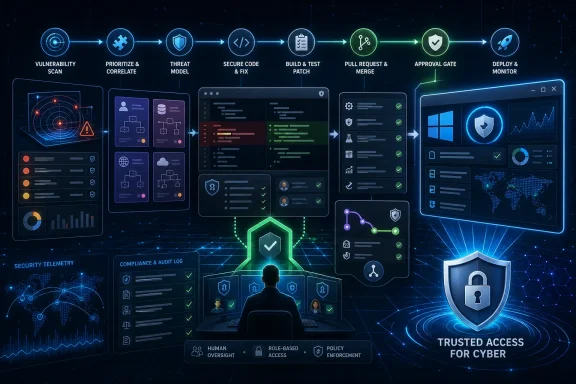 Cognizant Is Selling the Missing Middle of AI Security
The headline version is simple: Cognizant gets access to OpenAI’s GPT-5.5 cyber capability, wraps it in consulting and managed-services muscle, and points it at enterprise security backlogs. That is the version vendors like because it sounds clean, fast, and inevitable.The more interesting version is messier. Enterprises are already drowning in vulnerability findings from scanners, bug bounty reports, software composition tools, cloud posture products, endpoint telemetry, and incident queues. Adding a more capable model to the front of that pipeline may help, but it can also produce a new kind of overload if it does not improve the middle of the workflow.
Cognizant’s pitch is aimed precisely at that middle. The company says its teams will use GPT-5.5 with Trusted Access for Cyber across secure code review, threat modeling, vulnerability discovery and validation, detection engineering, threat hunting, and incident investigation. It also says the model will augment deterministic controls rather than replace them, with human validation and oversight at each step.
That framing matters. The enterprise buyer is not being asked to believe that GPT-5.5 is a magic patch machine. The buyer is being asked to believe that a large integrator with 5,000-plus security professionals can insert frontier AI into existing defensive workflows and shorten the distance between “we found something” and “we safely fixed it.”
The Announcement Is Really About Remediation, Not Discovery
For years, security vendors have competed on finding more. More CVEs. More misconfigurations. More exposed secrets. More suspicious behaviors. That race was useful, but it created the defining operational problem of modern defense: the backlog is now a permanent institution.Cognizant’s announcement leans into that reality. The company’s own language emphasizes that discovery is only the beginning, and that protection depends on validating whether findings are real, understanding their impact, developing and testing a patch, and landing the fix before attackers can act. That is not accidental wording. It is the product-market fit problem for AI in security.
A model that finds a bug but cannot help validate exploitability, reason about blast radius, propose a safe code change, generate tests, review a pull request, and document the risk decision is only partially useful. In a small engineering shop, a strong developer may bridge those steps manually. In a regulated enterprise, those steps cross teams, ticketing systems, code owners, change windows, compliance controls, and production-risk committees.
That is where Cognizant wants to stand. Its “Frontier AI Cyber Defense” branding is not just a model-access story; it is a process story. The company is effectively saying that the new defensible unit of cybersecurity value is not the alert, the report, or even the patch suggestion, but the validated remediation workflow.
OpenAI’s Trusted Access Model Creates a New Gatekeeper Layer
OpenAI’s Daybreak and Trusted Access for Cyber programs are designed around a hard truth: advanced cyber models are dual-use by nature. The same capability that helps a defender validate a vulnerability can help an attacker understand how to exploit one. The same model that assists malware analysis can assist malware improvement if access and use are poorly governed.According to OpenAI’s own Daybreak materials, GPT-5.5 with Trusted Access for Cyber is aimed at verified defensive workflows such as vulnerability triage, malware analysis, detection engineering, and patch validation. OpenAI distinguishes this from more specialized cyber access for higher-risk workflows such as red teaming, exploit development, reverse engineering, and controlled validation.
That creates a new kind of trust architecture around AI security tooling. Instead of simply selling an API and relying on universal safety filters, OpenAI is pushing a tiered model: ordinary access for general use, trusted defensive access for vetted users and organizations, and more permissive specialized access for narrowly scoped security teams.
For enterprises, this is both reassuring and awkward. It is reassuring because the model provider is acknowledging that cyber work needs different guardrails from ordinary office automation. It is awkward because critical security operations may increasingly depend on a vendor-mediated access regime that decides which teams, partners, and workflows are trusted enough to use the most capable tools.
Cognizant’s role in this structure is important. As a Daybreak Cyber Partner, it becomes not only a services provider but also a conduit through which OpenAI’s frontier cyber capabilities reach customers. That gives Cognizant leverage, but it also makes governance part of the product. Customers will need to know not just what the model can do, but who approved its use, what logs exist, what data is exposed, and where the boundary sits between authorized defense and prohibited behavior.
The “Client Zero” Claim Is the Part Enterprises Should Scrutinize
Cognizant says it is applying GPT-5.5 with Trusted Access for Cyber inside its own security operations before bringing the capability to clients, positioning itself as “Client Zero.” On paper, that is exactly what buyers should want to hear. No serious enterprise should be eager to become the first production test case for a new AI-assisted cyber remediation pipeline.But “Client Zero” can mean many things. It can mean a disciplined internal deployment across real repositories, production security queues, pull-request reviews, CI/CD controls, and incident workflows. It can also mean a limited internal pilot that proves the demo but not the operating model.
Cognizant’s announcement says its security teams are using the technology across internal secure code review, vulnerability triage and validation, and pull-request and CI/CD security review. That is a meaningful set of workflows if deployed deeply. It touches the software delivery chain where remediation either becomes real or dies in backlog triage.
Still, customers should press for evidence. How many repositories are in scope? Which languages and frameworks are covered? What false-positive and false-negative measurements exist? How often are model-suggested fixes accepted, modified, or rejected? How are regressions caught? How are sensitive code, secrets, telemetry, and customer data protected?
These are not gotcha questions. They are the difference between a frontier AI story and a production security program. If Cognizant can answer them with operational data, the announcement becomes more than a partnership press release. If it cannot, buyers should treat the offering as promising but immature.
Windows Shops Will Care About the Pipeline, Not the Press Release
For WindowsForum readers, the relevant question is not whether GPT-5.5 sounds impressive. It is whether AI-assisted remediation can fit the reality of Windows-heavy enterprise estates: Active Directory and Entra ID complexity, legacy .NET applications, PowerShell automation, Windows Server workloads, endpoint hardening, SCCM or Intune policy drift, third-party agents, and decades of line-of-business code.A model that can review code is useful. A model that can explain how a vulnerability interacts with Windows authentication boundaries, certificate stores, SMB exposure, Group Policy inheritance, service accounts, constrained delegation, and endpoint detection rules is much more useful. The operational value comes from context.
This is why Cognizant’s services wrapper matters. Many large companies do not need another point tool that identifies risk in isolation. They need someone or something to connect the scanner finding to the owner, the repository, the build process, the change window, the compensating control, and the audit trail.
That is especially true for Windows environments where risk often lives in the seams between packaged software, custom applications, privileged identity, and operational convenience. A vulnerable internal web app running on Windows Server may be less about the CVE itself than about the service account it uses, the shares it can reach, the old authentication pattern it still supports, and the business unit that refuses downtime.
If GPT-5.5-assisted workflows can help defenders reason across those seams, the announcement has practical weight. If the model mostly produces generic patch advice, it will become another expensive suggestion engine feeding the same old queue.
AI Remediation Will Shift Power Toward Those Who Own Change
Security teams like to talk about risk. Engineering and operations teams live with change. The remediation gap exists because those worlds overlap but do not fully align.AI threatens to rebalance that relationship. If a model can produce a credible patch, generate tests, summarize business impact, and prepare a pull request, security teams gain new leverage. They are no longer merely filing tickets that say “please fix”; they can arrive with a proposed, tested path forward.
That could be transformative, but it could also be politically explosive. Developers may resent model-generated patches from security teams if they appear without context or ownership. Operations teams may reject AI-assisted fixes if they suspect the model does not understand uptime constraints. Compliance teams may demand evidence that humans reviewed every material change.
Cognizant appears to understand this, at least in its messaging. The company stresses human oversight and integration into workflows customers already run. That is the right answer, but it is also the hard answer. The value of AI in remediation will depend less on whether it can write code and more on whether organizations redesign the handoff between security, engineering, and operations.
In mature environments, the model may become a force multiplier for existing secure development practices. In weaker environments, it may expose how little ownership exists. AI cannot fix a vulnerability management program that has no asset inventory, no code ownership map, no release discipline, and no appetite for removing obsolete systems.
The Dual-Use Problem Does Not Disappear Because the User Is a Defender
The security industry has a habit of treating “defensive use” as a moral category. In practice, it is an operational category, and it depends on authorization, scope, and control. The same steps used to validate a fix can look uncomfortably similar to the steps used to weaponize a flaw.OpenAI’s Trusted Access approach is an attempt to manage that ambiguity. It grants more useful cyber behavior to vetted users while still trying to constrain misuse. That is a sensible direction, but it is not a complete solution.
Enterprises using Cognizant’s service will need to understand the control plane. Who can prompt the model? What systems can it access? Does it see source code, binaries, logs, tickets, cloud configuration, endpoint telemetry, or production data? Are prompts and outputs retained? Can customers audit model-assisted decisions? What happens when the model suggests a risky validation step?
The old security tooling procurement checklist is not enough here. Buyers are not merely licensing a scanner or outsourcing triage. They are introducing a probabilistic reasoning system into workflows that may touch exploitability, patch generation, incident response, and production change.
That does not mean they should avoid it. It means they should govern it as security-critical infrastructure. The better the model becomes, the less plausible it is to treat it as a harmless assistant.
The Services Giants Are Moving Before the Market Has Standards
Cognizant is not alone in seeing the opening. OpenAI’s Daybreak partner materials have pointed to a broader ecosystem of security vendors, consultancies, and technology providers exploring GPT-5.5-backed defensive workflows. ITPro reported that OpenAI’s expanded Daybreak program included a roster of major partners and an emphasis on moving from vulnerability identification toward patching and remediation.That breadth is the tell. The market is forming before norms are settled. We do not yet have widely accepted benchmarks for AI-assisted vulnerability remediation in enterprise settings. We do not have mature audit practices for model-generated security fixes. We do not have a common vocabulary for measuring when AI reduces risk versus when it accelerates risky change.
Large services firms thrive in that ambiguity. They can sell strategy while building implementation muscle. They can absorb complexity that customers cannot staff internally. They can translate vendor platforms into board-friendly programs with governance decks, delivery milestones, and managed outcomes.
But that also means buyers should be wary of outsourcing judgment. A partner can operate the workflow, but the enterprise still owns the risk. If a model-assisted patch breaks production, misses a vulnerability, leaks sensitive code context, or creates a compliance dispute, the blast radius lands inside the customer’s business.
The smart customer will use Cognizant or any similar partner to accelerate capability, not to abdicate responsibility. The difference is whether internal security and engineering leaders remain technically engaged enough to challenge the outputs.
The Economics of Vulnerability Management Are Being Rewritten
The most compelling part of Cognizant’s announcement is economic, not technical. Vulnerability management has traditionally been constrained by human attention. You can buy more scanning, but validation, prioritization, patch development, testing, and deployment all consume scarce expert time.If AI can reduce the marginal cost of those middle steps, the shape of the program changes. Teams may validate more findings instead of sampling. They may generate safer patches faster. They may produce better detection logic while waiting for code fixes. They may revisit low-priority vulnerabilities that were previously ignored because the cost of action exceeded the perceived risk.
That is the optimistic case. The pessimistic case is that cheaper analysis produces more analysis, not more remediation. Every security operations center has seen tools that promised prioritization and delivered another dashboard. The hard metric is not how many vulnerabilities AI can discuss. It is how many validated fixes reach production with lower risk and less delay.
Cognizant’s pitch should therefore be judged by throughput and quality. Did mean time to remediate improve? Did reopen rates decline? Did emergency patches decrease because earlier validation improved? Did developers accept more security pull requests? Did production incidents caused by rushed fixes go down?
Those are the numbers that matter. Everything else is theater.
The Vendor Language Is Careful Because the Liability Is Real
Notice what Cognizant is not saying. It is not saying GPT-5.5 will autonomously patch customer environments. It is not saying human security engineers are obsolete. It is not saying deterministic controls can be replaced by model judgment. It is saying the model can be applied inside authorized workflows, with human validation and oversight, to speed the journey from finding to fix.That caution is not merely responsible messaging. It is liability management. In cybersecurity, a false sense of automation can be worse than no automation at all. If customers believe AI has “handled” remediation, they may defer the human review and operational testing that make fixes safe.
The same caution applies to incident response. AI can help correlate evidence, draft hypotheses, summarize logs, and propose containment steps. But during an active incident, a confident wrong answer can burn precious time or trigger a destructive action. Human validation is not a ceremonial phrase; it is the safety rail.
This is where enterprise buyers should reward boring design. Role-based access, scoped repositories, approval gates, reproducible test results, change records, and model-output logging are not glamorous. They are what separates production-grade AI defense from a dangerous lab experiment.
The Security Team Becomes an Editor of Machine Work
The best mental model for this generation of AI cyber tooling may not be “autonomous analyst.” It may be “junior specialist with impossible stamina.” The model can read, compare, draft, summarize, and propose at scale. But someone still has to decide what is true, what is safe, and what the business can tolerate.That changes the human role. Security engineers become reviewers of machine-produced hypotheses and fixes. Developers become editors of model-generated patches. Incident responders become supervisors of accelerated evidence gathering. Managers become accountable for workflows that blend human and machine judgment.
This can raise productivity, but it can also create review fatigue. If the model produces too many plausible but imperfect suggestions, experts may spend their time correcting machine output instead of solving problems directly. If the model is good enough to be trusted most of the time, complacency becomes the new threat.
The organizations that benefit most will be those that define review standards early. They will decide which classes of fixes can be model-assisted, which require senior approval, which must remain manual, and which are too sensitive for the system to touch. They will measure not only speed but also the cognitive load placed on reviewers.
The Patch Is Now the Product
Cognizant’s announcement lands at a moment when the security industry is being forced to admit that awareness is not defense. Dashboards do not reduce risk unless they change behavior. Findings do not protect customers unless they become fixes. AI does not help security unless it moves work across organizational boundaries.That is why the phrase “validated fixes” is the center of gravity. Validation is the bridge between model output and enterprise trust. A patch suggestion without validation is advice. A tested fix with context, ownership, rollback planning, and auditability is operational security.
For Windows-heavy enterprises, that distinction is essential. The environments are too complex, the dependencies too old, and the identity layers too consequential for automated patch generation to be treated casually. Remediation has to respect the architecture as it exists, not as a model imagines it from a clean-room example.
If Cognizant can combine OpenAI’s model capability with real institutional knowledge of customer environments, it may help customers attack the backlog that has haunted vulnerability management for years. If it cannot, the market will get another layer of AI gloss over the same unresolved process failures.
The Buyers Who Win Will Demand Proof, Not Demos
The immediate lesson from this announcement is not that every enterprise should rush to adopt GPT-5.5-backed cyber remediation. It is that the evaluation criteria for security AI need to mature quickly. A flashy demo of code review is no longer enough.- Enterprises should ask whether AI-assisted remediation measurably reduces time from validated finding to deployed fix.
- Security leaders should require audit trails showing what the model saw, what it proposed, who approved it, and how the fix was tested.
- Windows and hybrid-cloud teams should test the service against real legacy applications, identity dependencies, endpoint controls, and change-management constraints.
- Developers should be involved early, because model-generated security patches will fail politically if they arrive as drive-by pull requests from outside the code-owning team.
- Buyers should treat Trusted Access for Cyber as a governance feature to inspect, not a marketing phrase to admire.
- The strongest deployments will use AI to accelerate human-controlled workflows, not to pretend that vulnerability management can be fully automated.
References
- Primary source: The Fast Mode
Published: Thu, 02 Jul 2026 22:59:52 GMT
Cognizant Brings OpenAI GPT-5.5 to Enterprise Cyber Defense and Remediation
Cognizant Brings OpenAI GPT-5.5 to Enterprise Cyber Defense and Remediationwww.thefastmode.com - Independent coverage: ROI-NJ
Published: Thu, 02 Jul 2026 15:30:07 GMT
Cognizant applies OpenAI GPT-5.5 to speed enterprise cyber defense fixes | ROI-NJ
Cognizant is applying OpenAI’s GPT-5.5 in cyber defense services to help enterprises validate vulnerabilities and deliver fixes faster. www.roi-nj.com
- Independent coverage: Cognizant Technology Solutions
Published: Thu, 02 Jul 2026 13:05:17 GMT
Cognizant and OpenAI bring frontier AI cyber defense from vulnerability discovery to validated fixes - Jul 2, 2026
Get information on the latest Cognizant news, announcements, media coverage and press releases.news.cognizant.com - Related coverage: techradar.com
'We don’t believe this kind of government access process should become the long-term default': OpenAI unveils big GPT-5.6 upgrades for ChatGPT, but you can't use them yet | TechRadar
Only select partners for nowwww.techradar.com - Official source: help.openai.com
OpenAI Daybreak - Trusted Access for Cyber Overview | OpenAI Help Center
Learn what Trusted Access for Cyber is, what it supports, and how to request access. help.openai.com
- Official source: openai.com
Scaling Trusted Access for Cyber with GPT-5.5 and GPT-5.5-Cyber | OpenAI
OpenAI expands Trusted Access for Cyber with GPT-5.5 and GPT-5.5-Cyber, helping verified defenders accelerate vulnerability research and protect critical infrastructure.openai.com
- Related coverage: codersera.com
GPT-5.5 Cyber: OpenAI Daybreak & Trusted Access (2026)
GPT-5.5 Cyber is OpenAI's gated, security-tuned model under Daybreak. What 'trusted access' means, the CyberGym vs Mythos 5 claim, and why it matters. codersera.com
- Related coverage: itpro.com
OpenAI expands 'Daybreak' cyber program: New tools, partnerships, and a cyber-focused GPT-5.5 aim to help 'patch the world' | IT Pro
OpenAI has expanded its Daybreak cybersecurity initiative to cover fixing vulnerabilities, not just identifying them.www.itpro.com - Related coverage: axios.com
OpenAI makes GPT-5.5 more widely available to cyber defenders
Recent security testing suggests that GPT-5.5. model is nearly as good at finding and exploiting software bugs as Anthropic's Mythos Preview.www.axios.com
- Official source: deploymentsafety.openai.com
- Related coverage: labs.cloudsecurityalliance.org
Governing Cyber-Permissive AI: GPT-5.4-Cyber and the Identity Question
PDF documentlabs.cloudsecurityalliance.org
- Official source: cdn.openai.com