

AMD and Qualcomm have separately introduced new memory-packaging approaches in late June and early July 2026, with AMD adding LPDDR5X memory to Versal Premium Gen 2 adaptive SoCs and Qualcomm previewing High Bandwidth Compute for future AI inference accelerators. The announcements, detailed by Mark LaPedus at Semiecosystem and supported by company materials from AMD and Qualcomm, are not the same product story. They are, however, the same industry story: memory bandwidth has become the limiting reagent of modern computing, and packaging is where chipmakers are now trying to buy back momentum.
The old hierarchy was clean enough for marketing slides. Faster logic came from better process nodes, bigger systems came from more chips, and memory was the component you attached after the fact. That hierarchy is breaking down. In AI servers, embedded systems, aerospace boards, networking platforms, and video pipelines, the distance between compute and memory is now a first-order design constraint.
The phrase memory wall used to describe a familiar imbalance: processors improved faster than the systems feeding them data. Today, the wall is not merely architectural. It is physical, commercial, and logistical.
High Bandwidth Memory, or HBM, became the prestige answer to that problem because it puts stacked DRAM close to a processor, GPU, or accelerator inside a 2.5D package. The result is enormous bandwidth through a wide memory interface, but the industry has learned the cost of making one component too central to too many roadmaps. HBM capacity is constrained, HBM prices have risen with AI demand, and the advanced packaging used to assemble many of these systems — especially TSMC’s CoWoS — has itself become a bottleneck.
That matters because AI did not simply create a bigger market for memory. It changed what customers expect memory to do. Training and inference workloads are punished not only by raw compute shortages but by data movement, latency, power consumption, and rack-level thermals.
AMD and Qualcomm are approaching this from different ends of the market. AMD’s Versal Premium Gen 2 Memory on Package is aimed at embedded, industrial, communications, defense, test, and high-end signal-processing systems. Qualcomm’s High Bandwidth Compute is aimed squarely at AI inference in data centers, starting with its AI250 rack-scale platform expected to sample commercially in mid-2027. But both moves reflect the same design truth: the memory subsystem is no longer a peripheral decision.
According to AMD’s own announcement, the new MoP devices integrate up to 32GB of LPDDR5X in a single package and deliver up to 288GB/s of memory bandwidth while reducing board area by up to 60 percent compared with an equivalent discrete-memory implementation. AMD also says the in-package LPDDR5X interface is pre-validated, which is the sort of phrase that sounds dull until you have lived through high-speed board routing, signal-integrity simulation, qualification, and redesign.
That is the real pitch. AMD is not claiming LPDDR5X magically becomes HBM because it sits closer to the logic. It is claiming that many systems do not need HBM’s full cost, packaging complexity, or supply-chain risk to solve their actual problem. They need enough memory bandwidth, less board space, less validation work, better signal integrity, and a package that fits industrial product lifetimes.
Jon Peddie, writing separately from LaPedus, framed the move as a way to eliminate external memory routing and simplify board design. That may sound like a packaging footnote, but in embedded and industrial markets, it is often the product. A defense system, test instrument, or rugged VPX board may care less about benchmark supremacy than about predictable thermals, long availability, and fewer layout variables.
The timing also matters. AMD says Versal Premium Gen 2 MoP devices are expected to begin sampling at the end of 2026, with production shipments in the second half of 2027. That puts the technology on the roadmaps of customers designing systems now for deployment later, not buyers refreshing commodity PCs next quarter.
High Bandwidth Compute, or HBC, is central to that argument. Qualcomm describes HBC Gen 1 as a near-memory architecture that combines accelerator logic with 3D-stacked DRAM in a tightly coupled package. In Qualcomm’s materials for Dragonfly AI250, the company claims 133TB/s of effective memory bandwidth per card and 7.4PB/s effective bandwidth per rack, with more than 6TB of HBC memory per server.
Those numbers require careful reading. “Effective” bandwidth is not the same as a clean apples-to-apples raw HBM bandwidth figure, and Qualcomm’s comparisons are based on company estimates against contemporary GPU-based architectures. Still, the ambition is unmistakable. Qualcomm is trying to make bandwidth per watt, memory capacity per watt, and reduced data movement the core of its AI inference pitch.
That is a shrewd target. Training gets the glamour, but inference is where AI becomes an operating expense. Every token generated has a power, cooling, memory, and networking cost. If Qualcomm can make large-model inference less dependent on expensive HBM-heavy accelerator designs, it gives cloud providers and enterprises a reason to evaluate something outside the dominant GPU stack.
The word if is doing heavy lifting. Qualcomm still has to prove packaging yield, thermal behavior, software maturity, compiler visibility, memory supplier alignment, serviceability, and actual customer deployment. HBC sounds like an architecture designed by people who understand the data-movement problem. The question is whether it can become a platform, not just a slide.
HBM remains the high-end memory technology of choice for many AI accelerators because it offers immense bandwidth in a compact footprint. Micron, Samsung, and SK hynix are the major HBM suppliers, and AI demand has made their roadmaps strategically important to every accelerator vendor. TSMC’s CoWoS capacity has likewise become a gating factor because so many leading AI packages depend on advanced 2.5D integration.
That combination has created an unusual market condition. HBM is both technically attractive and operationally painful. It is what vendors want, what customers ask about, and what supply chains struggle to deliver in enough volume at the right price.
AMD’s MoP and Qualcomm’s HBC do not prove HBM is obsolete. They prove that the industry is no longer comfortable having one memory-packaging answer dominate every high-bandwidth discussion. LPDDR5X-on-package will not replace HBM in the highest-bandwidth training accelerators. Qualcomm’s HBC may not displace GPU-HBM systems where CUDA software gravity and procurement familiarity remain decisive.
But the cracks in the single-answer model are visible. Some workloads need lower board complexity more than absolute bandwidth. Some inference systems may benefit from tightly coupled memory capacity and bandwidth efficiency more than from chasing peak training throughput. Some industrial customers may prefer a 15-year lifecycle over the fastest data-center refresh cadence.
In that sense, HBM’s success has created the opening for alternatives. The more central HBM becomes, the more valuable it is to design systems that reduce exposure to HBM pricing, HBM supply, and HBM packaging queues.
A modern advanced package determines how close memory sits to compute, how much power is wasted moving data, how large the board must be, how difficult validation becomes, how thermals behave, and whether a product can be manufactured in useful volumes. Packaging is now an architectural choice and a supply-chain strategy at the same time.
That is why AMD’s and Qualcomm’s announcements belong in the same conversation even though their markets differ. AMD is using packaging to absorb complexity that would otherwise land on the board designer. Qualcomm is using packaging to make an AI accelerator architecture credible in a market where memory movement is one of the largest costs.
The industry is also experimenting beyond these two examples. LaPedus notes that SK hynix and Sandisk are pushing High Bandwidth Flash, while SoftBank subsidiary SAIMEMORY and Intel are collaborating on Z-Angle Memory. These are not interchangeable technologies, and not all of them will become mainstream. But they point to an ecosystem looking for more memory shapes than the HBM stack beside a giant accelerator.
This is what happens when Moore’s Law becomes less of a universal solvent. Chipmakers still chase denser transistors, but system performance increasingly comes from how logic, memory, interconnect, software, and packaging are composed. The package is no longer the end of the manufacturing story. It is where the system is negotiated.
But Windows users and IT pros should care because packaging decisions at the high end tend to migrate downward as economics improve. The same pressures shaping AI accelerators — bandwidth, latency, power, board area, thermal limits — also shape client PCs, edge devices, workstations, and local AI hardware. If AI features become a normal part of Windows software, the memory subsystem will matter more, not less.
Microsoft has been pushing AI deeper into Windows and developer tooling, while PC silicon vendors are adding NPUs and expanding unified-memory narratives. Today’s Copilot-class workloads are not the same as hyperscale inference, but the direction is clear. More local models, more media processing, more real-time enhancement, and more background intelligence all put pressure on memory bandwidth and efficiency.
Qualcomm already competes with AMD and Intel in Windows PCs through Snapdragon X systems. Its data-center HBC announcement does not mean HBC is coming to laptops, but the design philosophy is familiar: move data less, spend fewer joules, integrate more of the system. If Qualcomm can prove that argument in racks, it strengthens the credibility of its broader compute identity.
For AMD, the Versal MoP announcement reinforces a different kind of relevance. The company is not merely a CPU and GPU vendor; it owns adaptive computing assets from Xilinx that matter in industries where Windows workstations, embedded control systems, and specialized acceleration often coexist. The Windows ecosystem is bigger than consumer PCs, and memory packaging is one of the ways that ecosystem’s adjacent hardware will evolve.
Qualcomm’s HBC faces the bigger burden of proof because it is attached to a data-center platform ambition. Hyperscalers and enterprise buyers do not merely buy bandwidth claims. They buy software maturity, fleet management, service support, predictable delivery, and a reason to tolerate platform diversity. In AI, the software stack is not a supporting detail; it is the moat.
AMD’s risk profile is different. MoP is less speculative, and LPDDR5X is a familiar memory technology. But industrial and embedded customers are conservative for a reason. They will want to know not only that the package works, but that AMD can support it through long deployments, environmental extremes, and procurement cycles that move at the pace of infrastructure rather than consumer electronics.
There is also a broader market risk. The industry may be overcorrecting toward exotic memory integration because AI demand has made today’s bottlenecks feel permanent. If HBM supply loosens, CoWoS capacity expands, or AI model architectures shift in ways that change bandwidth needs, some alternative approaches may look less urgent than they do now.
Still, that is not an argument against experimentation. It is an argument for separating architecture from inevitability. AMD’s MoP looks valuable because it solves concrete board and lifecycle problems. Qualcomm’s HBC looks promising because inference economics are increasingly dominated by memory movement. Neither needs to “kill HBM” to matter.
In data centers, power availability and cooling are now strategic constraints. AI racks are not limited only by how many accelerators a vendor can ship; they are limited by how much energy a facility can deliver and how much heat it can remove. A memory architecture that improves bandwidth per watt can change deployment economics even if it does not win every peak-performance chart.
That is why Qualcomm emphasizes bandwidth per watt and capacity per watt. The company is not merely claiming that HBC moves more data. It is claiming that moving data differently can make inference racks more efficient. That is exactly the argument a mobile-chip company would bring to the data center.
AMD’s MoP is also a power story, though in a quieter way. Shorter memory routes, less board complexity, and integrated LPDDR5X can improve system efficiency in constrained designs. For a rugged embedded system, a radar processor, or a secure communications board, saving board area and reducing validation risk may be as important as squeezing out more theoretical performance.
The industry’s language has not fully caught up. We still talk as though “memory bandwidth” is a standalone metric. Increasingly, the useful question is how much bandwidth a system can deliver within a power, space, cost, and supply envelope.
HBM will continue to dominate many high-end accelerator designs. LPDDR5X-on-package will serve systems that need high bandwidth without HBM’s full cost or complexity. Near-memory and memory-centric architectures like Qualcomm’s HBC will try to carve out AI inference territory where efficiency and capacity matter as much as raw accelerator muscle. Flash-based and emerging memory approaches will compete for workloads where capacity, persistence, or cost alter the equation.
That fragmentation may frustrate buyers who want simple roadmaps, but it is a sign of maturity. The compute market is no longer one market. A Windows laptop, an AI inference rack, a VPX defense board, a 400G networking appliance, and a professional video system all move data differently. It would be strange if they all converged on the same memory package.
For sysadmins and IT planners, the practical implication is that hardware evaluation will become more workload-specific. The old shortcut — buy the biggest GPU with the most prestigious memory stack — will remain useful in some cases and wasteful in others. AI inference, edge processing, media pipelines, and industrial analytics may reward systems that look less conventional but fit the workload better.
That is where AMD and Qualcomm are both trying to position themselves. AMD is saying customers can get substantial bandwidth and capacity in a smaller, more validated package for long-life embedded systems. Qualcomm is saying the AI inference rack should be rebuilt around memory efficiency rather than inherited GPU assumptions.
That shift will change how systems are compared. A package that reduces board area may shorten product development. A memory architecture that cuts data movement may reduce rack power. A supply chain that avoids the most congested HBM path may ship when a theoretically faster design cannot.
For buyers, that means the spec sheet needs a more skeptical reading. Bandwidth claims should be tied to workload behavior. “Effective” bandwidth should be distinguished from raw bandwidth. Lifecycle promises should be weighed against actual supplier commitments. Packaging novelty should be treated as neither magic nor marketing fluff, but as a design variable with measurable consequences.
The old hierarchy was clean enough for marketing slides. Faster logic came from better process nodes, bigger systems came from more chips, and memory was the component you attached after the fact. That hierarchy is breaking down. In AI servers, embedded systems, aerospace boards, networking platforms, and video pipelines, the distance between compute and memory is now a first-order design constraint.
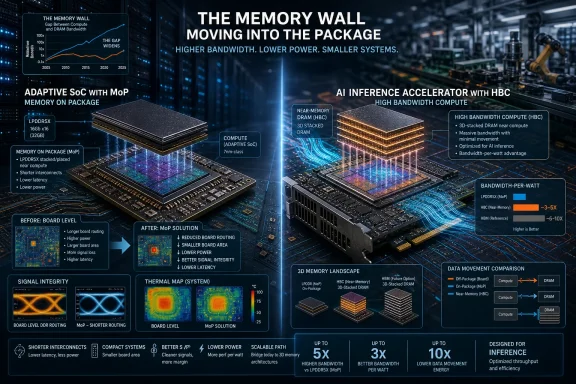 The Memory Wall Has Moved Into the Package
The phrase memory wall used to describe a familiar imbalance: processors improved faster than the systems feeding them data. Today, the wall is not merely architectural. It is physical, commercial, and logistical.High Bandwidth Memory, or HBM, became the prestige answer to that problem because it puts stacked DRAM close to a processor, GPU, or accelerator inside a 2.5D package. The result is enormous bandwidth through a wide memory interface, but the industry has learned the cost of making one component too central to too many roadmaps. HBM capacity is constrained, HBM prices have risen with AI demand, and the advanced packaging used to assemble many of these systems — especially TSMC’s CoWoS — has itself become a bottleneck.
That matters because AI did not simply create a bigger market for memory. It changed what customers expect memory to do. Training and inference workloads are punished not only by raw compute shortages but by data movement, latency, power consumption, and rack-level thermals.
AMD and Qualcomm are approaching this from different ends of the market. AMD’s Versal Premium Gen 2 Memory on Package is aimed at embedded, industrial, communications, defense, test, and high-end signal-processing systems. Qualcomm’s High Bandwidth Compute is aimed squarely at AI inference in data centers, starting with its AI250 rack-scale platform expected to sample commercially in mid-2027. But both moves reflect the same design truth: the memory subsystem is no longer a peripheral decision.
AMD’s MoP Is a Board-Level Escape Hatch, Not an HBM Killer
AMD’s Versal Premium Gen 2 Memory on Package, or MoP, is easy to misread if viewed only through the AI hype cycle. This is not AMD trying to replace HBM across its GPU portfolio, nor is it a direct shot at Nvidia’s highest-end AI accelerators. It is a more pragmatic move: AMD is taking LPDDR5X memory that would otherwise sit outside the chip package and moving it beside the Versal compute die.According to AMD’s own announcement, the new MoP devices integrate up to 32GB of LPDDR5X in a single package and deliver up to 288GB/s of memory bandwidth while reducing board area by up to 60 percent compared with an equivalent discrete-memory implementation. AMD also says the in-package LPDDR5X interface is pre-validated, which is the sort of phrase that sounds dull until you have lived through high-speed board routing, signal-integrity simulation, qualification, and redesign.
That is the real pitch. AMD is not claiming LPDDR5X magically becomes HBM because it sits closer to the logic. It is claiming that many systems do not need HBM’s full cost, packaging complexity, or supply-chain risk to solve their actual problem. They need enough memory bandwidth, less board space, less validation work, better signal integrity, and a package that fits industrial product lifetimes.
Jon Peddie, writing separately from LaPedus, framed the move as a way to eliminate external memory routing and simplify board design. That may sound like a packaging footnote, but in embedded and industrial markets, it is often the product. A defense system, test instrument, or rugged VPX board may care less about benchmark supremacy than about predictable thermals, long availability, and fewer layout variables.
The timing also matters. AMD says Versal Premium Gen 2 MoP devices are expected to begin sampling at the end of 2026, with production shipments in the second half of 2027. That puts the technology on the roadmaps of customers designing systems now for deployment later, not buyers refreshing commodity PCs next quarter.
Qualcomm Wants to Turn Memory Efficiency Into a Data Center Wedge
Qualcomm’s move is more audacious because Qualcomm is trying to re-enter — or perhaps finally enter in force — the data center conversation. The company is best known for mobile SoCs, modems, and increasingly Windows-on-Arm PC silicon. But its Dragonfly data center push, including the C1000 CPU, AI200, AI250, and AI300 accelerator roadmap, is an attempt to turn its power-efficiency DNA into a rack-scale AI argument.High Bandwidth Compute, or HBC, is central to that argument. Qualcomm describes HBC Gen 1 as a near-memory architecture that combines accelerator logic with 3D-stacked DRAM in a tightly coupled package. In Qualcomm’s materials for Dragonfly AI250, the company claims 133TB/s of effective memory bandwidth per card and 7.4PB/s effective bandwidth per rack, with more than 6TB of HBC memory per server.
Those numbers require careful reading. “Effective” bandwidth is not the same as a clean apples-to-apples raw HBM bandwidth figure, and Qualcomm’s comparisons are based on company estimates against contemporary GPU-based architectures. Still, the ambition is unmistakable. Qualcomm is trying to make bandwidth per watt, memory capacity per watt, and reduced data movement the core of its AI inference pitch.
That is a shrewd target. Training gets the glamour, but inference is where AI becomes an operating expense. Every token generated has a power, cooling, memory, and networking cost. If Qualcomm can make large-model inference less dependent on expensive HBM-heavy accelerator designs, it gives cloud providers and enterprises a reason to evaluate something outside the dominant GPU stack.
The word if is doing heavy lifting. Qualcomm still has to prove packaging yield, thermal behavior, software maturity, compiler visibility, memory supplier alignment, serviceability, and actual customer deployment. HBC sounds like an architecture designed by people who understand the data-movement problem. The question is whether it can become a platform, not just a slide.
HBM Is Still the Benchmark Everyone Is Trying to Route Around
Neither AMD nor Qualcomm can avoid HBM’s shadow. In fact, both announcements are defined by it.HBM remains the high-end memory technology of choice for many AI accelerators because it offers immense bandwidth in a compact footprint. Micron, Samsung, and SK hynix are the major HBM suppliers, and AI demand has made their roadmaps strategically important to every accelerator vendor. TSMC’s CoWoS capacity has likewise become a gating factor because so many leading AI packages depend on advanced 2.5D integration.
That combination has created an unusual market condition. HBM is both technically attractive and operationally painful. It is what vendors want, what customers ask about, and what supply chains struggle to deliver in enough volume at the right price.
AMD’s MoP and Qualcomm’s HBC do not prove HBM is obsolete. They prove that the industry is no longer comfortable having one memory-packaging answer dominate every high-bandwidth discussion. LPDDR5X-on-package will not replace HBM in the highest-bandwidth training accelerators. Qualcomm’s HBC may not displace GPU-HBM systems where CUDA software gravity and procurement familiarity remain decisive.
But the cracks in the single-answer model are visible. Some workloads need lower board complexity more than absolute bandwidth. Some inference systems may benefit from tightly coupled memory capacity and bandwidth efficiency more than from chasing peak training throughput. Some industrial customers may prefer a 15-year lifecycle over the fastest data-center refresh cadence.
In that sense, HBM’s success has created the opening for alternatives. The more central HBM becomes, the more valuable it is to design systems that reduce exposure to HBM pricing, HBM supply, and HBM packaging queues.
Packaging Has Become the New Platform Strategy
For decades, packaging was treated as an enabling discipline, important but rarely glamorous. The chip was the star; the package was the container. That mental model is now badly out of date.A modern advanced package determines how close memory sits to compute, how much power is wasted moving data, how large the board must be, how difficult validation becomes, how thermals behave, and whether a product can be manufactured in useful volumes. Packaging is now an architectural choice and a supply-chain strategy at the same time.
That is why AMD’s and Qualcomm’s announcements belong in the same conversation even though their markets differ. AMD is using packaging to absorb complexity that would otherwise land on the board designer. Qualcomm is using packaging to make an AI accelerator architecture credible in a market where memory movement is one of the largest costs.
The industry is also experimenting beyond these two examples. LaPedus notes that SK hynix and Sandisk are pushing High Bandwidth Flash, while SoftBank subsidiary SAIMEMORY and Intel are collaborating on Z-Angle Memory. These are not interchangeable technologies, and not all of them will become mainstream. But they point to an ecosystem looking for more memory shapes than the HBM stack beside a giant accelerator.
This is what happens when Moore’s Law becomes less of a universal solvent. Chipmakers still chase denser transistors, but system performance increasingly comes from how logic, memory, interconnect, software, and packaging are composed. The package is no longer the end of the manufacturing story. It is where the system is negotiated.
Windows PCs Are Not the Target, but Windows Users Should Still Care
At first glance, this sounds distant from the world of Windows desktops, laptops, and workstations. AMD’s Versal MoP is not going into a Ryzen gaming PC. Qualcomm’s HBC is not the next Snapdragon X memory subsystem for a consumer laptop. The immediate markets are industrial systems and AI data centers.But Windows users and IT pros should care because packaging decisions at the high end tend to migrate downward as economics improve. The same pressures shaping AI accelerators — bandwidth, latency, power, board area, thermal limits — also shape client PCs, edge devices, workstations, and local AI hardware. If AI features become a normal part of Windows software, the memory subsystem will matter more, not less.
Microsoft has been pushing AI deeper into Windows and developer tooling, while PC silicon vendors are adding NPUs and expanding unified-memory narratives. Today’s Copilot-class workloads are not the same as hyperscale inference, but the direction is clear. More local models, more media processing, more real-time enhancement, and more background intelligence all put pressure on memory bandwidth and efficiency.
Qualcomm already competes with AMD and Intel in Windows PCs through Snapdragon X systems. Its data-center HBC announcement does not mean HBC is coming to laptops, but the design philosophy is familiar: move data less, spend fewer joules, integrate more of the system. If Qualcomm can prove that argument in racks, it strengthens the credibility of its broader compute identity.
For AMD, the Versal MoP announcement reinforces a different kind of relevance. The company is not merely a CPU and GPU vendor; it owns adaptive computing assets from Xilinx that matter in industries where Windows workstations, embedded control systems, and specialized acceleration often coexist. The Windows ecosystem is bigger than consumer PCs, and memory packaging is one of the ways that ecosystem’s adjacent hardware will evolve.
The Risk Is That Marketing Outruns Manufacturing
Every packaging breakthrough arrives with a warning label: the package has to be buildable. A neat architecture diagram does not answer yield, repairability, thermal density, supplier qualification, or volume economics.Qualcomm’s HBC faces the bigger burden of proof because it is attached to a data-center platform ambition. Hyperscalers and enterprise buyers do not merely buy bandwidth claims. They buy software maturity, fleet management, service support, predictable delivery, and a reason to tolerate platform diversity. In AI, the software stack is not a supporting detail; it is the moat.
AMD’s risk profile is different. MoP is less speculative, and LPDDR5X is a familiar memory technology. But industrial and embedded customers are conservative for a reason. They will want to know not only that the package works, but that AMD can support it through long deployments, environmental extremes, and procurement cycles that move at the pace of infrastructure rather than consumer electronics.
There is also a broader market risk. The industry may be overcorrecting toward exotic memory integration because AI demand has made today’s bottlenecks feel permanent. If HBM supply loosens, CoWoS capacity expands, or AI model architectures shift in ways that change bandwidth needs, some alternative approaches may look less urgent than they do now.
Still, that is not an argument against experimentation. It is an argument for separating architecture from inevitability. AMD’s MoP looks valuable because it solves concrete board and lifecycle problems. Qualcomm’s HBC looks promising because inference economics are increasingly dominated by memory movement. Neither needs to “kill HBM” to matter.
The Bandwidth Story Is Really a Power Story
Bandwidth gets the headline because it is easy to quantify. Power is the deeper story because it determines what can be deployed.In data centers, power availability and cooling are now strategic constraints. AI racks are not limited only by how many accelerators a vendor can ship; they are limited by how much energy a facility can deliver and how much heat it can remove. A memory architecture that improves bandwidth per watt can change deployment economics even if it does not win every peak-performance chart.
That is why Qualcomm emphasizes bandwidth per watt and capacity per watt. The company is not merely claiming that HBC moves more data. It is claiming that moving data differently can make inference racks more efficient. That is exactly the argument a mobile-chip company would bring to the data center.
AMD’s MoP is also a power story, though in a quieter way. Shorter memory routes, less board complexity, and integrated LPDDR5X can improve system efficiency in constrained designs. For a rugged embedded system, a radar processor, or a secure communications board, saving board area and reducing validation risk may be as important as squeezing out more theoretical performance.
The industry’s language has not fully caught up. We still talk as though “memory bandwidth” is a standalone metric. Increasingly, the useful question is how much bandwidth a system can deliver within a power, space, cost, and supply envelope.
The Next Memory Era Will Be Messier, and That Is Healthy
The cleanest market story would be that one memory technology wins. That is not what is happening.HBM will continue to dominate many high-end accelerator designs. LPDDR5X-on-package will serve systems that need high bandwidth without HBM’s full cost or complexity. Near-memory and memory-centric architectures like Qualcomm’s HBC will try to carve out AI inference territory where efficiency and capacity matter as much as raw accelerator muscle. Flash-based and emerging memory approaches will compete for workloads where capacity, persistence, or cost alter the equation.
That fragmentation may frustrate buyers who want simple roadmaps, but it is a sign of maturity. The compute market is no longer one market. A Windows laptop, an AI inference rack, a VPX defense board, a 400G networking appliance, and a professional video system all move data differently. It would be strange if they all converged on the same memory package.
For sysadmins and IT planners, the practical implication is that hardware evaluation will become more workload-specific. The old shortcut — buy the biggest GPU with the most prestigious memory stack — will remain useful in some cases and wasteful in others. AI inference, edge processing, media pipelines, and industrial analytics may reward systems that look less conventional but fit the workload better.
That is where AMD and Qualcomm are both trying to position themselves. AMD is saying customers can get substantial bandwidth and capacity in a smaller, more validated package for long-life embedded systems. Qualcomm is saying the AI inference rack should be rebuilt around memory efficiency rather than inherited GPU assumptions.
The Package Is Now Part of the Procurement Decision
The concrete lesson from these announcements is not that one vendor has solved the memory bottleneck. It is that packaging choices are becoming visible to customers who used to care only about processor names, memory capacity, and accelerator counts.That shift will change how systems are compared. A package that reduces board area may shorten product development. A memory architecture that cuts data movement may reduce rack power. A supply chain that avoids the most congested HBM path may ship when a theoretically faster design cannot.
For buyers, that means the spec sheet needs a more skeptical reading. Bandwidth claims should be tied to workload behavior. “Effective” bandwidth should be distinguished from raw bandwidth. Lifecycle promises should be weighed against actual supplier commitments. Packaging novelty should be treated as neither magic nor marketing fluff, but as a design variable with measurable consequences.
AMD and Qualcomm Are Pointing at the Same Bottleneck From Opposite Ends
The useful way to read this week’s packaging news is to strip away the vendor theater and follow the data path. AMD and Qualcomm are both trying to reduce the penalty of moving information between logic and memory. They are simply doing it for different customers, at different scales, and with different risk profiles.- AMD’s Versal Premium Gen 2 MoP integrates up to 32GB of LPDDR5X in-package and is aimed at embedded and industrial systems that need bandwidth, compact boards, and long lifecycles.
- Qualcomm’s HBC is a memory-centric AI inference architecture planned for the AI250 platform, with commercial sampling expected around mid-2027.
- HBM remains the premium memory technology for many accelerator designs, but its cost, supply constraints, and packaging dependencies are encouraging alternatives.
- The most important comparison is not LPDDR5X versus HBM in the abstract, but whether a memory package fits the workload’s bandwidth, power, cost, board-space, and supply-chain limits.
- Windows users will not see these exact technologies in mainstream PCs immediately, but the same pressure to move data more efficiently will shape future client, workstation, and edge AI hardware.