

Cisco plans to give personalized AI agents to roughly 90,000 employees beginning in August 2026, according to reporting first published by Fortune and amplified by IndianWeb2, making the networking giant one of the largest test cases yet for company-wide agentic AI. The move is not just another Copilot-style productivity rollout. Cisco is trying to prove that AI agents can become part of the operating model of a mature enterprise, not merely an optional layer on top of email, chat, and documents. The risk is that the same deployment meant to tame complexity may expose just how much complexity large companies have been quietly tolerating.
Enterprise AI has spent the past three years trapped between two poles: executive enthusiasm and employee experimentation. Workers used chatbots to draft emails, summarize meetings, write code, and search internal documents, while CIOs tried to wrap governance around tools that often arrived before policy did. Cisco’s rollout moves the story into a different phase: every employee gets an agent, and the agent is expected to do more than answer prompts.
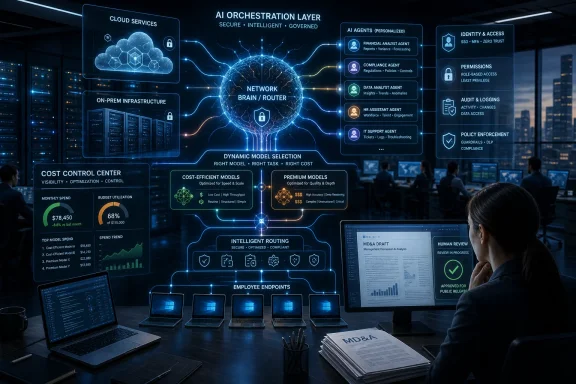
According to Fortune, the Cisco system is designed to route work to the most appropriate model rather than blindly throw every query at the most powerful and expensive one available. That detail matters more than the headline number. The most serious enterprise AI deployments are no longer about whether a model can produce a plausible answer; they are about whether a company can make millions of small AI decisions without letting compute bills, data exposure, and workflow drift spiral out of control.
Cisco’s choice also reflects a broader strategic repositioning. The company wants to be seen not simply as a seller of routers, switches, security appliances, and collaboration software, but as infrastructure for the AI era. That is a familiar vendor move, but this deployment gives Cisco a useful internal proof point: if it can run agents across its own global workforce, it can sell the architecture, security model, and operational discipline behind that story to customers.
The timing is pointed. Cisco has been publicly emphasizing AI infrastructure, security, silicon, optics, and automation while also restructuring parts of its workforce. In May, TechRadar and others reported that Cisco was cutting about 4,000 jobs, or less than 5 percent of its workforce, while describing the move as a shift toward high-growth areas rather than a conventional downturn response. That makes the AI rollout impossible to separate from the labor narrative surrounding it.
Token costs are not an abstraction when agents act autonomously or semi-autonomously. A simple chat exchange is one thing; a multi-step agent that searches documents, calls tools, checks results, rewrites outputs, and loops through validation can consume enormous amounts of context. At the scale of 90,000 employees, even modest inefficiencies compound into serious infrastructure spending.
That is why Cisco’s emphasis on dynamic model selection is worth watching. The consumer AI experience has trained users to think of intelligence as a single box: type something, get something back. Enterprise AI requires a more industrial mental model, closer to workload scheduling in a data center. The goal is not to use the “best” model every time; the goal is to use the cheapest adequate system that satisfies accuracy, latency, compliance, and security constraints.
This is where Cisco’s heritage gives it an argument. Networking companies understand routing, policy, access control, and traffic optimization. If AI agents become another class of enterprise traffic — moving requests, credentials, documents, and actions across systems — then the old infrastructure disciplines become newly relevant. Cisco’s pitch, implicitly, is that AI at scale is not a magic layer above IT. It is IT, with more autonomy and more expensive mistakes.
Running AI internally does not make it cheap. Hardware, power, cooling, staffing, lifecycle management, and model operations all carry real costs. But internal infrastructure can give a company more levers: which models run where, which workloads get priority, how data is retained, and how deeply AI systems are allowed to integrate with business applications. For a company like Cisco, those levers are part of the product story.
The on-premises angle also complicates the usual cloud-versus-local debate. Large enterprises are unlikely to choose one model permanently. Sensitive workflows may stay on private infrastructure, commodity tasks may go to public cloud models, and specialized use cases may flow through vendors with domain-specific capabilities. Cisco’s agent router, if it works as described, becomes a broker across that hybrid reality.
For WindowsForum readers, this is the part that should feel familiar. The enterprise desktop has always been a managed compromise between user freedom and administrative control. AI agents introduce the same tension at a higher velocity. The agent that can summarize a SharePoint library, query a CRM record, draft a procurement request, and file an IT ticket is useful precisely because it crosses boundaries that security teams have spent years hardening.
That does not mean AI is “doing the filing” in the human sense. A more realistic reading is that AI systems are generating first drafts, pulling recurring language, identifying changes, and helping teams prepare narratives that humans still review. Even so, the percentage matters because it suggests AI is moving from assistance at the edge of knowledge work into the production workflow itself.
Finance also reveals the limits of the productivity framing. If an agent drafts most of a disclosure document, the value is not merely that someone saved time typing. The value is that the company may standardize language, reduce repetitive manual work, surface anomalies faster, and make investor-relations teams more responsive. The risk is that automation can normalize errors with the same efficiency it applies to routine work.
This is why enterprise AI governance cannot stop at acceptable-use policies. The relevant questions are procedural: who reviews outputs, which systems are authoritative, how changes are logged, what happens when the agent is wrong, and who signs off when AI-generated language enters regulated communications. In finance, those answers must be explicit. Elsewhere in the company, they are often fuzzier.
Accenture’s deployment is a massive adoption of a major platform tool across a consulting workforce. Cisco’s plan, as reported, is more explicitly about personalized agents, model routing, internal infrastructure, and cost-aware orchestration. One is a bet on broad access to a productivity layer; the other is a bet that agentic AI can be woven into the machinery of the company itself.
Both approaches are plausible, and most large organizations will eventually use pieces of each. Microsoft Copilot-style deployments make sense where employees live in Office, Teams, Outlook, SharePoint, and Windows. More customized agent systems make sense where companies want to connect AI to internal workflows, proprietary data, and domain-specific processes. The future enterprise probably contains both: a general assistant on the desktop and specialized agents embedded in operations.
Cisco’s challenge is that customized agents are harder to govern than standardized assistants. The more an agent can do, the more the enterprise must know about what it is doing. That means identity, permissions, logging, data boundaries, prompt management, model evaluation, and incident response become first-class IT concerns. The agent is not just another app. It is a user-like actor that may operate at machine speed.
Traditional enterprise security assumes that users authenticate, applications enforce permissions, and logs capture meaningful actions. Agents blur those lines. A human may ask an agent to complete a task; the agent may call multiple systems; those systems may see a mix of user credentials, service accounts, API tokens, and automation flows. If the outcome is wrong or malicious, tracing responsibility becomes difficult.
Cisco’s security messaging around agents therefore serves two purposes. It warns customers that agentic AI is dangerous without controls, and it conveniently positions Cisco’s security portfolio as part of the answer. That is not cynical; it is how enterprise vendors package risk into products. But customers should still separate the valid warning from the sales motion.
For sysadmins, the practical issue is simple: AI agents create non-human activity that looks increasingly human in intent and increasingly automated in speed. That combination breaks lazy assumptions in access management. Least privilege, conditional access, data loss prevention, and audit logging all need to be reinterpreted for a world where software can initiate chains of work rather than merely respond to clicks.
Every company has workflows that survive because humans quietly compensate for broken systems. A finance analyst knows which spreadsheet is wrong but still used. A support manager knows which escalation path works faster than the official one. A sales operations employee knows which field in the CRM is technically mandatory but practically meaningless. AI agents do not automatically fix this hidden knowledge; they surface it.
That is why upskilling matters, but not in the shallow “everyone must learn AI” sense. Employees need to understand when to trust an agent, when to challenge it, how to express a workflow precisely, and how to recognize when automation is papering over a process problem. Managers need to decide whether AI is augmenting a role, changing it, or making parts of it redundant.
The cultural risk is that companies talk about empowerment while measuring only extraction. If agents are introduced as assistants but evaluated mainly through cost reduction, employees will notice. Trust in enterprise AI depends not only on model accuracy but on organizational intent. Cisco, like every company making this transition, will have to prove that “AI-native” does not simply mean “fewer people doing more work with less clarity.”
The first wave will look manageable. Employees will ask agents to summarize meetings, find documents, draft replies, and file tickets. The second wave will be harder: agents will request access, interact with SaaS platforms, trigger workflows, generate code, modify configurations, and recommend business decisions. At that point, endpoint management, browser policy, identity governance, and telemetry become part of AI governance whether IT asked for that role or not.
Microsoft’s own Copilot strategy already points in this direction. Copilot is becoming less like a single assistant and more like an interface across Microsoft’s productivity, security, developer, and business application stack. Cisco’s agentic approach is different, but the enterprise pattern is similar: AI becomes a layer of action across existing systems. The operating system and identity plane become the control surface.
For Windows environments, that means practical questions will arrive faster than philosophy. Which agent can read local files? Can it access synced OneDrive content? Does it inherit the user’s permissions or require separate approval? Are prompts and responses discoverable for legal hold? Can an administrator disable certain actions without blocking benign summarization? These are not edge cases. They are the next helpdesk tickets.
Cisco’s reported focus on cost control suggests it understands this. The agent that dazzles in a demo but consumes premium-model tokens recklessly is a liability. The agent that quietly routes 70 percent of routine work to cheaper systems while escalating only genuinely complex tasks may produce less theater and more value. Enterprise AI maturity will look less like science fiction and more like disciplined operations management.
There is also a measurement trap. If companies count AI success only by usage, they will get usage. Employees can generate more text, more summaries, more drafts, and more activity without improving outcomes. The harder question is whether the organization makes better decisions, responds faster to customers, reduces risk, and lowers the burden of administrative work.
Cisco’s internal deployment could therefore become a case study either way. If the company can show concrete improvements without runaway costs or governance failures, it strengthens its credibility as an AI infrastructure vendor. If the rollout produces confusion, security concerns, or ambiguous productivity claims, it will reinforce skepticism that agentic AI is still over-promising at enterprise scale.
 Cisco Is Turning the AI Pilot Into the Org Chart
Enterprise AI has spent the past three years trapped between two poles: executive enthusiasm and employee experimentation. Workers used chatbots to draft emails, summarize meetings, write code, and search internal documents, while CIOs tried to wrap governance around tools that often arrived before policy did. Cisco’s rollout moves the story into a different phase: every employee gets an agent, and the agent is expected to do more than answer prompts.According to Fortune, the Cisco system is designed to route work to the most appropriate model rather than blindly throw every query at the most powerful and expensive one available. That detail matters more than the headline number. The most serious enterprise AI deployments are no longer about whether a model can produce a plausible answer; they are about whether a company can make millions of small AI decisions without letting compute bills, data exposure, and workflow drift spiral out of control.
Cisco’s choice also reflects a broader strategic repositioning. The company wants to be seen not simply as a seller of routers, switches, security appliances, and collaboration software, but as infrastructure for the AI era. That is a familiar vendor move, but this deployment gives Cisco a useful internal proof point: if it can run agents across its own global workforce, it can sell the architecture, security model, and operational discipline behind that story to customers.
The timing is pointed. Cisco has been publicly emphasizing AI infrastructure, security, silicon, optics, and automation while also restructuring parts of its workforce. In May, TechRadar and others reported that Cisco was cutting about 4,000 jobs, or less than 5 percent of its workforce, while describing the move as a shift toward high-growth areas rather than a conventional downturn response. That makes the AI rollout impossible to separate from the labor narrative surrounding it.
The Real Innovation Is Not the Agent, but the Router Behind It
The phrase “personalized AI agent” risks sounding like marketing fog. In practice, the important architectural claim is that Cisco wants agents to decide where work should go: a cheaper model for lightweight summarization, a stronger model for complex reasoning, perhaps an internal system for sensitive data, and specialized tools for finance, customer support, or engineering workflows. That is less glamorous than a chatbot demo, but it is where enterprise AI economics will be won or lost.Token costs are not an abstraction when agents act autonomously or semi-autonomously. A simple chat exchange is one thing; a multi-step agent that searches documents, calls tools, checks results, rewrites outputs, and loops through validation can consume enormous amounts of context. At the scale of 90,000 employees, even modest inefficiencies compound into serious infrastructure spending.
That is why Cisco’s emphasis on dynamic model selection is worth watching. The consumer AI experience has trained users to think of intelligence as a single box: type something, get something back. Enterprise AI requires a more industrial mental model, closer to workload scheduling in a data center. The goal is not to use the “best” model every time; the goal is to use the cheapest adequate system that satisfies accuracy, latency, compliance, and security constraints.
This is where Cisco’s heritage gives it an argument. Networking companies understand routing, policy, access control, and traffic optimization. If AI agents become another class of enterprise traffic — moving requests, credentials, documents, and actions across systems — then the old infrastructure disciplines become newly relevant. Cisco’s pitch, implicitly, is that AI at scale is not a magic layer above IT. It is IT, with more autonomy and more expensive mistakes.
On-Premises AI Is Back, This Time Wearing a Cost-Control Badge
IndianWeb2’s summary of the rollout highlights that much of Cisco’s AI stack is reportedly hosted internally. That decision fits a trend that has been building across large enterprises: after the first wave of cloud-hosted generative AI enthusiasm, companies are rediscovering the appeal of control. Data security is the obvious reason, but cost predictability may be just as important.Running AI internally does not make it cheap. Hardware, power, cooling, staffing, lifecycle management, and model operations all carry real costs. But internal infrastructure can give a company more levers: which models run where, which workloads get priority, how data is retained, and how deeply AI systems are allowed to integrate with business applications. For a company like Cisco, those levers are part of the product story.
The on-premises angle also complicates the usual cloud-versus-local debate. Large enterprises are unlikely to choose one model permanently. Sensitive workflows may stay on private infrastructure, commodity tasks may go to public cloud models, and specialized use cases may flow through vendors with domain-specific capabilities. Cisco’s agent router, if it works as described, becomes a broker across that hybrid reality.
For WindowsForum readers, this is the part that should feel familiar. The enterprise desktop has always been a managed compromise between user freedom and administrative control. AI agents introduce the same tension at a higher velocity. The agent that can summarize a SharePoint library, query a CRM record, draft a procurement request, and file an IT ticket is useful precisely because it crosses boundaries that security teams have spent years hardening.
Finance Is the Canary in the Agentic Coal Mine
The most concrete example in the Cisco reporting is finance. According to IndianWeb2’s summary of the underlying reporting, AI is already drafting 80 to 90 percent of Cisco’s Management Discussion and Analysis filings and supporting investor relations with predictive insights. If accurate, that is a striking use case, because finance is not a low-stakes sandbox. It is one of the places where precision, auditability, and accountability matter most.That does not mean AI is “doing the filing” in the human sense. A more realistic reading is that AI systems are generating first drafts, pulling recurring language, identifying changes, and helping teams prepare narratives that humans still review. Even so, the percentage matters because it suggests AI is moving from assistance at the edge of knowledge work into the production workflow itself.
Finance also reveals the limits of the productivity framing. If an agent drafts most of a disclosure document, the value is not merely that someone saved time typing. The value is that the company may standardize language, reduce repetitive manual work, surface anomalies faster, and make investor-relations teams more responsive. The risk is that automation can normalize errors with the same efficiency it applies to routine work.
This is why enterprise AI governance cannot stop at acceptable-use policies. The relevant questions are procedural: who reviews outputs, which systems are authoritative, how changes are logged, what happens when the agent is wrong, and who signs off when AI-generated language enters regulated communications. In finance, those answers must be explicit. Elsewhere in the company, they are often fuzzier.
Accenture Set the Scale Benchmark, but Cisco Is Testing a Different Thesis
The Cisco rollout is not the largest enterprise AI deployment if headcount is the only metric. Accenture said in May that it was rolling out Microsoft Copilot across its global workforce of roughly 743,000 employees, a scale that dwarfs Cisco’s 90,000-person plan. But comparing the two only by employee count misses the more interesting distinction.Accenture’s deployment is a massive adoption of a major platform tool across a consulting workforce. Cisco’s plan, as reported, is more explicitly about personalized agents, model routing, internal infrastructure, and cost-aware orchestration. One is a bet on broad access to a productivity layer; the other is a bet that agentic AI can be woven into the machinery of the company itself.
Both approaches are plausible, and most large organizations will eventually use pieces of each. Microsoft Copilot-style deployments make sense where employees live in Office, Teams, Outlook, SharePoint, and Windows. More customized agent systems make sense where companies want to connect AI to internal workflows, proprietary data, and domain-specific processes. The future enterprise probably contains both: a general assistant on the desktop and specialized agents embedded in operations.
Cisco’s challenge is that customized agents are harder to govern than standardized assistants. The more an agent can do, the more the enterprise must know about what it is doing. That means identity, permissions, logging, data boundaries, prompt management, model evaluation, and incident response become first-class IT concerns. The agent is not just another app. It is a user-like actor that may operate at machine speed.
The Security Problem Is Not Hypothetical, and Cisco Knows It
Cisco has been unusually direct about the security implications of agentic AI. At RSA Conference 2026, the company framed AI agents as “digital coworkers” that need onboarding, identity, oversight, and accountability. That language may sound theatrical, but it captures the central problem: an agent that can act on behalf of a person must be governed more like a delegated identity than a passive software feature.Traditional enterprise security assumes that users authenticate, applications enforce permissions, and logs capture meaningful actions. Agents blur those lines. A human may ask an agent to complete a task; the agent may call multiple systems; those systems may see a mix of user credentials, service accounts, API tokens, and automation flows. If the outcome is wrong or malicious, tracing responsibility becomes difficult.
Cisco’s security messaging around agents therefore serves two purposes. It warns customers that agentic AI is dangerous without controls, and it conveniently positions Cisco’s security portfolio as part of the answer. That is not cynical; it is how enterprise vendors package risk into products. But customers should still separate the valid warning from the sales motion.
For sysadmins, the practical issue is simple: AI agents create non-human activity that looks increasingly human in intent and increasingly automated in speed. That combination breaks lazy assumptions in access management. Least privilege, conditional access, data loss prevention, and audit logging all need to be reinterpreted for a world where software can initiate chains of work rather than merely respond to clicks.
The “AI-Native Enterprise” Is a Cultural Reorg Disguised as a Tool Rollout
Cisco executives have reportedly described scaling AI across a large enterprise as something like “surgery without the drugs,” a vivid phrase because it admits what most vendor keynotes avoid: this will hurt. The pain will not come from teaching workers how to write better prompts. It will come from discovering which processes are too messy, undocumented, political, or exception-ridden for agents to handle cleanly.Every company has workflows that survive because humans quietly compensate for broken systems. A finance analyst knows which spreadsheet is wrong but still used. A support manager knows which escalation path works faster than the official one. A sales operations employee knows which field in the CRM is technically mandatory but practically meaningless. AI agents do not automatically fix this hidden knowledge; they surface it.
That is why upskilling matters, but not in the shallow “everyone must learn AI” sense. Employees need to understand when to trust an agent, when to challenge it, how to express a workflow precisely, and how to recognize when automation is papering over a process problem. Managers need to decide whether AI is augmenting a role, changing it, or making parts of it redundant.
The cultural risk is that companies talk about empowerment while measuring only extraction. If agents are introduced as assistants but evaluated mainly through cost reduction, employees will notice. Trust in enterprise AI depends not only on model accuracy but on organizational intent. Cisco, like every company making this transition, will have to prove that “AI-native” does not simply mean “fewer people doing more work with less clarity.”
Windows Shops Should See the Desktop Implications Coming
Although Cisco’s rollout is not a Windows product announcement, its implications land squarely in the world WindowsForum readers inhabit. Most enterprise knowledge work still happens across Windows endpoints, Microsoft 365, browsers, identity providers, VPNs, security agents, and line-of-business applications. If AI agents become standard employees’ companions, Windows administrators will inherit much of the operational burden.The first wave will look manageable. Employees will ask agents to summarize meetings, find documents, draft replies, and file tickets. The second wave will be harder: agents will request access, interact with SaaS platforms, trigger workflows, generate code, modify configurations, and recommend business decisions. At that point, endpoint management, browser policy, identity governance, and telemetry become part of AI governance whether IT asked for that role or not.
Microsoft’s own Copilot strategy already points in this direction. Copilot is becoming less like a single assistant and more like an interface across Microsoft’s productivity, security, developer, and business application stack. Cisco’s agentic approach is different, but the enterprise pattern is similar: AI becomes a layer of action across existing systems. The operating system and identity plane become the control surface.
For Windows environments, that means practical questions will arrive faster than philosophy. Which agent can read local files? Can it access synced OneDrive content? Does it inherit the user’s permissions or require separate approval? Are prompts and responses discoverable for legal hold? Can an administrator disable certain actions without blocking benign summarization? These are not edge cases. They are the next helpdesk tickets.
The Productivity Story Will Be Judged by Boring Metrics
AI rollouts are often sold through anecdotes. An employee saved three hours. A team reduced a document cycle. A developer shipped faster. Those stories are useful, but at Cisco’s scale the real judgment will come from boring metrics: support ticket resolution time, finance close duration, sales cycle friction, software defect rates, customer response quality, compute cost per task, and audit exceptions.Cisco’s reported focus on cost control suggests it understands this. The agent that dazzles in a demo but consumes premium-model tokens recklessly is a liability. The agent that quietly routes 70 percent of routine work to cheaper systems while escalating only genuinely complex tasks may produce less theater and more value. Enterprise AI maturity will look less like science fiction and more like disciplined operations management.
There is also a measurement trap. If companies count AI success only by usage, they will get usage. Employees can generate more text, more summaries, more drafts, and more activity without improving outcomes. The harder question is whether the organization makes better decisions, responds faster to customers, reduces risk, and lowers the burden of administrative work.
Cisco’s internal deployment could therefore become a case study either way. If the company can show concrete improvements without runaway costs or governance failures, it strengthens its credibility as an AI infrastructure vendor. If the rollout produces confusion, security concerns, or ambiguous productivity claims, it will reinforce skepticism that agentic AI is still over-promising at enterprise scale.
The Cisco Experiment Will Be Measured in Permissions, Not Prompts
Cisco’s agent rollout is best understood as a permissions story, a cost story, and a process story before it is a chatbot story. The headline says 90,000 employees get agents; the substance is whether those agents can operate safely inside a complex company.- Cisco’s August 2026 rollout is significant because it treats AI agents as a default employee tool rather than a limited pilot.
- The reported use of dynamic model routing shows that enterprise AI economics now matter as much as model capability.
- Cisco’s internal infrastructure approach reflects growing demand for control over sensitive data, latency, and recurring AI costs.
- Finance use cases such as MD&A drafting suggest agents are already entering regulated, high-accountability workflows.
- The comparison with Accenture’s Microsoft Copilot deployment shows that enterprise AI scale can mean either broad assistant access or deeper agentic integration.
- Windows and Microsoft 365 administrators should expect AI governance to become inseparable from endpoint, identity, data, and audit policy.
References
- Primary source: indianweb2.com
Published: 2026-07-05T10:16:12.020058
Loading…
www.indianweb2.com - Related coverage: newsroom.cisco.com
Loading…
newsroom.cisco.com - Related coverage: sightsinplus.com
Loading…
www.sightsinplus.com - Related coverage: newsbytesapp.com
Loading…
www.newsbytesapp.com - Related coverage: news24online.com
Loading…
news24online.com - Related coverage: businesstoday.in
Loading…
www.businesstoday.in
- Related coverage: memeburn.com
Loading…
memeburn.com - Related coverage: creati.ai
Loading…
creati.ai - Related coverage: euronews.com
Loading…
www.euronews.com - Related coverage: fortune.com
Loading…
fortune.com - Related coverage: investor.cisco.com
Loading…
investor.cisco.com - Related coverage: anz.peoplemattersglobal.com
Loading…
anz.peoplemattersglobal.com - Related coverage: benzatine.com
Loading…
benzatine.com - Related coverage: techradar.com
Loading…
www.techradar.com - Related coverage: itpro.com
Loading…
www.itpro.com - Related coverage: cisco.com
Loading…
www.cisco.com