

Valve’s new Steam Machine began shipping to early reservation customers on June 29, and within days one owner reported that the $1,049 living-room gaming PC failed after roughly 20 minutes, showing a right-side blinking red LED pattern that Valve’s own support documentation identifies as a GPU failure. The incident, first amplified through Reddit and then reported by Tom’s Hardware, Technobezz, GamesRadar, Windows Central, PC Gamer, and others, is not yet evidence of a hardware crisis. But it is exactly the kind of failure that can define a launch before a company has enough data to explain it. For Valve, the danger is not merely a dead unit; it is the sudden return of console history’s most expensive visual metaphor.
The Steam Machine was always going to be judged by a strange hybrid standard. Valve wants the flexibility and catalog depth of PC gaming, wrapped in the appliance-like simplicity of a console. That bargain is attractive precisely because it promises to hide the messy parts of PC ownership from the couch.
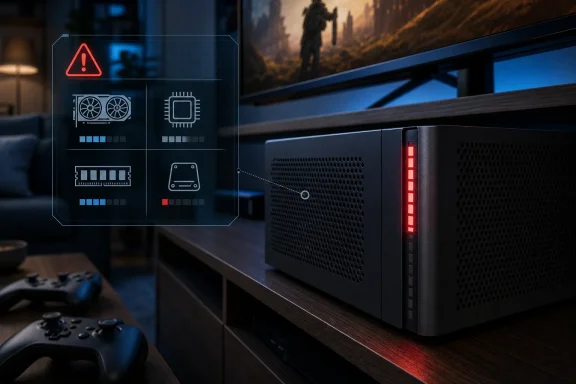
A red diagnostic light punctures that promise. The owner, posting as me_hill on the Steam Machine subreddit, said the system worked briefly, ran No Man’s Sky for about five minutes, installed an available update, and then “bricked itself.” According to reports from Tom’s Hardware and Technobezz, the front LED strip then displayed a blinking red pattern across the right half of the device.
That matters because Valve’s support material reportedly maps that right-half red breathing pattern to a detected GPU failure. It is not a vague “something went wrong” light. It is a diagnosis aimed at the most expensive and least user-serviceable part of the machine’s gaming identity.
The internet immediately reached for the Xbox 360’s Red Ring of Death, because of course it did. The comparison is emotionally obvious and technically premature. Microsoft’s failure was a mass-scale thermal and reliability disaster that eventually cost the company more than a billion dollars; Valve has, so far, one widely reported early failure from a first-run customer.
Still, the comparison tells us something important about how gaming hardware launches are remembered. A product can survive bugs, supply shortages, pricing debates, and missing features. But a memorable failure indicator on the front of the box can become the story faster than any spec sheet can correct it.
In practice, a red strip across the face of a new gaming machine is also a branding event. It is legible from a photograph. It travels well on Reddit. It compresses an entire support ticket into a phrase: Red Line of Death.
That is why this single report has received disproportionate attention. A lone graphics failure in a newly launched device is not statistically meaningful. Consumer electronics have early defects, and first production runs are where unlucky customers find the units that passed factory checks but fail under real-world conditions.
The issue is that Valve’s diagnostic design makes the failure theatrical. A conventional PC might refuse to post, throw a motherboard code, or black-screen after an update. Those events are frustrating, but they are not instantly mythologized. A half-red breathing light on the front of a new console-like machine is different. It has iconography.
This is the trap of making PCs more appliance-like. Consoles are not expected to expose their complexity, so when they fail, the failure appears total. A desktop owner might reseat a GPU, clear CMOS, swap a PSU, or test memory sticks. A Steam Machine owner who bought into the living-room pitch expects Valve to own the failure from end to end.
That expectation is reasonable. It is also expensive.
That distinction is central to the Steam Machine’s identity problem. Valve is selling PC gaming in a console form factor, but console form factors often come with console-style repair constraints. Small boards, integrated cooling, custom layouts, and soldered parts make for a cleaner product; they also move failure recovery away from the owner.
At $1,049, that trade-off lands harder. The Steam Machine is priced above mainstream consoles and in the same psychological territory as a capable small-form-factor gaming PC. Buyers at that price are not simply purchasing performance. They are purchasing trust that Valve’s hardware, software, drivers, update process, thermals, and support pipeline all work together.
That is why even a possibly isolated failure can stir anxiety. A $399 or $499 console that fails under warranty is annoying. A $1,049 machine that fails after a software update feels like a breach of the premium bargain.
It also complicates the usual PC enthusiast defense. Yes, all hardware can fail. Yes, one unit means almost nothing. But the Steam Machine is not being marketed as a pile of replaceable commodity parts. Its convenience comes from integration, and integration makes Valve the responsible party when a soldered component appears to die.
But update-adjacent failures are uniquely corrosive to user confidence. If a GPU physically fails, customers can understand it as bad luck. If an update can put a new device into a state that looks like GPU failure, the problem becomes less isolated and more frightening.
There are several plausible explanations, and the public evidence does not yet let us choose among them. The GPU may have been defective and merely failed coincidentally after the update. A firmware or BIOS update may have exposed an underlying hardware fault. A software bug may have caused a false-positive diagnostic state. A failed update may have corrupted low-level firmware in a way that prevents display initialization and triggers the GPU error path.
Those are very different problems. One is a warranty annoyance. Another is a production-quality concern. Another is a recoverability and update-design failure. Valve’s job is to determine which one this is before the phrase “Red Line of Death” hardens into folklore.
The company should also be careful not to hide behind the diagnostic label. “GPU failure” can mean a dead chip, but in modern systems it can also mean that the platform cannot initialize the graphics subsystem, cannot talk to it correctly, or cannot complete a boot-time check. Users hear “GPU failure” and imagine permanent silicon death. Support engineers know the category may be broader.
That distinction matters because the remedy may differ. A board replacement is one outcome. A recovery image, firmware rollback, or service-mode procedure is another. The worst possible outcome for Valve is ambiguity: customers seeing the red line, assuming catastrophic hardware failure, and waiting days for scarce replacement units when a software recovery path might exist.
Valve is nowhere near that territory. There is no evidence of widespread Steam Machine failures. There is no known pattern across batches. There is no public data suggesting defective thermal design, solder fatigue, or systemic GPU collapse.
But the comparison persists because the early shape is familiar: a new living-room gaming device, a visual red fault indicator, a graphics-related failure, and a customer whose machine dies almost immediately. The resemblance is superficial, but superficial resemblance is enough to drive headlines.
For Valve, the lesson from Microsoft is not “panic after one unit.” It is that hardware reliability stories become reputational stories when companies appear slow, opaque, or defensive. Microsoft’s eventual response to the Xbox 360 problem was expensive because the scale was enormous, but the reputational wound came from users feeling that the company had not owned the issue quickly enough.
Valve has an advantage Microsoft did not have in 2005: a direct support relationship, an enthusiast audience accustomed to firmware updates, and a distribution model that appears constrained enough to track early units closely. It should know exactly which batch this unit came from, what firmware it installed, and whether similar support tickets are appearing.
That is the benefit of a reservation-based rollout. The initial population is smaller, more engaged, and easier to study. The drawback is that early adopters are also very online, and a single photograph can become the launch narrative before the second batch leaves the warehouse.
If Valve has reserved replacement stock, the owner gets a quick swap and the story fades. If replacements are constrained by the same queue as new orders, the optics worsen. Early adopters already waited for scarce hardware. Being told to wait again because a unit failed after 20 minutes would make the machine feel less like a premium product and more like a lottery ticket.
This is where console expectations cut against Valve. When a PlayStation, Xbox, or Switch fails at launch, customers expect the platform holder to provide a replacement without forcing them to re-enter the retail scrum. Valve should be judged the same way, because it is selling the same kind of trust.
The company’s past support reputation among Steam Deck and Valve Index owners is mixed but often described as responsive, especially during launch-window hardware issues. That history helps, but it does not substitute for a clear policy. Steam Machine buyers need to know that a confirmed hardware fault will be handled as a priority replacement, not merely as a return in a constrained queue.
There is also a broader ecosystem concern. A Steam Machine is not just a box; it is a proof point for SteamOS as a living-room platform. If early support experiences feel uncertain, developers, accessory makers, and potential buyers will factor that uncertainty into their enthusiasm.
Tom’s Hardware and Technobezz both note the Steam Machine’s $1,049 price, a figure that places it above the mass-market console comfort zone. Valve reportedly wanted a lower price point, but the final number reflects the realities of unsubsidized PC hardware. Unlike Sony, Microsoft, or Nintendo, Valve cannot assume the same closed-platform economics around software margins and accessory licensing.
That makes the Steam Machine more honest, but also more exposed. If Valve is not subsidizing the box heavily, buyers will compare it to what they can assemble themselves. And if they compare it to a custom PC, the soldered GPU and appliance-like repair path become more salient.
The counterargument is that the Steam Machine is not trying to beat every DIY build on dollars per frame. It is trying to deliver a polished SteamOS experience in a quiet, compact, living-room-ready package. That has value, especially for players who want access to a large Steam library without managing Windows, drivers, launchers, and handheld compromises.
But polish is not a spec; it is a promise. A device that fails after an update, even once, challenges that promise more directly than a benchmark chart ever could.
Valve’s hardware pitch depends on the idea that PC gaming has become good enough, and SteamOS mature enough, to leave the desk. The Steam Deck proved that a Linux-based gaming device could make Proton compatibility, shader caches, controller profiles, suspend/resume, and storefront integration feel coherent. The Steam Machine tries to scale that idea to the TV.
That is a harder job than the Deck had. A handheld is personal and self-contained. A living-room box is communal. It competes for HDMI ports, spouse acceptance, family reliability, controller simplicity, and the expectation that pressing a button should start a game without ceremony.
A red GPU failure light therefore carries more symbolic weight on a Steam Machine than it would on a desktop motherboard. The desktop is allowed to be fussy. The living-room box is supposed to disappear.
Valve knows this, which is why the machine exists at all. SteamOS is not merely an operating system; it is Valve’s attempt to keep PC gaming from being trapped in Windows, desks, and handheld compromises. The hardware is a beachhead for an alternative living-room stack.
That makes reliability part of the platform strategy. If the first wave of users becomes a debugging cohort rather than an evangelist cohort, Valve loses the narrative advantage it earned with the Steam Deck.
That is useful engineering. It gives support staff and users a visible way to classify boot failures. It may reduce unnecessary troubleshooting and help Valve triage returns quickly.
But diagnostic transparency has a public-relations cost. A generic failure light might have produced a boring support story. A GPU-specific red line produces a headline. By telling users what the light means, Valve also gives the internet the vocabulary to dramatize it.
The answer is not to make diagnostics vaguer. The answer is to pair diagnostics with clear recovery language. If a right-half red pattern means “contact support for likely hardware service,” say that plainly. If it can also be caused by firmware initialization failure, say that too. If users should not attempt repeated power cycles, recovery images, or disassembly, spell that out.
In a world where every error code becomes a Reddit thread, support documentation is public messaging. Valve’s engineers may have written the LED table for support efficiency. The launch has turned it into crisis communications.
The next reservation batch matters because it increases the sample size. If the Red Line of Death remains a single unlucky case, the story will become a footnote. If more users report the same right-half red GPU pattern, especially after installing the same update, Valve will have a pattern it must address publicly.
The distinction between random defect and repeatable failure is everything. A manufacturing defect might cluster by batch, board revision, supplier lot, solder process, or thermal assembly. A firmware defect might cluster by update version. A diagnostic false positive might appear across otherwise healthy units. Each scenario requires a different response.
Valve should already be correlating support tickets against shipment dates, firmware versions, manufacturing lots, and usage sequences. It should also be watching whether affected systems fail after gaming load, after updates, after sleep/resume, or during initial setup. The public will see anecdotes; Valve should have data.
That data does not need to be published in full. But if additional cases appear, silence will no longer be a neutral posture. Enthusiast customers can tolerate defects. They are far less tolerant of uncertainty wrapped in corporate minimalism.
For decades, Windows has been the default gaming platform because it offered the broadest hardware support, the deepest driver ecosystem, and the largest native game compatibility base. Valve’s SteamOS push challenges that default by making a Linux-based gaming environment feel less like a hobbyist project and more like a consumer platform.
That challenge has never depended solely on frame rates. It depends on trust. If SteamOS devices are perceived as reliable, recoverable, and easier than Windows PCs in the living room, Valve gains ground. If they are perceived as opaque appliances with soldered parts and mysterious red failure states, Windows remains the messy but understandable fallback.
There is an irony here. Many Windows gaming PCs are harder to support than a Steam Machine because they combine arbitrary motherboards, GPUs, drivers, RGB utilities, anti-cheat layers, overlays, and firmware histories. But they also preserve a sense of user agency. When something breaks, a knowledgeable owner can often isolate and replace the culprit.
Valve is asking users to trade some of that agency for elegance. That trade can work, as the Steam Deck demonstrated. But the living-room PC has less patience for tinkering and a higher expectation of permanence. If the box under the TV behaves like a console, users will expect console-like warranty handling. If it behaves like a PC, they will expect PC-like serviceability. The Steam Machine lives uncomfortably between those two standards.
That is a delicate pitch. PC gamers are used to trade-offs, but living-room buyers are not shopping for a weekend project. They want the Steam library on the couch, controller-first navigation, reliable suspend/resume, and enough performance to justify the price. They do not want to learn LED fault quadrants.
Valve can still turn this incident into a non-story. A fast replacement, a clear explanation to the affected user, and no recurrence across the next shipment would make the Red Line of Death a launch-week curiosity. The internet loves a hardware scare, but it also moves on when the pattern fails to materialize.
The danger grows if Valve treats the story as too small to address while the community treats it as too vivid to ignore. Hardware trust is built in public now. Every support exchange, diagnostic table, and replacement delay becomes part of the launch record.
That is especially true for a company like Valve, which communicates less frequently and less formally than many platform holders. Its silence can feel confident when things are going well. During a hardware scare, the same silence can look like evasiveness.
 Valve Built a Console-Like PC, and Now It Has a Console-Like Panic
The Steam Machine was always going to be judged by a strange hybrid standard. Valve wants the flexibility and catalog depth of PC gaming, wrapped in the appliance-like simplicity of a console. That bargain is attractive precisely because it promises to hide the messy parts of PC ownership from the couch.A red diagnostic light punctures that promise. The owner, posting as me_hill on the Steam Machine subreddit, said the system worked briefly, ran No Man’s Sky for about five minutes, installed an available update, and then “bricked itself.” According to reports from Tom’s Hardware and Technobezz, the front LED strip then displayed a blinking red pattern across the right half of the device.
That matters because Valve’s support material reportedly maps that right-half red breathing pattern to a detected GPU failure. It is not a vague “something went wrong” light. It is a diagnosis aimed at the most expensive and least user-serviceable part of the machine’s gaming identity.
The internet immediately reached for the Xbox 360’s Red Ring of Death, because of course it did. The comparison is emotionally obvious and technically premature. Microsoft’s failure was a mass-scale thermal and reliability disaster that eventually cost the company more than a billion dollars; Valve has, so far, one widely reported early failure from a first-run customer.
Still, the comparison tells us something important about how gaming hardware launches are remembered. A product can survive bugs, supply shortages, pricing debates, and missing features. But a memorable failure indicator on the front of the box can become the story faster than any spec sheet can correct it.
The Red Line Is a Diagnostic Code, but the Meme Is the Product Risk
Valve’s LED strip was supposed to be useful. On a small living-room PC with limited front-panel feedback, a visible status bar can communicate boot progress, updates, thermals, and component problems without forcing the user into BIOS screens or external monitors. In theory, that is good product design.In practice, a red strip across the face of a new gaming machine is also a branding event. It is legible from a photograph. It travels well on Reddit. It compresses an entire support ticket into a phrase: Red Line of Death.
That is why this single report has received disproportionate attention. A lone graphics failure in a newly launched device is not statistically meaningful. Consumer electronics have early defects, and first production runs are where unlucky customers find the units that passed factory checks but fail under real-world conditions.
The issue is that Valve’s diagnostic design makes the failure theatrical. A conventional PC might refuse to post, throw a motherboard code, or black-screen after an update. Those events are frustrating, but they are not instantly mythologized. A half-red breathing light on the front of a new console-like machine is different. It has iconography.
This is the trap of making PCs more appliance-like. Consoles are not expected to expose their complexity, so when they fail, the failure appears total. A desktop owner might reseat a GPU, clear CMOS, swap a PSU, or test memory sticks. A Steam Machine owner who bought into the living-room pitch expects Valve to own the failure from end to end.
That expectation is reasonable. It is also expensive.
The GPU Failure Code Is Serious Because the GPU Is Not a Card
The reported fault points to the part of the Steam Machine that buyers cannot treat like a normal desktop component. Technobezz notes that the GPU is soldered to the motherboard, which means a confirmed hardware failure would not be resolved by popping open the case and replacing a graphics card. It would require a warranty replacement, a board-level repair, or professional service.That distinction is central to the Steam Machine’s identity problem. Valve is selling PC gaming in a console form factor, but console form factors often come with console-style repair constraints. Small boards, integrated cooling, custom layouts, and soldered parts make for a cleaner product; they also move failure recovery away from the owner.
At $1,049, that trade-off lands harder. The Steam Machine is priced above mainstream consoles and in the same psychological territory as a capable small-form-factor gaming PC. Buyers at that price are not simply purchasing performance. They are purchasing trust that Valve’s hardware, software, drivers, update process, thermals, and support pipeline all work together.
That is why even a possibly isolated failure can stir anxiety. A $399 or $499 console that fails under warranty is annoying. A $1,049 machine that fails after a software update feels like a breach of the premium bargain.
It also complicates the usual PC enthusiast defense. Yes, all hardware can fail. Yes, one unit means almost nothing. But the Steam Machine is not being marketed as a pile of replaceable commodity parts. Its convenience comes from integration, and integration makes Valve the responsible party when a soldered component appears to die.
The Update Timing Is the Detail Valve Needs to Explain
The owner’s account includes one especially important sequence: the system worked, played a game briefly, installed an update, and then failed. That chronology does not prove the update caused the problem. Hardware often fails under the first meaningful stress, and early setup can be the first time a machine draws sustained power, warms up, and exercises its firmware paths.But update-adjacent failures are uniquely corrosive to user confidence. If a GPU physically fails, customers can understand it as bad luck. If an update can put a new device into a state that looks like GPU failure, the problem becomes less isolated and more frightening.
There are several plausible explanations, and the public evidence does not yet let us choose among them. The GPU may have been defective and merely failed coincidentally after the update. A firmware or BIOS update may have exposed an underlying hardware fault. A software bug may have caused a false-positive diagnostic state. A failed update may have corrupted low-level firmware in a way that prevents display initialization and triggers the GPU error path.
Those are very different problems. One is a warranty annoyance. Another is a production-quality concern. Another is a recoverability and update-design failure. Valve’s job is to determine which one this is before the phrase “Red Line of Death” hardens into folklore.
The company should also be careful not to hide behind the diagnostic label. “GPU failure” can mean a dead chip, but in modern systems it can also mean that the platform cannot initialize the graphics subsystem, cannot talk to it correctly, or cannot complete a boot-time check. Users hear “GPU failure” and imagine permanent silicon death. Support engineers know the category may be broader.
That distinction matters because the remedy may differ. A board replacement is one outcome. A recovery image, firmware rollback, or service-mode procedure is another. The worst possible outcome for Valve is ambiguity: customers seeing the red line, assuming catastrophic hardware failure, and waiting days for scarce replacement units when a software recovery path might exist.
The Xbox 360 Comparison Is Unfair, but Valve Cannot Ignore It
The Xbox 360 Red Ring of Death is not just a gaming meme. It is the canonical warning about what happens when thermal design, manufacturing tolerances, and launch pressure collide with mass-market hardware. Microsoft eventually extended warranties and took a charge widely reported at roughly $1.15 billion.Valve is nowhere near that territory. There is no evidence of widespread Steam Machine failures. There is no known pattern across batches. There is no public data suggesting defective thermal design, solder fatigue, or systemic GPU collapse.
But the comparison persists because the early shape is familiar: a new living-room gaming device, a visual red fault indicator, a graphics-related failure, and a customer whose machine dies almost immediately. The resemblance is superficial, but superficial resemblance is enough to drive headlines.
For Valve, the lesson from Microsoft is not “panic after one unit.” It is that hardware reliability stories become reputational stories when companies appear slow, opaque, or defensive. Microsoft’s eventual response to the Xbox 360 problem was expensive because the scale was enormous, but the reputational wound came from users feeling that the company had not owned the issue quickly enough.
Valve has an advantage Microsoft did not have in 2005: a direct support relationship, an enthusiast audience accustomed to firmware updates, and a distribution model that appears constrained enough to track early units closely. It should know exactly which batch this unit came from, what firmware it installed, and whether similar support tickets are appearing.
That is the benefit of a reservation-based rollout. The initial population is smaller, more engaged, and easier to study. The drawback is that early adopters are also very online, and a single photograph can become the launch narrative before the second batch leaves the warehouse.
The Reservation Queue Turns Replacement Logistics Into Part of the Story
Technobezz reports that Valve is distributing first-run units through a reservation system, with another batch expected later in July. That means a failed launch unit is not merely a customer-service case; it is a supply-chain test.If Valve has reserved replacement stock, the owner gets a quick swap and the story fades. If replacements are constrained by the same queue as new orders, the optics worsen. Early adopters already waited for scarce hardware. Being told to wait again because a unit failed after 20 minutes would make the machine feel less like a premium product and more like a lottery ticket.
This is where console expectations cut against Valve. When a PlayStation, Xbox, or Switch fails at launch, customers expect the platform holder to provide a replacement without forcing them to re-enter the retail scrum. Valve should be judged the same way, because it is selling the same kind of trust.
The company’s past support reputation among Steam Deck and Valve Index owners is mixed but often described as responsive, especially during launch-window hardware issues. That history helps, but it does not substitute for a clear policy. Steam Machine buyers need to know that a confirmed hardware fault will be handled as a priority replacement, not merely as a return in a constrained queue.
There is also a broader ecosystem concern. A Steam Machine is not just a box; it is a proof point for SteamOS as a living-room platform. If early support experiences feel uncertain, developers, accessory makers, and potential buyers will factor that uncertainty into their enthusiasm.
A $1,049 Machine Has Less Room for Early-Adopter Forgiveness
Price changes the emotional math of hardware failure. Enthusiasts forgive rough edges when a product feels experimental, subsidized, or aggressively priced. They are less forgiving when it costs more than a mainstream console and competes with self-built PCs.Tom’s Hardware and Technobezz both note the Steam Machine’s $1,049 price, a figure that places it above the mass-market console comfort zone. Valve reportedly wanted a lower price point, but the final number reflects the realities of unsubsidized PC hardware. Unlike Sony, Microsoft, or Nintendo, Valve cannot assume the same closed-platform economics around software margins and accessory licensing.
That makes the Steam Machine more honest, but also more exposed. If Valve is not subsidizing the box heavily, buyers will compare it to what they can assemble themselves. And if they compare it to a custom PC, the soldered GPU and appliance-like repair path become more salient.
The counterargument is that the Steam Machine is not trying to beat every DIY build on dollars per frame. It is trying to deliver a polished SteamOS experience in a quiet, compact, living-room-ready package. That has value, especially for players who want access to a large Steam library without managing Windows, drivers, launchers, and handheld compromises.
But polish is not a spec; it is a promise. A device that fails after an update, even once, challenges that promise more directly than a benchmark chart ever could.
Valve’s Real Competition Is Not Just Sony and Microsoft
The Steam Machine’s most dangerous competitor may not be the PlayStation 5 Pro or the next Xbox. It may be the user’s own tolerance for PC inconvenience.Valve’s hardware pitch depends on the idea that PC gaming has become good enough, and SteamOS mature enough, to leave the desk. The Steam Deck proved that a Linux-based gaming device could make Proton compatibility, shader caches, controller profiles, suspend/resume, and storefront integration feel coherent. The Steam Machine tries to scale that idea to the TV.
That is a harder job than the Deck had. A handheld is personal and self-contained. A living-room box is communal. It competes for HDMI ports, spouse acceptance, family reliability, controller simplicity, and the expectation that pressing a button should start a game without ceremony.
A red GPU failure light therefore carries more symbolic weight on a Steam Machine than it would on a desktop motherboard. The desktop is allowed to be fussy. The living-room box is supposed to disappear.
Valve knows this, which is why the machine exists at all. SteamOS is not merely an operating system; it is Valve’s attempt to keep PC gaming from being trapped in Windows, desks, and handheld compromises. The hardware is a beachhead for an alternative living-room stack.
That makes reliability part of the platform strategy. If the first wave of users becomes a debugging cohort rather than an evangelist cohort, Valve loses the narrative advantage it earned with the Steam Deck.
The LED Codes Show Valve Planned for Failure, Not Necessarily for Fear
One overlooked point in the reporting is that Valve’s red LED patterns appear to be unusually specific. According to Technobezz, the support documentation distinguishes between overheating, memory-check failure, SSD detection failure, missing RAM, and GPU failure. A full red strip reportedly indicates overheating, with CPU or GPU temperatures exceeding defined thresholds. Partial red patterns identify different hardware checks.That is useful engineering. It gives support staff and users a visible way to classify boot failures. It may reduce unnecessary troubleshooting and help Valve triage returns quickly.
But diagnostic transparency has a public-relations cost. A generic failure light might have produced a boring support story. A GPU-specific red line produces a headline. By telling users what the light means, Valve also gives the internet the vocabulary to dramatize it.
The answer is not to make diagnostics vaguer. The answer is to pair diagnostics with clear recovery language. If a right-half red pattern means “contact support for likely hardware service,” say that plainly. If it can also be caused by firmware initialization failure, say that too. If users should not attempt repeated power cycles, recovery images, or disassembly, spell that out.
In a world where every error code becomes a Reddit thread, support documentation is public messaging. Valve’s engineers may have written the LED table for support efficiency. The launch has turned it into crisis communications.
One Failure Is Not a Pattern, but It Is a Signal to Watch the Next Batch
The most important sentence in this story is also the least exciting: one reported unit does not establish a systemic defect. Every hardware launch produces some number of failures, and early customers are more likely to report them loudly because they are excited, disappointed, and surrounded by other early adopters.The next reservation batch matters because it increases the sample size. If the Red Line of Death remains a single unlucky case, the story will become a footnote. If more users report the same right-half red GPU pattern, especially after installing the same update, Valve will have a pattern it must address publicly.
The distinction between random defect and repeatable failure is everything. A manufacturing defect might cluster by batch, board revision, supplier lot, solder process, or thermal assembly. A firmware defect might cluster by update version. A diagnostic false positive might appear across otherwise healthy units. Each scenario requires a different response.
Valve should already be correlating support tickets against shipment dates, firmware versions, manufacturing lots, and usage sequences. It should also be watching whether affected systems fail after gaming load, after updates, after sleep/resume, or during initial setup. The public will see anecdotes; Valve should have data.
That data does not need to be published in full. But if additional cases appear, silence will no longer be a neutral posture. Enthusiast customers can tolerate defects. They are far less tolerant of uncertainty wrapped in corporate minimalism.
The Windows Angle Is Bigger Than One Valve Box
For WindowsForum readers, the Steam Machine story is not just about Valve hardware. It is part of a larger struggle over where PC gaming lives.For decades, Windows has been the default gaming platform because it offered the broadest hardware support, the deepest driver ecosystem, and the largest native game compatibility base. Valve’s SteamOS push challenges that default by making a Linux-based gaming environment feel less like a hobbyist project and more like a consumer platform.
That challenge has never depended solely on frame rates. It depends on trust. If SteamOS devices are perceived as reliable, recoverable, and easier than Windows PCs in the living room, Valve gains ground. If they are perceived as opaque appliances with soldered parts and mysterious red failure states, Windows remains the messy but understandable fallback.
There is an irony here. Many Windows gaming PCs are harder to support than a Steam Machine because they combine arbitrary motherboards, GPUs, drivers, RGB utilities, anti-cheat layers, overlays, and firmware histories. But they also preserve a sense of user agency. When something breaks, a knowledgeable owner can often isolate and replace the culprit.
Valve is asking users to trade some of that agency for elegance. That trade can work, as the Steam Deck demonstrated. But the living-room PC has less patience for tinkering and a higher expectation of permanence. If the box under the TV behaves like a console, users will expect console-like warranty handling. If it behaves like a PC, they will expect PC-like serviceability. The Steam Machine lives uncomfortably between those two standards.
The Story Valve Wants Is Convenience; the Story It Must Avoid Is Fragility
The Steam Machine’s biggest challenge is not that one GPU may have failed. It is that the product’s entire value proposition depends on reducing anxiety. It asks buyers to believe that Valve can do for the living room what it did for handheld PC gaming: hide the seams without removing the freedom.That is a delicate pitch. PC gamers are used to trade-offs, but living-room buyers are not shopping for a weekend project. They want the Steam library on the couch, controller-first navigation, reliable suspend/resume, and enough performance to justify the price. They do not want to learn LED fault quadrants.
Valve can still turn this incident into a non-story. A fast replacement, a clear explanation to the affected user, and no recurrence across the next shipment would make the Red Line of Death a launch-week curiosity. The internet loves a hardware scare, but it also moves on when the pattern fails to materialize.
The danger grows if Valve treats the story as too small to address while the community treats it as too vivid to ignore. Hardware trust is built in public now. Every support exchange, diagnostic table, and replacement delay becomes part of the launch record.
That is especially true for a company like Valve, which communicates less frequently and less formally than many platform holders. Its silence can feel confident when things are going well. During a hardware scare, the same silence can look like evasiveness.
The First Red Line Leaves Valve With a Short, Practical Checklist
The sensible reading is neither panic nor dismissal. The first reported Steam Machine GPU failure is a small data point with a large symbolic footprint, and Valve’s response over the next few weeks will determine which part matters more.- Valve should treat any confirmed right-half red GPU fault in launch units as a priority replacement case, not a normal return competing with reservation demand.
- Valve should clarify whether the GPU failure LED can be triggered by firmware or initialization problems rather than permanent silicon failure.
- Valve should watch the next July shipment for repeated failures after the same setup or update sequence.
- Buyers should avoid assuming a systemic defect unless multiple independent reports emerge from the next batch.
- Reviewers and early adopters should distinguish between a dead GPU, a failed update, and a diagnostic false positive, because those are materially different problems.
- The Steam Machine’s $1,049 price makes support speed and transparency part of the product, not an afterthought.
References
- Primary source: Technobezz
Published: 2026-07-04T21:30:17.186689
Loading…
www.technobezz.com - Independent coverage: Tom's Hardware
Published: Fri, 03 Jul 2026 13:58:19 GMT
Loading…
www.tomshardware.com - Related coverage: gamesradar.com
Loading…
www.gamesradar.com - Related coverage: windowscentral.com
Loading…
www.windowscentral.com - Related coverage: pcgamer.com
Loading…
www.pcgamer.com - Related coverage: techradar.com
Loading…
www.techradar.com
- Related coverage: overclock3d.net
Loading…
overclock3d.net - Related coverage: noobfeed.com
Loading…
www.noobfeed.com - Related coverage: warp2search.net
Loading…
www.warp2search.net - Related coverage: club386.com
Loading…
www.club386.com - Related coverage: gamevicio.com
Loading…
www.gamevicio.com - Related coverage: androidauthority.com
Loading…
www.androidauthority.com - Related coverage: games.gg
Loading…
games.gg - Related coverage: particle.news
Loading…
particle.news - Related coverage: portaltela.com
Loading…
www.portaltela.com - Related coverage: playcentral.de
Loading…
www.playcentral.de
