

Valve’s revived Steam Machine is expected to ship in summer 2026 alongside Steam Frame and the new Steam Controller, but as of June 17 Valve has not publicly confirmed a final release date, reservation date, or price. That distinction matters because the current frenzy is being driven by a mix of official SteamOS work, credible-looking timing clues, and old-fashioned leak math. The hardware may be close; the business case is still the thing Valve has to prove. This is less a console launch than a referendum on whether SteamOS can finally move from handheld success to living-room platform.
The revived Steam Machine is not simply Valve taking another swing at the living room. It is Valve trying to turn the Steam Deck’s most important achievement — not the plastic, not the APU, but the operating system — into a broader hardware category. That makes the Steam Machine more interesting than a cube-shaped gaming PC and more strategically awkward than a PlayStation or Xbox rival.
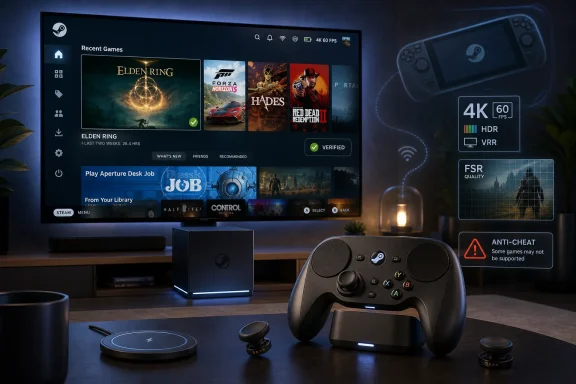
Valve’s public pitch is familiar enough: a compact SteamOS box, powered by semi-custom AMD hardware, designed for television play and meant to offer a console-like experience without the console lock-in. It targets 4K gaming at 60 frames per second with upscaling, supports modern display features, and arrives with a redesigned Steam Controller intended to make the couch feel less like a compromise for PC games.
But Valve is careful, as ever, not to describe the machine in the language Sony and Microsoft use. It is not promising a subsidized living-room appliance with a fixed generation and a retail shelf war. It is promising a PC-like Steam device that happens to sit under a TV.
That difference is not semantic. It explains why pricing is still the story, why anti-cheat compatibility remains a caveat, and why the first real test will not be whether the Steam Machine can run games. The test will be whether it can make PC gaming feel boringly reliable in the one place PC gaming has historically struggled: the couch.
What they do not yet fit is the standard of a confirmed launch. Valve has publicly moved the conversation toward summer 2026 shipping for Steam Machine and Steam Frame, but it has not published the final consumer timetable. Until it does, June 23 is best treated as a highly watched date rather than a fact.
This matters because the Steam Machine has already been through one expectation reset. Earlier messaging pointed to 2026 broadly, while later reporting and Valve-adjacent discussion tied delays to component costs and memory supply constraints. In a normal console cycle, that might be noise. In a Valve hardware launch, it is part of the product.
Valve tends to announce when it is ready, not when the industry calendar demands it. The company can afford to be strange because Steam itself pays the bills. That freedom lets Valve avoid panic launches, but it also leaves buyers and developers reading beta notes like tea leaves.
The SteamOS beta line mentioning initial support for upcoming Steam Machine hardware is therefore significant but not decisive. It shows the software train is moving. It does not prove the retail train has reached the station.
That sounds obvious, but it is the lesson Valve failed to land with the first Steam Machines a decade ago. Back then, SteamOS was an interesting Linux experiment bolted to a confusing third-party hardware ecosystem. The operating system did not have the compatibility layer, storefront integration, suspend behavior, controller support, or developer gravity needed to make the living-room pitch coherent.
The Steam Deck changed that. Proton made vast chunks of the Windows game library playable on Linux. The Deck Verified program gave users a rough but useful expectation system. Game Mode gave SteamOS a console-like front end that did not require users to care about window managers, driver stacks, or package updates.
The new Steam Machine inherits all of that work. It also inherits all of SteamOS’s unresolved problems.
That is why the beta updates matter. Initial hardware support is not just a driver footnote. It is the sign of Valve preparing SteamOS to treat the Steam Machine as a first-class device, not as a PC that happens to boot into Steam. If Valve gets that right, the machine has a chance to feel like a console without becoming one.
If it gets it wrong, users will discover the old bargain again: Linux gaming is astonishingly good until the one game you wanted to play does not cooperate.
That is a credible spec sheet for the TV. It is not a magic one.
The 4K claim depends heavily on upscaling, which is now normal across the industry but still worth saying plainly. Sony, Microsoft, Nvidia, AMD, and game developers have all normalized reconstructed pixels as part of modern performance targeting. Valve is not cheating by leaning on FSR; it is doing what every platform holder now does. But buyers should understand that “4K gaming” in 2026 usually means a performance strategy, not brute-force native rendering in every title.
The “six times Steam Deck” comparison is more useful as a generational marker than as a shopping guide. The Steam Deck is a 15-watt handheld with an aging but beautifully targeted AMD APU. Outrunning it by a wide margin is necessary for a living-room box, not evidence that the Steam Machine will demolish high-end gaming PCs or even every current console scenario.
Still, the design is coherent. Valve appears to be building a machine that sits above handheld compromises and below boutique PC excess. That middle ground is exactly where a SteamOS console-PC hybrid should live.
The harder question is whether the price will allow it to live there.
Valve has already warned, according to reporting, that memory and storage costs have affected hardware planning. That is not hard to believe. RAM, GDDR memory, SSDs, and related component markets have been volatile, and hardware makers cannot simply wish those costs away. A console platform can sometimes absorb that pain through subsidy and software royalties. Valve’s situation is more complicated.
Steam gives Valve a powerful software business, but the Steam Machine is still a PC-like device. If Valve prices it like a console, it may have to accept thinner margins or losses. If it prices it like a compact gaming PC, it risks losing the mainstream living-room argument before the first reservation page loads.
This is where comparisons to the PS5 Pro become unavoidable. If the Steam Machine lands near or above premium console pricing, it will have to justify itself with openness, library ownership, repairability, Steam sales, mod support, and PC flexibility. Those are real advantages. They are not always the advantages that move a living-room buyer who wants to play a few big games after work.
Valve’s best customers may be Steam Deck owners who already understand the trade. They know what Proton is. They know what shader compilation is. They have seen a game go from unsupported to playable after an update. They may accept an expensive SteamOS box because it extends a library they already own.
The broader console market is less forgiving. A high price would not kill the Steam Machine. It would define it as an enthusiast platform first and a mass-market console challenger second.
SteamOS does not need to beat Windows on the desktop to matter. It only needs to become the preferred operating system for enough gaming appliances that developers, anti-cheat vendors, and peripheral makers treat it as a platform rather than a curiosity. The Steam Deck already pushed that door open. The Steam Machine would push from the living room.
That should worry Microsoft more than raw unit sales. Windows remains the compatibility king, especially for competitive multiplayer titles, launchers, productivity software, modding tools, and the messy long tail of PC use. But gaming is one of the reasons many consumers keep Windows machines in the first place. If Valve can peel off handhelds and couch PCs into a SteamOS-first world, Microsoft loses some of the gravitational pull that made Windows the unquestioned home of PC gaming.
The timing is especially pointed because Microsoft has spent years trying to make Windows work better on handheld and console-adjacent devices, while also pushing Xbox as an ecosystem rather than a single box. The ASUS ROG Xbox Ally line and Windows handheld efforts show that Microsoft sees the same terrain Valve sees. The difference is that Valve controls the storefront, the shell, the compatibility layer, and the community expectation around SteamOS.
Windows still wins on breadth. SteamOS is trying to win on appliance behavior. That is a narrower target, but it is exactly the one that matters under a television.
This caveat is often waved away by enthusiasts because so much already works. That is understandable and dangerous. A living-room device is judged by the game someone wants to play tonight, not by the percentage of the Steam catalog that runs in theory.
If a major competitive title fails because its anti-cheat stack blocks SteamOS, the user does not blame the architecture of modern security tooling. They blame the box. Valve knows this, which is why the verification program matters and why messaging around compatibility must be conservative.
There is also a cultural tension here. Kernel-level anti-cheat has become controversial among security-minded users for good reasons. It expands trust, increases complexity, and asks players to accept deep system hooks in exchange for competitive integrity. SteamOS, by design, offers a different security and platform model. The conflict between those worlds will not be solved by wishful thinking.
Valve can pressure, persuade, and provide tooling. It cannot unilaterally make every publisher support SteamOS. That makes anti-cheat the Steam Machine’s most visible reminder that openness is not the same as universal compatibility.
Valve now has a better foundation. Steam Input is mature. The Steam Deck has trained millions of users to accept community layouts, gyro aiming, touchpads, rear buttons, and per-game profiles. The new controller arrives into that ecosystem rather than trying to invent it from scratch.
That matters because the Steam Machine must do more than run console-friendly games. If it only plays the same controller-native blockbusters as every other box, its advantage shrinks. Its promise is that a TV setup can reach deeper into the PC library without making users balance a keyboard on the couch.
Features such as magnetic thumbsticks, wireless charging, motion controls, and modern connectivity are useful. The bigger deal is whether the controller makes PC-native games feel approachable in a ten-foot interface. Valve does not need to make every strategy game perfect from the sofa. It needs to make enough of them feel plausible.
If the controller works, it expands the Steam Machine’s library in practice. If it does not, the machine becomes another small PC attached to a television, waiting for someone to plug in a keyboard.
It also complicates the support story.
A locked console has a narrow failure surface. A PC-like console has an expanding one. Users will dual-boot, install Windows, tweak firmware, sideload software, attach odd peripherals, replace storage, and then expect the official experience to remain clean. Valve can encourage openness, but it cannot make chaos disappear.
This is where SteamOS has to carry more weight than a normal Linux distribution. Users do not want a lecture about package conflicts when a game fails to launch. They want the system to recover gracefully, update predictably, and preserve the appliance illusion even after they have done PC things to it.
The Steam Deck showed Valve can manage this balance better than skeptics expected. Desktop Mode exists, but most users live in Game Mode. The underlying Linux system is accessible, but the default experience is curated. That same split will be essential on the Steam Machine.
The device has to be open enough to satisfy PC people and closed enough, by default, to avoid punishing everyone else. That is a subtle product problem, and Valve is one of the few companies in gaming with both the technical credibility and community goodwill to attempt it.
It was not that the idea was foolish. It was that the stack was premature.
Valve lacked Proton as it exists today. Linux graphics drivers were less friendly. Controller mapping was less mature. The Steam storefront had not yet trained users to think in compatibility badges. The PC market had not yet normalized compact gaming systems, handheld PCs, or upscaling as a standard performance tool.
Most importantly, Valve did not ship a single obvious hero product. It tried to make Steam Machines a category before it had proven the experience. The Steam Deck reversed that order. Valve shipped the hero product first, then built a category around the lessons it learned.
That is why the 2026 Steam Machine is not merely a retry. It is a sequel made after the prequel accidentally taught the company what the real product should have been.
Sony sells a tightly integrated console platform built around exclusives, subscriptions, first-party studios, and a predictable hardware target. Microsoft now sells Xbox as a more fluid ecosystem spanning consoles, Windows PCs, cloud gaming, Game Pass, and handheld partnerships. Valve sells access to a PC game marketplace and increasingly builds hardware to make that marketplace feel native in new contexts.
The Steam Machine does not need to outsell PlayStation to succeed. It needs to make Steam feel like it belongs on the television without apology. That is a smaller goal in market-share terms and a larger one in platform terms.
If Valve can establish SteamOS as a credible living-room operating system, the hardware itself becomes only one expression of the strategy. Third-party devices, mini PCs, handheld docks, and future SteamOS machines could all benefit. The first Steam Machine may be less important as a console than as a reference design.
That is why Microsoft should watch it carefully even if sales are modest. Platform shifts rarely begin by conquering the mainstream. They begin by making a niche feel inevitable.
Valve’s advantage is that developers already care about Steam. They do not need to be convinced that Steam users exist. They need to be convinced that SteamOS users are numerous enough, predictable enough, and commercially meaningful enough to justify polish.
The Steam Deck helped make that argument. It created a visible class of users who rewarded games that ran well on Valve’s handheld. It also created a storefront badge that could influence purchasing decisions. Steam Machine and Steam Frame appear to extend that verification logic, which suggests Valve is trying to turn hardware support into a storefront-wide quality signal.
That could be powerful. A game that is verified across Deck, Machine, and Frame is not merely compatible with a device. It is legible inside Steam’s buying experience. In a store with overwhelming choice, legibility matters.
But developers will not optimize for rumors. They will optimize for shipped hardware, active users, and support burden. Valve’s summer launch window is therefore not just a consumer date. It is the start of the data developers will actually believe.
PC gaming tolerates friction because PC gamers tolerate agency. Driver updates, graphics presets, launcher weirdness, cloud save conflicts, mod managers, keyboard prompts, and account sign-ins are part of the landscape. Console players, even technically savvy ones, expect less negotiation from the device attached to the television.
Valve has spent years sanding down that friction on the Steam Deck. The suspend-and-resume experience, when it works, is transformative. The Deck’s interface makes PC games feel browsable in a console-like way. Cloud saves make switching devices feel natural. These are not glamorous features, but they are the features that let hardware disappear.
The living room raises the standard. A handheld can be personal and slightly fiddly. A TV device is communal. It may be used by children, spouses, roommates, guests, and people who did not buy it. The interface must survive interruptions, controller handoffs, sleep states, display quirks, and the eternal problem of someone pressing the wrong button on the TV remote.
This is where Valve’s software maturity will matter more than benchmark charts. A Steam Machine that occasionally needs troubleshooting will still delight enthusiasts. A Steam Machine that behaves predictably every night could become something larger.
At an aggressive price, the Steam Machine becomes a serious living-room challenger and a natural upgrade path for Steam Deck owners. It could tempt console players with large Steam libraries, cheaper game sales, and the promise of a more open box. It could also put pressure on Windows gaming handhelds and mini PCs that rely on less polished software experiences.
At a premium price, the story changes. The Steam Machine becomes a polished enthusiast PC for the couch, closer to a boutique appliance than a mass-market console. That is still a valid product. It may even be the honest product in a brutal component market. But it would narrow the audience and make every compatibility gap feel more expensive.
Valve probably understands this better than anyone. The Steam Deck worked not only because it was clever, but because its entry price made the experiment feel accessible. Users were willing to forgive rough edges because the value proposition was strong. A four-figure Steam Machine would not receive the same patience.
The machine can be expensive or imperfect. It should not be both.
That trust gives Valve room to maneuver. It can say some games will not work immediately. It can lean on upscaling. It can leave the door open for alternate operating systems. It can ship a product that is more PC than console and still find an audience.
But trust is not infinite. If launch messaging overpromises 4K performance, hides compatibility caveats, or lets pricing shock drown out the platform story, Valve will make the Steam Machine’s job harder than it needs to be. The company’s best move is plain speaking: here is what it runs well, here is what still needs work, here is why SteamOS on the TV is worth buying into.
Valve does not need to pretend this is a PlayStation. It needs to make the case that the living room deserves a better PC.
 Valve Has Built a Console Without Wanting to Be a Console Company
The revived Steam Machine is not simply Valve taking another swing at the living room. It is Valve trying to turn the Steam Deck’s most important achievement — not the plastic, not the APU, but the operating system — into a broader hardware category. That makes the Steam Machine more interesting than a cube-shaped gaming PC and more strategically awkward than a PlayStation or Xbox rival.Valve’s public pitch is familiar enough: a compact SteamOS box, powered by semi-custom AMD hardware, designed for television play and meant to offer a console-like experience without the console lock-in. It targets 4K gaming at 60 frames per second with upscaling, supports modern display features, and arrives with a redesigned Steam Controller intended to make the couch feel less like a compromise for PC games.
But Valve is careful, as ever, not to describe the machine in the language Sony and Microsoft use. It is not promising a subsidized living-room appliance with a fixed generation and a retail shelf war. It is promising a PC-like Steam device that happens to sit under a TV.
That difference is not semantic. It explains why pricing is still the story, why anti-cheat compatibility remains a caveat, and why the first real test will not be whether the Steam Machine can run games. The test will be whether it can make PC gaming feel boringly reliable in the one place PC gaming has historically struggled: the couch.
The Release-Date Rumor Is Plausible, but It Is Not Yet a Release Date
The latest round of excitement centers on a rumored June 23 announcement, a possible June 30 reservation date, and claims that reviewers or creators may already have hardware. Those dates fit a neat narrative. They also fit the calendar pressure implied by Valve’s summer shipping window.What they do not yet fit is the standard of a confirmed launch. Valve has publicly moved the conversation toward summer 2026 shipping for Steam Machine and Steam Frame, but it has not published the final consumer timetable. Until it does, June 23 is best treated as a highly watched date rather than a fact.
This matters because the Steam Machine has already been through one expectation reset. Earlier messaging pointed to 2026 broadly, while later reporting and Valve-adjacent discussion tied delays to component costs and memory supply constraints. In a normal console cycle, that might be noise. In a Valve hardware launch, it is part of the product.
Valve tends to announce when it is ready, not when the industry calendar demands it. The company can afford to be strange because Steam itself pays the bills. That freedom lets Valve avoid panic launches, but it also leaves buyers and developers reading beta notes like tea leaves.
The SteamOS beta line mentioning initial support for upcoming Steam Machine hardware is therefore significant but not decisive. It shows the software train is moving. It does not prove the retail train has reached the station.
SteamOS Is the Product Valve Is Really Shipping
The most important Steam Machine spec may not be the CPU, GPU, RAM, or storage tier. It may be the sentence that says the box runs SteamOS.That sounds obvious, but it is the lesson Valve failed to land with the first Steam Machines a decade ago. Back then, SteamOS was an interesting Linux experiment bolted to a confusing third-party hardware ecosystem. The operating system did not have the compatibility layer, storefront integration, suspend behavior, controller support, or developer gravity needed to make the living-room pitch coherent.
The Steam Deck changed that. Proton made vast chunks of the Windows game library playable on Linux. The Deck Verified program gave users a rough but useful expectation system. Game Mode gave SteamOS a console-like front end that did not require users to care about window managers, driver stacks, or package updates.
The new Steam Machine inherits all of that work. It also inherits all of SteamOS’s unresolved problems.
That is why the beta updates matter. Initial hardware support is not just a driver footnote. It is the sign of Valve preparing SteamOS to treat the Steam Machine as a first-class device, not as a PC that happens to boot into Steam. If Valve gets that right, the machine has a chance to feel like a console without becoming one.
If it gets it wrong, users will discover the old bargain again: Linux gaming is astonishingly good until the one game you wanted to play does not cooperate.
The Specs Say “Console Rival,” but the Architecture Says “Small PC”
Valve’s published hardware direction points to a compact cube powered by a semi-custom AMD design, with a CPU and GPU far beyond the Steam Deck and a target of 4K 60 frames per second through AMD’s FSR upscaling. Storage is expected to come in 512GB and 2TB configurations, with expandable storage available. The machine also includes the living-room basics: HDMI, DisplayPort, USB, Wi-Fi, Bluetooth, and support for modern display niceties such as HDR and variable refresh rate.That is a credible spec sheet for the TV. It is not a magic one.
The 4K claim depends heavily on upscaling, which is now normal across the industry but still worth saying plainly. Sony, Microsoft, Nvidia, AMD, and game developers have all normalized reconstructed pixels as part of modern performance targeting. Valve is not cheating by leaning on FSR; it is doing what every platform holder now does. But buyers should understand that “4K gaming” in 2026 usually means a performance strategy, not brute-force native rendering in every title.
The “six times Steam Deck” comparison is more useful as a generational marker than as a shopping guide. The Steam Deck is a 15-watt handheld with an aging but beautifully targeted AMD APU. Outrunning it by a wide margin is necessary for a living-room box, not evidence that the Steam Machine will demolish high-end gaming PCs or even every current console scenario.
Still, the design is coherent. Valve appears to be building a machine that sits above handheld compromises and below boutique PC excess. That middle ground is exactly where a SteamOS console-PC hybrid should live.
The harder question is whether the price will allow it to live there.
Memory Prices Turned Valve’s Timing Problem Into a Pricing Problem
The most dangerous Steam Machine rumor is not the June 23 date. It is the suggestion that pricing could land closer to premium console or small-form-factor PC territory than early enthusiasts expected.Valve has already warned, according to reporting, that memory and storage costs have affected hardware planning. That is not hard to believe. RAM, GDDR memory, SSDs, and related component markets have been volatile, and hardware makers cannot simply wish those costs away. A console platform can sometimes absorb that pain through subsidy and software royalties. Valve’s situation is more complicated.
Steam gives Valve a powerful software business, but the Steam Machine is still a PC-like device. If Valve prices it like a console, it may have to accept thinner margins or losses. If it prices it like a compact gaming PC, it risks losing the mainstream living-room argument before the first reservation page loads.
This is where comparisons to the PS5 Pro become unavoidable. If the Steam Machine lands near or above premium console pricing, it will have to justify itself with openness, library ownership, repairability, Steam sales, mod support, and PC flexibility. Those are real advantages. They are not always the advantages that move a living-room buyer who wants to play a few big games after work.
Valve’s best customers may be Steam Deck owners who already understand the trade. They know what Proton is. They know what shader compilation is. They have seen a game go from unsupported to playable after an update. They may accept an expensive SteamOS box because it extends a library they already own.
The broader console market is less forgiving. A high price would not kill the Steam Machine. It would define it as an enthusiast platform first and a mass-market console challenger second.
The Windows Angle Is Not Subtle
For WindowsForum readers, the Steam Machine is not just a gaming story. It is another sign that Microsoft’s default ownership of PC gaming endpoints is no longer uncontested.SteamOS does not need to beat Windows on the desktop to matter. It only needs to become the preferred operating system for enough gaming appliances that developers, anti-cheat vendors, and peripheral makers treat it as a platform rather than a curiosity. The Steam Deck already pushed that door open. The Steam Machine would push from the living room.
That should worry Microsoft more than raw unit sales. Windows remains the compatibility king, especially for competitive multiplayer titles, launchers, productivity software, modding tools, and the messy long tail of PC use. But gaming is one of the reasons many consumers keep Windows machines in the first place. If Valve can peel off handhelds and couch PCs into a SteamOS-first world, Microsoft loses some of the gravitational pull that made Windows the unquestioned home of PC gaming.
The timing is especially pointed because Microsoft has spent years trying to make Windows work better on handheld and console-adjacent devices, while also pushing Xbox as an ecosystem rather than a single box. The ASUS ROG Xbox Ally line and Windows handheld efforts show that Microsoft sees the same terrain Valve sees. The difference is that Valve controls the storefront, the shell, the compatibility layer, and the community expectation around SteamOS.
Windows still wins on breadth. SteamOS is trying to win on appliance behavior. That is a narrower target, but it is exactly the one that matters under a television.
The Anti-Cheat Caveat Is the Platform’s Sharpest Edge
Valve’s biggest compatibility problem is no longer whether a single-player Windows game can run on Linux. Proton has made that question less dramatic than it once was. The sharper issue is multiplayer anti-cheat, especially systems that rely on kernel-level integration or vendor policies that do not support Linux.This caveat is often waved away by enthusiasts because so much already works. That is understandable and dangerous. A living-room device is judged by the game someone wants to play tonight, not by the percentage of the Steam catalog that runs in theory.
If a major competitive title fails because its anti-cheat stack blocks SteamOS, the user does not blame the architecture of modern security tooling. They blame the box. Valve knows this, which is why the verification program matters and why messaging around compatibility must be conservative.
There is also a cultural tension here. Kernel-level anti-cheat has become controversial among security-minded users for good reasons. It expands trust, increases complexity, and asks players to accept deep system hooks in exchange for competitive integrity. SteamOS, by design, offers a different security and platform model. The conflict between those worlds will not be solved by wishful thinking.
Valve can pressure, persuade, and provide tooling. It cannot unilaterally make every publisher support SteamOS. That makes anti-cheat the Steam Machine’s most visible reminder that openness is not the same as universal compatibility.
The New Controller Is More Than an Accessory
The redesigned Steam Controller may look like a supporting character, but it is central to the whole living-room pitch. PC games were not designed around one input model. Some expect a mouse. Some expect a keyboard. Some support controllers but hide settings behind launcher windows. The original Steam Controller tried to solve that problem with trackpads, configurability, and a learning curve that scared off normal people.Valve now has a better foundation. Steam Input is mature. The Steam Deck has trained millions of users to accept community layouts, gyro aiming, touchpads, rear buttons, and per-game profiles. The new controller arrives into that ecosystem rather than trying to invent it from scratch.
That matters because the Steam Machine must do more than run console-friendly games. If it only plays the same controller-native blockbusters as every other box, its advantage shrinks. Its promise is that a TV setup can reach deeper into the PC library without making users balance a keyboard on the couch.
Features such as magnetic thumbsticks, wireless charging, motion controls, and modern connectivity are useful. The bigger deal is whether the controller makes PC-native games feel approachable in a ten-foot interface. Valve does not need to make every strategy game perfect from the sofa. It needs to make enough of them feel plausible.
If the controller works, it expands the Steam Machine’s library in practice. If it does not, the machine becomes another small PC attached to a television, waiting for someone to plug in a keyboard.
Valve’s Openness Is Both the Selling Point and the Support Nightmare
Valve’s hardware philosophy remains unusually permissive. The Steam Machine is expected to let users install other operating systems, run third-party software, and treat the device more like a PC than a locked console. For enthusiasts, that is not a footnote. It is the reason to care.It also complicates the support story.
A locked console has a narrow failure surface. A PC-like console has an expanding one. Users will dual-boot, install Windows, tweak firmware, sideload software, attach odd peripherals, replace storage, and then expect the official experience to remain clean. Valve can encourage openness, but it cannot make chaos disappear.
This is where SteamOS has to carry more weight than a normal Linux distribution. Users do not want a lecture about package conflicts when a game fails to launch. They want the system to recover gracefully, update predictably, and preserve the appliance illusion even after they have done PC things to it.
The Steam Deck showed Valve can manage this balance better than skeptics expected. Desktop Mode exists, but most users live in Game Mode. The underlying Linux system is accessible, but the default experience is curated. That same split will be essential on the Steam Machine.
The device has to be open enough to satisfy PC people and closed enough, by default, to avoid punishing everyone else. That is a subtle product problem, and Valve is one of the few companies in gaming with both the technical credibility and community goodwill to attempt it.
The Original Steam Machines Failed Because the Ecosystem Wasn’t Ready
The revived Steam Machine inevitably drags the old Steam Machines behind it. That first effort, launched through multiple PC makers in the mid-2010s, was a confused blend of Linux ambition, Windows-era game compatibility gaps, expensive hardware, inconsistent configurations, and unclear consumer purpose.It was not that the idea was foolish. It was that the stack was premature.
Valve lacked Proton as it exists today. Linux graphics drivers were less friendly. Controller mapping was less mature. The Steam storefront had not yet trained users to think in compatibility badges. The PC market had not yet normalized compact gaming systems, handheld PCs, or upscaling as a standard performance tool.
Most importantly, Valve did not ship a single obvious hero product. It tried to make Steam Machines a category before it had proven the experience. The Steam Deck reversed that order. Valve shipped the hero product first, then built a category around the lessons it learned.
That is why the 2026 Steam Machine is not merely a retry. It is a sequel made after the prequel accidentally taught the company what the real product should have been.
The Console War Frame Misses the Point
It is tempting to describe the Steam Machine as Valve’s answer to PlayStation and Xbox. The comparison is useful up to a point and misleading after that.Sony sells a tightly integrated console platform built around exclusives, subscriptions, first-party studios, and a predictable hardware target. Microsoft now sells Xbox as a more fluid ecosystem spanning consoles, Windows PCs, cloud gaming, Game Pass, and handheld partnerships. Valve sells access to a PC game marketplace and increasingly builds hardware to make that marketplace feel native in new contexts.
The Steam Machine does not need to outsell PlayStation to succeed. It needs to make Steam feel like it belongs on the television without apology. That is a smaller goal in market-share terms and a larger one in platform terms.
If Valve can establish SteamOS as a credible living-room operating system, the hardware itself becomes only one expression of the strategy. Third-party devices, mini PCs, handheld docks, and future SteamOS machines could all benefit. The first Steam Machine may be less important as a console than as a reference design.
That is why Microsoft should watch it carefully even if sales are modest. Platform shifts rarely begin by conquering the mainstream. They begin by making a niche feel inevitable.
Developers Will Follow Certainty, Not Hype
For game developers, the Steam Machine’s appeal depends on how much extra work it creates. If SteamOS support means testing against another Linux target, worrying about anti-cheat exceptions, and handling bug reports from edge-case hardware, adoption will be uneven. If it mostly means validating Proton behavior and using Valve’s verification tools, the path gets easier.Valve’s advantage is that developers already care about Steam. They do not need to be convinced that Steam users exist. They need to be convinced that SteamOS users are numerous enough, predictable enough, and commercially meaningful enough to justify polish.
The Steam Deck helped make that argument. It created a visible class of users who rewarded games that ran well on Valve’s handheld. It also created a storefront badge that could influence purchasing decisions. Steam Machine and Steam Frame appear to extend that verification logic, which suggests Valve is trying to turn hardware support into a storefront-wide quality signal.
That could be powerful. A game that is verified across Deck, Machine, and Frame is not merely compatible with a device. It is legible inside Steam’s buying experience. In a store with overwhelming choice, legibility matters.
But developers will not optimize for rumors. They will optimize for shipped hardware, active users, and support burden. Valve’s summer launch window is therefore not just a consumer date. It is the start of the data developers will actually believe.
The Living Room Is Still Hostile Territory for PCs
The Steam Machine’s biggest enemy may not be Sony, Microsoft, or Nintendo. It may be the living room itself.PC gaming tolerates friction because PC gamers tolerate agency. Driver updates, graphics presets, launcher weirdness, cloud save conflicts, mod managers, keyboard prompts, and account sign-ins are part of the landscape. Console players, even technically savvy ones, expect less negotiation from the device attached to the television.
Valve has spent years sanding down that friction on the Steam Deck. The suspend-and-resume experience, when it works, is transformative. The Deck’s interface makes PC games feel browsable in a console-like way. Cloud saves make switching devices feel natural. These are not glamorous features, but they are the features that let hardware disappear.
The living room raises the standard. A handheld can be personal and slightly fiddly. A TV device is communal. It may be used by children, spouses, roommates, guests, and people who did not buy it. The interface must survive interruptions, controller handoffs, sleep states, display quirks, and the eternal problem of someone pressing the wrong button on the TV remote.
This is where Valve’s software maturity will matter more than benchmark charts. A Steam Machine that occasionally needs troubleshooting will still delight enthusiasts. A Steam Machine that behaves predictably every night could become something larger.
The Price Will Decide the Audience Before Performance Does
Assuming the rumored launch timing is close, Valve’s most consequential announcement will be price. Not because price is the only thing that matters, but because it tells us whom Valve thinks this device is for.At an aggressive price, the Steam Machine becomes a serious living-room challenger and a natural upgrade path for Steam Deck owners. It could tempt console players with large Steam libraries, cheaper game sales, and the promise of a more open box. It could also put pressure on Windows gaming handhelds and mini PCs that rely on less polished software experiences.
At a premium price, the story changes. The Steam Machine becomes a polished enthusiast PC for the couch, closer to a boutique appliance than a mass-market console. That is still a valid product. It may even be the honest product in a brutal component market. But it would narrow the audience and make every compatibility gap feel more expensive.
Valve probably understands this better than anyone. The Steam Deck worked not only because it was clever, but because its entry price made the experiment feel accessible. Users were willing to forgive rough edges because the value proposition was strong. A four-figure Steam Machine would not receive the same patience.
The machine can be expensive or imperfect. It should not be both.
Valve’s Summer Bet Comes Down to Trust
The Steam Machine arrives with unusual goodwill. Steam Deck owners have seen Valve improve a product materially after launch. Linux gamers have seen Proton turn from miracle into infrastructure. PC players have seen Steam Input, cloud saves, and storefront compatibility tools become part of daily life.That trust gives Valve room to maneuver. It can say some games will not work immediately. It can lean on upscaling. It can leave the door open for alternate operating systems. It can ship a product that is more PC than console and still find an audience.
But trust is not infinite. If launch messaging overpromises 4K performance, hides compatibility caveats, or lets pricing shock drown out the platform story, Valve will make the Steam Machine’s job harder than it needs to be. The company’s best move is plain speaking: here is what it runs well, here is what still needs work, here is why SteamOS on the TV is worth buying into.
Valve does not need to pretend this is a PlayStation. It needs to make the case that the living room deserves a better PC.
The Steam Machine Story Now Has Only a Few Things Left to Prove
The near-term picture is unusually concrete for an unreleased Valve device: the software support is appearing, the hardware specs are broadly known, the summer window is public, and the rumor mill has circled late June as the moment to watch. The uncertainty is no longer whether Valve is serious. The uncertainty is how sharply reality will cut into the pitch.- Valve has confirmed a summer 2026 shipping window for Steam Machine and Steam Frame, but it has not yet publicly locked a final release date or price.
- SteamOS beta support for upcoming Steam Machine hardware is meaningful evidence of launch preparation, not a substitute for a retail announcement.
- The hardware appears designed around 4K 60 FPS gaming with FSR upscaling, which should be read as a modern performance target rather than a guarantee of native 4K in every game.
- Pricing is the central risk because memory and storage cost pressure could push the Steam Machine out of impulse-console territory and into premium small-PC territory.
- SteamOS compatibility is vastly stronger than it was during the original Steam Machines era, but multiplayer anti-cheat remains the caveat most likely to frustrate mainstream buyers.
- The Steam Machine’s importance for Windows users is strategic: it tests whether PC gaming can move more of its appliance-like experiences away from Windows without giving up the Steam library.
References
- Primary source: SSBCrack
Published: 2026-06-17T00:20:18.819510
Steam Machine Set for Launch as Valve Reveals Release Date and Specs - SSBCrack News
Eight months following its initial announcement, the highly anticipated Steam Machine from Valve appears to be nearing its release. Insiders indicate that thenews.ssbcrack.com - Related coverage: gamesradar.com
SteamOS now plays nice with Intel handhelds, and that could help a shunned portable become a solid Steam Deck alternative | GamesRadar+
Now that SteamOS is working and improving on Intel handheld gaming PCs, it could help the OG MSI Claw shine as a makeshift Steam Deck.www.gamesradar.com - Related coverage: pcgamer.com
Steam Frame's tutorial video appears to leak on Reddit, demonstrating a very brief explainer of its software | PC Gamer
Here's hoping we actually see it release soon.www.pcgamer.com - Related coverage: pcworld.com
Valve's Steam Machine is still MIA, but SteamOS gets 'initial support' | PCWorld
The latest preview version of the Linux-based SteamOS gets an update to support the upcoming console-style gaming PC.www.pcworld.com - Related coverage: gematsu.com
Valve announces Steam Machine, Steam Frame, and Steam Controller - Gematsu
Valve has announced three new additions to the Steam hardware family—Steam Machine, Steam Frame, and Steam Controller. All three will launch in early 2026.www.gematsu.com - Related coverage: techspot.com
SteamOS update adds support for Steam Machine and other non-Valve hardware | TechSpot
Available now to Steam Deck Preview channel users, the update includes various fixes and improvements that appear aimed at addressing the Linux distro's weaknesses. Many of the...www.techspot.com
- Related coverage: phoronix.com
Valve Announces New Steam Machine, Steam Controller & Steam Frame - Phoronix
Valve just sent over the press release announcing three new Steam Hardware devices.www.phoronix.com
- Related coverage: techtimes.com
Valve Steam Machine Pre-Orders Expected by End of June, Price Reveal Imminent
Valve Steam Machine pre-order reservations are expected to open by June 30, with a price announcement reportedly set for June 23. Steam Frame pallets are already at US warehouses. Here is everythingwww.techtimes.com - Related coverage: arstechnica.com
Major SteamOS update adds support for Steam Machine, even more third-party hardware - Ars Technica
Both AMD- and Intel-based hardware is getting better support in SteamOS 3.8.arstechnica.com - Related coverage: tomshardware.com
Valve adds early Steam Machine support in SteamOS 3.8 — latest update brings performance gains, better controller support, and desktop improvements | Tom's Hardware
Vital improvements for handheld gaming PCs.www.tomshardware.com - Related coverage: tweaktown.com
Valve rolls out SteamOS support for Steam Machine in new massive update
Valve has rolled out a new update to SteamOS that introduces official support for the Steam Machine, along with a bunch of various platform upgrades. www.tweaktown.com
- Related coverage: techradar.com
Valve's Steam Machine gets its first support update ahead of launch via SteamOS preview 3.8.0 — and it includes one major fix I've been waiting for | TechRadar
Steam Machine might arrive sooner than we thought...www.techradar.com - Related coverage: windowscentral.com
Valve announces Steam Machine, Controller, and VR headset | Windows Central
Valve has announced the Steam Machine, a console-like PC running SteamOS with AMD Zen 4 power. it's 6x stronger than Steam Deck, targets 4K 60 FPS, and launches in early 2026 alongside a new Steam Controller.www.windowscentral.com - Related coverage: mixvale.com.br
Steam Machine gains initial support on SteamOS and signals launch in 2026 – Mix Vale
A SteamOS update brought explicit mention of Steam Machine. The note appears in the changelog for version 3.8 in the preview phase. The text says “initial support for future hardware Steam Machine”. Valve announced the new console at the end of 2025 as part of a hardware lineup that also...www.mixvale.com.br
