

Valve said on June 5, 2026, that its new Steam Machine living-room PC and Steam Frame headset are still “shipping this summer,” while expanding Steam’s Verified program into separate labels for Deck, Machine, and Frame. That sentence does more than narrow a launch window. It reveals how Valve wants to sell the next phase of Steam hardware: not as raw PC horsepower, but as a promise that PC gaming can behave like a console when it needs to. The unresolved question is whether that promise survives contact with pricing, VR performance demands, and the stubborn gravity of Windows.
Valve did not give the industry what it wanted most. There is still no final release date, no preorder button, and no price for either the Steam Machine or the Steam Frame. In ordinary consumer hardware terms, that would make the update feel thin.
But Valve rarely markets hardware in ordinary consumer hardware terms. Its most important move was to turn the Verified system into a platform architecture. Steam Deck Verified began as a store badge for a handheld; now it is becoming the compatibility language for an expanding SteamOS hardware family.
That matters because the Steam Machine is not just a small PC. If it were only a small PC, it would be judged almost entirely on specs-per-dollar against Windows desktops, mini PCs, and game consoles. Valve is trying to shift the comparison. It wants buyers to ask whether games work smoothly out of the box, whether the interface is built for a couch, and whether the Steam library carries over with fewer surprises than traditional PC gaming usually allows.
The summer window also changes the psychology of the launch. Earlier language around the hardware created expectations for the first half of 2026, and June technically sits inside that frame. But “this summer” gives Valve room to stretch toward late August or even the final days before the autumn calendar begins. That flexibility may be useful for logistics, but it also tells customers that the company is still preserving optionality.
That control is the entire bet. The Steam Deck succeeded not because it was the most powerful portable gaming device, but because Valve owned the hardware target, the OS layer, the store, the controller mapping tools, the shader pipeline, and the compatibility messaging. The new Steam Machine appears designed to import that model into the living room.
This is why the Verified expansion is not an afterthought. A console is not only defined by custom silicon or a fixed case design. It is defined by predictability. When a player buys a PlayStation or Xbox game, they expect the game to start, recognize the controller, use readable text, and run within an acceptable performance envelope. PC gaming has historically traded that predictability for openness, flexibility, and better long-term compatibility.
Valve is trying to split the difference. The Steam Machine can still be a PC, but the store can present it like a console. The machine can run SteamOS, but the game library can be filtered through a confidence system. Users can still tinker, but the sales pitch is that they should not have to.
That is a more radical Windows challenge than a spec sheet battle. Microsoft has survived countless “PC console” ideas because Windows remained the default place where PC games worked. Valve is not saying Windows cannot run games. It is saying a growing number of users may prefer not to deal with Windows at all when the primary job is launching a game from the couch.
That is Valve’s favorite kind of leverage. Steam already sits between developers and the world’s largest PC gaming audience. If a badge improves discoverability or reassures customers, developers have a reason to chase it. If enough developers chase it, the hardware becomes more attractive. If the hardware becomes more attractive, SteamOS becomes harder to ignore.
The Steam Deck provided the proof of concept. “Verified” did not mean perfect, and Deck users quickly learned that community reports, ProtonDB-style compatibility notes, and individual tolerance still mattered. But the badge created a shared vocabulary. It told buyers which games were likely to behave properly on a device that was not a typical Windows laptop.
Steam Machine verification appears to benefit directly from that work. Valve’s update indicates that games already verified for Steam Deck are eligible in a way that gives the new device a large starting library. That is commercially important. A new gaming box cannot launch with the software uncertainty of a new console generation if it wants mainstream traction.
The cleverness is that Valve can make the Steam Machine feel “new” without asking developers to port games to a new platform in the traditional sense. The platform is Steam, Proton, SteamOS, and a compatibility badge. That is less glamorous than a proprietary console SDK, but it may be much more powerful in practice.
That does not mean every Deck Verified game will be ideal on a living-room PC. A handheld screen and a television are different contexts. A game that feels acceptable at a compact display size may expose rough edges on a large 4K panel, and a 30 fps target that works for portable play may feel less impressive on the couch next to modern consoles promising higher refresh rates.
Still, the inheritance is powerful. Valve does not need to start from zero and ask developers to imagine a user base. The Steam Deck user base already exists, and many developers have already done the first round of work to make their games behave under SteamOS-like assumptions. The Steam Machine can arrive as the bigger sibling rather than the first child.
This is also why the Steam Machine’s exact specs may matter less than some enthusiasts think. Performance will matter, especially if the price is high. But the experience depends just as much on defaults. A game that chooses sensible settings, launches into controller-friendly menus, and avoids desktop cruft will feel more “console-like” than a more powerful box that requires manual adjustment.
That is the lesson Microsoft keeps relearning with Windows gaming handhelds. Hardware can be impressive and still feel awkward if the operating system is not shaped around the primary use case. Valve’s advantage is not that Linux is magically simpler than Windows. It is that SteamOS can be opinionated in ways Windows cannot easily be.
VR is different. Low frame rates, inconsistent frame pacing, blurry text, and poor resolution scaling can cause eye strain, nausea, or fatigue. A verification badge for a headset carries a heavier promise than one for a handheld or living-room PC. It is not merely saying “this game runs.” It is implying that the experience is comfortable enough to recommend.
That is why Valve’s Steam Frame criteria reportedly put stronger emphasis on visual clarity and higher performance targets, including a minimum 72 fps requirement for relevant experiences. In the VR world, that threshold is not luxury; it is table stakes. A headset cannot rely on the same tolerance that PC gamers sometimes bring to a demanding open-world game on a budget GPU.
The challenge is that VR software ecosystems are already fragmented. PC VR has powerful experiences but a smaller mainstream footprint than many expected. Standalone headsets have trained developers around mobile-class performance constraints. Valve’s Steam Frame must bridge expectations from both worlds: the fidelity and library depth associated with Steam, and the appliance-like simplicity that standalone VR buyers expect.
Verification can help, but it cannot invent a market by itself. Valve still needs enough developers to treat Steam Frame as worth optimizing for, not merely as another runtime target. The badge gives developers a checklist. The installed base will determine whether they care.
For the Steam Machine, the danger is obvious. If it is priced too close to a capable Windows gaming PC, skeptics will argue that users can build or buy comparable hardware and install SteamOS themselves. If it is priced too close to premium consoles without matching their perceived graphical performance, console buyers may shrug. If it is priced aggressively, Valve may have to accept thin margins or subsidize the hardware in service of Steam store revenue.
Valve has more room than a conventional PC manufacturer because Steam itself is the economic engine. A Steam Machine buyer is likely to remain inside Valve’s storefront, buying games, expansions, and seasonal sale temptations. That ecosystem value could justify pricing that looks strange if evaluated only as hardware margin.
But first impressions matter. A high launch price can frame a device as a niche enthusiast product before users ever experience the software. Once that narrative sticks, it is difficult to reverse. The original Steam Machines suffered partly because they invited direct comparison with PCs and consoles while failing to provide a simple, compelling answer to either.
The Steam Frame faces an even narrower path. VR buyers are price-sensitive, developers are cautious, and mainstream consumers still need convincing that a headset is something they will use regularly rather than admire for a week. Valve’s reputation among enthusiasts is strong, but enthusiasm is not the same as mass adoption.
That does not mean Windows gaming is suddenly in trouble. Windows remains the dominant PC gaming platform, the compatibility baseline for most developers, and the environment where anti-cheat systems, launchers, mod tools, creative apps, and productivity workflows are most deeply entrenched. For many users, especially those with large peripheral setups or non-Steam libraries, Windows is still the practical answer.
But Valve does not need SteamOS to replace Windows everywhere. It only needs SteamOS to become good enough in enough gaming-first contexts. Handhelds were the first wedge. The living room may be the second. VR could become the third if Valve can make the experience feel less like a PC peripheral and more like a coherent platform.
Microsoft’s vulnerability is not that Windows cannot play games well. It is that Windows is designed to be everything at once. That flexibility is its strength on a desktop and its weakness on devices where users want a focused, controller-first, no-maintenance experience. Valve’s hardware strategy exploits the gap between capable and comfortable.
The Steam Deck showed that many players will accept Linux underneath if the top layer feels like Steam and the games work. The Steam Machine asks whether that same tolerance extends to the television. The Steam Frame asks whether it extends to a headset, where friction is magnified and comfort is non-negotiable.
That is healthy for users because it acknowledges reality. A desktop PC with a mouse, a handheld with a seven- or eight-inch screen, a couch device controlled from ten feet away, and a VR headset are not interchangeable experiences. The same executable may serve all of them, but the same defaults rarely should.
It also complicates life for studios. Developers already juggle PC settings menus, console certification, multiple handheld profiles, ultrawide support, accessibility options, shader compilation, controller layouts, upscalers, and anti-cheat compatibility. Valve’s badges may be helpful, but they are still another set of targets in a development pipeline that is already crowded.
The upside is that Valve’s approach can reward practical polish. A studio that invests in readable UI, sane defaults, controller support, frame pacing, and scalable graphics may benefit across all three devices. Those improvements are not merely “Steam hardware” optimizations. They make PC games better in general.
The danger is badge inflation. If users see too many Verified games with caveats, or if the label becomes too generous, the system loses trust. Steam Deck users have already learned that a badge is a useful starting point rather than a guarantee of personal satisfaction. Valve will need to be stricter with Steam Frame because the consequences of a bad recommendation are more visceral.
That may be prudent. Hardware launches are unforgiving, and Valve’s reputation gives it some permission to move slowly. The company is not a yearly refresh vendor trying to hit a retail shelf cycle. It can wait until the experience is ready, especially if it believes the long-term platform matters more than a single quarter.
But anticipation has a shelf life. The Steam Machine and Steam Frame were exciting when they were revealed because they suggested a coordinated Valve hardware ecosystem: handheld, living-room box, controller, and headset, all orbiting SteamOS and Steam. The longer final details remain absent, the more the conversation shifts from possibility to anxiety.
Preorders or reservations could reset that energy. So could aggressive pricing. So could a strong launch lineup of Verified titles and a demonstration that Steam Frame is more than a curiosity for existing VR diehards. But until Valve shows those cards, every update will be read as much for what it omits as for what it says.
The company’s understated style can be charming when the product appears and works. It can be frustrating when customers are trying to plan purchases around an unknown price and date. Valve has earned patience from many players, but not unlimited patience.
The Steam Machine and Steam Frame will ultimately be judged by the old hardware questions: how much they cost, how well they run games, how comfortable they are to use, and whether buyers can actually get them. But Valve is trying to make the more important question happen before checkout: Will this game feel right on this device? If it can answer that reliably, SteamOS becomes less of an alternative operating system and more of a consumer expectation. That is the real summer launch to watch, because once PC gaming starts borrowing the certainty of consoles without giving up the depth of Steam, Windows will still be everywhere — but it will no longer be assumed everywhere.
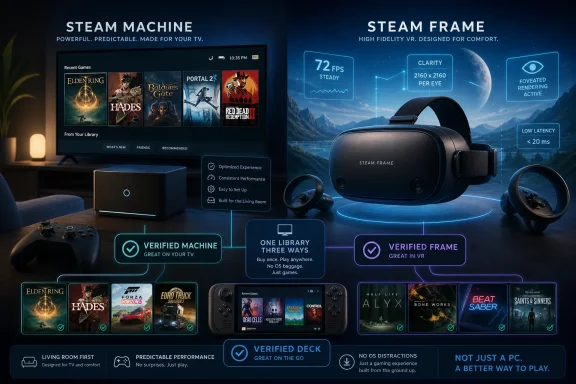 Valve’s Real Announcement Was Not the Date
Valve did not give the industry what it wanted most. There is still no final release date, no preorder button, and no price for either the Steam Machine or the Steam Frame. In ordinary consumer hardware terms, that would make the update feel thin.But Valve rarely markets hardware in ordinary consumer hardware terms. Its most important move was to turn the Verified system into a platform architecture. Steam Deck Verified began as a store badge for a handheld; now it is becoming the compatibility language for an expanding SteamOS hardware family.
That matters because the Steam Machine is not just a small PC. If it were only a small PC, it would be judged almost entirely on specs-per-dollar against Windows desktops, mini PCs, and game consoles. Valve is trying to shift the comparison. It wants buyers to ask whether games work smoothly out of the box, whether the interface is built for a couch, and whether the Steam library carries over with fewer surprises than traditional PC gaming usually allows.
The summer window also changes the psychology of the launch. Earlier language around the hardware created expectations for the first half of 2026, and June technically sits inside that frame. But “this summer” gives Valve room to stretch toward late August or even the final days before the autumn calendar begins. That flexibility may be useful for logistics, but it also tells customers that the company is still preserving optionality.
The Steam Machine Is a Console Argument Wearing PC Clothes
The Steam Machine’s burden is familiar because Valve has tried this before. The first Steam Machine push in the 2010s asked third-party hardware makers to build living-room PCs around SteamOS, and the result was a fragmented, underpowered, overpriced shrug. This time, Valve is taking tighter control.That control is the entire bet. The Steam Deck succeeded not because it was the most powerful portable gaming device, but because Valve owned the hardware target, the OS layer, the store, the controller mapping tools, the shader pipeline, and the compatibility messaging. The new Steam Machine appears designed to import that model into the living room.
This is why the Verified expansion is not an afterthought. A console is not only defined by custom silicon or a fixed case design. It is defined by predictability. When a player buys a PlayStation or Xbox game, they expect the game to start, recognize the controller, use readable text, and run within an acceptable performance envelope. PC gaming has historically traded that predictability for openness, flexibility, and better long-term compatibility.
Valve is trying to split the difference. The Steam Machine can still be a PC, but the store can present it like a console. The machine can run SteamOS, but the game library can be filtered through a confidence system. Users can still tinker, but the sales pitch is that they should not have to.
That is a more radical Windows challenge than a spec sheet battle. Microsoft has survived countless “PC console” ideas because Windows remained the default place where PC games worked. Valve is not saying Windows cannot run games. It is saying a growing number of users may prefer not to deal with Windows at all when the primary job is launching a game from the couch.
Verification Becomes Valve’s Quiet Platform Lock-In
The new Verified programs give Valve a way to shape developer behavior without issuing console-style certification mandates. Developers are not being forced to build exclusively for Steam Machine or Steam Frame. They are being nudged toward meeting visible standards that affect store presentation, buyer confidence, and likely sales conversion.That is Valve’s favorite kind of leverage. Steam already sits between developers and the world’s largest PC gaming audience. If a badge improves discoverability or reassures customers, developers have a reason to chase it. If enough developers chase it, the hardware becomes more attractive. If the hardware becomes more attractive, SteamOS becomes harder to ignore.
The Steam Deck provided the proof of concept. “Verified” did not mean perfect, and Deck users quickly learned that community reports, ProtonDB-style compatibility notes, and individual tolerance still mattered. But the badge created a shared vocabulary. It told buyers which games were likely to behave properly on a device that was not a typical Windows laptop.
Steam Machine verification appears to benefit directly from that work. Valve’s update indicates that games already verified for Steam Deck are eligible in a way that gives the new device a large starting library. That is commercially important. A new gaming box cannot launch with the software uncertainty of a new console generation if it wants mainstream traction.
The cleverness is that Valve can make the Steam Machine feel “new” without asking developers to port games to a new platform in the traditional sense. The platform is Steam, Proton, SteamOS, and a compatibility badge. That is less glamorous than a proprietary console SDK, but it may be much more powerful in practice.
The Steam Deck Library Is Valve’s Launch-Day Insurance Policy
The Steam Deck’s greatest gift to Valve’s next hardware wave is not brand recognition. It is the years of compatibility work already performed across thousands of games. Every fix to Proton, every developer patch for controller prompts, every update for text legibility, and every adjustment to default graphics settings becomes a foundation for the Steam Machine.That does not mean every Deck Verified game will be ideal on a living-room PC. A handheld screen and a television are different contexts. A game that feels acceptable at a compact display size may expose rough edges on a large 4K panel, and a 30 fps target that works for portable play may feel less impressive on the couch next to modern consoles promising higher refresh rates.
Still, the inheritance is powerful. Valve does not need to start from zero and ask developers to imagine a user base. The Steam Deck user base already exists, and many developers have already done the first round of work to make their games behave under SteamOS-like assumptions. The Steam Machine can arrive as the bigger sibling rather than the first child.
This is also why the Steam Machine’s exact specs may matter less than some enthusiasts think. Performance will matter, especially if the price is high. But the experience depends just as much on defaults. A game that chooses sensible settings, launches into controller-friendly menus, and avoids desktop cruft will feel more “console-like” than a more powerful box that requires manual adjustment.
That is the lesson Microsoft keeps relearning with Windows gaming handhelds. Hardware can be impressive and still feel awkward if the operating system is not shaped around the primary use case. Valve’s advantage is not that Linux is magically simpler than Windows. It is that SteamOS can be opinionated in ways Windows cannot easily be.
Steam Frame Raises the Stakes Because VR Is Less Forgiving
The Steam Frame is where Valve’s verification strategy becomes more demanding. Flat-screen games can survive a surprising amount of imperfection. A slightly small font, an inconsistent frame rate, or a clumsy launcher may annoy players, but it does not necessarily make the experience physically uncomfortable.VR is different. Low frame rates, inconsistent frame pacing, blurry text, and poor resolution scaling can cause eye strain, nausea, or fatigue. A verification badge for a headset carries a heavier promise than one for a handheld or living-room PC. It is not merely saying “this game runs.” It is implying that the experience is comfortable enough to recommend.
That is why Valve’s Steam Frame criteria reportedly put stronger emphasis on visual clarity and higher performance targets, including a minimum 72 fps requirement for relevant experiences. In the VR world, that threshold is not luxury; it is table stakes. A headset cannot rely on the same tolerance that PC gamers sometimes bring to a demanding open-world game on a budget GPU.
The challenge is that VR software ecosystems are already fragmented. PC VR has powerful experiences but a smaller mainstream footprint than many expected. Standalone headsets have trained developers around mobile-class performance constraints. Valve’s Steam Frame must bridge expectations from both worlds: the fidelity and library depth associated with Steam, and the appliance-like simplicity that standalone VR buyers expect.
Verification can help, but it cannot invent a market by itself. Valve still needs enough developers to treat Steam Frame as worth optimizing for, not merely as another runtime target. The badge gives developers a checklist. The installed base will determine whether they care.
The Pricing Silence Is Getting Louder
Valve’s refusal to discuss pricing is now part of the story. It may be a rational business decision, especially in a hardware market still dealing with component volatility, memory pricing pressure, and unpredictable demand for advanced chips. But the longer pricing remains unknown, the more the conversation fills with suspicion.For the Steam Machine, the danger is obvious. If it is priced too close to a capable Windows gaming PC, skeptics will argue that users can build or buy comparable hardware and install SteamOS themselves. If it is priced too close to premium consoles without matching their perceived graphical performance, console buyers may shrug. If it is priced aggressively, Valve may have to accept thin margins or subsidize the hardware in service of Steam store revenue.
Valve has more room than a conventional PC manufacturer because Steam itself is the economic engine. A Steam Machine buyer is likely to remain inside Valve’s storefront, buying games, expansions, and seasonal sale temptations. That ecosystem value could justify pricing that looks strange if evaluated only as hardware margin.
But first impressions matter. A high launch price can frame a device as a niche enthusiast product before users ever experience the software. Once that narrative sticks, it is difficult to reverse. The original Steam Machines suffered partly because they invited direct comparison with PCs and consoles while failing to provide a simple, compelling answer to either.
The Steam Frame faces an even narrower path. VR buyers are price-sensitive, developers are cautious, and mainstream consumers still need convincing that a headset is something they will use regularly rather than admire for a week. Valve’s reputation among enthusiasts is strong, but enthusiasm is not the same as mass adoption.
SteamOS Is the Windows Story Hiding in Plain Sight
For WindowsForum readers, the most interesting part of Valve’s update is not whether the Steam Machine arrives in July or September. It is what the device represents in the long contest over the default PC gaming environment. SteamOS is no longer an experiment living on one handheld. It is becoming a product line.That does not mean Windows gaming is suddenly in trouble. Windows remains the dominant PC gaming platform, the compatibility baseline for most developers, and the environment where anti-cheat systems, launchers, mod tools, creative apps, and productivity workflows are most deeply entrenched. For many users, especially those with large peripheral setups or non-Steam libraries, Windows is still the practical answer.
But Valve does not need SteamOS to replace Windows everywhere. It only needs SteamOS to become good enough in enough gaming-first contexts. Handhelds were the first wedge. The living room may be the second. VR could become the third if Valve can make the experience feel less like a PC peripheral and more like a coherent platform.
Microsoft’s vulnerability is not that Windows cannot play games well. It is that Windows is designed to be everything at once. That flexibility is its strength on a desktop and its weakness on devices where users want a focused, controller-first, no-maintenance experience. Valve’s hardware strategy exploits the gap between capable and comfortable.
The Steam Deck showed that many players will accept Linux underneath if the top layer feels like Steam and the games work. The Steam Machine asks whether that same tolerance extends to the television. The Steam Frame asks whether it extends to a headset, where friction is magnified and comfort is non-negotiable.
Developers Are Being Asked to Optimize for Context, Not Just Silicon
The expansion of Verified also sends a message to developers: performance is no longer a single PC checkbox. A game may run on Windows, run on Steam Deck, run on Steam Machine, and run on Steam Frame, but each context has different expectations. Valve is formalizing those differences.That is healthy for users because it acknowledges reality. A desktop PC with a mouse, a handheld with a seven- or eight-inch screen, a couch device controlled from ten feet away, and a VR headset are not interchangeable experiences. The same executable may serve all of them, but the same defaults rarely should.
It also complicates life for studios. Developers already juggle PC settings menus, console certification, multiple handheld profiles, ultrawide support, accessibility options, shader compilation, controller layouts, upscalers, and anti-cheat compatibility. Valve’s badges may be helpful, but they are still another set of targets in a development pipeline that is already crowded.
The upside is that Valve’s approach can reward practical polish. A studio that invests in readable UI, sane defaults, controller support, frame pacing, and scalable graphics may benefit across all three devices. Those improvements are not merely “Steam hardware” optimizations. They make PC games better in general.
The danger is badge inflation. If users see too many Verified games with caveats, or if the label becomes too generous, the system loses trust. Steam Deck users have already learned that a badge is a useful starting point rather than a guarantee of personal satisfaction. Valve will need to be stricter with Steam Frame because the consequences of a bad recommendation are more visceral.
The Launch Window Buys Flexibility but Spends Momentum
A summer launch window is both reassuring and evasive. It tells buyers that Valve has not slipped into vague “later this year” territory. It also allows the company to avoid committing to a specific day while hardware costs, inventory, software readiness, and marketing plans settle.That may be prudent. Hardware launches are unforgiving, and Valve’s reputation gives it some permission to move slowly. The company is not a yearly refresh vendor trying to hit a retail shelf cycle. It can wait until the experience is ready, especially if it believes the long-term platform matters more than a single quarter.
But anticipation has a shelf life. The Steam Machine and Steam Frame were exciting when they were revealed because they suggested a coordinated Valve hardware ecosystem: handheld, living-room box, controller, and headset, all orbiting SteamOS and Steam. The longer final details remain absent, the more the conversation shifts from possibility to anxiety.
Preorders or reservations could reset that energy. So could aggressive pricing. So could a strong launch lineup of Verified titles and a demonstration that Steam Frame is more than a curiosity for existing VR diehards. But until Valve shows those cards, every update will be read as much for what it omits as for what it says.
The company’s understated style can be charming when the product appears and works. It can be frustrating when customers are trying to plan purchases around an unknown price and date. Valve has earned patience from many players, but not unlimited patience.
The Summer Hardware Bet Comes Down to Trust
The practical read is simple, even if the strategy underneath is not.- Valve has narrowed the Steam Machine and Steam Frame launch language to summer 2026, but it has not announced exact dates, preorder timing, or prices.
- Steam Deck Verified is becoming the foundation for a broader Steam hardware compatibility system rather than a handheld-only badge.
- Steam Machine verification should benefit from the existing Deck Verified catalog, giving Valve a stronger launch story than the original Steam Machines had.
- Steam Frame verification carries higher stakes because VR comfort depends on clarity, frame rate, and consistency in ways flat-screen gaming does not.
- Pricing remains the largest unknown because component costs and buyer expectations could determine whether the devices feel mainstream, premium, or niche.
- The broader threat to Windows is not immediate replacement, but the gradual normalization of SteamOS as the default interface for dedicated gaming devices.
The Steam Machine and Steam Frame will ultimately be judged by the old hardware questions: how much they cost, how well they run games, how comfortable they are to use, and whether buyers can actually get them. But Valve is trying to make the more important question happen before checkout: Will this game feel right on this device? If it can answer that reliably, SteamOS becomes less of an alternative operating system and more of a consumer expectation. That is the real summer launch to watch, because once PC gaming starts borrowing the certainty of consoles without giving up the depth of Steam, Windows will still be everywhere — but it will no longer be assumed everywhere.
References
- Primary source: NoobFeed
Published: 2026-06-07T05:22:07.001175
Valve Reveals New Steam Machine and Steam Frame Verification Details | NoobFeed
Valve has released a new update regarding the Steam Machine and Steam Frame release dates. What is new in the news is the platform's verification programs...www.noobfeed.com - Related coverage: windowscentral.com
Valve confirms its Steam Machine PC and Steam Frame VR are still "shipping this summer" — without a whiff of any prices | Windows Central
Valve has reaffirmed its summer launch plans for Steam Machine and Steam Frame, but costs remain a complete mystery.www.windowscentral.com - Related coverage: tomsguide.com
'My wallet gonna cry': Valve gives official update on Steam Machine and Steam Frame launch, but still won't tell us the price | Tom's Guide
Valve announces a Steam Machine and Steam Frame launch update the week of Summer Games Fest but neglects to mention pricing.www.tomsguide.com - Related coverage: t3.com
Valve just gave everyone the best Steam Machine news – prepare for launch | T3
Valve's new console gets a release update, and it's great newswww.t3.com - Related coverage: gamesradar.com
Steam Machine is coming this summer, Valve confirms, but its lack of pricing has me raising an eyebrow as hardware prices surge | GamesRadar+
And as RAM shortages persistwww.gamesradar.com - Related coverage: tomshardware.com
Valve says Steam Machine and Steam Frame 'shipping this summer' — company confirms release window as it expands Verified program | Tom's Hardware
2026's most anticipated gaming product is finally ready to ship.www.tomshardware.com
- Related coverage: pcguide.com
Valve explains Steam Machine and Steam Frame Verified requirements, VR standalone drops to 72 FPS minimum - PC Guide
Steam Machine and Steam Frame will be released this summer, and Valve has confirmed 'Verified' requirements for game devs.www.pcguide.com - Related coverage: techspot.com
Valve details performance targets for Steam Machine and Steam Frame | TechSpot
Unsurprisingly, Steam Machine verification requirements will be more lenient than those for the Steam Deck, since the Machine is expected to provide roughly six times more performance...www.techspot.com - Related coverage: gigazine.net
ValveがゲーミングPC「Steam Machine」とVRヘッドセット「Steam Frame」の2026年夏発売を発表 - GIGAZINE
2026年6月4日、ValveがSteam Deckで快適に動作するゲームを評価する「Verifiedプログラム」を、Steam MachineおよびSteam Frameに拡大すると発表しました。また、Steam MachineおよびSteam Frameの発売時期は「2026年」となっていたのですが、2026年夏に決定しています。gigazine.net - Related coverage: mobilesyrup.com
Valve insists Steam Machine and Steam Frame still coming this summer
Even though it's still yet to confirm how much it will cost, especially after a recent massive Steam Deck price hike.mobilesyrup.com - Related coverage: easternherald.com
Valve Confirms Steam Frame and Steam Machine Summer Launch — No Price Yet
Valve confirmed Steam Frame and Steam Machine will ship this summer, revealing Verified performance benchmarks. Pricing for the VR headset and console PC remains undisclosed.easternherald.com - Related coverage: pcgamer.com
Valve really isn't budging: Steam Machine and Steam Frame are still 'shipping this summer,' it insists | PC Gamer
Despite the dire hardware and component landscape, it's apparently still happening.www.pcgamer.com - Related coverage: notebookcheck.net
Valve shares more definite update on Steam Machine, Frame release date - Notebookcheck News
The Steam Machine and Steam Frame were announced in November last year with an expected ‘first half of 2026’ launch. The market conditions, however, forced Valve to reassess its timeline and pricing for the two devices. www.notebookcheck.net
- Related coverage: gamespot.com
Steam Machine Has "Fewer Constraints" For Verification Compared To Steam Deck - GameSpot
Games with the verified label for Steam Deck will already be verified for Valve's upcoming hardware.www.gamespot.com - Related coverage: gadgets360.com
Steam Machine and Steam Frame VR Headset Will Launch This Summer, Valve Says | Technology News
In an update about Steam Machine and Steam Frame joining its verified program on Friday, Valve confirmed the devices are coming this summer.www.gadgets360.com - Related coverage: ubergizmo.com
Valve Steam Machine Price Leaks Online Ahead Of Summer 2026 Launch Window | Ubergizmo
Following several scheduling delays, Valve has officially established the launch window for its highly anticipated Steam Machine console and the...www.ubergizmo.com - Related coverage: as.com
Valve rompe su silencio sobre el lanzamiento de Steam Machine, pero sigue sin responder la gran pregunta de los jugadores - Meristation
Valve rompe su silencio sobre Steam Machine y confirma que saldrá en verano, pero sigue sin responder la pregunta más importante de los usuarios.as.com - Related coverage: steamcommunity.com
Events & Announcements :: Steam Hardware
steamcommunity.com
