

Valve’s new Steam Machine, now shipping in 2026 from $1,049, is a compact SteamOS gaming PC that often performs near a base PlayStation 5 but costs far more and depends heavily on per-game PC tuning. That is the uncomfortable center of the comparison. IGN’s Jackie Thomas framed the machine as surprisingly capable for its size, but still hard to recommend over a PS5 or Xbox Series X for anyone who mainly wants a living-room game box. The Steam Machine is not failing because it is weak; it is struggling because Valve is asking console buyers to pay PC prices for console-like results.
The most important thing about the Steam Machine is not that it can sit under a television. It is that it remains a PC in every operational sense that matters. It runs SteamOS, exposes PC graphics options, leans on technologies like FSR, and inherits the strengths and annoyances of the PC gaming ecosystem.
That distinction explains why the PS5 comparison is both irresistible and slightly unfair. Sony’s console is a fixed target: one hardware configuration, one certification pipeline, one set of performance modes, and years of developer optimization around a known memory and GPU budget. Valve’s cube is more flexible, but that flexibility moves work from the platform holder and developer onto the player.
IGN’s testing makes the trade visible. In some titles, the Steam Machine can match or even exceed the PS5’s 60 fps performance target. In others, it drops below the console badly enough that the user has to start negotiating with resolution, presets, upscaling modes, and dynamic scaling.
That negotiation is the essence of PC gaming. It is also exactly what many console buyers are paying to avoid.
At $499 or $599, “roughly PS5 performance in a tiny SteamOS cube” would sound like a direct assault on the console market. At $1,049 before the living-room controller question is fully settled, the Steam Machine becomes a premium mini PC that happens to target the same television and couch. That is a much narrower audience.
Valve has never had the same business model as Sony or Microsoft. Console makers can tolerate hardware economics that are unattractive in isolation because the platform monetizes through software, subscriptions, services, licensing, and the long tail of ecosystem lock-in. Valve also benefits from software sales, of course, but the Steam Machine is being priced much more like a specialist PC than a subsidized console.
That makes the value proposition brutally dependent on the buyer’s existing Steam library. If you already own hundreds of PC games, use Steam Deck cloud saves, prefer mods, and want a quiet living-room SteamOS box, the premium is easier to explain. If you are simply choosing a machine for new games on a television, the PS5 and Xbox Series X remain the cleaner purchase.
In Cyberpunk 2077, the Steam Machine reportedly averaged 68 fps, with dips into the mid-50s. That is a strong result for a small box, especially in a game that once punished far larger systems. CD Projekt Red’s long optimization campaign clearly matters here, and the PS5 version’s locked 60 fps performance mode gives the console a different kind of advantage: less peak headroom, but steadier delivery.
The image-quality comparison complicates the victory lap. IGN noted that the PS5 version preserved sharper fine detail in places like jewelry and wallpaper, while the Steam Machine’s medium texture settings softened some surfaces. That is exactly the kind of subtle delta that PC users can often correct manually, but it is also the kind of thing console players never have to think about.
Resident Evil Requiem told a similar story. The Steam Machine hovered around 60 fps, with occasional drops into the low 50s, while the PS5 again presented a steadier 60 fps target. In ordinary play, that gap may not matter much. But it reinforces the pattern: the Steam Machine can land near console performance, while the console more reliably behaves like a console.
Then the wheels wobble. In 007 First Light, IGN saw the Steam Machine average around 53 fps at 4K output with FSR Performance and a mix of medium and low settings, with explosions briefly knocking performance down toward 35 fps. The PS5 held its 60 fps performance target by leaning harder on internal resolution scaling, reportedly dropping as low as 720p in demanding moments.
That is not a simple win for Sony. The Steam Machine could look sharper in some scenes, and when IGN dropped output resolution to 1800p, performance improved substantially. But the fact that the user has to make that call is the point. Valve’s box lets you choose the compromise; Sony’s box hides the compromise.
Lowering settings and resolution did not immediately solve the problem. IGN reported that even 1440p with low settings left the Steam Machine around 45 to 50 fps. Only at 1080p output, medium settings, and dynamic resolution scaling did the machine reach a stable 60 fps.
That is a stark difference. It turns the Steam Machine from “a premium compact PC that trades blows with PS5” into “a premium compact PC that sometimes needs handheld-style compromises.” For a $1,049 living-room machine, that is a dangerous perception problem.
It also illustrates why console optimization remains powerful late in a generation. The PS5 is not new hardware. Its CPU and GPU architecture are well understood, and its performance envelope is fixed. Developers targeting it can spend years extracting consistent results from a known box, while PC versions must scale across a sprawling hardware market, driver stack, API environment, operating system layer, and storefront ecosystem.
Valve can improve some of this over time through SteamOS updates, graphics driver work, Proton fixes, shader precompilation, and better low-VRAM behavior. But it cannot make every PC port behave like a first-party console showcase. That is the practical ceiling of the Steam Machine concept.
That bargain is easy to undervalue in enthusiast circles. WindowsForum readers know the appeal of granular settings, alternate launchers, driver updates, Proton compatibility notes, frame-time graphs, and custom power profiles. But the living room is not the desktop. A device connected to the family television is judged by different rules.
The PS5’s performance mode is often a black box, and not always a flattering one. It may reduce internal resolution, simplify shadows, drop ray tracing, or lean aggressively on reconstruction. But it usually presents those trade-offs as a single button. That simplicity has value.
The Steam Machine offers more agency, but more agency is not always more convenience. It lets the player decide whether 1800p with better texture clarity is preferable to 4K output with heavier upscaling, or whether medium shadows matter more than dense foliage. For PC players, that is freedom. For console players, it is homework.
Tom’s Hardware called attention to the price gap against consoles, including the PS5 Pro. TechSpot and others have emphasized that Valve’s mini PC has custom thermal, motherboard, and power-supply work behind it, which helps explain why it is not simply a pile of cheap off-the-shelf parts. But buyers do not pay for bill-of-materials sympathy. They pay for outcomes.
Those outcomes are mixed. A conventional gaming PC around the same price may offer better performance, more upgrade flexibility, or a stronger GPU. It may also be larger, louder, uglier, more power-hungry, and less suited to a television stand. The Steam Machine’s elegance is real, but elegance is hard to benchmark.
That is where Valve’s hardware strategy starts to resemble Apple’s more than Sony’s. The company is not merely selling teraflops. It is selling industrial design, OS integration, suspend-and-resume behavior, controller mapping, Steam library continuity, and a console-like front end for PC games. Those are meaningful advantages if you care about them.
But if the question is only “which box gives me the best game performance per dollar on a TV,” the Steam Machine loses quickly.
That matters because the Steam Machine is not launching into the same world as Valve’s failed 2010s living-room PC push. Proton is better. Developers understand Steam Deck verification. PC gamers are more accustomed to handheld and couch PC experiences. The storefront, cloud-save, remote-play, and controller layers are far more coherent.
For Windows users, the Steam Machine also raises an uncomfortable question: how much of PC gaming still needs Windows in the living room? SteamOS will not replace Windows for every game, especially titles with incompatible anti-cheat systems, niche launchers, or productivity needs. But for a large slice of Steam libraries, the Linux gaming experience is now good enough that the operating system becomes invisible.
That invisibility is Valve’s long-term play. The company does not need the Steam Machine to outsell PS5. It needs SteamOS to become a credible default for PC gaming appliances. Every Steam Deck, Steam Machine, and third-party SteamOS box chips away at the assumption that Windows is the only serious PC gaming platform.
That is why Microsoft should be paying attention even if Sony wins the direct comparison. Valve is not just competing for console customers. It is making a case that PC gaming’s most user-friendly future may not be Windows-first.
This time, there is one official Valve box. SteamOS is credible. The hardware is small and quiet. The performance target is understandable: roughly console-class gaming with PC flexibility. The problem is that the price reintroduces confusion.
A $1,049 machine must be more than “roughly as good as a PS5 most of the time.” It must persuade buyers that Steam library access, mod support, PC settings, smaller size, lower noise, and SteamOS integration are worth hundreds of dollars. That is a sophisticated argument for a mainstream living-room device.
And mainstream buyers do not usually buy sophisticated arguments. They buy consoles because the message is simple: here is the box that plays the games, at the price everyone understands, with the controller in the box and the performance mode already tuned.
Valve’s audience is therefore narrower but not imaginary. It includes Steam Deck owners who want a more powerful couch companion. It includes PC gamers who hate Windows in the living room. It includes apartment dwellers, minimalists, Linux enthusiasts, and players with large Steam libraries who do not want a tower near the TV.
That is a real market. It is just not the same market as the PS5.
The distinction matters. “4K output” is not the same thing as native 4K rendering, and “4K with FSR” can mean many different internal resolutions depending on the game, preset, and reconstruction mode. Console marketing has blurred this line for years, but PC players are more likely to notice because the settings menu exposes the trick.
In fairness, the PS5 also relies heavily on dynamic resolution and reconstruction. IGN’s 007 First Light comparison is a good example: the PS5 maintained frame rate partly by dropping internal resolution dramatically when needed. The console’s advantage is not purity. It is integration.
Valve is asking users to accept the same reconstruction-heavy future, but with knobs attached. That may be the right design for Steam’s audience. It is also a reminder that the phrase “4K gaming” has become more of a display compatibility promise than a rendering guarantee.
The Steam Machine can drive a 4K TV. It can often deliver a 60 fps experience on that TV. But in demanding modern games, the path from silicon to screen is filled with compromises. Valve’s honesty problem is that PC gamers can see all of them.
That engineering work deserves credit. Valve appears to have built a tasteful living-room PC that does not look like a shrunken tower or a RGB lunchbox. For users who care about the physical object, the Steam Machine’s compact cube design is part of the product’s appeal.
But smallness is not free. Compact systems usually sacrifice peak performance, upgradeability, cooling headroom, component standardization, or price. The Steam Machine’s performance profile looks very much like the result of those negotiations. Valve got console-class results into a much smaller and quieter chassis, but the buyer pays for that achievement.
This is where the PS5 comparison becomes less direct. Sony’s console is large because it can be. It is optimized for cost, thermals, mass production, and a fixed lifecycle, not for PC-style modularity or desktop elegance. Valve’s machine is solving a different design problem.
The trouble is that consumers rarely reward invisible engineering unless it produces visible superiority. Quiet, small, and elegant may not beat cheaper, faster, and simpler.
If PC ports remain inconsistent, the machine will feel inconsistent. That is not unique to Valve. Windows gaming PCs suffer the same problem, but desktop PC users expect it. A console-like product gets judged more harshly when games need manual rescue.
The Steam Deck created a useful certification language with Deck Verified, even if that badge has never been perfect. Valve may need something more explicit for Steam Machine owners: not merely whether a game runs, but whether it has a good living-room profile at 60 fps, what resolution target to expect, and whether controller-first navigation works from boot to quit.
That kind of curation could narrow the experience gap with PS5. It would not eliminate the hardware delta in games like Death Stranding 2, but it would reduce user friction. The less time players spend discovering the correct settings, the more the Steam Machine feels like a console rather than a science project.
Valve’s challenge is cultural as much as technical. PC gaming has long celebrated configurability. The living room rewards predictability.
Microsoft has spent years trying to unify Xbox and Windows gaming through Game Pass, Play Anywhere, cloud saves, cross-buy, and app improvements. Yet the Windows living-room experience remains clumsy compared with a console UI or SteamOS. Nobody wants to troubleshoot focus stealing, driver pop-ups, account prompts, or launcher windows from ten feet away with a controller.
SteamOS avoids much of that by narrowing the mission. It is not trying to be the world’s general-purpose desktop in game mode. It is trying to be Steam on a TV, with a KDE desktop available when necessary. That constraint is powerful.
If the Steam Machine succeeds even modestly, it gives PC manufacturers permission to imagine gaming systems that do not boot into Windows by default. That does not mean Windows gaming is doomed. It means Microsoft can no longer assume the living-room PC belongs to it simply because it owns DirectX and the desktop.
The irony is that Valve’s hardware may matter most as software leverage. Even if the Steam Machine remains niche, SteamOS could become the reference experience that Windows handhelds and mini PCs are judged against.
The Steam Machine is the better answer for a buyer already invested in Steam who values flexibility more than simplicity. It carries forward a PC library, supports PC storefront habits to the extent SteamOS allows, enables mods in many games, and gives users control over the visual-performance trade. It is less a console replacement than a living-room endpoint for an existing PC gaming life.
That distinction also explains why the device can look overpriced and rational at the same time. Compared with a PS5, it is expensive. Compared with a boutique compact Linux gaming PC with custom integration and a console-like interface, it is less absurd. The problem is that most consumers know the first comparison better than the second.
Valve’s marketing must therefore thread a needle. If it sells the Steam Machine as a console killer, it invites a price-performance fight it cannot win. If it sells it as a premium SteamOS appliance, it limits the audience but tells the truth.
The second strategy is less glamorous. It is also more credible.
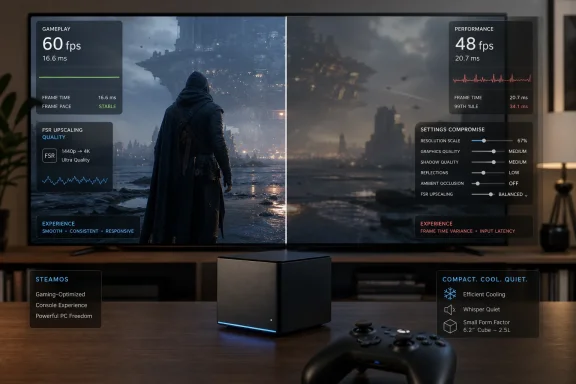 Valve Built a Console-Sized PC, Not a Console
The most important thing about the Steam Machine is not that it can sit under a television. It is that it remains a PC in every operational sense that matters. It runs SteamOS, exposes PC graphics options, leans on technologies like FSR, and inherits the strengths and annoyances of the PC gaming ecosystem.That distinction explains why the PS5 comparison is both irresistible and slightly unfair. Sony’s console is a fixed target: one hardware configuration, one certification pipeline, one set of performance modes, and years of developer optimization around a known memory and GPU budget. Valve’s cube is more flexible, but that flexibility moves work from the platform holder and developer onto the player.
IGN’s testing makes the trade visible. In some titles, the Steam Machine can match or even exceed the PS5’s 60 fps performance target. In others, it drops below the console badly enough that the user has to start negotiating with resolution, presets, upscaling modes, and dynamic scaling.
That negotiation is the essence of PC gaming. It is also exactly what many console buyers are paying to avoid.
The Price Turns a Clever Box Into a Difficult Argument
The Steam Machine starts at $1,049 for the 512GB model, with higher-capacity and controller bundles climbing further. Multiple outlets, including Phoronix, PCGamesN, TechSpot, Tom’s Hardware, and Windows Central, have treated that price as the central fact of the launch because it changes the product’s entire competitive frame.At $499 or $599, “roughly PS5 performance in a tiny SteamOS cube” would sound like a direct assault on the console market. At $1,049 before the living-room controller question is fully settled, the Steam Machine becomes a premium mini PC that happens to target the same television and couch. That is a much narrower audience.
Valve has never had the same business model as Sony or Microsoft. Console makers can tolerate hardware economics that are unattractive in isolation because the platform monetizes through software, subscriptions, services, licensing, and the long tail of ecosystem lock-in. Valve also benefits from software sales, of course, but the Steam Machine is being priced much more like a specialist PC than a subsidized console.
That makes the value proposition brutally dependent on the buyer’s existing Steam library. If you already own hundreds of PC games, use Steam Deck cloud saves, prefer mods, and want a quiet living-room SteamOS box, the premium is easier to explain. If you are simply choosing a machine for new games on a television, the PS5 and Xbox Series X remain the cleaner purchase.
IGN’s Benchmarks Show the Steam Machine at Its Best and Worst
IGN tested four games against the PS5 in performance mode: Cyberpunk 2077, Resident Evil Requiem, 007 First Light, and Death Stranding 2. The Steam Machine was configured around medium settings, 4K output, and FSR Performance, an approach that gives the little PC a fighting chance while still aiming at the same living-room display target as the console.In Cyberpunk 2077, the Steam Machine reportedly averaged 68 fps, with dips into the mid-50s. That is a strong result for a small box, especially in a game that once punished far larger systems. CD Projekt Red’s long optimization campaign clearly matters here, and the PS5 version’s locked 60 fps performance mode gives the console a different kind of advantage: less peak headroom, but steadier delivery.
The image-quality comparison complicates the victory lap. IGN noted that the PS5 version preserved sharper fine detail in places like jewelry and wallpaper, while the Steam Machine’s medium texture settings softened some surfaces. That is exactly the kind of subtle delta that PC users can often correct manually, but it is also the kind of thing console players never have to think about.
Resident Evil Requiem told a similar story. The Steam Machine hovered around 60 fps, with occasional drops into the low 50s, while the PS5 again presented a steadier 60 fps target. In ordinary play, that gap may not matter much. But it reinforces the pattern: the Steam Machine can land near console performance, while the console more reliably behaves like a console.
Then the wheels wobble. In 007 First Light, IGN saw the Steam Machine average around 53 fps at 4K output with FSR Performance and a mix of medium and low settings, with explosions briefly knocking performance down toward 35 fps. The PS5 held its 60 fps performance target by leaning harder on internal resolution scaling, reportedly dropping as low as 720p in demanding moments.
That is not a simple win for Sony. The Steam Machine could look sharper in some scenes, and when IGN dropped output resolution to 1800p, performance improved substantially. But the fact that the user has to make that call is the point. Valve’s box lets you choose the compromise; Sony’s box hides the compromise.
Death Stranding 2 Exposes the Optimization Gap
The hardest result for Valve is Death Stranding 2. According to IGN, the Steam Machine averaged only around 35 fps at 4K output with FSR Performance and the medium preset in a demanding scene with night lighting, vegetation, and water. The PS5, by contrast, held a steady 60 fps in the same broad comparison.Lowering settings and resolution did not immediately solve the problem. IGN reported that even 1440p with low settings left the Steam Machine around 45 to 50 fps. Only at 1080p output, medium settings, and dynamic resolution scaling did the machine reach a stable 60 fps.
That is a stark difference. It turns the Steam Machine from “a premium compact PC that trades blows with PS5” into “a premium compact PC that sometimes needs handheld-style compromises.” For a $1,049 living-room machine, that is a dangerous perception problem.
It also illustrates why console optimization remains powerful late in a generation. The PS5 is not new hardware. Its CPU and GPU architecture are well understood, and its performance envelope is fixed. Developers targeting it can spend years extracting consistent results from a known box, while PC versions must scale across a sprawling hardware market, driver stack, API environment, operating system layer, and storefront ecosystem.
Valve can improve some of this over time through SteamOS updates, graphics driver work, Proton fixes, shader precompilation, and better low-VRAM behavior. But it cannot make every PC port behave like a first-party console showcase. That is the practical ceiling of the Steam Machine concept.
The PS5 Wins by Being Boring
The PS5’s advantage is not that it is magically stronger than the Steam Machine in every metric. It is that its limitations are packaged into a familiar consumer bargain. You choose performance mode or quality mode, download the game, and expect the platform to do most of the thinking.That bargain is easy to undervalue in enthusiast circles. WindowsForum readers know the appeal of granular settings, alternate launchers, driver updates, Proton compatibility notes, frame-time graphs, and custom power profiles. But the living room is not the desktop. A device connected to the family television is judged by different rules.
The PS5’s performance mode is often a black box, and not always a flattering one. It may reduce internal resolution, simplify shadows, drop ray tracing, or lean aggressively on reconstruction. But it usually presents those trade-offs as a single button. That simplicity has value.
The Steam Machine offers more agency, but more agency is not always more convenience. It lets the player decide whether 1800p with better texture clarity is preferable to 4K output with heavier upscaling, or whether medium shadows matter more than dense foliage. For PC players, that is freedom. For console players, it is homework.
The Steam Machine’s Real Rival Is Not Just the PS5
Valve’s problem is broader than Sony. The Steam Machine also has to justify itself against Xbox Series X, PS5 Pro, small-form-factor gaming PCs, gaming laptops, handheld PCs with docks, and the user’s existing desktop. That is a crowded battlefield for a device whose defining pitch is convenience.Tom’s Hardware called attention to the price gap against consoles, including the PS5 Pro. TechSpot and others have emphasized that Valve’s mini PC has custom thermal, motherboard, and power-supply work behind it, which helps explain why it is not simply a pile of cheap off-the-shelf parts. But buyers do not pay for bill-of-materials sympathy. They pay for outcomes.
Those outcomes are mixed. A conventional gaming PC around the same price may offer better performance, more upgrade flexibility, or a stronger GPU. It may also be larger, louder, uglier, more power-hungry, and less suited to a television stand. The Steam Machine’s elegance is real, but elegance is hard to benchmark.
That is where Valve’s hardware strategy starts to resemble Apple’s more than Sony’s. The company is not merely selling teraflops. It is selling industrial design, OS integration, suspend-and-resume behavior, controller mapping, Steam library continuity, and a console-like front end for PC games. Those are meaningful advantages if you care about them.
But if the question is only “which box gives me the best game performance per dollar on a TV,” the Steam Machine loses quickly.
SteamOS Is the Differentiator Sony Cannot Copy
The strongest case for the Steam Machine is not raw performance. It is SteamOS. Valve’s Linux-based gaming environment has matured dramatically since the early Steam Machine era, largely because the Steam Deck forced the company to solve real compatibility, suspend, input, and shader problems at mass-market scale.That matters because the Steam Machine is not launching into the same world as Valve’s failed 2010s living-room PC push. Proton is better. Developers understand Steam Deck verification. PC gamers are more accustomed to handheld and couch PC experiences. The storefront, cloud-save, remote-play, and controller layers are far more coherent.
For Windows users, the Steam Machine also raises an uncomfortable question: how much of PC gaming still needs Windows in the living room? SteamOS will not replace Windows for every game, especially titles with incompatible anti-cheat systems, niche launchers, or productivity needs. But for a large slice of Steam libraries, the Linux gaming experience is now good enough that the operating system becomes invisible.
That invisibility is Valve’s long-term play. The company does not need the Steam Machine to outsell PS5. It needs SteamOS to become a credible default for PC gaming appliances. Every Steam Deck, Steam Machine, and third-party SteamOS box chips away at the assumption that Windows is the only serious PC gaming platform.
That is why Microsoft should be paying attention even if Sony wins the direct comparison. Valve is not just competing for console customers. It is making a case that PC gaming’s most user-friendly future may not be Windows-first.
The Living-Room PC Still Has a Trust Problem
The original Steam Machines failed because the concept was ahead of the software, pricing, and consumer clarity. Too many vendors shipped too many configurations, SteamOS was immature, Linux game support was thin, and buyers could not easily understand why they should choose one over a console. Valve’s 2026 machine solves some of that, but not all of it.This time, there is one official Valve box. SteamOS is credible. The hardware is small and quiet. The performance target is understandable: roughly console-class gaming with PC flexibility. The problem is that the price reintroduces confusion.
A $1,049 machine must be more than “roughly as good as a PS5 most of the time.” It must persuade buyers that Steam library access, mod support, PC settings, smaller size, lower noise, and SteamOS integration are worth hundreds of dollars. That is a sophisticated argument for a mainstream living-room device.
And mainstream buyers do not usually buy sophisticated arguments. They buy consoles because the message is simple: here is the box that plays the games, at the price everyone understands, with the controller in the box and the performance mode already tuned.
Valve’s audience is therefore narrower but not imaginary. It includes Steam Deck owners who want a more powerful couch companion. It includes PC gamers who hate Windows in the living room. It includes apartment dwellers, minimalists, Linux enthusiasts, and players with large Steam libraries who do not want a tower near the TV.
That is a real market. It is just not the same market as the PS5.
The 4K Claim Was Always Going to Be Conditional
Much of the Steam Machine debate revolves around 4K. Valve has described the machine in terms of 4K gaming with FSR, and Phoronix and other outlets have repeated the company’s “six times more powerful than Steam Deck” framing. Windows Central reported that Valve later softened some 4K 60 fps language after the first wave of pricing and performance scrutiny.The distinction matters. “4K output” is not the same thing as native 4K rendering, and “4K with FSR” can mean many different internal resolutions depending on the game, preset, and reconstruction mode. Console marketing has blurred this line for years, but PC players are more likely to notice because the settings menu exposes the trick.
In fairness, the PS5 also relies heavily on dynamic resolution and reconstruction. IGN’s 007 First Light comparison is a good example: the PS5 maintained frame rate partly by dropping internal resolution dramatically when needed. The console’s advantage is not purity. It is integration.
Valve is asking users to accept the same reconstruction-heavy future, but with knobs attached. That may be the right design for Steam’s audience. It is also a reminder that the phrase “4K gaming” has become more of a display compatibility promise than a rendering guarantee.
The Steam Machine can drive a 4K TV. It can often deliver a 60 fps experience on that TV. But in demanding modern games, the path from silicon to screen is filled with compromises. Valve’s honesty problem is that PC gamers can see all of them.
Size and Noise Are Valve’s Best Hardware Arguments
The Steam Machine is genuinely small. IGN emphasizes that it is far smaller than the PS5 and quieter under load, which is not a trivial accomplishment. Anyone who has tried to make a compact gaming PC knows that heat, acoustics, and power delivery become the real design constraints long before the spec sheet is done.That engineering work deserves credit. Valve appears to have built a tasteful living-room PC that does not look like a shrunken tower or a RGB lunchbox. For users who care about the physical object, the Steam Machine’s compact cube design is part of the product’s appeal.
But smallness is not free. Compact systems usually sacrifice peak performance, upgradeability, cooling headroom, component standardization, or price. The Steam Machine’s performance profile looks very much like the result of those negotiations. Valve got console-class results into a much smaller and quieter chassis, but the buyer pays for that achievement.
This is where the PS5 comparison becomes less direct. Sony’s console is large because it can be. It is optimized for cost, thermals, mass production, and a fixed lifecycle, not for PC-style modularity or desktop elegance. Valve’s machine is solving a different design problem.
The trouble is that consumers rarely reward invisible engineering unless it produces visible superiority. Quiet, small, and elegant may not beat cheaper, faster, and simpler.
Developers Will Decide How Good This Gets
The Steam Machine’s future performance will depend heavily on how developers treat SteamOS. If studios increasingly test against Steam Deck and Steam Machine profiles, ship sane presets, support dynamic resolution properly, and avoid anti-cheat choices that break Linux compatibility, Valve’s box will age better than its launch benchmarks suggest.If PC ports remain inconsistent, the machine will feel inconsistent. That is not unique to Valve. Windows gaming PCs suffer the same problem, but desktop PC users expect it. A console-like product gets judged more harshly when games need manual rescue.
The Steam Deck created a useful certification language with Deck Verified, even if that badge has never been perfect. Valve may need something more explicit for Steam Machine owners: not merely whether a game runs, but whether it has a good living-room profile at 60 fps, what resolution target to expect, and whether controller-first navigation works from boot to quit.
That kind of curation could narrow the experience gap with PS5. It would not eliminate the hardware delta in games like Death Stranding 2, but it would reduce user friction. The less time players spend discovering the correct settings, the more the Steam Machine feels like a console rather than a science project.
Valve’s challenge is cultural as much as technical. PC gaming has long celebrated configurability. The living room rewards predictability.
Microsoft Is the Unnamed Third Player in This Fight
For WindowsForum readers, the Steam Machine is interesting because it is a gaming PC that sidelines Windows by design. The device is not an Xbox competitor in the traditional sense, but it does pressure Microsoft from an awkward angle. It suggests that the most console-like PC gaming experience may come from Valve, not Windows.Microsoft has spent years trying to unify Xbox and Windows gaming through Game Pass, Play Anywhere, cloud saves, cross-buy, and app improvements. Yet the Windows living-room experience remains clumsy compared with a console UI or SteamOS. Nobody wants to troubleshoot focus stealing, driver pop-ups, account prompts, or launcher windows from ten feet away with a controller.
SteamOS avoids much of that by narrowing the mission. It is not trying to be the world’s general-purpose desktop in game mode. It is trying to be Steam on a TV, with a KDE desktop available when necessary. That constraint is powerful.
If the Steam Machine succeeds even modestly, it gives PC manufacturers permission to imagine gaming systems that do not boot into Windows by default. That does not mean Windows gaming is doomed. It means Microsoft can no longer assume the living-room PC belongs to it simply because it owns DirectX and the desktop.
The irony is that Valve’s hardware may matter most as software leverage. Even if the Steam Machine remains niche, SteamOS could become the reference experience that Windows handhelds and mini PCs are judged against.
The Buyer’s Decision Is Really About Libraries and Patience
The Steam Machine versus PS5 debate becomes much clearer once performance is treated as only one variable. The PS5 is the better answer for a buyer starting from zero who wants current AAA games on a television with minimal friction. It is cheaper, more predictable, and backed by console-specific optimization.The Steam Machine is the better answer for a buyer already invested in Steam who values flexibility more than simplicity. It carries forward a PC library, supports PC storefront habits to the extent SteamOS allows, enables mods in many games, and gives users control over the visual-performance trade. It is less a console replacement than a living-room endpoint for an existing PC gaming life.
That distinction also explains why the device can look overpriced and rational at the same time. Compared with a PS5, it is expensive. Compared with a boutique compact Linux gaming PC with custom integration and a console-like interface, it is less absurd. The problem is that most consumers know the first comparison better than the second.
Valve’s marketing must therefore thread a needle. If it sells the Steam Machine as a console killer, it invites a price-performance fight it cannot win. If it sells it as a premium SteamOS appliance, it limits the audience but tells the truth.
The second strategy is less glamorous. It is also more credible.
The Cube Makes Sense Only If You Want the Compromise
The Steam Machine’s launch verdict is not a clean win or loss. It is a product that makes sense only when the buyer values the exact bundle of compromises Valve has chosen.- The Steam Machine can often approach base PS5 performance, but it does not consistently match the PS5’s tuned 60 fps experience across demanding games.
- The $1,049 starting price makes the machine a premium mini PC rather than a mass-market console rival.
- SteamOS is the product’s strongest strategic advantage because it turns a PC library into a couch-first experience without requiring Windows.
- The PS5 remains the better pure gaming purchase for users who do not already own a large Steam library.
- Valve’s small, quiet hardware design is impressive, but the cost of that engineering shows up in both price and performance headroom.
- Future SteamOS updates and developer profiling could improve the experience, but they cannot erase the basic economics of competing with subsidized consoles.
References
- Primary source: IGN Southeast Asia
Published: 2026-07-07T01:40:13.404185
Loading…
sea.ign.com - Related coverage: pcgamer.com
Valve doesn't currently have 'any specific plans' for more Steam Machine faceplates, so you'll have to make them yourself | PC Gamer
Seems like a problem a lot of glitter can fix.www.pcgamer.com - Related coverage: windowscentral.com
Valve quietly drops Steam Machine's 4K 60 FPS claim after $1,049 machine falls short of expectations | Windows Central
Valve has quietly removed its earlier 4K 60 FPS claim for Steam Machine, replacing it with a more cautious description highlighting FSR 4.1 support.www.windowscentral.com - Related coverage: techradar.com
New Steam Machine clone shows copycats are missing the point — the $1,299 'Steamroller' may run SteamOS, but it gets 4 key aspects wrong | TechRadar
It's a PC that must live in the living roomwww.techradar.com - Related coverage: gamesradar.com
Loading…
www.gamesradar.com - Related coverage: phoronix.com
Steam Machine Launches, Priced $1049 To $1428 USD - Phoronix
Valve today finally revealed pricing on their SteamOS Linux-powered Steam Machine living room PCwww.phoronix.com
- Related coverage: gamenguide.com
Valve Steam Machine Officially Launches With Prices Starting at $1,049: Specs, Storage, and More
Valve Steam Machine starts at $1,049 with 512 GB and 2 TB models, Steam Controller bundles, SteamOS features, and a randomized reservation system.www.gamenguide.com - Related coverage: pcgamesn.com
Loading…
www.pcgamesn.com - Related coverage: en.softonic.com
Loading…
en.softonic.com - Related coverage: techspot.com
Valve's Steam Machine is here: starts at $1,049 for 512GB or $1,349 for the 2TB version | TechSpot
Under the hood, the Steam Machine packs a semi-custom AMD platform: a 6-core, 12-thread Zen 4 CPU clocked up to 4.86GHz, an RDNA 3 GPU with 28...www.techspot.com - Related coverage: pcworld.com
Valve's new Steam Machine is '6x more powerful than the Steam Deck' | PCWorld
Think of it like a tiny living room PC version of the Steam Deck, with all the boosts that entails.www.pcworld.com - Related coverage: abit.ee
Loading…
abit.ee - Related coverage: gamer.org
Loading…
www.gamer.org - Related coverage: tomshardware.com
Valve Steam Machine review: Couch gaming unboxed, but not always at 4K | Tom's Hardware
The $1,049 starting price, while fair for comparable PC hardware, may limit its appeal to devoted Steam fans.www.tomshardware.com - Related coverage: pcper.com
The Steam Machine Cometh, Starting At US $1049 - PC Perspective
The Steam Machine Cometh, Starting At US $1049 With over six times the horsepower of Steam Deck, Steam Machine has the power to play your whole Steam library,pcper.com - Related coverage: indiekings.com
Loading…
www.indiekings.com