

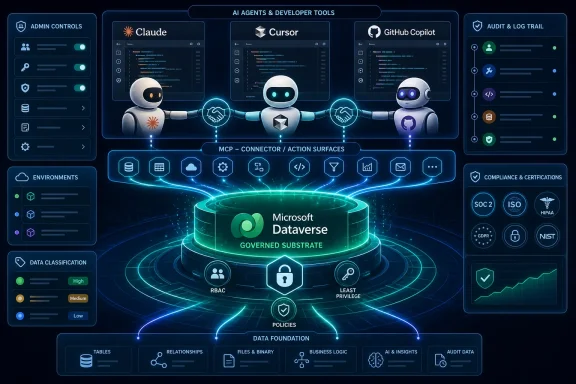
Microsoft announced on July 6, 2026, that Dataverse is expanding its role as an agent data platform by bringing its coding-agent plugin to Claude, Cursor, and GitHub Copilot while broadening MCP support, certification, and governance across Microsoft’s AI stack. The news, detailed in a Microsoft Power Platform Blog post by Dataverse product leader Julie Koesmarno, is less about one plugin than about where Microsoft wants enterprise AI development to happen. The company is trying to make Dataverse the governed substrate beneath agents, apps, copilots, and developer workflows. That is a bigger bet than another marketplace listing.
The pitch is straightforward: if AI agents are going to create records, inspect schemas, run queries, update business data, and help developers build production applications, they need a trusted system of record. Microsoft’s answer is Dataverse, the Power Platform data layer that already underpins Dynamics 365, Power Apps, Copilot Studio scenarios, and a growing number of low-code and pro-code integrations.
That framing matters because the current wave of agentic software is not short on demos. It is short on safe places to operate. A chatbot that drafts an email is one thing; an agent that changes customer records, provisions business objects, or modifies data models is something else entirely.
Microsoft’s July update argues that Dataverse can supply the missing middle: not merely storage, and not merely a connector, but a governed operational environment where coding agents and business agents can touch enterprise data without bypassing role-based access control, authentication policy, or administrative oversight.
This is classic Microsoft platform strategy. The company is not trying to win agent development only by having the cleverest model or the flashiest chat surface. It is trying to win by making the boring enterprise substrate — identity, permissions, catalogs, connectors, certification, admin controls — feel like the safest path to production.
Under the hood, the plugin routes requests through whichever tool is appropriate: the Dataverse MCP server, Python SDK, PAC CLI, or Dataverse CLI. In Microsoft’s telling, the developer does not need to know which of those paths is best for a given task; the plugin acts as a skill router that chooses the right implementation mechanism.
That is a subtle but important change in how Microsoft wants developers to think about Power Platform extensibility. Historically, Dataverse development has required a fair bit of context switching: environment URLs, authentication flows, solution packaging, table metadata, command-line incantations, SDK conventions, and admin-center configuration all live in different mental compartments. A coding-agent plugin collapses those compartments into a conversational interface.
The move into Claude and Cursor also acknowledges reality. Microsoft may own GitHub Copilot, Visual Studio Code, and enormous portions of the enterprise developer estate, but modern developers are not staying inside one assistant. Cursor has become a serious AI-native editor for many teams, and Claude has become a preferred coding companion for developers who like its reasoning style and long-context behavior.
By showing up in those marketplaces, Microsoft is choosing reach over enclosure. That is the correct instinct. If Dataverse is to be the enterprise data layer for agents, it cannot behave as though all agents will be Microsoft-branded.
That choice is where many enterprise agent projects get dangerous. A model that guesses at APIs can hallucinate. A model that has too much permission can do damage. A model that has too little structured tooling becomes a fancy autocomplete system with no operational teeth.
Microsoft’s plugin architecture is meant to thread that needle. The assistant can understand the developer’s intent, but execution is delegated to known tools with known authentication behavior. Microsoft says the plugin follows documented authentication patterns, respects existing Dataverse role-based access control, and is built around least-privilege security.
For IT pros, that is the sentence to underline. The usefulness of agentic development will not be determined only by how often the model produces working code. It will be determined by whether security teams can explain what the agent was allowed to do, why it was allowed to do it, which identity it used, and how the action can be audited afterward.
Microsoft’s blog says its MCP catalog now includes more than 60 ready MCP servers and is designed around systems enterprises already use, from productivity and developer tools to business applications and partner platforms. The company positions the same MCP standard as usable across Microsoft 365 Copilot, Copilot Studio, Azure AI Foundry, GitHub Copilot, and other MCP-compatible experiences.
That is a broader ambition than Dataverse alone. Microsoft is attempting to make MCP feel like the agent-era equivalent of connectors: a common way to expose tools, actions, and systems to AI experiences without rebuilding integrations for every assistant.
For WindowsForum readers who live in the Microsoft admin universe, the analogy is useful but imperfect. Power Platform connectors usually feel like application integration plumbing. MCP servers are closer to action surfaces for autonomous or semi-autonomous systems. They do not just move data from A to B; they give agents a menu of things they may attempt to do.
That difference raises the stakes. The connector era was about access. The MCP era is about delegated operation.
That tool surface turns Dataverse from a passive database-like backend into something agents can actively work with. An agent can inspect the shape of a business system, reason over records, create new operational data, and perform maintenance tasks — assuming the user and environment permissions allow it.
The administrative implications are large. If an agent can create and update records, it becomes part of the business process. If it can create and update tables, it becomes part of the application lifecycle. If it can query and fetch data, it becomes part of the security and compliance boundary.
Microsoft is aware of this, which is why the July announcement repeatedly leans on governance language. But customers should not let the comfort of familiar words obscure the novelty of the operating model. “The agent respected RBAC” is necessary. It is not sufficient by itself.
Enterprises will need to decide which environments are appropriate for agent access, which tools are enabled, how preview features are handled, what telemetry is retained, and how generated changes move through development, test, and production. The Dataverse MCP server may make agents more capable, but it also makes environment hygiene more important.
That caveat should shape how enterprises adopt this stack. The temptation with agent tooling is to wire it directly into the highest-value process because that is where the demo looks most impressive. The safer path is to start in constrained environments, with test data, limited permissions, and explicit review gates.
The distinction between standard MCP tool surfaces and preview endpoints is especially important. Microsoft’s documentation notes that preview tools are separate from generally available tools and can be enabled by administrators through Power Platform admin center settings. Once enabled, the preview endpoint can be used by clients such as Claude, GitHub, or other MCP-compatible tools.
That is powerful, but it is also the kind of switch that deserves change control. Admins should treat it less like enabling a convenience feature and more like adding a new operational interface to an environment. If an agent can call it, monitor it.
Microsoft Learn describes certification as a process intended to give customers and administrators confidence that external MCP services meet expectations for reliability, security, compliance, and responsible operation. The updated certification path uses the Partner Center offer type “Apps and Agents for M365 and Copilot,” while Microsoft says existing certified MCPs do not need to be resubmitted solely because of the transition.
This is another place where Microsoft’s old platform instincts reappear. When a software category is young, the market is chaotic. Every vendor has a connector, every startup has an agent, every integration claims to be secure. Microsoft wants to be the party that sorts the shelf.
For ISVs, certification is a distribution opportunity. For customers, it is a filtering mechanism. For Microsoft, it is a way to make the agent ecosystem orbit its admin and marketplace machinery.
Still, certification should not be mistaken for risk elimination. It can establish minimum expectations and improve discoverability, but it does not answer every customer-specific question. A certified MCP server may still be inappropriate for a particular data classification, tenant policy, regulatory environment, or operational workflow.
Every enterprise has systems that do not fit neatly into public catalogs. There are proprietary APIs, internal approval workflows, line-of-business databases, industry-specific tools, legacy middleware layers, and deeply customized business processes. If agents are going to be genuinely useful, they must eventually touch those systems.
Bring Your Own MCP gives Microsoft a way to say yes without telling customers to abandon governance. The stated goal is to register the MCP once, make it discoverable in the right scenarios, and manage it with expectations around admin approval, visibility, and control.
That is the correct model, but it also shifts responsibility back to the customer. Microsoft can provide the registry, the admin surface, and the integration pattern. It cannot decide whether your internal “approve refund” tool should be callable by a sales-support agent, or whether your “update supplier bank details” workflow should require human confirmation every single time.
The agent platform may be standardized. The risk model remains local.
The July 2026 update pushes Dataverse further into pro-developer territory. Support for Claude, Cursor, and GitHub Copilot is not primarily aimed at casual app makers building a quick departmental form. It is aimed at developers who expect their AI assistant to work inside the editor and understand the platform beneath the code.
That does not mean low-code is being abandoned. Rather, Microsoft is merging the maker and developer stories around a shared data and governance layer. A maker may use Copilot Studio or Power Apps; a developer may use Cursor or GitHub Copilot; an admin may govern the Dataverse environment; an ISV may publish a certified MCP. Microsoft wants all of them pointed at the same platform.
The upside is consistency. The downside is complexity. As the same environment becomes accessible through more agent surfaces, organizations need clearer operating rules. Who is allowed to generate schema changes? Who can approve MCP servers? Which agents can touch production? Which actions require human review? Which logs are reviewed, and by whom?
These are not philosophical questions. They are the practical difference between agentic development as a productivity gain and agentic development as a new class of shadow IT.
Enterprise buyers will hear a different story: control. The same announcement talks about least privilege, documented authentication, existing Dataverse RBAC, certified MCPs, Partner Center packaging, Key Vault-backed authentication details, admin approval, visibility, and governance.
That dual message is not accidental. AI coding tools have already proven that developers like speed. What remains unresolved is whether organizations can absorb that speed without losing oversight. Microsoft is trying to make the answer “yes, if you route the work through our platform.”
This is where the Dataverse strategy becomes more than a Power Platform feature update. Microsoft is positioning its data platform, connector estate, identity system, marketplace process, and agent tools as one governed pipeline from experimentation to execution.
The phrase “from experimentation to execution” appears in Microsoft’s own framing, and it is doing a lot of work. Experiments tolerate rough edges. Execution requires accountability. The July update is Microsoft’s argument that Dataverse can bridge that gap.
Agent tools multiply endpoints of action. A developer’s editor, a Copilot Studio agent, an Azure AI Foundry workflow, a third-party MCP client, and an internal tool registry may all become ways to reach the same business data. Without a strong admin model, that becomes sprawling fast.
The Microsoft-centric advantage is that many of these controls can be made legible to the people already running the tenant. Power Platform admins understand environments. Microsoft Entra administrators understand identity and conditional access. Security teams understand audit trails and least privilege. Developers understand CLI tools and SDKs. The opportunity is to connect those disciplines before agents connect themselves to production data.
The risk is assuming that because each component has a familiar Microsoft label, the combined system is automatically familiar. It is not. Agentic access changes the tempo of operations. A user can describe intent at a higher level, and the system can translate that into multiple tool calls. That makes review and logging more important, not less.
Microsoft’s advantage is breadth. Dataverse is connected to Dynamics 365 and Power Platform. Microsoft 365 Copilot gives the company a massive productivity surface. GitHub gives it developer reach. Azure AI Foundry gives it a model and orchestration platform. Entra gives it identity. Partner Center and marketplace mechanisms give it an ecosystem path.
The challenge is coherence. Microsoft’s stack can be powerful precisely because it is sprawling, but customers can also get lost in overlapping names, preview labels, connector models, Copilot surfaces, and admin settings. MCP may help by creating a common protocol layer, but it does not magically simplify product strategy.
That is why the Dataverse update is worth reading as a platform consolidation move. Microsoft is trying to make Dataverse the default answer when an enterprise asks, “Where should our agents safely interact with business data?” If that answer sticks, Dataverse becomes more strategic than its low-code reputation sometimes suggests.
The developer loop gets tighter because the Dataverse plugin is available in more coding-agent marketplaces. The tool loop gets tighter because MCP gives agents a common way to discover and call capabilities. The partner loop gets tighter because certification creates a more trusted route for ISV-built MCPs. The internal-enterprise loop gets tighter because Bring Your Own MCP gives organizations a governed path for proprietary systems.
That is what makes the announcement notable. It is infrastructure work disguised as productivity news. The demo is a developer asking a coding agent to help with Dataverse. The strategy is Microsoft trying to own the control plane for agentic business operations.
For admins, the right response is neither hype nor dismissal. This is not just another Copilot flourish, but it is also not magic. It is a set of integration and governance primitives that will become more important as organizations let agents move from suggestions to actions.
Teams should read the announcement with a deployment lens rather than a demo lens. The important question is not whether a coding agent can impressively describe a table or generate a command. The important question is whether your organization has decided where that agent may operate, which identity it uses, which tools it can call, and how its work is reviewed.
 Microsoft Wants Dataverse to Be the Place Agents Go to Work
The pitch is straightforward: if AI agents are going to create records, inspect schemas, run queries, update business data, and help developers build production applications, they need a trusted system of record. Microsoft’s answer is Dataverse, the Power Platform data layer that already underpins Dynamics 365, Power Apps, Copilot Studio scenarios, and a growing number of low-code and pro-code integrations.That framing matters because the current wave of agentic software is not short on demos. It is short on safe places to operate. A chatbot that drafts an email is one thing; an agent that changes customer records, provisions business objects, or modifies data models is something else entirely.
Microsoft’s July update argues that Dataverse can supply the missing middle: not merely storage, and not merely a connector, but a governed operational environment where coding agents and business agents can touch enterprise data without bypassing role-based access control, authentication policy, or administrative oversight.
This is classic Microsoft platform strategy. The company is not trying to win agent development only by having the cleverest model or the flashiest chat surface. It is trying to win by making the boring enterprise substrate — identity, permissions, catalogs, connectors, certification, admin controls — feel like the safest path to production.
The Plugin Expansion Is Really a Distribution Move
The most immediately visible announcement is that the Dataverse plugin for coding agents is now available across Claude, Cursor, and GitHub Copilot. Microsoft says the plugin lets developers work in natural language from inside their coding environment rather than hopping between documentation, admin portals, command-line tools, and browser tabs.Under the hood, the plugin routes requests through whichever tool is appropriate: the Dataverse MCP server, Python SDK, PAC CLI, or Dataverse CLI. In Microsoft’s telling, the developer does not need to know which of those paths is best for a given task; the plugin acts as a skill router that chooses the right implementation mechanism.
That is a subtle but important change in how Microsoft wants developers to think about Power Platform extensibility. Historically, Dataverse development has required a fair bit of context switching: environment URLs, authentication flows, solution packaging, table metadata, command-line incantations, SDK conventions, and admin-center configuration all live in different mental compartments. A coding-agent plugin collapses those compartments into a conversational interface.
The move into Claude and Cursor also acknowledges reality. Microsoft may own GitHub Copilot, Visual Studio Code, and enormous portions of the enterprise developer estate, but modern developers are not staying inside one assistant. Cursor has become a serious AI-native editor for many teams, and Claude has become a preferred coding companion for developers who like its reasoning style and long-context behavior.
By showing up in those marketplaces, Microsoft is choosing reach over enclosure. That is the correct instinct. If Dataverse is to be the enterprise data layer for agents, it cannot behave as though all agents will be Microsoft-branded.
Natural Language Is the Interface, but Tool Routing Is the Product
The phrase “natural language” tends to dominate AI product announcements, but the more interesting part of Microsoft’s Dataverse update is tool routing. A developer asking an agent to “create a table for vendor onboarding” or “inspect this environment’s account schema” is not simply issuing a chat prompt. They are asking software to choose between discovery, metadata manipulation, query execution, code generation, and administrative action.That choice is where many enterprise agent projects get dangerous. A model that guesses at APIs can hallucinate. A model that has too much permission can do damage. A model that has too little structured tooling becomes a fancy autocomplete system with no operational teeth.
Microsoft’s plugin architecture is meant to thread that needle. The assistant can understand the developer’s intent, but execution is delegated to known tools with known authentication behavior. Microsoft says the plugin follows documented authentication patterns, respects existing Dataverse role-based access control, and is built around least-privilege security.
For IT pros, that is the sentence to underline. The usefulness of agentic development will not be determined only by how often the model produces working code. It will be determined by whether security teams can explain what the agent was allowed to do, why it was allowed to do it, which identity it used, and how the action can be audited afterward.
MCP Is Becoming the New Connector Layer
The other pillar of Microsoft’s update is Model Context Protocol, or MCP. Originally popularized by Anthropic as a standard way for AI systems to discover and call tools, MCP has rapidly become a candidate for the missing protocol layer between models and enterprise systems.Microsoft’s blog says its MCP catalog now includes more than 60 ready MCP servers and is designed around systems enterprises already use, from productivity and developer tools to business applications and partner platforms. The company positions the same MCP standard as usable across Microsoft 365 Copilot, Copilot Studio, Azure AI Foundry, GitHub Copilot, and other MCP-compatible experiences.
That is a broader ambition than Dataverse alone. Microsoft is attempting to make MCP feel like the agent-era equivalent of connectors: a common way to expose tools, actions, and systems to AI experiences without rebuilding integrations for every assistant.
For WindowsForum readers who live in the Microsoft admin universe, the analogy is useful but imperfect. Power Platform connectors usually feel like application integration plumbing. MCP servers are closer to action surfaces for autonomous or semi-autonomous systems. They do not just move data from A to B; they give agents a menu of things they may attempt to do.
That difference raises the stakes. The connector era was about access. The MCP era is about delegated operation.
Dataverse MCP Gives Agents Hands, Not Just Eyes
Microsoft’s Dataverse MCP server is already positioned as a way for agents to interact with Dataverse from Copilot Studio, Azure AI Foundry, and MCP-compatible clients. Microsoft Learn documentation describes Dataverse MCP capabilities around listing tables, describing table schemas, creating and updating records, running read queries, searching records, fetching full record details, and even creating or modifying tables.That tool surface turns Dataverse from a passive database-like backend into something agents can actively work with. An agent can inspect the shape of a business system, reason over records, create new operational data, and perform maintenance tasks — assuming the user and environment permissions allow it.
The administrative implications are large. If an agent can create and update records, it becomes part of the business process. If it can create and update tables, it becomes part of the application lifecycle. If it can query and fetch data, it becomes part of the security and compliance boundary.
Microsoft is aware of this, which is why the July announcement repeatedly leans on governance language. But customers should not let the comfort of familiar words obscure the novelty of the operating model. “The agent respected RBAC” is necessary. It is not sufficient by itself.
Enterprises will need to decide which environments are appropriate for agent access, which tools are enabled, how preview features are handled, what telemetry is retained, and how generated changes move through development, test, and production. The Dataverse MCP server may make agents more capable, but it also makes environment hygiene more important.
Preview Features Belong in the Lab, Not the Finance Close
Microsoft’s documentation for Dataverse MCP preview tools is appropriately cautious. Preview tools are for evaluation, feedback, integration validation, and preparation for future releases; they may not support full functionality, scale, or general-availability reliability. Microsoft also warns that preview behavior can change.That caveat should shape how enterprises adopt this stack. The temptation with agent tooling is to wire it directly into the highest-value process because that is where the demo looks most impressive. The safer path is to start in constrained environments, with test data, limited permissions, and explicit review gates.
The distinction between standard MCP tool surfaces and preview endpoints is especially important. Microsoft’s documentation notes that preview tools are separate from generally available tools and can be enabled by administrators through Power Platform admin center settings. Once enabled, the preview endpoint can be used by clients such as Claude, GitHub, or other MCP-compatible tools.
That is powerful, but it is also the kind of switch that deserves change control. Admins should treat it less like enabling a convenience feature and more like adding a new operational interface to an environment. If an agent can call it, monitor it.
Certification Is Microsoft’s Trust Funnel for Partner Agents
The July update also highlights MCP certification for ISVs and partners. The idea is simple: partner-built MCP servers can be packaged, submitted through Partner Center, validated, and then made easier for customers to discover and adopt across supported Microsoft surfaces.Microsoft Learn describes certification as a process intended to give customers and administrators confidence that external MCP services meet expectations for reliability, security, compliance, and responsible operation. The updated certification path uses the Partner Center offer type “Apps and Agents for M365 and Copilot,” while Microsoft says existing certified MCPs do not need to be resubmitted solely because of the transition.
This is another place where Microsoft’s old platform instincts reappear. When a software category is young, the market is chaotic. Every vendor has a connector, every startup has an agent, every integration claims to be secure. Microsoft wants to be the party that sorts the shelf.
For ISVs, certification is a distribution opportunity. For customers, it is a filtering mechanism. For Microsoft, it is a way to make the agent ecosystem orbit its admin and marketplace machinery.
Still, certification should not be mistaken for risk elimination. It can establish minimum expectations and improve discoverability, but it does not answer every customer-specific question. A certified MCP server may still be inappropriate for a particular data classification, tenant policy, regulatory environment, or operational workflow.
Bring Your Own MCP Is Where the Governance Story Gets Real
Beyond certified partner MCPs, Microsoft is pushing “Bring Your Own MCP,” which lets organizations register internal MCP servers and make them available to agents under enterprise controls. This may be the most consequential part of the announcement for large organizations.Every enterprise has systems that do not fit neatly into public catalogs. There are proprietary APIs, internal approval workflows, line-of-business databases, industry-specific tools, legacy middleware layers, and deeply customized business processes. If agents are going to be genuinely useful, they must eventually touch those systems.
Bring Your Own MCP gives Microsoft a way to say yes without telling customers to abandon governance. The stated goal is to register the MCP once, make it discoverable in the right scenarios, and manage it with expectations around admin approval, visibility, and control.
That is the correct model, but it also shifts responsibility back to the customer. Microsoft can provide the registry, the admin surface, and the integration pattern. It cannot decide whether your internal “approve refund” tool should be callable by a sales-support agent, or whether your “update supplier bank details” workflow should require human confirmation every single time.
The agent platform may be standardized. The risk model remains local.
The Power Platform Boundary Keeps Moving Toward Developers
For years, Power Platform has lived with a productive tension. Microsoft sells it as a low-code environment for makers, but enterprise adoption almost always pulls in professional developers, solution architects, security teams, and platform administrators. Dataverse sits at the center of that tension.The July 2026 update pushes Dataverse further into pro-developer territory. Support for Claude, Cursor, and GitHub Copilot is not primarily aimed at casual app makers building a quick departmental form. It is aimed at developers who expect their AI assistant to work inside the editor and understand the platform beneath the code.
That does not mean low-code is being abandoned. Rather, Microsoft is merging the maker and developer stories around a shared data and governance layer. A maker may use Copilot Studio or Power Apps; a developer may use Cursor or GitHub Copilot; an admin may govern the Dataverse environment; an ISV may publish a certified MCP. Microsoft wants all of them pointed at the same platform.
The upside is consistency. The downside is complexity. As the same environment becomes accessible through more agent surfaces, organizations need clearer operating rules. Who is allowed to generate schema changes? Who can approve MCP servers? Which agents can touch production? Which actions require human review? Which logs are reviewed, and by whom?
These are not philosophical questions. They are the practical difference between agentic development as a productivity gain and agentic development as a new class of shadow IT.
Microsoft Is Selling Flow, but Enterprises Will Buy Control
Microsoft’s product language emphasizes staying “in flow.” Developers can ask for what they need without leaving their coding environment. Agents can use the right tool at the right time. MCPs can connect to familiar business systems. The story is speed.Enterprise buyers will hear a different story: control. The same announcement talks about least privilege, documented authentication, existing Dataverse RBAC, certified MCPs, Partner Center packaging, Key Vault-backed authentication details, admin approval, visibility, and governance.
That dual message is not accidental. AI coding tools have already proven that developers like speed. What remains unresolved is whether organizations can absorb that speed without losing oversight. Microsoft is trying to make the answer “yes, if you route the work through our platform.”
This is where the Dataverse strategy becomes more than a Power Platform feature update. Microsoft is positioning its data platform, connector estate, identity system, marketplace process, and agent tools as one governed pipeline from experimentation to execution.
The phrase “from experimentation to execution” appears in Microsoft’s own framing, and it is doing a lot of work. Experiments tolerate rough edges. Execution requires accountability. The July update is Microsoft’s argument that Dataverse can bridge that gap.
Windows Shops Should Watch the Admin Plane, Not Just the Assistant
For Windows-centric IT teams, the immediate instinct may be to focus on GitHub Copilot support. That is understandable, especially in organizations already standardizing on GitHub Enterprise, Visual Studio Code, and Microsoft developer tooling. But the more important surface may be the admin plane.Agent tools multiply endpoints of action. A developer’s editor, a Copilot Studio agent, an Azure AI Foundry workflow, a third-party MCP client, and an internal tool registry may all become ways to reach the same business data. Without a strong admin model, that becomes sprawling fast.
The Microsoft-centric advantage is that many of these controls can be made legible to the people already running the tenant. Power Platform admins understand environments. Microsoft Entra administrators understand identity and conditional access. Security teams understand audit trails and least privilege. Developers understand CLI tools and SDKs. The opportunity is to connect those disciplines before agents connect themselves to production data.
The risk is assuming that because each component has a familiar Microsoft label, the combined system is automatically familiar. It is not. Agentic access changes the tempo of operations. A user can describe intent at a higher level, and the system can translate that into multiple tool calls. That makes review and logging more important, not less.
The Real Competition Is the Default Data Layer
Microsoft is not alone in seeing the agent-data problem. Every major enterprise software vendor wants its system to become the place agents retrieve context and take action. Salesforce has its own agent platform ambitions. ServiceNow wants workflow agents close to enterprise operations. Database vendors want vector and transactional workloads to converge. Developer platforms want agents to live where code lives.Microsoft’s advantage is breadth. Dataverse is connected to Dynamics 365 and Power Platform. Microsoft 365 Copilot gives the company a massive productivity surface. GitHub gives it developer reach. Azure AI Foundry gives it a model and orchestration platform. Entra gives it identity. Partner Center and marketplace mechanisms give it an ecosystem path.
The challenge is coherence. Microsoft’s stack can be powerful precisely because it is sprawling, but customers can also get lost in overlapping names, preview labels, connector models, Copilot surfaces, and admin settings. MCP may help by creating a common protocol layer, but it does not magically simplify product strategy.
That is why the Dataverse update is worth reading as a platform consolidation move. Microsoft is trying to make Dataverse the default answer when an enterprise asks, “Where should our agents safely interact with business data?” If that answer sticks, Dataverse becomes more strategic than its low-code reputation sometimes suggests.
The July Signal Is Bigger Than the July Feature Set
Microsoft’s July 2026 Dataverse update does not deliver one giant feature that changes enterprise AI overnight. Instead, it tightens several loops that need to close before agents become normal enterprise software.The developer loop gets tighter because the Dataverse plugin is available in more coding-agent marketplaces. The tool loop gets tighter because MCP gives agents a common way to discover and call capabilities. The partner loop gets tighter because certification creates a more trusted route for ISV-built MCPs. The internal-enterprise loop gets tighter because Bring Your Own MCP gives organizations a governed path for proprietary systems.
That is what makes the announcement notable. It is infrastructure work disguised as productivity news. The demo is a developer asking a coding agent to help with Dataverse. The strategy is Microsoft trying to own the control plane for agentic business operations.
For admins, the right response is neither hype nor dismissal. This is not just another Copilot flourish, but it is also not magic. It is a set of integration and governance primitives that will become more important as organizations let agents move from suggestions to actions.
The Practical Read for Dataverse Teams
Microsoft’s July update gives Dataverse customers a roadmap signal as much as a product signal. The platform is being prepared for a world in which agents are not occasional helpers but routine participants in development, data operations, and business workflows.Teams should read the announcement with a deployment lens rather than a demo lens. The important question is not whether a coding agent can impressively describe a table or generate a command. The important question is whether your organization has decided where that agent may operate, which identity it uses, which tools it can call, and how its work is reviewed.
- The Dataverse coding-agent plugin is now positioned as a cross-marketplace tool, with availability for Claude, Cursor, and GitHub Copilot.
- MCP is becoming Microsoft’s preferred connective tissue for agents that need to discover and use tools across enterprise systems.
- The Dataverse MCP server gives agents operational access to business data and metadata, which makes permissions and environment design central to adoption.
- Certified MCPs give ISVs a Microsoft-approved route into customer environments, but certification should complement internal risk assessment rather than replace it.
- Bring Your Own MCP is likely to matter most in large enterprises, where internal systems and proprietary workflows define the real automation opportunity.
- Preview MCP capabilities should be isolated, tested, and governed carefully before any organization lets them near production-critical processes.
References
- Primary source: Microsoft
Published: 2026-07-06T15:50:08.950029
Loading…
www.microsoft.com