

TechPP’s July 6 and July 7, 2026 Daily Briefs captured a two-day burst of platform news in which Google tightened Android backup accounting, Samsung moved users toward Google Messages, Microsoft announced 4,800 layoffs, and Apple’s next software and hardware bets edged closer to launch. The individual items look scattered; the pattern is not. Big Tech is using 2026 to make ecosystems less optional, less generous, and more expensive to leave.
That is the useful reading for WindowsForum readers. The story is not simply that Android backups now count differently, or that Xbox is being cut again, or that Samsung Messages is fading. The story is that the largest consumer platforms are narrowing the escape routes while asking users, developers, and IT departments to trust that convenience will compensate for lock-in.
Google’s Android backup change is small in megabytes and large in meaning. As TechPP noted in its July 7 brief, Google is expanding what counts against Google Account storage so that more Android backup data, including SMS, call history, and device settings, is included in the account quota. 9to5Google separately reported that the change begins July 7 for new Android backup users, with existing users to follow.
Google’s position is that the practical hit should be modest, around tens of megabytes for an average user. That may be true. Most users will not wake up to find their Google One plan suddenly exhausted because call history and settings joined Photos, Drive, and Gmail in the same storage bucket.
But the size of the charge is not the whole story. The strategic move is that system state — the stuff that makes a phone feel like your phone after a restore — is being pulled into the same paid-capacity logic as photos, files, and email. It is one more reminder that cloud backup is no longer a background courtesy. It is infrastructure, and infrastructure eventually gets priced.
For Android users, this change arrives after years of Google shifting once-loose cloud assumptions into more explicit account management. Google Photos lost its unlimited free backup era. Gmail, Drive, Photos, and device backups now compete inside the same quota. Even if this specific change adds only a sliver of storage pressure, it trains users to think about recovery, identity, and continuity as parts of a paid Google relationship.
That matters for Windows users because the same pattern is visible across Microsoft’s world. OneDrive backup prompts, Microsoft account sign-in pressure, Windows Settings sync, Edge profile sync, BitLocker recovery keys tied to cloud accounts, and Microsoft 365 storage all operate on the same principle: the device is less important than the account that reconstitutes it. The PC has not become a phone, but the recovery model increasingly has.
The trouble is that consent in modern operating systems is often implemented after the default has already been chosen. Users are technically able to opt out, but the interface assumes that the platform’s preferred path is the normal one. Over time, the burden moves from the vendor proving why a category should be backed up to the user discovering why it was backed up in the first place.
This is familiar territory for Windows administrators. Microsoft’s cloud-first defaults are rarely framed as coercion; they are framed as recovery, convenience, security, and continuity. Those are real benefits. A Windows laptop with a dead SSD is far less painful to replace when files, browser state, settings, and credentials are waiting in the cloud.
Yet IT departments know the shadow side. Defaults become policy by accident. Personal accounts creep into work machines. Consumer backup flows collide with compliance rules. A feature meant to make restore easier can become a data governance issue if nobody mapped where the data went, who controls it, and how long it stays there.
The Android change is therefore less about 40MB and more about the politics of defaults. Once backup categories are counted, categorized, toggled, and billed, they become part of a platform contract. Users who never read that contract still live under it.
Messaging is not just another app category. It is the place where identity, two-factor codes, family logistics, customer service, political organizing, spam, and emergency contact all collide. Whoever owns the default messaging client owns a privileged layer of daily life.
For Google, Samsung’s retreat is a major consolidation win. Android has always suffered from a certain messaging incoherence: carrier apps, OEM apps, Google apps, regional apps, and over-the-top services like WhatsApp and Telegram all claiming pieces of the same behavior. Google Messages gives Android a more unified answer to iMessage, particularly in markets where SMS and RCS still matter.
For Samsung, the tradeoff is more complicated. The company gains relief from maintaining a parallel messaging stack, while aligning with the RCS implementation Google has been pushing. But it also gives up another piece of the software relationship that once distinguished Galaxy phones from generic Android devices.
Windows users have seen this movie in reverse. OEMs once tried to differentiate PCs with their own utilities, control panels, media apps, backup tools, update agents, and security trials. Microsoft spent years pulling more of that experience back into Windows itself. Some of that was good; much OEM software was dreadful. But the result was a less differentiated PC market where the operating system vendor, not the hardware maker, increasingly defined the experience.
Samsung’s messaging decision suggests Android is undergoing the same cleanup. The chaos is being reduced. So is the room for independent user experience.
The interesting point is not simply that foldables are expensive. They have always been expensive. The point is that the premium phone market appears to be searching for a new justification after years of camera upgrades, chip gains, and display improvements began feeling incremental to normal buyers.
Apple’s entry, if it arrives this cycle, would validate the category in a way Android vendors have wanted for years. Samsung has done the heavy lifting, absorbing the early durability concerns, software awkwardness, and public skepticism. Apple can now enter when the components are better, the use cases are clearer, and the market has been trained to understand what a foldable is supposed to be.
That does not mean Apple will democratize the category. If anything, a limited launch would reinforce foldables as luxury devices first and mainstream devices later. The “Ultra” framing, if accurate, would tell buyers not to expect a replacement for the base iPhone. It would be a status machine, a developer target, and a margin product.
There is a Windows angle here too. Foldables and dual-screen ideas have long tempted PC makers, from Lenovo’s experimental designs to Microsoft’s abandoned Surface Neo vision. The lesson from phones is that hardware novelty only survives when the software model is ready. A hinge is not a platform. A larger pocket screen is only useful if apps, multitasking, durability, battery life, and repair economics make sense together.
The timing is important. Microsoft’s fiscal year starts in July, and annual restructuring has become a grim rhythm across the company. But this round lands differently because Microsoft is simultaneously spending enormous sums on AI infrastructure, cloud capacity, and the enterprise services that now dominate its growth narrative.
That does not mean every layoff is “because of AI,” a phrase that often explains too much and too little. Companies restructure for margin, strategy, overlap after acquisitions, changing demand, and executive fashion. But it is impossible to ignore the resource reallocation. Microsoft is telling Wall Street that AI and cloud are the growth engines, while telling thousands of workers that their current roles no longer fit the plan.
Xbox is especially exposed because it sits at the intersection of old and new Microsoft. It is a hardware brand, a subscription service, a studio network, a cloud gaming experiment, and a content library built through enormous acquisitions. That makes it strategically attractive but operationally messy.
For Windows users, Xbox also matters beyond consoles. Game Pass, PC gaming, the Microsoft Store, DirectX, Windows handhelds, and cloud streaming are all tied to how Microsoft sees gaming’s future. If Xbox becomes leaner, more service-driven, and less attached to traditional console identity, Windows gaming could benefit in some ways and lose in others.
The benefit would be more cross-platform pragmatism. Microsoft has already been moving away from old exclusivity assumptions, and a reset could accelerate a world where Xbox means account, library, and service rather than box under the TV. The risk is that cuts hollow out the creative and support structure that made the ecosystem worth joining.
Simplification is not inherently bad. Users often benefit when duplicate apps disappear, backups become clearer, and software stacks become easier to maintain. Developers benefit when there are fewer weird OEM divergences to test. IT departments benefit when platform behavior becomes predictable.
But simplification almost always points upward. It simplifies life for the platform owner first. The user gets the cleaner interface after the vendor gets the cleaner cost structure, cleaner data model, cleaner support matrix, or cleaner monetization path.
The reported Oppo move is a useful example. OxygenOS built OnePlus loyalty because it felt fast, restrained, and enthusiast-friendly. Over time, as OnePlus became more integrated with Oppo, that identity softened. A full ColorOS consolidation would be rational from an engineering perspective. It would also confirm that the brand’s old software promise has been absorbed into a corporate efficiency plan.
Samsung Messages tells a similar story. Google Messages is probably the better long-term default for RCS. But the more Android standardizes around Google’s apps, the less meaningful OEM differentiation becomes. Android remains open in licensing terms, yet the lived experience becomes more centralized.
Windows has spent decades oscillating between those poles. Too much OEM freedom created junkware and driver chaos. Too much Microsoft control creates user resentment and regulatory scrutiny. The healthiest platform is not the one with the fewest choices; it is the one where defaults are good and exits remain real.
Apple’s lock-in has always felt different from Google’s and Microsoft’s because it is packaged as taste. The interface is polished. The hardware is integrated. The ecosystem behaviors are often genuinely delightful. Users do not feel trapped when everything works.
But a polished cage is still a cage if key features require deeper subscriptions or newer hardware. TechPP noted that Apple Home’s new AI camera features may require a 2TB iCloud+ plan or Apple One Premier, based on beta release note findings. If that holds, Apple’s smart home pitch will follow the same pattern as cloud storage and AI features elsewhere: the best version of the product is not in the box you bought, but in the service tier you keep paying for.
This is where Apple’s and Microsoft’s strategies increasingly rhyme. Apple sells premium hardware and attaches services. Microsoft sells cloud services and uses Windows, Office, Xbox, and security tooling as distribution. Google sells attention and cloud intelligence, then makes Android the identity surface. Different business models, same destination: the account is the product’s center of gravity.
For administrators, that changes procurement. Buying devices is no longer enough. The real questions are which account system restores the device, which cloud stores the data, which AI layer reads the content, which subscription unlocks the management feature, and which vendor can change the default next year.
The absurdity is obvious: AI systems are now needed to defend human conversation from AI systems pretending to be human conversation. But this is not merely a Reddit problem. It is the emerging maintenance cost of the public internet.
Search engines increasingly surface Reddit threads because they look more human than SEO-choked web pages. Marketers follow that attention. AI makes it cheap to flood communities with plausible product chatter, fake anecdotes, and synthetic consensus. The platform then deploys AI to detect the AI it helped make economically attractive.
For WindowsForum and similar communities, this is more than industry gossip. Technical forums are valuable precisely because they contain lived troubleshooting history: the weird driver conflict, the obscure registry fix, the update that broke one printer model, the admin who tested a workaround before a vendor acknowledged the bug. If that corpus gets polluted by AI-generated filler, the community loses its reason to exist.
The lesson is that authenticity is becoming an infrastructure problem. Moderation, identity, reputation, and provenance will matter as much as search and hosting. The next useful technical community will not be the one with the most posts. It will be the one that can prove enough of its posts came from people who actually tried the thing.
Google shutting down the Tenor API for third-party use, as TechPP reported, fits the same pattern. A service can continue inside the owner’s own products while becoming less available to outsiders. Developers who built around the API must move, absorb the cost, or explain to users why a familiar feature changed.
Google Wallet showing Wear OS transaction history inside the Android phone app is another small example in the other direction. It is useful, coherent, and exactly the kind of cross-device integration users want. The catch is that every convenience strengthens the gravitational pull of the account and platform.
Samsung’s smart glasses leak, Sony’s RX10 teaser, WhatsApp’s online-status indicators, Notion’s app tease, and Chrome 150’s rollout all sit inside the same environment. Devices and apps are no longer discrete products as much as endpoints in service networks. The winners are not merely the companies with the best hardware or interface; they are the companies that can make switching feel irrational.
That is why Windows remains central even when the headlines are about phones. The PC is still the place where many users expect general-purpose computing to survive. It is where files can still be local, browsers can still be swapped, apps can still come from outside a single store, and power users can still bend the system to their will. Microsoft has narrowed some of that freedom in Windows 11, but the expectation remains culturally important.
If the phone world keeps consolidating, the PC world becomes the counterweight by default. That gives Microsoft both an opportunity and a responsibility. Windows can either become another locked endpoint in a cloud subscription chain, or it can remain the platform where users and admins retain meaningful agency.
That is the useful reading for WindowsForum readers. The story is not simply that Android backups now count differently, or that Xbox is being cut again, or that Samsung Messages is fading. The story is that the largest consumer platforms are narrowing the escape routes while asking users, developers, and IT departments to trust that convenience will compensate for lock-in.
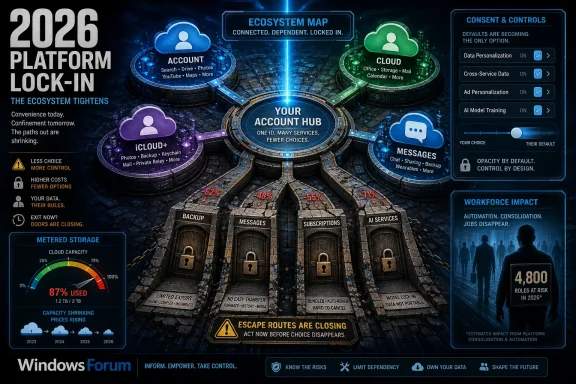 The Free Tier Is Becoming a Metered Utility
Google’s Android backup change is small in megabytes and large in meaning. As TechPP noted in its July 7 brief, Google is expanding what counts against Google Account storage so that more Android backup data, including SMS, call history, and device settings, is included in the account quota. 9to5Google separately reported that the change begins July 7 for new Android backup users, with existing users to follow.Google’s position is that the practical hit should be modest, around tens of megabytes for an average user. That may be true. Most users will not wake up to find their Google One plan suddenly exhausted because call history and settings joined Photos, Drive, and Gmail in the same storage bucket.
But the size of the charge is not the whole story. The strategic move is that system state — the stuff that makes a phone feel like your phone after a restore — is being pulled into the same paid-capacity logic as photos, files, and email. It is one more reminder that cloud backup is no longer a background courtesy. It is infrastructure, and infrastructure eventually gets priced.
For Android users, this change arrives after years of Google shifting once-loose cloud assumptions into more explicit account management. Google Photos lost its unlimited free backup era. Gmail, Drive, Photos, and device backups now compete inside the same quota. Even if this specific change adds only a sliver of storage pressure, it trains users to think about recovery, identity, and continuity as parts of a paid Google relationship.
That matters for Windows users because the same pattern is visible across Microsoft’s world. OneDrive backup prompts, Microsoft account sign-in pressure, Windows Settings sync, Edge profile sync, BitLocker recovery keys tied to cloud accounts, and Microsoft 365 storage all operate on the same principle: the device is less important than the account that reconstitutes it. The PC has not become a phone, but the recovery model increasingly has.
Android’s Backup Shift Is Really About Consent
The defense of Google’s change is obvious: backup systems cost money, and more granular toggles are better than an all-or-nothing switch. TechPP noted that Google is offering controls to turn off backup for categories such as SMS, call history, and device settings. For privacy-minded users, that is a meaningful improvement.The trouble is that consent in modern operating systems is often implemented after the default has already been chosen. Users are technically able to opt out, but the interface assumes that the platform’s preferred path is the normal one. Over time, the burden moves from the vendor proving why a category should be backed up to the user discovering why it was backed up in the first place.
This is familiar territory for Windows administrators. Microsoft’s cloud-first defaults are rarely framed as coercion; they are framed as recovery, convenience, security, and continuity. Those are real benefits. A Windows laptop with a dead SSD is far less painful to replace when files, browser state, settings, and credentials are waiting in the cloud.
Yet IT departments know the shadow side. Defaults become policy by accident. Personal accounts creep into work machines. Consumer backup flows collide with compliance rules. A feature meant to make restore easier can become a data governance issue if nobody mapped where the data went, who controls it, and how long it stays there.
The Android change is therefore less about 40MB and more about the politics of defaults. Once backup categories are counted, categorized, toggled, and billed, they become part of a platform contract. Users who never read that contract still live under it.
Samsung’s Messaging Retreat Hands Google the Relationship Layer
TechPP’s July 6 brief also highlighted Samsung’s move away from Samsung Messages in favor of Google Messages. This is not a sudden rupture; Samsung has been nudging users toward Google Messages for years, especially as RCS became the industry’s preferred answer to the aging SMS/MMS stack. But “use Google Messages” and “Samsung Messages is going away” are different moments.Messaging is not just another app category. It is the place where identity, two-factor codes, family logistics, customer service, political organizing, spam, and emergency contact all collide. Whoever owns the default messaging client owns a privileged layer of daily life.
For Google, Samsung’s retreat is a major consolidation win. Android has always suffered from a certain messaging incoherence: carrier apps, OEM apps, Google apps, regional apps, and over-the-top services like WhatsApp and Telegram all claiming pieces of the same behavior. Google Messages gives Android a more unified answer to iMessage, particularly in markets where SMS and RCS still matter.
For Samsung, the tradeoff is more complicated. The company gains relief from maintaining a parallel messaging stack, while aligning with the RCS implementation Google has been pushing. But it also gives up another piece of the software relationship that once distinguished Galaxy phones from generic Android devices.
Windows users have seen this movie in reverse. OEMs once tried to differentiate PCs with their own utilities, control panels, media apps, backup tools, update agents, and security trials. Microsoft spent years pulling more of that experience back into Windows itself. Some of that was good; much OEM software was dreadful. But the result was a less differentiated PC market where the operating system vendor, not the hardware maker, increasingly defined the experience.
Samsung’s messaging decision suggests Android is undergoing the same cleanup. The chaos is being reduced. So is the room for independent user experience.
Foldables Are Becoming the New Premium Tax
The July 6 TechPP brief framed Apple’s rumored foldable iPhone — possibly branded as an Ultra model, according to analyst Ming-Chi Kuo’s reporting as described by TechPP — as a limited-availability launch. Samsung, meanwhile, is expected to push new foldable formats, including a wider Fold model, with European pricing leaks suggesting ultra-premium territory.The interesting point is not simply that foldables are expensive. They have always been expensive. The point is that the premium phone market appears to be searching for a new justification after years of camera upgrades, chip gains, and display improvements began feeling incremental to normal buyers.
Apple’s entry, if it arrives this cycle, would validate the category in a way Android vendors have wanted for years. Samsung has done the heavy lifting, absorbing the early durability concerns, software awkwardness, and public skepticism. Apple can now enter when the components are better, the use cases are clearer, and the market has been trained to understand what a foldable is supposed to be.
That does not mean Apple will democratize the category. If anything, a limited launch would reinforce foldables as luxury devices first and mainstream devices later. The “Ultra” framing, if accurate, would tell buyers not to expect a replacement for the base iPhone. It would be a status machine, a developer target, and a margin product.
There is a Windows angle here too. Foldables and dual-screen ideas have long tempted PC makers, from Lenovo’s experimental designs to Microsoft’s abandoned Surface Neo vision. The lesson from phones is that hardware novelty only survives when the software model is ready. A hinge is not a platform. A larger pocket screen is only useful if apps, multitasking, durability, battery life, and repair economics make sense together.
Microsoft’s Xbox Cuts Show the Cloud Bill Coming Due
The hardest item in TechPP’s July 7 brief was Microsoft’s layoff announcement. TechPP cited Reuters in reporting that Microsoft is cutting 4,800 jobs globally, with a large share affecting Xbox. The Associated Press also reported the cuts as part of a major Xbox reset, while Axios described studio sales and broader restructuring inside the gaming business.The timing is important. Microsoft’s fiscal year starts in July, and annual restructuring has become a grim rhythm across the company. But this round lands differently because Microsoft is simultaneously spending enormous sums on AI infrastructure, cloud capacity, and the enterprise services that now dominate its growth narrative.
That does not mean every layoff is “because of AI,” a phrase that often explains too much and too little. Companies restructure for margin, strategy, overlap after acquisitions, changing demand, and executive fashion. But it is impossible to ignore the resource reallocation. Microsoft is telling Wall Street that AI and cloud are the growth engines, while telling thousands of workers that their current roles no longer fit the plan.
Xbox is especially exposed because it sits at the intersection of old and new Microsoft. It is a hardware brand, a subscription service, a studio network, a cloud gaming experiment, and a content library built through enormous acquisitions. That makes it strategically attractive but operationally messy.
For Windows users, Xbox also matters beyond consoles. Game Pass, PC gaming, the Microsoft Store, DirectX, Windows handhelds, and cloud streaming are all tied to how Microsoft sees gaming’s future. If Xbox becomes leaner, more service-driven, and less attached to traditional console identity, Windows gaming could benefit in some ways and lose in others.
The benefit would be more cross-platform pragmatism. Microsoft has already been moving away from old exclusivity assumptions, and a reset could accelerate a world where Xbox means account, library, and service rather than box under the TV. The risk is that cuts hollow out the creative and support structure that made the ecosystem worth joining.
The Platform Company Always Says It Is Simplifying
A phrase runs through nearly every item in these two TechPP briefs: simplification. Google simplifies backup accounting. Samsung simplifies messaging. Oppo reportedly simplifies its Android skins by consolidating OxygenOS and Realme UI under ColorOS, according to Smartprix reporting cited by TechPP. Microsoft simplifies Xbox through restructuring. Apple simplifies product segmentation by pushing its most experimental hardware into an Ultra tier.Simplification is not inherently bad. Users often benefit when duplicate apps disappear, backups become clearer, and software stacks become easier to maintain. Developers benefit when there are fewer weird OEM divergences to test. IT departments benefit when platform behavior becomes predictable.
But simplification almost always points upward. It simplifies life for the platform owner first. The user gets the cleaner interface after the vendor gets the cleaner cost structure, cleaner data model, cleaner support matrix, or cleaner monetization path.
The reported Oppo move is a useful example. OxygenOS built OnePlus loyalty because it felt fast, restrained, and enthusiast-friendly. Over time, as OnePlus became more integrated with Oppo, that identity softened. A full ColorOS consolidation would be rational from an engineering perspective. It would also confirm that the brand’s old software promise has been absorbed into a corporate efficiency plan.
Samsung Messages tells a similar story. Google Messages is probably the better long-term default for RCS. But the more Android standardizes around Google’s apps, the less meaningful OEM differentiation becomes. Android remains open in licensing terms, yet the lived experience becomes more centralized.
Windows has spent decades oscillating between those poles. Too much OEM freedom created junkware and driver chaos. Too much Microsoft control creates user resentment and regulatory scrutiny. The healthiest platform is not the one with the fewest choices; it is the one where defaults are good and exits remain real.
Apple’s Betas Reveal the Other Kind of Lock-In
Apple’s iOS 27 Beta 3 rollout, covered by TechPP and MacRumors, is the soft-power version of the same ecosystem story. Liquid Glass refinements, Siri improvements, third-party app hooks, and cross-device beta releases for macOS, watchOS, tvOS, and iPadOS all point toward Apple’s preferred future: not one device, but one ambient system.Apple’s lock-in has always felt different from Google’s and Microsoft’s because it is packaged as taste. The interface is polished. The hardware is integrated. The ecosystem behaviors are often genuinely delightful. Users do not feel trapped when everything works.
But a polished cage is still a cage if key features require deeper subscriptions or newer hardware. TechPP noted that Apple Home’s new AI camera features may require a 2TB iCloud+ plan or Apple One Premier, based on beta release note findings. If that holds, Apple’s smart home pitch will follow the same pattern as cloud storage and AI features elsewhere: the best version of the product is not in the box you bought, but in the service tier you keep paying for.
This is where Apple’s and Microsoft’s strategies increasingly rhyme. Apple sells premium hardware and attaches services. Microsoft sells cloud services and uses Windows, Office, Xbox, and security tooling as distribution. Google sells attention and cloud intelligence, then makes Android the identity surface. Different business models, same destination: the account is the product’s center of gravity.
For administrators, that changes procurement. Buying devices is no longer enough. The real questions are which account system restores the device, which cloud stores the data, which AI layer reads the content, which subscription unlocks the management feature, and which vendor can change the default next year.
Reddit’s AI Spam Fight Is the Internet Admitting Defeat
Among the more revealing July 7 items was Reddit’s reported use of AI to fight AI-generated marketing spam. TechPP said Reddit claimed it blocked tens of millions of spam users per day, caught thousands of spam posts and comments, revoked millions of inauthentic votes, and saw spam posts fall during the first quarter of 2026.The absurdity is obvious: AI systems are now needed to defend human conversation from AI systems pretending to be human conversation. But this is not merely a Reddit problem. It is the emerging maintenance cost of the public internet.
Search engines increasingly surface Reddit threads because they look more human than SEO-choked web pages. Marketers follow that attention. AI makes it cheap to flood communities with plausible product chatter, fake anecdotes, and synthetic consensus. The platform then deploys AI to detect the AI it helped make economically attractive.
For WindowsForum and similar communities, this is more than industry gossip. Technical forums are valuable precisely because they contain lived troubleshooting history: the weird driver conflict, the obscure registry fix, the update that broke one printer model, the admin who tested a workaround before a vendor acknowledged the bug. If that corpus gets polluted by AI-generated filler, the community loses its reason to exist.
The lesson is that authenticity is becoming an infrastructure problem. Moderation, identity, reputation, and provenance will matter as much as search and hosting. The next useful technical community will not be the one with the most posts. It will be the one that can prove enough of its posts came from people who actually tried the thing.
The Week’s Small Items Point to One Big Operating-System Story
The temptation with daily briefs is to treat them as a pile of unrelated updates. A beta here, a layoff there, a discontinued API, a messaging migration, a leaked foldable price. But the platform economy often reveals itself in the small items before the keynote does.Google shutting down the Tenor API for third-party use, as TechPP reported, fits the same pattern. A service can continue inside the owner’s own products while becoming less available to outsiders. Developers who built around the API must move, absorb the cost, or explain to users why a familiar feature changed.
Google Wallet showing Wear OS transaction history inside the Android phone app is another small example in the other direction. It is useful, coherent, and exactly the kind of cross-device integration users want. The catch is that every convenience strengthens the gravitational pull of the account and platform.
Samsung’s smart glasses leak, Sony’s RX10 teaser, WhatsApp’s online-status indicators, Notion’s app tease, and Chrome 150’s rollout all sit inside the same environment. Devices and apps are no longer discrete products as much as endpoints in service networks. The winners are not merely the companies with the best hardware or interface; they are the companies that can make switching feel irrational.
That is why Windows remains central even when the headlines are about phones. The PC is still the place where many users expect general-purpose computing to survive. It is where files can still be local, browsers can still be swapped, apps can still come from outside a single store, and power users can still bend the system to their will. Microsoft has narrowed some of that freedom in Windows 11, but the expectation remains culturally important.
If the phone world keeps consolidating, the PC world becomes the counterweight by default. That gives Microsoft both an opportunity and a responsibility. Windows can either become another locked endpoint in a cloud subscription chain, or it can remain the platform where users and admins retain meaningful agency.
The July 7 Signal Beneath the Noise
The practical reading of this news cycle is not panic. It is inventory. Users and administrators should treat these announcements as prompts to map which platform assumptions they have been making without noticing.- Google’s Android backup change is small for most users today, but it confirms that device recovery is part of the metered cloud economy.
- Samsung’s move toward Google Messages makes Android messaging cleaner, while giving Google more control over a core relationship layer.
- Microsoft’s 4,800 layoffs show how aggressively the company is reallocating resources as AI, cloud, and services dominate its strategy.
- Apple’s iOS 27 beta cycle and rumored foldable plans show a premium ecosystem getting deeper, more integrated, and more subscription-aware.
- Reddit’s AI spam fight is an early warning that authentic technical communities will need stronger defenses against synthetic participation.
- Developers should assume that platform APIs, defaults, and free allowances can change quickly when they no longer serve the owner’s strategy.
References
- Primary source: TechPP
Published: Tue, 07 Jul 2026 03:05:09 GMT
- Related coverage: windowscentral.com
Microsoft expected to lay off thousands in what has become an annual July restructuring | Windows Central
Reportedly, thousands of roles will be cut across Xbox, sales, and consulting as the tech giant starts its new fiscal year.www.windowscentral.com - Official source: 9to5google.com
All Android backup data counts towards Google Account storage
Google is making a policy change to Android backups that adjusts what counts towards your Google Account storage.9to5google.com - Official source: support.google.com
- Related coverage: techpp.app
TechPP Data | Tech Availability & Comparisons
Explore tech availability, comparisons, and real-world performance data. Interactive data maps and benchmarks for Apple, Snapdragon, Android, ChatGPT, and more.techpp.app
