

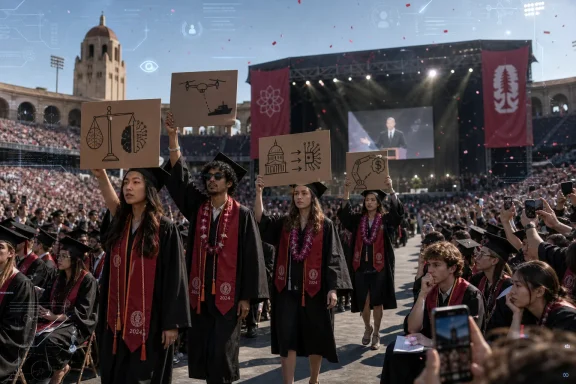
Google CEO Sundar Pichai delivered Stanford University’s 135th commencement address on June 14, 2026, at Stanford Stadium, where roughly 100 to 200 graduates walked out while others protested Google’s AI, immigration-enforcement, and Israel-related government work. The moment mattered because Stanford is not a random stage for the AI backlash; it is one of Silicon Valley’s deepest talent wells. If the sales pitch is faltering there, Big Tech has a legitimacy problem that cannot be fixed with a better demo.
For decades, the Stanford commencement stage has carried a convenient myth for the technology industry: the university produces the builders, the builders join the platforms, and the platforms change the world. It is a tidy story, flattering to everyone involved. The graduate gets destiny, the company gets talent, and the institution gets proof that proximity to power is still a form of intellectual capital.
Pichai should have been the safest possible messenger for that story. He is a Stanford alumnus, a Google lifer turned Alphabet chief executive, and the public face of a company that helped define the modern web. He arrived not as an outsider but as a product of the same prestige pipeline the graduates had just completed.
Instead, the ceremony exposed a rupture. Some graduates did not hear an alumnus returning home; they saw the executive of a company whose technologies are now bound up with surveillance, war, immigration enforcement, labor disruption, and the automation of white-collar work. That is a very different kind of commencement symbolism.
The BBC’s framing — Stanford as a “golden ticket” that AI may complicate — gets at the anxiety beneath the protest. A Stanford degree still opens doors. But the door it opens most reliably leads into an industry that increasingly asks young workers to accept automation as destiny and political entanglement as infrastructure.
That was a rational decision. Earlier in the commencement season, former Google CEO Eric Schmidt and other speakers had drawn boos for optimistic references to AI. The pattern became visible enough that “don’t mention AI” looked less like media coaching and more like survival advice for any tech executive handed a microphone in front of graduates.
But dodging the acronym did not dodge the issue. AI is no longer a discrete topic that can be omitted from a speech. It is the operating assumption behind product roadmaps, hiring freezes, cloud contracts, enterprise software refreshes, coding tools, search redesigns, and the rhetoric of productivity now washing through every boardroom.
That is why the walkout was not merely a protest against one word. Students held signs referencing Google AI and ICE, while others waved Palestinian flags or objected to Google’s government work. The criticism fused AI with power: who deploys it, who profits from it, who is watched by it, and who has to live with the consequences.
This is the part Silicon Valley still struggles to absorb. The public debate is not simply “AI good” versus “AI bad.” It is a debate over whether a handful of platform companies should be trusted to industrialize a general-purpose technology while also selling cloud, data, and analytics services to governments.
That is precisely why the backlash is notable. A protest at Stanford does not mean the next generation has rejected technology. It means even many of the people best positioned to benefit from the AI boom are not willing to accept the industry’s moral framing at face value.
The graduating class is not looking at AI from the outside. Many have used generative tools in coursework, internships, research projects, and job searches. Some will build the systems. Some will join the labs. Some will be paid very well to make AI more capable, more reliable, and more deeply embedded in everyday software.
Their skepticism therefore lands differently from the skepticism of people whom the industry can dismiss as uninformed or technologically nostalgic. Stanford graduates understand the upside. What they are challenging is the assumption that upside settles the argument.
That distinction matters for Windows users and IT pros, too. Enterprise technology buyers are not anti-software when they question Copilot licensing, data governance, endpoint telemetry, or AI-assisted administration. They are asking whether the vendor’s roadmap aligns with their risk model. The Stanford protest is the campus version of the same conversation now happening in procurement meetings.
It is not hard to see why the applause line fails. A commencement speech is supposed to tell graduates that the future needs them. AI rhetoric often sounds, to new graduates, like the future is being optimized to need fewer of them.
The evidence is still messier than the rhetoric. AI will create work as well as displace it. It will make some employees more productive, render some tasks obsolete, and generate new categories of oversight, integration, security, and compliance work. The early effect is uneven, varying by occupation, company, and the willingness of managers to replace training pipelines with automation dashboards.
But graduates do not experience labor-market uncertainty as an academic debate. They experience it as a job search. If entry-level writing, coding, analysis, design, marketing, and operations tasks are the easiest to automate, then the first rung of the career ladder starts to look unstable.
That should worry employers as much as graduates. Companies cannot indefinitely automate junior work and still expect a healthy supply of senior workers ten years from now. Apprenticeship has always been inefficient, but it is how expertise reproduces itself.
Yet the philosophical problem keeps returning through the side door. Who owns the data? Who can audit the output? Which human remains accountable? What happens when an assistant has access to email, files, calendars, tickets, source code, endpoint data, and identity systems?
For sysadmins, the issue is not whether AI can save time. It can. The issue is whether the savings come with invisible permission creep, unreliable outputs, new attack surfaces, and a management culture that mistakes plausible text for verified knowledge.
That is the professional version of the graduates’ unease. The technology is impressive, but the institutional wrapper is thin. Vendors promise transformation; administrators inherit configuration drift, policy exceptions, hallucinated answers, and executives asking why the expensive AI license has not magically reduced headcount.
The campus protest was louder, but the enterprise reaction is often more consequential. IT departments do not walk out of commencement speeches. They delay rollouts, disable features, restrict data access, demand contractual commitments, and quietly build policy around tools the vendor hoped would be adopted by enthusiasm alone.
Google’s particular burden is that it carries multiple histories at once. It is the search company that organized the web, the advertising giant that monetized attention, the Android steward that helped shape mobile computing, the cloud vendor chasing enterprise relevance, and the AI lab operator trying to prove it has not been outflanked by OpenAI and Microsoft. In public perception, those histories do not remain neatly separated.
That makes a commencement address unusually difficult. Pichai could speak as an immigrant success story, a technologist, an alumnus, or a CEO. The protesters heard him as the CEO.
This is a trap for every Big Tech leader now sent into civic spaces. They cannot appear merely as inspirational figures because their companies have become infrastructure. They are not just making apps. They are shaping education, policing, migration systems, military procurement, media distribution, workplace surveillance, and the terms on which knowledge work is performed.
When a company becomes infrastructure, its executives lose the luxury of being treated as entrepreneurs with charming anecdotes. They become political actors, whether or not they use political language.
But the meaning of the ticket is shifting. In the older version, the elite graduate gained entry to the room where technology’s future was being made. In the new version, the graduate also inherits responsibility for what that room has already done.
That is a heavier bargain. The same credential that helps a young engineer land a job at a frontier AI company may also place them inside debates over model safety, content moderation, defense contracts, data access, bias, labor displacement, and surveillance. The credential opens the door, but the room is no longer morally frictionless.
Some graduates will decide that the best answer is to join and influence from within. Others will work on open-source alternatives, public-interest technology, regulation, labor organizing, or research outside the largest platforms. Many will simply take the best offer available because rent, loans, visas, health insurance, and family expectations are not abstractions.
That complexity is worth preserving. The students who walked out are not the whole class, and the students who stayed are not necessarily endorsing every Google contract. A commencement ceremony is a compressed symbol, not a referendum with clean categories.
But inevitability is not legitimacy. A technology can be real, useful, profitable, and still socially contested. The stronger AI becomes, the more important that distinction gets.
The industry’s current problem is that it often confuses adoption with consent. People use AI search summaries because they appear in search. Workers use AI meeting notes because their employer enables them. Students use AI writing tools because every peer is experimenting. Developers use coding assistants because the productivity gains can be genuine.
That does not mean users have accepted the broader settlement. They may like the feature and distrust the company. They may appreciate the tool and fear the labor model. They may use the assistant and still object to the government contract. They may build the product and still question the incentives behind it.
This is where tech’s traditional optimism begins to sound evasive. “Every technology has trade-offs” is true, but it is not an answer. The question is who bears the trade-offs, who gets paid for them, and who gets a meaningful say before they become embedded in infrastructure.
Microsoft has been more explicit than almost anyone about making AI a daily companion inside productivity software. Copilot branding now spans documents, email, Teams meetings, code, security operations, cloud administration, and Windows experiences. For some users, that will be genuinely useful. For others, it will feel like yet another layer of telemetry, licensing complexity, and managerial expectation.
The Windows ecosystem has seen this pattern before. Features introduced as convenience become defaults; defaults become dependencies; dependencies become policy headaches. Administrators then spend years unwinding assumptions that were made upstream by product teams optimizing for adoption metrics.
AI raises the stakes because the tool does not merely store or transmit information. It interprets, generates, summarizes, recommends, and sometimes acts. That means errors can look authoritative, permissions can become more consequential, and audit trails become essential rather than nice to have.
If the industry wants less resistance, it should stop treating skepticism as ignorance. The people asking hard questions are often the ones who will be blamed when the rollout goes wrong.
A better reading is that they are reacting to a future presented without negotiation. They are entering a labor market in which AI is already invoked to justify restructuring, a political environment in which cloud platforms support state power, and a media ecosystem in which synthetic content complicates trust. Their objection is not that technology changes things. Their objection is that the people changing things keep insisting the rest of society applaud on schedule.
This is why Pichai’s optimism, however sincere, could not fully control the room. Optimism is useful when it motivates hard work. It becomes suspect when it asks people to look past present harms in exchange for promised future abundance.
The same applies in IT organizations. A well-governed AI pilot can be a good thing. A vague mandate to “use AI everywhere” is not strategy; it is procurement theater with a keynote deck attached.
The industry needs a more adult pitch. Not “AI will solve everything.” Not “AI is overhyped and should be stopped.” The honest pitch is that AI will be powerful, uneven, expensive, useful, risky, and politically contested — and that institutions adopting it have obligations that cannot be delegated to a model card.
 Silicon Valley’s Favorite Graduation Myth Meets a Hostile Audience
For decades, the Stanford commencement stage has carried a convenient myth for the technology industry: the university produces the builders, the builders join the platforms, and the platforms change the world. It is a tidy story, flattering to everyone involved. The graduate gets destiny, the company gets talent, and the institution gets proof that proximity to power is still a form of intellectual capital.Pichai should have been the safest possible messenger for that story. He is a Stanford alumnus, a Google lifer turned Alphabet chief executive, and the public face of a company that helped define the modern web. He arrived not as an outsider but as a product of the same prestige pipeline the graduates had just completed.
Instead, the ceremony exposed a rupture. Some graduates did not hear an alumnus returning home; they saw the executive of a company whose technologies are now bound up with surveillance, war, immigration enforcement, labor disruption, and the automation of white-collar work. That is a very different kind of commencement symbolism.
The BBC’s framing — Stanford as a “golden ticket” that AI may complicate — gets at the anxiety beneath the protest. A Stanford degree still opens doors. But the door it opens most reliably leads into an industry that increasingly asks young workers to accept automation as destiny and political entanglement as infrastructure.
Pichai Tried to Dodge AI, but AI Was Already in the Room
One of the stranger details of the Stanford address is that Pichai reportedly went out of his way not to make artificial intelligence the centerpiece. He joked that people had advised him what not to say, a wink at the obvious fact that the last two letters of his surname now look like an unavoidable punchline. He then moved toward safer commencement terrain: optimism, hard problems, personal choices, and the long arc of a career.That was a rational decision. Earlier in the commencement season, former Google CEO Eric Schmidt and other speakers had drawn boos for optimistic references to AI. The pattern became visible enough that “don’t mention AI” looked less like media coaching and more like survival advice for any tech executive handed a microphone in front of graduates.
But dodging the acronym did not dodge the issue. AI is no longer a discrete topic that can be omitted from a speech. It is the operating assumption behind product roadmaps, hiring freezes, cloud contracts, enterprise software refreshes, coding tools, search redesigns, and the rhetoric of productivity now washing through every boardroom.
That is why the walkout was not merely a protest against one word. Students held signs referencing Google AI and ICE, while others waved Palestinian flags or objected to Google’s government work. The criticism fused AI with power: who deploys it, who profits from it, who is watched by it, and who has to live with the consequences.
This is the part Silicon Valley still struggles to absorb. The public debate is not simply “AI good” versus “AI bad.” It is a debate over whether a handful of platform companies should be trusted to industrialize a general-purpose technology while also selling cloud, data, and analytics services to governments.
Stanford Is Not Anti-Tech, Which Is Why the Protest Stings
It would be easy, and wrong, to dismiss the Stanford walkout as anti-technology theater. Stanford is not a humanities seminar accidentally dropped into Silicon Valley. It is one of the central institutions in the region’s innovation machine, with deep ties to venture capital, computer science, AI research, and the companies that recruit aggressively from its graduating classes.That is precisely why the backlash is notable. A protest at Stanford does not mean the next generation has rejected technology. It means even many of the people best positioned to benefit from the AI boom are not willing to accept the industry’s moral framing at face value.
The graduating class is not looking at AI from the outside. Many have used generative tools in coursework, internships, research projects, and job searches. Some will build the systems. Some will join the labs. Some will be paid very well to make AI more capable, more reliable, and more deeply embedded in everyday software.
Their skepticism therefore lands differently from the skepticism of people whom the industry can dismiss as uninformed or technologically nostalgic. Stanford graduates understand the upside. What they are challenging is the assumption that upside settles the argument.
That distinction matters for Windows users and IT pros, too. Enterprise technology buyers are not anti-software when they question Copilot licensing, data governance, endpoint telemetry, or AI-assisted administration. They are asking whether the vendor’s roadmap aligns with their risk model. The Stanford protest is the campus version of the same conversation now happening in procurement meetings.
The Job Market Anxiety Is Not Irrational
The most obvious reason graduates recoil from AI boosterism is employment. For years, students were told to acquire elite credentials, learn to code, build networks, and enter industries where cognitive skill commanded a premium. Now the loudest voices in those industries are boasting that software can draft documents, generate code, summarize meetings, answer support tickets, create images, analyze data, and automate junior-level tasks.It is not hard to see why the applause line fails. A commencement speech is supposed to tell graduates that the future needs them. AI rhetoric often sounds, to new graduates, like the future is being optimized to need fewer of them.
The evidence is still messier than the rhetoric. AI will create work as well as displace it. It will make some employees more productive, render some tasks obsolete, and generate new categories of oversight, integration, security, and compliance work. The early effect is uneven, varying by occupation, company, and the willingness of managers to replace training pipelines with automation dashboards.
But graduates do not experience labor-market uncertainty as an academic debate. They experience it as a job search. If entry-level writing, coding, analysis, design, marketing, and operations tasks are the easiest to automate, then the first rung of the career ladder starts to look unstable.
That should worry employers as much as graduates. Companies cannot indefinitely automate junior work and still expect a healthy supply of senior workers ten years from now. Apprenticeship has always been inefficient, but it is how expertise reproduces itself.
The Campus Protest and the Enterprise Pilot Share a Common Fear
The Stanford walkout may look far removed from the world of Windows administration, but the underlying concern is familiar: powerful systems are being introduced faster than institutions can explain, govern, or contain them. In the enterprise, AI arrives as a toggle in productivity suites, a feature in browsers, a sidebar in development environments, a security assistant in the SOC, or a summarization layer in collaboration tools. It is rarely introduced as a philosophical problem.Yet the philosophical problem keeps returning through the side door. Who owns the data? Who can audit the output? Which human remains accountable? What happens when an assistant has access to email, files, calendars, tickets, source code, endpoint data, and identity systems?
For sysadmins, the issue is not whether AI can save time. It can. The issue is whether the savings come with invisible permission creep, unreliable outputs, new attack surfaces, and a management culture that mistakes plausible text for verified knowledge.
That is the professional version of the graduates’ unease. The technology is impressive, but the institutional wrapper is thin. Vendors promise transformation; administrators inherit configuration drift, policy exceptions, hallucinated answers, and executives asking why the expensive AI license has not magically reduced headcount.
The campus protest was louder, but the enterprise reaction is often more consequential. IT departments do not walk out of commencement speeches. They delay rollouts, disable features, restrict data access, demand contractual commitments, and quietly build policy around tools the vendor hoped would be adopted by enthusiasm alone.
Google Is a Symbol, Not the Whole Story
Pichai became the focal point because he was on stage, but the backlash is not only about Google. Microsoft, OpenAI, Amazon, Meta, Anthropic, Nvidia, and a widening ring of cloud and software vendors are all implicated in the same transition. The AI economy is being built atop data centers, foundation models, cloud contracts, enterprise subscriptions, chip supply chains, and public-sector relationships.Google’s particular burden is that it carries multiple histories at once. It is the search company that organized the web, the advertising giant that monetized attention, the Android steward that helped shape mobile computing, the cloud vendor chasing enterprise relevance, and the AI lab operator trying to prove it has not been outflanked by OpenAI and Microsoft. In public perception, those histories do not remain neatly separated.
That makes a commencement address unusually difficult. Pichai could speak as an immigrant success story, a technologist, an alumnus, or a CEO. The protesters heard him as the CEO.
This is a trap for every Big Tech leader now sent into civic spaces. They cannot appear merely as inspirational figures because their companies have become infrastructure. They are not just making apps. They are shaping education, policing, migration systems, military procurement, media distribution, workplace surveillance, and the terms on which knowledge work is performed.
When a company becomes infrastructure, its executives lose the luxury of being treated as entrepreneurs with charming anecdotes. They become political actors, whether or not they use political language.
The “Golden Ticket” Still Works, but Its Terms Have Changed
The Stanford degree remains a golden ticket in the narrow sense. Its graduates will still enjoy extraordinary access to employers, investors, graduate programs, research networks, and alumni channels. A walkout at commencement does not change the brutal arithmetic of prestige.But the meaning of the ticket is shifting. In the older version, the elite graduate gained entry to the room where technology’s future was being made. In the new version, the graduate also inherits responsibility for what that room has already done.
That is a heavier bargain. The same credential that helps a young engineer land a job at a frontier AI company may also place them inside debates over model safety, content moderation, defense contracts, data access, bias, labor displacement, and surveillance. The credential opens the door, but the room is no longer morally frictionless.
Some graduates will decide that the best answer is to join and influence from within. Others will work on open-source alternatives, public-interest technology, regulation, labor organizing, or research outside the largest platforms. Many will simply take the best offer available because rent, loans, visas, health insurance, and family expectations are not abstractions.
That complexity is worth preserving. The students who walked out are not the whole class, and the students who stayed are not necessarily endorsing every Google contract. A commencement ceremony is a compressed symbol, not a referendum with clean categories.
AI’s Sales Pitch Has Outrun Its Social License
The technology industry has spent the last three years selling AI as inevitability. That word does a lot of work. It tells investors not to miss the platform shift, customers not to fall behind, employees not to resist restructuring, and regulators not to smother the next industrial revolution.But inevitability is not legitimacy. A technology can be real, useful, profitable, and still socially contested. The stronger AI becomes, the more important that distinction gets.
The industry’s current problem is that it often confuses adoption with consent. People use AI search summaries because they appear in search. Workers use AI meeting notes because their employer enables them. Students use AI writing tools because every peer is experimenting. Developers use coding assistants because the productivity gains can be genuine.
That does not mean users have accepted the broader settlement. They may like the feature and distrust the company. They may appreciate the tool and fear the labor model. They may use the assistant and still object to the government contract. They may build the product and still question the incentives behind it.
This is where tech’s traditional optimism begins to sound evasive. “Every technology has trade-offs” is true, but it is not an answer. The question is who bears the trade-offs, who gets paid for them, and who gets a meaningful say before they become embedded in infrastructure.
The Windows World Should Read the Room
For WindowsForum readers, the Stanford episode is not just a campus culture story. It is a preview of the emotional terrain Microsoft and its partners must navigate as AI becomes a default layer across Windows, Microsoft 365, Azure, GitHub, security tooling, and endpoint management. The backlash may look different in corporate IT, but it comes from the same place: fatigue with being told that a massive platform shift is both optional and unavoidable.Microsoft has been more explicit than almost anyone about making AI a daily companion inside productivity software. Copilot branding now spans documents, email, Teams meetings, code, security operations, cloud administration, and Windows experiences. For some users, that will be genuinely useful. For others, it will feel like yet another layer of telemetry, licensing complexity, and managerial expectation.
The Windows ecosystem has seen this pattern before. Features introduced as convenience become defaults; defaults become dependencies; dependencies become policy headaches. Administrators then spend years unwinding assumptions that were made upstream by product teams optimizing for adoption metrics.
AI raises the stakes because the tool does not merely store or transmit information. It interprets, generates, summarizes, recommends, and sometimes acts. That means errors can look authoritative, permissions can become more consequential, and audit trails become essential rather than nice to have.
If the industry wants less resistance, it should stop treating skepticism as ignorance. The people asking hard questions are often the ones who will be blamed when the rollout goes wrong.
The Backlash Is Not a Rejection of the Future
There is a lazy reading of the Stanford walkout that says young people are simply scared of change. That reading is comforting to executives because it turns a political and economic critique into a maturity problem. If graduates are just anxious, then time and exposure will fix them.A better reading is that they are reacting to a future presented without negotiation. They are entering a labor market in which AI is already invoked to justify restructuring, a political environment in which cloud platforms support state power, and a media ecosystem in which synthetic content complicates trust. Their objection is not that technology changes things. Their objection is that the people changing things keep insisting the rest of society applaud on schedule.
This is why Pichai’s optimism, however sincere, could not fully control the room. Optimism is useful when it motivates hard work. It becomes suspect when it asks people to look past present harms in exchange for promised future abundance.
The same applies in IT organizations. A well-governed AI pilot can be a good thing. A vague mandate to “use AI everywhere” is not strategy; it is procurement theater with a keynote deck attached.
The industry needs a more adult pitch. Not “AI will solve everything.” Not “AI is overhyped and should be stopped.” The honest pitch is that AI will be powerful, uneven, expensive, useful, risky, and politically contested — and that institutions adopting it have obligations that cannot be delegated to a model card.
The Stanford Lesson Big Tech Cannot Automate Away
The most concrete lesson from Stanford is that elite proximity no longer guarantees elite consent. The graduates closest to the AI economy may still join it, but they will not necessarily provide the cultural permission slip Big Tech wants. That should change how companies talk, hire, govern, and deploy.- Stanford’s June 14, 2026, commencement protest turned Google’s home-field advantage into a warning about AI’s weakening social license.
- Pichai’s decision to largely sidestep AI showed that executives understand the backlash, even if their companies remain committed to rapid deployment.
- The protest mixed job anxiety with objections to government and military-adjacent technology, which means the industry cannot answer it with productivity statistics alone.
- For Windows administrators and enterprise buyers, the same debate appears as governance, data access, auditability, licensing, and accountability.
- The next phase of AI adoption will depend less on dazzling demos and more on whether vendors can prove that users and institutions retain meaningful control.
References
- Primary source: WINNFM 98.9
Published: 2026-06-24T16:30:13.349144
- Independent coverage: AzerNews
Published: Wed, 24 Jun 2026 16:26:00 GMT
Stanford was their “golden ticket,” but AI may change that
American college graduates have made one thing clear to this year’s batch of commencement speakers: avoid bringing up artificial intelligence (AI), AzerNEWS reports, citing an article by BBC.www.azernews.az - Independent coverage: BBC
Published: 2026-06-23T23:30:13.363482
Stanford was their golden ticket - could AI help or hinder that? - BBC News
The BBC spoke with Stanford University graduates about what they really think about artificial intelligence.www.bbc.co.uk - Related coverage: techcrunch.com
Sundar Pichai faces boos, walkout at Stanford graduation ceremony over Google's Israel, ICE ties | TechCrunch
AI is once again at the heart of a college graduation protest — this time for the technology's use in Google's defense contracts.techcrunch.com - Related coverage: thedailystar.net
Sundar Pichai faces boos and walkout at Stanford graduation
Students walkout on Google boss during graduation ceremony over the company's ties with Israel and ICE contracts.www.thedailystar.net - Related coverage: tvcnews.tv
Stanford Graduates Stage Walkout During Commencement Address by Google CEO Pichai
A section of graduating students at Stanford University staged a protest during their commencement ceremony by walking out as Sundar Pichai took the stage to deliver the keynote address.www.tvcnews.tv
- Related coverage: fortune.com
Hundreds of Stanford graduates walk out during Google CEO speech in protest | Fortune
Sundar Pichai was careful to not address AI directly in his speech, concerned with backlash. Protesters were mad about something else.fortune.com
- Related coverage: thegatewaypundit.com
- Related coverage: breitbart.com
Stanford U. Grads Walk Out of Google CEO Sundar Pichai's Commencement Speech
A group of Stanford University graduates walked out of their commencement ceremony after Google CEO Sundar Pichai began delivering his keynote address. The Walkout, organized by Students for Justice in Palestine (SJP), was designed to protest the company's contracts with Israel. www.breitbart.com
- Related coverage: sfgate.com
- Related coverage: asatunews.co.id
Stanford Students Walk Out of Google CEO Commencement Speech
Around 200 Stanford University students walked out of Google CEO Sundar Pichai's commencement address on June 15, 2026, to protest tech contracts.www.asatunews.co.id - Related coverage: newser.com
As Google CEO Speaks at Stanford, the Walkout Begins
Stanford's commencement turned into a slow-motion walkout Sunday as Google chief Sundar Pichai began his keynote address . Video captured dozens of grads leaving their seats,...www.newser.com
- Related coverage: hoodline.com
Stanford Grads Stage Stadium Walkout On Sundar Pichai
About 200 Stanford graduates walked out during Sundar Pichai’s June 14 commencement speech to protest Project Nimbus and Google's ties to Israel.hoodline.com - Related coverage: pcgamer.com
'I understand that fear': Ex-Google CEO loudly booed by stadium full of students after talking about AI | PC Gamer
If you don't care about science, that's okay... because AI is going to touch everything else as well.www.pcgamer.com - Related coverage: setr.stanford.edu
2200413945
The fiber laser cutting machine cutting machine cut the stainless steel tube. The hi-technology sheet metal manufacturing process by laser cutting machine.setr.stanford.edu
- Related coverage: blog.google
Read Sundar Pichai’s Stanford commencement speech
Read a transcript of Sundar Pichai’s commencement speech at Stanford University.blog.google - Related coverage: news.stanford.edu
Sundar Pichai will be Stanford’s 2026 Commencement speaker | Stanford Report
The CEO of Google and Alphabet will be the keynote speaker for Commencement 2026. Pichai holds a master’s in materials science and engineering from the university.news.stanford.edu - Related coverage: commencement.stanford.edu
2026 Commencement Ceremony
commencement.stanford.edu
- Related coverage: livemint.com
Google CEO and Stanford alumnus Sundar Pichai faces student protests at university's commencement ceremony | Video | Today News
Sundar Pichai, a Stanford alumnus, faced protests from a section of graduates over Google's contract with the Israeli government.www.livemint.com - Related coverage: techradar.com
'People thought it would be really difficult for me': Alphabet CEO Sundar Pichai dodges AI at Stanford graduation speech — but hundreds of students walk out in protest at Google's Palestine policies | TechRadar
Pichai steers clear of AI in Stanford speechwww.techradar.com - Related coverage: theory.stanford.edu
