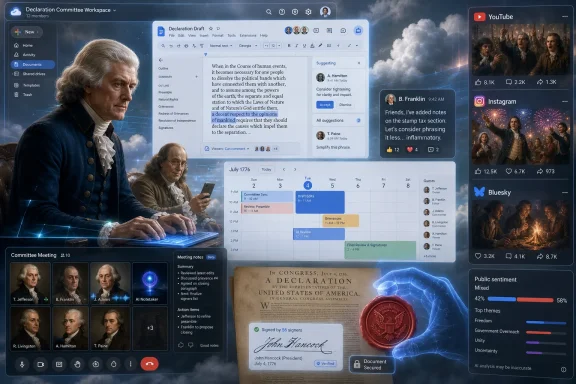
Google released a July 2026 Workspace and Gemini commercial that reimagines the drafting of the Declaration of Independence as a cloud-collaboration project, with Thomas Jefferson, Benjamin Franklin, and other founders using Docs, Calendar, Meet, e-signatures, and AI tools ahead of America’s 250th anniversary. The ad, first covered by TechCrunch and picked apart in The Verge’s account of the social-media backlash, is not really about 1776 at all. It is about 2026’s central software argument: whether AI belongs inside the ordinary machinery of work, or whether vendors are forcing it into places where human judgment is the whole point.
Google’s answer is predictable but revealing. The company does not show Gemini rewriting the Declaration’s famous prose; it shows AI taking notes, generating visuals, and advising on access control. That restraint is the ad’s smartest move—and also the reason the backlash is worth taking seriously.
The commercial’s premise is simple enough to survive a Super Bowl break: “Group project, but make it 1776.” Jefferson is mid-draft, Franklin is nudging him through modern messaging, collaborators pile into Google’s productivity stack, and the American founding becomes a slightly chaotic office workflow.
In TechCrunch’s description, Google Docs handles edits, Google Calendar schedules the meeting, Google Meet hosts the remote discussion, and e-signatures close the loop. The humor depends on the absurdity of dropping cloud software into a revolutionary moment. The corporate objective depends on making that absurdity feel almost normal.
That is the real sales pitch. Google is not merely saying Workspace can help a marketing team finish a deck or a finance department circulate a spreadsheet. It is saying the same tools that manage quotidian workplace friction could, in a fictional universe, manage the logistics of political history.
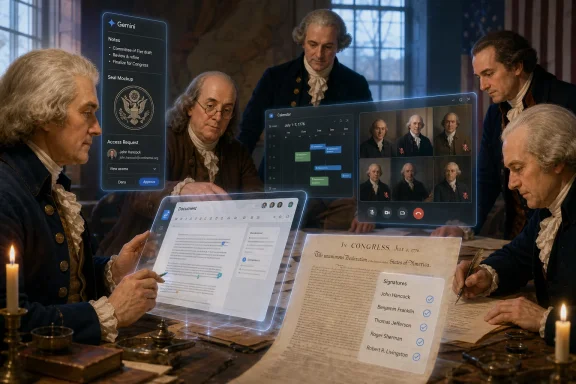
The AI pieces are deliberately ancillary. Gemini does not author “We hold these truths” or tune Jefferson’s rhetoric for engagement. Instead, it helps visualize animals for a national seal, takes meeting notes, and weighs in when King George III requests access to the document.
That distinction matters. Google appears to have learned from earlier AI-advertising stumbles, including criticism of commercials that implied generative AI should mediate heartfelt human expression. Here, the company keeps AI near the edges of the process, where enterprise buyers are already being encouraged to see it: as a helper, recorder, summarizer, and workflow accelerator.
Google Workspace’s competitive advantage has always been that it makes collaboration feel mundane. Multiple people editing a document, leaving comments, resolving suggestions, joining a video call, and tracking access permissions are no longer futuristic behaviors. They are the background hum of white-collar work.
That makes the Declaration parody legible. A viewer does not need a product tutorial to understand what is happening. The gag lands because millions of people have lived through the modern group project: someone is late, someone wants wording changed, someone schedules a meeting that could have been a comment, and someone inevitably asks for access.
The more interesting move is that Google folds Gemini into that same mundane layer. The ad does not present AI as a separate destination or a magical oracle. It presents it as another affordance inside the shared document, the meeting, and the workflow.
That is where Google’s long game differs from many AI startups. A standalone chatbot has to persuade users to change habits. Google can put Gemini into the documents, inboxes, calendars, calls, and search boxes people already use. If the company wins, it will not be because every worker wakes up excited to “use AI.” It will be because AI became part of clicking, typing, approving, searching, and summarizing.
That critique has teeth because the founding is not merely a “project.” It was a political rupture, a legal argument, a propaganda document, and a dangerous act of collective commitment. Reducing it to a productivity workflow is funny only if the audience accepts the distance between the historical reality and the corporate joke.
The risk for Google is that AI advertising often collapses that distance. Tech companies are fond of treating any human endeavor as an optimization problem: write faster, meet faster, summarize faster, decide faster. But some processes derive their legitimacy from friction.
Political writing is one of them. So is organizing. So is dissent. The long debate, the unresolved argument, the distrust, the persuasion, and the refusal to grant access to the wrong person are not inefficiencies in the system. They are part of the system.
Google seems aware of this, which is why Gemini’s role in the ad is modest. Yet the very modesty creates a second problem: if the AI is mostly taking notes and generating seal mockups, the commercial invites viewers to ask whether the future being advertised is transformative or merely decorative.
That shift is important for WindowsForum readers because it mirrors Microsoft’s own Copilot strategy. The battle is not only between models. It is between operating environments. Microsoft wants Copilot to live where enterprise work happens in Windows, Microsoft 365, Teams, Edge, Azure, and security tooling. Google wants Gemini to live where Google work happens in Docs, Gmail, Meet, Drive, Chrome, Search, and Cloud.
The Declaration ad is consumer-facing, but its structure is enterprise-facing. It shows the whole stack. A document is created, reviewed, discussed, governed, signed, and archived. Gemini is not the product in isolation; Gemini is the intelligence layer threaded through the suite.
That is why the King George access-request joke matters more than the animal-seal image generation. In an enterprise context, AI that understands permissions, context, and collaboration boundaries is far more valuable than AI that produces a clever graphic. The joke is a governance joke, whether the ad says so or not.
For administrators, that is also where the anxiety begins. If AI is embedded in collaboration tools, the questions become painfully practical: What data can it see? What can it summarize? What can it infer from meeting transcripts? What happens when the assistant’s convenience intersects with compliance, retention, discovery, or internal politics?
That would have been catastrophic. The Declaration of Independence is not a quarterly memo. Its language is part of the American civic canon, even as its contradictions remain central to the nation’s history. Turning that prose into an AI rewrite gag would have made the ad feel less playful and more desecrating.
Instead, Google positions AI around the edges of communication. It visualizes options, records discussion, and assists with a procedural decision. This is exactly the safer territory where vendors have tried to move after the first wave of AI hype provoked skepticism.
But safer is not the same as persuasive. Meeting notes are useful. Visual brainstorming can be useful. Access-request advice can be useful if grounded in policy and context. None of those features, however, resolves the larger question of whether generative AI improves collaboration or merely adds another layer of automation theater.
The strongest argument for Gemini in Workspace is not that it can simulate creativity. It is that it can reduce the tax imposed by modern software sprawl. The average professional’s day is already fragmented across chats, documents, calls, notifications, and approval flows. If AI can stitch that mess together without leaking data, hallucinating decisions, or flattening nuance, it has a real role.
The “AI sheen” is becoming recognizable: surfaces too smooth, motion slightly weightless, historical detail rendered with impressive but oddly frictionless confidence. It is not always bad. It can be striking, funny, and efficient. But it also gives viewers the sense that the past has been passed through a corporate dream filter.
That is especially loaded when the subject is national memory. American founding imagery has been reproduced, parodied, sanctified, and commercialized for centuries. AI-generated or AI-styled video adds a new layer: the ability to fabricate plausible historical spectacle at industrial speed.
For advertisers, that is a gift. For historians, educators, and media-literate viewers, it is a warning. The more convincing synthetic historical imagery becomes, the more important it is to distinguish satire, marketing, reconstruction, and deception.
Google’s ad is clearly a joke. No reasonable viewer thinks Jefferson had a Google account. But the technical capacity on display belongs to a world in which fake archives, fake speeches, fake meetings, and fake documentary footage will be easier to produce and harder to dismiss at a glance.
Microsoft has spent the last several years embedding Copilot into Windows and Microsoft 365, while asking customers to treat AI as a natural extension of productivity software. Google is making the same argument through a different cultural object. The tools differ, but the thesis is identical: AI becomes powerful when it is not a destination, but a layer.
That has consequences for platform choice. The next phase of productivity competition will not be decided only by who has the better word processor, mail client, or video meeting app. It will be decided by which vendor can make AI feel helpful without making users feel surveilled, patronized, or trapped.
For sysadmins, this is less about ad sentiment and more about policy. A funny commercial can normalize features that later become procurement questions. AI meeting notes imply transcript handling. Document-aware assistants imply data access. Cross-app intelligence implies identity, permissions, auditing, and retention controls.
The old productivity-suite question was, “Can our users get their work done?” The new one is, “Can our users get their work done while an AI layer watches, summarizes, suggests, and sometimes acts?” That is a much harder governance problem.
In other words, it really was collaborative. That is why Google’s premise is clever. The founding was not a lone-genius typing session; it was a negotiation over language, legitimacy, and risk.
But that is also why the AI framing is awkward. Collaboration is not merely simultaneous editing. It is conflict made productive. It is the process by which people discover what they can sign their names to, what they cannot, and what they are willing to defend in public.
A tool can support that process. It cannot substitute for it. The danger in AI productivity marketing is that it often treats the visible artifacts of collaboration—notes, drafts, summaries, calendars—as if they were the substance of collaboration itself.
That distinction is not academic. In workplaces, the summary of a meeting can become the memory of a meeting. The generated draft can become the default draft. The suggested wording can narrow the range of what is considered reasonable. Convenience has politics.
That is a more credible near-term vision for enterprise AI. Most organizations do not need software that pretends to be a founder, strategist, lawyer, artist, and executive all at once. They need software that reduces the cost of coordination without degrading accountability.
The word accountability is doing a lot of work here. If Gemini takes meeting notes, someone still needs to verify them. If it recommends denying access, someone still needs to own the decision. If it generates images, someone still needs to decide whether the output is appropriate, accurate, and lawful.
The best AI systems in productivity software will not be the ones that make humans feel unnecessary. They will be the ones that make human review easier, clearer, and more meaningful. That is less glamorous than the agentic future promised on keynote stages, but it is far more likely to survive contact with legal departments and security teams.
For Google, the challenge is proving that Gemini can be humble at scale. For Microsoft, the same challenge applies to Copilot. For every vendor, the task is to stop confusing workflow acceleration with institutional wisdom.
That is why Google and Microsoft are so aggressive about embedding AI into office tools. Docs, Word, Gmail, Outlook, Drive, SharePoint, Meet, and Teams are not just applications. They are repositories of intent. They contain the drafts, disputes, approvals, plans, secrets, and half-formed decisions that make organizations run.
An AI assistant connected to that layer is much more useful than an AI assistant sitting outside it. It is also much more sensitive. The assistant that can summarize a meeting can misrepresent it. The assistant that can find a document can expose it. The assistant that can draft a response can subtly change the organization’s voice.
That is the real reason the Declaration ad feels bigger than a holiday joke. Google is using a national founding myth to advertise the idea that collaboration history can be captured, optimized, and routed through its stack. The joke is light. The platform ambition is not.
Google’s answer is predictable but revealing. The company does not show Gemini rewriting the Declaration’s famous prose; it shows AI taking notes, generating visuals, and advising on access control. That restraint is the ad’s smartest move—and also the reason the backlash is worth taking seriously.
 Google Turns the Founding Into a Workspace Demo
The commercial’s premise is simple enough to survive a Super Bowl break: “Group project, but make it 1776.” Jefferson is mid-draft, Franklin is nudging him through modern messaging, collaborators pile into Google’s productivity stack, and the American founding becomes a slightly chaotic office workflow.In TechCrunch’s description, Google Docs handles edits, Google Calendar schedules the meeting, Google Meet hosts the remote discussion, and e-signatures close the loop. The humor depends on the absurdity of dropping cloud software into a revolutionary moment. The corporate objective depends on making that absurdity feel almost normal.
That is the real sales pitch. Google is not merely saying Workspace can help a marketing team finish a deck or a finance department circulate a spreadsheet. It is saying the same tools that manage quotidian workplace friction could, in a fictional universe, manage the logistics of political history.
The AI pieces are deliberately ancillary. Gemini does not author “We hold these truths” or tune Jefferson’s rhetoric for engagement. Instead, it helps visualize animals for a national seal, takes meeting notes, and weighs in when King George III requests access to the document.
That distinction matters. Google appears to have learned from earlier AI-advertising stumbles, including criticism of commercials that implied generative AI should mediate heartfelt human expression. Here, the company keeps AI near the edges of the process, where enterprise buyers are already being encouraged to see it: as a helper, recorder, summarizer, and workflow accelerator.
The Joke Works Because the Software Is Boring
For all the period costumes and revolutionary staging, the ad’s most important character is not Jefferson. It is the modern office suite.Google Workspace’s competitive advantage has always been that it makes collaboration feel mundane. Multiple people editing a document, leaving comments, resolving suggestions, joining a video call, and tracking access permissions are no longer futuristic behaviors. They are the background hum of white-collar work.
That makes the Declaration parody legible. A viewer does not need a product tutorial to understand what is happening. The gag lands because millions of people have lived through the modern group project: someone is late, someone wants wording changed, someone schedules a meeting that could have been a comment, and someone inevitably asks for access.
The more interesting move is that Google folds Gemini into that same mundane layer. The ad does not present AI as a separate destination or a magical oracle. It presents it as another affordance inside the shared document, the meeting, and the workflow.
That is where Google’s long game differs from many AI startups. A standalone chatbot has to persuade users to change habits. Google can put Gemini into the documents, inboxes, calendars, calls, and search boxes people already use. If the company wins, it will not be because every worker wakes up excited to “use AI.” It will be because AI became part of clicking, typing, approving, searching, and summarizing.
The Backlash Was Not Just Internet Scolding
According to The Verge, reactions split by platform. YouTube and Instagram comments leaned amused; Bluesky users were much harsher, calling the ad tone-deaf and criticizing the AI framing. Historian Angus Johnston argued that even in a corny fantasy, the ad struggles to make AI look genuinely useful for political organizing, writing, or human collaboration.That critique has teeth because the founding is not merely a “project.” It was a political rupture, a legal argument, a propaganda document, and a dangerous act of collective commitment. Reducing it to a productivity workflow is funny only if the audience accepts the distance between the historical reality and the corporate joke.
The risk for Google is that AI advertising often collapses that distance. Tech companies are fond of treating any human endeavor as an optimization problem: write faster, meet faster, summarize faster, decide faster. But some processes derive their legitimacy from friction.
Political writing is one of them. So is organizing. So is dissent. The long debate, the unresolved argument, the distrust, the persuasion, and the refusal to grant access to the wrong person are not inefficiencies in the system. They are part of the system.
Google seems aware of this, which is why Gemini’s role in the ad is modest. Yet the very modesty creates a second problem: if the AI is mostly taking notes and generating seal mockups, the commercial invites viewers to ask whether the future being advertised is transformative or merely decorative.
Gemini Is Being Sold as Infrastructure, Not Inspiration
The ad arrives at a moment when Google has been pushing Gemini deeper into Workspace and the broader Google ecosystem. At I/O 2026 and in recent Workspace updates covered by outlets such as TechCrunch, Ars Technica, and TechRadar, the company has framed Gemini less as a chatbot and more as an agentic layer across documents, email, meetings, search, and cloud services.That shift is important for WindowsForum readers because it mirrors Microsoft’s own Copilot strategy. The battle is not only between models. It is between operating environments. Microsoft wants Copilot to live where enterprise work happens in Windows, Microsoft 365, Teams, Edge, Azure, and security tooling. Google wants Gemini to live where Google work happens in Docs, Gmail, Meet, Drive, Chrome, Search, and Cloud.
The Declaration ad is consumer-facing, but its structure is enterprise-facing. It shows the whole stack. A document is created, reviewed, discussed, governed, signed, and archived. Gemini is not the product in isolation; Gemini is the intelligence layer threaded through the suite.
That is why the King George access-request joke matters more than the animal-seal image generation. In an enterprise context, AI that understands permissions, context, and collaboration boundaries is far more valuable than AI that produces a clever graphic. The joke is a governance joke, whether the ad says so or not.
For administrators, that is also where the anxiety begins. If AI is embedded in collaboration tools, the questions become painfully practical: What data can it see? What can it summarize? What can it infer from meeting transcripts? What happens when the assistant’s convenience intersects with compliance, retention, discovery, or internal politics?
The Ad Avoids the Worst AI Sin: Replacing the Human Voice
Google deserves some credit for what the commercial apparently does not do. It does not suggest that Gemini could improve the Declaration’s language. It does not show Jefferson asking a chatbot to make the prose more inspirational, more concise, or more viral.That would have been catastrophic. The Declaration of Independence is not a quarterly memo. Its language is part of the American civic canon, even as its contradictions remain central to the nation’s history. Turning that prose into an AI rewrite gag would have made the ad feel less playful and more desecrating.
Instead, Google positions AI around the edges of communication. It visualizes options, records discussion, and assists with a procedural decision. This is exactly the safer territory where vendors have tried to move after the first wave of AI hype provoked skepticism.
But safer is not the same as persuasive. Meeting notes are useful. Visual brainstorming can be useful. Access-request advice can be useful if grounded in policy and context. None of those features, however, resolves the larger question of whether generative AI improves collaboration or merely adds another layer of automation theater.
The strongest argument for Gemini in Workspace is not that it can simulate creativity. It is that it can reduce the tax imposed by modern software sprawl. The average professional’s day is already fragmented across chats, documents, calls, notifications, and approval flows. If AI can stitch that mess together without leaking data, hallucinating decisions, or flattening nuance, it has a real role.
The Visual Gloss Gives the Game Away
TechCrunch noted that the footage itself has the uncanny glow associated with AI-generated video. That observation matters because the ad is not only advertising AI features; it is participating in the broader aesthetic shift AI has brought to commercial media.The “AI sheen” is becoming recognizable: surfaces too smooth, motion slightly weightless, historical detail rendered with impressive but oddly frictionless confidence. It is not always bad. It can be striking, funny, and efficient. But it also gives viewers the sense that the past has been passed through a corporate dream filter.
That is especially loaded when the subject is national memory. American founding imagery has been reproduced, parodied, sanctified, and commercialized for centuries. AI-generated or AI-styled video adds a new layer: the ability to fabricate plausible historical spectacle at industrial speed.
For advertisers, that is a gift. For historians, educators, and media-literate viewers, it is a warning. The more convincing synthetic historical imagery becomes, the more important it is to distinguish satire, marketing, reconstruction, and deception.
Google’s ad is clearly a joke. No reasonable viewer thinks Jefferson had a Google account. But the technical capacity on display belongs to a world in which fake archives, fake speeches, fake meetings, and fake documentary footage will be easier to produce and harder to dismiss at a glance.
Microsoft Should Recognize the Playbook
This is a Google story, but it sits squarely inside a Microsoft-shaped market. Windows users and IT departments are already living through the same product logic from the other side.Microsoft has spent the last several years embedding Copilot into Windows and Microsoft 365, while asking customers to treat AI as a natural extension of productivity software. Google is making the same argument through a different cultural object. The tools differ, but the thesis is identical: AI becomes powerful when it is not a destination, but a layer.
That has consequences for platform choice. The next phase of productivity competition will not be decided only by who has the better word processor, mail client, or video meeting app. It will be decided by which vendor can make AI feel helpful without making users feel surveilled, patronized, or trapped.
For sysadmins, this is less about ad sentiment and more about policy. A funny commercial can normalize features that later become procurement questions. AI meeting notes imply transcript handling. Document-aware assistants imply data access. Cross-app intelligence implies identity, permissions, auditing, and retention controls.
The old productivity-suite question was, “Can our users get their work done?” The new one is, “Can our users get their work done while an AI layer watches, summarizes, suggests, and sometimes acts?” That is a much harder governance problem.
The Founders Make an Awkward Case Study for Automation
The Declaration’s drafting history is messier than popular memory allows. Jefferson wrote the initial draft, but the document passed through committees, edits, deletions, and political compromises. Congress removed passages, altered language, and shaped the final text into something that could carry collective authority.In other words, it really was collaborative. That is why Google’s premise is clever. The founding was not a lone-genius typing session; it was a negotiation over language, legitimacy, and risk.
But that is also why the AI framing is awkward. Collaboration is not merely simultaneous editing. It is conflict made productive. It is the process by which people discover what they can sign their names to, what they cannot, and what they are willing to defend in public.
A tool can support that process. It cannot substitute for it. The danger in AI productivity marketing is that it often treats the visible artifacts of collaboration—notes, drafts, summaries, calendars—as if they were the substance of collaboration itself.
That distinction is not academic. In workplaces, the summary of a meeting can become the memory of a meeting. The generated draft can become the default draft. The suggested wording can narrow the range of what is considered reasonable. Convenience has politics.
The Better AI Pitch Is Administrative Humility
If Google’s ad works, it works because it accidentally makes a modest argument. AI is not shown as the author of independence. It is shown as a clerk, designer, note-taker, and gatekeeping assistant.That is a more credible near-term vision for enterprise AI. Most organizations do not need software that pretends to be a founder, strategist, lawyer, artist, and executive all at once. They need software that reduces the cost of coordination without degrading accountability.
The word accountability is doing a lot of work here. If Gemini takes meeting notes, someone still needs to verify them. If it recommends denying access, someone still needs to own the decision. If it generates images, someone still needs to decide whether the output is appropriate, accurate, and lawful.
The best AI systems in productivity software will not be the ones that make humans feel unnecessary. They will be the ones that make human review easier, clearer, and more meaningful. That is less glamorous than the agentic future promised on keynote stages, but it is far more likely to survive contact with legal departments and security teams.
For Google, the challenge is proving that Gemini can be humble at scale. For Microsoft, the same challenge applies to Copilot. For every vendor, the task is to stop confusing workflow acceleration with institutional wisdom.
The Productivity Suite Is Becoming the New Browser War
There is an older platform story hiding under the bicentennial bunting. In the 1990s and 2000s, browsers became strategic because they mediated access to the web. In the 2010s, mobile operating systems became strategic because they mediated access to apps, identity, payments, and sensors. In the 2020s, productivity suites are becoming strategic because they mediate access to organizational knowledge.That is why Google and Microsoft are so aggressive about embedding AI into office tools. Docs, Word, Gmail, Outlook, Drive, SharePoint, Meet, and Teams are not just applications. They are repositories of intent. They contain the drafts, disputes, approvals, plans, secrets, and half-formed decisions that make organizations run.
An AI assistant connected to that layer is much more useful than an AI assistant sitting outside it. It is also much more sensitive. The assistant that can summarize a meeting can misrepresent it. The assistant that can find a document can expose it. The assistant that can draft a response can subtly change the organization’s voice.
That is the real reason the Declaration ad feels bigger than a holiday joke. Google is using a national founding myth to advertise the idea that collaboration history can be captured, optimized, and routed through its stack. The joke is light. The platform ambition is not.
The Fireworks Hide a Procurement Memo
The practical lessons from Google’s 1776 fantasy are not about whether the ad is funny. They are about what it normalizes for the next round of productivity software decisions.- Google is positioning Gemini as an embedded Workspace layer rather than a separate chatbot users must deliberately visit.
- The ad carefully avoids showing AI rewriting the Declaration, which suggests Google understands the reputational risk of automating emotionally or historically significant expression.
- The most enterprise-relevant AI moments are not the flashy image-generation gags, but the meeting notes and document-access decision.
- The backlash shows that AI marketing still struggles when it treats civic, artistic, or political labor as a productivity problem.
- Windows and Microsoft 365 administrators should read the ad as part of the same market shift driving Copilot: collaboration suites are becoming AI-governed knowledge platforms.
- The next meaningful test for Google, Microsoft, and their rivals is not whether AI can appear useful in a commercial, but whether it can operate under real-world constraints around permission, accuracy, auditability, and trust.
References
- Primary source: zamin.uz
Published: 2026-07-04T20:53:40.228707
Google Writes the US Declaration of Independence Using AI in New Ad – Zamin.uz, 05.07.2026
Ahead of the 250th anniversary of US independence, Google has unveiled its new commercial. The tech giant poses an intriguing… – Zamin.uz, 05.07.2026zamin.uz - Related coverage: techcrunch.com
Google introduces Gemini Spark, a 24/7 agentic assistant with Gmail integration, at IO 2026 | TechCrunch
At the Google I/O developer conference, the company announced a new agentic personal assistant called Gemini Spark, built from Gemini's base models and an agentic harness from Google Antigravity.techcrunch.com - Related coverage: phonearena.com
Every Gemini update Google announced at I/O 2026 declaring the agentic era is here - PhoneArena
A new model, a new personal agent, and a Search overhaul are coming this summer.www.phonearena.com - Related coverage: techradar.com
Google I/O 2026 made one thing clear — Gemini is becoming impossible to avoid | TechRadar
Google's AI push turns Search, Android, shopping, and productivity into one giant Gemini ecosystemwww.techradar.com - Related coverage: arstechnica.com
Gemini burrows deeper into Google Workspace with revamped document creation and editing - Ars Technica
Gemini can now pull context from your files, emails, and more to create and edit documents.arstechnica.com - Related coverage: benzinga.com
Sundar Pichai Touts Google Workspace Ad that Reimagines US Founding Fathers Using Gemini AI and Docs in A - Benzinga
Sundar Pichai shared a Google Workspace ad imagining the Founding Fathers using Gemini AI to draft the Declaration of Independence.www.benzinga.com
- Related coverage: macrumors.com
Google I/O 2026 Roundup: Gemini 3.5, AI Search, Android XR Glasses, and More
Google held its annual Google I/O event today, launching new AI products and giving us a look at what's coming in the near future. Google I/O is Google's equivalent of Apple's Worldwide Developers Conference, and Google's announcements offer insight into what Apple is going...www.macrumors.com - Related coverage: economictimes.indiatimes.com
Google I/O 2026: Google Enters Its 'Agentic Gemini Era' - The Economic Times
At Google I/O 2026, Sundar Pichai unveiled Googles vision for an “Agentic Gemini Era,” where AI moves beyond simple assistants to autonomous systems deeply integrated across Search, Android, Workspace, YouTube, Cloud, and developer tools. The company revealed explosive AI adoption...economictimes.indiatimes.com
- Official source: 9to5google.com
Everything Google announced at I/O 2026: Gemini, Android, more
We've collected all the consumer-facing announcements and notable developer developments made at Google I/O 2026 below.9to5google.com - Related coverage: ai.google
2154445294
Digitally generated image of abstract glass blue glowing futuristic digital data flowing and network structure. Innovation, AI, cloud technology, fintech technology and cybersecurity concepts. Clean design.ai.google
- Related coverage: techxplore.com
- Official source: services.google.com