

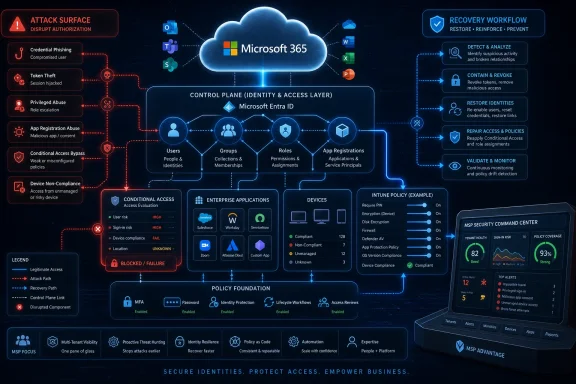
Acronis on July 7, 2026, introduced Entra ID Backup for managed service providers, extending its Microsoft 365 protection portfolio beyond Exchange Online, OneDrive, SharePoint and Teams into Microsoft Entra ID identities, access policies, roles, applications, devices and selected Intune configurations. The launch matters because the Microsoft 365 recovery conversation has outgrown the mailbox. As Acronis framed it in its announcement, the identity layer is now both an attack surface and an operational dependency. If Entra ID is the control plane, then backing up Microsoft 365 data without protecting identity is increasingly a partial answer to a full-stack failure.
The easy way to read Acronis Entra ID Backup is as another addition to a crowded Microsoft 365 backup catalog. That undersells the move. Acronis is not merely adding one more workload; it is moving the definition of Microsoft 365 protection closer to how tenants actually break.
For years, the SaaS backup pitch was simple enough for procurement decks: Microsoft keeps the service running, but customers need independent backup for their data. That logic still applies, especially for mailboxes, SharePoint sites, OneDrive files and Teams content. But the more interesting failure mode in 2026 is not always deleted data. It is deleted access, broken authorization, poisoned application consent, or a Conditional Access policy that turns a healthy tenant into a locked building.
That is the opening Acronis is trying to occupy. Its new service is aimed squarely at MSPs, not only enterprise security teams, and the distinction matters. MSPs live or die by repeatable recovery workflows across many tenants. A clever identity backup product that works once for one sophisticated customer is less useful to them than a recoverable model they can operationalize across dozens or hundreds of small and midmarket environments.
Acronis says the protected assets include users, groups, roles, administrative units, app registrations, enterprise applications, Conditional Access policies, devices and selected Intune policies. It also says MSPs can preserve historical audit and sign-in logs for investigations and compliance. That combination is the story: not just identity objects, but identity relationships and evidence.
Microsoft Entra ID, formerly Azure Active Directory, sits at the middle of that reality. It handles authentication and authorization, yes, but it also connects users to SaaS applications, devices to policy, administrators to roles, and Conditional Access to the practical enforcement of security intent. Calling it a directory is technically understandable and strategically misleading.
Acronis cites Microsoft’s 2025 Digital Defense Report for the claim that Microsoft analyzes 38 million identity-risk detections on an average day. It also points to Cloud Security Alliance research on an OAuth device-code phishing campaign that compromised more than 340 Microsoft 365 organizations across five countries. Those numbers are not decorative; they explain why identity recovery is being packaged as resilience rather than merely administration.
Device-code phishing is a useful example because it does not look like the archetypal malicious attachment or drive-by exploit. The attacker abuses a legitimate authentication flow, persuading a user to authorize access in a way that can hand over tokens and bypass the instincts users have built around suspicious executables. The point is not that every MSP customer is being hammered by the same campaign. The point is that identity misuse is increasingly native-looking.
That is what makes identity incidents so operationally ugly. If an attacker changes mail forwarding, grants application permissions, tampers with groups, alters policy or creates persistence through enterprise applications, the visible symptom may be a compromised account. The real damage may be a rewired access graph.
But native capability and managed recovery service are different things. A recycle bin for some objects is not the same as a point-in-time reconstruction of a tenant’s identity posture. A log entry is not the same as a recoverable configuration. A security alert is not the same as a clean rollback path after someone discovers that group memberships, roles and application permissions have been altered.
This is where the shared-responsibility model becomes more than a diagram in a compliance deck. Microsoft operates the cloud service; customers remain responsible for many aspects of data, configuration, identity governance and recovery planning. The uncomfortable part is that most SMBs do not experience that as a model. They experience it as a billable emergency when something breaks.
For MSPs, the problem compounds. One tenant’s accidental deletion is a ticket. A flawed automation script pushed across multiple clients is a crisis. A compromised administrator account that changes access controls can become a forensic, operational and contractual mess in the same afternoon.
The Acronis pitch is that identity recovery should live next to Microsoft 365 backup rather than in a separate universe. That is sensible, provided the product can deliver recovery fidelity where it matters: memberships, assignments, dependencies, policy state and application relationships. The value is not in saying “we backed up users.” It is in restoring the web that made those users useful and secure.
That is why Acronis is smart to talk about accidental deletion, faulty scripts and misconfigured Conditional Access policies alongside cyberattacks. The market often sells backup through the drama of ransomware, but many Microsoft 365 recovery events begin with ordinary administrative failure. In identity systems, ordinary failure is rarely small because access is a dependency for everything else.
Consider the difference between restoring a mailbox and restoring the ability to reach the mailbox. If the user object exists but the group assignment is gone, the licensing is wrong, the app assignment is missing, or the Conditional Access rule blocks the session, the data may be intact and still effectively unavailable. From a user’s perspective, that distinction is academic.
The same logic applies to single sign-on. App registrations and enterprise applications are easy for business stakeholders to ignore until they disappear or are changed. Then the organization discovers that a “Microsoft 365 issue” is really an identity configuration issue affecting payroll, CRM, collaboration, line-of-business apps and administrative portals.
A backup product that understands those dependencies is more valuable than a product that exports a flat list of objects. The hard part is preserving not only what existed, but how it related to everything else. Acronis is explicitly positioning Entra ID Backup around that relationship layer.
MSPs already juggle backup consoles, RMM platforms, PSA tools, endpoint security portals, email security dashboards, Microsoft admin centers, security posture tools and incident response workflows. Adding a standalone Entra ID recovery tool may solve a technical problem while worsening an operational one. Acronis is betting that integration is not a luxury feature but the product category’s main differentiator.
That argument is stronger in the SMB and midmarket channel than it would be in a Fortune 100 enterprise. Large enterprises may already have identity governance specialists, configuration-as-code practices, privileged access workflows and bespoke recovery procedures. Smaller organizations often have none of that. Their practical identity resilience may be whatever their MSP can consistently deliver under pressure.
The managed-service question is not “Can this object be recovered somehow?” It is “Can a technician recover the right object, at the right point in time, for the right tenant, without improvising during an outage?” That is why Acronis’s single-console argument lands. Tool sprawl is not merely annoying; it is a recovery-time risk.
There is also a commercial angle. MSPs want to package services clients can understand. “Microsoft 365 backup” is already a line item many customers recognize. “Identity resilience for Microsoft 365” is more abstract, but Acronis is trying to attach it to the existing backup conversation. That may make it easier for MSPs to upsell protection for a layer clients rarely budget for until it fails.
That framing is important. Identity backup should not become an excuse to tolerate sloppy identity governance. If anything, it should expose the cost of sloppy governance more clearly. A tenant with chaotic group design, unmanaged app consent, stale administrators and undocumented Conditional Access policies will be harder to recover cleanly even with a good tool.
Recovery is the last line, not the only line. The strongest use case is not “ignore prevention because we can restore later.” It is “assume prevention will sometimes fail, and make failure survivable.” That is the same principle that moved backup from a back-office chore to a ransomware boardroom topic over the last decade.
The difference is that identity recovery has not yet reached the same level of everyday operational maturity. Many organizations test file restore. Fewer test restoration of identity relationships. Fewer still can say exactly how they would recover from a mass deletion of groups, a broken Conditional Access rollout, or malicious changes to enterprise app permissions.
Acronis is trying to turn that gap into a managed service. If it works, the best outcome is boring: fewer heroic rebuilds, fewer tenant archaeology exercises, fewer nights spent reconstructing access from screenshots and half-current documentation.
For example, restoring a user is one thing. Restoring the user’s group memberships, role assignments, application access, administrative unit relationships and policy impact is much more meaningful. Restoring an app registration is useful, but restoring the correct permissions and relationships around it is where the practical value lives. Recovering a Conditional Access policy is powerful, but restoring a bad policy to production without understanding why it broke access would simply replay the outage.
That means MSPs should evaluate the product with scenarios, not checklists. Acronis lists several common ones: mass deletion recovery, faulty Conditional Access rollback, app registration and enterprise application recovery after SSO disruption, and access to historical audit and sign-in records during investigations. Those are the right scenarios to test because they map to business pain rather than product taxonomy.
The audit and sign-in log preservation element is also worth watching. In identity incidents, the post-incident question is often not only “How do we get back?” but “What happened, when, and who or what changed it?” If logs disappear or age out before the MSP completes its investigation, recovery becomes guesswork and compliance reporting becomes uncomfortable.
The best version of this service would give MSPs both a rollback path and an evidence path. The worst version would be a partial object restore tool wearing the language of resilience. The details will decide which one customers experience.
That shift mirrors how Microsoft 365 itself has evolved. A modern tenant is not just Exchange plus SharePoint plus Teams. It is Entra ID, Intune, Defender, Purview, Conditional Access, Graph permissions, application registrations, guest identities and a constant stream of policy decisions. The collaboration data is still critical, but the system that governs access to it is just as critical.
Acronis is not alone in noticing this. The broader ecosystem has been moving toward SaaS security posture management, identity threat detection, app governance, backup for configuration state and cloud-to-cloud resilience. The difference here is the packaging into an MSP-oriented Microsoft 365 protection story.
For WindowsForum readers, the practical implication is clear: Microsoft 365 resilience should be discussed in tenant terms, not workload terms. A backup plan that can restore Exchange data but cannot help when identity policy breaks access is incomplete. A security plan that can flag risky sign-ins but cannot help reconstruct the pre-incident access model is also incomplete.
That does not mean every organization needs to buy Acronis. It means every organization using Microsoft 365 should ask whether it can recover the identity state that makes Microsoft 365 usable. If the honest answer is “we would rebuild it manually,” that is not a plan. It is an estimate for downtime.
Identity exposes the sharp edge of that arrangement. Microsoft can keep Entra ID available while a customer’s tenant configuration is broken. Microsoft can offer native controls while an administrator or attacker makes destructive changes within the customer’s scope. Microsoft can provide logs, recycle bins and protections without guaranteeing that a business can return to a known-good identity state on its own timeline.
That is the space third-party vendors want to fill. Some will overstate the gap, because that is what vendors do. But the underlying issue is real. SaaS availability does not equal customer recoverability.
Acronis’s announcement is careful to acknowledge native Microsoft capabilities while arguing that MSPs need consistent cross-tenant recovery aligned with existing backup workflows. That is the right argument. It avoids pretending Microsoft does nothing and instead focuses on the operational layer where MSPs actually struggle.
This is also where compliance enters the story. Auditors do not only care whether a service provider can say “Microsoft has redundancy.” They care whether the organization can demonstrate control, retention, investigation and recovery practices. Preserving identity logs and recoverable configuration states can help turn identity management from tribal knowledge into evidence.
The first better question is simple: who can change identity policy, and how would we know? The second is harder: if that policy changed destructively, how would we return to a safe state? The third is the one MSPs should care about most: can we do that repeatedly, across tenants, without relying on the memory of one senior engineer?
There is a cultural issue here, too. Identity configuration often grows organically. Groups are created for projects that ended years ago. Applications accumulate permissions. Administrators retain roles because nobody wants to break something by removing them. Conditional Access policies multiply as exceptions become permanent.
Backup will not fix that. But backup plus posture management plus periodic review can make the mess visible, recoverable and eventually governable. That is the more mature version of the Acronis story.
The danger is that customers treat identity backup as a magic undo button. It is not. A known-good restore point is only as good as the governance that made it good. If yesterday’s tenant was already over-permissioned, restoring yesterday’s tenant after an incident may restore the vulnerability along with the access.
They should also define what “recovery” means contractually. Does it mean object restoration? Relationship restoration? Policy rollback? Log retention? Assistance during incident response? Recovery-time objectives for identity services are not the same as mailbox restore promises, and MSPs will need service language that reflects that.
Licensing and tenant coverage will also matter. MSPs have learned the hard way that backup services become messy when coverage is inconsistent. If some clients have Exchange backup but not identity backup, and some have posture management but not recovery, incident response becomes a menu of disappointments. The integrated-console story only pays off if the service catalog is clean.
The product should also be evaluated against Microsoft’s own roadmap. Microsoft continues to add native backup, recovery and security capabilities across Microsoft 365 and Entra. Third-party vendors win when they are more complete, more manageable, more independent, or more MSP-friendly than the native option. They lose when they merely duplicate what customers already have.
That competitive pressure is healthy. Identity resilience should not be a niche add-on forever. The more vendors push the topic, the more likely Microsoft and the broader ecosystem are to make identity recovery a normal part of tenant operations.
 Acronis Is Selling Recovery for the Part of Microsoft 365 Everyone Pretends Is Plumbing
The easy way to read Acronis Entra ID Backup is as another addition to a crowded Microsoft 365 backup catalog. That undersells the move. Acronis is not merely adding one more workload; it is moving the definition of Microsoft 365 protection closer to how tenants actually break.For years, the SaaS backup pitch was simple enough for procurement decks: Microsoft keeps the service running, but customers need independent backup for their data. That logic still applies, especially for mailboxes, SharePoint sites, OneDrive files and Teams content. But the more interesting failure mode in 2026 is not always deleted data. It is deleted access, broken authorization, poisoned application consent, or a Conditional Access policy that turns a healthy tenant into a locked building.
That is the opening Acronis is trying to occupy. Its new service is aimed squarely at MSPs, not only enterprise security teams, and the distinction matters. MSPs live or die by repeatable recovery workflows across many tenants. A clever identity backup product that works once for one sophisticated customer is less useful to them than a recoverable model they can operationalize across dozens or hundreds of small and midmarket environments.
Acronis says the protected assets include users, groups, roles, administrative units, app registrations, enterprise applications, Conditional Access policies, devices and selected Intune policies. It also says MSPs can preserve historical audit and sign-in logs for investigations and compliance. That combination is the story: not just identity objects, but identity relationships and evidence.
The Identity Layer Has Become the Quietest Way Into the Loudest Systems
The old mental model of Microsoft 365 compromise begins with an inbox and ends with stolen mail. The modern model often begins with identity and radiates outward. A valid sign-in, a token, a consent grant, or an administrator account can do what malware once had to fight to accomplish: move through services using the victim’s own cloud permissions.Microsoft Entra ID, formerly Azure Active Directory, sits at the middle of that reality. It handles authentication and authorization, yes, but it also connects users to SaaS applications, devices to policy, administrators to roles, and Conditional Access to the practical enforcement of security intent. Calling it a directory is technically understandable and strategically misleading.
Acronis cites Microsoft’s 2025 Digital Defense Report for the claim that Microsoft analyzes 38 million identity-risk detections on an average day. It also points to Cloud Security Alliance research on an OAuth device-code phishing campaign that compromised more than 340 Microsoft 365 organizations across five countries. Those numbers are not decorative; they explain why identity recovery is being packaged as resilience rather than merely administration.
Device-code phishing is a useful example because it does not look like the archetypal malicious attachment or drive-by exploit. The attacker abuses a legitimate authentication flow, persuading a user to authorize access in a way that can hand over tokens and bypass the instincts users have built around suspicious executables. The point is not that every MSP customer is being hammered by the same campaign. The point is that identity misuse is increasingly native-looking.
That is what makes identity incidents so operationally ugly. If an attacker changes mail forwarding, grants application permissions, tampers with groups, alters policy or creates persistence through enterprise applications, the visible symptom may be a compromised account. The real damage may be a rewired access graph.
Native Recovery Is Useful, but It Was Never a Full MSP Operating Model
Microsoft provides important native capabilities around service availability, security controls, identity protection and recovery for certain directory objects. No serious analysis should imply that Entra ID is an unprotected void. Microsoft has spent years building identity protection, Conditional Access, privileged identity management and administrative safeguards into its cloud stack.But native capability and managed recovery service are different things. A recycle bin for some objects is not the same as a point-in-time reconstruction of a tenant’s identity posture. A log entry is not the same as a recoverable configuration. A security alert is not the same as a clean rollback path after someone discovers that group memberships, roles and application permissions have been altered.
This is where the shared-responsibility model becomes more than a diagram in a compliance deck. Microsoft operates the cloud service; customers remain responsible for many aspects of data, configuration, identity governance and recovery planning. The uncomfortable part is that most SMBs do not experience that as a model. They experience it as a billable emergency when something breaks.
For MSPs, the problem compounds. One tenant’s accidental deletion is a ticket. A flawed automation script pushed across multiple clients is a crisis. A compromised administrator account that changes access controls can become a forensic, operational and contractual mess in the same afternoon.
The Acronis pitch is that identity recovery should live next to Microsoft 365 backup rather than in a separate universe. That is sensible, provided the product can deliver recovery fidelity where it matters: memberships, assignments, dependencies, policy state and application relationships. The value is not in saying “we backed up users.” It is in restoring the web that made those users useful and secure.
Conditional Access Is Where Misconfiguration Becomes Downtime
Conditional Access is one of Microsoft’s most powerful security mechanisms, and like most powerful mechanisms, it can injure its operator. A policy intended to block risky sign-ins can lock out legitimate users. A change intended to tighten administrator access can strand the very people who need to undo it. A well-meaning compliance tweak can become an outage with no malware involved.That is why Acronis is smart to talk about accidental deletion, faulty scripts and misconfigured Conditional Access policies alongside cyberattacks. The market often sells backup through the drama of ransomware, but many Microsoft 365 recovery events begin with ordinary administrative failure. In identity systems, ordinary failure is rarely small because access is a dependency for everything else.
Consider the difference between restoring a mailbox and restoring the ability to reach the mailbox. If the user object exists but the group assignment is gone, the licensing is wrong, the app assignment is missing, or the Conditional Access rule blocks the session, the data may be intact and still effectively unavailable. From a user’s perspective, that distinction is academic.
The same logic applies to single sign-on. App registrations and enterprise applications are easy for business stakeholders to ignore until they disappear or are changed. Then the organization discovers that a “Microsoft 365 issue” is really an identity configuration issue affecting payroll, CRM, collaboration, line-of-business apps and administrative portals.
A backup product that understands those dependencies is more valuable than a product that exports a flat list of objects. The hard part is preserving not only what existed, but how it related to everything else. Acronis is explicitly positioning Entra ID Backup around that relationship layer.
The MSP Angle Is Not Marketing Fluff This Time
Vendors love to say “for MSPs” when what they mean is “multi-tenant billing.” In this case, the MSP focus is more substantial. Identity recovery is exactly the kind of function that becomes painful when every customer has a different ad hoc tool, a different documentation standard and a different emergency procedure.MSPs already juggle backup consoles, RMM platforms, PSA tools, endpoint security portals, email security dashboards, Microsoft admin centers, security posture tools and incident response workflows. Adding a standalone Entra ID recovery tool may solve a technical problem while worsening an operational one. Acronis is betting that integration is not a luxury feature but the product category’s main differentiator.
That argument is stronger in the SMB and midmarket channel than it would be in a Fortune 100 enterprise. Large enterprises may already have identity governance specialists, configuration-as-code practices, privileged access workflows and bespoke recovery procedures. Smaller organizations often have none of that. Their practical identity resilience may be whatever their MSP can consistently deliver under pressure.
The managed-service question is not “Can this object be recovered somehow?” It is “Can a technician recover the right object, at the right point in time, for the right tenant, without improvising during an outage?” That is why Acronis’s single-console argument lands. Tool sprawl is not merely annoying; it is a recovery-time risk.
There is also a commercial angle. MSPs want to package services clients can understand. “Microsoft 365 backup” is already a line item many customers recognize. “Identity resilience for Microsoft 365” is more abstract, but Acronis is trying to attach it to the existing backup conversation. That may make it easier for MSPs to upsell protection for a layer clients rarely budget for until it fails.
The Security Story Is Really a Resilience Story
Acronis also points to Security Posture Management for Microsoft 365 as part of the broader picture. That matters because the company is not claiming that backup is a substitute for prevention. It is instead building a familiar modern security arc: reduce misconfiguration, detect suspicious activity, respond to incidents, and recover from known-good state.That framing is important. Identity backup should not become an excuse to tolerate sloppy identity governance. If anything, it should expose the cost of sloppy governance more clearly. A tenant with chaotic group design, unmanaged app consent, stale administrators and undocumented Conditional Access policies will be harder to recover cleanly even with a good tool.
Recovery is the last line, not the only line. The strongest use case is not “ignore prevention because we can restore later.” It is “assume prevention will sometimes fail, and make failure survivable.” That is the same principle that moved backup from a back-office chore to a ransomware boardroom topic over the last decade.
The difference is that identity recovery has not yet reached the same level of everyday operational maturity. Many organizations test file restore. Fewer test restoration of identity relationships. Fewer still can say exactly how they would recover from a mass deletion of groups, a broken Conditional Access rollout, or malicious changes to enterprise app permissions.
Acronis is trying to turn that gap into a managed service. If it works, the best outcome is boring: fewer heroic rebuilds, fewer tenant archaeology exercises, fewer nights spent reconstructing access from screenshots and half-current documentation.
The Product Will Be Judged by Fidelity, Not Feature Names
The risk for Acronis is that “Entra ID backup” can sound simpler than it is. Backing up identity is not like backing up a folder. Some objects are dynamic, some dependencies are external, some states interact with Microsoft’s own service behavior, and some recovery operations must be handled carefully to avoid making an incident worse.For example, restoring a user is one thing. Restoring the user’s group memberships, role assignments, application access, administrative unit relationships and policy impact is much more meaningful. Restoring an app registration is useful, but restoring the correct permissions and relationships around it is where the practical value lives. Recovering a Conditional Access policy is powerful, but restoring a bad policy to production without understanding why it broke access would simply replay the outage.
That means MSPs should evaluate the product with scenarios, not checklists. Acronis lists several common ones: mass deletion recovery, faulty Conditional Access rollback, app registration and enterprise application recovery after SSO disruption, and access to historical audit and sign-in records during investigations. Those are the right scenarios to test because they map to business pain rather than product taxonomy.
The audit and sign-in log preservation element is also worth watching. In identity incidents, the post-incident question is often not only “How do we get back?” but “What happened, when, and who or what changed it?” If logs disappear or age out before the MSP completes its investigation, recovery becomes guesswork and compliance reporting becomes uncomfortable.
The best version of this service would give MSPs both a rollback path and an evidence path. The worst version would be a partial object restore tool wearing the language of resilience. The details will decide which one customers experience.
Microsoft 365 Backup Is Becoming a Control-Plane Business
This launch also says something about where Microsoft 365 backup as a category is heading. The market began with data protection for SaaS content because that was the obvious gap. But the operational center of gravity has shifted toward control planes: identity, policy, device management, app access and security configuration.That shift mirrors how Microsoft 365 itself has evolved. A modern tenant is not just Exchange plus SharePoint plus Teams. It is Entra ID, Intune, Defender, Purview, Conditional Access, Graph permissions, application registrations, guest identities and a constant stream of policy decisions. The collaboration data is still critical, but the system that governs access to it is just as critical.
Acronis is not alone in noticing this. The broader ecosystem has been moving toward SaaS security posture management, identity threat detection, app governance, backup for configuration state and cloud-to-cloud resilience. The difference here is the packaging into an MSP-oriented Microsoft 365 protection story.
For WindowsForum readers, the practical implication is clear: Microsoft 365 resilience should be discussed in tenant terms, not workload terms. A backup plan that can restore Exchange data but cannot help when identity policy breaks access is incomplete. A security plan that can flag risky sign-ins but cannot help reconstruct the pre-incident access model is also incomplete.
That does not mean every organization needs to buy Acronis. It means every organization using Microsoft 365 should ask whether it can recover the identity state that makes Microsoft 365 usable. If the honest answer is “we would rebuild it manually,” that is not a plan. It is an estimate for downtime.
The Shared-Responsibility Conversation Finally Gets Concrete
The phrase shared responsibility is often abused because it can sound like a vendor’s way of saying “not our problem.” In Microsoft 365, it is more nuanced. Microsoft is responsible for the service fabric, availability of the platform and many native protections. Customers are responsible for their data governance, configurations, access decisions and recovery posture.Identity exposes the sharp edge of that arrangement. Microsoft can keep Entra ID available while a customer’s tenant configuration is broken. Microsoft can offer native controls while an administrator or attacker makes destructive changes within the customer’s scope. Microsoft can provide logs, recycle bins and protections without guaranteeing that a business can return to a known-good identity state on its own timeline.
That is the space third-party vendors want to fill. Some will overstate the gap, because that is what vendors do. But the underlying issue is real. SaaS availability does not equal customer recoverability.
Acronis’s announcement is careful to acknowledge native Microsoft capabilities while arguing that MSPs need consistent cross-tenant recovery aligned with existing backup workflows. That is the right argument. It avoids pretending Microsoft does nothing and instead focuses on the operational layer where MSPs actually struggle.
This is also where compliance enters the story. Auditors do not only care whether a service provider can say “Microsoft has redundancy.” They care whether the organization can demonstrate control, retention, investigation and recovery practices. Preserving identity logs and recoverable configuration states can help turn identity management from tribal knowledge into evidence.
The Identity Backup Pitch Will Force Better Questions From Customers
One useful side effect of products like this is that they make customers ask better questions. Many SMB leaders know they need Microsoft 365 backup because they understand deleted email. Fewer understand why app registrations, Conditional Access policies and role assignments need protection. A product category built around Entra ID recovery may change that conversation.The first better question is simple: who can change identity policy, and how would we know? The second is harder: if that policy changed destructively, how would we return to a safe state? The third is the one MSPs should care about most: can we do that repeatedly, across tenants, without relying on the memory of one senior engineer?
There is a cultural issue here, too. Identity configuration often grows organically. Groups are created for projects that ended years ago. Applications accumulate permissions. Administrators retain roles because nobody wants to break something by removing them. Conditional Access policies multiply as exceptions become permanent.
Backup will not fix that. But backup plus posture management plus periodic review can make the mess visible, recoverable and eventually governable. That is the more mature version of the Acronis story.
The danger is that customers treat identity backup as a magic undo button. It is not. A known-good restore point is only as good as the governance that made it good. If yesterday’s tenant was already over-permissioned, restoring yesterday’s tenant after an incident may restore the vulnerability along with the access.
The Fine Print MSPs Should Read Before They Sell the New Bundle
Acronis’s launch is directionally right, but MSPs should resist selling it as instant identity invincibility. Identity recovery is too important for brochure-level understanding. Before packaging it as a service, providers should test how it behaves in realistic tenant conditions.They should also define what “recovery” means contractually. Does it mean object restoration? Relationship restoration? Policy rollback? Log retention? Assistance during incident response? Recovery-time objectives for identity services are not the same as mailbox restore promises, and MSPs will need service language that reflects that.
Licensing and tenant coverage will also matter. MSPs have learned the hard way that backup services become messy when coverage is inconsistent. If some clients have Exchange backup but not identity backup, and some have posture management but not recovery, incident response becomes a menu of disappointments. The integrated-console story only pays off if the service catalog is clean.
The product should also be evaluated against Microsoft’s own roadmap. Microsoft continues to add native backup, recovery and security capabilities across Microsoft 365 and Entra. Third-party vendors win when they are more complete, more manageable, more independent, or more MSP-friendly than the native option. They lose when they merely duplicate what customers already have.
That competitive pressure is healthy. Identity resilience should not be a niche add-on forever. The more vendors push the topic, the more likely Microsoft and the broader ecosystem are to make identity recovery a normal part of tenant operations.
Acronis Makes Identity Resilience a Line Item
The most concrete lesson from Acronis Entra ID Backup is that identity now belongs in the same business-continuity conversation as mail, files and endpoints. For MSPs, the immediate work is not just enabling a new product, but turning identity recovery into a tested service with defined scope and repeatable procedures.- Acronis introduced Entra ID Backup on July 7, 2026, as an MSP-focused extension of its Microsoft 365 protection portfolio.
- The service is designed to back up and recover Entra ID users, groups, roles, administrative units, app registrations, enterprise applications, Conditional Access policies, devices and selected Intune policies.
- The strongest recovery use cases are not isolated object restores, but restoration of relationships such as group membership, role assignment, application access and policy configuration.
- Microsoft’s native controls remain important, but Acronis is targeting the operational gap between platform availability and tenant-level recoverability.
- MSPs should test identity recovery scenarios before selling the service, especially Conditional Access rollback, mass deletion recovery and SSO disruption involving app registrations.
- The broader market signal is that Microsoft 365 resilience is moving from workload backup toward protection of the identity and policy control plane.
References
- Primary source: Acronis
Published: 2026-07-07T09:12:10.834634
Acronis extends Microsoft 365 protection with Entra ID Backup
With the introduction of Entra ID Backup, Acronis is delivering a service that will enable managed service providers (MSPs) to protect the increasingly vulnerable Microsoft 365 identity layer. www.acronis.com