

A Spanish reseller called La Tienda de las Licencias, operated by MYA WIFI S.L.U., is marketing low-cost Windows, Office, server, database, and security software licenses internationally on the legal theory that used software licenses may be resold under European Union law. The pitch, published in a Barchart-distributed press release, is simple: genuine activation without Microsoft Store pricing. The more interesting story is not that cheap keys exist; Windows users have known that for years. It is that Europe’s software resale doctrine has turned a grubby corner of the PC market into a legitimate, if still legally nuanced, business model.
Every Windows enthusiast knows the ritual. You build a PC, replace a motherboard, refurbish an older laptop, or set up a small office machine, and suddenly the “free” operating system becomes a line item. Microsoft’s official retail pricing has long made Windows and Office feel less like commodity software and more like a tax on doing things properly.
That tension created the market that La Tienda de las Licencias is now trying to occupy in the open. The company says it sells genuine licenses delivered by email within minutes, including Windows 11 Pro, Windows 10 Pro, Office 2024, Office 2021, Microsoft 365, Windows Server, SQL Server, and antivirus products. It also says it has processed more than 70,000 orders across more than 30 countries and points to eKomi reviews as proof that buyers are not simply throwing money into the void.
The important distinction is between a cheap key and a legal chain of title. The internet is full of product keys of unclear origin: surplus volume-license keys, regional keys, MSDN keys, stolen keys, keys generated through fraud, and keys that work until they abruptly do not. La Tienda de las Licencias is presenting itself as something different: a reseller of previously issued licenses under a European legal framework.
That distinction matters because activation is not the same as legitimacy. A key can activate Windows and still leave a business exposed during an audit. Conversely, a resale license can look suspiciously cheap to a consumer trained by Microsoft’s retail pricing, while still resting on a defensible legal basis.
That was a major crack in the software industry’s preferred story. Vendors had spent years nudging customers away from the idea that they owned anything at all, framing software as a licensed experience wrapped in non-transferable terms. The court was not having all of it. If the transaction functioned economically like a sale for unlimited use, the first sale exhausted the vendor’s ability to control further distribution of that copy.
The ruling did not say that every key on every website is automatically lawful. It came with conditions, including that the original buyer must stop using the software and that the resale cannot simply split up certain multi-user license bundles in ways the ruling did not permit. But it did establish the principle that the secondary software market is not inherently piracy.
That is the plot twist behind La Tienda de las Licencias. The company is not claiming to be Microsoft, nor is it claiming that Microsoft has blessed its business. According to the press material, it says it is an independent reseller, not an authorized Microsoft partner or official distributor, with Panda Security identified as an exception where authorization exists. In a market saturated with “official-ish” badges and suspicious trust seals, that admission is more important than it first appears.
That does not make Microsoft’s position irrational. From Redmond’s perspective, cheap resale licenses complicate support, compliance, anti-fraud enforcement, channel relationships, and customer expectations. If a user buys a license for a fraction of the official price and later has an activation problem, Microsoft may become the face of the failure even when it was not the seller.
But the consumer’s perspective is equally obvious. If a license was lawfully sold once, why should it vanish as an economic asset simply because the vendor would prefer a subscription? A small business closing a branch, a company migrating to cloud services, or an organization standardizing on newer software may have surplus licenses that still hold value. The secondary market turns that dead inventory into supply.
That is why the UsedSoft principle remains so consequential. It converts “cheap software” from a question of morality into a question of provenance. The right issue is not whether Microsoft likes the market. The right issue is whether the license being resold satisfies the legal and practical requirements that make resale legitimate.
The reported argument is technical but important. Microsoft has contended, in essence, that some elements of its products may involve copyright works beyond the “computer program” covered by the software exhaustion rules. Resellers have argued that accepting such a theory would undermine the used software market that has operated in Europe since UsedSoft.
For buyers, the practical result is not panic but caution. The existence of litigation does not erase the 2012 CJEU ruling, and it does not mean every resale license is suspect. It does mean the market is not as simple as “Europe said yes, therefore all cheap keys are fine forever.”
That is especially relevant for businesses. A home user may only care whether Windows activates. An IT department needs invoices, documentation, license history, proof of transfer, and confidence that the original license is no longer being used elsewhere. Cheap is nice; defensible is better.
A legitimate resale software transaction should be able to explain where the license came from, what rights are being transferred, whether the original owner has ceased use, and what documentation the buyer receives. Without that, the buyer is not really buying compliance; they are buying a working activation code and hoping nobody asks hard questions later.
This is where La Tienda de las Licencias’ pitch is strongest and most vulnerable. The company emphasizes genuine licenses, fast email delivery, international service, verified reviews, and its legal basis under EU resale law. Those are useful trust signals. But a serious buyer should still care about the underlying license type and evidence of transfer, especially for Microsoft server products and business deployments.
Windows and Office for a single home PC are one thing. Windows Server, SQL Server, and Office deployments across a company are another. The compliance stakes rise quickly once software is tied to production workloads, remote desktop services, virtualization, client access licensing, or regulated business environments.
This does not mean small businesses should avoid the secondary market. It means they should treat it like procurement, not bargain hunting. If a reseller cannot produce documentation suitable for an audit, the discount may be the least interesting part of the transaction.
That shift is not accidental. The easiest way to defeat the used software market is not necessarily to litigate it out of existence. It is to stop selling the kind of software that can be resold.
Microsoft 365 is the clearest example. A subscription is not a surplus perpetual license sitting unused after a company changes course. It is an ongoing service relationship. When the subscription ends, the entitlement ends. There is no second-hand copy in the same way there was with a perpetual Office license.
That is why the secondary market is both economically useful and historically fragile. It depends on a stock of licenses from an era when software was still sold in forms that could plausibly be transferred. As Microsoft and other vendors move more functionality into cloud services and account-bound activation systems, the pool of cleanly resellable perpetual licenses becomes more strategically important and more politically contested.
La Tienda de las Licencias is therefore not just selling cheap Windows keys. It is monetizing the remains of an ownership model the software industry has spent years trying to bury.
The danger is that consumers often compress three different questions into one. Does the key work? Is the software genuine? Is the license legally transferable to me? Those are related questions, but they are not identical.
A key that activates answers only the first question. Genuine Microsoft software answers the second. A resale framework, with documentation and compliance, answers the third. The third is the one users most often ignore because it is also the least visible when everything goes smoothly.
Still, the existence of a legal resale market is good for users. It introduces price pressure into a market where the vendor otherwise controls the primary channel. It also gives budget-conscious users a better option than piracy, sketchy activators, or malware-laced downloads masquerading as “free Office.”
The press release says La Tienda de las Licencias serves users and businesses, and its catalog includes products that sit squarely in professional infrastructure. That makes the company relevant to WindowsForum’s admin audience, but it also raises the bar. Server licensing is complex even when bought directly through standard channels; buying it second-hand demands more diligence, not less.
The questions are practical. Is the license perpetual? Was it first placed on the EU market? Has it been transferred as a whole where required? Does the invoice identify the license clearly? Is there a declaration that the previous owner has ceased use? Are client access licenses involved? Does the deployment scenario match the rights being sold?
None of those questions are glamorous, and none fit neatly into a checkout page. But they separate lawful cost optimization from future audit pain. The smarter the IT shop, the less it treats discount licensing as a vibes-based purchase.
The release also makes several claims that are easy to understand and attractive to buyers: instant email delivery, 24/7 automation, international reach, local-currency payment support in Latin America, thousands of verified eKomi reviews, and a 9.8 out of 10 rating. Those claims, if accurate, make the store look less like a fly-by-night key bazaar and more like an established e-commerce operation.
But journalism has to separate the pitch from the underlying reality. A reseller can be reputable and still operate in a legally complex market. A license can be genuine and still require careful matching to the buyer’s use case. A court ruling can make resale lawful under conditions without turning every downstream transaction into a sure thing.
That is the right frame for this story. Not “too good to be true,” and not “nothing to see here.” The more accurate conclusion is that Europe carved out a genuine secondary market, and companies like La Tienda de las Licencias are packaging that market for ordinary users who would otherwise never read a CJEU judgment.
Used software resale is not a radical idea. It is the digital version of a familiar principle: if a product has been sold, the seller should not control it forever. The difficulty is that software blurs the line between product, service, copy, account, contract, and ongoing update stream. Vendors have used that blur to expand control.
The CJEU’s UsedSoft ruling did not solve every problem in digital ownership. It did, however, draw a line around computer programs sold for unlimited use. Within that line, the court recognized that customers are not merely temporary passengers in a vendor-controlled licensing machine.
That is why Microsoft and other software companies have such strong incentives to move beyond perpetual software. The cloud does not merely improve deployment and update cadence. It changes the legal and economic character of the transaction. Once everything becomes a service, the second-hand market has little left to trade.
That makes this audience well suited to understand the nuance. La Tienda de las Licencias is not interesting because it offers cheap software. Cheap software is everywhere. It is interesting because it is explicitly tying that offer to the European doctrine of software exhaustion and presenting itself as an independent reseller rather than pretending to be an official Microsoft outlet.
The responsible reaction is neither blind trust nor reflexive dismissal. For personal use, buyers should verify that the product matches their machine, region, and activation needs. For business use, they should demand documentation and preserve it as they would any other procurement record. For infrastructure products, they should be even more careful.
There is also a cultural point here. The Windows ecosystem has always been sustained by tinkerers, refurbishers, small shops, consultants, schools, charities, and businesses that stretch hardware far beyond the upgrade cycle Microsoft would prefer. A functioning secondary software market helps that world stay legal.
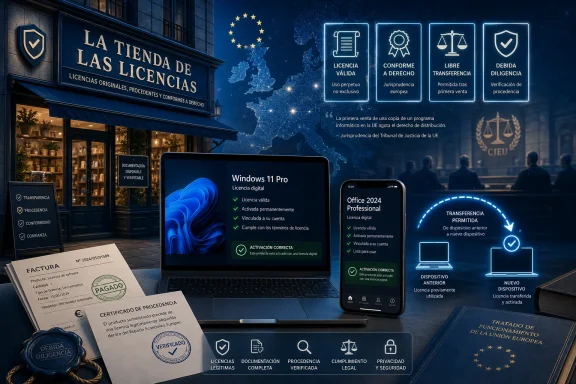 Cheap Windows Keys Are No Longer Just a Back-Alley Internet Story
Every Windows enthusiast knows the ritual. You build a PC, replace a motherboard, refurbish an older laptop, or set up a small office machine, and suddenly the “free” operating system becomes a line item. Microsoft’s official retail pricing has long made Windows and Office feel less like commodity software and more like a tax on doing things properly.That tension created the market that La Tienda de las Licencias is now trying to occupy in the open. The company says it sells genuine licenses delivered by email within minutes, including Windows 11 Pro, Windows 10 Pro, Office 2024, Office 2021, Microsoft 365, Windows Server, SQL Server, and antivirus products. It also says it has processed more than 70,000 orders across more than 30 countries and points to eKomi reviews as proof that buyers are not simply throwing money into the void.
The important distinction is between a cheap key and a legal chain of title. The internet is full of product keys of unclear origin: surplus volume-license keys, regional keys, MSDN keys, stolen keys, keys generated through fraud, and keys that work until they abruptly do not. La Tienda de las Licencias is presenting itself as something different: a reseller of previously issued licenses under a European legal framework.
That distinction matters because activation is not the same as legitimacy. A key can activate Windows and still leave a business exposed during an audit. Conversely, a resale license can look suspiciously cheap to a consumer trained by Microsoft’s retail pricing, while still resting on a defensible legal basis.
The Whole Business Rests on a 2012 Courtroom Detour
The legal hinge is the Court of Justice of the European Union’s 2012 ruling in UsedSoft v. Oracle, case C-128/11. In that case, the EU’s top court held that the copyright holder’s distribution right in a copy of a computer program can be exhausted after the first authorized sale in the EU, even when the software was downloaded rather than supplied on a disc. In plain English, software could have a second-hand market.That was a major crack in the software industry’s preferred story. Vendors had spent years nudging customers away from the idea that they owned anything at all, framing software as a licensed experience wrapped in non-transferable terms. The court was not having all of it. If the transaction functioned economically like a sale for unlimited use, the first sale exhausted the vendor’s ability to control further distribution of that copy.
The ruling did not say that every key on every website is automatically lawful. It came with conditions, including that the original buyer must stop using the software and that the resale cannot simply split up certain multi-user license bundles in ways the ruling did not permit. But it did establish the principle that the secondary software market is not inherently piracy.
That is the plot twist behind La Tienda de las Licencias. The company is not claiming to be Microsoft, nor is it claiming that Microsoft has blessed its business. According to the press material, it says it is an independent reseller, not an authorized Microsoft partner or official distributor, with Panda Security identified as an exception where authorization exists. In a market saturated with “official-ish” badges and suspicious trust seals, that admission is more important than it first appears.
Microsoft’s Preferred Future Has Fewer Perpetual Licenses in It
This market exists in tension with the direction Microsoft has been pushing for more than a decade. The company would rather sell Microsoft 365 subscriptions, Azure consumption, Windows-as-a-service management, and enterprise agreements than watch perpetual licenses move around like used office chairs. The economics are obvious: subscriptions produce recurring revenue; used perpetual licenses compete with new sales.That does not make Microsoft’s position irrational. From Redmond’s perspective, cheap resale licenses complicate support, compliance, anti-fraud enforcement, channel relationships, and customer expectations. If a user buys a license for a fraction of the official price and later has an activation problem, Microsoft may become the face of the failure even when it was not the seller.
But the consumer’s perspective is equally obvious. If a license was lawfully sold once, why should it vanish as an economic asset simply because the vendor would prefer a subscription? A small business closing a branch, a company migrating to cloud services, or an organization standardizing on newer software may have surplus licenses that still hold value. The secondary market turns that dead inventory into supply.
That is why the UsedSoft principle remains so consequential. It converts “cheap software” from a question of morality into a question of provenance. The right issue is not whether Microsoft likes the market. The right issue is whether the license being resold satisfies the legal and practical requirements that make resale legitimate.
The UK Fight Shows the Question Is Not Entirely Settled
Anyone writing about used Microsoft licenses in 2026 has to add a caveat: this is not a dead legal topic. Recent reporting from outlets including The Register, Tom’s Hardware, TechRadar, and PC Gamer has tracked Microsoft’s fight with ValueLicensing in the United Kingdom, where the company has challenged aspects of the pre-owned Microsoft software market. That dispute has put fresh attention on whether parts of Windows and Office fall cleanly inside Europe’s software exhaustion doctrine.The reported argument is technical but important. Microsoft has contended, in essence, that some elements of its products may involve copyright works beyond the “computer program” covered by the software exhaustion rules. Resellers have argued that accepting such a theory would undermine the used software market that has operated in Europe since UsedSoft.
For buyers, the practical result is not panic but caution. The existence of litigation does not erase the 2012 CJEU ruling, and it does not mean every resale license is suspect. It does mean the market is not as simple as “Europe said yes, therefore all cheap keys are fine forever.”
That is especially relevant for businesses. A home user may only care whether Windows activates. An IT department needs invoices, documentation, license history, proof of transfer, and confidence that the original license is no longer being used elsewhere. Cheap is nice; defensible is better.
The Difference Between a Reseller and a Random Key Shop Is Paperwork
The most important thing a reseller can sell is not the key. It is the paper trail.A legitimate resale software transaction should be able to explain where the license came from, what rights are being transferred, whether the original owner has ceased use, and what documentation the buyer receives. Without that, the buyer is not really buying compliance; they are buying a working activation code and hoping nobody asks hard questions later.
This is where La Tienda de las Licencias’ pitch is strongest and most vulnerable. The company emphasizes genuine licenses, fast email delivery, international service, verified reviews, and its legal basis under EU resale law. Those are useful trust signals. But a serious buyer should still care about the underlying license type and evidence of transfer, especially for Microsoft server products and business deployments.
Windows and Office for a single home PC are one thing. Windows Server, SQL Server, and Office deployments across a company are another. The compliance stakes rise quickly once software is tied to production workloads, remote desktop services, virtualization, client access licensing, or regulated business environments.
This does not mean small businesses should avoid the secondary market. It means they should treat it like procurement, not bargain hunting. If a reseller cannot produce documentation suitable for an audit, the discount may be the least interesting part of the transaction.
Europe Created a Market the Cloud Has Been Trying to Erase
The UsedSoft ruling belongs to a different software era. In 2012, the fight was still about downloaded programs, perpetual rights, and whether a digital copy should behave like a physical one. Since then, the industry has moved aggressively toward cloud-tethered subscriptions, account-based entitlement, and services that are never truly “sold” in the old sense.That shift is not accidental. The easiest way to defeat the used software market is not necessarily to litigate it out of existence. It is to stop selling the kind of software that can be resold.
Microsoft 365 is the clearest example. A subscription is not a surplus perpetual license sitting unused after a company changes course. It is an ongoing service relationship. When the subscription ends, the entitlement ends. There is no second-hand copy in the same way there was with a perpetual Office license.
That is why the secondary market is both economically useful and historically fragile. It depends on a stock of licenses from an era when software was still sold in forms that could plausibly be transferred. As Microsoft and other vendors move more functionality into cloud services and account-bound activation systems, the pool of cleanly resellable perpetual licenses becomes more strategically important and more politically contested.
La Tienda de las Licencias is therefore not just selling cheap Windows keys. It is monetizing the remains of an ownership model the software industry has spent years trying to bury.
For Home Users, the Appeal Is Obvious — and So Is the Risk
For an individual user, the appeal is almost embarrassingly straightforward. If you can activate Windows 11 Pro or install Office for far less than official retail pricing, and if the license is genuine, the value proposition sells itself. A refurbished laptop suddenly becomes more attractive. A self-built PC gets a legal OS without turning the operating system into one of the most expensive components in the build.The danger is that consumers often compress three different questions into one. Does the key work? Is the software genuine? Is the license legally transferable to me? Those are related questions, but they are not identical.
A key that activates answers only the first question. Genuine Microsoft software answers the second. A resale framework, with documentation and compliance, answers the third. The third is the one users most often ignore because it is also the least visible when everything goes smoothly.
Still, the existence of a legal resale market is good for users. It introduces price pressure into a market where the vendor otherwise controls the primary channel. It also gives budget-conscious users a better option than piracy, sketchy activators, or malware-laced downloads masquerading as “free Office.”
For IT Pros, Cheap Licenses Are a Procurement Problem
IT administrators should be more skeptical than home users, not because the used license market is inherently illegitimate, but because enterprise compliance is unforgiving. A sysadmin cannot defend a production SQL Server deployment by saying the website had a gold badge and the key arrived quickly. They need records.The press release says La Tienda de las Licencias serves users and businesses, and its catalog includes products that sit squarely in professional infrastructure. That makes the company relevant to WindowsForum’s admin audience, but it also raises the bar. Server licensing is complex even when bought directly through standard channels; buying it second-hand demands more diligence, not less.
The questions are practical. Is the license perpetual? Was it first placed on the EU market? Has it been transferred as a whole where required? Does the invoice identify the license clearly? Is there a declaration that the previous owner has ceased use? Are client access licenses involved? Does the deployment scenario match the rights being sold?
None of those questions are glamorous, and none fit neatly into a checkout page. But they separate lawful cost optimization from future audit pain. The smarter the IT shop, the less it treats discount licensing as a vibes-based purchase.
The Press Release Gets the Mood Right, but Buyers Still Need Discipline
The Barchart-distributed announcement frames La Tienda de las Licencias as a quiet Spanish shop offering a third way between overpaying and piracy. As marketing, that is effective because it speaks to a real frustration. Microsoft’s official pricing can feel disconnected from the everyday economics of PC ownership, especially outside high-income markets.The release also makes several claims that are easy to understand and attractive to buyers: instant email delivery, 24/7 automation, international reach, local-currency payment support in Latin America, thousands of verified eKomi reviews, and a 9.8 out of 10 rating. Those claims, if accurate, make the store look less like a fly-by-night key bazaar and more like an established e-commerce operation.
But journalism has to separate the pitch from the underlying reality. A reseller can be reputable and still operate in a legally complex market. A license can be genuine and still require careful matching to the buyer’s use case. A court ruling can make resale lawful under conditions without turning every downstream transaction into a sure thing.
That is the right frame for this story. Not “too good to be true,” and not “nothing to see here.” The more accurate conclusion is that Europe carved out a genuine secondary market, and companies like La Tienda de las Licencias are packaging that market for ordinary users who would otherwise never read a CJEU judgment.
The Real Bargain Is Not the Key, but the Escape From Vendor Lock-In
There is a deeper policy argument hiding under the checkout flow. Software vendors benefit when customers believe digital goods cannot be owned, transferred, resold, repaired, or audited except on vendor terms. The secondary license market pushes back against that worldview.Used software resale is not a radical idea. It is the digital version of a familiar principle: if a product has been sold, the seller should not control it forever. The difficulty is that software blurs the line between product, service, copy, account, contract, and ongoing update stream. Vendors have used that blur to expand control.
The CJEU’s UsedSoft ruling did not solve every problem in digital ownership. It did, however, draw a line around computer programs sold for unlimited use. Within that line, the court recognized that customers are not merely temporary passengers in a vendor-controlled licensing machine.
That is why Microsoft and other software companies have such strong incentives to move beyond perpetual software. The cloud does not merely improve deployment and update cadence. It changes the legal and economic character of the transaction. Once everything becomes a service, the second-hand market has little left to trade.
The Windows Crowd Should Welcome the Market Without Romanticizing It
Windows enthusiasts are unusually good at spotting nonsense in the software channel. They know the difference between OEM keys, retail licenses, volume licensing, KMS activation, Microsoft accounts, digital entitlements, and the gray-market sludge that search engines happily surface. They also know that Microsoft’s own licensing language can be opaque enough to make honest buyers feel like suspects.That makes this audience well suited to understand the nuance. La Tienda de las Licencias is not interesting because it offers cheap software. Cheap software is everywhere. It is interesting because it is explicitly tying that offer to the European doctrine of software exhaustion and presenting itself as an independent reseller rather than pretending to be an official Microsoft outlet.
The responsible reaction is neither blind trust nor reflexive dismissal. For personal use, buyers should verify that the product matches their machine, region, and activation needs. For business use, they should demand documentation and preserve it as they would any other procurement record. For infrastructure products, they should be even more careful.
There is also a cultural point here. The Windows ecosystem has always been sustained by tinkerers, refurbishers, small shops, consultants, schools, charities, and businesses that stretch hardware far beyond the upgrade cycle Microsoft would prefer. A functioning secondary software market helps that world stay legal.
The Fine Print Is Where the Savings Become Real
The most concrete lesson from La Tienda de las Licencias is that legal cheap software is possible, but it is not magic. The discount matters only if the license is genuine, transferable, appropriate for the deployment, and backed by records a buyer can keep.- Buyers should distinguish a working activation key from a legally transferable license.
- Home users should still verify edition, language, region, and activation method before treating a low price as a safe purchase.
- Businesses should retain invoices, transfer documentation, and any declaration that the previous license holder stopped using the software.
- Server and SQL Server purchases deserve extra scrutiny because deployment rights, virtualization, and access licensing can change the compliance picture.
- The EU resale framework gives the secondary market a real legal foundation, but it does not bless every cheap-key seller on the internet.
- Microsoft’s long-term move toward subscriptions and cloud services will keep shrinking the universe of software that behaves like a resellable asset.
References
- Primary source: barchart.com
Published: 2026-07-07T09:40:13.739757
Loading…
www.barchart.com - Related coverage: concurrences.com
Loading…
www.concurrences.com - Related coverage: techradar.com
Tribunal hears Microsoft case on whether second hand Office and Windows license trading is unlawful | TechRadar
Long-running fight between Microsoft and ValueLicensing ramps up againwww.techradar.com - Related coverage: tomshardware.com
Loading…
www.tomshardware.com - Related coverage: pcgamer.com
Loading…
www.pcgamer.com - Related coverage: bestbuy.com
Loading…
www.bestbuy.com
- Official source: microsoft.com
Loading…
www.microsoft.com - Official source: answers.microsoft.com
Loading…
answers.microsoft.com - Official source: techcommunity.microsoft.com
Loading…
techcommunity.microsoft.com - Related coverage: thesoftwarecity.com
Loading…
thesoftwarecity.com - Related coverage: windowscentral.com
Loading…
www.windowscentral.com - Official source: learn.microsoft.com
Loading…
learn.microsoft.com - Official source: store.apple.com
