

European businesses can legally buy certain used Windows Server licenses when the original license was perpetual, the seller’s rights have been extinguished, and the buyer receives a verifiable chain of ownership showing how the license moved from first purchaser to current holder. That is the unglamorous but important point behind the secondary software market: this is not a gray-market key bazaar by default, and it is not a magic discount machine either. It is a compliance exercise dressed up as procurement savings. For Windows shops under pressure to modernize infrastructure without letting licensing swallow the budget, the distinction matters.
The pitch is easy to understand. Windows Server remains the quiet workhorse behind Active Directory, file services, line-of-business applications, Remote Desktop deployments, Hyper-V hosts, print infrastructure, and decades of accumulated enterprise logic. It also remains expensive, especially once core licensing, virtualization rights, Software Assurance decisions, and Client Access Licenses enter the spreadsheet. A used license promising savings of as much as 70 percent will naturally attract attention.
But the real story is not that companies can buy cheaper server software. The real story is that licensing has become such a high-friction part of infrastructure planning that a properly documented second-hand license can look less like bargain hunting and more like governance. Used Windows Server licensing is not a loophole; in the EU and EEA, when handled correctly, it is a consequence of the same exhaustion principle that prevents vendors from controlling every downstream sale of a product forever.
The used-license market asks IT departments to change how they think about software purchasing. A new Windows Server license bought through normal channels feels clean because the paperwork begins with the buyer. A used license asks the buyer to trust a chain of events that started somewhere else: a company migrated to cloud services, retired a data center, merged with another firm, downsized, or standardized on a different platform.
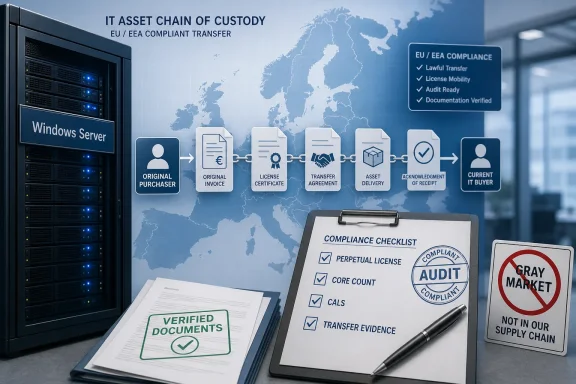
That does not make the transaction illegitimate. It does make documentation the center of gravity. The license key, download media, or invoice line is not enough. What matters is whether the buyer can show that the original license was validly purchased, that it was perpetual rather than subscription-based, that the previous owner stopped using it, and that the transfer did not leave the license split or duplicated in a way the law does not protect.
This is where a serious used-license dealer differs from the sort of marketplace seller offering “cheap server keys” with no provenance. In a legitimate transaction, the deliverable is not merely activation. Activation proves that Microsoft’s technical systems accepted a key at a given moment. It does not prove that the customer owns enough rights to survive an audit.
That is why the claim of “identical software” is both true and incomplete. The bits are identical. Windows Server does not become a lesser operating system because the license changed hands. But the usable asset is the bundle of software rights plus evidence, and in the secondary market the evidence is what the buyer is really paying a reputable broker to assemble.
For enterprise buyers, the important part is not the courtroom drama between Oracle and UsedSoft. It is the principle that a perpetual license sold for an economic value resembling ownership cannot be treated as forever locked to the first customer merely because the vendor wrote “non-transferable” into standard terms. The ruling did not make every resale lawful. It created a path.
That path has guardrails. The original acquirer must stop using the software. The license must not be sliced into fragments in a way that breaks the original licensed bundle. The rights being transferred must be the kind of rights exhaustion can sensibly attach to. A subscription service, by contrast, is not the same creature as a perpetual license, and a cloud entitlement is not automatically a transferable copy of software.
This is why the used Windows Server market lives in the details. Vendors and resellers may talk about “used software” as a category, but a compliance officer has to talk about specific licenses, specific editions, specific agreements, and specific proof. The legal foundation is real; the operational burden is also real.
The result is a market that is both more legitimate and more boring than its skeptics assume. It is not piracy with invoices. It is also not a one-click procurement hack. It is a documentary exercise in proving that the license now being used by Company B is the same enforceable right Company A no longer uses.
Windows Server Standard and Datacenter may run the same basic operating system, but they are economically different products in virtualized environments. Standard can be cost-effective for lightly virtualized hosts, while Datacenter becomes the obvious candidate when a host is expected to run many Windows Server virtual machines. Used licensing does not change that math. It only changes the acquisition price of some of the inputs.
Then come CALs. Windows Server is not licensed only at the server. Most internal users or devices accessing Windows Server services require Client Access Licenses, and some roles require additional licenses on top. Remote Desktop Services is the classic trap: installing the role is technically easy, but compliance requires the right RDS CALs. A company that buys a discounted server license and forgets the access layer has not saved money; it has deferred a liability.
This is where procurement teams can fool themselves. A used Windows Server license might reduce capital cost dramatically, but the total licensing position still has to be modeled. The number of cores, the edition, the version, downgrade rights, CALs, virtualization plans, disaster recovery arrangements, and deployment location all shape the answer.
That complexity is not a secondary-market problem. It is a Microsoft licensing problem. The used market merely exposes it by inviting businesses to separate “Can I activate this?” from “Am I correctly licensed?”
That distinction matters because server refresh cycles create exactly the inventory that tempts resale. A business retires a rack of old hosts and sees Windows Server labels, certificates, old invoices, and activation history. To a non-specialist, that can look like a pool of reusable value. To a licensing auditor, it may look like rights that lived and died with the machines.
Volume licenses are a different story, but not a frictionless one. They are generally the core of the legitimate used-license market because they are not attached to a specific physical server in the same way OEM licenses are. Even there, the buyer needs clean transfer documentation and should understand what the original agreement permitted, what rights were actually acquired, and whether any benefits tied to Software Assurance are included or excluded.
This is also why the cheapest offer is often the least useful offer. A suspiciously cheap key without origin documents might work today and become indefensible tomorrow. The key is not the license. The license is the right, and the right is only as strong as the proof surrounding it.
For IT departments, the practical rule is simple: if the seller cannot explain exactly what kind of license is being transferred, where it came from, and why the previous owner can no longer use it, the discount is noise. The secondary market rewards patience and punishes wishful thinking.
That is the economic engine of the used-software market. One firm’s migration residue becomes another firm’s budget relief. The seller recovers value from sunk software costs, the buyer avoids paying new-license pricing, and the broker earns a margin by turning compliance paperwork into a tradable asset.
This is especially relevant for businesses that are not on the same cloud timeline as Microsoft’s marketing department. Plenty of organizations still need Windows Server on-premises because of latency, regulatory constraints, industrial systems, branch-office realities, application compatibility, or plain operational conservatism. For them, the question is not whether Windows Server is fashionable. The question is whether they can run required workloads legally at a tolerable cost.
Used licensing also fits awkward transitional periods. A company may be modernizing, but not fast enough to justify full-price perpetual licenses for systems it expects to retire in three years. It may need to expand capacity temporarily after an acquisition. It may need lab, test, staging, or disaster-recovery environments that mirror production without blowing up the licensing budget.
None of that eliminates the appeal of subscriptions or cloud-hosted services. But it complicates the narrative that all software value now flows through monthly consumption models. Perpetual licenses still have a second life precisely because many businesses are living through hybrid infrastructure rather than a clean break with the past.
A properly documented used license should be treated like any other compliance asset. It belongs in the same repository as volume licensing agreements, invoices, proof of transfer, deployment records, CAL counts, hardware inventories, and virtualization diagrams. If a company cannot connect the license paperwork to the actual servers consuming the rights, it is asking for trouble.
The previous owner’s declaration matters because exhaustion depends on the old use ending. A buyer wants clear evidence that the license was taken out of use and transferred as a whole, not duplicated. The dealer’s warranty or functionality guarantee may help commercially, but the audit file needs more than a promise that the key activates.
The practical risk is asymmetry. When a new license is bought through established Microsoft channels, the transaction is easy to explain. When a used license is bought, the company may need to explain more. That explanation can be perfectly valid, but it has to exist before the audit letter arrives.
In other words, the compliance burden shifts left. The buyer should perform due diligence before purchase, not after deployment. The savings are only real if the transaction survives the boring administrative questions that follow.
American businesses have their own doctrines around first sale and software licensing, but U.S. courts have often treated software transactions differently depending on whether the user is deemed an owner or a licensee. Contract terms, distribution method, and the structure of the transaction can matter heavily. A European reseller’s confidence should not be imported wholesale into a U.S. compliance memo.
That does not mean U.S. companies should ignore the concept. Multinationals operating in Europe may be able to use the secondary market within appropriate legal boundaries. U.S.-based IT leaders can also learn from the European debate because it exposes a broader tension in software economics: vendors want software rights to behave like revocable services, while customers often budget for them like durable assets.
The regional distinction also matters for forum readers evaluating online offers. A page describing EU legality is not a universal permission slip. If the buyer, seller, original purchaser, or deployment location sits outside the EU/EEA, counsel should be involved before anyone assumes the same answer applies.
That may sound cautious, but it is the kind of caution that keeps a savings project from becoming an executive-level incident. The used-license market is legal under specific conditions in specific places. Precision is not pedantry here; it is the business model.
That skepticism is rational. The internet is full of cheap software keys with no meaningful provenance. Windows administrators have seen activation shortcuts, recycled MAK keys, MSDN keys sold as production licenses, regionally restricted offers, and “lifetime” deals that evaporate the moment a vendor tightens enforcement. Against that background, a legitimate used-license dealer has to differentiate itself from a gray-market key shop.
The differentiator is process. A reputable dealer should provide proof of origin, transfer documentation, clear terms, a statement of the previous owner’s non-use, and support if activation or audit questions arise. It should also be willing to say no when a license type is not suitable. If every license is magically transferable and every scenario is conveniently compliant, the buyer should walk away.
There is also a subtle point about incentives. A dealer that expects repeat business from enterprises has reason to protect the buyer’s audit position. A one-off marketplace seller has reason to move inventory. In software licensing, incentives matter because the harm from a bad transaction may surface months or years after the payment clears.
Soft & Cloud’s argument, then, is less radical than it might first appear. It is not “buy used software because Microsoft charges too much.” It is “buy documented rights from a specialist when the law, license type, and deployment scenario line up.” That is a much narrower claim, and a much stronger one.
Perpetual Windows Server licensing sits awkwardly in that world. Microsoft still sells it because many server deployments demand it, but the company’s strategic center of gravity is plainly cloud and subscription. Customers, meanwhile, may prefer perpetual rights for stable workloads precisely because they can budget once and run for years.
A secondary market strengthens that customer position. It says that a perpetual license is not merely a historical receipt; under the right legal framework, it is an asset that can move. That makes software look a little more like equipment again, and less like a one-way toll road.
Vendors dislike that idea for obvious reasons. Every used license sale is potentially a new license sale that did not happen. It also weakens pricing power by creating a reference market outside official channels. Even if the volume is modest compared with Microsoft’s total licensing business, the principle is uncomfortable.
But the customer-side argument is powerful. If an organization paid for a perpetual license and stopped using it, why should the economic value vanish? The UsedSoft logic answered that question in Europe more than a decade ago, and the answer still resonates in an era when enterprise software feels increasingly rented.
The security risk in Windows Server deployment is not that a legitimate second-hand license somehow changes the code. The risk is that cost pressure might push organizations toward unsupported versions, unpatched systems, or illegal activation workarounds. If used licensing lets a business stay compliant while keeping servers on supported releases, it can improve the security posture rather than weaken it.
There is, however, a lifecycle trap. A cheap license for an older Windows Server version may look attractive, but support timelines still matter. Running an operating system beyond mainstream or extended support can increase operational and security risk, and extended security arrangements may not be available or economical for every customer. A bargain license for the wrong version is not a bargain.
The healthier use case is disciplined matching. Buy the rights needed for the version and edition that fit the organization’s lifecycle plan, not merely the cheapest SKU in the catalog. Align licensing with patch policy, backup architecture, identity design, and virtualization strategy. Treat price as one requirement among many.
Used licenses can reduce waste, but they cannot make obsolete infrastructure modern. The license file may be clean while the server estate remains a museum. IT leaders should not confuse procurement cleverness with platform strategy.
That makes the secondary market less attractive to chaotic environments, even if those environments most need savings. If a company does not know how many users access Windows Server, whether devices or users are the right CAL metric, how many virtual machines run on each host, or which workloads are moving to cloud next year, a used-license purchase may simply add another unknown.
The procurement workflow should therefore begin with demand, not supply. Do not start by asking what discounted licenses are available. Start by asking what rights the organization lacks, what rights it already owns, and which rights will still matter over the next planning horizon. Only then does the used market become a sourcing option.
There is also a governance lesson for MSPs and consultants. Recommending used licenses can be a real value-add, but it increases the responsibility to document assumptions. A client that later faces an audit will not remember the nuance of the sales conversation. It will ask why the consultant said the cheaper path was safe.
The mature posture is neither fear nor enthusiasm. It is controlled adoption. Used Windows Server licenses can belong in the toolkit, but they should sit beside legal review, SAM discipline, and a sober understanding of Microsoft’s licensing mechanics.
The buyer should also confirm that the license is not being improperly split. The UsedSoft ruling was not a blanket invitation to break large license bundles into arbitrary pieces. If the original right was acquired as a defined package, the transfer has to respect the legal and contractual boundaries around that package.
Core licensing deserves special attention because undercounting is easy. A server with more physical cores than the purchased license covers is not compliant just because Windows activates. The same is true for virtualization. Standard edition rights may need to be stacked to cover additional virtual operating system environments, while Datacenter may make more sense for dense hosts.
CALs are another place where used licensing can be useful but dangerous. Buying server rights without matching access rights is like buying a car and forgetting the roads have tolls. User CALs, device CALs, RDS CALs, and other access requirements need their own review.
The final check is jurisdiction. If the legal basis depends on EU/EEA exhaustion, the transaction should be structured accordingly. A business should not assume that a reseller’s European compliance model automatically travels with a license into every legal system.
That may sound like a narrower market than the headline discount implies. It is. But narrow does not mean insignificant. Many small and mid-sized businesses, public-sector bodies, manufacturers, professional-services firms, and regional enterprises still run infrastructure where Windows Server is indispensable and budgets are under pressure.
For those organizations, the difference between full-price and used licensing can fund other priorities: backup modernization, endpoint hardening, identity cleanup, network upgrades, or migration work that would otherwise be deferred. The irony is that a second-hand license can sometimes help pay for the modernization that will eventually reduce dependence on that license.
The decision should not be emotional. Microsoft is not wrong to protect its licensing revenue, and buyers are not wrong to seek lawful savings. The tension between those positions is the normal friction of enterprise software economics. The winner should be the party with the better paperwork.
The pitch is easy to understand. Windows Server remains the quiet workhorse behind Active Directory, file services, line-of-business applications, Remote Desktop deployments, Hyper-V hosts, print infrastructure, and decades of accumulated enterprise logic. It also remains expensive, especially once core licensing, virtualization rights, Software Assurance decisions, and Client Access Licenses enter the spreadsheet. A used license promising savings of as much as 70 percent will naturally attract attention.
But the real story is not that companies can buy cheaper server software. The real story is that licensing has become such a high-friction part of infrastructure planning that a properly documented second-hand license can look less like bargain hunting and more like governance. Used Windows Server licensing is not a loophole; in the EU and EEA, when handled correctly, it is a consequence of the same exhaustion principle that prevents vendors from controlling every downstream sale of a product forever.
 The Discount Is Real, but the Paper Trail Is the Product
The used-license market asks IT departments to change how they think about software purchasing. A new Windows Server license bought through normal channels feels clean because the paperwork begins with the buyer. A used license asks the buyer to trust a chain of events that started somewhere else: a company migrated to cloud services, retired a data center, merged with another firm, downsized, or standardized on a different platform.That does not make the transaction illegitimate. It does make documentation the center of gravity. The license key, download media, or invoice line is not enough. What matters is whether the buyer can show that the original license was validly purchased, that it was perpetual rather than subscription-based, that the previous owner stopped using it, and that the transfer did not leave the license split or duplicated in a way the law does not protect.
This is where a serious used-license dealer differs from the sort of marketplace seller offering “cheap server keys” with no provenance. In a legitimate transaction, the deliverable is not merely activation. Activation proves that Microsoft’s technical systems accepted a key at a given moment. It does not prove that the customer owns enough rights to survive an audit.
That is why the claim of “identical software” is both true and incomplete. The bits are identical. Windows Server does not become a lesser operating system because the license changed hands. But the usable asset is the bundle of software rights plus evidence, and in the secondary market the evidence is what the buyer is really paying a reputable broker to assemble.
UsedSoft Still Casts a Long Shadow Over Enterprise Procurement
The legal anchor for the European used-software market is the 2012 UsedSoft v. Oracle ruling from the Court of Justice of the European Union. The court held that, under certain conditions, the resale of downloaded software could be lawful because the copyright holder’s distribution right had been exhausted after the first sale. That was a major moment because it prevented software vendors from defeating resale rights simply by moving from discs to downloads.For enterprise buyers, the important part is not the courtroom drama between Oracle and UsedSoft. It is the principle that a perpetual license sold for an economic value resembling ownership cannot be treated as forever locked to the first customer merely because the vendor wrote “non-transferable” into standard terms. The ruling did not make every resale lawful. It created a path.
That path has guardrails. The original acquirer must stop using the software. The license must not be sliced into fragments in a way that breaks the original licensed bundle. The rights being transferred must be the kind of rights exhaustion can sensibly attach to. A subscription service, by contrast, is not the same creature as a perpetual license, and a cloud entitlement is not automatically a transferable copy of software.
This is why the used Windows Server market lives in the details. Vendors and resellers may talk about “used software” as a category, but a compliance officer has to talk about specific licenses, specific editions, specific agreements, and specific proof. The legal foundation is real; the operational burden is also real.
The result is a market that is both more legitimate and more boring than its skeptics assume. It is not piracy with invoices. It is also not a one-click procurement hack. It is a documentary exercise in proving that the license now being used by Company B is the same enforceable right Company A no longer uses.
Microsoft Licensing Makes the Savings Harder to Count Than the Discount Suggests
The headline discount on a used Windows Server license is attractive because server licensing is rarely one simple purchase. Modern Windows Server Standard and Datacenter licensing is built around physical cores, with minimums per server and per processor. That means a buyer cannot simply ask how many servers it has. It has to know how many physical cores it must cover and what virtualization rights it expects to exercise.Windows Server Standard and Datacenter may run the same basic operating system, but they are economically different products in virtualized environments. Standard can be cost-effective for lightly virtualized hosts, while Datacenter becomes the obvious candidate when a host is expected to run many Windows Server virtual machines. Used licensing does not change that math. It only changes the acquisition price of some of the inputs.
Then come CALs. Windows Server is not licensed only at the server. Most internal users or devices accessing Windows Server services require Client Access Licenses, and some roles require additional licenses on top. Remote Desktop Services is the classic trap: installing the role is technically easy, but compliance requires the right RDS CALs. A company that buys a discounted server license and forgets the access layer has not saved money; it has deferred a liability.
This is where procurement teams can fool themselves. A used Windows Server license might reduce capital cost dramatically, but the total licensing position still has to be modeled. The number of cores, the edition, the version, downgrade rights, CALs, virtualization plans, disaster recovery arrangements, and deployment location all shape the answer.
That complexity is not a secondary-market problem. It is a Microsoft licensing problem. The used market merely exposes it by inviting businesses to separate “Can I activate this?” from “Am I correctly licensed?”
OEM Licenses Are the Trap Door Under the Bargain Bin
Not every license is a candidate for resale, and OEM licensing is where many bargain narratives fall apart. OEM licenses are typically tied to the original hardware with which they were sold. They may have downgrade rights, and they may be perfectly legitimate on the original machine, but that does not mean they can be lifted from retired hardware and redeployed wherever the buyer likes.That distinction matters because server refresh cycles create exactly the inventory that tempts resale. A business retires a rack of old hosts and sees Windows Server labels, certificates, old invoices, and activation history. To a non-specialist, that can look like a pool of reusable value. To a licensing auditor, it may look like rights that lived and died with the machines.
Volume licenses are a different story, but not a frictionless one. They are generally the core of the legitimate used-license market because they are not attached to a specific physical server in the same way OEM licenses are. Even there, the buyer needs clean transfer documentation and should understand what the original agreement permitted, what rights were actually acquired, and whether any benefits tied to Software Assurance are included or excluded.
This is also why the cheapest offer is often the least useful offer. A suspiciously cheap key without origin documents might work today and become indefensible tomorrow. The key is not the license. The license is the right, and the right is only as strong as the proof surrounding it.
For IT departments, the practical rule is simple: if the seller cannot explain exactly what kind of license is being transferred, where it came from, and why the previous owner can no longer use it, the discount is noise. The secondary market rewards patience and punishes wishful thinking.
The Cloud Made Old Licenses More Valuable, Not Less
It is tempting to assume that cloud migration would make perpetual server licenses obsolete. In practice, the opposite can happen. As organizations move workloads into Azure, AWS, Google Cloud, SaaS platforms, and managed services, they create surplus on-premises license positions. Those licenses may no longer fit the seller’s architecture, but they may fit another company’s perfectly.That is the economic engine of the used-software market. One firm’s migration residue becomes another firm’s budget relief. The seller recovers value from sunk software costs, the buyer avoids paying new-license pricing, and the broker earns a margin by turning compliance paperwork into a tradable asset.
This is especially relevant for businesses that are not on the same cloud timeline as Microsoft’s marketing department. Plenty of organizations still need Windows Server on-premises because of latency, regulatory constraints, industrial systems, branch-office realities, application compatibility, or plain operational conservatism. For them, the question is not whether Windows Server is fashionable. The question is whether they can run required workloads legally at a tolerable cost.
Used licensing also fits awkward transitional periods. A company may be modernizing, but not fast enough to justify full-price perpetual licenses for systems it expects to retire in three years. It may need to expand capacity temporarily after an acquisition. It may need lab, test, staging, or disaster-recovery environments that mirror production without blowing up the licensing budget.
None of that eliminates the appeal of subscriptions or cloud-hosted services. But it complicates the narrative that all software value now flows through monthly consumption models. Perpetual licenses still have a second life precisely because many businesses are living through hybrid infrastructure rather than a clean break with the past.
The Audit Risk Is Not the Used License; It Is the Weak File
Microsoft audits and software asset management reviews are often discussed as if they are ambushes. In reality, most audit pain comes from organizations not knowing what they have deployed, what they bought, and what rights attach to each deployment. Used licenses do not inherently worsen that problem. Bad used-license purchases do.A properly documented used license should be treated like any other compliance asset. It belongs in the same repository as volume licensing agreements, invoices, proof of transfer, deployment records, CAL counts, hardware inventories, and virtualization diagrams. If a company cannot connect the license paperwork to the actual servers consuming the rights, it is asking for trouble.
The previous owner’s declaration matters because exhaustion depends on the old use ending. A buyer wants clear evidence that the license was taken out of use and transferred as a whole, not duplicated. The dealer’s warranty or functionality guarantee may help commercially, but the audit file needs more than a promise that the key activates.
The practical risk is asymmetry. When a new license is bought through established Microsoft channels, the transaction is easy to explain. When a used license is bought, the company may need to explain more. That explanation can be perfectly valid, but it has to exist before the audit letter arrives.
In other words, the compliance burden shifts left. The buyer should perform due diligence before purchase, not after deployment. The savings are only real if the transaction survives the boring administrative questions that follow.
The U.S. Reader Should Notice the Geography
For WindowsForum.com’s global readership, the regional boundary is crucial. The strongest legal framing for used Windows Server license resale sits in the EU and EEA, where the exhaustion principle and the UsedSoft decision provide the foundation. That does not automatically translate into the same risk profile in the United States or other jurisdictions.American businesses have their own doctrines around first sale and software licensing, but U.S. courts have often treated software transactions differently depending on whether the user is deemed an owner or a licensee. Contract terms, distribution method, and the structure of the transaction can matter heavily. A European reseller’s confidence should not be imported wholesale into a U.S. compliance memo.
That does not mean U.S. companies should ignore the concept. Multinationals operating in Europe may be able to use the secondary market within appropriate legal boundaries. U.S.-based IT leaders can also learn from the European debate because it exposes a broader tension in software economics: vendors want software rights to behave like revocable services, while customers often budget for them like durable assets.
The regional distinction also matters for forum readers evaluating online offers. A page describing EU legality is not a universal permission slip. If the buyer, seller, original purchaser, or deployment location sits outside the EU/EEA, counsel should be involved before anyone assumes the same answer applies.
That may sound cautious, but it is the kind of caution that keeps a savings project from becoming an executive-level incident. The used-license market is legal under specific conditions in specific places. Precision is not pedantry here; it is the business model.
Soft & Cloud Sells Trust in a Market Built on Distrust
The Windows Report article frames Soft & Cloud’s message plainly: the risk lies mostly in execution, not in the existence of the used-license market itself. That is a useful framing, but it also reveals the seller’s challenge. Anyone operating in this space must spend as much time convincing buyers that it is not a scam as explaining the savings.That skepticism is rational. The internet is full of cheap software keys with no meaningful provenance. Windows administrators have seen activation shortcuts, recycled MAK keys, MSDN keys sold as production licenses, regionally restricted offers, and “lifetime” deals that evaporate the moment a vendor tightens enforcement. Against that background, a legitimate used-license dealer has to differentiate itself from a gray-market key shop.
The differentiator is process. A reputable dealer should provide proof of origin, transfer documentation, clear terms, a statement of the previous owner’s non-use, and support if activation or audit questions arise. It should also be willing to say no when a license type is not suitable. If every license is magically transferable and every scenario is conveniently compliant, the buyer should walk away.
There is also a subtle point about incentives. A dealer that expects repeat business from enterprises has reason to protect the buyer’s audit position. A one-off marketplace seller has reason to move inventory. In software licensing, incentives matter because the harm from a bad transaction may surface months or years after the payment clears.
Soft & Cloud’s argument, then, is less radical than it might first appear. It is not “buy used software because Microsoft charges too much.” It is “buy documented rights from a specialist when the law, license type, and deployment scenario line up.” That is a much narrower claim, and a much stronger one.
Perpetual Licensing Has Become a Form of Financial Resistance
The appeal of used Windows Server licenses is part of a larger enterprise software backlash. Over the last decade, vendors have pushed customers toward subscriptions, cloud consumption, bundled suites, and licensing models that reduce the customer’s ability to hold an asset outside the vendor’s ongoing commercial relationship. Sometimes that shift brings real value: faster updates, better security integration, elastic capacity, and simpler procurement. Sometimes it mainly converts ownership-like spend into recurring obligation.Perpetual Windows Server licensing sits awkwardly in that world. Microsoft still sells it because many server deployments demand it, but the company’s strategic center of gravity is plainly cloud and subscription. Customers, meanwhile, may prefer perpetual rights for stable workloads precisely because they can budget once and run for years.
A secondary market strengthens that customer position. It says that a perpetual license is not merely a historical receipt; under the right legal framework, it is an asset that can move. That makes software look a little more like equipment again, and less like a one-way toll road.
Vendors dislike that idea for obvious reasons. Every used license sale is potentially a new license sale that did not happen. It also weakens pricing power by creating a reference market outside official channels. Even if the volume is modest compared with Microsoft’s total licensing business, the principle is uncomfortable.
But the customer-side argument is powerful. If an organization paid for a perpetual license and stopped using it, why should the economic value vanish? The UsedSoft logic answered that question in Europe more than a decade ago, and the answer still resonates in an era when enterprise software feels increasingly rented.
The Security Argument Cuts Both Ways
Security-minded administrators may instinctively distrust used software because the phrase evokes tampered installers, dubious downloads, and keys from unknown origins. That concern is valid when the transaction includes untrusted media. It is much less persuasive when the customer obtains installation bits from official Microsoft channels and uses the used transaction only to establish license rights.The security risk in Windows Server deployment is not that a legitimate second-hand license somehow changes the code. The risk is that cost pressure might push organizations toward unsupported versions, unpatched systems, or illegal activation workarounds. If used licensing lets a business stay compliant while keeping servers on supported releases, it can improve the security posture rather than weaken it.
There is, however, a lifecycle trap. A cheap license for an older Windows Server version may look attractive, but support timelines still matter. Running an operating system beyond mainstream or extended support can increase operational and security risk, and extended security arrangements may not be available or economical for every customer. A bargain license for the wrong version is not a bargain.
The healthier use case is disciplined matching. Buy the rights needed for the version and edition that fit the organization’s lifecycle plan, not merely the cheapest SKU in the catalog. Align licensing with patch policy, backup architecture, identity design, and virtualization strategy. Treat price as one requirement among many.
Used licenses can reduce waste, but they cannot make obsolete infrastructure modern. The license file may be clean while the server estate remains a museum. IT leaders should not confuse procurement cleverness with platform strategy.
The Real Buyer Is the Asset Manager, Not the Bargain Hunter
The businesses best suited to used Windows Server licensing are not necessarily the ones most desperate to save money. They are the ones with mature asset management. They know their server inventory, core counts, CAL requirements, virtualization topology, and retirement schedule. They can map a purchased license to a specific compliance need.That makes the secondary market less attractive to chaotic environments, even if those environments most need savings. If a company does not know how many users access Windows Server, whether devices or users are the right CAL metric, how many virtual machines run on each host, or which workloads are moving to cloud next year, a used-license purchase may simply add another unknown.
The procurement workflow should therefore begin with demand, not supply. Do not start by asking what discounted licenses are available. Start by asking what rights the organization lacks, what rights it already owns, and which rights will still matter over the next planning horizon. Only then does the used market become a sourcing option.
There is also a governance lesson for MSPs and consultants. Recommending used licenses can be a real value-add, but it increases the responsibility to document assumptions. A client that later faces an audit will not remember the nuance of the sales conversation. It will ask why the consultant said the cheaper path was safe.
The mature posture is neither fear nor enthusiasm. It is controlled adoption. Used Windows Server licenses can belong in the toolkit, but they should sit beside legal review, SAM discipline, and a sober understanding of Microsoft’s licensing mechanics.
The Fine Print Is Where the Savings Either Survive or Die
Before a business buys a used Windows Server license, it should know what kind of proof it expects to receive. Vague assurances are not enough. The documents should establish the original acquisition, the transfer path, the license type, the edition and version, the quantity, and the fact that the previous owner has stopped using the rights.The buyer should also confirm that the license is not being improperly split. The UsedSoft ruling was not a blanket invitation to break large license bundles into arbitrary pieces. If the original right was acquired as a defined package, the transfer has to respect the legal and contractual boundaries around that package.
Core licensing deserves special attention because undercounting is easy. A server with more physical cores than the purchased license covers is not compliant just because Windows activates. The same is true for virtualization. Standard edition rights may need to be stacked to cover additional virtual operating system environments, while Datacenter may make more sense for dense hosts.
CALs are another place where used licensing can be useful but dangerous. Buying server rights without matching access rights is like buying a car and forgetting the roads have tolls. User CALs, device CALs, RDS CALs, and other access requirements need their own review.
The final check is jurisdiction. If the legal basis depends on EU/EEA exhaustion, the transaction should be structured accordingly. A business should not assume that a reseller’s European compliance model automatically travels with a license into every legal system.
The Sensible Savings Are Narrower Than the Marketing, and That Is Fine
The strongest case for used Windows Server licenses is not that every company should rush into the secondary market. It is that the market offers a legitimate option for a specific category of buyer: one that needs perpetual Windows Server rights, operates in a jurisdiction where resale is legally supported, can document the chain of title, and has the internal discipline to count cores and CALs correctly.That may sound like a narrower market than the headline discount implies. It is. But narrow does not mean insignificant. Many small and mid-sized businesses, public-sector bodies, manufacturers, professional-services firms, and regional enterprises still run infrastructure where Windows Server is indispensable and budgets are under pressure.
For those organizations, the difference between full-price and used licensing can fund other priorities: backup modernization, endpoint hardening, identity cleanup, network upgrades, or migration work that would otherwise be deferred. The irony is that a second-hand license can sometimes help pay for the modernization that will eventually reduce dependence on that license.
The decision should not be emotional. Microsoft is not wrong to protect its licensing revenue, and buyers are not wrong to seek lawful savings. The tension between those positions is the normal friction of enterprise software economics. The winner should be the party with the better paperwork.
The Windows Server Bargain That Only Works When It Looks Boring
The lesson for IT buyers is that used Windows Server licensing is at its safest when it resembles a dull compliance transaction rather than an exciting deal. The more a seller emphasizes unbelievable prices and instant activation, the more cautious the buyer should become. The more it emphasizes provenance, transfer documents, license type, and audit readiness, the more seriously the offer deserves to be taken.- A used Windows Server license is not inherently illegal in the EU/EEA when it is perpetual, properly transferred, and no longer used by the original owner.
- OEM licenses remain a major danger zone because they are typically tied to the original hardware and should not be treated like freely movable volume licenses.
- Core counts, edition choice, virtualization rights, and CAL coverage still determine whether the deployment is compliant after the discounted purchase.
- Activation is not proof of licensing compliance, because a working key does not establish ownership, transferability, or sufficient usage rights.
- Buyers outside the EU/EEA should treat European resale claims as jurisdiction-specific and seek legal advice before relying on them.
- The best candidates for used licensing are organizations with strong software asset management, not organizations hoping a cheap key will clean up a messy estate.
References
- Primary source: Windows Report
Published: 2026-06-09T10:40:29.727980
Used Windows Server Licenses: A Legal, Low-Risk Way for Businesses to Cut IT Costs
A used Windows Server license is one originally bought by another organization and legally transferred to a new owner. windowsreport.com
- Official source: microsoft.com
Windows Server 2025 Licensing Guidance
This page provides detailed information about Windows Server 2025 and helps users understand key considerations, options, and scenarios related to this topic within Microsoft licensing programs. It supports informed decision-making and clarifies important requirements.www.microsoft.com - Official source: learn.microsoft.com
Hardware Requirements for Windows Server | Microsoft Learn
Review the minimum hardware requirements for CPU, memory (RAM), storage, and network needed to install and run Windows Server.learn.microsoft.com - Related coverage: tomshardware.com
Microsoft facing $2.8 billion UK lawsuit for overcharging 60,000 businesses using Microsoft Server on other clouds — Azure users allegedly received lower wholesale pricing | Tom's Hardware
Is the company charging a premium for users not on Azure?www.tomshardware.com
