

Siemens and CISA disclosed on July 7, 2026, that Mendix Studio Pro versions before 11.12, plus specific 10.24 and 11.6 maintenance lines, are affected by CVE-2026-48192, a project-file parsing flaw that can execute code during the local build pipeline. The advisory, republished by CISA from Siemens ProductCERT’s SSA-779310, lands in the awkward middle ground between “developer workstation bug” and “industrial software supply-chain risk.” That is exactly why Windows administrators should not shrug at its medium CVSS score. A malicious Mendix project is not a network worm, but in the right environment it is a delivery vehicle aimed squarely at the people who build and maintain business-critical applications.
The flaw affects Siemens Mendix Studio Pro, the Windows-based integrated development environment used to build Mendix low-code applications. According to Siemens ProductCERT, affected Studio Pro versions fail to properly validate or sanitize project files processed during the build pipeline. If an attacker convinces a user to open and run a specially crafted malicious project locally, arbitrary code can run in the context of that user.
That sentence does not sound as dramatic as “remote code execution on an internet-facing server,” and the CVSS 3.1 score of 5.4 reflects that. The vector requires high attack complexity, high privileges, and user interaction. But the score also obscures the real-world workflow: developers, consultants, integrators, and administrators open project files as part of their normal jobs.
Mendix occupies a peculiar place in enterprise IT. It is sold as an accelerator, a way for organizations to build applications without treating every workflow as a bespoke software engineering project. That convenience creates a broader population of people who may handle application artifacts, sample projects, templates, or inherited codebases without approaching them with the suspicion a security engineer would apply to an unknown executable.
The vulnerability is therefore not merely about a parser. It is about trust moving one layer up the stack. Instead of tricking someone into running a suspicious binary, an attacker can package the trigger as the thing a Mendix user is already expected to open: a project.
Modern security programs have spent years hardening servers, identity systems, and endpoints. Developer tooling, by contrast, has often been treated as trusted infrastructure by default. Build systems run scripts, resolve dependencies, transform files, generate code, invoke compilers, and produce artifacts that eventually become production software. If a malicious project can seize execution during that process, the attacker has reached a privileged moment in the software lifecycle.
In Windows environments, that may mean code running as the signed-in developer, consultant, or build operator. If that user has access to source repositories, credentials, tokens, internal documentation, deployment pipelines, or cloud resources, the damage does not need administrator privileges to matter. A stolen token from a build workstation can be more useful than local admin rights on a lightly used laptop.
This is why the “user interaction required” label is only partly reassuring. In a phishing email, user interaction is a hurdle. In software collaboration, it is the business process. A project sent by a partner, downloaded from a vendor portal, recovered from an archive, or shared in a proof-of-concept engagement may pass through the hands of exactly the people who have access worth stealing.
That is not a single bad release. It is a cross-version flaw spanning major and minor lines likely to be found across organizations with different upgrade cadences. The split remediation also says something about enterprise reality: Siemens points users to 10.24.21 or later for the 10.24 line, 11.6.7 or later for the 11.6 line, and newer 11.x releases for those able to move forward.
The advisory also says no fix is planned for some affected versions. That phrase is easy to overlook, but it is operationally important. It means some organizations cannot simply “patch the version they have” and call the incident closed. They must either move to a supported fixed branch, change how they handle untrusted projects, or accept the risk.
For WindowsForum.com readers, this should feel familiar. Windows shops have lived through the same friction with long-lived OS builds, Office channels, Visual Studio versions, .NET runtimes, and industrial tooling that lags mainstream patch cycles. Security advisories often speak in clean version numbers; production environments speak in compatibility exceptions, locked-down images, vendor dependencies, and app owners who insist that the “old version still works.”
But CVSS is a description of technical exploit characteristics, not a business-impact model. A medium-severity flaw in a widely used development environment can deserve faster action than a higher-scored bug in a dead-end system. The question is not only “how easy is exploitation?” but “whose machine is exposed, and what can that person reach?”
A Mendix developer or platform engineer may have access to application repositories, domain models, database connection settings, deployment credentials, cloud environments, and business logic that maps directly onto sensitive processes. In industrial and energy settings, even a low-code app may sit near workflows that support operations, maintenance, reporting, or compliance. Siemens and CISA list the relevant critical infrastructure sectors as Critical Manufacturing and Energy, with worldwide deployment.
That does not mean this advisory describes an immediate path to plant-floor compromise. It does mean the affected software lives in ecosystems where application tooling and operational processes overlap. Attackers do not need every vulnerability to be catastrophic. They need one credible way into a trusted person’s workflow.
A project is not just data. It is a package of instructions, metadata, configuration, dependencies, generated artifacts, and build-time behavior. When a platform processes it, it may perform actions that look a lot like code execution even before the application is deployed. That makes “open this project and build it” a more dangerous instruction than it appears.
Low-code environments complicate the old distinction between developer and user. A citizen developer may not think of themselves as handling hostile code. A consultant receiving a project handoff may be under deadline pressure. A systems integrator may need to reproduce a customer bug by opening exactly the project that customer provides. These are not exotic scenarios; they are ordinary support and delivery workflows.
That is where the vulnerability becomes operationally interesting. The most plausible exploitation path is not a random internet scan. It is a targeted social-engineering chain against someone who already works with Mendix artifacts. The advisory’s “attacker who tricks a user” language should be read less like consumer phishing and more like a software supply-chain lure.
The advisory does not say the vulnerability is being exploited in the wild. It does not place the issue in CISA’s Known Exploited Vulnerabilities catalog. It does not claim remote compromise of deployed Mendix applications. Administrators should avoid inflating the advisory into something it is not.
At the same time, CISA’s standard defensive recommendations are not boilerplate to ignore simply because this particular flaw targets a development tool. CISA again advises organizations to minimize network exposure for control system devices, place control system networks behind firewalls, isolate them from business networks, and use updated VPNs when remote access is required. Those recommendations speak to a broader truth: when development workstations bridge corporate IT, vendor ecosystems, and operational environments, segmentation is part of the mitigation story.
The most important practical reading is this: patch the tool, but do not pretend the tool exists in isolation. If a Mendix workstation can reach sensitive repositories, shared drives, deployment portals, or operational systems, then a project-file exploit has more room to matter.
That version sprawl is not accidental. Application platforms often require alignment between project versions, runtime versions, dependencies, and supported upgrade paths. A team may keep Studio Pro 10.x for a long-lived production app while another team evaluates 11.x. A security fix that says “move forward” can collide with application lifecycle management.
This is where endpoint inventory has to meet application ownership. The security team can find binaries and version numbers, but it may not know which projects require which Studio Pro line. The Mendix platform owner may know the applications, but not every machine where Studio Pro is installed. The help desk may see the software only when it breaks. The right response is a small cross-functional sweep, not a ticket dumped into a generic patch queue.
Organizations should also distinguish between casual installed copies and systems that process external or semi-trusted projects. A lab VM used only for internal demos carries different risk from a consultant workstation that opens customer-supplied projects weekly. A build machine that handles imported project packages deserves special attention, especially if it stores credentials or has persistent access to deployment targets.
The snag is that not every affected line receives a fix. The advisory’s “no fix planned” status for some products is the quiet alarm bell. If you are sitting on 10.11, 10.15, 10.21, 11.3, or 11.10, the mitigation path may require more than a patch installer. It may require testing the application against a newer Studio Pro line, validating build outputs, coordinating with app owners, and scheduling upgrades that carry regression risk.
That is a familiar enterprise tradeoff, but it should not become an excuse for indefinite delay. A developer-tool RCE class vulnerability does not need to be exploited at scale to be valuable. It is tailor-made for targeted attacks against organizations that share project artifacts across trust boundaries.
Where immediate upgrade is not possible, Siemens recommends countermeasures. The advisory text emphasizes operating devices in protected IT environments, following Siemens industrial security guidance, and applying product-manual recommendations. Translated into Windows admin practice, that means reducing who can open unknown Mendix projects, isolating test environments, tightening endpoint controls around Studio Pro systems, and avoiding build operations on workstations that also hold broad operational access.
A better question is whether the workflow assumes project files are inert. If support engineers download customer projects onto their primary laptops, if integrators exchange packages over email, if build operators test unknown artifacts on machines with cached credentials, then the organization has already made the file format part of its trust boundary. CVE-2026-48192 simply makes that boundary visible.
Security teams should also examine where Mendix projects enter the organization. Are they accepted from external vendors? Are they stored in shared portals? Are they unpacked on virtual desktops? Are sample apps pulled from training sites? Are old projects archived without provenance? The goal is not to paralyze collaboration, but to make sure untrusted or newly received projects are opened first in environments designed to absorb risk.
Virtual machines, disposable sandboxes, and least-privilege test accounts are not glamorous mitigations, but they are exactly the kind of controls that make a user-interaction exploit less damaging. If the first build happens in a throwaway environment with no standing access to production systems, the attacker’s prize shrinks dramatically.
That gap is not unique to Siemens. Vendor advisories often stop at “update” and “restrict access” because anything more specific depends on customer architecture. But low-code platforms blur responsibility between application teams, business units, and central IT. The people most likely to open a malicious project may not be subscribed to ProductCERT advisories or CISA ICS feeds.
This is why internal communication matters. A concise notice to Mendix users can do more than a buried vulnerability record. It should explain that project files can trigger code execution during build, list the fixed versions, warn against opening unsolicited or unexpected projects, and direct users to a safe intake process for external artifacts. The warning should be practical, not theatrical.
The best security messaging here sounds less like “a critical cyber threat has emerged” and more like “treat Mendix projects like executable code until further notice.” That is the sentence a busy developer, consultant, or app owner will remember.
On Windows, the attacker may also inherit access to integrated authentication flows. A compromised user session can be enough to reach internal portals, file shares, repository systems, or collaboration tools. If Studio Pro is running on a machine used for broader administrative work, the blast radius grows.
This is where least privilege becomes more than compliance theater. Mendix users should not be local administrators unless they truly need to be. Build and test systems should not have permanent production credentials. Tokens should be scoped, rotated, and stored in systems designed for secrets, not scattered through local folders and scripts.
None of that is unique to Mendix, which is precisely the point. CVE-2026-48192 is another reminder that developer workstations are part of the attack surface. Windows endpoint security cannot stop at antivirus and patch compliance when the user’s normal job is to run complex, semi-trusted build processes.
Low-code platforms are often marketed as a way to democratize application development. That democratization has security consequences. More people can build, more teams can experiment, and more artifacts can move through the enterprise without traditional software engineering checkpoints. The upside is speed; the downside is an expanded toolchain that may not be tracked with the rigor applied to server software.
This is particularly relevant for industrial and energy organizations, the sectors named in the advisory. They often run mixed estates where modern development practices intersect with conservative operational constraints. A Mendix app may be “just” a business workflow application, but the people maintaining it may sit close to data, processes, or systems that are operationally sensitive.
The right audit is therefore not limited to Mendix. It should include other low-code and developer tools that parse projects, templates, archives, plugins, extensions, and build scripts. Any tool that turns someone else’s file into local execution deserves scrutiny. The industry learned this lesson with package managers, CI/CD systems, IDE extensions, document macros, and archive extractors. Low-code project files now belong in that family.
Administrators should consider blocking or warning on old Studio Pro versions after the upgrade window closes. They should review software restriction policies, endpoint management rules, and application control baselines to make sure unsupported versions do not quietly remain usable. If multiple versions must coexist, the older ones should be tied to documented exceptions and isolated use cases.
Security teams should also watch for suspicious project-open and build activity around the disclosure window. The advisory became public through Siemens on June 30, 2026, and CISA republished it on July 7, 2026. That does not prove attackers are exploiting it, but it does mean the vulnerability is now public enough to attract experimentation.
The most mature organizations will use this moment to rehearse a broader response pattern. When an IDE, low-code platform, or build tool gets a project-file code execution advisory, who owns the fix? Endpoint management? App platform owners? DevSecOps? Industrial security? The answer should be decided before the next advisory, not improvised during it.
CVE-2026-48192 sits in that quieter category. It does not need a compromised package registry or a breached source-control platform. It needs a project that looks plausible enough for someone to open and build. The exploit path is social, procedural, and technical at the same time.
That hybridity is why simple severity scoring underplays the lesson. A medium vulnerability in a tool used by trusted builders can be a strategic foothold. An attacker who compromises the person who builds the app may not need to compromise the app directly. They can wait for the victim’s access, habits, and credentials to do the work.
For Windows professionals, this should sharpen an already developing instinct: treat development tools as high-value endpoints. The workstation that compiles, packages, signs, deploys, or configures applications deserves the same seriousness as the server that runs them.
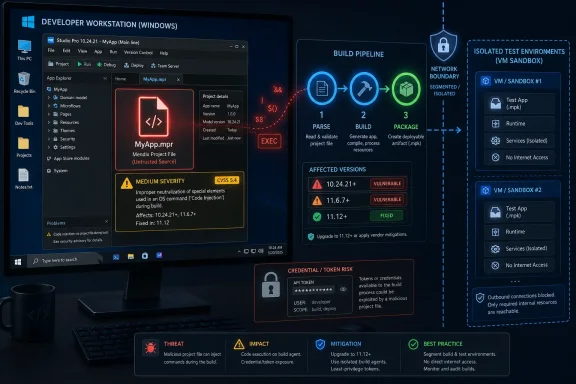 Siemens’ Low-Code Problem Starts on the Developer’s Desktop
The flaw affects Siemens Mendix Studio Pro, the Windows-based integrated development environment used to build Mendix low-code applications. According to Siemens ProductCERT, affected Studio Pro versions fail to properly validate or sanitize project files processed during the build pipeline. If an attacker convinces a user to open and run a specially crafted malicious project locally, arbitrary code can run in the context of that user.That sentence does not sound as dramatic as “remote code execution on an internet-facing server,” and the CVSS 3.1 score of 5.4 reflects that. The vector requires high attack complexity, high privileges, and user interaction. But the score also obscures the real-world workflow: developers, consultants, integrators, and administrators open project files as part of their normal jobs.
Mendix occupies a peculiar place in enterprise IT. It is sold as an accelerator, a way for organizations to build applications without treating every workflow as a bespoke software engineering project. That convenience creates a broader population of people who may handle application artifacts, sample projects, templates, or inherited codebases without approaching them with the suspicion a security engineer would apply to an unknown executable.
The vulnerability is therefore not merely about a parser. It is about trust moving one layer up the stack. Instead of tricking someone into running a suspicious binary, an attacker can package the trigger as the thing a Mendix user is already expected to open: a project.
The Build Pipeline Is the Attack Surface Nobody Wants to Call an Endpoint
Siemens describes the vulnerability as occurring when Studio Pro reads a specially crafted malicious project during the build pipeline. That distinction matters. This is not a flaw in the deployed Mendix runtime, at least as described in the advisory; it is a flaw in the toolchain that produces and packages applications.Modern security programs have spent years hardening servers, identity systems, and endpoints. Developer tooling, by contrast, has often been treated as trusted infrastructure by default. Build systems run scripts, resolve dependencies, transform files, generate code, invoke compilers, and produce artifacts that eventually become production software. If a malicious project can seize execution during that process, the attacker has reached a privileged moment in the software lifecycle.
In Windows environments, that may mean code running as the signed-in developer, consultant, or build operator. If that user has access to source repositories, credentials, tokens, internal documentation, deployment pipelines, or cloud resources, the damage does not need administrator privileges to matter. A stolen token from a build workstation can be more useful than local admin rights on a lightly used laptop.
This is why the “user interaction required” label is only partly reassuring. In a phishing email, user interaction is a hurdle. In software collaboration, it is the business process. A project sent by a partner, downloaded from a vendor portal, recovered from an archive, or shared in a proof-of-concept engagement may pass through the hands of exactly the people who have access worth stealing.
The Version Matrix Tells a Story of Long-Lived Enterprise Tooling
The affected range is broad. Siemens lists Mendix Studio Pro 10.11 through 10.23 as affected in all versions, Mendix Studio Pro 10.24 before 10.24.21 as affected, Mendix Studio Pro 11.0 through 11.5 as affected in all versions, Mendix Studio Pro 11.6 before 11.6.7 as affected, and Mendix Studio Pro 11.7 through 11.11 as affected in all versions. Mendix’s own security advisory page identifies CVE-2026-48192 as an arbitrary code execution vulnerability in Studio Pro before 11.12.That is not a single bad release. It is a cross-version flaw spanning major and minor lines likely to be found across organizations with different upgrade cadences. The split remediation also says something about enterprise reality: Siemens points users to 10.24.21 or later for the 10.24 line, 11.6.7 or later for the 11.6 line, and newer 11.x releases for those able to move forward.
The advisory also says no fix is planned for some affected versions. That phrase is easy to overlook, but it is operationally important. It means some organizations cannot simply “patch the version they have” and call the incident closed. They must either move to a supported fixed branch, change how they handle untrusted projects, or accept the risk.
For WindowsForum.com readers, this should feel familiar. Windows shops have lived through the same friction with long-lived OS builds, Office channels, Visual Studio versions, .NET runtimes, and industrial tooling that lags mainstream patch cycles. Security advisories often speak in clean version numbers; production environments speak in compatibility exceptions, locked-down images, vendor dependencies, and app owners who insist that the “old version still works.”
A Medium CVSS Score Can Still Be a High-Value Foothold
CVE-2026-48192 is rated medium severity, with a CVSS 3.1 base score of 5.4. The vector string published in the advisory indicates network attack vector, high attack complexity, high privileges required, user interaction required, changed scope, high integrity impact, and no confidentiality or availability impact. On paper, that is not the kind of vulnerability that triggers emergency war rooms.But CVSS is a description of technical exploit characteristics, not a business-impact model. A medium-severity flaw in a widely used development environment can deserve faster action than a higher-scored bug in a dead-end system. The question is not only “how easy is exploitation?” but “whose machine is exposed, and what can that person reach?”
A Mendix developer or platform engineer may have access to application repositories, domain models, database connection settings, deployment credentials, cloud environments, and business logic that maps directly onto sensitive processes. In industrial and energy settings, even a low-code app may sit near workflows that support operations, maintenance, reporting, or compliance. Siemens and CISA list the relevant critical infrastructure sectors as Critical Manufacturing and Energy, with worldwide deployment.
That does not mean this advisory describes an immediate path to plant-floor compromise. It does mean the affected software lives in ecosystems where application tooling and operational processes overlap. Attackers do not need every vulnerability to be catastrophic. They need one credible way into a trusted person’s workflow.
The Malicious Project File Is the New Malicious Macro
The security industry has spent decades teaching users not to enable Office macros from untrusted documents. The lesson did not eliminate macro abuse, but it did make one thing clear: productivity file formats are executable attack surfaces when they sit inside feature-rich applications. Mendix project files now belong in that same mental category.A project is not just data. It is a package of instructions, metadata, configuration, dependencies, generated artifacts, and build-time behavior. When a platform processes it, it may perform actions that look a lot like code execution even before the application is deployed. That makes “open this project and build it” a more dangerous instruction than it appears.
Low-code environments complicate the old distinction between developer and user. A citizen developer may not think of themselves as handling hostile code. A consultant receiving a project handoff may be under deadline pressure. A systems integrator may need to reproduce a customer bug by opening exactly the project that customer provides. These are not exotic scenarios; they are ordinary support and delivery workflows.
That is where the vulnerability becomes operationally interesting. The most plausible exploitation path is not a random internet scan. It is a targeted social-engineering chain against someone who already works with Mendix artifacts. The advisory’s “attacker who tricks a user” language should be read less like consumer phishing and more like a software supply-chain lure.
CISA’s Republication Is Visibility, Not a Federal Panic Button
CISA’s page is a republication of Siemens ProductCERT’s advisory under the Industrial Control Systems advisory program. CISA explicitly notes that this is a verbatim CSAF conversion of Siemens ProductCERT SSA-779310 and is provided “as-is” for visibility. That matters because it defines the role CISA is playing here: amplification and distribution, not independent editorial rewriting of the technical findings.The advisory does not say the vulnerability is being exploited in the wild. It does not place the issue in CISA’s Known Exploited Vulnerabilities catalog. It does not claim remote compromise of deployed Mendix applications. Administrators should avoid inflating the advisory into something it is not.
At the same time, CISA’s standard defensive recommendations are not boilerplate to ignore simply because this particular flaw targets a development tool. CISA again advises organizations to minimize network exposure for control system devices, place control system networks behind firewalls, isolate them from business networks, and use updated VPNs when remote access is required. Those recommendations speak to a broader truth: when development workstations bridge corporate IT, vendor ecosystems, and operational environments, segmentation is part of the mitigation story.
The most important practical reading is this: patch the tool, but do not pretend the tool exists in isolation. If a Mendix workstation can reach sensitive repositories, shared drives, deployment portals, or operational systems, then a project-file exploit has more room to matter.
Windows Shops Should Inventory the People, Not Just the Installers
The obvious first step is to identify installed versions of Mendix Studio Pro. But in many organizations, Studio Pro may not be centrally managed like Microsoft 365 Apps or a standard endpoint agent. It may sit on developer machines, consultant laptops, virtual desktops, lab systems, training images, and build hosts. It may also exist in multiple versions because teams keep older Studio Pro builds to maintain older Mendix apps.That version sprawl is not accidental. Application platforms often require alignment between project versions, runtime versions, dependencies, and supported upgrade paths. A team may keep Studio Pro 10.x for a long-lived production app while another team evaluates 11.x. A security fix that says “move forward” can collide with application lifecycle management.
This is where endpoint inventory has to meet application ownership. The security team can find binaries and version numbers, but it may not know which projects require which Studio Pro line. The Mendix platform owner may know the applications, but not every machine where Studio Pro is installed. The help desk may see the software only when it breaks. The right response is a small cross-functional sweep, not a ticket dumped into a generic patch queue.
Organizations should also distinguish between casual installed copies and systems that process external or semi-trusted projects. A lab VM used only for internal demos carries different risk from a consultant workstation that opens customer-supplied projects weekly. A build machine that handles imported project packages deserves special attention, especially if it stores credentials or has persistent access to deployment targets.
The Fix Is Straightforward Only If Your Mendix Estate Is Modern
Siemens recommends updating affected products to the latest versions, with specific fixed releases called out for some branches. Mendix Studio Pro 10.24 users should update to 10.24.21 or later. Mendix Studio Pro 11.6 users should update to 11.6.7 or later. Users on other affected 11.x versions should move beyond the affected range, with Mendix Studio Pro 11.12 identified in Mendix documentation as the point after which the vulnerability no longer applies.The snag is that not every affected line receives a fix. The advisory’s “no fix planned” status for some products is the quiet alarm bell. If you are sitting on 10.11, 10.15, 10.21, 11.3, or 11.10, the mitigation path may require more than a patch installer. It may require testing the application against a newer Studio Pro line, validating build outputs, coordinating with app owners, and scheduling upgrades that carry regression risk.
That is a familiar enterprise tradeoff, but it should not become an excuse for indefinite delay. A developer-tool RCE class vulnerability does not need to be exploited at scale to be valuable. It is tailor-made for targeted attacks against organizations that share project artifacts across trust boundaries.
Where immediate upgrade is not possible, Siemens recommends countermeasures. The advisory text emphasizes operating devices in protected IT environments, following Siemens industrial security guidance, and applying product-manual recommendations. Translated into Windows admin practice, that means reducing who can open unknown Mendix projects, isolating test environments, tightening endpoint controls around Studio Pro systems, and avoiding build operations on workstations that also hold broad operational access.
Trust Boundaries Matter More Than Trust Badges
The natural temptation after a file-parsing advisory is to ask whether a project came from a “trusted source.” That question is not useless, but it is insufficient. Trusted partners get compromised. Customer environments get infected. Internal repositories accumulate forgotten proof-of-concept artifacts. A project that originated from a legitimate business relationship can still be the wrong thing to open on a privileged workstation.A better question is whether the workflow assumes project files are inert. If support engineers download customer projects onto their primary laptops, if integrators exchange packages over email, if build operators test unknown artifacts on machines with cached credentials, then the organization has already made the file format part of its trust boundary. CVE-2026-48192 simply makes that boundary visible.
Security teams should also examine where Mendix projects enter the organization. Are they accepted from external vendors? Are they stored in shared portals? Are they unpacked on virtual desktops? Are sample apps pulled from training sites? Are old projects archived without provenance? The goal is not to paralyze collaboration, but to make sure untrusted or newly received projects are opened first in environments designed to absorb risk.
Virtual machines, disposable sandboxes, and least-privilege test accounts are not glamorous mitigations, but they are exactly the kind of controls that make a user-interaction exploit less damaging. If the first build happens in a throwaway environment with no standing access to production systems, the attacker’s prize shrinks dramatically.
The Advisory Also Exposes a Documentation Gap
There is a subtle communication problem in advisories like this one. The affected products list is long and precise, but the operational advice is broad. Siemens tells users which versions are affected and which fixed versions exist, while CISA appends its standard ICS defensive guidance. What many administrators still need is a workflow-specific playbook: how to safely handle Mendix project files until every system is upgraded.That gap is not unique to Siemens. Vendor advisories often stop at “update” and “restrict access” because anything more specific depends on customer architecture. But low-code platforms blur responsibility between application teams, business units, and central IT. The people most likely to open a malicious project may not be subscribed to ProductCERT advisories or CISA ICS feeds.
This is why internal communication matters. A concise notice to Mendix users can do more than a buried vulnerability record. It should explain that project files can trigger code execution during build, list the fixed versions, warn against opening unsolicited or unexpected projects, and direct users to a safe intake process for external artifacts. The warning should be practical, not theatrical.
The best security messaging here sounds less like “a critical cyber threat has emerged” and more like “treat Mendix projects like executable code until further notice.” That is the sentence a busy developer, consultant, or app owner will remember.
The Real Risk Is the Credential Trail Behind the Builder
Attackers love build environments because build environments are full of secrets. Even when a local code execution bug does not directly expose confidentiality under CVSS scoring, the machine it compromises may contain credentials, configuration files, API keys, browser sessions, personal access tokens, SSH keys, or access to private package sources. The advisory’s formal impact categories do not fully describe that surrounding ecosystem.On Windows, the attacker may also inherit access to integrated authentication flows. A compromised user session can be enough to reach internal portals, file shares, repository systems, or collaboration tools. If Studio Pro is running on a machine used for broader administrative work, the blast radius grows.
This is where least privilege becomes more than compliance theater. Mendix users should not be local administrators unless they truly need to be. Build and test systems should not have permanent production credentials. Tokens should be scoped, rotated, and stored in systems designed for secrets, not scattered through local folders and scripts.
None of that is unique to Mendix, which is precisely the point. CVE-2026-48192 is another reminder that developer workstations are part of the attack surface. Windows endpoint security cannot stop at antivirus and patch compliance when the user’s normal job is to run complex, semi-trusted build processes.
The Mendix Fix Should Trigger a Bigger Toolchain Audit
A rational response to this advisory is not panic; it is inventory. If an organization can quickly answer which Studio Pro versions are installed, who uses them, which projects they touch, and whether those systems open external artifacts, then CVE-2026-48192 becomes a manageable patching exercise. If those answers require a week of Slack archaeology and spreadsheet reconstruction, the vulnerability has exposed a governance problem.Low-code platforms are often marketed as a way to democratize application development. That democratization has security consequences. More people can build, more teams can experiment, and more artifacts can move through the enterprise without traditional software engineering checkpoints. The upside is speed; the downside is an expanded toolchain that may not be tracked with the rigor applied to server software.
This is particularly relevant for industrial and energy organizations, the sectors named in the advisory. They often run mixed estates where modern development practices intersect with conservative operational constraints. A Mendix app may be “just” a business workflow application, but the people maintaining it may sit close to data, processes, or systems that are operationally sensitive.
The right audit is therefore not limited to Mendix. It should include other low-code and developer tools that parse projects, templates, archives, plugins, extensions, and build scripts. Any tool that turns someone else’s file into local execution deserves scrutiny. The industry learned this lesson with package managers, CI/CD systems, IDE extensions, document macros, and archive extractors. Low-code project files now belong in that family.
The Patch Notes Are Only Half the Job
For teams running Mendix Studio Pro 10.24, the immediate target is 10.24.21 or later. For teams running 11.6, it is 11.6.7 or later. For the broader 11.x line before 11.12, the practical destination is a non-affected Studio Pro version. But updating the installer does not automatically clean up risky workflows.Administrators should consider blocking or warning on old Studio Pro versions after the upgrade window closes. They should review software restriction policies, endpoint management rules, and application control baselines to make sure unsupported versions do not quietly remain usable. If multiple versions must coexist, the older ones should be tied to documented exceptions and isolated use cases.
Security teams should also watch for suspicious project-open and build activity around the disclosure window. The advisory became public through Siemens on June 30, 2026, and CISA republished it on July 7, 2026. That does not prove attackers are exploiting it, but it does mean the vulnerability is now public enough to attract experimentation.
The most mature organizations will use this moment to rehearse a broader response pattern. When an IDE, low-code platform, or build tool gets a project-file code execution advisory, who owns the fix? Endpoint management? App platform owners? DevSecOps? Industrial security? The answer should be decided before the next advisory, not improvised during it.
Siemens’ Advisory Is a Small Warning About a Larger Supply-Chain Habit
There is a tendency to think of software supply-chain security as a problem of public packages, open-source dependencies, and poisoned CI/CD pipelines. Those are real risks, but they are not the whole story. A project file shared between humans is also part of the supply chain. So is a template. So is a customer-provided reproduction package. So is an exported app archive.CVE-2026-48192 sits in that quieter category. It does not need a compromised package registry or a breached source-control platform. It needs a project that looks plausible enough for someone to open and build. The exploit path is social, procedural, and technical at the same time.
That hybridity is why simple severity scoring underplays the lesson. A medium vulnerability in a tool used by trusted builders can be a strategic foothold. An attacker who compromises the person who builds the app may not need to compromise the app directly. They can wait for the victim’s access, habits, and credentials to do the work.
For Windows professionals, this should sharpen an already developing instinct: treat development tools as high-value endpoints. The workstation that compiles, packages, signs, deploys, or configures applications deserves the same seriousness as the server that runs them.
The Action Window Is Narrowest for Teams That Share Projects
The practical path is clear enough, even if the estate work is messy. Patch supported versions, migrate unsupported versions, isolate untrusted project handling, and communicate the risk to Mendix users in language they can act on. The organizations most exposed are not necessarily the ones with the most Mendix apps; they are the ones with the loosest project-sharing workflows.- Organizations should identify every installed copy of Mendix Studio Pro and map it to the affected version ranges listed by Siemens.
- Teams on Mendix Studio Pro 10.24 should move to 10.24.21 or later, while teams on 11.6 should move to 11.6.7 or later.
- Users on other affected 10.x and 11.x versions should plan a move to a fixed supported version rather than waiting for fixes that Siemens says are not planned for some lines.
- Mendix project files from customers, partners, archives, or unsolicited sources should be opened first in isolated environments with no standing production access.
- Security teams should treat Studio Pro machines as developer endpoints that may contain valuable credentials, tokens, and repository access.
- Internal advisories should tell Mendix users plainly that a malicious project can execute code during the build process.
References
- Primary source: CISA
Published: 2026-07-07T12:00:00+00:00

Siemens Mendix Studio Pro | CISA
www.cisa.gov
- Related coverage: docs.mendix.com
Mendix Studio Pro Version 10 Release Notes | Mendix Documentation
The release notes for version 10 of Mendix Studio Pro. docs.mendix.com
- Related coverage: support.mendix.com
Mendix Service Console Error: Java 21 is required to run this app – Mendix
IssueWhen attempting to start a service in Mendix Service Console, the following error message appears stating that Java 21 is...support.mendix.com - Related coverage: support.industry.siemens.com
Loading…
support.industry.siemens.com - Related coverage: dhruvts.com