

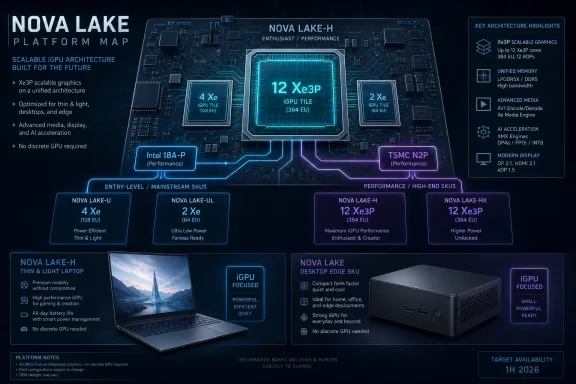
Intel’s next-generation Nova Lake client lineup is reportedly being split across more capable Xe3P integrated graphics configurations and different manufacturing nodes, with Wccftech reporting on July 7, 2026, that multiple mobile chips and one desktop-oriented SKU will carry 12 Xe3P GPU cores while some entry-level processors use Intel’s 18A-P process. The leak, attributed to hardware tipster Jaykihn and amplified by Wccftech’s Hassan Mujtaba, is not an Intel product announcement. But it sketches a revealing map of where Intel thinks its next client fight will be fought: not only in CPU core counts, but in graphics tiles, process allocation, and the uncomfortable economics of building a modern PC chip empire across both Intel and TSMC fabs.
The easy read on the Wccftech report is that Intel is preparing beefier integrated graphics for some Nova Lake chips. That is true, and for buyers it may be the most immediately understandable part of the leak. A 12-core Xe3P iGPU in several Nova Lake-H mobile parts would represent a clear push beyond the old assumption that Intel integrated graphics exists mostly to light up displays, accelerate media, and survive a few browser-based games.
The more interesting read is that Intel appears to be segmenting Nova Lake with unusual precision. According to Wccftech, Nova Lake-H parts with 12 Xe graphics blocks move to Xe3P, while 4-Xe and 2-Xe variants remain on Xe3. The rumored desktop chip with 12 Xe3P cores is described as a more specialized design, reportedly an 8-core processor built around E-cores and aimed at edge-market use rather than the mainstream gaming desktop.
That distinction matters because it suggests Intel is not merely “adding a bigger iGPU” across the board. It is treating graphics capability as a product-class marker. In mobile, the big iGPU becomes a way to compete for premium thin-and-light designs, handheld-adjacent systems, and AI/media workloads where discrete graphics are either too costly or too power-hungry. On desktop, the same graphics block becomes a niche play: useful for edge systems, small-form-factor PCs, industrial deployments, and perhaps the kind of compact enthusiast box that wants more graphics than normal socketed Intel desktop chips have historically offered.
Nova Lake is also arriving after Intel has spent several generations trying to make its tile strategy look less like an engineering recovery plan and more like a competitive advantage. Meteor Lake introduced the modern tiled client architecture to Intel’s mainstream branding. Lunar Lake sharpened the mobile-first pitch with on-package memory and a much stronger GPU story. Panther Lake is Intel’s first large client showcase for 18A. Nova Lake, if these leaks hold, becomes the family where Intel starts playing a more granular game: which tiles deserve internal process capacity, which ones go to TSMC, and which SKUs get graphics good enough to change buying behavior.
That is a very different kind of product strategy from the old desktop-era Intel rhythm of “more CPU, same basic iGPU.” It is closer to how Apple, AMD, Qualcomm, and Nvidia talk about client silicon: the chip is the platform, and the platform is judged by how well its compute, graphics, media, memory, and AI blocks cooperate under a fixed power budget.
Wccftech frames Xe3P as the performance-enhanced successor architecture, internally associated with Celestial. That naming is important for enthusiasts, but the commercial question is simpler: can Intel make integrated graphics strong enough that an OEM can skip a low-end discrete GPU without making the machine feel compromised?
For a large swath of the Windows laptop market, the answer is increasingly yes. The low-end discrete GPU has been squeezed from both sides. Integrated graphics are much better than they used to be, while truly useful discrete GPUs add cost, board complexity, heat, battery drain, and driver support overhead. In a 14-inch productivity notebook, the case for a small separate GPU becomes harder to make if the iGPU can handle esports titles, light creator workloads, modern media blocks, external displays, and local AI acceleration adjacent to the NPU.
That is why 12 Xe3P cores in Nova Lake-H would be strategically useful even before benchmarks exist. It gives Intel a clean story for premium mobile designs: the big graphics configuration is not just a checkbox, it is the SKU you choose when you want a laptop that feels modern without a dGPU. That competes directly against AMD’s Ryzen APUs, especially the parts whose integrated Radeon graphics have long been a reason enthusiasts recommended them over Intel machines.
The desktop angle is stranger, but not pointless. Intel socketed desktop chips have traditionally carried modest integrated graphics, useful for troubleshooting, media, Quick Sync, and office work. A 12 Xe3P desktop SKU would challenge that pattern. Even if Wccftech is right that the part is aimed at edge use, any desktop-class chip with a serious iGPU invites comparison with AMD’s APU lineage and with the mini-PC market that has quietly become one of the more interesting places in Windows hardware.
Edge systems do not need gaming credentials to benefit from a larger iGPU. They may need video analytics, media transcode, display walls, inference-adjacent workloads, or compact deployments where a discrete GPU is undesirable. But enthusiasts will still ask the obvious question: if Intel can put a real iGPU in a desktop package once, why not more often?
AMD has benefited from this shift because its APUs carried a clear identity. They were not always the fastest CPUs, and they were not replacements for serious gaming GPUs, but buyers understood the pitch. You got competent CPU performance and unusually capable integrated Radeon graphics in one package. That clarity helped AMD in mini-PCs, budget builds, and portable gaming experiments.
Intel’s rumored Nova Lake desktop Xe3P part looks like a response, but perhaps a cautious one. If it is truly a single desktop design aimed at edge systems, Intel is not yet turning its mainstream desktop lineup into an APU-first family. It is testing how much demand exists for a socketed or desktop-class Intel chip where the GPU is not an afterthought.
That caution is understandable. A bigger iGPU is not free. It consumes die area, power budget, validation time, driver exposure, and platform design attention. On enthusiast desktops, many buyers would rather Intel spend that budget on CPU clocks, cache, or lower pricing, because they plan to install a GeForce or Radeon card anyway.
But the old assumption that every performance desktop has a discrete GPU is less universal than it used to be. GPU prices have repeatedly distorted the market. Small-form-factor systems are more popular. Home servers and media machines increasingly benefit from strong encode/decode blocks. Businesses want fewer components to fail. A desktop Nova Lake chip with a meaningful iGPU could give Intel an option it has not had in years: a PC that feels graphically competent out of the box without becoming a full gaming tower.
The danger is that Intel treats this as a curiosity rather than a wedge. If the desktop 12 Xe3P part is hard to buy, OEM-only, or buried in edge-market channels, enthusiasts will see another glimpse of a better Intel iGPU strategy that never quite reaches them.
For decades, Intel’s product identity and process identity were inseparable. Intel CPUs were Intel designs made in Intel fabs, and that vertical integration was the company’s superpower. The modern Intel is more complicated. Its client chips can combine internal and external manufacturing, and its most advanced products may depend on TSMC for some high-end tiles while Intel proves its own nodes on other parts of the stack.
That is not necessarily a weakness. In fact, using TSMC where it makes sense and Intel Foundry where it makes sense may be the only rational strategy during a recovery. But it creates a messaging problem. Intel wants investors, customers, and governments to believe its fabs are returning to leadership. At the same time, its product teams need to ship competitive silicon on time. Those priorities overlap, but they are not identical.
Putting entry-level Nova Lake parts on 18A-P would give Intel internal volume and a real product vehicle for the enhanced node. It would also limit risk. Entry-level client chips are important, but they do not carry the same prestige burden as halo mobile and desktop parts. If yields, clocks, or supply are uneven, Intel has more room to manage the fallout than it would on a flagship Core Ultra launch.
The reported TSMC N2P use for the rest of the lineup tells us Intel is still willing to buy leading-edge capacity externally when the product demands it. That is pragmatic. It is also a tacit admission that process leadership is no longer a slogan Intel can simply attach to every major client die.
That is the kind of technology story Intel needs. It is also the kind of story that only becomes real when chips ship in volume, OEMs can get enough of them, and users do not experience the platform as a science project. Panther Lake is the first big client proof point for 18A. Nova Lake using 18A-P, even at the low end, would be the next phase.
The reported entry-level placement is therefore double-edged. On one hand, it gives Intel a controlled proving ground. On the other, it suggests the most desirable Nova Lake configurations may still be tied to TSMC N2P, not Intel’s own most politically and strategically important fabs.
That may frustrate Intel loyalists, but it should not surprise IT buyers. Enterprises do not buy process-roadmap romance. They buy availability, stability, lifecycle support, manageable thermals, and predictable platform behavior. If TSMC-built Nova Lake tiles are the safest path for premium products while Intel ramps 18A-P through lower-cost silicon, that may be the correct operating decision.
The larger question is whether Intel can turn that bridge into a destination. A hybrid sourcing strategy is defensible during a transition. It becomes awkward if, generation after generation, the flagship client silicon still needs someone else’s leading node while Intel’s fabs are reserved for narrower slices of the portfolio.
AMD’s APU reputation gives it a durable advantage in buyer perception. Even users who do not know the details of RDNA compute units often know that “the AMD one has better integrated graphics” has been a reasonable rule of thumb in many laptop and mini-PC comparisons. Intel has been working hard to break that reflex.
Lunar Lake helped. Panther Lake is supposed to help more. Nova Lake with 12 Xe3P configurations would push the argument further, especially if Intel can combine GPU performance with strong media, battery life, and driver maturity. In notebooks, that package could matter more than another small CPU uplift.
The challenge is that AMD is not standing still. By the time Nova Lake becomes a shipping product family, AMD’s Zen 6-era APUs and next-generation graphics blocks will be part of the comparison set. Qualcomm will also continue pressing Windows on Arm into premium mobile designs, even if compatibility and enterprise inertia keep x86 in a strong position. Nvidia, meanwhile, remains the gravity well for anything that smells like serious GPU compute.
That last point is especially relevant because Wccftech notes Intel’s broader GPU-heavy ambitions, including larger “Halo” designs and custom silicon work involving Nvidia RTX tiles. The industry’s direction is clear: the CPU is still important, but the most valuable client platforms are increasingly judged by the accelerators around it. Graphics, NPUs, media engines, memory architecture, and software stacks all affect the user experience.
For WindowsForum readers, this is the piece to watch. A faster iGPU is nice. A faster iGPU with reliable drivers, good game compatibility, mature creative-app acceleration, strong video blocks, and no battery-life penalty is a platform shift. Intel has often had the hardware ambition before the software polish. The Arc era showed improvement, but also reminded everyone that GPUs are ecosystems, not just silicon blocks.
For IT departments, that could make procurement cleaner. A fleet laptop with strong integrated graphics can serve more roles without fragmenting into CPU-only and dGPU-equipped variants. It can support more external displays, better conferencing, smoother media work, and occasional GPU-accelerated tasks without saddling every user with a hotter and more expensive machine.
The risk is segmentation confusion. Intel’s branding has already become dense, and if Nova Lake mobile includes Xe3 and Xe3P variants across similar Core Ultra names, buyers will need to read spec sheets carefully. A “Nova Lake-H” laptop may not tell you enough. The difference between 2 Xe, 4 Xe, and 12 Xe3P configurations could be the difference between a basic business notebook and a genuinely capable graphics machine.
OEM behavior will matter as much as Intel’s silicon. Some vendors will pair better iGPUs with better memory configurations and cooling, allowing the GPU to stretch. Others will bury promising silicon inside thin designs with constrained power limits or single-channel-like memory compromises, then market the architecture name as if it guarantees performance. Windows laptop history is full of parts that looked much better in Intel’s launch deck than in the cheapest shipping chassis.
That is why benchmarks will be essential. Not synthetic victory laps, but sustained performance under real laptop power limits. The question is not whether 12 Xe3P can beat a smaller iGPU in isolation. It is whether a shipping Nova Lake-H laptop can maintain its advantage after ten minutes of gaming, exporting, transcoding, or driving multiple displays while unplugged.
That may sound like inside baseball, but it has practical consequences. If a laptop buyer hears “Nova Lake” and assumes all versions include the same graphics generation, they may be disappointed. If a desktop buyer hears about a 12 Xe3P Nova Lake part and assumes mainstream Core Ultra desktop chips will all carry strong integrated graphics, they may be equally disappointed.
Intel can solve some of this with clear product naming, but only if it chooses clarity over marketing fog. The company should make the GPU configuration visible in consumer-facing materials, not buried in Ark tables and OEM PDFs. AMD has the same problem with some of its mobile naming, and Qualcomm’s Snapdragon X segmentation is not exactly self-explanatory either. But Intel has less room for ambiguity because it is trying to rebuild trust across several fronts at once.
The process-node side is even harder to communicate. Most consumers do not care whether a tile is made on Intel 18A-P or TSMC N2P. Many IT buyers do not care either, unless it affects supply, performance, power, or support. Investors and enthusiasts care a lot, which means Intel’s public story has to satisfy a technically literate audience without overpromising what process sourcing means for real products.
If the flagship Nova Lake parts are TSMC-heavy while entry-level parts use Intel 18A-P, Intel will need to be honest about why. The right answer is probably boring and operational: product requirements, capacity planning, yield curves, cost targets, and packaging strategy. The wrong answer would be pretending every sourcing decision is proof of unconditional Intel process leadership.
A strong integrated GPU changes the floor. It makes casual gaming less miserable. It makes creative apps more responsive. It improves media workflows. It helps with multi-monitor setups and high-resolution displays. It can also support local AI workloads where GPU acceleration complements the NPU or fills gaps in software support.
The catch is that integrated graphics depend heavily on memory bandwidth and power delivery. A 12-core iGPU starved by slow memory or constrained by a poor thermal design will not perform like the architecture suggests. This is where Windows enthusiasts should be skeptical of spec-sheet marketing. The GPU block is only one part of the platform.
Driver quality is the other long pole. Intel has made real progress with Arc drivers, and its integrated graphics driver stack has decades of Windows history behind it. But modern GPU expectations are unforgiving. Game compatibility, day-one patches, creator-app acceleration, video feature support, HDR behavior, sleep/wake stability, and external display reliability all matter. A good iGPU that behaves unpredictably is not a good product for mainstream users or IT fleets.
That is why Nova Lake’s iGPU story should be judged in shipping systems, not leaks. The rumor tells us where Intel may be aiming. The laptops will tell us whether Intel got there.
That uncertainty does not make the report irrelevant. Hardware roadmaps leak because suppliers, OEMs, firmware developers, board partners, and validation teams need to plan long before launch. By the time a client CPU family is near public announcement, many of its broad architectural decisions have been circulating privately for months or years.
Still, a responsible read requires restraint. A 12 Xe3P configuration on a planning roadmap can become a limited OEM part. A desktop edge SKU can change package, channel, or timing. A process allocation can shift if yields, costs, or capacity change. Even naming can mutate before launch.
The most durable takeaway is not the exact SKU table. It is the direction of travel. Intel appears to be preparing a Nova Lake family where graphics segmentation is more deliberate, where mobile gets the most obvious benefit, where at least one desktop-class product challenges Intel’s weak-iGPU tradition, and where internal Intel manufacturing is used selectively rather than universally.
That is enough to matter. It shows Intel trying to compete in the PC market as it exists now, not the one it dominated fifteen years ago.
 Nova Lake Is Starting to Look Like a Platform Strategy, Not Just Another CPU Family
The easy read on the Wccftech report is that Intel is preparing beefier integrated graphics for some Nova Lake chips. That is true, and for buyers it may be the most immediately understandable part of the leak. A 12-core Xe3P iGPU in several Nova Lake-H mobile parts would represent a clear push beyond the old assumption that Intel integrated graphics exists mostly to light up displays, accelerate media, and survive a few browser-based games.The more interesting read is that Intel appears to be segmenting Nova Lake with unusual precision. According to Wccftech, Nova Lake-H parts with 12 Xe graphics blocks move to Xe3P, while 4-Xe and 2-Xe variants remain on Xe3. The rumored desktop chip with 12 Xe3P cores is described as a more specialized design, reportedly an 8-core processor built around E-cores and aimed at edge-market use rather than the mainstream gaming desktop.
That distinction matters because it suggests Intel is not merely “adding a bigger iGPU” across the board. It is treating graphics capability as a product-class marker. In mobile, the big iGPU becomes a way to compete for premium thin-and-light designs, handheld-adjacent systems, and AI/media workloads where discrete graphics are either too costly or too power-hungry. On desktop, the same graphics block becomes a niche play: useful for edge systems, small-form-factor PCs, industrial deployments, and perhaps the kind of compact enthusiast box that wants more graphics than normal socketed Intel desktop chips have historically offered.
Nova Lake is also arriving after Intel has spent several generations trying to make its tile strategy look less like an engineering recovery plan and more like a competitive advantage. Meteor Lake introduced the modern tiled client architecture to Intel’s mainstream branding. Lunar Lake sharpened the mobile-first pitch with on-package memory and a much stronger GPU story. Panther Lake is Intel’s first large client showcase for 18A. Nova Lake, if these leaks hold, becomes the family where Intel starts playing a more granular game: which tiles deserve internal process capacity, which ones go to TSMC, and which SKUs get graphics good enough to change buying behavior.
That is a very different kind of product strategy from the old desktop-era Intel rhythm of “more CPU, same basic iGPU.” It is closer to how Apple, AMD, Qualcomm, and Nvidia talk about client silicon: the chip is the platform, and the platform is judged by how well its compute, graphics, media, memory, and AI blocks cooperate under a fixed power budget.
Xe3P Is Intel’s Attempt to Make Integrated Graphics a Buying Criterion
The leaked 12 Xe3P configuration matters because Intel has spent years trying to get users to believe in its GPU roadmap. The company’s discrete Arc effort has been uneven, but its integrated graphics progress has been much easier to defend. Lunar Lake’s Xe2 GPU was a major step forward for Intel laptops, and Panther Lake’s Xe3 graphics has been positioned as another generational jump.Wccftech frames Xe3P as the performance-enhanced successor architecture, internally associated with Celestial. That naming is important for enthusiasts, but the commercial question is simpler: can Intel make integrated graphics strong enough that an OEM can skip a low-end discrete GPU without making the machine feel compromised?
For a large swath of the Windows laptop market, the answer is increasingly yes. The low-end discrete GPU has been squeezed from both sides. Integrated graphics are much better than they used to be, while truly useful discrete GPUs add cost, board complexity, heat, battery drain, and driver support overhead. In a 14-inch productivity notebook, the case for a small separate GPU becomes harder to make if the iGPU can handle esports titles, light creator workloads, modern media blocks, external displays, and local AI acceleration adjacent to the NPU.
That is why 12 Xe3P cores in Nova Lake-H would be strategically useful even before benchmarks exist. It gives Intel a clean story for premium mobile designs: the big graphics configuration is not just a checkbox, it is the SKU you choose when you want a laptop that feels modern without a dGPU. That competes directly against AMD’s Ryzen APUs, especially the parts whose integrated Radeon graphics have long been a reason enthusiasts recommended them over Intel machines.
The desktop angle is stranger, but not pointless. Intel socketed desktop chips have traditionally carried modest integrated graphics, useful for troubleshooting, media, Quick Sync, and office work. A 12 Xe3P desktop SKU would challenge that pattern. Even if Wccftech is right that the part is aimed at edge use, any desktop-class chip with a serious iGPU invites comparison with AMD’s APU lineage and with the mini-PC market that has quietly become one of the more interesting places in Windows hardware.
Edge systems do not need gaming credentials to benefit from a larger iGPU. They may need video analytics, media transcode, display walls, inference-adjacent workloads, or compact deployments where a discrete GPU is undesirable. But enthusiasts will still ask the obvious question: if Intel can put a real iGPU in a desktop package once, why not more often?
The Desktop 12 Xe3P Leak Is Small, but It Points at a Bigger Weakness
Intel has never lacked for desktop CPU strength, but it has often lacked imagination in desktop integrated graphics. That made sense when the desktop market was split between office boxes that did not care and gaming rigs that used discrete GPUs. It makes less sense in a world of compact PCs, home labs, low-power edge appliances, creator boxes, and living-room Windows machines.AMD has benefited from this shift because its APUs carried a clear identity. They were not always the fastest CPUs, and they were not replacements for serious gaming GPUs, but buyers understood the pitch. You got competent CPU performance and unusually capable integrated Radeon graphics in one package. That clarity helped AMD in mini-PCs, budget builds, and portable gaming experiments.
Intel’s rumored Nova Lake desktop Xe3P part looks like a response, but perhaps a cautious one. If it is truly a single desktop design aimed at edge systems, Intel is not yet turning its mainstream desktop lineup into an APU-first family. It is testing how much demand exists for a socketed or desktop-class Intel chip where the GPU is not an afterthought.
That caution is understandable. A bigger iGPU is not free. It consumes die area, power budget, validation time, driver exposure, and platform design attention. On enthusiast desktops, many buyers would rather Intel spend that budget on CPU clocks, cache, or lower pricing, because they plan to install a GeForce or Radeon card anyway.
But the old assumption that every performance desktop has a discrete GPU is less universal than it used to be. GPU prices have repeatedly distorted the market. Small-form-factor systems are more popular. Home servers and media machines increasingly benefit from strong encode/decode blocks. Businesses want fewer components to fail. A desktop Nova Lake chip with a meaningful iGPU could give Intel an option it has not had in years: a PC that feels graphically competent out of the box without becoming a full gaming tower.
The danger is that Intel treats this as a curiosity rather than a wedge. If the desktop 12 Xe3P part is hard to buy, OEM-only, or buried in edge-market channels, enthusiasts will see another glimpse of a better Intel iGPU strategy that never quite reaches them.
The Node Split Tells the Real Story About Intel’s Manufacturing Recovery
The second half of the Wccftech report is less flashy than the 12 Xe3P leak, but more important. According to Jaykihn, entry-level Nova Lake chips with a 4+0 configuration are expected to use Intel 18A-P, while the rest of the lineup uses TSMC N2P. If accurate, that is a remarkable snapshot of Intel’s current manufacturing reality.For decades, Intel’s product identity and process identity were inseparable. Intel CPUs were Intel designs made in Intel fabs, and that vertical integration was the company’s superpower. The modern Intel is more complicated. Its client chips can combine internal and external manufacturing, and its most advanced products may depend on TSMC for some high-end tiles while Intel proves its own nodes on other parts of the stack.
That is not necessarily a weakness. In fact, using TSMC where it makes sense and Intel Foundry where it makes sense may be the only rational strategy during a recovery. But it creates a messaging problem. Intel wants investors, customers, and governments to believe its fabs are returning to leadership. At the same time, its product teams need to ship competitive silicon on time. Those priorities overlap, but they are not identical.
Putting entry-level Nova Lake parts on 18A-P would give Intel internal volume and a real product vehicle for the enhanced node. It would also limit risk. Entry-level client chips are important, but they do not carry the same prestige burden as halo mobile and desktop parts. If yields, clocks, or supply are uneven, Intel has more room to manage the fallout than it would on a flagship Core Ultra launch.
The reported TSMC N2P use for the rest of the lineup tells us Intel is still willing to buy leading-edge capacity externally when the product demands it. That is pragmatic. It is also a tacit admission that process leadership is no longer a slogan Intel can simply attach to every major client die.
18A-P Has to Prove Itself in Products, Not Slide Decks
Intel has been talking about 18A and its derivatives as central to the company’s comeback. The company’s public foundry materials describe 18A as a major process generation built around RibbonFET gate-all-around transistors and PowerVia backside power delivery. Industry reporting from Tom’s Hardware and TechSpot has also tracked the arrival of 18A-P risk production, with the enhanced node described as a performance and efficiency refinement of 18A.That is the kind of technology story Intel needs. It is also the kind of story that only becomes real when chips ship in volume, OEMs can get enough of them, and users do not experience the platform as a science project. Panther Lake is the first big client proof point for 18A. Nova Lake using 18A-P, even at the low end, would be the next phase.
The reported entry-level placement is therefore double-edged. On one hand, it gives Intel a controlled proving ground. On the other, it suggests the most desirable Nova Lake configurations may still be tied to TSMC N2P, not Intel’s own most politically and strategically important fabs.
That may frustrate Intel loyalists, but it should not surprise IT buyers. Enterprises do not buy process-roadmap romance. They buy availability, stability, lifecycle support, manageable thermals, and predictable platform behavior. If TSMC-built Nova Lake tiles are the safest path for premium products while Intel ramps 18A-P through lower-cost silicon, that may be the correct operating decision.
The larger question is whether Intel can turn that bridge into a destination. A hybrid sourcing strategy is defensible during a transition. It becomes awkward if, generation after generation, the flagship client silicon still needs someone else’s leading node while Intel’s fabs are reserved for narrower slices of the portfolio.
Intel Is Fighting AMD on APUs and TSMC on Credibility at the Same Time
The Wccftech piece compares Intel’s rumored plans against AMD’s future Olympic Ridge platform and today’s Ryzen integrated graphics momentum. The specific future-product tables should be treated cautiously, because both Intel and AMD roadmaps can change long before launch. But the competitive frame is right: Intel is no longer fighting AMD on CPU cores alone.AMD’s APU reputation gives it a durable advantage in buyer perception. Even users who do not know the details of RDNA compute units often know that “the AMD one has better integrated graphics” has been a reasonable rule of thumb in many laptop and mini-PC comparisons. Intel has been working hard to break that reflex.
Lunar Lake helped. Panther Lake is supposed to help more. Nova Lake with 12 Xe3P configurations would push the argument further, especially if Intel can combine GPU performance with strong media, battery life, and driver maturity. In notebooks, that package could matter more than another small CPU uplift.
The challenge is that AMD is not standing still. By the time Nova Lake becomes a shipping product family, AMD’s Zen 6-era APUs and next-generation graphics blocks will be part of the comparison set. Qualcomm will also continue pressing Windows on Arm into premium mobile designs, even if compatibility and enterprise inertia keep x86 in a strong position. Nvidia, meanwhile, remains the gravity well for anything that smells like serious GPU compute.
That last point is especially relevant because Wccftech notes Intel’s broader GPU-heavy ambitions, including larger “Halo” designs and custom silicon work involving Nvidia RTX tiles. The industry’s direction is clear: the CPU is still important, but the most valuable client platforms are increasingly judged by the accelerators around it. Graphics, NPUs, media engines, memory architecture, and software stacks all affect the user experience.
For WindowsForum readers, this is the piece to watch. A faster iGPU is nice. A faster iGPU with reliable drivers, good game compatibility, mature creative-app acceleration, strong video blocks, and no battery-life penalty is a platform shift. Intel has often had the hardware ambition before the software polish. The Arc era showed improvement, but also reminded everyone that GPUs are ecosystems, not just silicon blocks.
Mobile Buyers Will Feel This Before Desktop Enthusiasts Do
If the leak is accurate, Nova Lake-H is where the 12 Xe3P story will matter first. That makes sense. Mobile is where integrated graphics can change the bill of materials and the physical design of a PC. Remove a low-end dGPU from a laptop, and the OEM may gain board space, thermal headroom, battery capacity, lower cost, or simply fewer support variables.For IT departments, that could make procurement cleaner. A fleet laptop with strong integrated graphics can serve more roles without fragmenting into CPU-only and dGPU-equipped variants. It can support more external displays, better conferencing, smoother media work, and occasional GPU-accelerated tasks without saddling every user with a hotter and more expensive machine.
The risk is segmentation confusion. Intel’s branding has already become dense, and if Nova Lake mobile includes Xe3 and Xe3P variants across similar Core Ultra names, buyers will need to read spec sheets carefully. A “Nova Lake-H” laptop may not tell you enough. The difference between 2 Xe, 4 Xe, and 12 Xe3P configurations could be the difference between a basic business notebook and a genuinely capable graphics machine.
OEM behavior will matter as much as Intel’s silicon. Some vendors will pair better iGPUs with better memory configurations and cooling, allowing the GPU to stretch. Others will bury promising silicon inside thin designs with constrained power limits or single-channel-like memory compromises, then market the architecture name as if it guarantees performance. Windows laptop history is full of parts that looked much better in Intel’s launch deck than in the cheapest shipping chassis.
That is why benchmarks will be essential. Not synthetic victory laps, but sustained performance under real laptop power limits. The question is not whether 12 Xe3P can beat a smaller iGPU in isolation. It is whether a shipping Nova Lake-H laptop can maintain its advantage after ten minutes of gaming, exporting, transcoding, or driving multiple displays while unplugged.
The Leak Also Exposes Intel’s Branding Problem Before It Happens
Intel’s client branding has been through enough reinvention that even enthusiasts sometimes need a decoder ring. Core i became Core Ultra. Generational numbers shifted. Mobile suffixes multiplied. AI PC messaging layered NPU requirements on top of traditional CPU and GPU segmentation. Nova Lake risks adding another axis that buyers must understand: not just what CPU class they are buying, but which GPU architecture and which process story sits underneath it.That may sound like inside baseball, but it has practical consequences. If a laptop buyer hears “Nova Lake” and assumes all versions include the same graphics generation, they may be disappointed. If a desktop buyer hears about a 12 Xe3P Nova Lake part and assumes mainstream Core Ultra desktop chips will all carry strong integrated graphics, they may be equally disappointed.
Intel can solve some of this with clear product naming, but only if it chooses clarity over marketing fog. The company should make the GPU configuration visible in consumer-facing materials, not buried in Ark tables and OEM PDFs. AMD has the same problem with some of its mobile naming, and Qualcomm’s Snapdragon X segmentation is not exactly self-explanatory either. But Intel has less room for ambiguity because it is trying to rebuild trust across several fronts at once.
The process-node side is even harder to communicate. Most consumers do not care whether a tile is made on Intel 18A-P or TSMC N2P. Many IT buyers do not care either, unless it affects supply, performance, power, or support. Investors and enthusiasts care a lot, which means Intel’s public story has to satisfy a technically literate audience without overpromising what process sourcing means for real products.
If the flagship Nova Lake parts are TSMC-heavy while entry-level parts use Intel 18A-P, Intel will need to be honest about why. The right answer is probably boring and operational: product requirements, capacity planning, yield curves, cost targets, and packaging strategy. The wrong answer would be pretending every sourcing decision is proof of unconditional Intel process leadership.
For Windows Users, the Practical Upside Is Less Compromise
Strip away the code names and the semiconductor geopolitics, and the user-facing promise is simple: fewer Windows PCs should need bad graphics. That is a meaningful improvement. For years, many mainstream laptops were competent until a user asked for anything beyond office work, video playback, and light multitasking. Then the limits of the iGPU became obvious.A strong integrated GPU changes the floor. It makes casual gaming less miserable. It makes creative apps more responsive. It improves media workflows. It helps with multi-monitor setups and high-resolution displays. It can also support local AI workloads where GPU acceleration complements the NPU or fills gaps in software support.
The catch is that integrated graphics depend heavily on memory bandwidth and power delivery. A 12-core iGPU starved by slow memory or constrained by a poor thermal design will not perform like the architecture suggests. This is where Windows enthusiasts should be skeptical of spec-sheet marketing. The GPU block is only one part of the platform.
Driver quality is the other long pole. Intel has made real progress with Arc drivers, and its integrated graphics driver stack has decades of Windows history behind it. But modern GPU expectations are unforgiving. Game compatibility, day-one patches, creator-app acceleration, video feature support, HDR behavior, sleep/wake stability, and external display reliability all matter. A good iGPU that behaves unpredictably is not a good product for mainstream users or IT fleets.
That is why Nova Lake’s iGPU story should be judged in shipping systems, not leaks. The rumor tells us where Intel may be aiming. The laptops will tell us whether Intel got there.
The Most Important Nova Lake Details Are the Ones Intel Hasn’t Confirmed
Several parts of this story remain firmly in leak territory. Intel has not formally announced the full Nova Lake SKU stack described by Wccftech. It has not confirmed which Nova Lake variants will use Xe3P, which will use Xe3, or how many desktop products will receive larger integrated graphics. It has not publicly laid out a consumer-facing Nova Lake node split matching Jaykihn’s claims.That uncertainty does not make the report irrelevant. Hardware roadmaps leak because suppliers, OEMs, firmware developers, board partners, and validation teams need to plan long before launch. By the time a client CPU family is near public announcement, many of its broad architectural decisions have been circulating privately for months or years.
Still, a responsible read requires restraint. A 12 Xe3P configuration on a planning roadmap can become a limited OEM part. A desktop edge SKU can change package, channel, or timing. A process allocation can shift if yields, costs, or capacity change. Even naming can mutate before launch.
The most durable takeaway is not the exact SKU table. It is the direction of travel. Intel appears to be preparing a Nova Lake family where graphics segmentation is more deliberate, where mobile gets the most obvious benefit, where at least one desktop-class product challenges Intel’s weak-iGPU tradition, and where internal Intel manufacturing is used selectively rather than universally.
That is enough to matter. It shows Intel trying to compete in the PC market as it exists now, not the one it dominated fifteen years ago.
The Nova Lake Rumor Worth Remembering When the Benchmarks Arrive
The reported Nova Lake details are not a launch, but they give Windows buyers and IT planners a useful checklist for evaluating the eventual products. The danger will be treating “Nova Lake” as one thing when the family may span very different graphics and manufacturing choices.- Multiple Nova Lake-H mobile SKUs are reportedly planned with 12 Xe3P integrated graphics, while smaller 4-Xe and 2-Xe configurations are expected to remain on Xe3.
- A single desktop-oriented Nova Lake design with 12 Xe3P graphics has reportedly been in development, though Wccftech describes it as an edge-focused part rather than a mainstream enthusiast desktop lineup.
- Entry-level Nova Lake chips with a 4+0 configuration are reportedly tied to Intel 18A-P, while higher-end or mainstream parts are said to use TSMC N2P.
- The mobile impact is likely to be larger than the desktop impact because stronger integrated graphics can let OEMs avoid low-end discrete GPUs in thinner systems.
- The final value of these chips will depend on shipping laptop power limits, memory bandwidth, thermals, drivers, and OEM configurations rather than architecture names alone.
- Intel’s biggest challenge will be explaining a segmented Nova Lake lineup clearly enough that buyers understand which chips actually carry the stronger GPU.
References
- Primary source: Wccftech
Published: Tue, 07 Jul 2026 08:55:05 GMT
Intel To Feature 12 Xe3P iGPU Across Multiple Nova Lake Mobile & A Single Desktop CPU, Entry-Level Chips Based on 18A-P Node
Intel Nova Lake CPUs will come with multiple SKUs with 12 Xe3P iGPUs, while entry-level models will utilize the internal 18A-P node.wccftech.com
- Related coverage: tomshardware.com
Intel 18A wafer-to-wafer yield issues fixed, report claims — says production up to 15,000 wafers per month at both sites | Tom's Hardware
Still not out of the woods.www.tomshardware.com - Related coverage: techspot.com
Intel says 14A is on track for 2028 risk production, 10A and 7A now in development | TechSpot
Speaking at J.P. Morgan' 54th annual Global Technology, Media and Communications Conference in Boston, Tan revealed that development of Intel's 14A process node is progressing as planned,...www.techspot.com - Related coverage: hardware-news.de
Intel Nova Lake erhält Xe3P-Grafik und 18A-P-Fertigung
Ein Leak nennt neue Details zu Intel Nova Lake: Mehrere Mobile-CPUs sollen Xe3P-Grafik mit bis zu 12 Xe-Kernen erhalten. Einstiegsmodelle könnten auf Intels 18A-P-Prozess setzen.www.hardware-news.de - Related coverage: indiekings.com
Intel Nova Lake Desktop APU: 12 Xe3P GPU Cores Leaked
A new leak points to an Intel Nova Lake desktop SoC SKU packing 12 Xe3P graphics cores — a direct challenge to AMD's Ryzen G-series APUs.www.indiekings.com
- Related coverage: intel.com
- Related coverage: technetbooks.com
Intel 18A Manufacturing Yields Show Improvement as 14A Node Development Progresses | Technetbook
Intel resolves 18A node yield issues and begins 18A P risk trial production while 14A manufacturing targets 2028 risk trials for foundry customers.www.technetbooks.com
- Related coverage: pcgamer.com
New report claims Intel is 'struggling' to supply laptop CPUs based on its latest 18A node after speaking to Computex sources | PC Gamer
But it might not be because there's a problem with 18A itself.www.pcgamer.com - Related coverage: notebookcheck.net
Intel foundry aims for breakeven by 2027 - Notebookcheck News
Intel’s foundry business continues to post heavy losses, but CFO David Zinsner says the unit should reach break-even in 2027. The plan hinges on bringing the 18A process into volume production this year, moving key client and server CPUs onto it, and winning more external orders for the 14A node. www.notebookcheck.net
- Related coverage: download.intel.com
Intel Launches World’s First Systems Foundry Designed for the AI Era
PDF documentdownload.intel.com
