

Intel’s rumored Nova Lake-S desktop lineup now reportedly includes two 22-core Core Ultra 400 chips with 6 performance cores, 12 efficiency cores, 4 low-power efficiency cores, and Intel’s large bLLC cache, according to July 3 reporting from VideoCardz and HotHardware based on leaker Jaykihn. The leak matters less because it adds another SKU to a spreadsheet and more because it suggests Intel may push its biggest gaming-oriented cache weapon below the halo tier. If true, Nova Lake will not merely be Intel’s next desktop generation; it will be the company’s most direct admission yet that AMD’s 3D V-Cache strategy changed the rules of enthusiast CPUs. The mid-range, not the flagship, may be where that fight gets interesting.
For years, Intel’s desktop pitch leaned on clocks, core counts, platform familiarity, and the long memory of Core i5 and Core i7 dominance. AMD’s X3D chips complicated that story by proving that, in many games, a mountain of cache can be more useful than another handful of cores or another few hundred MHz. The latest Nova Lake-S rumor is notable because Intel’s answer, bLLC, is no longer being whispered about only in connection with expensive top-bin parts.
VideoCardz reports that Intel is preparing two Core Ultra 400S models with the same 6+12+4 layout: one 125W unlocked part and one 65W non-K version. HotHardware frames the 125W model as particularly intriguing because it appears to land in the Core Ultra 5 class, the old spiritual home of Intel’s best gaming value chips. That is the real news: Intel may be treating large last-level cache not as an exotic luxury, but as a feature it needs in the part of the stack gamers actually buy.
The nomenclature is still rumor-land messy. VideoCardz says the chips would belong to the Core Ultra 400S family, also known as Nova Lake-S, while HotHardware emphasizes the historical appeal of the “5” tier. Intel has not formally announced these SKUs, their branding, their pricing, or the cache capacities that will ship in retail silicon. But the direction of travel is clear enough: cache is becoming a mainstream battlefield.
That shift is overdue. AMD’s Ryzen X3D parts have trained buyers to ask a blunt question before they pay for a CPU: does this chip have the cache configuration that makes games faster? Intel can argue about architecture and benchmarks later, but it first has to show up with a product answer that fits the same buying logic.
That is why a rumored Core Ultra 5-class Nova Lake-S chip with bLLC is more interesting than another ultra-expensive monster SKU. If Intel only placed large cache on high-end Core Ultra 9 models, the feature would function as a halo badge. By pushing it down to a 22-core configuration, Intel would be trying to compete where buyers compare FPS-per-dollar, cooler requirements, motherboard budgets, and upgrade timing.
HotHardware makes the historical point explicitly: Intel’s “5” tier has often been where gaming value lives, stretching back to chips like the Core i5-2500K. That comparison is not just nostalgia. It is a reminder that enthusiast reputation is built when a mid-tier part feels like it punches above its class.
A 6 P-core, 12 E-core, 4 LP-E-core chip would not be “mid-range” in the old quad-core sense, of course. It would be a dense hybrid desktop processor with more total cores than yesterday’s workstation-class parts. But in Intel’s modern segmentation, it could still sit below the big Core Ultra 7 and Core Ultra 9 options while offering the very cache characteristic that gamers care about most.
That is the dangerous part for AMD. Ryzen X3D has enjoyed a clean marketing line: buy the cache chip if you want the gaming chip. If Intel can offer a credible cache-heavy Core Ultra 5, the decision becomes less automatic.
That distinction matters because it could shape everything from yields to SKU segmentation. HotHardware argues that if the large cache block is part of the compute tile, Intel may be able to sell chips with different enabled cache capacities depending on defects or binning. VideoCardz’s preliminary table reflects that kind of tiering, with rumored bLLC amounts ranging upward through single-tile and dual-tile configurations.
For buyers, the practical question is not whether Intel’s implementation is philosophically purer or more elegant. The question is whether it delivers the latency, capacity, power behavior, and scheduling consistency needed to improve real games. Cache is only magic when the workload can use it.
Still, Intel’s architecture choice could give the company a different playbook. If bLLC can be spread across several tiers without AMD-style packaging costs or constraints, Intel may be able to make cache a portfolio feature rather than a special edition. That would be a bigger strategic move than simply copying the headline benefit.
For Windows users, that mixture raises a familiar issue: the operating system and firmware have to make good decisions about where threads land. Intel’s hybrid designs have improved since the early Alder Lake era, and Windows has matured around heterogeneous scheduling. But every new architecture reopens the question of whether games, launchers, anti-cheat systems, recording tools, browsers, and background services behave cleanly across the core types.
The four LP-E cores are especially interesting on a desktop chip because low-power islands are often associated with mobile designs. Their presence suggests Intel is still chasing a broader system-level efficiency model, even in socketed desktop silicon. That may matter less to someone running a 360mm liquid cooler and more to small-form-factor builders, always-on home servers, and users who care about idle power.
The catch is that a big core-count number can mislead buyers. A 6+12+4 chip is not the same as a traditional 22-core processor made of 22 identical high-performance cores. Intel will need to market Nova Lake carefully if it wants to avoid both overpromising and underselling what the hybrid design can do.
The 125W version is the obvious forum-bait part. It invites overclocking speculation, cooler debates, motherboard VRM comparisons, and inevitable arguments about whether modern “TDP” numbers tell the whole story. If it carries bLLC and sits in a Core Ultra 5 tier, it could become the chip that DIY builders watch most closely.
The 65W version may be more important commercially. A non-K cache-heavy chip could fit into prebuilt gaming desktops, compact towers, and mainstream systems that cannot justify flagship thermals. If Intel wants to make cache a broad selling point, a lower-power SKU is the mechanism.
This is also where Intel has to be disciplined. A nominal 65W CPU that behaves like a much hotter part under motherboard-default turbo policies will not win trust from system builders or IT departments. The desktop market has become more skeptical about power labels, and Nova Lake will arrive in an environment where reviewers will measure behavior, not repeat spec sheets.
Socket changes are painful in the enthusiast market because they force a motherboard decision at the same time as the CPU decision. Intel knows this history well. The company has often been criticized for shorter-lived desktop platforms, while AMD has earned goodwill from longer AM4 and AM5 continuity.
HotHardware notes previous leak chatter suggesting Intel may stick with LGA 1954 for multiple generations. If that proves true, it would be one of the more important non-performance details around Nova Lake. A cache-heavy Core Ultra 5 is easier to buy into if the motherboard feels like an investment rather than a one-generation toll.
Cooler compatibility also matters. VideoCardz reports that Intel is expected to keep Socket V cooler compatibility for the platform, though Intel has not publicly confirmed the full story. For enthusiasts with high-end cooling already installed, bracket compatibility can be the difference between a rational upgrade and another hidden cost.
The memory angle is equally consequential. DDR5-8000 support, if it becomes an official and reliable platform characteristic, would give Intel another performance knob. But memory support on paper is not the same as stable plug-and-play behavior across boards, DIMMs, and BIOS revisions. WindowsForum readers know how often the difference between “supported” and “boring” shows up only after a few firmware updates.
Intel cannot simply add cache and declare victory. AMD has had several product generations to tune packaging, thermals, firmware, and messaging around X3D parts. Game developers, reviewers, and buyers understand what those chips are for.
But Intel has an advantage AMD did not have when it first made 3D V-Cache a desktop phenomenon: the market is already educated. Intel does not need to convince buyers that cache can matter. It needs to convince them that Intel’s version matters enough.
That is a subtler challenge. If a Nova Lake bLLC chip wins in a handful of games but loses badly in power, price, platform cost, or productivity trade-offs, the market will shrug. If it delivers broadly competitive gaming performance in the tier below the flagship, Intel gets to reopen a battle AMD has largely controlled.
Gaming workloads are particularly sensitive because the foreground process often coexists with a messy halo of launchers, overlays, voice chat, browser tabs, capture software, RGB utilities, telemetry agents, and anti-cheat drivers. The best CPU design in the world can feel worse than expected if threads land unpredictably or background work steals time from the wrong cores. Intel and Microsoft have had years to refine Thread Director-era behavior, but Nova Lake’s new architecture will still need validation.
This is not a reason to panic. Hybrid desktop CPUs are no longer exotic, and Windows 11 is far more comfortable with them than Windows 10 was at the start of the Alder Lake transition. But a new core mix and a new cache hierarchy create new edge cases.
For sysadmins, the lesson is different from the gamer takeaway. If Nova Lake systems enter fleets, especially in engineering, creative, or mixed-use environments, performance testing should reflect actual workloads rather than synthetic core-count assumptions. The presence of bLLC may help some tasks, do little for others, and complicate comparisons against older homogeneous-core desktops.
This is both exciting and risky. Enthusiasts love ambitious roadmaps, but Intel’s recent desktop history has not been free of turbulence. Power behavior, thermals, platform churn, and inconsistent generational leaps have all created openings for AMD.
Nova Lake therefore carries a burden larger than one product family usually should. It has to demonstrate that Intel can scale hybrid architecture, deploy large cache effectively, manage platform expectations, and price the result against a competitor with a clean gaming story. That is a lot to hang on one generation.
The rumored Core Ultra 5 bLLC part is attractive because it narrows the challenge. Intel does not have to beat every AMD chip in every workload to make noise. It only has to create a mid-stack part that reviewers and builders can describe as the obvious Intel gaming value.
Intel can still change names, disable features, adjust clocks, alter power limits, delay models, or reserve bLLC for different price bands. Retail chips are not real until Intel announces them, motherboard vendors validate them, and reviewers test them. Between now and an expected 2027 Nova Lake-S window, the shape of the lineup can still move.
That does not make the leak meaningless. Good leaks often reveal strategic direction before they reveal final products. In this case, the strategic direction appears to be Intel experimenting with cache-rich chips below the most expensive tier.
The danger is that enthusiasts will start treating the rumored 108MB figure shown in VideoCardz’s preliminary table as a guaranteed spec for a future Core Ultra 5. VideoCardz itself says the exact cache size for the SKU is unknown. That caveat should travel with every conversation about this chip.
A strong Core Ultra 5 bLLC part would put pressure on AMD to defend the lower end of its X3D stack. AMD has often used X3D branding brilliantly, but it has also been able to command premiums because the performance story is so clear. Intel entering that lane could make cache-heavy gaming CPUs more affordable.
It could also force reviewers to become more nuanced. Comparing a Nova Lake Core Ultra 5 bLLC chip against an AMD X3D part will require more than average FPS charts. Test suites will need to capture power, lows, memory sensitivity, Windows scheduling behavior, productivity trade-offs, and platform cost.
That is good for buyers. The most useful CPU reviews are the ones that make the compromise visible. A cache war in the mid-range would give reviewers something worth measuring.
The risk is especially acute if platform cost climbs. A new LGA 1954 motherboard, fast DDR5, and a 125W unlocked CPU can quickly turn a “mid-range” processor into the anchor of a premium build. If the total platform price approaches a higher-performing AMD X3D configuration, Intel’s SKU positioning will not save it.
Power is the other trap. Enthusiasts will tolerate heat when the performance is undeniable, but cache-heavy gaming chips are often appealing precisely because they can deliver excellent results without brute-force wattage. If Intel’s answer to AMD’s efficient gaming advantage is a cache chip that still leans heavily on power, the message gets muddier.
The 65W version could help avoid that trap, but only if it is not artificially hobbled. A locked chip with bLLC, sane power behavior, and strong gaming performance would be far more disruptive than a 125W overclocker that mostly exists to chase benchmark crowns.
If you are already on a recent AMD X3D system or a high-end Intel platform that meets your needs, Nova Lake is not a reason to freeze. Rumored CPUs do not render real systems obsolete. But if you are sitting on an older Intel platform and planning a full motherboard-memory-CPU rebuild, LGA 1954’s expected arrival is a factor.
The uncertainty around platform longevity cuts both ways. If Intel truly supports LGA 1954 for several generations, early adopters could be rewarded. If support is shorter or fractured by chipset features, buyers may feel burned again.
This is where Intel’s official messaging will matter almost as much as benchmarks. Enthusiasts do not need vague promises. They need to know what cooler mounts work, what memory speeds are realistic, how long the socket is expected to live, and which features are reserved for premium chipsets.
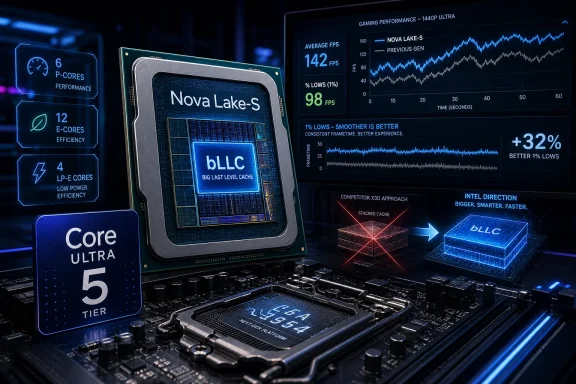 Intel’s Cache Counterpunch Moves Down the Stack
For years, Intel’s desktop pitch leaned on clocks, core counts, platform familiarity, and the long memory of Core i5 and Core i7 dominance. AMD’s X3D chips complicated that story by proving that, in many games, a mountain of cache can be more useful than another handful of cores or another few hundred MHz. The latest Nova Lake-S rumor is notable because Intel’s answer, bLLC, is no longer being whispered about only in connection with expensive top-bin parts.VideoCardz reports that Intel is preparing two Core Ultra 400S models with the same 6+12+4 layout: one 125W unlocked part and one 65W non-K version. HotHardware frames the 125W model as particularly intriguing because it appears to land in the Core Ultra 5 class, the old spiritual home of Intel’s best gaming value chips. That is the real news: Intel may be treating large last-level cache not as an exotic luxury, but as a feature it needs in the part of the stack gamers actually buy.
The nomenclature is still rumor-land messy. VideoCardz says the chips would belong to the Core Ultra 400S family, also known as Nova Lake-S, while HotHardware emphasizes the historical appeal of the “5” tier. Intel has not formally announced these SKUs, their branding, their pricing, or the cache capacities that will ship in retail silicon. But the direction of travel is clear enough: cache is becoming a mainstream battlefield.
That shift is overdue. AMD’s Ryzen X3D parts have trained buyers to ask a blunt question before they pay for a CPU: does this chip have the cache configuration that makes games faster? Intel can argue about architecture and benchmarks later, but it first has to show up with a product answer that fits the same buying logic.
The Core Ultra 5 Angle Is the Part AMD Should Notice
The conventional desktop CPU stack has always carried a little theater. Flagship chips exist to win reviews, dominate charts, and make buyers feel that the platform has headroom. The real volume, and often the real cultural momentum among PC builders, sits one or two tiers below.That is why a rumored Core Ultra 5-class Nova Lake-S chip with bLLC is more interesting than another ultra-expensive monster SKU. If Intel only placed large cache on high-end Core Ultra 9 models, the feature would function as a halo badge. By pushing it down to a 22-core configuration, Intel would be trying to compete where buyers compare FPS-per-dollar, cooler requirements, motherboard budgets, and upgrade timing.
HotHardware makes the historical point explicitly: Intel’s “5” tier has often been where gaming value lives, stretching back to chips like the Core i5-2500K. That comparison is not just nostalgia. It is a reminder that enthusiast reputation is built when a mid-tier part feels like it punches above its class.
A 6 P-core, 12 E-core, 4 LP-E-core chip would not be “mid-range” in the old quad-core sense, of course. It would be a dense hybrid desktop processor with more total cores than yesterday’s workstation-class parts. But in Intel’s modern segmentation, it could still sit below the big Core Ultra 7 and Core Ultra 9 options while offering the very cache characteristic that gamers care about most.
That is the dangerous part for AMD. Ryzen X3D has enjoyed a clean marketing line: buy the cache chip if you want the gaming chip. If Intel can offer a credible cache-heavy Core Ultra 5, the decision becomes less automatic.
bLLC Is Not Just Intel Saying “Me Too”
The temptation is to describe bLLC as Intel’s version of AMD 3D V-Cache, but that shorthand risks flattening the engineering difference. AMD’s well-known approach places additional cache using stacked chiplet technology. The current Nova Lake rumors suggest Intel’s Big Last Level Cache is built into the relevant compute tile configuration rather than arriving as the same kind of separate stacked cache slice.That distinction matters because it could shape everything from yields to SKU segmentation. HotHardware argues that if the large cache block is part of the compute tile, Intel may be able to sell chips with different enabled cache capacities depending on defects or binning. VideoCardz’s preliminary table reflects that kind of tiering, with rumored bLLC amounts ranging upward through single-tile and dual-tile configurations.
For buyers, the practical question is not whether Intel’s implementation is philosophically purer or more elegant. The question is whether it delivers the latency, capacity, power behavior, and scheduling consistency needed to improve real games. Cache is only magic when the workload can use it.
Still, Intel’s architecture choice could give the company a different playbook. If bLLC can be spread across several tiers without AMD-style packaging costs or constraints, Intel may be able to make cache a portfolio feature rather than a special edition. That would be a bigger strategic move than simply copying the headline benefit.
A 22-Core “Mid-Range” Chip Shows How Strange Desktop CPUs Have Become
A rumored Core Ultra 5 with 22 total cores sounds absurd if you grew up with the old desktop ladder. But Intel’s hybrid architecture has made core counts harder to interpret. Six performance cores still define the part’s likely high-thread, high-clock personality, while the 12 E-cores and 4 LP-E cores fill in the background and efficiency story.For Windows users, that mixture raises a familiar issue: the operating system and firmware have to make good decisions about where threads land. Intel’s hybrid designs have improved since the early Alder Lake era, and Windows has matured around heterogeneous scheduling. But every new architecture reopens the question of whether games, launchers, anti-cheat systems, recording tools, browsers, and background services behave cleanly across the core types.
The four LP-E cores are especially interesting on a desktop chip because low-power islands are often associated with mobile designs. Their presence suggests Intel is still chasing a broader system-level efficiency model, even in socketed desktop silicon. That may matter less to someone running a 360mm liquid cooler and more to small-form-factor builders, always-on home servers, and users who care about idle power.
The catch is that a big core-count number can mislead buyers. A 6+12+4 chip is not the same as a traditional 22-core processor made of 22 identical high-performance cores. Intel will need to market Nova Lake carefully if it wants to avoid both overpromising and underselling what the hybrid design can do.
The 125W and 65W Split Tells Two Different Stories
VideoCardz reports that the two 22-core bLLC models differ by power target and multiplier support: a 125W unlocked chip and a 65W non-K chip. That split is classic Intel segmentation, but in this case it may also reveal two very different customer targets. One is the enthusiast gamer who wants cache, clocks, and BIOS freedom; the other is the builder or OEM who wants cache benefits inside a more ordinary thermal envelope.The 125W version is the obvious forum-bait part. It invites overclocking speculation, cooler debates, motherboard VRM comparisons, and inevitable arguments about whether modern “TDP” numbers tell the whole story. If it carries bLLC and sits in a Core Ultra 5 tier, it could become the chip that DIY builders watch most closely.
The 65W version may be more important commercially. A non-K cache-heavy chip could fit into prebuilt gaming desktops, compact towers, and mainstream systems that cannot justify flagship thermals. If Intel wants to make cache a broad selling point, a lower-power SKU is the mechanism.
This is also where Intel has to be disciplined. A nominal 65W CPU that behaves like a much hotter part under motherboard-default turbo policies will not win trust from system builders or IT departments. The desktop market has become more skeptical about power labels, and Nova Lake will arrive in an environment where reviewers will measure behavior, not repeat spec sheets.
LGA 1954 Makes This a Platform Bet, Not Just a CPU Leak
VideoCardz says Nova Lake-S is expected to move to a new LGA 1954 socket, with the family reportedly offering DDR5-8000 support and up to 52 cores at the top end. That means the rumored 22-core bLLC chip cannot be evaluated only as a processor. It is part of a broader platform reset.Socket changes are painful in the enthusiast market because they force a motherboard decision at the same time as the CPU decision. Intel knows this history well. The company has often been criticized for shorter-lived desktop platforms, while AMD has earned goodwill from longer AM4 and AM5 continuity.
HotHardware notes previous leak chatter suggesting Intel may stick with LGA 1954 for multiple generations. If that proves true, it would be one of the more important non-performance details around Nova Lake. A cache-heavy Core Ultra 5 is easier to buy into if the motherboard feels like an investment rather than a one-generation toll.
Cooler compatibility also matters. VideoCardz reports that Intel is expected to keep Socket V cooler compatibility for the platform, though Intel has not publicly confirmed the full story. For enthusiasts with high-end cooling already installed, bracket compatibility can be the difference between a rational upgrade and another hidden cost.
The memory angle is equally consequential. DDR5-8000 support, if it becomes an official and reliable platform characteristic, would give Intel another performance knob. But memory support on paper is not the same as stable plug-and-play behavior across boards, DIMMs, and BIOS revisions. WindowsForum readers know how often the difference between “supported” and “boring” shows up only after a few firmware updates.
AMD Forced Intel to Compete on the Shape of Performance
The CPU market has spent years arguing about average frame rates, but AMD’s X3D success shifted the conversation toward the shape of performance. More cache often shows up not just in headline averages but in lows, stutter reduction, and the awkward CPU-bound scenarios that make expensive GPUs feel underfed. That is why Intel’s rumored bLLC push matters even before benchmarks exist.Intel cannot simply add cache and declare victory. AMD has had several product generations to tune packaging, thermals, firmware, and messaging around X3D parts. Game developers, reviewers, and buyers understand what those chips are for.
But Intel has an advantage AMD did not have when it first made 3D V-Cache a desktop phenomenon: the market is already educated. Intel does not need to convince buyers that cache can matter. It needs to convince them that Intel’s version matters enough.
That is a subtler challenge. If a Nova Lake bLLC chip wins in a handful of games but loses badly in power, price, platform cost, or productivity trade-offs, the market will shrug. If it delivers broadly competitive gaming performance in the tier below the flagship, Intel gets to reopen a battle AMD has largely controlled.
Windows Scheduling Will Be Part of the Benchmark, Whether Intel Likes It or Not
Any discussion of a hybrid Intel desktop CPU eventually becomes a Windows discussion. Performance does not emerge from silicon alone; it emerges from how firmware, drivers, the Windows scheduler, and applications cooperate. With a 6+12+4 layout, the operating system’s decisions will matter.Gaming workloads are particularly sensitive because the foreground process often coexists with a messy halo of launchers, overlays, voice chat, browser tabs, capture software, RGB utilities, telemetry agents, and anti-cheat drivers. The best CPU design in the world can feel worse than expected if threads land unpredictably or background work steals time from the wrong cores. Intel and Microsoft have had years to refine Thread Director-era behavior, but Nova Lake’s new architecture will still need validation.
This is not a reason to panic. Hybrid desktop CPUs are no longer exotic, and Windows 11 is far more comfortable with them than Windows 10 was at the start of the Alder Lake transition. But a new core mix and a new cache hierarchy create new edge cases.
For sysadmins, the lesson is different from the gamer takeaway. If Nova Lake systems enter fleets, especially in engineering, creative, or mixed-use environments, performance testing should reflect actual workloads rather than synthetic core-count assumptions. The presence of bLLC may help some tasks, do little for others, and complicate comparisons against older homogeneous-core desktops.
The Leak Also Hints at a More Aggressive Intel
The broader VideoCardz preliminary table paints a large Nova Lake-S lineup: single-tile parts, dual-tile parts, high core counts, multiple bLLC configurations, and power envelopes that reportedly climb steeply at the top. One rumored dual-tile variant has already been associated with very high turbo power limits in prior reporting. That combination suggests Intel is preparing to fight across every segment at once.This is both exciting and risky. Enthusiasts love ambitious roadmaps, but Intel’s recent desktop history has not been free of turbulence. Power behavior, thermals, platform churn, and inconsistent generational leaps have all created openings for AMD.
Nova Lake therefore carries a burden larger than one product family usually should. It has to demonstrate that Intel can scale hybrid architecture, deploy large cache effectively, manage platform expectations, and price the result against a competitor with a clean gaming story. That is a lot to hang on one generation.
The rumored Core Ultra 5 bLLC part is attractive because it narrows the challenge. Intel does not have to beat every AMD chip in every workload to make noise. It only has to create a mid-stack part that reviewers and builders can describe as the obvious Intel gaming value.
Rumor Discipline Matters More Than Ever
There is a reason VideoCardz labels the story as a rumor and notes that Jaykihn corrected an earlier core-configuration detail. The corrected claim is that the 125W part is 6+12+4, not 6+8+4, with a corresponding 65W model in the mix. That kind of correction is normal in leak culture, but it is also a reminder that SKU tables are not launch documents.Intel can still change names, disable features, adjust clocks, alter power limits, delay models, or reserve bLLC for different price bands. Retail chips are not real until Intel announces them, motherboard vendors validate them, and reviewers test them. Between now and an expected 2027 Nova Lake-S window, the shape of the lineup can still move.
That does not make the leak meaningless. Good leaks often reveal strategic direction before they reveal final products. In this case, the strategic direction appears to be Intel experimenting with cache-rich chips below the most expensive tier.
The danger is that enthusiasts will start treating the rumored 108MB figure shown in VideoCardz’s preliminary table as a guaranteed spec for a future Core Ultra 5. VideoCardz itself says the exact cache size for the SKU is unknown. That caveat should travel with every conversation about this chip.
The Best-Case Scenario Is a New Value War
If the rumor holds, the best outcome for Windows desktop users is not simply that Intel launches a faster CPU. The best outcome is that Intel and AMD are forced into a value war over gaming-relevant architecture rather than superficial stack inflation. Cache, power, platform longevity, and real-world frame pacing are better competitive axes than raw model numbers.A strong Core Ultra 5 bLLC part would put pressure on AMD to defend the lower end of its X3D stack. AMD has often used X3D branding brilliantly, but it has also been able to command premiums because the performance story is so clear. Intel entering that lane could make cache-heavy gaming CPUs more affordable.
It could also force reviewers to become more nuanced. Comparing a Nova Lake Core Ultra 5 bLLC chip against an AMD X3D part will require more than average FPS charts. Test suites will need to capture power, lows, memory sensitivity, Windows scheduling behavior, productivity trade-offs, and platform cost.
That is good for buyers. The most useful CPU reviews are the ones that make the compromise visible. A cache war in the mid-range would give reviewers something worth measuring.
The Worst-Case Scenario Is Another Spec Sheet Victory
There is also a less flattering possibility. Intel could ship bLLC-branded chips that look spectacular in leaked tables but land awkwardly in stores: too expensive, too hot, too late, or too inconsistent across games. The desktop market has seen plenty of CPUs that made sense in segmentation charts and little sense in shopping carts.The risk is especially acute if platform cost climbs. A new LGA 1954 motherboard, fast DDR5, and a 125W unlocked CPU can quickly turn a “mid-range” processor into the anchor of a premium build. If the total platform price approaches a higher-performing AMD X3D configuration, Intel’s SKU positioning will not save it.
Power is the other trap. Enthusiasts will tolerate heat when the performance is undeniable, but cache-heavy gaming chips are often appealing precisely because they can deliver excellent results without brute-force wattage. If Intel’s answer to AMD’s efficient gaming advantage is a cache chip that still leans heavily on power, the message gets muddier.
The 65W version could help avoid that trap, but only if it is not artificially hobbled. A locked chip with bLLC, sane power behavior, and strong gaming performance would be far more disruptive than a 125W overclocker that mostly exists to chase benchmark crowns.
The Windows PC Upgrade Calendar Gets More Complicated
For Windows enthusiasts planning upgrades, Nova Lake’s rumored 2027 arrival creates a familiar dilemma. Buy into today’s platforms now, or wait for the next socket, next cache strategy, and next Intel architecture? There is no universal answer, but this leak makes waiting more tempting for a specific kind of buyer.If you are already on a recent AMD X3D system or a high-end Intel platform that meets your needs, Nova Lake is not a reason to freeze. Rumored CPUs do not render real systems obsolete. But if you are sitting on an older Intel platform and planning a full motherboard-memory-CPU rebuild, LGA 1954’s expected arrival is a factor.
The uncertainty around platform longevity cuts both ways. If Intel truly supports LGA 1954 for several generations, early adopters could be rewarded. If support is shorter or fractured by chipset features, buyers may feel burned again.
This is where Intel’s official messaging will matter almost as much as benchmarks. Enthusiasts do not need vague promises. They need to know what cooler mounts work, what memory speeds are realistic, how long the socket is expected to live, and which features are reserved for premium chipsets.
The Cache Leak Redraws the Nova Lake Watchlist
The practical story is still provisional, but the shape of the next Intel desktop fight is becoming easier to see. The rumored 22-core bLLC chips are not just another pair of model numbers; they are evidence that Intel may finally be willing to contest AMD’s gaming-cache advantage in the volume-sensitive middle of the market.- Intel’s rumored 22-core Nova Lake-S parts reportedly use a 6 P-core, 12 E-core, and 4 LP-E-core configuration rather than the earlier 6+8+4 figure.
- The more enthusiast-focused model is reportedly a 125W unlocked chip, while a 65W non-K variant is also said to be planned.
- The chips are reported to include bLLC, Intel’s large last-level cache feature for selected Nova Lake-S desktop parts.
- The exact cache amount for these particular SKUs remains unconfirmed, even though preliminary tables point to large bLLC capacities elsewhere in the lineup.
- Nova Lake-S is currently expected in 2027 and is associated in reporting with the new LGA 1954 desktop socket.
- The biggest competitive implication is that Intel may bring cache-enhanced gaming performance into the Core Ultra 5 tier instead of reserving it for only the most expensive desktop CPUs.