

On July 8, 2026, The Korea Times published an economic essay by Inha University student Narzullaeva Maftuna Shukhrat Kizi arguing that South Korea’s financial sector needs local “server interceptors” to stop sensitive customer data from leaking into foreign AI systems. The proposal is simple enough to sound like plumbing and ambitious enough to reshape the way banks deploy generative AI. Its real target is not ChatGPT, Copilot, Gemini, or any single vendor. It is the dangerous fiction that data sovereignty can be preserved by asking distracted humans to behave perfectly.
The essay’s opening image is deliberately ordinary: an elderly woman in Seoul photographs a bank statement and uploads it to an AI chatbot because she wants help understanding a charge. That scene works because it is not a cybersecurity thriller. There is no hacker, no malware, no breached firewall, and no employee smuggling customer records out of a bank on a USB stick.
That is precisely why the argument lands. Generative AI has turned the upload box into a shadow data-transfer mechanism. A document that once stayed inside a customer’s drawer, a bank branch, or a mobile-banking app can now become prompt material for a model hosted somewhere else.
The Korea Times essay calls this the “screenshot nobody thinks about,” and that phrase captures the policy gap better than most official language does. Financial regulation has spent decades hardening databases, auditing internal access, and supervising vendors. It has not fully adjusted to a world where the customer, the intern, the analyst, and the executive can all become accidental export channels.
The uncomfortable truth is that this is not a niche elderly-user problem. It is a workflow problem. When AI tools are useful, people use them at the moment of friction, and moments of friction are exactly when they are least likely to perform a careful legal analysis of where a model provider processes uploaded images.
The essay’s strongest claim is that this approach is not policy but hope. That is not rhetorical excess. In security engineering, a rule that depends on every user making the right judgment under time pressure is not a control; it is a liability with a PDF attached.
Financial institutions already know this in other contexts. Banks do not merely tell customers not to fall for phishing; they add transaction monitoring, authentication checks, device fingerprinting, fraud holds, spending limits, and recovery procedures. The point is not that users are foolish. The point is that systems handling high-value data must assume ordinary human behavior.
Generative AI breaks that assumption in a particularly slippery way. Users are not trying to exfiltrate data. They are trying to summarize a statement, draft a complaint, translate a notice, identify a fee, or understand a policy. The leak hides inside legitimate assistance.
That is why the proposed local interceptor is interesting. It shifts the compliance burden away from individual caution and toward infrastructure. It treats outbound AI prompts and uploads the way banks already treat payments, messages, and suspicious logins: as events to be inspected before they cross a boundary.
That policy backdrop matters because the essay does not argue for a ban on foreign AI. It argues for a domestic choke point between Korean financial data and foreign model infrastructure. In other words, sovereignty here is not only about building a Korean foundation model. It is about controlling the route that sensitive data takes when users inevitably reach for whatever model is most convenient.
This is a more practical version of sovereignty than the slogan-heavy kind. A national model strategy can take years, billions of dollars, and uncertain market adoption. Middleware can be narrower: scan, classify, redact, log, route, and enforce policy before data exits the institution or jurisdiction.
That distinction is important for WindowsForum’s usual audience of sysadmins and IT pros. The essay is not really asking regulators to pick a winning chatbot. It is asking them to mandate a gateway architecture, the same way enterprises already deploy secure web gateways, data loss prevention tools, email filters, endpoint agents, and cloud access security brokers.
The new twist is that old DLP categories are not enough. AI prompts are messy. Screenshots are semi-structured. Bank statements may arrive as photos, PDFs, cropped images, or copied tables. A useful interceptor would need optical character recognition, Korean-language entity recognition, financial-pattern detection, policy routing, and a way to preserve enough context that the AI response remains useful after redaction.
Financial data is inferential. A transaction history without an account number can still identify a person if it contains a salary deposit, a hospital payment, a school fee, a neighborhood merchant, and a timestamp. An investment portfolio can reveal wealth, risk tolerance, employer stock exposure, family status, and even political or religious affiliations through donations and payments.
That means a serious interceptor cannot be limited to masking resident registration numbers and account identifiers. It needs to reason about combinations of data. It must distinguish between harmless context and re-identification risk. It must know when to redact, when to generalize, when to block, and when to route the request to an approved domestic model instead.
This is where the essay’s proposal becomes both compelling and expensive. The more intelligent the interceptor becomes, the closer it gets to being a regulated AI system in its own right. If it misclassifies data, it can either leak sensitive information or degrade the user’s request until the AI is useless.
That tradeoff is familiar to anyone who has tuned enterprise DLP. Over-blocking drives users to workarounds. Under-blocking creates the incident the system was meant to prevent. The difference is that generative AI makes both failure modes more visible because the user expects an immediate answer and may simply try again with a different tool if the first path is blocked.
The European Data Protection Board and European Commission describe cross-border transfer rules in terms of adequacy decisions, safeguards, standard contractual clauses, binding corporate rules, and enforceable rights. That machinery is legal and contractual. It asks whether protection travels with the data when the data crosses borders.
The Korean finance problem is more operational. A consumer does not negotiate standard contractual clauses before uploading a screenshot to an AI assistant. A bank employee under deadline does not perform a transfer-impact assessment before pasting a client memo into a summarizer. The legal theory may exist, but the user interface moves faster than the compliance process.
That is why an interceptor is best understood as a bridge between law and behavior. It turns an abstract prohibition into a technical enforcement point. It also creates logs, metrics, and audit trails that regulators can actually inspect.
Europe’s lesson is not that Korea should copy GDPR line by line. The lesson is that data-transfer regimes become credible only when institutions can demonstrate how they prevent uncontrolled movement of protected information. For AI, that demonstration will increasingly require systems, not slogans.
There is also a customer-trust reason to begin with finance. Most consumers understand, at least intuitively, that bank statements and investment records deserve stronger protection than a restaurant recommendation or a travel itinerary. If regulators cannot establish AI data controls around account numbers and transaction histories, the case for broader sovereignty protections will look unserious.
The financial sector also offers a manageable test environment. Banks already operate secure customer portals, authenticated mobile apps, fraud-detection systems, internal data-classification policies, and vendor-risk programs. A regulator could require AI interactions inside those controlled channels to pass through approved local gateways before any external model call is made.
That would not stop every consumer from using a public chatbot outside the bank’s app. But it would give banks a safer official path to offer AI assistance and reduce the incentive for customers to improvise. The best security controls do not merely say “no.” They make the safe path the easiest path.
For employees, the case is even stronger. A financial institution can require managed browsers, endpoint controls, proxy routing, approved AI tools, and redaction gateways for corporate devices and networks. If banks are serious about AI adoption, the interceptor becomes part of the enterprise architecture rather than an optional privacy feature.
Security asks whether data is protected from unauthorized access. Sovereignty asks which laws, courts, governments, vendors, subcontractors, and infrastructure operators can affect that data once it moves. A system can be secure and still be outside Korea’s practical control.
This distinction is often flattened in cloud marketing. A provider may offer excellent security engineering while still processing data in a jurisdiction with different legal obligations. A customer may receive contractual assurances while still lacking meaningful visibility into model-routing decisions, logging behavior, subcontractor access, or support workflows.
For banks, this is not an abstract concern. Financial institutions are accountable not only for whether a vendor is hacked but also for whether outsourcing arrangements, cross-border transfers, and operational dependencies satisfy domestic supervisory expectations. AI adds a new category of dependency whose boundaries are harder to see.
An interceptor would not eliminate the need for vendor diligence. It would reduce the blast radius of vendor trust. Instead of sending raw sensitive data and relying entirely on the provider’s promise, the institution sends minimized data after local inspection. That is a healthier trust model.
The answer is not crude masking. A competent interceptor would need multiple transformations. It might preserve transaction categories while hiding merchant names, round amounts into bands, replace account identifiers with stable placeholders, or keep the last four digits only when necessary. It might summarize a document locally before sending a reduced version to an external model.
In some cases, the system should not send anything externally at all. If the request can be answered by deterministic rules, a domestic retrieval system, or the bank’s own customer-service model, the gateway should keep it inside the institution. The foreign model should be the last mile for general reasoning, not the first stop for raw financial records.
This is where Korean banks could turn compliance into product quality. A well-designed AI assistant inside a banking app could explain fees, categorize spending, translate notices, and prepare dispute letters without requiring customers to upload screenshots to a general-purpose chatbot. The interceptor then becomes invisible infrastructure behind a safer user experience.
The danger is that regulators mandate a box-checking appliance instead of an architecture. If compliance means “run a regex over the prompt,” the system will fail. If it means data minimization, local preprocessing, policy routing, and auditable controls, the idea has legs.
The problem is that AI traffic often cuts across those categories. A prompt may be typed into a web page, uploaded through a browser, passed through an API, embedded in an Office document workflow, or sent from a mobile app. The content can be text, image, audio, PDF, spreadsheet, or screenshot. The policy decision may depend on both the user’s role and the semantic meaning of the data.
That is why the next generation of AI governance tools will look less like old perimeter security and more like policy-aware content mediation. They will need to understand documents, not merely ports and domains. They will need to classify intent, not merely file extensions. They will need to offer a sanctioned path rather than simply blocking every interaction with an unapproved model.
Microsoft’s own enterprise ecosystem points in this direction, even if the Korea Times essay is not about Microsoft specifically. Copilot deployments, Purview controls, sensitivity labels, endpoint management, and tenant-level data policies all reflect the same basic reality: AI adoption in business will be governed through identity, data classification, and administrative control planes.
But national sovereignty adds another layer. A bank’s Microsoft 365 tenant policy may satisfy internal governance while still leaving open the question of where data is processed and which jurisdiction applies. For Korean finance, the interceptor idea says the national boundary matters alongside the enterprise boundary.
The analogy is not perfect. MyData is about regulated sharing of financial information among approved actors. Generative AI prompts are often unstructured, spontaneous, and user-driven. But the cultural lesson carries over: when data is sensitive enough, the channel matters as much as the consent screen.
A local AI interceptor could extend the MyData philosophy into the generative-AI era. Instead of pretending users will stop seeking AI help, regulators could require that sensitive financial AI interactions pass through governed rails. That would make AI assistance part of the formal financial-data ecosystem rather than a parallel gray market of screenshots and pasted statements.
This approach would also create room for domestic AI providers. If Korean models can handle more sensitive workloads locally, banks may route certain requests to them by default while reserving foreign models for lower-risk tasks. That is industrial policy through architecture rather than procurement rhetoric.
Still, Korea should avoid confusing sovereignty with isolation. A rigid rule that blocks all foreign AI could slow innovation, raise costs, and frustrate users. The better policy is tiered: keep the most sensitive data local, sanitize what leaves, audit the flows, and allow institutions to use global models where the risk is controlled.
But “expensive” is not the end of the analysis. Financial regulation is full of costly controls because the alternative is systemic fragility. Authentication, anti-money-laundering monitoring, fraud analytics, disaster recovery, encryption, and audit logging all cost money. Nobody serious argues that banks should skip them because customers can be educated instead.
The more serious concern is fragmentation. If every bank builds its own interceptor with different redaction rules, customers will get inconsistent results and vendors will face a compliance maze. Regulators should therefore define baseline outcomes and certification criteria rather than prescribing one technical design.
A national standard could specify categories of protected financial information, required logging, redaction performance thresholds, model-routing rules, user-notice requirements, and auditability. It could also create safe harbors for approved architectures, giving banks confidence that investment will satisfy supervisors.
The market would then compete on implementation quality. Some institutions would build in-house gateways. Others would use certified domestic providers. The key is that the control becomes mandatory enough to change behavior but flexible enough to evolve with AI capabilities.
That is not an argument against the concept. It is an argument for strict design limits. The gateway should minimize retained content, separate security logs from raw user data, enforce access controls, and make deletion schedules explicit. It should record enough to prove compliance and investigate incidents, not enough to reconstruct every user’s financial anxiety.
This matters especially in finance, where AI conversations may reveal more than transactions. A customer might ask about debt, gambling losses, medical bills, divorce expenses, unemployment, or elder-care payments. The privacy risk is not only that data goes to California. It is also that a domestic system quietly accumulates an intimate behavioral archive.
Regulators therefore need to supervise the interceptor as a sensitive system, not a magic privacy appliance. Who can inspect its logs? How long are sanitized and original versions retained? Can data be used to train domestic models? Are customers told when redaction occurs? Can they challenge an automated block?
A sovereignty regime that ignores these questions would merely move the trust problem from foreign AI vendors to local intermediaries. That is better only if the local controls are transparent, accountable, and technically sound.
If a confused customer’s easiest option is to open a public chatbot and upload a bank statement, sensitive data will leak. If the easiest option is to tap “Ask my bank” inside a secure app where the statement is analyzed locally or sanitized before external processing, most users will never think about the interceptor at all. That is success.
The same applies inside financial institutions. If employees are given slow, awkward, inferior AI tools, they will find faster ones. If approved systems are integrated into their document workflows, email clients, knowledge bases, and reporting tools, compliance becomes a convenience rather than a constraint.
This is the lesson Windows administrators have learned repeatedly. Users do not route around security because they hate security. They route around security when it blocks the work without providing a usable alternative. The winning control is the one that disappears into the workflow while still enforcing the policy.
Korea’s opportunity is to build that control before a scandal forces a cruder response. A major leak involving AI-uploaded financial records would likely produce blunt prohibitions, emergency audits, and political theater. A preemptive interceptor mandate could produce something more durable: safe adoption.
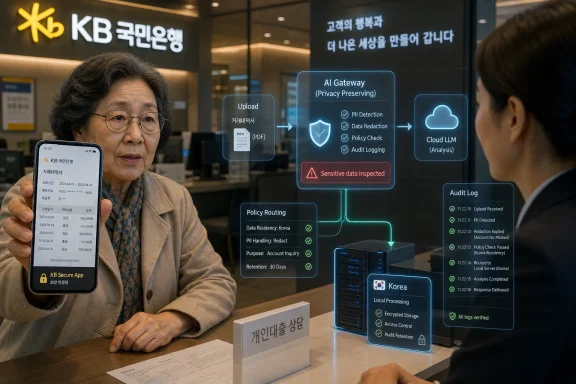 The AI Leak Is Now a User-Interface Problem
The essay’s opening image is deliberately ordinary: an elderly woman in Seoul photographs a bank statement and uploads it to an AI chatbot because she wants help understanding a charge. That scene works because it is not a cybersecurity thriller. There is no hacker, no malware, no breached firewall, and no employee smuggling customer records out of a bank on a USB stick.That is precisely why the argument lands. Generative AI has turned the upload box into a shadow data-transfer mechanism. A document that once stayed inside a customer’s drawer, a bank branch, or a mobile-banking app can now become prompt material for a model hosted somewhere else.
The Korea Times essay calls this the “screenshot nobody thinks about,” and that phrase captures the policy gap better than most official language does. Financial regulation has spent decades hardening databases, auditing internal access, and supervising vendors. It has not fully adjusted to a world where the customer, the intern, the analyst, and the executive can all become accidental export channels.
The uncomfortable truth is that this is not a niche elderly-user problem. It is a workflow problem. When AI tools are useful, people use them at the moment of friction, and moments of friction are exactly when they are least likely to perform a careful legal analysis of where a model provider processes uploaded images.
“Do Not Upload Sensitive Data” Is Not a Control
The standard corporate answer to this problem is training. Employees are told not to paste confidential information into public AI tools. Customers are warned not to share account numbers. Acceptable-use policies are updated, email reminders are sent, and compliance teams hope the message sticks.The essay’s strongest claim is that this approach is not policy but hope. That is not rhetorical excess. In security engineering, a rule that depends on every user making the right judgment under time pressure is not a control; it is a liability with a PDF attached.
Financial institutions already know this in other contexts. Banks do not merely tell customers not to fall for phishing; they add transaction monitoring, authentication checks, device fingerprinting, fraud holds, spending limits, and recovery procedures. The point is not that users are foolish. The point is that systems handling high-value data must assume ordinary human behavior.
Generative AI breaks that assumption in a particularly slippery way. Users are not trying to exfiltrate data. They are trying to summarize a statement, draft a complaint, translate a notice, identify a fee, or understand a policy. The leak hides inside legitimate assistance.
That is why the proposed local interceptor is interesting. It shifts the compliance burden away from individual caution and toward infrastructure. It treats outbound AI prompts and uploads the way banks already treat payments, messages, and suspicious logins: as events to be inspected before they cross a boundary.
Korea’s Sovereignty Debate Has Moved From Models to Middleware
South Korea is already deep in the politics of AI sovereignty. The government’s AI Basic Act took effect on January 22, 2026, according to Korea.net and the Ministry of Science and ICT, creating a national framework for AI governance, industry promotion, and trust. The law is part of a broader push to make Korea not merely a consumer of foreign AI services but a serious AI power with domestic capacity.That policy backdrop matters because the essay does not argue for a ban on foreign AI. It argues for a domestic choke point between Korean financial data and foreign model infrastructure. In other words, sovereignty here is not only about building a Korean foundation model. It is about controlling the route that sensitive data takes when users inevitably reach for whatever model is most convenient.
This is a more practical version of sovereignty than the slogan-heavy kind. A national model strategy can take years, billions of dollars, and uncertain market adoption. Middleware can be narrower: scan, classify, redact, log, route, and enforce policy before data exits the institution or jurisdiction.
That distinction is important for WindowsForum’s usual audience of sysadmins and IT pros. The essay is not really asking regulators to pick a winning chatbot. It is asking them to mandate a gateway architecture, the same way enterprises already deploy secure web gateways, data loss prevention tools, email filters, endpoint agents, and cloud access security brokers.
The new twist is that old DLP categories are not enough. AI prompts are messy. Screenshots are semi-structured. Bank statements may arrive as photos, PDFs, cropped images, or copied tables. A useful interceptor would need optical character recognition, Korean-language entity recognition, financial-pattern detection, policy routing, and a way to preserve enough context that the AI response remains useful after redaction.
The Bank Statement Is Only the First Test Case
A local server interceptor sounds straightforward when the example is a bank statement with an account number. Pattern-match the number, redact the obvious identifiers, and forward the sanitized content. The real world is harsher.Financial data is inferential. A transaction history without an account number can still identify a person if it contains a salary deposit, a hospital payment, a school fee, a neighborhood merchant, and a timestamp. An investment portfolio can reveal wealth, risk tolerance, employer stock exposure, family status, and even political or religious affiliations through donations and payments.
That means a serious interceptor cannot be limited to masking resident registration numbers and account identifiers. It needs to reason about combinations of data. It must distinguish between harmless context and re-identification risk. It must know when to redact, when to generalize, when to block, and when to route the request to an approved domestic model instead.
This is where the essay’s proposal becomes both compelling and expensive. The more intelligent the interceptor becomes, the closer it gets to being a regulated AI system in its own right. If it misclassifies data, it can either leak sensitive information or degrade the user’s request until the AI is useless.
That tradeoff is familiar to anyone who has tuned enterprise DLP. Over-blocking drives users to workarounds. Under-blocking creates the incident the system was meant to prevent. The difference is that generative AI makes both failure modes more visible because the user expects an immediate answer and may simply try again with a different tool if the first path is blocked.
Europe Shows the Legal Logic, Not the Product Design
The essay invokes Europe’s GDPR as a precedent for strict treatment of data leaving a jurisdiction. That comparison is directionally right, but it should not be overstated. GDPR is a legal framework for personal-data protection and international transfers; it is not a product blueprint for AI prompt interception.The European Data Protection Board and European Commission describe cross-border transfer rules in terms of adequacy decisions, safeguards, standard contractual clauses, binding corporate rules, and enforceable rights. That machinery is legal and contractual. It asks whether protection travels with the data when the data crosses borders.
The Korean finance problem is more operational. A consumer does not negotiate standard contractual clauses before uploading a screenshot to an AI assistant. A bank employee under deadline does not perform a transfer-impact assessment before pasting a client memo into a summarizer. The legal theory may exist, but the user interface moves faster than the compliance process.
That is why an interceptor is best understood as a bridge between law and behavior. It turns an abstract prohibition into a technical enforcement point. It also creates logs, metrics, and audit trails that regulators can actually inspect.
Europe’s lesson is not that Korea should copy GDPR line by line. The lesson is that data-transfer regimes become credible only when institutions can demonstrate how they prevent uncontrolled movement of protected information. For AI, that demonstration will increasingly require systems, not slogans.
Financial Regulators Are the Right First Movers
The Korea Times essay argues that finance is the sector where regulators should act first, and that is hard to dispute. Banking data is unusually structured, unusually sensitive, and unusually valuable. It is also already governed by a mature compliance culture that can absorb new technical mandates more readily than many other industries.There is also a customer-trust reason to begin with finance. Most consumers understand, at least intuitively, that bank statements and investment records deserve stronger protection than a restaurant recommendation or a travel itinerary. If regulators cannot establish AI data controls around account numbers and transaction histories, the case for broader sovereignty protections will look unserious.
The financial sector also offers a manageable test environment. Banks already operate secure customer portals, authenticated mobile apps, fraud-detection systems, internal data-classification policies, and vendor-risk programs. A regulator could require AI interactions inside those controlled channels to pass through approved local gateways before any external model call is made.
That would not stop every consumer from using a public chatbot outside the bank’s app. But it would give banks a safer official path to offer AI assistance and reduce the incentive for customers to improvise. The best security controls do not merely say “no.” They make the safe path the easiest path.
For employees, the case is even stronger. A financial institution can require managed browsers, endpoint controls, proxy routing, approved AI tools, and redaction gateways for corporate devices and networks. If banks are serious about AI adoption, the interceptor becomes part of the enterprise architecture rather than an optional privacy feature.
The Vendor Promise Is Not the Same as Sovereignty
Large AI vendors will object, or at least gently redirect the conversation. They will point to enterprise privacy terms, encryption, regional data centers, no-training commitments, audit reports, and contractual controls. Those measures matter. They are not the same as sovereignty.Security asks whether data is protected from unauthorized access. Sovereignty asks which laws, courts, governments, vendors, subcontractors, and infrastructure operators can affect that data once it moves. A system can be secure and still be outside Korea’s practical control.
This distinction is often flattened in cloud marketing. A provider may offer excellent security engineering while still processing data in a jurisdiction with different legal obligations. A customer may receive contractual assurances while still lacking meaningful visibility into model-routing decisions, logging behavior, subcontractor access, or support workflows.
For banks, this is not an abstract concern. Financial institutions are accountable not only for whether a vendor is hacked but also for whether outsourcing arrangements, cross-border transfers, and operational dependencies satisfy domestic supervisory expectations. AI adds a new category of dependency whose boundaries are harder to see.
An interceptor would not eliminate the need for vendor diligence. It would reduce the blast radius of vendor trust. Instead of sending raw sensitive data and relying entirely on the provider’s promise, the institution sends minimized data after local inspection. That is a healthier trust model.
The Hard Part Is Preserving Usefulness After Redaction
The obvious critique of automated redaction is that it can destroy the value of the AI interaction. If a customer asks why a specific transaction occurred, removing the merchant, amount, date, and surrounding history may leave the model with nothing meaningful to analyze. A sanitized prompt that says “Transaction A appears near Transaction B” may be safe, but it may also be useless.The answer is not crude masking. A competent interceptor would need multiple transformations. It might preserve transaction categories while hiding merchant names, round amounts into bands, replace account identifiers with stable placeholders, or keep the last four digits only when necessary. It might summarize a document locally before sending a reduced version to an external model.
In some cases, the system should not send anything externally at all. If the request can be answered by deterministic rules, a domestic retrieval system, or the bank’s own customer-service model, the gateway should keep it inside the institution. The foreign model should be the last mile for general reasoning, not the first stop for raw financial records.
This is where Korean banks could turn compliance into product quality. A well-designed AI assistant inside a banking app could explain fees, categorize spending, translate notices, and prepare dispute letters without requiring customers to upload screenshots to a general-purpose chatbot. The interceptor then becomes invisible infrastructure behind a safer user experience.
The danger is that regulators mandate a box-checking appliance instead of an architecture. If compliance means “run a regex over the prompt,” the system will fail. If it means data minimization, local preprocessing, policy routing, and auditable controls, the idea has legs.
The Windows Enterprise Playbook Already Has the Bones
For IT professionals, the local interceptor is not a foreign concept. It resembles a stack of familiar enterprise controls refitted for generative AI. Secure web gateways inspect traffic. DLP systems scan for sensitive data. CASBs broker access to cloud services. Identity systems enforce conditional access. Endpoint management constrains what users can install and where data can go.The problem is that AI traffic often cuts across those categories. A prompt may be typed into a web page, uploaded through a browser, passed through an API, embedded in an Office document workflow, or sent from a mobile app. The content can be text, image, audio, PDF, spreadsheet, or screenshot. The policy decision may depend on both the user’s role and the semantic meaning of the data.
That is why the next generation of AI governance tools will look less like old perimeter security and more like policy-aware content mediation. They will need to understand documents, not merely ports and domains. They will need to classify intent, not merely file extensions. They will need to offer a sanctioned path rather than simply blocking every interaction with an unapproved model.
Microsoft’s own enterprise ecosystem points in this direction, even if the Korea Times essay is not about Microsoft specifically. Copilot deployments, Purview controls, sensitivity labels, endpoint management, and tenant-level data policies all reflect the same basic reality: AI adoption in business will be governed through identity, data classification, and administrative control planes.
But national sovereignty adds another layer. A bank’s Microsoft 365 tenant policy may satisfy internal governance while still leaving open the question of where data is processed and which jurisdiction applies. For Korean finance, the interceptor idea says the national boundary matters alongside the enterprise boundary.
MyData Gives Korea a Useful Starting Point
The essay points to Korea’s MyData initiative as a logical foundation. That is a smart move because MyData already frames personal financial information as something that should move through authorized, structured, consent-based channels rather than ad hoc copying and pasting.The analogy is not perfect. MyData is about regulated sharing of financial information among approved actors. Generative AI prompts are often unstructured, spontaneous, and user-driven. But the cultural lesson carries over: when data is sensitive enough, the channel matters as much as the consent screen.
A local AI interceptor could extend the MyData philosophy into the generative-AI era. Instead of pretending users will stop seeking AI help, regulators could require that sensitive financial AI interactions pass through governed rails. That would make AI assistance part of the formal financial-data ecosystem rather than a parallel gray market of screenshots and pasted statements.
This approach would also create room for domestic AI providers. If Korean models can handle more sensitive workloads locally, banks may route certain requests to them by default while reserving foreign models for lower-risk tasks. That is industrial policy through architecture rather than procurement rhetoric.
Still, Korea should avoid confusing sovereignty with isolation. A rigid rule that blocks all foreign AI could slow innovation, raise costs, and frustrate users. The better policy is tiered: keep the most sensitive data local, sanitize what leaves, audit the flows, and allow institutions to use global models where the risk is controlled.
The Cost Argument Cuts Both Ways
Opponents will say that mandatory local interceptors would be expensive. They are right. Banks would need new infrastructure, model-evaluation processes, monitoring teams, incident-response procedures, and compliance reporting. Smaller financial firms would need shared services or certified vendors to avoid being crushed by implementation costs.But “expensive” is not the end of the analysis. Financial regulation is full of costly controls because the alternative is systemic fragility. Authentication, anti-money-laundering monitoring, fraud analytics, disaster recovery, encryption, and audit logging all cost money. Nobody serious argues that banks should skip them because customers can be educated instead.
The more serious concern is fragmentation. If every bank builds its own interceptor with different redaction rules, customers will get inconsistent results and vendors will face a compliance maze. Regulators should therefore define baseline outcomes and certification criteria rather than prescribing one technical design.
A national standard could specify categories of protected financial information, required logging, redaction performance thresholds, model-routing rules, user-notice requirements, and auditability. It could also create safe harbors for approved architectures, giving banks confidence that investment will satisfy supervisors.
The market would then compete on implementation quality. Some institutions would build in-house gateways. Others would use certified domestic providers. The key is that the control becomes mandatory enough to change behavior but flexible enough to evolve with AI capabilities.
The Interceptor Must Not Become a Surveillance Machine
There is another risk the essay only implies: a system that inspects AI-bound data can protect users, but it can also become a powerful surveillance layer. If every customer prompt, employee draft, screenshot, and document upload is logged centrally, the interceptor itself becomes a tempting database.That is not an argument against the concept. It is an argument for strict design limits. The gateway should minimize retained content, separate security logs from raw user data, enforce access controls, and make deletion schedules explicit. It should record enough to prove compliance and investigate incidents, not enough to reconstruct every user’s financial anxiety.
This matters especially in finance, where AI conversations may reveal more than transactions. A customer might ask about debt, gambling losses, medical bills, divorce expenses, unemployment, or elder-care payments. The privacy risk is not only that data goes to California. It is also that a domestic system quietly accumulates an intimate behavioral archive.
Regulators therefore need to supervise the interceptor as a sensitive system, not a magic privacy appliance. Who can inspect its logs? How long are sanitized and original versions retained? Can data be used to train domestic models? Are customers told when redaction occurs? Can they challenge an automated block?
A sovereignty regime that ignores these questions would merely move the trust problem from foreign AI vendors to local intermediaries. That is better only if the local controls are transparent, accountable, and technically sound.
The Real Battle Is Over Default Behavior
The most persuasive part of the Korea Times essay is its insistence that people will keep using AI. Banning general-purpose tools is politically unattractive, operationally unrealistic, and likely to fail. The better fight is over defaults.If a confused customer’s easiest option is to open a public chatbot and upload a bank statement, sensitive data will leak. If the easiest option is to tap “Ask my bank” inside a secure app where the statement is analyzed locally or sanitized before external processing, most users will never think about the interceptor at all. That is success.
The same applies inside financial institutions. If employees are given slow, awkward, inferior AI tools, they will find faster ones. If approved systems are integrated into their document workflows, email clients, knowledge bases, and reporting tools, compliance becomes a convenience rather than a constraint.
This is the lesson Windows administrators have learned repeatedly. Users do not route around security because they hate security. They route around security when it blocks the work without providing a usable alternative. The winning control is the one that disappears into the workflow while still enforcing the policy.
Korea’s opportunity is to build that control before a scandal forces a cruder response. A major leak involving AI-uploaded financial records would likely produce blunt prohibitions, emergency audits, and political theater. A preemptive interceptor mandate could produce something more durable: safe adoption.
A Seoul Bank Statement Becomes the Policy Test
The practical implications of the Korea Times essay are concrete enough for regulators and IT teams to start arguing over implementation now. The debate should not be whether users can be trusted never to paste sensitive data into AI systems. They cannot, and the entire history of security engineering says they should not have to.- South Korean financial regulators should treat generative-AI uploads as a regulated data-transfer channel, not as ordinary web browsing.
- Banks should provide approved AI assistance inside authenticated environments so customers are not pushed toward public chatbots with screenshots.
- Local interception should combine redaction, policy routing, audit logging, and domestic processing options rather than relying on simple keyword filters.
- Any mandated gateway should be governed by privacy rules of its own, because the interceptor will handle highly sensitive original data before it sanitizes anything.
- Korea’s AI Basic Act and MyData experience give policymakers a foundation, but financial-sector rules will need more specific technical standards.
- Foreign AI vendors can remain part of the ecosystem, but raw Korean financial data should not leave the country merely because a user wanted a quick explanation.
References
- Primary source: The Korea Times
Published: 2026-07-07T22:50:08.163076
[ECONOMIC ESSAY CONTEST] AI data sovereignty: The case for a local server interceptor in Korean finance - The Korea Times
The Screenshot Nobody Thinks About An elderly woman in Seoul takes a photo of her bank statement. She is confusing about a transaction. Her grandso...www.koreatimes.co.kr - Related coverage: fierce-network.com
Korean operators ramp up AI investments to make country an AI superpower
Korean telcos are racing to turn AI ambition into infrastructure reality, with SK Telecom, KT and LG Uplus pouring billions into data centers, compute and connectivity as South Korea pushes to become a top-three global AI power.www.fierce-network.com - Related coverage: cybercenter.space
Semiconductors, Custom Silicon, and the Restructuring of the AI Supply Chain: A Korean Pivot – Center for Cyber Diplomacy and International Security
In late June and early July 2026, South Korea announced a $649 billion investment in AI infrastructure, coinciding with Anthropic’s discussions with Samsung Electronics for a 2nm AI chip manu…cybercenter.space - Related coverage: lightreading.com
Korean telcos lay out further massive AI investments
KT Corp commits $12 billion in networks and AI data centers as it aims to become AI platform company, while SK Telecom announces 15GW data center buildout.www.lightreading.com - Related coverage: smallake.kr
Global AI leadership: AI stack strategic positioning
</rdf:Alt> </dc:description> <dc:title> <rdf:Alt> <rdf:li xml:lang="x-default">The AI stack: layered dependencies, concentration points, and mitigation levers. smallake.kr
- Official source: cdn.openai.com
- Related coverage: edps.europa.eu
- Related coverage: commission.europa.eu
Rules on international data transfers
Data protection rules on personal data transferred outside the EU.commission.europa.eu - Related coverage: trade.gov
South Korea AI Basic Act
South Korea's AI Basic Act creates new compliance and market entry considerations for U.S. AI companies serving or entering Korea.www.trade.gov
- Related coverage: whitecase.com
- Related coverage: licentium.io
South Korea AI regulation | Licentium
South Korea has adopted a comprehensive national AI law — the Framework Act on the Development of Artificial Intelligence and the Creation of a Foundation for Trust — effective from 22 January 2026. It distinguishes ordinary AI from generative AI and high-impact AI, and creates duties for AI...www.licentium.io - Related coverage: korea.net
