

UPEI’s Teaching and Learning Centre has told the campus community that Yuja and Collaborate licenses will not be renewed, with Microsoft Teams becoming the institution’s supported platform for video conferencing, recording, and related instructional activities beginning this fall. The announcement is short, but the operational meaning is large: one campus-supported workflow is replacing a patchwork of familiar teaching tools. For instructors, the change is not simply “use Teams instead.” It is a forced migration of habits, course design, classroom capture expectations, student support paths, and institutional memory into a platform many people know for meetings but may not yet treat as their teaching backbone.
The notice, titled “Transition from Yuja and Collaborate to Microsoft Teams,” reads like a routine service update. It is not. When a university declines to renew licenses for two instructional platforms and names a single supported replacement, it is making a governance decision about where teaching technology lives, who supports it, and how much tool diversity the institution is willing to carry.
That distinction matters because higher education technology transitions often fail in the seams. Faculty do not experience them as procurement events; they experience them at 8:29 a.m. when a lecture is about to begin, at 11:45 p.m. when a student cannot find a recording, or during the first week of term when every support unit is already overloaded. UPEI’s message gives the campus a direction. The hard part now is turning that direction into a semester that does not feel like a pilot.
The most important sentence in the Teaching and Learning Centre’s notice is not the one about Teams. It is the one that says the licenses for Yuja and Collaborate “will not be renewed.” That wording means the institution is not merely adding Teams as another option; it is removing the renewal path for existing licensed platforms and consolidating support around Microsoft Teams.
That makes this a platform transition, not a feature substitution. Yuja, Collaborate, and Teams may overlap around video, meetings, recordings, and instructional activity, but they entered campus life through different doorways. Instructors may have used one tool for lecture capture, another for synchronous online sessions, and another for ad hoc communication. UPEI’s decision pushes those uses toward a single supported Microsoft environment.
The practical logic is obvious enough. Universities have spent years accumulating overlapping teaching technologies, often under emergency conditions, departmental preferences, accessibility needs, procurement cycles, and pandemic-era urgency. Every additional platform brings licensing costs, support documentation, training obligations, integration complexity, and an invisible tax on students who must learn yet another interface.
But consolidation carries its own risk. The retiring tools are not just names on a contract; they are routines embedded in syllabi, course shells, recorded-content archives, instructor muscle memory, and student expectations. The transition succeeds only if UPEI treats Teams not as a generic replacement but as the new institutional path for a set of very specific teaching behaviors.
The notice is careful on that point. It says Teams will be the supported platform for “video conferencing, recording, and related instructional activities.” That phrase is broad enough to cover the main teaching scenarios but narrow enough to avoid pretending that Teams is a full replacement for every specialized function instructors may have built around Yuja or Collaborate. The distinction is important. A supported institutional platform can become the default without becoming a magic clone of everything it replaces.
The comparison is stark because the notice is stark. Two licenses are ending. One platform is being supported. The campus now has to move from that procurement-level simplicity to the messy reality of teaching.
August — Training opportunities for instructors will be offered, with online, on-demand resources also made available.
This fall — Microsoft Teams becomes the institution’s supported platform for video conferencing, recording, and related instructional activities.
That sequence is workable, but only if the August training is designed around the semester’s real failure points. Faculty do not need a tour of every button. They need to know how to run the first class, how to record, how to make materials findable, how to communicate expectations to students, and what to do when the planned workflow breaks.
The danger in a summer transition is that it can look calm from the support side and then become chaotic when courses begin. In July, the campus is reachable in fragments. In August, attention returns unevenly. By the first week of fall classes, every unresolved question becomes urgent at once.
The Teaching and Learning Centre’s notice says additional details will be shared in the coming weeks. That is the correct signal, but the quality of those details will determine whether the move feels managed or merely announced. Instructors will need more than confirmation that Teams is supported. They will need course-ready guidance: what to change in syllabi, how to tell students where meetings and recordings live, and which old instructions should be removed before they create confusion.
The phrase “beginning this fall” also deserves attention. It does not necessarily mean every historical dependency disappears overnight, but it does mean the supported center of gravity changes at the start of the academic cycle. If an instructor builds a fall course around a non-renewed platform, they are building against the institution’s stated direction.
That is the hard edge of a soft-sounding notice. The TLC is not scolding anyone. It is giving the campus enough warning to move before the old assumptions stop being safe.
If classroom cameras required replacement, the transition would immediately become a capital project. Rooms would need audits, schedules, installations, testing, and exceptions. Faculty would worry not only about software but about whether the physical room could still support hybrid or recorded teaching. The TLC’s statement reduces that risk: the webcams already in classrooms are expected to work with Teams.
That does not make the transition effortless. A webcam that “works” with Teams still has to be selected correctly, paired with the right microphone path, recognized by the room computer, and tested before class. But the notice’s hardware assurance means UPEI is not asking instructors to accept a platform change and a classroom equipment change at the same time.
This is the kind of detail that makes a short notice more credible. Institutions often announce new platforms in abstract terms and leave faculty to discover physical constraints later. UPEI is at least addressing the obvious classroom question up front: will the cameras already in place still function?
The answer, according to the Teaching and Learning Centre, is yes. For instructors, that should change the preparation task. The question is less “Do I need new classroom equipment?” and more “Have I confirmed the Teams workflow in the room where I teach?”
Those are very different support problems. The first requires procurement and installation. The second requires training, documentation, and a test run. One threatens the fall timetable; the other can be managed if people act early.
Collaborate and Yuja likely occupied different mental categories for many users. One may have been associated with live online class sessions, the other with capture or recorded content. Teams, by contrast, arrives as a broader collaboration platform. That breadth is useful, but it also requires clearer institutional norms.
A university can standardize on Teams and still leave instructors with too many choices unless it defines the basic teaching patterns. Should instructors create recurring meetings in a consistent way? Where should students expect recordings to appear? What language should go into course outlines? What is the recommended practice for classes that meet partly in person and partly online? The notice does not answer those questions, and it should not be expected to in a first announcement. But those are the questions that will decide the experience.
This is where the August training becomes more than a courtesy. It is the bridge between “Teams can do this” and “Here is how UPEI wants you to do this in a course.” The latter is more valuable. Faculty can find generic Teams tutorials anywhere; what they need from the institution is a supported pattern that aligns with local classrooms, student expectations, and help channels.
The shift also forces instructors to revisit assumptions that may have been stable for years. A recorded lecture is not just a file; it is a promise about availability, discoverability, and continuity. A live online class is not just a meeting; it is a structured learning environment with norms around chat, attendance, participation, and follow-up. Moving those activities into Teams gives UPEI a chance to simplify support, but it also requires careful attention to how teaching actually happens.
There is an upside here. Standardization can reduce the cognitive load on students who otherwise move from course to course through different digital rituals. If Teams becomes the supported common denominator, students may spend less time asking where the session is and more time participating in it. But that benefit appears only if the campus implements the platform consistently enough for students to recognize the pattern.
Still, the support model is being redrawn whether the notice says so explicitly or not. When Yuja and Collaborate licenses are not renewed, the institution’s support expertise must follow the supported platform. Documentation, workshops, troubleshooting scripts, classroom instructions, and help-desk escalation paths all have to be updated around Teams.
The danger is a split-brain period in which some campus materials still point to old platforms while official support has moved on. That kind of mismatch is maddening for students and instructors because it creates uncertainty at the exact moment people need confidence. If a syllabus says one thing, a course page says another, and a support article says a third, the platform transition will be blamed even if the underlying technology works.
UPEI can avoid that by treating the migration as a content cleanup project as much as a software rollout. Old references to Yuja and Collaborate in course templates, help pages, orientation materials, departmental guides, and copied syllabus language should be flagged before fall. The goal is not historical erasure; it is operational clarity.
The contact address in the notice, [email protected], is therefore more than a courtesy line. It is the pressure valve for the transition. Instructors with unusual teaching setups, accessibility concerns, recording dependencies, or classroom-specific workflows need a place to ask before those questions become semester-blocking problems.
The Teaching and Learning Centre should expect the questions to cluster in predictable ways. Faculty will ask how to record, how to share recordings, how students join, what happens in classrooms with existing webcams, and where training materials live. Departments will ask whether they can standardize local guidance. Students may ask why familiar links have disappeared. Those are not edge cases. They are the migration.
If the transition works, students see fewer platform names, fewer login surprises, and fewer course-by-course variations in where live sessions and recordings happen. If it does not, students will spend the first weeks of term decoding each instructor’s version of the move to Teams. The difference depends less on Teams itself than on how clearly instructors communicate the new workflow.
The student-facing message needs to be plain: this course uses Microsoft Teams for the relevant live and recorded instructional activities; here is where to go; here is what to do if something fails. That kind of wording should appear before the first session, not after the first confused email.
There is also an equity dimension, though the notice does not dwell on it. Students who are new, remote, commuting, working, using assistive technologies, or navigating unstable schedules are most affected by unclear digital logistics. A platform transition that looks minor to experienced faculty can become a barrier for students who rely on recordings or remote access to stay current.
That is why consistency matters. A single supported platform can improve access only when the path is visible and repeatable. If every course implements Teams differently, the institution may have reduced its license count without reducing student confusion.
The transition also arrives with a cultural challenge. Many students and instructors already associate Teams with meetings, group chats, or administrative collaboration. Moving it into the center of instructional activity requires reframing it as a teaching space. That is not automatic. It has to be modeled in course design and reinforced by institutional guidance.
UPEI’s notice is candid about the licensing trigger. Yuja and Collaborate licenses will not be renewed. The announcement does not frame the decision around product criticism, service failure, or a dramatic incident. It simply states the institutional move: Teams will be supported beginning this fall.
That matters because it avoids the trap of platform theater. This is not a claim that one product is universally superior to another. It is an institutional standardization decision. The value comes from supportability, common training, and a shared direction.
Still, standardization can produce frustration among experienced users of the outgoing tools. People who have invested time in a platform often hear “we are not renewing it” as “your workflow no longer matters.” The institution has to counter that by acknowledging the practical cost of switching and offering usable migration paths.
The notice’s promise of August training and online, on-demand resources is a start. But training should not be limited to generic introductions. The most useful sessions will likely be scenario-based: replacing a live Collaborate session with a Teams session, recording a class using classroom webcams, preparing students for the new workflow, and troubleshooting the first week of use.
A good migration program respects the fact that faculty expertise is often procedural. Instructors know exactly where to click in the old tool because they have done it under pressure. They do not want a philosophical tour of Teams; they want to recover that same confidence before students are in the room.
That is the real cost of not renewing licenses. The invoice may disappear, but the transition labor moves to people: instructors, support staff, learning technologists, and students.
But plausibility is not perfection. A tool built for broad collaboration may not map cleanly onto every specialized teaching workflow developed in Yuja or Collaborate. The correct institutional message is not “everything will be identical.” It is “this is the supported path, and we will help you move the core work there.”
That distinction protects trust. Faculty can adapt to change when the tradeoffs are named honestly. They become resistant when a migration is oversold as frictionless and then friction appears on the first day of class.
The notice mostly avoids overclaiming. It says existing webcams are universal and will work with Teams. It says training opportunities will be offered in August. It says online, on-demand resources will be available. It says additional details will be shared. Those are concrete commitments without grandiose promises.
The next round of details should preserve that tone. UPEI does not need to market Teams to its own instructors. It needs to make the transition legible: what is changing, what remains supported, what instructors must do before fall, and where they can get help.
There is also a strategic benefit in having the supported platform align with a broader institutional collaboration environment. If Teams is already familiar for meetings or departmental work, the training burden may be lower than adopting an entirely new system. But familiarity can be deceptive. Knowing how to join a meeting is not the same as knowing how to run a course session, manage recordings, or design a reliable student workflow.
That is why the transition should be measured by fewer support incidents and clearer student access, not by the mere fact that Teams launches.
The best training will be short, repeatable, and tied to actual course tasks. Instructors preparing for fall do not need every Teams capability at once. They need a minimum viable teaching workflow they can trust: schedule, run, record, share, support.
Online, on-demand resources are equally important because not every instructor can attend live sessions in August. Asynchronous materials also help instructors recover answers at the moment of need. A recording or guide that can be consulted the night before class may be more valuable than a live workshop attended weeks earlier.
The Teaching and Learning Centre should assume different levels of readiness. Some instructors will already be comfortable in Teams. Others may have used it only for meetings. Some may have extensive Yuja or Collaborate workflows and need help translating them. A single introductory session will not serve all three groups equally.
The training should also include language instructors can copy into course materials. That may sound minor, but it is one of the fastest ways to produce consistency. If every instructor writes their own student-facing explanation from scratch, the campus gets variation. If the TLC provides recommended wording, students get a clearer shared pattern.
The same is true for troubleshooting. Instructors should know what students are likely to report and how to respond. “I cannot find the meeting,” “I cannot access the recording,” and “the classroom camera is not showing” are not exotic problems. They are the predictable opening acts of a platform migration.
August is late enough that instructors are thinking concretely about courses, but early enough to prevent most avoidable problems. UPEI has chosen the right month for training. Now it has to make that training practical enough to survive contact with September.
A department can do a simple audit without inventing bureaucracy. Which fall courses rely on Yuja or Collaborate? Which instructors record regularly? Which rooms use webcams? Which courses have remote or hybrid components? Which course outlines still name old platforms?
That local knowledge is often invisible to central support until something fails. Departments know which instructors are heavy users, which courses have unusual requirements, and which students depend on recordings. If they gather that information early, the TLC can respond before the fall rush.
The transition also creates an opportunity for departments to standardize student communication. A program that uses consistent language across multiple courses will reduce confusion. Even if instructors differ in teaching style, the basic navigation for live sessions and recordings should not feel like a scavenger hunt.
This is particularly important for first-year students and new faculty. Returning users may infer what changed. New users have no baseline. They will judge the institution by the clarity of the current workflow, not by memories of the previous one.
Local readiness should include classroom testing. The notice says existing webcams will work with Teams, but every instructor who depends on a room setup should still test the actual room. Compatibility as a category does not guarantee confidence in a specific teaching space at a specific time.
The message for departments is simple: central support can set the platform, but local units know where the transition risk lives.
Half-migrations are common because they feel less disruptive in the short term. People keep old instructions “just in case.” Departments delay cleanup until after the term starts. Instructors assume students will figure it out. Support teams publish new guidance but leave old pages discoverable.
The result is a confusing overlap period where the institution has made a clear licensing decision but the user experience remains muddy. That is the scenario UPEI should work hardest to avoid. If the licenses for Yuja and Collaborate will not be renewed, the campus message should be equally direct: Teams is the supported route for the named instructional activities beginning this fall.
That does not mean punishing edge cases or pretending every workflow is identical. It means preventing ambiguity from becoming the default. Exceptions should be handled as exceptions, not as silent parallel systems.
The notice already provides the skeleton of a clean migration: old licenses ending, Teams supported, webcams compatible, August training, on-demand resources, more details coming, TLC contact available. The next task is execution. Every vague instruction left unresolved now will become a help request later.
A half-migration also undermines the financial and support rationale for consolidation. The institution gives up the simplicity benefit if users continue to operate as though three platforms are still equally viable. Standardization pays off only when the community can actually standardize.
For instructors and admins, the useful reading is not “Teams is coming.” It is “the old licensed defaults are leaving, and preparation has to happen before fall.” The campus has a narrow but real window to make the change feel orderly.
If UPEI manages the details well, the move to Teams could reduce platform sprawl and give students a clearer, more consistent path for live and recorded instructional activity. If it manages the details poorly, the same decision will be remembered as another fall-term scramble disguised as a software update. The technology choice has been made; the real test now is whether the institution can turn a short notice into a coherent teaching experience before the first classes depend on it.
The notice, titled “Transition from Yuja and Collaborate to Microsoft Teams,” reads like a routine service update. It is not. When a university declines to renew licenses for two instructional platforms and names a single supported replacement, it is making a governance decision about where teaching technology lives, who supports it, and how much tool diversity the institution is willing to carry.
That distinction matters because higher education technology transitions often fail in the seams. Faculty do not experience them as procurement events; they experience them at 8:29 a.m. when a lecture is about to begin, at 11:45 p.m. when a student cannot find a recording, or during the first week of term when every support unit is already overloaded. UPEI’s message gives the campus a direction. The hard part now is turning that direction into a semester that does not feel like a pilot.
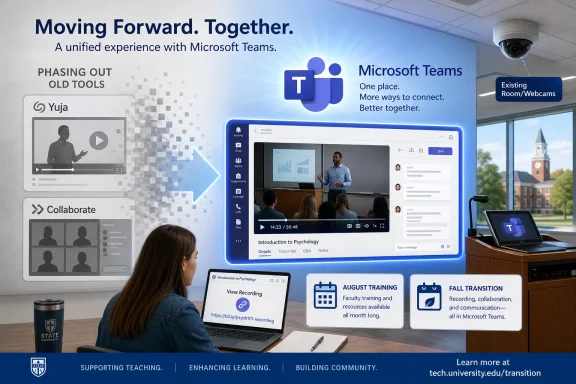 UPEI Is Collapsing Three Teaching Workflows Into One Supported Lane
The most important sentence in the Teaching and Learning Centre’s notice is not the one about Teams. It is the one that says the licenses for Yuja and Collaborate “will not be renewed.” That wording means the institution is not merely adding Teams as another option; it is removing the renewal path for existing licensed platforms and consolidating support around Microsoft Teams.That makes this a platform transition, not a feature substitution. Yuja, Collaborate, and Teams may overlap around video, meetings, recordings, and instructional activity, but they entered campus life through different doorways. Instructors may have used one tool for lecture capture, another for synchronous online sessions, and another for ad hoc communication. UPEI’s decision pushes those uses toward a single supported Microsoft environment.
The practical logic is obvious enough. Universities have spent years accumulating overlapping teaching technologies, often under emergency conditions, departmental preferences, accessibility needs, procurement cycles, and pandemic-era urgency. Every additional platform brings licensing costs, support documentation, training obligations, integration complexity, and an invisible tax on students who must learn yet another interface.
But consolidation carries its own risk. The retiring tools are not just names on a contract; they are routines embedded in syllabi, course shells, recorded-content archives, instructor muscle memory, and student expectations. The transition succeeds only if UPEI treats Teams not as a generic replacement but as the new institutional path for a set of very specific teaching behaviors.
The notice is careful on that point. It says Teams will be the supported platform for “video conferencing, recording, and related instructional activities.” That phrase is broad enough to cover the main teaching scenarios but narrow enough to avoid pretending that Teams is a full replacement for every specialized function instructors may have built around Yuja or Collaborate. The distinction is important. A supported institutional platform can become the default without becoming a magic clone of everything it replaces.
| Platform | Renewal or support status | Institutional role after the notice | Timing named in the notice |
|---|---|---|---|
| Yuja | License will not be renewed | No longer part of the renewed licensed toolset | Transition begins this fall |
| Collaborate | License will not be renewed | No longer part of the renewed licensed toolset | Transition begins this fall |
| Microsoft Teams | Supported platform | Video conferencing, recording, and related instructional activities | Training offered in August; transition begins this fall |
The Calendar Is the Real Constraint
UPEI’s timeline is compressed in the way academic technology timelines often are. The notice appears under a 2026/07 source path, training is promised in August, and the transition begins this fall. That gives instructors a summer runway, but not a long one.Timeline
July 2026 — The Teaching and Learning Centre notice announces the transition from Yuja and Collaborate to Microsoft Teams.August — Training opportunities for instructors will be offered, with online, on-demand resources also made available.
This fall — Microsoft Teams becomes the institution’s supported platform for video conferencing, recording, and related instructional activities.
That sequence is workable, but only if the August training is designed around the semester’s real failure points. Faculty do not need a tour of every button. They need to know how to run the first class, how to record, how to make materials findable, how to communicate expectations to students, and what to do when the planned workflow breaks.
The danger in a summer transition is that it can look calm from the support side and then become chaotic when courses begin. In July, the campus is reachable in fragments. In August, attention returns unevenly. By the first week of fall classes, every unresolved question becomes urgent at once.
The Teaching and Learning Centre’s notice says additional details will be shared in the coming weeks. That is the correct signal, but the quality of those details will determine whether the move feels managed or merely announced. Instructors will need more than confirmation that Teams is supported. They will need course-ready guidance: what to change in syllabi, how to tell students where meetings and recordings live, and which old instructions should be removed before they create confusion.
The phrase “beginning this fall” also deserves attention. It does not necessarily mean every historical dependency disappears overnight, but it does mean the supported center of gravity changes at the start of the academic cycle. If an instructor builds a fall course around a non-renewed platform, they are building against the institution’s stated direction.
That is the hard edge of a soft-sounding notice. The TLC is not scolding anyone. It is giving the campus enough warning to move before the old assumptions stop being safe.
Classroom Hardware Is the One Piece UPEI Says Should Not Break
The most reassuring operational detail in the notice is the statement that existing webcams in classrooms are universal and will work with Teams. That single sentence matters because hardware compatibility is where many teaching-technology migrations become politically expensive.If classroom cameras required replacement, the transition would immediately become a capital project. Rooms would need audits, schedules, installations, testing, and exceptions. Faculty would worry not only about software but about whether the physical room could still support hybrid or recorded teaching. The TLC’s statement reduces that risk: the webcams already in classrooms are expected to work with Teams.
That does not make the transition effortless. A webcam that “works” with Teams still has to be selected correctly, paired with the right microphone path, recognized by the room computer, and tested before class. But the notice’s hardware assurance means UPEI is not asking instructors to accept a platform change and a classroom equipment change at the same time.
This is the kind of detail that makes a short notice more credible. Institutions often announce new platforms in abstract terms and leave faculty to discover physical constraints later. UPEI is at least addressing the obvious classroom question up front: will the cameras already in place still function?
The answer, according to the Teaching and Learning Centre, is yes. For instructors, that should change the preparation task. The question is less “Do I need new classroom equipment?” and more “Have I confirmed the Teams workflow in the room where I teach?”
Those are very different support problems. The first requires procurement and installation. The second requires training, documentation, and a test run. One threatens the fall timetable; the other can be managed if people act early.
The Hidden Migration Is Not Video — It Is Pedagogy
The term “video conferencing” makes the transition sound like a meeting-platform decision. That understates the instructional stakes. In teaching, video tools are rarely just video tools; they shape how instructors structure participation, attendance, recordings, office hours, guest speakers, review sessions, group work, and contingency plans for disruption.Collaborate and Yuja likely occupied different mental categories for many users. One may have been associated with live online class sessions, the other with capture or recorded content. Teams, by contrast, arrives as a broader collaboration platform. That breadth is useful, but it also requires clearer institutional norms.
A university can standardize on Teams and still leave instructors with too many choices unless it defines the basic teaching patterns. Should instructors create recurring meetings in a consistent way? Where should students expect recordings to appear? What language should go into course outlines? What is the recommended practice for classes that meet partly in person and partly online? The notice does not answer those questions, and it should not be expected to in a first announcement. But those are the questions that will decide the experience.
This is where the August training becomes more than a courtesy. It is the bridge between “Teams can do this” and “Here is how UPEI wants you to do this in a course.” The latter is more valuable. Faculty can find generic Teams tutorials anywhere; what they need from the institution is a supported pattern that aligns with local classrooms, student expectations, and help channels.
The shift also forces instructors to revisit assumptions that may have been stable for years. A recorded lecture is not just a file; it is a promise about availability, discoverability, and continuity. A live online class is not just a meeting; it is a structured learning environment with norms around chat, attendance, participation, and follow-up. Moving those activities into Teams gives UPEI a chance to simplify support, but it also requires careful attention to how teaching actually happens.
There is an upside here. Standardization can reduce the cognitive load on students who otherwise move from course to course through different digital rituals. If Teams becomes the supported common denominator, students may spend less time asking where the session is and more time participating in it. But that benefit appears only if the campus implements the platform consistently enough for students to recognize the pattern.
The Support Model Is Being Redrawn
The notice comes from the Teaching and Learning Centre, and that origin matters. This is not framed as a purely technical change from an IT back office; it is being communicated as a teaching and learning transition. That signals that UPEI understands the main risk is instructional adoption, not merely software availability.Still, the support model is being redrawn whether the notice says so explicitly or not. When Yuja and Collaborate licenses are not renewed, the institution’s support expertise must follow the supported platform. Documentation, workshops, troubleshooting scripts, classroom instructions, and help-desk escalation paths all have to be updated around Teams.
The danger is a split-brain period in which some campus materials still point to old platforms while official support has moved on. That kind of mismatch is maddening for students and instructors because it creates uncertainty at the exact moment people need confidence. If a syllabus says one thing, a course page says another, and a support article says a third, the platform transition will be blamed even if the underlying technology works.
UPEI can avoid that by treating the migration as a content cleanup project as much as a software rollout. Old references to Yuja and Collaborate in course templates, help pages, orientation materials, departmental guides, and copied syllabus language should be flagged before fall. The goal is not historical erasure; it is operational clarity.
The contact address in the notice, [email protected], is therefore more than a courtesy line. It is the pressure valve for the transition. Instructors with unusual teaching setups, accessibility concerns, recording dependencies, or classroom-specific workflows need a place to ask before those questions become semester-blocking problems.
The Teaching and Learning Centre should expect the questions to cluster in predictable ways. Faculty will ask how to record, how to share recordings, how students join, what happens in classrooms with existing webcams, and where training materials live. Departments will ask whether they can standardize local guidance. Students may ask why familiar links have disappeared. Those are not edge cases. They are the migration.
Students Will Feel the Change Even If They Never Read the Notice
Campus technology announcements are often written for employees, but students are usually the largest affected group. UPEI’s notice is addressed to the campus community, yet the direct training offer is for instructors. That is reasonable; instructors configure the course experience. But students will experience the resulting consistency or inconsistency immediately.If the transition works, students see fewer platform names, fewer login surprises, and fewer course-by-course variations in where live sessions and recordings happen. If it does not, students will spend the first weeks of term decoding each instructor’s version of the move to Teams. The difference depends less on Teams itself than on how clearly instructors communicate the new workflow.
The student-facing message needs to be plain: this course uses Microsoft Teams for the relevant live and recorded instructional activities; here is where to go; here is what to do if something fails. That kind of wording should appear before the first session, not after the first confused email.
There is also an equity dimension, though the notice does not dwell on it. Students who are new, remote, commuting, working, using assistive technologies, or navigating unstable schedules are most affected by unclear digital logistics. A platform transition that looks minor to experienced faculty can become a barrier for students who rely on recordings or remote access to stay current.
That is why consistency matters. A single supported platform can improve access only when the path is visible and repeatable. If every course implements Teams differently, the institution may have reduced its license count without reducing student confusion.
The transition also arrives with a cultural challenge. Many students and instructors already associate Teams with meetings, group chats, or administrative collaboration. Moving it into the center of instructional activity requires reframing it as a teaching space. That is not automatic. It has to be modeled in course design and reinforced by institutional guidance.
The End of License Renewal Is a Procurement Decision With Academic Consequences
Universities rarely say the quiet part loudly: licensing decisions shape pedagogy. When an institution renews a tool, it keeps a set of practices viable. When it declines renewal, it sends those practices into transition, workaround, or retirement.UPEI’s notice is candid about the licensing trigger. Yuja and Collaborate licenses will not be renewed. The announcement does not frame the decision around product criticism, service failure, or a dramatic incident. It simply states the institutional move: Teams will be supported beginning this fall.
That matters because it avoids the trap of platform theater. This is not a claim that one product is universally superior to another. It is an institutional standardization decision. The value comes from supportability, common training, and a shared direction.
Still, standardization can produce frustration among experienced users of the outgoing tools. People who have invested time in a platform often hear “we are not renewing it” as “your workflow no longer matters.” The institution has to counter that by acknowledging the practical cost of switching and offering usable migration paths.
The notice’s promise of August training and online, on-demand resources is a start. But training should not be limited to generic introductions. The most useful sessions will likely be scenario-based: replacing a live Collaborate session with a Teams session, recording a class using classroom webcams, preparing students for the new workflow, and troubleshooting the first week of use.
A good migration program respects the fact that faculty expertise is often procedural. Instructors know exactly where to click in the old tool because they have done it under pressure. They do not want a philosophical tour of Teams; they want to recover that same confidence before students are in the room.
That is the real cost of not renewing licenses. The invoice may disappear, but the transition labor moves to people: instructors, support staff, learning technologists, and students.
Why Teams Is the Plausible Default, Not a Perfect Substitute
Microsoft Teams is a plausible institutional default because it sits at the intersection of meetings, recordings, collaboration, and identity. For many organizations, including universities, that makes it easier to support than a collection of specialized tools. UPEI’s notice reflects that logic by naming Teams as the supported platform for the activities that sit closest to instruction.But plausibility is not perfection. A tool built for broad collaboration may not map cleanly onto every specialized teaching workflow developed in Yuja or Collaborate. The correct institutional message is not “everything will be identical.” It is “this is the supported path, and we will help you move the core work there.”
That distinction protects trust. Faculty can adapt to change when the tradeoffs are named honestly. They become resistant when a migration is oversold as frictionless and then friction appears on the first day of class.
The notice mostly avoids overclaiming. It says existing webcams are universal and will work with Teams. It says training opportunities will be offered in August. It says online, on-demand resources will be available. It says additional details will be shared. Those are concrete commitments without grandiose promises.
The next round of details should preserve that tone. UPEI does not need to market Teams to its own instructors. It needs to make the transition legible: what is changing, what remains supported, what instructors must do before fall, and where they can get help.
There is also a strategic benefit in having the supported platform align with a broader institutional collaboration environment. If Teams is already familiar for meetings or departmental work, the training burden may be lower than adopting an entirely new system. But familiarity can be deceptive. Knowing how to join a meeting is not the same as knowing how to run a course session, manage recordings, or design a reliable student workflow.
That is why the transition should be measured by fewer support incidents and clearer student access, not by the mere fact that Teams launches.
August Training Has to Be Built for the First Week of Class
The August training window is the pivot point. It is the one named intervention before the fall transition begins, and it will likely determine whether instructors treat the move as manageable or as another unsupported mandate.The best training will be short, repeatable, and tied to actual course tasks. Instructors preparing for fall do not need every Teams capability at once. They need a minimum viable teaching workflow they can trust: schedule, run, record, share, support.
Online, on-demand resources are equally important because not every instructor can attend live sessions in August. Asynchronous materials also help instructors recover answers at the moment of need. A recording or guide that can be consulted the night before class may be more valuable than a live workshop attended weeks earlier.
The Teaching and Learning Centre should assume different levels of readiness. Some instructors will already be comfortable in Teams. Others may have used it only for meetings. Some may have extensive Yuja or Collaborate workflows and need help translating them. A single introductory session will not serve all three groups equally.
The training should also include language instructors can copy into course materials. That may sound minor, but it is one of the fastest ways to produce consistency. If every instructor writes their own student-facing explanation from scratch, the campus gets variation. If the TLC provides recommended wording, students get a clearer shared pattern.
The same is true for troubleshooting. Instructors should know what students are likely to report and how to respond. “I cannot find the meeting,” “I cannot access the recording,” and “the classroom camera is not showing” are not exotic problems. They are the predictable opening acts of a platform migration.
August is late enough that instructors are thinking concretely about courses, but early enough to prevent most avoidable problems. UPEI has chosen the right month for training. Now it has to make that training practical enough to survive contact with September.
Departments Should Treat This as a Local Readiness Test
Although the notice is campus-wide, the transition will happen department by department, course by course, and room by room. That means local academic units should not wait passively for central instructions. They should translate the institutional decision into local readiness.A department can do a simple audit without inventing bureaucracy. Which fall courses rely on Yuja or Collaborate? Which instructors record regularly? Which rooms use webcams? Which courses have remote or hybrid components? Which course outlines still name old platforms?
That local knowledge is often invisible to central support until something fails. Departments know which instructors are heavy users, which courses have unusual requirements, and which students depend on recordings. If they gather that information early, the TLC can respond before the fall rush.
The transition also creates an opportunity for departments to standardize student communication. A program that uses consistent language across multiple courses will reduce confusion. Even if instructors differ in teaching style, the basic navigation for live sessions and recordings should not feel like a scavenger hunt.
This is particularly important for first-year students and new faculty. Returning users may infer what changed. New users have no baseline. They will judge the institution by the clarity of the current workflow, not by memories of the previous one.
Local readiness should include classroom testing. The notice says existing webcams will work with Teams, but every instructor who depends on a room setup should still test the actual room. Compatibility as a category does not guarantee confidence in a specific teaching space at a specific time.
The message for departments is simple: central support can set the platform, but local units know where the transition risk lives.
Action checklist for admins
- Identify fall courses and instructors that currently depend on Yuja or Collaborate workflows.
- Remove or update course, syllabus, and departmental references that direct students to the non-renewed platforms.
- Encourage instructors to attend August training or use the online, on-demand resources before classes begin.
- Test Teams in classrooms where webcam-based conferencing or recording will be used.
- Provide students with consistent course-level instructions for Teams meetings, recordings, and support contacts.
- Route unresolved questions to the Teaching and Learning Centre at [email protected] before the fall term pressure spike.
The Biggest Risk Is a Half-Migration
The most dangerous outcome is not that Teams fails outright. It is that the campus enters fall with some instructors fully moved, some partially moved, some still using old documentation, and students forced to guess which platform matters in which course.Half-migrations are common because they feel less disruptive in the short term. People keep old instructions “just in case.” Departments delay cleanup until after the term starts. Instructors assume students will figure it out. Support teams publish new guidance but leave old pages discoverable.
The result is a confusing overlap period where the institution has made a clear licensing decision but the user experience remains muddy. That is the scenario UPEI should work hardest to avoid. If the licenses for Yuja and Collaborate will not be renewed, the campus message should be equally direct: Teams is the supported route for the named instructional activities beginning this fall.
That does not mean punishing edge cases or pretending every workflow is identical. It means preventing ambiguity from becoming the default. Exceptions should be handled as exceptions, not as silent parallel systems.
The notice already provides the skeleton of a clean migration: old licenses ending, Teams supported, webcams compatible, August training, on-demand resources, more details coming, TLC contact available. The next task is execution. Every vague instruction left unresolved now will become a help request later.
A half-migration also undermines the financial and support rationale for consolidation. The institution gives up the simplicity benefit if users continue to operate as though three platforms are still equally viable. Standardization pays off only when the community can actually standardize.
What UPEI’s Short Notice Really Says
The Teaching and Learning Centre’s announcement is brief, but its implications are concrete. UPEI is not merely changing a meeting link; it is moving the supported center of instructional video activity to Microsoft Teams. That affects classrooms, recordings, training, student instructions, and the support assumptions behind fall teaching.For instructors and admins, the useful reading is not “Teams is coming.” It is “the old licensed defaults are leaving, and preparation has to happen before fall.” The campus has a narrow but real window to make the change feel orderly.
- Yuja and Collaborate licenses will not be renewed.
- Microsoft Teams becomes the supported platform for video conferencing, recording, and related instructional activities beginning this fall.
- Existing classroom webcams are expected to work with Teams.
- Instructor training is scheduled for August, with online, on-demand resources also planned.
- Additional details are expected in the coming weeks.
- Questions should go to the Teaching and Learning Centre at [email protected].
If UPEI manages the details well, the move to Teams could reduce platform sprawl and give students a clearer, more consistent path for live and recorded instructional activity. If it manages the details poorly, the same decision will be remembered as another fall-term scramble disguised as a software update. The technology choice has been made; the real test now is whether the institution can turn a short notice into a coherent teaching experience before the first classes depend on it.
References
- Primary source: UPEI
Published: 2026-07-08T12:42:09.292011
Transition from Yuja and Collaborate to Microsoft Teams | UPEI
Big futures start at UPEI—interesting and unique programs; caring and supporting instructors and staff; and amazing opportunities to shape your ambitions.www.upei.ca