

Suralink announced on June 3, 2026, from Salt Lake City, that its agentic automation platform for accounting firms and their clients is adding an expanded Agent Library, a Cloud Testing Suite, Excel-based Workpaper Suite Intelligence, and native integrations with Microsoft Copilot and Claude. The announcement, distributed by Business Wire at 07:00 AM and disclosed at 07:02 AM, is less a routine AI feature drop than a bid to control the accounting workflow before bad data poisons it. Suralink’s core argument is blunt: accounting firms do not get transformative results from AI if the inputs are inaccurate, incomplete, or late. The company is trying to turn the client intake layer—the messy “front door” of engagements—into the place where agentic AI either earns its keep or fails.
Most AI announcements in professional services orbit the same promise: automate the drudgery, summarize the documents, draft the memo, speed up the review. Suralink’s June 3 announcement takes a more operationally interesting angle. It argues that the accounting industry’s AI bottleneck is not only the intelligence of the model or the sophistication of the assistant, but the condition of the client data that gets fed into those systems.
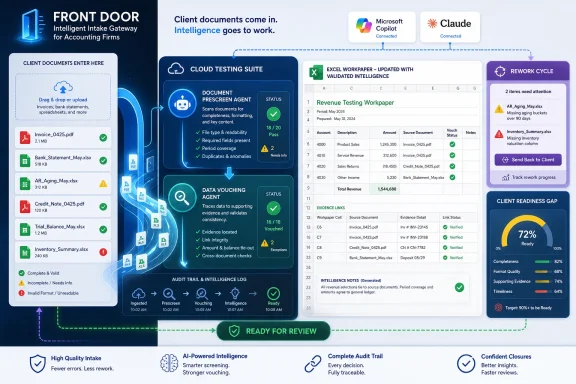
That is why the company centers the announcement on what it calls the Rework Cycle. In Suralink’s framing, the Rework Cycle is the redundant work accounting firms incur when clients submit inaccurate or incomplete data. The company calls it the #1 cause of engagement inefficiency and the #1 issue preventing AI from delivering on its transformational potential for the accounting industry.
That is a strong claim, and it matters because it recasts AI implementation as a workflow-control problem rather than a chatbot-adoption problem. If the first serious inspection of a client document happens only after the file has already entered the firm’s systems, AI can accelerate the wrong thing. It can classify flawed information faster, route incomplete evidence faster, and create a more polished version of a mess that still has to be unwound by humans.
Suralink’s pitch is that firms need AI at the moment of upload, not merely at the moment of analysis. That is the significance of positioning Suralink as the “Front Door” of client data. The firm that controls intake can prescreen, validate, ask for corrections, and reduce downstream churn before accountants and auditors spend billable hours discovering what should have been caught at the gate.
Accounting work depends on client-provided evidence: trial balances, invoices, bank statements, schedules, reconciliations, exports, workpapers, and supporting documentation. When those materials arrive late, incomplete, mislabeled, duplicated, or inconsistent with the request list, the firm pays for the error twice. First it spends time identifying the defect, then it spends more time chasing the client for a corrected version and reconciling the new information against work already performed.
AI does not automatically eliminate that waste. In some cases, it can deepen it. A model that extracts data from a bad source can produce confident but unusable output. An automation that routes an incomplete document to the next step can create a false sense of progress. A digital assistant summarizing an unreliable workpaper can make the output look more complete than it really is.
That is the “Client Readiness Gap” in Suralink’s terminology. The release says the Rework Cycle is rooted in that gap, which is a useful distinction. The problem is not merely that accounting teams are inefficient; it is that client-side readiness is uneven, and firms often absorb the cost of that unevenness after the engagement has already moved forward.
For WindowsForum readers, the lesson reaches beyond accounting. Every Microsoft 365, Copilot, and line-of-business automation rollout eventually runs into the same reality: AI tools are downstream consumers of organizational data quality. The assistant is only as useful as the workflow that decides what gets submitted, what gets verified, what gets rejected, and what gets promoted into the system of record.
The two named agents are the important ones for the story because they anchor Suralink’s new Cloud Testing Suite. According to the announcement, Document Prescreen Agent and Data Vouching Agent are combined into that suite, which “fully automates the prescreening of client data and completes initial testing without firm users needing to do anything.” That is the operational claim on which the announcement stands or falls.
Prescreening is the more intuitive function. At intake, an agent can examine whether the client uploaded the right kind of document, whether it appears complete, whether it matches the request, and whether obvious defects should be surfaced immediately. If that works well, the firm avoids turning every missing page, wrong period, or malformed export into a staff-level discovery exercise.
Data vouching is more consequential. In accounting, vouching implies tracing a recorded item back to supporting evidence, or otherwise checking whether data is supported by source documentation. Suralink’s release does not provide a technical explanation of how its Data Vouching Agent operates, so it would be wrong to infer more than the company states. But by pairing prescreening and vouching inside a Cloud Testing Suite, Suralink is clearly aiming beyond document triage and toward initial audit or engagement testing.
That is why the phrase “without firm users needing to do anything” is both attractive and provocative. It speaks directly to capacity constraints in accounting firms, where staff time is scarce and review bottlenecks compound during busy seasons. It also raises governance questions: what counts as “initial testing,” how exceptions are flagged, how evidence is retained, and how a human reviewer later understands what the agent did.
That positioning matters. Suralink describes its platform as a fully integrated Request-to-Review platform, which means its value proposition spans the path from asking the client for information through receiving, organizing, testing, and preparing material for review. If AI is embedded across that path, it can theoretically reduce friction at multiple points rather than functioning as an assistant bolted onto the end.
The phrase “Cloud Testing Suite” also signals where Suralink wants buyers to place the product in their mental architecture. This is not a desktop macro, a local Excel add-in, or a generic file-upload checker. It is positioned as a cloud workflow layer that can inspect client data when it arrives and perform initial testing before staff users spend time on it.
That will appeal to firms that already operate across distributed teams and client portals. It may also make some IT and risk leaders cautious, especially in regulated professional environments where audit trails, permissions, retention, and explainability matter. The release does not detail those controls, so buyers should not assume them; they should ask for them.
The more interesting implication is competitive. If Suralink can make the intake layer intelligent and sticky, it gains influence over the entire engagement workflow. The firm does not merely use Suralink to collect files. It depends on Suralink to decide whether files are usable, whether testing can begin, and whether staff should spend time on the next stage.
Suralink says it is launching native connectors with Copilot and Claude, described as two of the leading agentic platforms. The company does not specify in the release exactly what data, prompts, actions, or workflows the connectors expose. That means any precise claim about functionality beyond “native connectors” would be overreach.
Still, the choice of partners is revealing. Microsoft Copilot is the obvious enterprise doorway because accounting firms live in Microsoft-heavy environments: Outlook, Teams, SharePoint, OneDrive, Excel, and the broader Microsoft 365 stack. Claude, meanwhile, has become associated in many professional settings with long-context reasoning, document work, and assistant-style analysis. Suralink’s announcement puts both under the same umbrella: external agentic platforms that can connect to the accounting workflow Suralink controls.
The table is intentionally narrow because the source material is narrow. Suralink does not publish a feature-by-feature comparison of the Copilot and Claude connectors in the announcement. It simply says both are native connectors and that they bring Suralink’s AI capabilities across all parts of the fully integrated Request-to-Review platform.
For buyers, that lack of detail should shape the evaluation. A “native connector” can mean anything from read-only data access to action-taking workflow integration. It can expose documents, metadata, request status, testing results, exception lists, or summarized engagement context. It can also vary widely in permission handling, logging, and administrative control.
The right question is not whether a connector exists. The right question is what the connector is allowed to do.
Workpapers remain the connective tissue of many engagements. Even when firms use cloud platforms, document portals, data extraction tools, audit suites, and practice-management systems, Excel still functions as the flexible medium where accountants reconcile, annotate, calculate, tie out, and review. Any AI product that ignores Excel risks becoming an impressive sidecar rather than a daily workflow tool.
Suralink’s release does not describe the Excel-based Workpaper Suite Intelligence in detail. It names the capability and places it alongside the native Copilot and Claude connectors as part of the effort to bring Suralink’s AI capabilities across the Request-to-Review platform. That is enough to understand the strategic placement: Suralink wants AI to follow the engagement into the workpaper layer, not stop at document intake.
For IT leaders, Excel integration is both a selling point and a risk surface. The spreadsheet is where business logic often lives without being formally documented. It is where version control can degrade, macros can linger, formulas can break, and review procedures can become dependent on individual preparer habits. Adding intelligence to that environment can be valuable, but only if the firm understands how the system treats formulas, references, attachments, and reviewer sign-offs.
This is the broader tension of accounting AI. The most useful workflows are also the ones closest to professional judgment. Automating document prescreening is one thing. Producing ready-to-review results from client data and workpapers is another. The closer the AI gets to the conclusion, the more important it becomes to preserve traceability.
That is a bold positioning statement. Fitzpatrick is not merely saying Suralink has added AI. He is saying Suralink occupies the workflow location that makes agentic AI most effective.
This is a classic platform argument. The most valuable software layer is often the one closest to the source of truth, the system of action, or the workflow choke point. In accounting engagements, client-provided data is the source material; the request list is the workflow contract; review is the expensive bottleneck. Suralink is arguing that because it sits at the entrance to that flow, it can impose structure before chaos spreads.
The phrase “Front Door” also tells customers how Suralink wants to be evaluated against generic AI tools. Copilot and Claude may be powerful assistants, but they are not inherently accounting intake platforms. They do not automatically know whether a client has satisfied a request, whether supporting documentation is complete, or whether a workpaper is ready for review inside a particular engagement workflow. Suralink is saying that domain context and workflow position matter as much as model capability.
The risk, from a buyer’s perspective, is dependency. Once a platform becomes the front door for client data, replacing it becomes harder. Files, requests, workflows, exceptions, staff habits, client routines, and review procedures accumulate around it. If Suralink’s AI delivers as promised, that stickiness is a feature. If the implementation disappoints, it becomes another enterprise workflow trap.
Those are powerful proof points, but they should be read carefully. The announcement does not explain the methodology behind the “84% faster” growth metric. It does not define the peer group, the measurement basis, or whether the comparison adjusts for firm size, geography, service mix, or market conditions. Because the figure comes from Suralink’s own release, buyers should treat it as a headline claim and ask for the underlying analysis.
Even so, the customer-reach statement matters. Serving over 50% of the top 100 firms suggests Suralink is not pitching an untested tool to a market it barely knows. It is selling deeper automation into an existing professional-services customer base. That makes the AI announcement more significant than a startup feature launch would be in isolation.
For top-tier firms, the competitive pressure is clear. If larger firms can reduce rework at the client intake stage, they may improve realization, staff utilization, and engagement turnaround. If they can do that at scale, smaller firms may face a widening operational gap unless they adopt similar workflow automation or specialize in areas where client complexity is lower.
For midmarket and regional firms, the question is not whether “agentic AI” sounds futuristic. The question is whether the firm can standardize intake enough for automation to help. AI cannot fix a process that nobody follows. It can, however, enforce structure around requests, uploads, prescreening, and exception handling if leadership is willing to make the workflow nonoptional.
June 3, 2026, 07:00 AM — Business Wire lists the Suralink press release publication time.
June 3, 2026, 07:02 AM — Business Wire lists the disclosure time for the release.
June 3, 2026 — Suralink announces multiple major additions to its agentic AI capabilities, including an Agent Library with five new agents, the Cloud Testing Suite, Excel-based Workpaper Suite Intelligence, and native connectors with Microsoft Copilot and Claude.
Many organizations think about Copilot adoption in terms of licensing, prompts, security trimming, Teams meetings, Word drafts, Outlook summaries, and SharePoint search. Suralink’s announcement points to a more specialized pattern: Copilot becomes more useful when connected to domain systems that know the state of real work. In this case, that work is the accounting request-to-review process.
That has consequences for Microsoft-centered IT departments. If Copilot is allowed to participate in accounting workflows, IT needs to understand what Suralink exposes through its native connector, what permissions govern that exposure, and whether the connector respects the same client confidentiality boundaries the firm enforces elsewhere. The fact that an integration is native does not answer those questions.
The same is true for Claude. Firms evaluating both ecosystems will need to decide whether they want AI assistants acting as general-purpose reasoning layers over Suralink-managed engagement data, whether they want narrow task execution, or whether they want Suralink’s own agents to do the accounting-specific work while Copilot and Claude provide user-facing assistance.
The best architecture may not be a single AI assistant that does everything. It may be a layered model: Suralink agents handle intake, prescreening, vouching, and workpaper intelligence inside the engagement workflow; Copilot assists users inside Microsoft 365; Claude supports document reasoning or other assistant workflows where appropriate. But that architecture only works if permissions, logs, and responsibilities are clear.
A summarization tool can be wrong and still be relatively easy to contain if humans treat the output as a draft. An agent that prescreens client data, conducts initial testing, and delivers ready-to-review results becomes part of the production workflow. Its mistakes may affect scheduling, review queues, exception handling, and client follow-up.
That does not mean firms should avoid it. It means they should treat it like workflow infrastructure, not like an experimental convenience. Firms need to know what the agent checked, what it skipped, what confidence thresholds or business rules applied, and how exceptions are escalated. They also need to decide which engagement types are suitable for automation first.
The release’s promise that the Cloud Testing Suite completes initial testing without firm users needing to do anything will be attractive to executives trying to escape capacity constraints. But “without firm users needing to do anything” should not mean without firm oversight, policy, or review design. The highest-value implementations will likely be the ones where firms define precisely what counts as prescreening, what counts as initial testing, and where human review begins.
The professional liability dimension is also unavoidable. Accounting firms do not simply process documents; they issue work product that clients, regulators, lenders, investors, and management teams rely on. If AI becomes part of the evidentiary chain, the firm must be able to explain its procedures. The announcement does not discuss liability or assurance standards, so firms should bring those questions into procurement and implementation.
AI can help only if it changes that pattern. Prescreening at upload creates an opportunity for immediate feedback. A client who submits the wrong file can be told sooner. A request that lacks required support can be flagged before staff build work around it. A recurring defect can become visible as a client-readiness issue rather than a one-off annoyance.
But that also means firms must decide how firm they want the front door to be. If the system flags bad submissions but staff override the warnings to keep the engagement moving, the Rework Cycle survives. If clients are allowed to dump data into the portal without consequence, automation becomes cleanup rather than prevention. If partners resist standardized workflows for high-touch clients, the AI will inherit the exceptions.
The most successful deployments will likely be as much about change management as software. Firms will need client communication templates, intake standards, escalation rules, and internal expectations about what gets accepted. They will need to train staff not to treat AI findings as magic and not to ignore them as noise.
That is why Suralink’s “Client Readiness Gap” language is useful. It places responsibility on the boundary between firm and client. The gap is not entirely inside the firm’s technology stack or entirely inside the client’s behavior. It exists where the two meet.
There is no detailed description of the five agents beyond the two named examples. There is no technical breakdown of the Document Prescreen Agent or Data Vouching Agent. There is no specific explanation of what the Copilot and Claude connectors expose or whether they support read, write, or action-taking workflows. There is no security architecture, data-residency discussion, retention model, or admin-control matrix in the source material.
That is normal for a press release, but it matters because agentic AI products can sound more complete than they are. The phrase “ready-to-review results” is especially important. A reviewer needs more than a final output; the reviewer needs context, evidence, exception notes, and a reliable trail of how the result was produced.
Firms should also ask how Suralink handles false positives and false negatives. If the prescreening agent rejects valid materials too often, staff and clients will route around it. If it accepts flawed materials too often, the promised reduction in rework will not materialize. If the Data Vouching Agent produces outputs without transparent linkage to source documents, reviewers may save little time.
Another open question is how the product behaves across firm methodologies. Accounting firms may share broad engagement patterns, but they differ in templates, risk tolerances, industry practices, client segments, and review expectations. A system that works beautifully for one standardized workflow may require careful configuration for another.
Accounting is a logical proving ground because the work is structured but not simple. There are request lists, documents, workpapers, reviews, deadlines, and repeatable procedures. There are also exceptions, judgment calls, client-specific quirks, and evidentiary requirements. That mix makes the field attractive for agentic automation but unforgiving of sloppy implementation.
Suralink is betting that the highest-leverage place to apply AI is not after accountants have already cleaned the data. It is before the cleanup becomes necessary. If that bet is right, the Rework Cycle becomes less a fact of life and more a design failure.
Competitors will almost certainly make similar arguments. Client portals, audit platforms, tax workflow systems, document-management products, and Microsoft 365-adjacent tools all have incentives to claim the same territory. The phrase “front door” will become contested because the front door is where the data, the client relationship, and the workflow all converge.
For firms, the danger is buying overlapping AI layers that do not agree about process ownership. One tool may prescreen documents, another may summarize them, another may route tasks, and another may generate review notes. Without a clear architecture, agentic AI can create a new Rework Cycle of its own: reconciling outputs from disconnected assistants.
Suralink’s announcement is a sign that professional-services AI is maturing from spectacle into plumbing: less about dazzling prompts, more about where the data enters, who verifies it, and how quickly bad inputs are stopped. If accounting firms want agentic AI to do more than decorate existing inefficiencies, they will need to treat the “front door” as strategic infrastructure—and demand that every AI agent crossing it leaves a trail clear enough for humans to trust.
 Suralink Wants to Move AI Upstream, Before the Work Breaks
Most AI announcements in professional services orbit the same promise: automate the drudgery, summarize the documents, draft the memo, speed up the review. Suralink’s June 3 announcement takes a more operationally interesting angle. It argues that the accounting industry’s AI bottleneck is not only the intelligence of the model or the sophistication of the assistant, but the condition of the client data that gets fed into those systems.That is why the company centers the announcement on what it calls the Rework Cycle. In Suralink’s framing, the Rework Cycle is the redundant work accounting firms incur when clients submit inaccurate or incomplete data. The company calls it the #1 cause of engagement inefficiency and the #1 issue preventing AI from delivering on its transformational potential for the accounting industry.
That is a strong claim, and it matters because it recasts AI implementation as a workflow-control problem rather than a chatbot-adoption problem. If the first serious inspection of a client document happens only after the file has already entered the firm’s systems, AI can accelerate the wrong thing. It can classify flawed information faster, route incomplete evidence faster, and create a more polished version of a mess that still has to be unwound by humans.
Suralink’s pitch is that firms need AI at the moment of upload, not merely at the moment of analysis. That is the significance of positioning Suralink as the “Front Door” of client data. The firm that controls intake can prescreen, validate, ask for corrections, and reduce downstream churn before accountants and auditors spend billable hours discovering what should have been caught at the gate.
The Press Release Is Marketing, But the Workflow Problem Is Real
The source material is a Suralink announcement carried by Business Wire and republished by AOL, so the language is plainly promotional. “Industry’s Most Comprehensive Agentic AI Platform” is the kind of headline every buyer should read with skepticism. But the underlying workflow problem Suralink describes is familiar to anyone who has worked around audits, tax engagements, client accounting services, or professional-services project management.Accounting work depends on client-provided evidence: trial balances, invoices, bank statements, schedules, reconciliations, exports, workpapers, and supporting documentation. When those materials arrive late, incomplete, mislabeled, duplicated, or inconsistent with the request list, the firm pays for the error twice. First it spends time identifying the defect, then it spends more time chasing the client for a corrected version and reconciling the new information against work already performed.
AI does not automatically eliminate that waste. In some cases, it can deepen it. A model that extracts data from a bad source can produce confident but unusable output. An automation that routes an incomplete document to the next step can create a false sense of progress. A digital assistant summarizing an unreliable workpaper can make the output look more complete than it really is.
That is the “Client Readiness Gap” in Suralink’s terminology. The release says the Rework Cycle is rooted in that gap, which is a useful distinction. The problem is not merely that accounting teams are inefficient; it is that client-side readiness is uneven, and firms often absorb the cost of that unevenness after the engagement has already moved forward.
For WindowsForum readers, the lesson reaches beyond accounting. Every Microsoft 365, Copilot, and line-of-business automation rollout eventually runs into the same reality: AI tools are downstream consumers of organizational data quality. The assistant is only as useful as the workflow that decides what gets submitted, what gets verified, what gets rejected, and what gets promoted into the system of record.
Five New Agents, Two Named Workhorses, One Clear Target
Suralink says its Agent Library includes five powerful new agents, though the release names only two: Document Prescreen Agent and Data Vouching Agent. That omission is notable. The announcement gives enough detail to understand the strategic thrust, but not enough to evaluate the full scope of the Agent Library agent by agent.The two named agents are the important ones for the story because they anchor Suralink’s new Cloud Testing Suite. According to the announcement, Document Prescreen Agent and Data Vouching Agent are combined into that suite, which “fully automates the prescreening of client data and completes initial testing without firm users needing to do anything.” That is the operational claim on which the announcement stands or falls.
Prescreening is the more intuitive function. At intake, an agent can examine whether the client uploaded the right kind of document, whether it appears complete, whether it matches the request, and whether obvious defects should be surfaced immediately. If that works well, the firm avoids turning every missing page, wrong period, or malformed export into a staff-level discovery exercise.
Data vouching is more consequential. In accounting, vouching implies tracing a recorded item back to supporting evidence, or otherwise checking whether data is supported by source documentation. Suralink’s release does not provide a technical explanation of how its Data Vouching Agent operates, so it would be wrong to infer more than the company states. But by pairing prescreening and vouching inside a Cloud Testing Suite, Suralink is clearly aiming beyond document triage and toward initial audit or engagement testing.
That is why the phrase “without firm users needing to do anything” is both attractive and provocative. It speaks directly to capacity constraints in accounting firms, where staff time is scarce and review bottlenecks compound during busy seasons. It also raises governance questions: what counts as “initial testing,” how exceptions are flagged, how evidence is retained, and how a human reviewer later understands what the agent did.
The Cloud Testing Suite Is an Intake Bet, Not Just an AI Feature
The Cloud Testing Suite is the most concrete product idea in the announcement because it binds Suralink’s agentic AI pitch to a recognizable accounting workflow. It is not simply “AI in the app.” It is a claim that prescreening and initial testing can be automated inside the request-to-review process.That positioning matters. Suralink describes its platform as a fully integrated Request-to-Review platform, which means its value proposition spans the path from asking the client for information through receiving, organizing, testing, and preparing material for review. If AI is embedded across that path, it can theoretically reduce friction at multiple points rather than functioning as an assistant bolted onto the end.
The phrase “Cloud Testing Suite” also signals where Suralink wants buyers to place the product in their mental architecture. This is not a desktop macro, a local Excel add-in, or a generic file-upload checker. It is positioned as a cloud workflow layer that can inspect client data when it arrives and perform initial testing before staff users spend time on it.
That will appeal to firms that already operate across distributed teams and client portals. It may also make some IT and risk leaders cautious, especially in regulated professional environments where audit trails, permissions, retention, and explainability matter. The release does not detail those controls, so buyers should not assume them; they should ask for them.
The more interesting implication is competitive. If Suralink can make the intake layer intelligent and sticky, it gains influence over the entire engagement workflow. The firm does not merely use Suralink to collect files. It depends on Suralink to decide whether files are usable, whether testing can begin, and whether staff should spend time on the next stage.
Copilot and Claude Are Connectors, Not the Whole Story
The Microsoft Copilot and Claude integrations will be the part of the announcement that catches the widest attention, particularly for firms already standardizing on Microsoft 365 or experimenting with Anthropic’s assistant ecosystem. But the connectors are not the whole strategy. They are distribution and interoperability moves wrapped around Suralink’s more important claim: that its own platform has the context needed to make accounting-specific AI useful.Suralink says it is launching native connectors with Copilot and Claude, described as two of the leading agentic platforms. The company does not specify in the release exactly what data, prompts, actions, or workflows the connectors expose. That means any precise claim about functionality beyond “native connectors” would be overreach.
Still, the choice of partners is revealing. Microsoft Copilot is the obvious enterprise doorway because accounting firms live in Microsoft-heavy environments: Outlook, Teams, SharePoint, OneDrive, Excel, and the broader Microsoft 365 stack. Claude, meanwhile, has become associated in many professional settings with long-context reasoning, document work, and assistant-style analysis. Suralink’s announcement puts both under the same umbrella: external agentic platforms that can connect to the accounting workflow Suralink controls.
| Platform named by Suralink | Integration described | Role in the announcement | Practical significance for firms |
|---|---|---|---|
| Microsoft Copilot | Native connector | One of two leading agentic platforms named | Connects Suralink’s AI capabilities to Microsoft-centered work environments |
| Claude | Native connector | One of two leading agentic platforms named | Extends Suralink’s AI capabilities into a second major agentic assistant ecosystem |
For buyers, that lack of detail should shape the evaluation. A “native connector” can mean anything from read-only data access to action-taking workflow integration. It can expose documents, metadata, request status, testing results, exception lists, or summarized engagement context. It can also vary widely in permission handling, logging, and administrative control.
The right question is not whether a connector exists. The right question is what the connector is allowed to do.
Excel Remains the Accounting Industry’s Unavoidable Center of Gravity
The announcement’s reference to Excel-based Workpaper Suite Intelligence may look secondary beside agent libraries and Copilot/Claude integrations, but it may be just as important in practice. Accounting firms do not live in AI dashboards. They live in Excel.Workpapers remain the connective tissue of many engagements. Even when firms use cloud platforms, document portals, data extraction tools, audit suites, and practice-management systems, Excel still functions as the flexible medium where accountants reconcile, annotate, calculate, tie out, and review. Any AI product that ignores Excel risks becoming an impressive sidecar rather than a daily workflow tool.
Suralink’s release does not describe the Excel-based Workpaper Suite Intelligence in detail. It names the capability and places it alongside the native Copilot and Claude connectors as part of the effort to bring Suralink’s AI capabilities across the Request-to-Review platform. That is enough to understand the strategic placement: Suralink wants AI to follow the engagement into the workpaper layer, not stop at document intake.
For IT leaders, Excel integration is both a selling point and a risk surface. The spreadsheet is where business logic often lives without being formally documented. It is where version control can degrade, macros can linger, formulas can break, and review procedures can become dependent on individual preparer habits. Adding intelligence to that environment can be valuable, but only if the firm understands how the system treats formulas, references, attachments, and reviewer sign-offs.
This is the broader tension of accounting AI. The most useful workflows are also the ones closest to professional judgment. Automating document prescreening is one thing. Producing ready-to-review results from client data and workpapers is another. The closer the AI gets to the conclusion, the more important it becomes to preserve traceability.
The “Front Door” Argument Is Really a Platform-Control Argument
Suralink CEO Evan Fitzpatrick provides the announcement’s thesis in unusually direct form: “As the ‘Front Door’ of all client data that comes into accounting firms, Suralink has always been the best-positioned platform to enable firms and their clients to realize the full potential of agentic AI.” In the same statement, he says Suralink can prescreen client data at upload, automatically conduct testing procedures, and deliver ready-to-review results, enabling firms to eliminate the Rework Cycle and close the Client Readiness Gap.That is a bold positioning statement. Fitzpatrick is not merely saying Suralink has added AI. He is saying Suralink occupies the workflow location that makes agentic AI most effective.
This is a classic platform argument. The most valuable software layer is often the one closest to the source of truth, the system of action, or the workflow choke point. In accounting engagements, client-provided data is the source material; the request list is the workflow contract; review is the expensive bottleneck. Suralink is arguing that because it sits at the entrance to that flow, it can impose structure before chaos spreads.
The phrase “Front Door” also tells customers how Suralink wants to be evaluated against generic AI tools. Copilot and Claude may be powerful assistants, but they are not inherently accounting intake platforms. They do not automatically know whether a client has satisfied a request, whether supporting documentation is complete, or whether a workpaper is ready for review inside a particular engagement workflow. Suralink is saying that domain context and workflow position matter as much as model capability.
The risk, from a buyer’s perspective, is dependency. Once a platform becomes the front door for client data, replacing it becomes harder. Files, requests, workflows, exceptions, staff habits, client routines, and review procedures accumulate around it. If Suralink’s AI delivers as promised, that stickiness is a feature. If the implementation disappoints, it becomes another enterprise workflow trap.
The Growth Claim Raises the Stakes
Suralink says it serves over 50% of the top 100 firms. The company also says that in 2025, Suralink customers grew 84% faster than their peers, and that top 20 firms like Eide Bially LLP have publicly championed the strong ROI they captured by moving to Suralink’s fully integrated Request-to-Review platform.Those are powerful proof points, but they should be read carefully. The announcement does not explain the methodology behind the “84% faster” growth metric. It does not define the peer group, the measurement basis, or whether the comparison adjusts for firm size, geography, service mix, or market conditions. Because the figure comes from Suralink’s own release, buyers should treat it as a headline claim and ask for the underlying analysis.
Even so, the customer-reach statement matters. Serving over 50% of the top 100 firms suggests Suralink is not pitching an untested tool to a market it barely knows. It is selling deeper automation into an existing professional-services customer base. That makes the AI announcement more significant than a startup feature launch would be in isolation.
For top-tier firms, the competitive pressure is clear. If larger firms can reduce rework at the client intake stage, they may improve realization, staff utilization, and engagement turnaround. If they can do that at scale, smaller firms may face a widening operational gap unless they adopt similar workflow automation or specialize in areas where client complexity is lower.
For midmarket and regional firms, the question is not whether “agentic AI” sounds futuristic. The question is whether the firm can standardize intake enough for automation to help. AI cannot fix a process that nobody follows. It can, however, enforce structure around requests, uploads, prescreening, and exception handling if leadership is willing to make the workflow nonoptional.
Timeline
2025 — Suralink says its customers grew 84% faster than their peers, a claim used in the announcement to demonstrate customer impact.June 3, 2026, 07:00 AM — Business Wire lists the Suralink press release publication time.
June 3, 2026, 07:02 AM — Business Wire lists the disclosure time for the release.
June 3, 2026 — Suralink announces multiple major additions to its agentic AI capabilities, including an Agent Library with five new agents, the Cloud Testing Suite, Excel-based Workpaper Suite Intelligence, and native connectors with Microsoft Copilot and Claude.
Where Windows and Microsoft 365 Shops Should Pay Attention
The WindowsForum angle is not that Suralink is a Windows product announcement. It is that Microsoft Copilot is now part of a professional-services automation story where the decisive data may live outside Microsoft 365.Many organizations think about Copilot adoption in terms of licensing, prompts, security trimming, Teams meetings, Word drafts, Outlook summaries, and SharePoint search. Suralink’s announcement points to a more specialized pattern: Copilot becomes more useful when connected to domain systems that know the state of real work. In this case, that work is the accounting request-to-review process.
That has consequences for Microsoft-centered IT departments. If Copilot is allowed to participate in accounting workflows, IT needs to understand what Suralink exposes through its native connector, what permissions govern that exposure, and whether the connector respects the same client confidentiality boundaries the firm enforces elsewhere. The fact that an integration is native does not answer those questions.
The same is true for Claude. Firms evaluating both ecosystems will need to decide whether they want AI assistants acting as general-purpose reasoning layers over Suralink-managed engagement data, whether they want narrow task execution, or whether they want Suralink’s own agents to do the accounting-specific work while Copilot and Claude provide user-facing assistance.
The best architecture may not be a single AI assistant that does everything. It may be a layered model: Suralink agents handle intake, prescreening, vouching, and workpaper intelligence inside the engagement workflow; Copilot assists users inside Microsoft 365; Claude supports document reasoning or other assistant workflows where appropriate. But that architecture only works if permissions, logs, and responsibilities are clear.
Agentic AI Makes Governance Less Optional
“Agentic” is the word doing the most marketing work in the announcement. In its strongest form, agentic AI means systems that do not merely respond to prompts but can pursue tasks, make tool calls, evaluate intermediate results, and move work forward. In accounting, that changes the governance conversation.A summarization tool can be wrong and still be relatively easy to contain if humans treat the output as a draft. An agent that prescreens client data, conducts initial testing, and delivers ready-to-review results becomes part of the production workflow. Its mistakes may affect scheduling, review queues, exception handling, and client follow-up.
That does not mean firms should avoid it. It means they should treat it like workflow infrastructure, not like an experimental convenience. Firms need to know what the agent checked, what it skipped, what confidence thresholds or business rules applied, and how exceptions are escalated. They also need to decide which engagement types are suitable for automation first.
The release’s promise that the Cloud Testing Suite completes initial testing without firm users needing to do anything will be attractive to executives trying to escape capacity constraints. But “without firm users needing to do anything” should not mean without firm oversight, policy, or review design. The highest-value implementations will likely be the ones where firms define precisely what counts as prescreening, what counts as initial testing, and where human review begins.
The professional liability dimension is also unavoidable. Accounting firms do not simply process documents; they issue work product that clients, regulators, lenders, investors, and management teams rely on. If AI becomes part of the evidentiary chain, the firm must be able to explain its procedures. The announcement does not discuss liability or assurance standards, so firms should bring those questions into procurement and implementation.
The Rework Cycle Is a People Problem Wearing a Software Mask
Suralink’s diagnosis is technical, but the Rework Cycle is also behavioral. Clients submit incomplete data for many reasons: they misunderstand the request, lack internal controls, depend on manual exports, delay until the deadline, or assume the accounting firm will sort it out. Firms tolerate that behavior because client service is relationship-driven and because busy teams often patch problems rather than redesign intake.AI can help only if it changes that pattern. Prescreening at upload creates an opportunity for immediate feedback. A client who submits the wrong file can be told sooner. A request that lacks required support can be flagged before staff build work around it. A recurring defect can become visible as a client-readiness issue rather than a one-off annoyance.
But that also means firms must decide how firm they want the front door to be. If the system flags bad submissions but staff override the warnings to keep the engagement moving, the Rework Cycle survives. If clients are allowed to dump data into the portal without consequence, automation becomes cleanup rather than prevention. If partners resist standardized workflows for high-touch clients, the AI will inherit the exceptions.
The most successful deployments will likely be as much about change management as software. Firms will need client communication templates, intake standards, escalation rules, and internal expectations about what gets accepted. They will need to train staff not to treat AI findings as magic and not to ignore them as noise.
That is why Suralink’s “Client Readiness Gap” language is useful. It places responsibility on the boundary between firm and client. The gap is not entirely inside the firm’s technology stack or entirely inside the client’s behavior. It exists where the two meet.
The Announcement Leaves Important Questions Unanswered
The Business Wire release gives Suralink’s product direction, named features, named integrations, and executive thesis. It does not give the implementation detail that IT, security, audit methodology, and operations leaders will need before committing critical workflows to the new capabilities.There is no detailed description of the five agents beyond the two named examples. There is no technical breakdown of the Document Prescreen Agent or Data Vouching Agent. There is no specific explanation of what the Copilot and Claude connectors expose or whether they support read, write, or action-taking workflows. There is no security architecture, data-residency discussion, retention model, or admin-control matrix in the source material.
That is normal for a press release, but it matters because agentic AI products can sound more complete than they are. The phrase “ready-to-review results” is especially important. A reviewer needs more than a final output; the reviewer needs context, evidence, exception notes, and a reliable trail of how the result was produced.
Firms should also ask how Suralink handles false positives and false negatives. If the prescreening agent rejects valid materials too often, staff and clients will route around it. If it accepts flawed materials too often, the promised reduction in rework will not materialize. If the Data Vouching Agent produces outputs without transparent linkage to source documents, reviewers may save little time.
Another open question is how the product behaves across firm methodologies. Accounting firms may share broad engagement patterns, but they differ in templates, risk tolerances, industry practices, client segments, and review expectations. A system that works beautifully for one standardized workflow may require careful configuration for another.
Action Checklist for Admins
- Inventory where client-provided data enters the firm today, including portals, email, shared drives, Teams channels, and ad hoc uploads.
- Ask Suralink for a precise description of what the Document Prescreen Agent and Data Vouching Agent check, produce, log, and escalate.
- Validate what the Microsoft Copilot and Claude native connectors can access, and whether they can take actions or only surface information.
- Define which engagement types are eligible for automated prescreening and initial testing before enabling broad rollout.
- Require audit trails that show source documents, agent actions, exceptions, timestamps, and reviewer decisions.
- Pilot with a workflow that has measurable rework today, then compare defect rates, turnaround time, and reviewer effort before expanding.
The Market Signal Is Bigger Than One Vendor
Suralink’s announcement fits a broader shift in enterprise AI: vendors are moving from assistant features toward workflow ownership. The first wave of AI adoption often emphasized conversational interfaces. The next wave is more likely to reward systems that sit inside the operational path and can complete bounded tasks with context.Accounting is a logical proving ground because the work is structured but not simple. There are request lists, documents, workpapers, reviews, deadlines, and repeatable procedures. There are also exceptions, judgment calls, client-specific quirks, and evidentiary requirements. That mix makes the field attractive for agentic automation but unforgiving of sloppy implementation.
Suralink is betting that the highest-leverage place to apply AI is not after accountants have already cleaned the data. It is before the cleanup becomes necessary. If that bet is right, the Rework Cycle becomes less a fact of life and more a design failure.
Competitors will almost certainly make similar arguments. Client portals, audit platforms, tax workflow systems, document-management products, and Microsoft 365-adjacent tools all have incentives to claim the same territory. The phrase “front door” will become contested because the front door is where the data, the client relationship, and the workflow all converge.
For firms, the danger is buying overlapping AI layers that do not agree about process ownership. One tool may prescreen documents, another may summarize them, another may route tasks, and another may generate review notes. Without a clear architecture, agentic AI can create a new Rework Cycle of its own: reconciling outputs from disconnected assistants.
What Firms Should Remember Before the Demo
The most concrete reading of Suralink’s June 3 announcement is that the company is trying to turn client intake into an AI-governed control point. That is the right problem to attack, but it is also the point in the workflow where mistakes can propagate if governance is weak.- Suralink announced multiple major agentic AI additions on June 3, 2026, including five new agents in its Agent Library.
- The two named agents, Document Prescreen Agent and Data Vouching Agent, form the new Cloud Testing Suite.
- The Cloud Testing Suite is positioned to automate prescreening of client data and complete initial testing without firm users needing to act.
- Microsoft Copilot and Claude are named as native integration targets, but the release does not specify detailed connector capabilities.
- Excel-based Workpaper Suite Intelligence signals that Suralink wants AI to reach the workpaper layer, not just the upload portal.
- The central business claim is that reducing the Rework Cycle requires closing the Client Readiness Gap before flawed data enters the firm’s downstream process.
Suralink’s announcement is a sign that professional-services AI is maturing from spectacle into plumbing: less about dazzling prompts, more about where the data enters, who verifies it, and how quickly bad inputs are stopped. If accounting firms want agentic AI to do more than decorate existing inefficiencies, they will need to treat the “front door” as strategic infrastructure—and demand that every AI agent crossing it leaves a trail clear enough for humans to trust.
References
- Primary source: aol.com
Published: 2026-07-08T08:50:08.546429

