

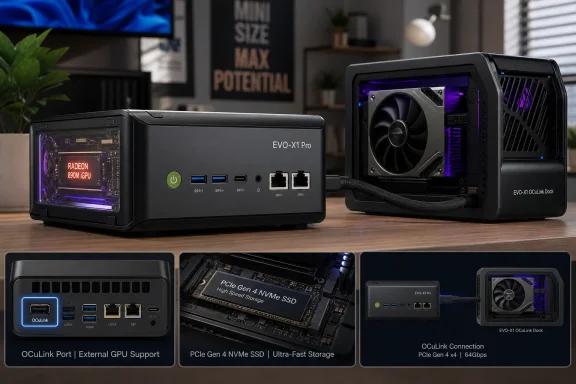
GMKtec’s EVO-X1 Pro is a compact Windows mini-PC already available to order in China and reportedly launching globally on July 14, pairing AMD’s newer Ryzen AI 9 HX 470 with 64 GB of RAM, OCuLink expansion, a PCIe Gen 4 SSD slot, and a $1,249 global price. The easy headline is “new chip, same tiny box,” but the more important story is subtler: this is a refresh that improves the GPU clock and preserves the external-GPU path while walking back memory speed. For Windows users and IT buyers, the EVO-X1 Pro is less a revolutionary mini-PC than a careful repositioning of last year’s high-end small-form-factor formula for the AI-PC era.
The EVO-X1 Pro sits in a category that has become much more interesting than the old “cheap NUC alternative” label suggests. Modern mini-PCs are no longer just low-power boxes for kiosks, conference rooms, and home labs; they are increasingly laptop-class performance platforms without the laptop attached. GMKtec’s EVO line has leaned into that shift, using high-end mobile silicon, dense memory configurations, and external expansion to make the mini-PC feel less like a compromise.
Notebookcheck’s report frames the EVO-X1 Pro as a return to the EVO-X1 generation rather than a clean-sheet design. That matters because the original EVO-X1 was already a fairly aggressive pitch: AMD Ryzen AI 9 HX 370 performance, Radeon 890M graphics, OCuLink support, and a compact chassis aimed at users who wanted desktop-like flexibility without a desktop tower. The Pro model keeps that same basic proposition but swaps in the Ryzen AI 9 HX 470 from AMD’s Gorgon Point family.
That processor change is the center of the launch, but it is not the whole launch. The EVO-X1 Pro keeps OCuLink, brings back a PCIe Gen 4 SSD slot, includes dual Gigabit Ethernet, and tops out at 64 GB of RAM. In China, the listed configuration is already available to order with 64 GB of RAM and 1 TB of storage for CNY 9,999, roughly $1,469. Notebookcheck says the global launch is reportedly set for July 14 at $1,249, which immediately makes the international price look more aggressive than the China listing if that figure holds.
The result is a product that reads like a specification-sheet negotiation. GMKtec appears to be preserving the features enthusiasts would miss most — OCuLink, high memory capacity, fast NVMe storage support, and the Radeon 890M — while changing the memory subsystem in a way that could matter precisely to the users most likely to care about integrated graphics performance.
AMD’s own product information identifies the Ryzen AI 9 HX 470 as part of the Ryzen AI 400 Series and lists Gorgon Point as the former codename. The CPU belongs to the same broad modern AMD mobile APU strategy: high-performance Zen-era CPU cores, integrated Radeon graphics, and Ryzen AI branding intended to make the platform relevant to local AI workloads as well as conventional Windows productivity. For mini-PC buyers, the point is not simply that the processor is “AI” branded; it is that the same silicon class can cover office work, development, content creation, light gaming, media use, and edge-style workloads in a box small enough to disappear behind a monitor.
The most concrete change is on the graphics side. AMD has overclocked the Radeon 890M iGPU by almost 7%, taking it from 2.9 GHz to 3.1 GHz. That is the kind of improvement that sounds minor until you remember the audience: integrated graphics buyers are often fighting for every frame, every watt, and every degree of thermal headroom.
Still, there is a ceiling to what a clock bump can do. The Radeon 890M remains an integrated GPU, sharing package power, thermals, and system memory bandwidth with the rest of the machine. A faster iGPU clock is welcome, especially in a mini-PC that may be used for light gaming or GPU-accelerated desktop workloads, but it does not magically turn a compact APU system into a gaming tower.
This is why the EVO-X1 Pro’s return of OCuLink is more than a checkbox. If the Radeon 890M is the credible built-in option, OCuLink is the escape hatch. It lets the machine remain small for everyday work while giving enthusiasts and power users a path to external graphics without relying solely on the integrated GPU.
For a Windows user, OCuLink’s appeal is straightforward: it offers a direct external PCIe path for devices such as external GPU docks. That matters because many compact systems are limited by internal space and cooling long before they run out of CPU ambition. A high-end mobile APU can feel fast in Windows, fast in browser workloads, and fast in development tools, yet still hit a wall in modern games, GPU compute, or rendering tasks that want a real discrete GPU.
The EVO-X1 Pro therefore has two personalities. On its own, it is a compact 64 GB Ryzen AI mini-PC with a faster-clocked Radeon 890M. With OCuLink, it becomes a small host system for a larger graphics setup. That second identity will not appeal to everyone, because external-GPU cabling and docks undermine the clean simplicity of a tiny PC, but it is exactly the kind of option that keeps enthusiasts engaged.
This is also where GMKtec’s pricing becomes interesting. A $1,249 global launch price is not impulse-buy territory for a mini-PC. At that level, buyers are comparing not only against cheaper small-form-factor systems but also against laptops, used desktops, self-built compact PCs, and higher-end boxes from other mini-PC vendors. OCuLink helps justify the price because it gives the system an upgrade path that a sealed, iGPU-only box lacks.
But OCuLink is not magic. A buyer still needs to account for the external GPU, dock, power delivery, cabling, physical layout, and driver behavior under Windows. The EVO-X1 Pro may be compact, but an OCuLink gaming or workstation setup is no longer truly minimalist. It is modular, not invisible.
That detail could easily be buried under the higher model number and faster iGPU clock, but it should not be. Integrated graphics performance depends heavily on memory bandwidth because the iGPU does not have its own dedicated VRAM. When a mini-PC leans on Radeon 890M graphics, memory speed is not a cosmetic specification; it is part of the graphics subsystem.
This creates a tension in the EVO-X1 Pro’s design. AMD has increased the Radeon 890M iGPU clock from 2.9 GHz to 3.1 GHz, but GMKtec has moved from LPDDR5X-7500 in the EVO-X1 to LPDDR5-6400 in the EVO-X1 Pro. In the real world, the net impact will depend on workload, thermals, firmware, power limits, and driver behavior. But on paper, the company has improved one part of the integrated graphics equation while weakening another.
For CPU-heavy work, the change may matter less. Compilation, office workloads, browser-heavy multitasking, and many business applications are not always constrained by memory bandwidth in the same way an iGPU gaming workload can be. For graphics-heavy tasks, however, the memory change is precisely where reviewers will need to look.
That is the central contradiction of the EVO-X1 Pro. It gets a newer APU and a faster iGPU clock, but it also gives up the faster memory used in the prior EVO-X1. Enthusiasts are right to ask whether the “Pro” label translates into better sustained performance or merely a newer processor name, a higher GPU clock, and a different bill of materials.
The table shows why this launch is not a simple “newer is better” story. The EVO-X1 Pro has the newer processor and faster iGPU clock. The EVO-X1, however, had faster LPDDR5X-7500 memory. For buyers who care about integrated graphics, that tradeoff is not academic.
At roughly $1,469, the China listing makes the EVO-X1 Pro look like an expensive compact machine for a specialized buyer. At $1,249 globally, it still is not cheap, but it becomes easier to justify for users who specifically want the combination of Ryzen AI 9 HX 470, 64 GB of RAM, OCuLink, and compact size. The difference between those price points could decide whether buyers see the system as a premium niche box or a plausible workstation alternative.
There is also a timing element. A July 14 global launch means GMKtec is trying to put the EVO-X1 Pro in front of international buyers quickly rather than letting the China listing sit as a curiosity. That matters in the mini-PC market, where products can become stale fast. AMD mobile silicon, Intel mobile silicon, USB4 docks, external-GPU options, and memory configurations all move quickly enough that a delayed global release can make a launch feel old before it arrives.
The global price also positions the EVO-X1 Pro against an awkward range of alternatives. Below it are cheaper mini-PCs that may offer enough performance for most users. Around it are high-end compact systems and premium laptops. Above it are more specialized workstation-class or gaming-focused small systems. GMKtec’s job is to convince buyers that this particular combination — compact chassis, 64 GB memory ceiling, OCuLink, Radeon 890M, and Ryzen AI branding — is worth paying for.
That argument will land differently depending on the buyer. A home-lab user may care more about networking, RAM, thermals, and storage. A light gamer may care more about the Radeon 890M and OCuLink. A developer may care about CPU performance, memory capacity, and a clean desk setup. An IT department may care about warranty, manageability, deployment consistency, and whether the machine behaves predictably under Windows updates and sleep states.
For the EVO-X1 Pro, the more grounded view is better. The Ryzen AI 9 HX 470 gives GMKtec a modern AMD platform with current Ryzen AI branding. That makes the machine more future-facing than a generic older mini-PC, especially for users who expect Windows and Windows applications to lean more on local acceleration over time. But the most immediate benefits will still come from familiar things: CPU speed, memory capacity, storage, display support, graphics capability, ports, and thermal behavior.
That is why the 64 GB memory configuration is important. For ordinary office users, 64 GB is overkill. For developers, virtual-machine users, creators, browser tab hoarders, local database testers, and people experimenting with local AI workloads, it can be the difference between a fun toy and a serious daily machine. The EVO-X1 Pro’s capacity gives it room to serve workloads that cheaper 16 GB or 32 GB mini-PCs may struggle with.
The storage story is similarly practical. A PCIe Gen 4 SSD slot means the machine is not trapped in low-end storage territory. A 1 TB configuration is a reasonable starting point, but power users will likely care about expansion and replacement as much as the included drive. Mini-PCs live or die by their ability to avoid feeling sealed and disposable.
Still, buyers should not confuse dense specifications with enterprise readiness. The EVO-X1 Pro may be a strong Windows mini-PC, but IT departments will want to validate imaging, drivers, firmware updates, sleep behavior, BitLocker behavior, peripheral compatibility, and recovery processes before deploying it broadly. Mini-PC vendors can deliver excellent hardware value, but the support model is often not the same as buying from a large enterprise OEM.
A compact Ryzen AI mini-PC with 64 GB of RAM and dual Ethernet can be a surprisingly capable home-lab node. It can run Windows, Linux, hypervisors, containers, test environments, monitoring tools, and small services without demanding a rack or a tower. It can sit quietly in an office, lab, or media cabinet, assuming the cooling profile is acceptable under load.
The caveat is that the source material identifies dual Gigabit Ethernet, not faster multi-gig networking. For some buyers, that will be enough. For others, especially those building storage-heavy labs or moving large media files, Gigabit Ethernet may feel conservative in a machine priced above $1,000. At that point, buyers may need to lean on other connectivity or use the machine in roles where CPU, RAM, and compactness matter more than raw network throughput.
That tradeoff matters because mini-PC buyers often expect one box to do everything. They want a workstation, game machine, NAS-adjacent node, lab server, and media box in the same enclosure. The EVO-X1 Pro can plausibly participate in several of those roles, but it is not automatically ideal for all of them. Dual Gigabit Ethernet is useful; it is not the same as a dedicated multi-gig storage server.
The Pro has a faster Radeon 890M clock. It reaches 3.1 GHz instead of 2.9 GHz. It retains OCuLink. It supports up to 64 GB of RAM. It is reportedly launching globally at $1,249. Those are all real selling points.
But the EVO-X1 had LPDDR5X-7500 memory, while the EVO-X1 Pro uses LPDDR5-6400. That fact complicates the upgrade narrative. If the workload is CPU-focused, the newer processor’s slightly higher benchmark behavior may carry the day. If the workload leans on the integrated GPU, the slower memory may claw back some of the benefit of the higher GPU clock. If the workload uses an external GPU over OCuLink, the iGPU and memory-speed debate becomes less important, and the system’s role as a compact host becomes more important.
This is exactly the kind of product where reviewers need to test more than synthetic CPU benchmarks. The meaningful questions are sustained performance, fan noise, iGPU gaming behavior, external-GPU stability, SSD thermals, sleep and resume behavior, and driver maturity. Notebookcheck’s prior EVO-X1 review praised the concept but also identified rough edges, including fan noise under load and power-state bugs. The EVO-X1 Pro needs to show not only that its processor is newer, but that the platform has matured.
For buyers, that means waiting for independent testing is not cowardice; it is due diligence. A mini-PC this dense can look perfect in a product grid and still frustrate users if firmware, cooling, or driver behavior falls short.
The first question is deployment consistency. If an organization buys a batch of EVO-X1 Pro units, it needs confidence that the firmware, storage, memory configuration, drivers, and Windows image behave consistently across the fleet. Mini-PCs from smaller vendors can be attractive on price and density, but IT departments should not assume they will get the same lifecycle tooling, driver cadence, or enterprise support guarantees they expect from larger OEMs.
The second question is thermals. A compact machine with a powerful mobile APU can deliver excellent peak performance, but sustained workloads expose the real design. Developers compiling code, analysts processing datasets, creators exporting media, and lab users running multiple services all care about what happens after the first few minutes. Does the system hold clocks? Does fan noise become intrusive? Does the SSD throttle? Does the chassis become too hot for its environment?
The third question is expansion behavior. OCuLink is valuable, but an OCuLink deployment adds variables: external GPU dock, power supply, cable quality, driver state, hot-plug behavior, and physical placement. For a single enthusiast, those are solvable problems. For an office, classroom, or lab, they are support tickets waiting to happen unless standardized carefully.
The wrong lesson is soldering the product identity too tightly to marketing cycles. When a chip family refresh arrives, vendors can relabel a machine around the newer part, advertise AI branding, and move quickly to a new SKU. That does not automatically make the resulting product bad, but it does force buyers to read past the name. Ryzen AI 9 HX 470 sounds newer than Ryzen AI 9 HX 370 because it is newer, but Notebookcheck’s “effectively re-branded” phrasing is the phrase buyers should remember.
The memory change reinforces the point. A product can carry a newer processor and still make a tradeoff elsewhere. In thin laptops, those tradeoffs are often about battery life, thermals, weight, or cost. In mini-PCs, they are about thermals, board design, margins, component availability, and segmentation. The EVO-X1 Pro looks like a classic small-system compromise: more modern processor branding and a faster iGPU clock, balanced against slower RAM.
None of this makes the EVO-X1 Pro unappealing. If anything, it makes it more interesting. The machine is a reminder that mini-PCs are now sophisticated enough to require the same analysis we apply to laptops and desktops. Buyers cannot judge them by CPU name alone.
The EVO-X1 Pro’s Radeon 890M clock increase from 2.9 GHz to 3.1 GHz is therefore meaningful. It gives GMKtec a straightforward performance story and gives buyers a reason to expect slightly better integrated graphics behavior than the earlier EVO-X1, all else being equal. Light gaming, emulation, GPU-accelerated creative tools, multi-display productivity, and media workloads all stand to benefit from a capable iGPU.
But all else is not equal when memory changes. The move from LPDDR5X-7500 to LPDDR5-6400 is precisely why final judgment should wait for testing. In bandwidth-sensitive gaming scenarios, the slower RAM may matter. In CPU-heavy or OCuLink-assisted scenarios, it may matter much less. In mixed workloads, the answer may vary from application to application.
That nuance is important because the mini-PC audience is unusually heterogeneous. One buyer may run Windows 11, a browser, Office, Teams, and a few admin tools. Another may run Steam, an external GPU, local AI experiments, and multiple virtual machines. Another may use the same box as a development node. The EVO-X1 Pro can plausibly serve all of them, but the value equation changes with each use case.
The first detail to watch is configuration. The China listing is 64 GB of RAM and 1 TB of storage. If the global $1,249 price maps to the same configuration, GMKtec will have a stronger story. If global SKUs vary, buyers will need to compare carefully and avoid assuming that every headline specification applies to every version.
The second detail is availability. Mini-PC launches sometimes begin with limited stock, marketplace listings, coupon pricing, or regional differences that make the real purchase price less clear than the launch price. A stated $1,249 global price is useful, but the actual buyer experience depends on where it appears, how it is supported, and whether tax, shipping, warranty, and returns are straightforward.
The third detail is review coverage. Notebookcheck has already provided the critical framing: this is a compact EVO-series refresh with Ryzen AI 9 HX 470, OCuLink, a faster Radeon 890M clock, and slower memory than the EVO-X1. The next layer of coverage needs to test whether those ingredients produce a better machine.
That is especially true for anyone considering the EVO-X1 Pro as a Windows workstation replacement. A spec sheet can tell you the RAM capacity and processor model. It cannot tell you whether the fans bother you in a quiet room, whether the firmware behaves, whether the storage stays cool, or whether an OCuLink setup remains stable after hours of load.
The strongest buyer is someone who wants a powerful Windows mini-PC, values OCuLink, needs or wants 64 GB of RAM, and understands that the Radeon 890M is good integrated graphics rather than a replacement for a serious discrete GPU. That buyer will see the EVO-X1 Pro as a dense, flexible platform with a modern AMD APU and an external expansion path.
The weaker buyer is someone who wants guaranteed maximum integrated-GPU performance. For that person, the RAM downgrade from the EVO-X1 raises a real question. The faster Radeon 890M clock may help, but slower system memory could limit gains in the workloads where the iGPU matters most. This is not a reason to dismiss the product, but it is a reason to wait for benchmarks.
The enterprise or small-business buyer sits somewhere in between. The EVO-X1 Pro could be useful as a compact workstation, lab box, or edge system, but only after validation. The hardware looks capable; the operational question is whether GMKtec’s firmware, support, and configuration consistency meet the buyer’s tolerance for risk.
 GMKtec Updates the Box, Not the Basic Argument
The EVO-X1 Pro sits in a category that has become much more interesting than the old “cheap NUC alternative” label suggests. Modern mini-PCs are no longer just low-power boxes for kiosks, conference rooms, and home labs; they are increasingly laptop-class performance platforms without the laptop attached. GMKtec’s EVO line has leaned into that shift, using high-end mobile silicon, dense memory configurations, and external expansion to make the mini-PC feel less like a compromise.Notebookcheck’s report frames the EVO-X1 Pro as a return to the EVO-X1 generation rather than a clean-sheet design. That matters because the original EVO-X1 was already a fairly aggressive pitch: AMD Ryzen AI 9 HX 370 performance, Radeon 890M graphics, OCuLink support, and a compact chassis aimed at users who wanted desktop-like flexibility without a desktop tower. The Pro model keeps that same basic proposition but swaps in the Ryzen AI 9 HX 470 from AMD’s Gorgon Point family.
That processor change is the center of the launch, but it is not the whole launch. The EVO-X1 Pro keeps OCuLink, brings back a PCIe Gen 4 SSD slot, includes dual Gigabit Ethernet, and tops out at 64 GB of RAM. In China, the listed configuration is already available to order with 64 GB of RAM and 1 TB of storage for CNY 9,999, roughly $1,469. Notebookcheck says the global launch is reportedly set for July 14 at $1,249, which immediately makes the international price look more aggressive than the China listing if that figure holds.
The result is a product that reads like a specification-sheet negotiation. GMKtec appears to be preserving the features enthusiasts would miss most — OCuLink, high memory capacity, fast NVMe storage support, and the Radeon 890M — while changing the memory subsystem in a way that could matter precisely to the users most likely to care about integrated graphics performance.
The Ryzen AI 9 HX 470 Is a Refresh With One Very Visible Clock Bump
AMD’s Ryzen AI 9 HX 470 gives the EVO-X1 Pro its “new” status, but Notebookcheck’s characterization is blunt: the chip is effectively a re-branded Ryzen AI 9 HX 370. That does not mean the part is meaningless. It means buyers should understand the improvement as an incremental platform refresh, not a generational leap.AMD’s own product information identifies the Ryzen AI 9 HX 470 as part of the Ryzen AI 400 Series and lists Gorgon Point as the former codename. The CPU belongs to the same broad modern AMD mobile APU strategy: high-performance Zen-era CPU cores, integrated Radeon graphics, and Ryzen AI branding intended to make the platform relevant to local AI workloads as well as conventional Windows productivity. For mini-PC buyers, the point is not simply that the processor is “AI” branded; it is that the same silicon class can cover office work, development, content creation, light gaming, media use, and edge-style workloads in a box small enough to disappear behind a monitor.
The most concrete change is on the graphics side. AMD has overclocked the Radeon 890M iGPU by almost 7%, taking it from 2.9 GHz to 3.1 GHz. That is the kind of improvement that sounds minor until you remember the audience: integrated graphics buyers are often fighting for every frame, every watt, and every degree of thermal headroom.
Still, there is a ceiling to what a clock bump can do. The Radeon 890M remains an integrated GPU, sharing package power, thermals, and system memory bandwidth with the rest of the machine. A faster iGPU clock is welcome, especially in a mini-PC that may be used for light gaming or GPU-accelerated desktop workloads, but it does not magically turn a compact APU system into a gaming tower.
This is why the EVO-X1 Pro’s return of OCuLink is more than a checkbox. If the Radeon 890M is the credible built-in option, OCuLink is the escape hatch. It lets the machine remain small for everyday work while giving enthusiasts and power users a path to external graphics without relying solely on the integrated GPU.
OCuLink Is the Feature That Keeps the EVO-X1 Pro From Being Just Another AI Mini-PC
OCuLink has become one of those enthusiast features that looks niche until you need it. In the mini-PC world, it can be the difference between “nice compact computer” and “modular workstation experiment.” GMKtec keeping OCuLink on the EVO-X1 Pro signals that the company understands why the EVO-X1 attracted attention in the first place.For a Windows user, OCuLink’s appeal is straightforward: it offers a direct external PCIe path for devices such as external GPU docks. That matters because many compact systems are limited by internal space and cooling long before they run out of CPU ambition. A high-end mobile APU can feel fast in Windows, fast in browser workloads, and fast in development tools, yet still hit a wall in modern games, GPU compute, or rendering tasks that want a real discrete GPU.
The EVO-X1 Pro therefore has two personalities. On its own, it is a compact 64 GB Ryzen AI mini-PC with a faster-clocked Radeon 890M. With OCuLink, it becomes a small host system for a larger graphics setup. That second identity will not appeal to everyone, because external-GPU cabling and docks undermine the clean simplicity of a tiny PC, but it is exactly the kind of option that keeps enthusiasts engaged.
This is also where GMKtec’s pricing becomes interesting. A $1,249 global launch price is not impulse-buy territory for a mini-PC. At that level, buyers are comparing not only against cheaper small-form-factor systems but also against laptops, used desktops, self-built compact PCs, and higher-end boxes from other mini-PC vendors. OCuLink helps justify the price because it gives the system an upgrade path that a sealed, iGPU-only box lacks.
But OCuLink is not magic. A buyer still needs to account for the external GPU, dock, power delivery, cabling, physical layout, and driver behavior under Windows. The EVO-X1 Pro may be compact, but an OCuLink gaming or workstation setup is no longer truly minimalist. It is modular, not invisible.
The Memory Downgrade Is the Specification That Deserves the Most Scrutiny
The oddest decision in the EVO-X1 Pro is not the processor. It is the RAM. GMKtec used LPDDR5X-7500 inside the EVO-X1, but the EVO-X1 Pro uses slower LPDDR5-6400.That detail could easily be buried under the higher model number and faster iGPU clock, but it should not be. Integrated graphics performance depends heavily on memory bandwidth because the iGPU does not have its own dedicated VRAM. When a mini-PC leans on Radeon 890M graphics, memory speed is not a cosmetic specification; it is part of the graphics subsystem.
This creates a tension in the EVO-X1 Pro’s design. AMD has increased the Radeon 890M iGPU clock from 2.9 GHz to 3.1 GHz, but GMKtec has moved from LPDDR5X-7500 in the EVO-X1 to LPDDR5-6400 in the EVO-X1 Pro. In the real world, the net impact will depend on workload, thermals, firmware, power limits, and driver behavior. But on paper, the company has improved one part of the integrated graphics equation while weakening another.
For CPU-heavy work, the change may matter less. Compilation, office workloads, browser-heavy multitasking, and many business applications are not always constrained by memory bandwidth in the same way an iGPU gaming workload can be. For graphics-heavy tasks, however, the memory change is precisely where reviewers will need to look.
That is the central contradiction of the EVO-X1 Pro. It gets a newer APU and a faster iGPU clock, but it also gives up the faster memory used in the prior EVO-X1. Enthusiasts are right to ask whether the “Pro” label translates into better sustained performance or merely a newer processor name, a higher GPU clock, and a different bill of materials.
| Feature | EVO-X1 Pro | EVO-X1 |
|---|---|---|
| Processor | Ryzen AI 9 HX 470 | Ryzen AI 9 HX 370 |
| AMD family | Gorgon Point | Not stated in source material |
| Integrated GPU | Radeon 890M at 3.1 GHz | Radeon 890M at 2.9 GHz |
| RAM type | LPDDR5-6400 | LPDDR5X-7500 |
| Maximum RAM noted | Up to 64 GB | Not stated in fact table |
| Expansion noted | OCuLink, PCIe Gen 4 SSD slot | OCuLink support noted in prior coverage |
The Price Says Global Buyers Are the Real Target
The EVO-X1 Pro is already available to order in China with 64 GB of RAM and 1 TB of storage for CNY 9,999, or about $1,469. Notebookcheck reports that the global launch is expected on July 14 at $1,249. If those numbers remain accurate at launch, the global price is not merely lower after conversion; it changes the competitive story.At roughly $1,469, the China listing makes the EVO-X1 Pro look like an expensive compact machine for a specialized buyer. At $1,249 globally, it still is not cheap, but it becomes easier to justify for users who specifically want the combination of Ryzen AI 9 HX 470, 64 GB of RAM, OCuLink, and compact size. The difference between those price points could decide whether buyers see the system as a premium niche box or a plausible workstation alternative.
There is also a timing element. A July 14 global launch means GMKtec is trying to put the EVO-X1 Pro in front of international buyers quickly rather than letting the China listing sit as a curiosity. That matters in the mini-PC market, where products can become stale fast. AMD mobile silicon, Intel mobile silicon, USB4 docks, external-GPU options, and memory configurations all move quickly enough that a delayed global release can make a launch feel old before it arrives.
The global price also positions the EVO-X1 Pro against an awkward range of alternatives. Below it are cheaper mini-PCs that may offer enough performance for most users. Around it are high-end compact systems and premium laptops. Above it are more specialized workstation-class or gaming-focused small systems. GMKtec’s job is to convince buyers that this particular combination — compact chassis, 64 GB memory ceiling, OCuLink, Radeon 890M, and Ryzen AI branding — is worth paying for.
That argument will land differently depending on the buyer. A home-lab user may care more about networking, RAM, thermals, and storage. A light gamer may care more about the Radeon 890M and OCuLink. A developer may care about CPU performance, memory capacity, and a clean desk setup. An IT department may care about warranty, manageability, deployment consistency, and whether the machine behaves predictably under Windows updates and sleep states.
Windows Users Get a Capable AI-Era Desktop, But Not a Miracle Box
The EVO-X1 Pro arrives in a Windows market where “AI PC” has become both a genuine platform transition and a marketing fog machine. AMD, Intel, Qualcomm, Microsoft, and OEMs have spent the last two years teaching buyers to look for AI branding, neural processors, and local inference capability. The danger is that consumers begin to treat the badge as a guarantee of practical value.For the EVO-X1 Pro, the more grounded view is better. The Ryzen AI 9 HX 470 gives GMKtec a modern AMD platform with current Ryzen AI branding. That makes the machine more future-facing than a generic older mini-PC, especially for users who expect Windows and Windows applications to lean more on local acceleration over time. But the most immediate benefits will still come from familiar things: CPU speed, memory capacity, storage, display support, graphics capability, ports, and thermal behavior.
That is why the 64 GB memory configuration is important. For ordinary office users, 64 GB is overkill. For developers, virtual-machine users, creators, browser tab hoarders, local database testers, and people experimenting with local AI workloads, it can be the difference between a fun toy and a serious daily machine. The EVO-X1 Pro’s capacity gives it room to serve workloads that cheaper 16 GB or 32 GB mini-PCs may struggle with.
The storage story is similarly practical. A PCIe Gen 4 SSD slot means the machine is not trapped in low-end storage territory. A 1 TB configuration is a reasonable starting point, but power users will likely care about expansion and replacement as much as the included drive. Mini-PCs live or die by their ability to avoid feeling sealed and disposable.
Still, buyers should not confuse dense specifications with enterprise readiness. The EVO-X1 Pro may be a strong Windows mini-PC, but IT departments will want to validate imaging, drivers, firmware updates, sleep behavior, BitLocker behavior, peripheral compatibility, and recovery processes before deploying it broadly. Mini-PC vendors can deliver excellent hardware value, but the support model is often not the same as buying from a large enterprise OEM.
Dual Gigabit Ethernet Makes the EVO-X1 Pro More Than a Desk Toy
The presence of dual Gigabit Ethernet is easy to overlook because consumer coverage tends to focus on CPU and GPU performance. For many WindowsForum readers, however, networking is the specification that makes a mini-PC useful beyond a single desk. Dual wired ports open the door to routing, firewall, virtualization, lab, and segmented-network use cases.A compact Ryzen AI mini-PC with 64 GB of RAM and dual Ethernet can be a surprisingly capable home-lab node. It can run Windows, Linux, hypervisors, containers, test environments, monitoring tools, and small services without demanding a rack or a tower. It can sit quietly in an office, lab, or media cabinet, assuming the cooling profile is acceptable under load.
The caveat is that the source material identifies dual Gigabit Ethernet, not faster multi-gig networking. For some buyers, that will be enough. For others, especially those building storage-heavy labs or moving large media files, Gigabit Ethernet may feel conservative in a machine priced above $1,000. At that point, buyers may need to lean on other connectivity or use the machine in roles where CPU, RAM, and compactness matter more than raw network throughput.
That tradeoff matters because mini-PC buyers often expect one box to do everything. They want a workstation, game machine, NAS-adjacent node, lab server, and media box in the same enclosure. The EVO-X1 Pro can plausibly participate in several of those roles, but it is not automatically ideal for all of them. Dual Gigabit Ethernet is useful; it is not the same as a dedicated multi-gig storage server.
The EVO-X1 Pro’s Biggest Competitor May Be the EVO-X1
The most uncomfortable comparison for the EVO-X1 Pro is not necessarily another vendor’s mini-PC. It is the original EVO-X1. When a new product is described as effectively moving from a Ryzen AI 9 HX 370 to a re-branded Ryzen AI 9 HX 470, the burden shifts from the model number to the platform details.The Pro has a faster Radeon 890M clock. It reaches 3.1 GHz instead of 2.9 GHz. It retains OCuLink. It supports up to 64 GB of RAM. It is reportedly launching globally at $1,249. Those are all real selling points.
But the EVO-X1 had LPDDR5X-7500 memory, while the EVO-X1 Pro uses LPDDR5-6400. That fact complicates the upgrade narrative. If the workload is CPU-focused, the newer processor’s slightly higher benchmark behavior may carry the day. If the workload leans on the integrated GPU, the slower memory may claw back some of the benefit of the higher GPU clock. If the workload uses an external GPU over OCuLink, the iGPU and memory-speed debate becomes less important, and the system’s role as a compact host becomes more important.
This is exactly the kind of product where reviewers need to test more than synthetic CPU benchmarks. The meaningful questions are sustained performance, fan noise, iGPU gaming behavior, external-GPU stability, SSD thermals, sleep and resume behavior, and driver maturity. Notebookcheck’s prior EVO-X1 review praised the concept but also identified rough edges, including fan noise under load and power-state bugs. The EVO-X1 Pro needs to show not only that its processor is newer, but that the platform has matured.
For buyers, that means waiting for independent testing is not cowardice; it is due diligence. A mini-PC this dense can look perfect in a product grid and still frustrate users if firmware, cooling, or driver behavior falls short.
For IT Buyers, the Small Box Creates Big Validation Work
The EVO-X1 Pro is not just an enthusiast gadget. Its combination of compact size, 64 GB RAM, dual Ethernet, and modern AMD silicon makes it plausible for small offices, developers, labs, and edge deployments. But the higher the spec sheet climbs, the more important validation becomes.The first question is deployment consistency. If an organization buys a batch of EVO-X1 Pro units, it needs confidence that the firmware, storage, memory configuration, drivers, and Windows image behave consistently across the fleet. Mini-PCs from smaller vendors can be attractive on price and density, but IT departments should not assume they will get the same lifecycle tooling, driver cadence, or enterprise support guarantees they expect from larger OEMs.
The second question is thermals. A compact machine with a powerful mobile APU can deliver excellent peak performance, but sustained workloads expose the real design. Developers compiling code, analysts processing datasets, creators exporting media, and lab users running multiple services all care about what happens after the first few minutes. Does the system hold clocks? Does fan noise become intrusive? Does the SSD throttle? Does the chassis become too hot for its environment?
The third question is expansion behavior. OCuLink is valuable, but an OCuLink deployment adds variables: external GPU dock, power supply, cable quality, driver state, hot-plug behavior, and physical placement. For a single enthusiast, those are solvable problems. For an office, classroom, or lab, they are support tickets waiting to happen unless standardized carefully.
Action checklist for admins
- Treat the EVO-X1 Pro as a pilot device first, not a blind fleet purchase.
- Validate Windows imaging, driver installation, firmware updates, sleep/resume, BitLocker, and recovery behavior.
- Test sustained CPU and GPU workloads, not only short benchmark runs.
- If using OCuLink, standardize the external GPU dock, cable, power supply, and driver package.
- Confirm whether dual Gigabit Ethernet is sufficient for the intended workload before assigning storage-heavy or routing-heavy roles.
- Compare the EVO-X1 Pro against the older EVO-X1 if memory bandwidth or integrated-GPU performance is a priority.
The Mini-PC Market Is Learning the Wrong and Right Lessons From Laptops
The EVO-X1 Pro exists because laptop silicon has become good enough to escape the laptop. AMD’s modern mobile APUs are efficient, fast, and graphically competent enough that a vendor like GMKtec can build a serious desktop-class-feeling machine around them. That is the right lesson from laptops: use efficient silicon to make smaller, quieter, more flexible desktops.The wrong lesson is soldering the product identity too tightly to marketing cycles. When a chip family refresh arrives, vendors can relabel a machine around the newer part, advertise AI branding, and move quickly to a new SKU. That does not automatically make the resulting product bad, but it does force buyers to read past the name. Ryzen AI 9 HX 470 sounds newer than Ryzen AI 9 HX 370 because it is newer, but Notebookcheck’s “effectively re-branded” phrasing is the phrase buyers should remember.
The memory change reinforces the point. A product can carry a newer processor and still make a tradeoff elsewhere. In thin laptops, those tradeoffs are often about battery life, thermals, weight, or cost. In mini-PCs, they are about thermals, board design, margins, component availability, and segmentation. The EVO-X1 Pro looks like a classic small-system compromise: more modern processor branding and a faster iGPU clock, balanced against slower RAM.
None of this makes the EVO-X1 Pro unappealing. If anything, it makes it more interesting. The machine is a reminder that mini-PCs are now sophisticated enough to require the same analysis we apply to laptops and desktops. Buyers cannot judge them by CPU name alone.
The Radeon 890M Remains the Built-In Star, Even With the Memory Question
The Radeon 890M is central to why systems like the EVO-X1 Pro attract attention. Integrated graphics used to be the part of the spec sheet that told you what the machine could not do. With modern AMD APUs, the iGPU is often one of the reasons to buy the system.The EVO-X1 Pro’s Radeon 890M clock increase from 2.9 GHz to 3.1 GHz is therefore meaningful. It gives GMKtec a straightforward performance story and gives buyers a reason to expect slightly better integrated graphics behavior than the earlier EVO-X1, all else being equal. Light gaming, emulation, GPU-accelerated creative tools, multi-display productivity, and media workloads all stand to benefit from a capable iGPU.
But all else is not equal when memory changes. The move from LPDDR5X-7500 to LPDDR5-6400 is precisely why final judgment should wait for testing. In bandwidth-sensitive gaming scenarios, the slower RAM may matter. In CPU-heavy or OCuLink-assisted scenarios, it may matter much less. In mixed workloads, the answer may vary from application to application.
That nuance is important because the mini-PC audience is unusually heterogeneous. One buyer may run Windows 11, a browser, Office, Teams, and a few admin tools. Another may run Steam, an external GPU, local AI experiments, and multiple virtual machines. Another may use the same box as a development node. The EVO-X1 Pro can plausibly serve all of them, but the value equation changes with each use case.
The Smart Buyer Waits for the July 14 Global Details
The reported July 14 global launch is the next meaningful checkpoint. Until then, the EVO-X1 Pro exists for international buyers as a partly confirmed, partly reported product: already available to order in China, with a global launch and $1,249 price reportedly coming. The difference between a clean global launch and a messy one will matter.The first detail to watch is configuration. The China listing is 64 GB of RAM and 1 TB of storage. If the global $1,249 price maps to the same configuration, GMKtec will have a stronger story. If global SKUs vary, buyers will need to compare carefully and avoid assuming that every headline specification applies to every version.
The second detail is availability. Mini-PC launches sometimes begin with limited stock, marketplace listings, coupon pricing, or regional differences that make the real purchase price less clear than the launch price. A stated $1,249 global price is useful, but the actual buyer experience depends on where it appears, how it is supported, and whether tax, shipping, warranty, and returns are straightforward.
The third detail is review coverage. Notebookcheck has already provided the critical framing: this is a compact EVO-series refresh with Ryzen AI 9 HX 470, OCuLink, a faster Radeon 890M clock, and slower memory than the EVO-X1. The next layer of coverage needs to test whether those ingredients produce a better machine.
That is especially true for anyone considering the EVO-X1 Pro as a Windows workstation replacement. A spec sheet can tell you the RAM capacity and processor model. It cannot tell you whether the fans bother you in a quiet room, whether the firmware behaves, whether the storage stays cool, or whether an OCuLink setup remains stable after hours of load.
The Purchase Decision Comes Down to Which Compromise You Prefer
The EVO-X1 Pro is attractive because it refuses to be a basic mini-PC. It has the processor class, memory capacity, expansion story, and graphics capability to serve users who would never consider a low-end Celeron-class box or a disposable office terminal. But its appeal depends on accepting that this is a compact system built from tradeoffs.The strongest buyer is someone who wants a powerful Windows mini-PC, values OCuLink, needs or wants 64 GB of RAM, and understands that the Radeon 890M is good integrated graphics rather than a replacement for a serious discrete GPU. That buyer will see the EVO-X1 Pro as a dense, flexible platform with a modern AMD APU and an external expansion path.
The weaker buyer is someone who wants guaranteed maximum integrated-GPU performance. For that person, the RAM downgrade from the EVO-X1 raises a real question. The faster Radeon 890M clock may help, but slower system memory could limit gains in the workloads where the iGPU matters most. This is not a reason to dismiss the product, but it is a reason to wait for benchmarks.
The enterprise or small-business buyer sits somewhere in between. The EVO-X1 Pro could be useful as a compact workstation, lab box, or edge system, but only after validation. The hardware looks capable; the operational question is whether GMKtec’s firmware, support, and configuration consistency meet the buyer’s tolerance for risk.
The Practical Read Before Purchase Orders
The EVO-X1 Pro looks strongest when judged as a compact, expandable Ryzen AI mini-PC rather than as a clean generational upgrade over the EVO-X1. The processor is newer, the iGPU clock is higher, and OCuLink remains the feature that gives the system unusual flexibility. The slower memory, however, is the specification that prevents an easy victory lap.- The EVO-X1 Pro adopts AMD’s Ryzen AI 9 HX 470 from the Gorgon Point family.
- The Radeon 890M iGPU clock rises from 2.9 GHz to 3.1 GHz, an almost 7% increase.
- OCuLink support returns, keeping external-GPU expansion central to the machine’s appeal.
- GMKtec moved from LPDDR5X-7500 in the EVO-X1 to slower LPDDR5-6400 in the EVO-X1 Pro.
- The China configuration is 64 GB of RAM and 1 TB of storage for CNY 9,999, roughly $1,469.
- The global launch is reportedly July 14 at $1,249.
References
- Primary source: Notebookcheck
Published: 2026-07-09T00:00:17.131984
GMKtec releases new compact mini-PC with 64 GB RAM and OCuLink - Notebookcheck News
GMKtec has released a powerful new mini-PC. Equipped with up to 64 GB of RAM and OCuLink support, the EVO-X1 Pro maintains a particularly small form factor despite its powerful internals. Global release plans have been detailed, too. www.notebookcheck.net
- Related coverage: techradar.com
GMKtec's $810 mini PC deal beats heavy engineering laptops | TechRadar
Don't want to cart a 6lb laptop across campus? This mini PC is dorm room-ready for engineering projectswww.techradar.com - Related coverage: notebookcheck.com
Evo-X1: Mini-PC startet mit größerem Arbeitsspeicher und eGPU-Support - Notebookcheck News
Der Evo-X1 ist ein leistungsstarker Mini-PC, welcher mit einer aktuellen APU kommt und in verschiedenen Speicherversionen angeboten wird. Aktuell soll das Modell mit dem besonders großem Arbeitsspeicher noch zu einem stark vergünstigten Preis angeboten werden. www.notebookcheck.com