

Microsoft’s MSRC entry for CVE-2026-9079 puts a name on a curl/libcurl flaw disclosed in late June 2026: a stale proxy password leak in which libcurl could keep old proxy authentication credentials after being told to clear them, then reuse them on a later transfer that should not have had them. The bug is not a classic “Windows is on fire” remote-code-execution story, but it lands squarely in the part of modern Windows administration that is easiest to underestimate: command-line plumbing, proxy authentication, CI jobs, endpoint scripts, and embedded libraries. For Windows users, the significance is not that every PC is automatically compromised; it is that a tiny state-management failure in a tool Microsoft now ships as part of the Windows command-line experience can become an identity incident when scripts reuse handles, credentials, and network paths. The uncomfortable lesson is that credential bugs in infrastructure libraries age worse than memory bugs, because the thing they leak often outlives the process that leaked it.
CVE-2026-9079 is formally titled “stale proxy password leak,” and that plain wording is doing a lot of work. According to the public vulnerability description carried by NVD and the curl project, libcurl could be instructed to clear proxy authentication credentials but fail to do so, leaving the old credentials available for subsequent transfers. In practical terms, a later request that was supposed to run without those proxy credentials, or with different credentials, could still inherit the stale password.
That is a narrow bug, but it sits in a wide blast radius. curl is no longer a Unix-only convenience that Windows admins install from a third-party ZIP when a vendor script asks for it. Microsoft’s own Windows documentation describes curl as included with Windows and built from the upstream curl project, and the curl project’s Windows page separately notes that Windows 10 and Windows 11 installations include a Microsoft-provided curl by default.
That does not mean every Windows installation is affected by CVE-2026-9079. It means Windows administrators cannot dismiss a curl advisory as “Linux patch noise” anymore. On Windows, curl.exe is now part of the default operator toolbox, appears in documentation, is used in deployment scripts, and often becomes the fastest way to test APIs, pull payloads, reach internal web services, or traverse authenticated enterprise proxies.
The more important part is libcurl. The command-line curl tool is visible; libcurl is the reusable library that disappears inside other software. Security teams can find
That is why CVE-2026-9079 is an admin story, not just a curl story. The bug is about stale credential state. The enterprise environments most likely to care about proxy credentials are also the environments most likely to centralize outbound access through authenticated proxies, reuse scripts across users and service accounts, and run long-lived automation workers that perform multiple transfers inside the same process.
The upstream curl ecosystem gives the clearest operational framing. OSV lists the issue as affecting curl beginning with 8.8.0 and fixed in 8.21.0. The curl project’s own CVE table places CVE-2026-9079 in the medium-severity category, marks it as a libcurl issue, and lists the vulnerable range as 8.8.0 through 8.20.0. The oss-sec advisory bundle for curl 8.21.0 also labels the issue medium, alongside several other curl advisories published in the same release window.
NVD’s page is more complicated. It repeats the same functional description but, through CISA-ADP enrichment, shows a CVSS 3.1 score of 9.8 Critical, with network attack vector, low complexity, no privileges, no user interaction, unchanged scope, and high confidentiality, integrity, and availability impact. NVD itself had not provided its own base assessment at the time reflected in the public page, while CISA-ADP supplied the severe vector and SSVC metadata. That creates a predictable conflict for defenders: the vendor calls it medium; a government-enriched record can cause scanners, dashboards, and risk reports to light it up as critical.
This is where mature vulnerability management should slow down rather than simply pick the scarier label. A stale proxy password leak is not automatically equivalent to unauthenticated remote takeover of a host. Its severity depends on how an application uses libcurl, whether it reuses handles, whether proxy credentials are sensitive and privileged, whether later transfers cross trust boundaries, and whether those credentials can be observed or used by an attacker-controlled endpoint or proxy.
But the reverse mistake is just as dangerous. “Medium” does not mean ignorable. A medium-severity credential-handling bug inside a ubiquitous transfer library can be a real incident when the credential belongs to a service account with broad egress, when the proxy mediates access to internal systems, or when automation jobs process attacker-influenced URLs. This is one of those cases where severity scores describe the generic vulnerability, while the environment decides the business impact.
The stale nature of the bug is what makes it subtle. A developer or admin can write code that explicitly clears proxy credentials and assume the dangerous state is gone. The later transfer may appear, in the script or program logic, to be unauthenticated. If libcurl keeps the old proxy password internally, the visible configuration no longer matches the actual network behavior.
That mismatch is a classic source of hard-to-debug exposure. Logs may show a request to one destination but not the retained credential context that libcurl used behind the scenes. The developer may inspect the code and see the cleanup call. The security reviewer may see that the second transfer should not contain proxy credentials. The network device, however, may receive traffic authenticated with credentials that were supposed to be cleared.
This is why credential-state bugs tend to be worse in long-lived processes than in one-shot command invocations. A single
For Windows admins, that distinction matters. The visible curl.exe binary is easy to version-check. The more interesting exposure may be in third-party Windows software that embeds libcurl, in DevOps tools installed on Windows build agents, in security products that perform outbound API calls, or in internal utilities compiled years ago and never re-inventoried. The vulnerability is not “someone typed curl wrong.” It is “software that thought it cleared proxy authentication may not have actually cleared it.”
Curl’s medium rating reflects an upstream maintainer view of the bug class and likely exploit conditions. Credential leakage through stale proxy state is serious, but it requires a particular use pattern: clearing proxy authentication, then performing subsequent transfers that should not inherit it. It is not the same shape as a network service that any unauthenticated internet host can crash or command.
The CISA-ADP vector, by contrast, models a worst-case technical impact: network-reachable, low-complexity, no-privilege, no-user-interaction, high-impact consequences. That kind of enrichment can be useful when it prevents defenders from underreacting to a credential exposure primitive. It can also be misleading if organizations treat it as proof that every deployed curl binary is an internet-facing critical exposure.
The right operational answer is neither panic nor dismissal. Treat the issue as high priority where proxy credentials cross trust boundaries: shared automation, service accounts, multi-tenant build runners, internal developer platforms, privileged egress proxies, and any product that accepts user-controlled URLs before making server-side libcurl requests. Treat it as lower urgency for isolated one-shot local command use, especially where no authenticated proxy is configured and no long-lived libcurl handle is involved.
That risk-based reading is more useful than arguing with a score. If your environment does not use authenticated proxies, the bug may be mostly a dependency hygiene item. If your environment does use authenticated proxies heavily, particularly in automation, the vulnerability is about identity spillover between requests. That is a different incident class from code execution, but it can still produce real consequences.
For CVE-2026-9079, that alias distinction is not a footnote. If an admin runs
The second step is to avoid assuming that the Microsoft-bundled curl is the only curl on the machine. Developer workstations often carry copies from Git for Windows, MSYS2, Cygwin, Chocolatey packages, Scoop packages, language runtimes, container tooling, security scanners, backup clients, and application installers. Build agents and servers are worse, because vendors routinely bundle their own network stack to avoid depending on the operating system version.
This is why “we patched Windows” is not necessarily the end of a curl vulnerability. Windows Update may address Microsoft-shipped components when Microsoft ships a relevant update, but it will not automatically replace every private libcurl copy installed under an application directory. The same is true on Linux, but Windows shops sometimes discover it later because their dependency inventory is less mature outside the OS and Microsoft 365 estate.
A useful Windows audit therefore starts with the easy checks but does not end there. Query the system curl.exe version. Search common software directories for additional curl binaries. Ask endpoint management, EDR, or software inventory tools to report libcurl DLLs and statically bundled copies where they can. Then correlate those findings with whether the host actually uses authenticated proxies and whether the software performs multi-step transfers through reused state.
The table illustrates a point that vulnerability tools often obscure: version numbers are evidence, not verdicts. Upstream says 8.8.0 through 8.20.0 are affected. A distribution can ship an older-looking package with a backported fix. A Windows application can ship a newer-looking private build with unknown patches. A vendor can statically link libcurl in a way that your scanner never sees.
For WindowsForum readers, the most important row is the one that is not in any package manager: private application bundles. Windows software has a long history of copying DLLs into application directories and then forgetting about them. The result is that a curl CVE may show up in your environment after the OS-level curl is already current, because the vulnerable copy is under a backup product, a monitoring agent, a development toolchain, or an internal line-of-business application.
The operational question is not “Do we have curl?” The answer is almost certainly yes. The question is “Which curl or libcurl copies perform authenticated proxy transfers in long-lived processes, and which of those copies are in the affected range or missing the vendor fix?”
Consider a build runner that first pulls dependencies through an enterprise proxy using a service account, then fetches artifacts from another location that should not receive or use those credentials. Or a management agent that checks in to one service, clears its proxy auth, then contacts a second URL derived from policy or remote configuration. Or a desktop tool that tests connectivity through multiple proxies and reuses a libcurl handle for efficiency.
The attacker’s role depends on the application. In some cases, an attacker may control a later URL. In others, the risk is that credentials are sent to the wrong proxy or retained in a way that undermines intended separation between transfers. The key is not that the bug magically exposes every proxy password to the internet. The key is that software boundaries expressed in code may not line up with the credential boundary maintained by the library.
That is why remediation should not stop at version bumping. Admins should look for scripts and applications that reuse libcurl handles while changing proxy settings. Developers should check whether their cleanup routines rely on credential clearing semantics that were broken in the affected versions. Security teams should examine whether proxy logs show service credentials used in contexts where they should not appear.
This is also a good moment to revisit proxy account design. If a single proxy credential is shared by a fleet of automation tasks, any leak becomes fleet-wide. If proxy credentials are scoped per service, rotated regularly, and monitored for unusual destination patterns, the same bug becomes easier to contain. Vulnerability management and identity hygiene are not separate disciplines here; the bug is specifically about credential state.
June 24, 2026 — OSV published its record for the issue, listing the affected upstream range as introduced in 8.8.0 and fixed in 8.21.0.
June 30, 2026 — Ubuntu issued USN-8487-1 for curl vulnerabilities, including CVE-2026-9079, with fixed package status for affected supported releases.
July 3, 2026 — NVD recorded the new CVE from curl and carried the description that libcurl could fail to clear proxy authentication credentials.
July 6, 2026 — CISA-ADP modified the NVD record with a CVSS 3.1 vector that produced a 9.8 Critical score and added SSVC metadata.
July 7, 2026 — NVD’s initial analysis added CWE-522, “Insufficiently Protected Credentials,” and listed the affected upstream configuration as curl versions from 8.8.0 up to, but excluding, 8.21.0.
That gap is not unusual for third-party component CVEs. Microsoft ships and documents curl on Windows, but curl remains an upstream open-source project with its own release cadence, advisories, and packaging realities. The MSRC entry should be treated as a signal to investigate, not as the complete remediation playbook.
For desktop users, the immediate risk is likely narrow unless they use authenticated proxies or run software that does. For enterprise admins, especially in proxy-heavy networks, the risk sits in automation and bundled dependencies. For developers, the risk sits in assumptions about cleanup semantics: if code relied on libcurl clearing proxy credentials between transfers, affected versions broke that assumption.
The Microsoft angle also complicates communication. If a scanner flags CVE-2026-9079 on Windows, a help desk or operations team may assume the fix is simply Windows Update. Sometimes that may be part of the answer. But if the detection points to a private application path, a Git installation, a package manager copy, or a vendor appliance component, the fix belongs to that owner. Central Windows patching will not clean up every curl-shaped object on disk.
That is the broader lesson of modern Windows security: the OS is only one software supply chain on the endpoint. Developer tools, security agents, open-source runtimes, and vendor bundles bring their own patch clocks. CVE-2026-9079 is a good test of whether an organization can trace a vulnerability from CVE name to actual executable path to business process.
The first dividing line is proxy authentication. If a system never configures proxy credentials and no bundled application does either, the practical exposure is limited. The second dividing line is process lifetime and request sequence. One-shot transfers are less interesting than multi-transfer programs that reuse handles. The third dividing line is credential value. A low-privilege proxy account scoped to one job is different from a shared service credential used across an enterprise fleet.
The fourth dividing line is trust boundary. If the later transfer can be influenced by an untrusted user, tenant, repository, artifact, or remote policy, stale credential reuse becomes more serious. If all transfers are fixed, internal, and controlled, the risk may be mostly accidental leakage or policy bypass. Both matter, but they do not deserve the same pager alert.
For Windows admins, closure should be evidence-based. A ticket that says “upgrade curl” is incomplete. A better closure record says which binary or library was present, which version or vendor build it used, whether authenticated proxies were configured, whether the component reused libcurl state across transfers, and what update or mitigation removed the exposure.
That documentation is not bureaucracy. It is how you avoid rediscovering the same bundled-library problem every quarter. Curl is popular precisely because it is reliable, portable, and easy to embed. Those strengths make it a persistent inventory challenge.
Teams using libcurl directly should inspect code paths that set and clear proxy authentication options. If a handle is reused across transfers, the safer pattern after a sensitive authenticated proxy operation may be to reset or recreate the handle, depending on the application’s performance and security requirements. Once the library is updated, that extra conservatism may still be warranted in high-trust-boundary code.
Teams that use wrappers should not assume the wrapper makes the issue disappear. Higher-level HTTP clients often reuse connection pools and handles for efficiency. That is normally good engineering. It becomes security-sensitive when credential state changes between requests. The right review question is not “Do we call curl?” but “Where does the network layer retain state across requests, and can credentials from one request influence another?”
CI/CD systems deserve special attention. They often have broad outbound access, run untrusted or semi-trusted code, fetch dependencies, talk to artifact stores, and use proxy credentials that operators rarely rotate. A stale proxy password in that context can become a bridge between steps that were supposed to be isolated. It may also be hard to spot because CI logs often redact secrets while proxy logs focus on authentication success, not application intent.
The same is true for internal developer platforms. A service that accepts a URL from one user and fetches it server-side through a shared proxy is already a sensitive design. Add stale credential behavior and the boundary becomes even more fragile. Updating libcurl is the baseline; reviewing URL-fetch and proxy-auth architecture is the improvement.
That is why the incident owner should not be chosen solely by where the scanner found the file. If the file is under
Proxy logs are especially valuable here. They can show whether a credential was used by an unexpected host, process path if enriched by endpoint telemetry, destination class, or time window. They may not prove exploitation, but they can reveal suspicious credential reuse patterns. If an account that should only support one automation flow suddenly appears in traffic associated with another tool or destination, that is worth investigating.
Organizations with mature secret management should also ask why proxy passwords are long-lived at all. Some environments still treat proxy authentication as a static configuration value baked into scripts, machine images, or application settings. CVE-2026-9079 is a reminder that static network credentials are secrets, and secrets embedded in plumbing eventually leak through plumbing.
The practical answer is scoped accounts, rotation, monitoring, and least privilege. Those controls do not require waiting for the next curl advisory. They reduce the blast radius of this one and the next one.
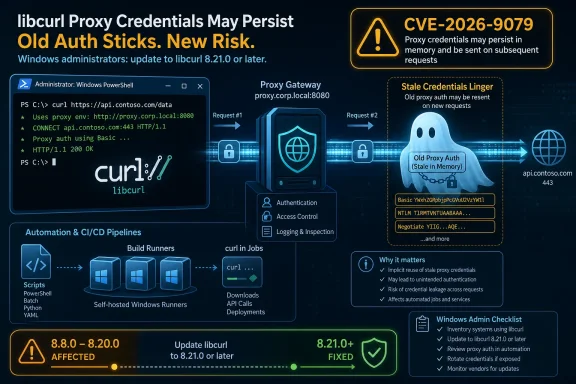 A Small libcurl State Bug Becomes a Windows Admin Problem
CVE-2026-9079 is formally titled “stale proxy password leak,” and that plain wording is doing a lot of work. According to the public vulnerability description carried by NVD and the curl project, libcurl could be instructed to clear proxy authentication credentials but fail to do so, leaving the old credentials available for subsequent transfers. In practical terms, a later request that was supposed to run without those proxy credentials, or with different credentials, could still inherit the stale password.That is a narrow bug, but it sits in a wide blast radius. curl is no longer a Unix-only convenience that Windows admins install from a third-party ZIP when a vendor script asks for it. Microsoft’s own Windows documentation describes curl as included with Windows and built from the upstream curl project, and the curl project’s Windows page separately notes that Windows 10 and Windows 11 installations include a Microsoft-provided curl by default.
That does not mean every Windows installation is affected by CVE-2026-9079. It means Windows administrators cannot dismiss a curl advisory as “Linux patch noise” anymore. On Windows, curl.exe is now part of the default operator toolbox, appears in documentation, is used in deployment scripts, and often becomes the fastest way to test APIs, pull payloads, reach internal web services, or traverse authenticated enterprise proxies.
The more important part is libcurl. The command-line curl tool is visible; libcurl is the reusable library that disappears inside other software. Security teams can find
curl.exe with a file inventory. They have a harder time finding every application that statically links libcurl, bundles its own copy, carries a vendor-patched version, or exposes the vulnerable state pattern through a higher-level HTTP client.That is why CVE-2026-9079 is an admin story, not just a curl story. The bug is about stale credential state. The enterprise environments most likely to care about proxy credentials are also the environments most likely to centralize outbound access through authenticated proxies, reuse scripts across users and service accounts, and run long-lived automation workers that perform multiple transfers inside the same process.
The Advisory Trail Is Messier Than the Bug
The verified Microsoft fact pattern is intentionally sparse: CVE-2026-9079, stale proxy password leak, with an MSRC Security Update Guide page. The provided Microsoft source material contains the company’s standard “as is” Knowledge Base disclaimer rather than a detailed Windows-specific mitigation narrative. That absence matters. It leaves admins to reconcile Microsoft’s CVE listing with the upstream curl advisory, NVD enrichment, OSV package metadata, Linux distribution advisories, and scanner output.The upstream curl ecosystem gives the clearest operational framing. OSV lists the issue as affecting curl beginning with 8.8.0 and fixed in 8.21.0. The curl project’s own CVE table places CVE-2026-9079 in the medium-severity category, marks it as a libcurl issue, and lists the vulnerable range as 8.8.0 through 8.20.0. The oss-sec advisory bundle for curl 8.21.0 also labels the issue medium, alongside several other curl advisories published in the same release window.
NVD’s page is more complicated. It repeats the same functional description but, through CISA-ADP enrichment, shows a CVSS 3.1 score of 9.8 Critical, with network attack vector, low complexity, no privileges, no user interaction, unchanged scope, and high confidentiality, integrity, and availability impact. NVD itself had not provided its own base assessment at the time reflected in the public page, while CISA-ADP supplied the severe vector and SSVC metadata. That creates a predictable conflict for defenders: the vendor calls it medium; a government-enriched record can cause scanners, dashboards, and risk reports to light it up as critical.
This is where mature vulnerability management should slow down rather than simply pick the scarier label. A stale proxy password leak is not automatically equivalent to unauthenticated remote takeover of a host. Its severity depends on how an application uses libcurl, whether it reuses handles, whether proxy credentials are sensitive and privileged, whether later transfers cross trust boundaries, and whether those credentials can be observed or used by an attacker-controlled endpoint or proxy.
But the reverse mistake is just as dangerous. “Medium” does not mean ignorable. A medium-severity credential-handling bug inside a ubiquitous transfer library can be a real incident when the credential belongs to a service account with broad egress, when the proxy mediates access to internal systems, or when automation jobs process attacker-influenced URLs. This is one of those cases where severity scores describe the generic vulnerability, while the environment decides the business impact.
Why Proxy Passwords Are Different From Ordinary Secrets
Proxy credentials are often treated as plumbing credentials rather than crown jewels. That is a mistake. In many enterprises, an authenticated proxy is the policy choke point between managed endpoints and the internet, between build systems and package repositories, or between server networks and external APIs. A proxy password may not log into a domain controller, but it can authorize outbound access, attribute activity to a user or service, and bypass network restrictions that anonymous traffic would hit.The stale nature of the bug is what makes it subtle. A developer or admin can write code that explicitly clears proxy credentials and assume the dangerous state is gone. The later transfer may appear, in the script or program logic, to be unauthenticated. If libcurl keeps the old proxy password internally, the visible configuration no longer matches the actual network behavior.
That mismatch is a classic source of hard-to-debug exposure. Logs may show a request to one destination but not the retained credential context that libcurl used behind the scenes. The developer may inspect the code and see the cleanup call. The security reviewer may see that the second transfer should not contain proxy credentials. The network device, however, may receive traffic authenticated with credentials that were supposed to be cleared.
This is why credential-state bugs tend to be worse in long-lived processes than in one-shot command invocations. A single
curl.exe command starts, transfers, exits, and drops process memory. A service, agent, plugin host, build runner, backup tool, installer, package manager, or monitoring probe can keep libcurl handles alive across multiple operations. That is where stale state becomes a cross-request problem.For Windows admins, that distinction matters. The visible curl.exe binary is easy to version-check. The more interesting exposure may be in third-party Windows software that embeds libcurl, in DevOps tools installed on Windows build agents, in security products that perform outbound API calls, or in internal utilities compiled years ago and never re-inventoried. The vulnerability is not “someone typed curl wrong.” It is “software that thought it cleared proxy authentication may not have actually cleared it.”
The Severity Split Is a Signal, Not a Contradiction
The biggest interpretive trap in CVE-2026-9079 is the distance between curl’s medium severity and CISA-ADP’s critical CVSS vector as displayed by NVD. That split will show up in scanner tickets. It will show up in executive dashboards. It may show up in compliance reports that flatten nuance into red/yellow/green.Curl’s medium rating reflects an upstream maintainer view of the bug class and likely exploit conditions. Credential leakage through stale proxy state is serious, but it requires a particular use pattern: clearing proxy authentication, then performing subsequent transfers that should not inherit it. It is not the same shape as a network service that any unauthenticated internet host can crash or command.
The CISA-ADP vector, by contrast, models a worst-case technical impact: network-reachable, low-complexity, no-privilege, no-user-interaction, high-impact consequences. That kind of enrichment can be useful when it prevents defenders from underreacting to a credential exposure primitive. It can also be misleading if organizations treat it as proof that every deployed curl binary is an internet-facing critical exposure.
The right operational answer is neither panic nor dismissal. Treat the issue as high priority where proxy credentials cross trust boundaries: shared automation, service accounts, multi-tenant build runners, internal developer platforms, privileged egress proxies, and any product that accepts user-controlled URLs before making server-side libcurl requests. Treat it as lower urgency for isolated one-shot local command use, especially where no authenticated proxy is configured and no long-lived libcurl handle is involved.
That risk-based reading is more useful than arguing with a score. If your environment does not use authenticated proxies, the bug may be mostly a dependency hygiene item. If your environment does use authenticated proxies heavily, particularly in automation, the vulnerability is about identity spillover between requests. That is a different incident class from code execution, but it can still produce real consequences.
Windows Ships curl, But Windows Is Not the Whole Attack Surface
Microsoft’s inclusion of curl in Windows changed the baseline for administrators. The tool is present, documented, and familiar. Microsoft Learn notes that Windows PowerShell 5.1 also definescurl as an alias for Invoke-WebRequest, which can shadow curl.exe, while PowerShell 7 and later do not define that alias. That distinction still causes confusion during triage: curl in a legacy PowerShell session may not be curl at all, while curl.exe is the actual executable.For CVE-2026-9079, that alias distinction is not a footnote. If an admin runs
curl --version in the wrong context, or tests a script in PowerShell 5.1 without explicitly invoking curl.exe, they may not be checking the component they think they are checking. The first step in any Windows assessment is to identify the actual binary and library in use.The second step is to avoid assuming that the Microsoft-bundled curl is the only curl on the machine. Developer workstations often carry copies from Git for Windows, MSYS2, Cygwin, Chocolatey packages, Scoop packages, language runtimes, container tooling, security scanners, backup clients, and application installers. Build agents and servers are worse, because vendors routinely bundle their own network stack to avoid depending on the operating system version.
This is why “we patched Windows” is not necessarily the end of a curl vulnerability. Windows Update may address Microsoft-shipped components when Microsoft ships a relevant update, but it will not automatically replace every private libcurl copy installed under an application directory. The same is true on Linux, but Windows shops sometimes discover it later because their dependency inventory is less mature outside the OS and Microsoft 365 estate.
A useful Windows audit therefore starts with the easy checks but does not end there. Query the system curl.exe version. Search common software directories for additional curl binaries. Ask endpoint management, EDR, or software inventory tools to report libcurl DLLs and statically bundled copies where they can. Then correlate those findings with whether the host actually uses authenticated proxies and whether the software performs multi-step transfers through reused state.
The Affected-Version Matrix Is Simple; Deployment Reality Is Not
The cleanest upstream version story is that curl/libcurl versions from 8.8.0 up to but not including 8.21.0 are affected, and 8.21.0 contains the fix. Ubuntu’s advisory adds distribution-specific context: its newer releases received fixed packages, while several older supported releases were marked not affected. That divergence is normal. Distribution packages often backport fixes or carry older versions outside an upstream vulnerable range.| Component or source | Affected range or status | Fixed version or status | What admins should verify |
|---|---|---|---|
| Upstream curl/libcurl | 8.8.0 through 8.20.0 | 8.21.0 | Actual curl/libcurl version in each runtime |
| OSV package record | Introduced in 8.8.0 | Fixed in 8.21.0 | Whether packaged or bundled copies follow upstream semver |
| curl project CVE table | First affected 8.8.0, last affected 8.20.0 | Fixed after that range | Whether the vulnerable library is used, not merely installed |
| Ubuntu 26.04 LTS package | Affected package line received fix | Fixed as 8.18.0-1ubuntu2.2 | Distribution backport status, not just upstream version number |
| Ubuntu 25.10 package | Affected package line received fix | Fixed as 8.14.1-2ubuntu1.4 | Distribution backport status, not just upstream version number |
| Ubuntu 24.04 LTS and older listed releases | Marked not affected | Not applicable | Whether third-party bundled curl exists outside OS packages |
For WindowsForum readers, the most important row is the one that is not in any package manager: private application bundles. Windows software has a long history of copying DLLs into application directories and then forgetting about them. The result is that a curl CVE may show up in your environment after the OS-level curl is already current, because the vulnerable copy is under a backup product, a monitoring agent, a development toolchain, or an internal line-of-business application.
The operational question is not “Do we have curl?” The answer is almost certainly yes. The question is “Which curl or libcurl copies perform authenticated proxy transfers in long-lived processes, and which of those copies are in the affected range or missing the vendor fix?”
The Real Exploit Path Runs Through Reuse
The vulnerability description hinges on reuse: old proxy credentials remain available for later transfers. That makes the exploit path less dramatic than a wormable server bug but more plausible in complicated automation. The most interesting targets are systems that perform several network operations with different credential expectations inside one process.Consider a build runner that first pulls dependencies through an enterprise proxy using a service account, then fetches artifacts from another location that should not receive or use those credentials. Or a management agent that checks in to one service, clears its proxy auth, then contacts a second URL derived from policy or remote configuration. Or a desktop tool that tests connectivity through multiple proxies and reuses a libcurl handle for efficiency.
The attacker’s role depends on the application. In some cases, an attacker may control a later URL. In others, the risk is that credentials are sent to the wrong proxy or retained in a way that undermines intended separation between transfers. The key is not that the bug magically exposes every proxy password to the internet. The key is that software boundaries expressed in code may not line up with the credential boundary maintained by the library.
That is why remediation should not stop at version bumping. Admins should look for scripts and applications that reuse libcurl handles while changing proxy settings. Developers should check whether their cleanup routines rely on credential clearing semantics that were broken in the affected versions. Security teams should examine whether proxy logs show service credentials used in contexts where they should not appear.
This is also a good moment to revisit proxy account design. If a single proxy credential is shared by a fleet of automation tasks, any leak becomes fleet-wide. If proxy credentials are scoped per service, rotated regularly, and monitored for unusual destination patterns, the same bug becomes easier to contain. Vulnerability management and identity hygiene are not separate disciplines here; the bug is specifically about credential state.
Timeline
June 24, 2026 — The curl ecosystem published security advisories for curl 8.21.0, including CVE-2026-9079 as a medium-severity stale proxy password leak affecting libcurl.June 24, 2026 — OSV published its record for the issue, listing the affected upstream range as introduced in 8.8.0 and fixed in 8.21.0.
June 30, 2026 — Ubuntu issued USN-8487-1 for curl vulnerabilities, including CVE-2026-9079, with fixed package status for affected supported releases.
July 3, 2026 — NVD recorded the new CVE from curl and carried the description that libcurl could fail to clear proxy authentication credentials.
July 6, 2026 — CISA-ADP modified the NVD record with a CVSS 3.1 vector that produced a 9.8 Critical score and added SSVC metadata.
July 7, 2026 — NVD’s initial analysis added CWE-522, “Insufficiently Protected Credentials,” and listed the affected upstream configuration as curl versions from 8.8.0 up to, but excluding, 8.21.0.
What Microsoft’s MSRC Listing Does—and Does Not—Tell You
The existence of an MSRC entry for CVE-2026-9079 is useful because it places the vulnerability into Microsoft’s security-tracking universe. It gives Windows administrators a familiar anchor: the CVE exists, Microsoft knows about it, and the issue is visible through the Security Update Guide. But the MSRC page, as provided in the source material, does not by itself answer the questions admins most need answered: which Windows-serviced curl builds are affected, what update contains a fix, whether specific Windows Server images are impacted, or whether bundled third-party libcurl copies are in scope.That gap is not unusual for third-party component CVEs. Microsoft ships and documents curl on Windows, but curl remains an upstream open-source project with its own release cadence, advisories, and packaging realities. The MSRC entry should be treated as a signal to investigate, not as the complete remediation playbook.
For desktop users, the immediate risk is likely narrow unless they use authenticated proxies or run software that does. For enterprise admins, especially in proxy-heavy networks, the risk sits in automation and bundled dependencies. For developers, the risk sits in assumptions about cleanup semantics: if code relied on libcurl clearing proxy credentials between transfers, affected versions broke that assumption.
The Microsoft angle also complicates communication. If a scanner flags CVE-2026-9079 on Windows, a help desk or operations team may assume the fix is simply Windows Update. Sometimes that may be part of the answer. But if the detection points to a private application path, a Git installation, a package manager copy, or a vendor appliance component, the fix belongs to that owner. Central Windows patching will not clean up every curl-shaped object on disk.
That is the broader lesson of modern Windows security: the OS is only one software supply chain on the endpoint. Developer tools, security agents, open-source runtimes, and vendor bundles bring their own patch clocks. CVE-2026-9079 is a good test of whether an organization can trace a vulnerability from CVE name to actual executable path to business process.
Action Checklist for Admins
- Inventory
curl.exe, libcurl DLLs, and vendor-bundled curl components across endpoints, servers, build agents, and developer workstations. - Treat upstream curl/libcurl 8.8.0 through 8.20.0 as affected unless a vendor or distribution confirms a backported fix.
- Prioritize systems that use authenticated HTTP, HTTPS, or SOCKS proxies, especially long-lived services and automation jobs.
- Check scripts and applications that reuse libcurl handles while changing or clearing proxy credentials between transfers.
- Rotate proxy credentials used by high-value service accounts if logs suggest they may have been reused in unexpected contexts.
- Confirm whether scanner findings refer to Microsoft’s Windows-bundled curl or to separate copies installed by applications or developer tools.
The Scanner Ticket Needs Context Before It Needs Closure
A well-run vulnerability program will not simply suppress CVE-2026-9079 because curl calls it medium. It also will not automatically declare an emergency because a dashboard shows 9.8 Critical. It will split the environment by exploit relevance.The first dividing line is proxy authentication. If a system never configures proxy credentials and no bundled application does either, the practical exposure is limited. The second dividing line is process lifetime and request sequence. One-shot transfers are less interesting than multi-transfer programs that reuse handles. The third dividing line is credential value. A low-privilege proxy account scoped to one job is different from a shared service credential used across an enterprise fleet.
The fourth dividing line is trust boundary. If the later transfer can be influenced by an untrusted user, tenant, repository, artifact, or remote policy, stale credential reuse becomes more serious. If all transfers are fixed, internal, and controlled, the risk may be mostly accidental leakage or policy bypass. Both matter, but they do not deserve the same pager alert.
For Windows admins, closure should be evidence-based. A ticket that says “upgrade curl” is incomplete. A better closure record says which binary or library was present, which version or vendor build it used, whether authenticated proxies were configured, whether the component reused libcurl state across transfers, and what update or mitigation removed the exposure.
That documentation is not bureaucracy. It is how you avoid rediscovering the same bundled-library problem every quarter. Curl is popular precisely because it is reliable, portable, and easy to embed. Those strengths make it a persistent inventory challenge.
Developers Should Audit the Assumption, Not Just the Version
The developer-facing lesson from CVE-2026-9079 is blunt: clearing a credential in an API is a security boundary only if the library actually clears it. A bug in that boundary means application code can look correct while runtime behavior remains wrong.Teams using libcurl directly should inspect code paths that set and clear proxy authentication options. If a handle is reused across transfers, the safer pattern after a sensitive authenticated proxy operation may be to reset or recreate the handle, depending on the application’s performance and security requirements. Once the library is updated, that extra conservatism may still be warranted in high-trust-boundary code.
Teams that use wrappers should not assume the wrapper makes the issue disappear. Higher-level HTTP clients often reuse connection pools and handles for efficiency. That is normally good engineering. It becomes security-sensitive when credential state changes between requests. The right review question is not “Do we call curl?” but “Where does the network layer retain state across requests, and can credentials from one request influence another?”
CI/CD systems deserve special attention. They often have broad outbound access, run untrusted or semi-trusted code, fetch dependencies, talk to artifact stores, and use proxy credentials that operators rarely rotate. A stale proxy password in that context can become a bridge between steps that were supposed to be isolated. It may also be hard to spot because CI logs often redact secrets while proxy logs focus on authentication success, not application intent.
The same is true for internal developer platforms. A service that accepts a URL from one user and fetches it server-side through a shared proxy is already a sensitive design. Add stale credential behavior and the boundary becomes even more fragile. Updating libcurl is the baseline; reviewing URL-fetch and proxy-auth architecture is the improvement.
Why This One Belongs in the “Identity” Queue
Security teams love categories: vulnerability management, identity, endpoint, network, application security. CVE-2026-9079 cuts across them because the vulnerable component is a network transfer library, the failure mode is credential handling, the remediation is dependency patching, and the investigation lives in proxy logs and software inventory.That is why the incident owner should not be chosen solely by where the scanner found the file. If the file is under
System32, Windows endpoint management may own the update. If it is under an application directory, the app owner may own the vendor patch. If it runs on a build agent, DevOps may own the runtime. But identity or network teams may still need to evaluate whether proxy credentials were over-scoped, shared, or due for rotation.Proxy logs are especially valuable here. They can show whether a credential was used by an unexpected host, process path if enriched by endpoint telemetry, destination class, or time window. They may not prove exploitation, but they can reveal suspicious credential reuse patterns. If an account that should only support one automation flow suddenly appears in traffic associated with another tool or destination, that is worth investigating.
Organizations with mature secret management should also ask why proxy passwords are long-lived at all. Some environments still treat proxy authentication as a static configuration value baked into scripts, machine images, or application settings. CVE-2026-9079 is a reminder that static network credentials are secrets, and secrets embedded in plumbing eventually leak through plumbing.
The practical answer is scoped accounts, rotation, monitoring, and least privilege. Those controls do not require waiting for the next curl advisory. They reduce the blast radius of this one and the next one.
The Practical Read for Windows Shops
The useful summary is not “curl had a bug.” It is that a default Windows-era tool and a widely embedded library mishandled proxy credential cleanup in a way that can matter anywhere authenticated proxy traffic, long-lived processes, and reused transfer state meet. That is a narrower claim than the scariest CVSS interpretation, but a more actionable one.- CVE-2026-9079 is a stale proxy password leak in libcurl, not a general proof that every Windows machine is remotely exploitable.
- Upstream curl identifies 8.8.0 through 8.20.0 as affected, with 8.21.0 as the fixed release.
- NVD shows a CISA-ADP Critical CVSS score, while curl labels the issue Medium; environment determines which framing is closer to reality.
- Windows admins should check both Microsoft-shipped curl and privately bundled curl/libcurl copies.
- Authenticated proxy environments, CI systems, service accounts, and long-lived agents deserve priority.
- The cleanest mitigation is updating affected libcurl copies, but credential rotation and proxy-log review may be appropriate where high-value credentials were in use.
References
- Primary source: MSRC
Published: 2026-07-09T01:46:04-07:00
Security Update Guide - Microsoft Security Response Center
 msrc.microsoft.com
- Related coverage: floxy.io
How to Use cURL With Proxy (HTTP, HTTPS & SOCKS5 Examples)
In this comprehensive guide, learn how to use cURL with proxies like HTTP, HTTPS, and SOCKS5 with real use case examples. Common errors are also addressed.www.floxy.io - Related coverage: csc.gov.im
Vulnerability Notice: Chrome, Ubiquiti, Curl
A number of warnings (and patches) have been reported for Chrome, Ubiquiti, Curlcsc.gov.im - Official source: microsoft.com
MSRC - Microsoft Security Response Center
The Microsoft Security Response Center is part of the defender community and on the front line of security response evolution. For over twenty years, we have been engaged with security researchers working to protect customers and the broader ecosystem.www.microsoft.com
- Related coverage: osv.dev

OSV - Open Source Vulnerabilities
Comprehensive vulnerability database for your open source projects and dependencies.
osv.dev
- Related coverage: thehackerwire.com
- Official source: learn.microsoft.com
curl on Windows | Microsoft Learn
Use the built-in curl command on Windows to transfer data to and from servers over HTTP, HTTPS, FTP, and other protocols from the command line.learn.microsoft.com - Related coverage: curl.se
curl shipped by Microsoft
curl.se
- Official source: devblogs.microsoft.com
What's new for the Command Line in Windows 10 version 1803 - Windows Command Line
The next Windows 10 update includes many new features for Command Line developers. In this post we'll review WSL, Hyper-V, new tools, and UWP Consoledevblogs.microsoft.com - Official source: answers.microsoft.com
HELP!!!!! update CURL.EXE Issues!!! Cant install updates - Microsoft Q&A
Hello, I updated Curl.exe to 8.4 in October (system32 and syswow64. ) I have had no issue until I tried to add one Microsoft update KB5032189. The update fails with invalid data, therefore I ran SFC and find out that CURL.EXE in both spots is…answers.microsoft.com