

Analytics Insight’s 2026 roundup of AI agent development companies in the United States highlights San Francisco-based LeewayHertz as a leading provider, citing its decade-plus enterprise AI experience and a services menu spanning agent development, multi-agent systems, generative AI, LLM integration, RAG, copilots, enterprise solutions, and consulting.
That sounds like another vendor-list entry in a market full of vendor-list entries. It is more useful than that if read correctly: as a snapshot of how enterprise AI buying has moved from “build me a chatbot” to “wire decision-making software into the operating fabric of the business.” The real story is not that LeewayHertz appears in a 2026 top-ten list; it is that the list’s language shows what enterprises now expect an AI partner to prove before anyone trusts it near healthcare records, finance workflows, logistics exceptions, legal review, or insurance claims.
For the past two years, almost every software firm has found a way to place “AI agent” somewhere on its homepage. That has made the category both important and noisy. An AI agent, in the enterprise sense, is not merely a prompt wrapped in a friendly interface; it is a system that interprets context, calls tools, follows workflows, retrieves information, and takes bounded action under human or policy supervision.
That distinction matters because the buyers are no longer just innovation teams looking for a demo. They are business-unit leaders trying to reduce cycle time, IT teams trying to integrate with existing systems, and security officers trying to prevent a probabilistic model from becoming an ungoverned employee. The vendor that wins in this environment is not the one with the most theatrical demo, but the one that can connect models, data, permissions, evaluation, and workflow controls into something a company can actually operate.
Analytics Insight’s profile of LeewayHertz lands precisely in that transition. It describes the company as widely recognized among AI agent development companies in the USA and emphasizes more than ten years of experience in enterprise AI applications. The experience claim is important not as résumé padding, but because enterprise AI rarely fails at the model layer alone. It fails when the system cannot reach the right data, cannot respect business rules, cannot be monitored, or cannot be explained to the people expected to rely on it.
LeewayHertz’s stated service mix reads like a checklist for this more mature market. AI agent development is the headline capability, but the surrounding categories — multi-agent systems, generative AI development, LLM integration, RAG development, AI copilot development, enterprise AI solutions, and AI consulting — are the scaffolding that separates a production program from a prototype. In other words, the firm is not being positioned merely as a builder of autonomous widgets. It is being positioned as an implementation partner for businesses trying to decide where autonomy should begin, where it should stop, and how it should be governed.
Those are not interchangeable labels. A copilot assists a human inside a task. An autonomous workflow agent performs steps within a constrained process. A multi-agent system divides work among multiple specialized agents. RAG, or retrieval-augmented generation, grounds model output in enterprise knowledge rather than relying only on the model’s pretrained memory. Each architecture implies a different risk profile, a different integration burden, and a different governance model.
That is why a credible AI agent partner has to talk in layers. A customer service copilot may need access to policies, tickets, and account history but still keep a human agent in the loop. A logistics exception agent may need to compare orders, carrier status, inventory, and delivery windows, then recommend a next-best action. A legal or insurance agent may need stricter retrieval, audit trails, and review gates because a plausible but wrong answer can become a compliance problem quickly.
LeewayHertz’s own public positioning, as reflected in its official AI development and AI agent service pages, reinforces the same theme: the company presents AI development as a matter of enterprise integration, workflow automation, model selection, consulting, and deployment rather than model access alone. That distinction is increasingly decisive. In 2026, most serious buyers already know that powerful models exist. What they do not know is how to place them safely inside messy business systems.
This is where the San Francisco headquarters detail is less interesting than the enterprise orientation. A Bay Area address may help with market signaling, but it does not build a secure RAG pipeline, a permissions-aware agent, or a reliable escalation path when an automated workflow hits an exception. The practical value of a company like LeewayHertz, if it delivers on the profile described by Analytics Insight, is its ability to translate agentic AI from a product category into business process engineering.
The table also exposes why “AI agent development company” has become a difficult category to evaluate. A vendor may be strong in generative user interfaces but weak in orchestration. Another may understand RAG but lack experience in enterprise workflow redesign. A third may build impressive autonomous demos but have little appreciation for auditability, access control, or long-term maintenance.
Analytics Insight’s profile puts LeewayHertz across the full stack. That breadth is an advantage only if the company can prove depth in the use case the buyer actually needs. A healthcare organization evaluating agentic intake automation should not be reassured merely by the words “healthcare” and “AI agent.” It should ask how protected data is isolated, how retrieval sources are validated, what happens when the system lacks confidence, and how human review is documented.
The same is true in finance, manufacturing, logistics, retail, legal, and insurance — the industries named in the source material. These sectors share a need for automation but not a common tolerance for error. A retail merchandising assistant and an insurance claims agent may both use RAG and LLM integration, but they do not create the same operational or regulatory blast radius when wrong.
Healthcare AI agents may need to navigate sensitive records, clinical policies, appointment workflows, and patient communication. Finance agents may touch risk analysis, reporting, reconciliation, or customer support. Manufacturing agents may be asked to interpret machinery data, maintenance procedures, or supply constraints. Logistics agents may sit in the middle of delivery exceptions where speed matters but bad automation can compound delays.
Retail, legal, and insurance add their own complications. Retail use cases often sound safer because they involve recommendations, merchandising, or service automation, yet they still affect pricing, customer treatment, and brand trust. Legal workflows require source grounding, confidentiality, and careful distinction between assistance and judgment. Insurance workflows are document-heavy, rules-heavy, and emotionally loaded because the outcome affects real people waiting on claims.
This is why the best reading of LeewayHertz’s industry coverage is not “one vendor fits all.” It is “the vendor is claiming enough horizontal AI capability to be evaluated vertically.” Enterprise buyers should force that evaluation. Ask for examples that match the industry’s data shape, regulatory burden, and operational tempo. Ask how the company adapts architecture when the agent moves from summarizing knowledge to taking action.
The phrase “autonomous agents for workflows” deserves particular scrutiny. Autonomy inside a workflow is not binary. An agent can draft, classify, route, recommend, schedule, reconcile, or execute. Each step moves the system closer to business impact and therefore closer to business risk. A well-designed implementation will make those boundaries explicit rather than hiding behind the reassuring magic word “agent.”
That corroboration is useful, but it should not be overread. These guides do not all rank companies the same way, and many are written by firms that also compete in the same market. Their value is less in declaring a universal winner and more in showing that the vendor landscape has converged around a common set of buying criteria: LLM expertise, RAG, workflow automation, multi-agent orchestration, vertical knowledge, and the ability to ship production systems.
Analytics Insight’s framing of LeewayHertz is therefore credible as a market signal, not a substitute for diligence. It says the company belongs in the conversation. It does not prove that LeewayHertz is the right partner for every enterprise use case, every budget, every compliance regime, or every internal architecture. That distinction is crucial because AI-agent procurement is now entering the same danger zone cloud migration and ERP modernization did before it: executives want transformation, vendors promise acceleration, and the hard work hides in integration details.
The stronger claim is that LeewayHertz’s described portfolio matches the direction of enterprise demand. Buyers are no longer asking only for a chatbot, a summarizer, or a proof of concept. They are asking for systems that can retrieve trusted knowledge, reason across context, coordinate subtasks, and sit beside or inside existing workflows. That is exactly the combination represented by AI agent development, multi-agent systems, LLM integration, RAG, copilots, enterprise AI solutions, and consulting.
Large language models are powerful, but they are not born knowing a company’s latest policies, contracts, product manuals, shipment records, or internal procedures. RAG attempts to solve that by retrieving relevant information from controlled sources and injecting it into the model’s context. Done well, it allows an AI system to answer from approved materials. Done poorly, it creates a more dangerous illusion: a fluent answer that appears grounded but is actually based on weak retrieval, stale documents, or mismatched context.
For Windows-heavy IT environments, this is where the real implementation burden begins. Business knowledge often lives across file shares, document repositories, ticketing platforms, CRM systems, ERP systems, email archives, and line-of-business applications. The agent’s quality depends on how well those sources are indexed, secured, refreshed, and permissioned. If a user should not see a document outside the AI system, the agent should not be able to reveal it inside a generated answer.
That is why RAG development cannot be treated as a feature toggle. It requires document preparation, metadata design, access control alignment, retrieval testing, evaluation datasets, and monitoring. It also requires a decision about when the system should refuse to answer or escalate rather than improvise. The technical work is inseparable from governance.
LeewayHertz’s inclusion of RAG in its AI-agent capability set is therefore a meaningful signal. It suggests the company is not pitching agents as free-floating reasoning machines, but as systems connected to enterprise knowledge. The question for buyers is whether that connection is robust enough for the domain in question. In legal, finance, healthcare, and insurance, “mostly right” retrieval is not a harmless inconvenience. It can become a business event.
That architecture can make complex workflows more modular. It can also make failures harder to understand. When several agents collaborate, the organization needs visibility into which agent made which decision, which source was used, which tool was called, and where the system changed course. Otherwise, multi-agent automation becomes a black box assembled from smaller black boxes.
This matters especially in industries like manufacturing and logistics, where a chain of small decisions can create physical-world consequences. A scheduling recommendation can affect labor, inventory, shipping, or machine downtime. In finance or insurance, a multi-agent workflow can affect customer treatment, risk assessment, or document interpretation. In legal, it can influence how information is summarized before a professional even sees it.
A mature implementation partner should therefore be able to explain why a multi-agent system is necessary instead of a simpler copilot or RAG assistant. Complexity is not a virtue. If one agent with good retrieval, clear tools, and strong human review solves the problem, adding more agents may create operational theater rather than operational value.
This is one reason the LeewayHertz profile is best understood as a menu, not a mandate. The presence of multi-agent systems in the service list tells buyers the company can support that architecture. It does not mean every project should use it. The most trustworthy AI consulting conversation may begin with the vendor recommending less autonomy than the client initially imagined.
That may sound less ambitious than autonomous agents, but in enterprise IT it is often the faster route to value. A good copilot embedded in a support, sales, legal, or operations workflow can reduce time spent searching and drafting without requiring a wholesale redesign of responsibility. It also creates a learning loop: organizations can observe what users ask, which recommendations they accept, where the system fails, and what guardrails are needed before more autonomy is introduced.
The danger is that copilots are sometimes treated as harmless because they are “only assisting.” That is too casual. A copilot can still leak information, produce wrong summaries, reinforce bad processes, or nudge users toward decisions they do not fully understand. The human-in-the-loop model only works if the human has enough time, context, and authority to disagree.
LeewayHertz’s source-stated coverage of both copilots and autonomous workflow agents is therefore strategically important. It means the conversation can be staged. A company can begin with an assistive layer, measure adoption and error patterns, then decide whether any process step is stable enough for bounded automation. That is how agent programs should mature: not by declaring autonomy on day one, but by earning it.
For IT leaders, the governance implication is straightforward. Treat copilot logs, feedback, and exception handling as design inputs for future automation. If the copilot repeatedly struggles with a category of request, that is not merely a model-quality issue. It may reveal poor documentation, fragmented data ownership, unclear policy, or a workflow that has never been formally mapped.
Consulting matters because most organizations do not yet have a mature internal language for AI autonomy. Business leaders may describe a desired outcome in broad terms: reduce support backlog, speed up claims processing, improve compliance search, automate logistics exceptions. Engineers then have to translate that into data requirements, model behavior, tool access, human review, escalation rules, and operational metrics.
A weak vendor turns that ambiguity into a demo. A strong vendor turns it into a design process. The difference shows up later, when the system faces edge cases, missing data, hostile inputs, conflicting policies, or users who misunderstand what the agent is allowed to do.
The source material’s phrasing — that LeewayHertz can provide assistance in implementing a solution according to an organization’s needs — is conventional, but the underlying point is real. Enterprise agent development cannot be productized completely because the enterprise itself is part of the system. Its documents, approvals, exception paths, legacy applications, and risk tolerance shape the agent’s behavior as much as the model does.
That is especially true in the industries named by the source. Healthcare, finance, legal, and insurance require domain-specific controls. Manufacturing and logistics require operational integration. Retail requires sensitivity to customer experience and commercial context. A vendor that treats those sectors as interchangeable logos on a slide will not survive serious procurement scrutiny.
That is why LLM integration, another source-stated LeewayHertz service, deserves attention. Integration is where the agent stops being a novelty and starts becoming part of the workday. It is also where security teams begin to worry, because every integration potentially expands what the model can see, infer, or do.
A Windows-centric organization evaluating an AI agent partner should ask how identity and permissions are enforced end to end. It should ask whether the agent respects the same access boundaries as the underlying systems. It should ask how prompts, retrieved documents, generated outputs, tool calls, and user feedback are logged. It should ask how data retention works and who can inspect the traces.
Those questions are not anti-AI. They are the conditions under which AI becomes deployable. The worst outcome is not that an agent fails in testing. The worst outcome is that it succeeds just enough to spread informally before governance catches up. Shadow AI is already a familiar pattern: users adopt whatever saves time, and IT inherits the risk later.
LeewayHertz’s positioning around enterprise AI solutions and AI consulting suggests a pitch aimed at organizations that need more than a standalone app. That is the right pitch for Windows-heavy enterprises. The procurement test is whether the architecture, documentation, and support model are equally enterprise-grade.
That is where LeewayHertz’s broad services list creates both promise and obligation. AI agent development, multi-agent systems, generative AI development, LLM integration, RAG, copilots, enterprise solutions, and consulting cover most of what an enterprise would ask for in 2026. But breadth can also blur accountability unless the buyer insists on clear deliverables.
A serious statement of work should not merely say “build an AI agent.” It should define the business process, user roles, data sources, allowed actions, disallowed actions, evaluation criteria, fallback paths, monitoring requirements, and maintenance plan. It should specify what success looks like beyond a working interface. It should also define what failure looks like, because failure in agentic systems is not always a crash. Sometimes it is a confident answer from the wrong source, a tool call made too early, or an escalation that never happens.
The vendor should be able to explain model choice without turning the conversation into brand worship. The best model for a use case depends on accuracy, latency, cost, privacy, context needs, tool use, deployment constraints, and evaluation results. The customer should own the requirements; the vendor should justify the architecture.
This is where over ten years of enterprise AI experience, as cited in the source material, becomes relevant. Experience should show up as scar tissue. A mature AI partner knows where pilots get stuck, where business users overtrust outputs, where document quality undermines RAG, where integrations become political, and where automation quietly recreates a broken process at higher speed.
A company choosing an AI agent partner is really choosing a theory of implementation. Does it want a consulting-heavy partner to define strategy and architecture? A productized platform provider to accelerate deployment? A specialist in RAG and knowledge systems? A firm with vertical experience in healthcare, finance, manufacturing, logistics, retail, legal, or insurance? A team that can modernize existing applications while adding LLM capabilities?
LeewayHertz’s profile suggests a broad, enterprise-oriented answer: it can work across agents, copilots, multi-agent systems, RAG, LLM integration, and consulting. That makes it a plausible candidate for organizations that need a custom implementation rather than a narrow off-the-shelf assistant. But it also means buyers should be precise about which part of the portfolio they are actually buying.
The risk with any broad AI development firm is that the sales conversation stays at the altitude of possibility. Possibility is cheap in 2026. Almost any vendor can produce a slide showing an agent that reads documents, calls systems, and drafts decisions. The hard part is proving reliability under the client’s data, users, constraints, and exceptions.
This is why references, pilots, and architecture reviews matter more than leaderboard language. A vendor’s inclusion in a top-ten list should get it into the first meeting, not through final approval. The real evaluation begins when the vendor is asked to work with messy documents, legacy permissions, incomplete workflows, skeptical users, and measurable service-level goals.
The source-stated LeewayHertz services give buyers a useful vocabulary for that decomposition. AI copilot development points to assisted work. RAG development points to grounded knowledge. LLM integration points to embedding model capabilities inside existing systems. Multi-agent systems point to complex orchestration. Enterprise AI solutions and AI consulting point to strategy, governance, and deployment.
That vocabulary should be used to narrow scope. A good first project has a defined user group, known data sources, clear success metrics, manageable risk, and a visible owner. It should not begin with the broad ambition to “add agents to the enterprise.” That phrasing is how companies buy expensive ambiguity.
For Windows and IT administrators, the best early projects are often internal-facing workflows where the organization can control the data, monitor usage, and compare outputs against known processes. Service desk assistance, policy search, knowledge-base summarization, document triage, and analyst copilots are common starting points because they provide value without immediately handing the system irreversible authority. More autonomous workflows can follow once the organization has evidence, trust, and controls.
This staged approach does not make AI less transformative. It makes transformation survivable. The companies that get lasting value from agents will be the ones that treat implementation as an operating-model change, not a software installation.
The concrete takeaways are simple but important:
The 2026 AI-agent market is moving from experimentation to infrastructure, and that shift will favor firms that can connect model capability with enterprise discipline. LeewayHertz’s appearance in Analytics Insight’s roundup places it squarely in that conversation, but the buyers who benefit most will be those who treat the listing as a starting point: define the workflow, constrain the autonomy, test the retrieval, verify the integrations, and make the agent earn trust before it earns authority.
That sounds like another vendor-list entry in a market full of vendor-list entries. It is more useful than that if read correctly: as a snapshot of how enterprise AI buying has moved from “build me a chatbot” to “wire decision-making software into the operating fabric of the business.” The real story is not that LeewayHertz appears in a 2026 top-ten list; it is that the list’s language shows what enterprises now expect an AI partner to prove before anyone trusts it near healthcare records, finance workflows, logistics exceptions, legal review, or insurance claims.
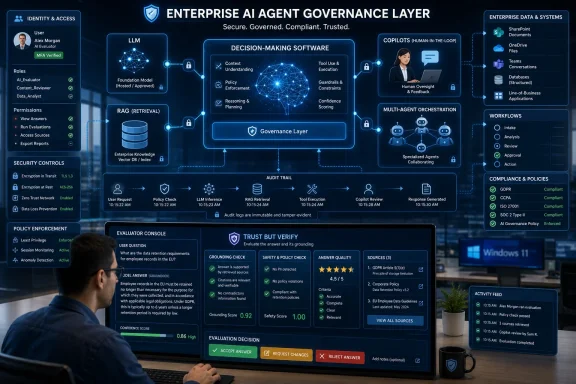 The AI-Agent Market Has Outgrown the Chatbot Pitch
For the past two years, almost every software firm has found a way to place “AI agent” somewhere on its homepage. That has made the category both important and noisy. An AI agent, in the enterprise sense, is not merely a prompt wrapped in a friendly interface; it is a system that interprets context, calls tools, follows workflows, retrieves information, and takes bounded action under human or policy supervision.That distinction matters because the buyers are no longer just innovation teams looking for a demo. They are business-unit leaders trying to reduce cycle time, IT teams trying to integrate with existing systems, and security officers trying to prevent a probabilistic model from becoming an ungoverned employee. The vendor that wins in this environment is not the one with the most theatrical demo, but the one that can connect models, data, permissions, evaluation, and workflow controls into something a company can actually operate.
Analytics Insight’s profile of LeewayHertz lands precisely in that transition. It describes the company as widely recognized among AI agent development companies in the USA and emphasizes more than ten years of experience in enterprise AI applications. The experience claim is important not as résumé padding, but because enterprise AI rarely fails at the model layer alone. It fails when the system cannot reach the right data, cannot respect business rules, cannot be monitored, or cannot be explained to the people expected to rely on it.
LeewayHertz’s stated service mix reads like a checklist for this more mature market. AI agent development is the headline capability, but the surrounding categories — multi-agent systems, generative AI development, LLM integration, RAG development, AI copilot development, enterprise AI solutions, and AI consulting — are the scaffolding that separates a production program from a prototype. In other words, the firm is not being positioned merely as a builder of autonomous widgets. It is being positioned as an implementation partner for businesses trying to decide where autonomy should begin, where it should stop, and how it should be governed.
LeewayHertz’s Pitch Is Really About Enterprise Plumbing
The most revealing part of the source material is not the phrase “leading AI agent development company.” Every company in a buyer guide is “leading” at something. The more revealing detail is the range of delivery models LeewayHertz is said to support: AI copilots, autonomous agents for workflows, multi-agent systems, and RAG.Those are not interchangeable labels. A copilot assists a human inside a task. An autonomous workflow agent performs steps within a constrained process. A multi-agent system divides work among multiple specialized agents. RAG, or retrieval-augmented generation, grounds model output in enterprise knowledge rather than relying only on the model’s pretrained memory. Each architecture implies a different risk profile, a different integration burden, and a different governance model.
That is why a credible AI agent partner has to talk in layers. A customer service copilot may need access to policies, tickets, and account history but still keep a human agent in the loop. A logistics exception agent may need to compare orders, carrier status, inventory, and delivery windows, then recommend a next-best action. A legal or insurance agent may need stricter retrieval, audit trails, and review gates because a plausible but wrong answer can become a compliance problem quickly.
LeewayHertz’s own public positioning, as reflected in its official AI development and AI agent service pages, reinforces the same theme: the company presents AI development as a matter of enterprise integration, workflow automation, model selection, consulting, and deployment rather than model access alone. That distinction is increasingly decisive. In 2026, most serious buyers already know that powerful models exist. What they do not know is how to place them safely inside messy business systems.
This is where the San Francisco headquarters detail is less interesting than the enterprise orientation. A Bay Area address may help with market signaling, but it does not build a secure RAG pipeline, a permissions-aware agent, or a reliable escalation path when an automated workflow hits an exception. The practical value of a company like LeewayHertz, if it delivers on the profile described by Analytics Insight, is its ability to translate agentic AI from a product category into business process engineering.
The Services List Maps to the Buyer’s Real Problem
A useful way to read the LeewayHertz profile is to stop treating its services as marketing bullets and start treating them as architectural choices. The difference between an AI copilot and a multi-agent system is not cosmetic. It changes who owns the process, where the human sits, what telemetry is needed, and how failure is contained.| Source-stated service or capability | What it usually means in practice | Best-fit enterprise use | Risk buyers should test early |
|---|---|---|---|
| AI agent development | Building agents that can reason over context and execute bounded tasks | Workflow automation, support operations, internal productivity | Tool misuse, weak handoffs, unclear escalation |
| Multi-agent systems | Coordinating multiple agents with specialized roles | Complex processes with research, planning, review, and execution steps | Agent conflicts, brittle orchestration, poor observability |
| Generative AI development | Creating applications that generate text, summaries, recommendations, or content | Knowledge work, customer experience, document-heavy processes | Hallucination, tone drift, compliance exposure |
| LLM integration | Connecting large language models to enterprise applications and data | Modernizing existing apps with AI capabilities | Vendor lock-in, latency, cost, permissions leakage |
| RAG development | Grounding model responses in retrieved business knowledge | Legal, finance, insurance, support, policy search | Stale data, bad retrieval, false confidence |
| AI copilot development | Creating assistants that support human users inside workflows | Employee productivity, service desks, analysts, sales support | Overreliance, weak review controls, poor UX fit |
Analytics Insight’s profile puts LeewayHertz across the full stack. That breadth is an advantage only if the company can prove depth in the use case the buyer actually needs. A healthcare organization evaluating agentic intake automation should not be reassured merely by the words “healthcare” and “AI agent.” It should ask how protected data is isolated, how retrieval sources are validated, what happens when the system lacks confidence, and how human review is documented.
The same is true in finance, manufacturing, logistics, retail, legal, and insurance — the industries named in the source material. These sectors share a need for automation but not a common tolerance for error. A retail merchandising assistant and an insurance claims agent may both use RAG and LLM integration, but they do not create the same operational or regulatory blast radius when wrong.
The Industry List Is a Warning Label, Not Just a Sales Claim
The source material says LeewayHertz serves healthcare, finance, manufacturing, logistics, retail, legal, and insurance. That is an impressive set of industries, but it should make careful buyers more demanding, not less. The more regulated and operationally complex the sector, the less acceptable it is to buy an agent as a generic productivity layer.Healthcare AI agents may need to navigate sensitive records, clinical policies, appointment workflows, and patient communication. Finance agents may touch risk analysis, reporting, reconciliation, or customer support. Manufacturing agents may be asked to interpret machinery data, maintenance procedures, or supply constraints. Logistics agents may sit in the middle of delivery exceptions where speed matters but bad automation can compound delays.
Retail, legal, and insurance add their own complications. Retail use cases often sound safer because they involve recommendations, merchandising, or service automation, yet they still affect pricing, customer treatment, and brand trust. Legal workflows require source grounding, confidentiality, and careful distinction between assistance and judgment. Insurance workflows are document-heavy, rules-heavy, and emotionally loaded because the outcome affects real people waiting on claims.
This is why the best reading of LeewayHertz’s industry coverage is not “one vendor fits all.” It is “the vendor is claiming enough horizontal AI capability to be evaluated vertically.” Enterprise buyers should force that evaluation. Ask for examples that match the industry’s data shape, regulatory burden, and operational tempo. Ask how the company adapts architecture when the agent moves from summarizing knowledge to taking action.
The phrase “autonomous agents for workflows” deserves particular scrutiny. Autonomy inside a workflow is not binary. An agent can draft, classify, route, recommend, schedule, reconcile, or execute. Each step moves the system closer to business impact and therefore closer to business risk. A well-designed implementation will make those boundaries explicit rather than hiding behind the reassuring magic word “agent.”
Other Buyer Guides Confirm the Category, But Not the Winner
A search of current buyer guides shows LeewayHertz appearing in the same general consideration set as other AI agent and AI development firms. Intuz’s 2026 guide, for example, lists LeewayHertz among companies serving areas such as AI agents and production-oriented vertical automation. RaftLabs’ buyer coverage similarly includes LeewayHertz in the broader 2026 market for agent development providers, while framing the category around enterprise strategy and production deployment.That corroboration is useful, but it should not be overread. These guides do not all rank companies the same way, and many are written by firms that also compete in the same market. Their value is less in declaring a universal winner and more in showing that the vendor landscape has converged around a common set of buying criteria: LLM expertise, RAG, workflow automation, multi-agent orchestration, vertical knowledge, and the ability to ship production systems.
Analytics Insight’s framing of LeewayHertz is therefore credible as a market signal, not a substitute for diligence. It says the company belongs in the conversation. It does not prove that LeewayHertz is the right partner for every enterprise use case, every budget, every compliance regime, or every internal architecture. That distinction is crucial because AI-agent procurement is now entering the same danger zone cloud migration and ERP modernization did before it: executives want transformation, vendors promise acceleration, and the hard work hides in integration details.
The stronger claim is that LeewayHertz’s described portfolio matches the direction of enterprise demand. Buyers are no longer asking only for a chatbot, a summarizer, or a proof of concept. They are asking for systems that can retrieve trusted knowledge, reason across context, coordinate subtasks, and sit beside or inside existing workflows. That is exactly the combination represented by AI agent development, multi-agent systems, LLM integration, RAG, copilots, enterprise AI solutions, and consulting.
The RAG Detail Is Where the Hype Meets the Database
RAG appears in the source material twice: once in the services list as RAG development and again as one of the capabilities LeewayHertz can use when implementing solutions. That repetition is significant. In enterprise AI, RAG is often the difference between a clever demo and a tool that can be trusted with current business knowledge.Large language models are powerful, but they are not born knowing a company’s latest policies, contracts, product manuals, shipment records, or internal procedures. RAG attempts to solve that by retrieving relevant information from controlled sources and injecting it into the model’s context. Done well, it allows an AI system to answer from approved materials. Done poorly, it creates a more dangerous illusion: a fluent answer that appears grounded but is actually based on weak retrieval, stale documents, or mismatched context.
For Windows-heavy IT environments, this is where the real implementation burden begins. Business knowledge often lives across file shares, document repositories, ticketing platforms, CRM systems, ERP systems, email archives, and line-of-business applications. The agent’s quality depends on how well those sources are indexed, secured, refreshed, and permissioned. If a user should not see a document outside the AI system, the agent should not be able to reveal it inside a generated answer.
That is why RAG development cannot be treated as a feature toggle. It requires document preparation, metadata design, access control alignment, retrieval testing, evaluation datasets, and monitoring. It also requires a decision about when the system should refuse to answer or escalate rather than improvise. The technical work is inseparable from governance.
LeewayHertz’s inclusion of RAG in its AI-agent capability set is therefore a meaningful signal. It suggests the company is not pitching agents as free-floating reasoning machines, but as systems connected to enterprise knowledge. The question for buyers is whether that connection is robust enough for the domain in question. In legal, finance, healthcare, and insurance, “mostly right” retrieval is not a harmless inconvenience. It can become a business event.
Multi-Agent Systems Are Powerful Because They Are Dangerous
Multi-agent systems are another source-stated LeewayHertz service, and they deserve the same sober treatment. The appeal is obvious: instead of one general-purpose assistant trying to do everything, multiple agents can divide a process into roles. One agent might retrieve information, another might analyze it, another might generate a response, and another might review or route the result.That architecture can make complex workflows more modular. It can also make failures harder to understand. When several agents collaborate, the organization needs visibility into which agent made which decision, which source was used, which tool was called, and where the system changed course. Otherwise, multi-agent automation becomes a black box assembled from smaller black boxes.
This matters especially in industries like manufacturing and logistics, where a chain of small decisions can create physical-world consequences. A scheduling recommendation can affect labor, inventory, shipping, or machine downtime. In finance or insurance, a multi-agent workflow can affect customer treatment, risk assessment, or document interpretation. In legal, it can influence how information is summarized before a professional even sees it.
A mature implementation partner should therefore be able to explain why a multi-agent system is necessary instead of a simpler copilot or RAG assistant. Complexity is not a virtue. If one agent with good retrieval, clear tools, and strong human review solves the problem, adding more agents may create operational theater rather than operational value.
This is one reason the LeewayHertz profile is best understood as a menu, not a mandate. The presence of multi-agent systems in the service list tells buyers the company can support that architecture. It does not mean every project should use it. The most trustworthy AI consulting conversation may begin with the vendor recommending less autonomy than the client initially imagined.
Copilots Remain the Safer On-Ramp for Many Enterprises
AI copilot development is another named LeewayHertz service, and it may be the most practical starting point for many organizations. Copilots let companies introduce generative AI and agentic assistance without immediately handing execution authority to software. They can draft, summarize, search, classify, and recommend while keeping a human accountable for final action.That may sound less ambitious than autonomous agents, but in enterprise IT it is often the faster route to value. A good copilot embedded in a support, sales, legal, or operations workflow can reduce time spent searching and drafting without requiring a wholesale redesign of responsibility. It also creates a learning loop: organizations can observe what users ask, which recommendations they accept, where the system fails, and what guardrails are needed before more autonomy is introduced.
The danger is that copilots are sometimes treated as harmless because they are “only assisting.” That is too casual. A copilot can still leak information, produce wrong summaries, reinforce bad processes, or nudge users toward decisions they do not fully understand. The human-in-the-loop model only works if the human has enough time, context, and authority to disagree.
LeewayHertz’s source-stated coverage of both copilots and autonomous workflow agents is therefore strategically important. It means the conversation can be staged. A company can begin with an assistive layer, measure adoption and error patterns, then decide whether any process step is stable enough for bounded automation. That is how agent programs should mature: not by declaring autonomy on day one, but by earning it.
For IT leaders, the governance implication is straightforward. Treat copilot logs, feedback, and exception handling as design inputs for future automation. If the copilot repeatedly struggles with a category of request, that is not merely a model-quality issue. It may reveal poor documentation, fragmented data ownership, unclear policy, or a workflow that has never been formally mapped.
The Consulting Line May Matter More Than the Code
AI consulting is the least glamorous item in the LeewayHertz services list, but it may be the most important. In agentic AI, the hardest question is often not “Can this be built?” It is “Should this be automated, and under what constraints?”Consulting matters because most organizations do not yet have a mature internal language for AI autonomy. Business leaders may describe a desired outcome in broad terms: reduce support backlog, speed up claims processing, improve compliance search, automate logistics exceptions. Engineers then have to translate that into data requirements, model behavior, tool access, human review, escalation rules, and operational metrics.
A weak vendor turns that ambiguity into a demo. A strong vendor turns it into a design process. The difference shows up later, when the system faces edge cases, missing data, hostile inputs, conflicting policies, or users who misunderstand what the agent is allowed to do.
The source material’s phrasing — that LeewayHertz can provide assistance in implementing a solution according to an organization’s needs — is conventional, but the underlying point is real. Enterprise agent development cannot be productized completely because the enterprise itself is part of the system. Its documents, approvals, exception paths, legacy applications, and risk tolerance shape the agent’s behavior as much as the model does.
That is especially true in the industries named by the source. Healthcare, finance, legal, and insurance require domain-specific controls. Manufacturing and logistics require operational integration. Retail requires sensitivity to customer experience and commercial context. A vendor that treats those sectors as interchangeable logos on a slide will not survive serious procurement scrutiny.
Windows Shops Should Read This as an Integration Story
For the WindowsForum audience, the relevance is not limited to who appears on an AI vendor list. Most enterprises that run on Windows also run on a dense mesh of identity systems, endpoint management, productivity applications, document stores, databases, SaaS platforms, and legacy line-of-business software. AI agents become useful only when they can operate inside that mesh without violating it.That is why LLM integration, another source-stated LeewayHertz service, deserves attention. Integration is where the agent stops being a novelty and starts becoming part of the workday. It is also where security teams begin to worry, because every integration potentially expands what the model can see, infer, or do.
A Windows-centric organization evaluating an AI agent partner should ask how identity and permissions are enforced end to end. It should ask whether the agent respects the same access boundaries as the underlying systems. It should ask how prompts, retrieved documents, generated outputs, tool calls, and user feedback are logged. It should ask how data retention works and who can inspect the traces.
Those questions are not anti-AI. They are the conditions under which AI becomes deployable. The worst outcome is not that an agent fails in testing. The worst outcome is that it succeeds just enough to spread informally before governance catches up. Shadow AI is already a familiar pattern: users adopt whatever saves time, and IT inherits the risk later.
LeewayHertz’s positioning around enterprise AI solutions and AI consulting suggests a pitch aimed at organizations that need more than a standalone app. That is the right pitch for Windows-heavy enterprises. The procurement test is whether the architecture, documentation, and support model are equally enterprise-grade.
Action checklist for admins
- Inventory the workflows where an AI agent would touch sensitive data, regulated decisions, or customer-facing outcomes.
- Separate copilot use cases from autonomous workflow use cases before speaking with vendors.
- Require a written architecture for LLM integration, RAG sources, permissions, logging, and escalation.
- Test retrieval quality against real internal documents, not sanitized demo content.
- Define human review points and refusal behavior before production deployment.
- Start with a bounded pilot tied to measurable cycle-time, accuracy, adoption, and exception-rate goals.
Procurement Should Reward Restraint, Not Just Capability
The current AI-agent market rewards vendors that can describe broad capability. Enterprise procurement should reward vendors that can also describe limits. The most credible partner is not the one that says every workflow can be agentic. It is the one that can explain which workflows should remain human-led, which should be copilot-assisted, and which are stable enough for bounded automation.That is where LeewayHertz’s broad services list creates both promise and obligation. AI agent development, multi-agent systems, generative AI development, LLM integration, RAG, copilots, enterprise solutions, and consulting cover most of what an enterprise would ask for in 2026. But breadth can also blur accountability unless the buyer insists on clear deliverables.
A serious statement of work should not merely say “build an AI agent.” It should define the business process, user roles, data sources, allowed actions, disallowed actions, evaluation criteria, fallback paths, monitoring requirements, and maintenance plan. It should specify what success looks like beyond a working interface. It should also define what failure looks like, because failure in agentic systems is not always a crash. Sometimes it is a confident answer from the wrong source, a tool call made too early, or an escalation that never happens.
The vendor should be able to explain model choice without turning the conversation into brand worship. The best model for a use case depends on accuracy, latency, cost, privacy, context needs, tool use, deployment constraints, and evaluation results. The customer should own the requirements; the vendor should justify the architecture.
This is where over ten years of enterprise AI experience, as cited in the source material, becomes relevant. Experience should show up as scar tissue. A mature AI partner knows where pilots get stuck, where business users overtrust outputs, where document quality undermines RAG, where integrations become political, and where automation quietly recreates a broken process at higher speed.
The Real Competition Is Not Another Vendor List
Analytics Insight’s article is framed as a top-ten list, and other outlets and company blogs are publishing similar 2026 rankings. That format is useful for discovery, but it can mislead buyers into thinking the decision is primarily about vendor prestige. In agentic AI, the better question is fit.A company choosing an AI agent partner is really choosing a theory of implementation. Does it want a consulting-heavy partner to define strategy and architecture? A productized platform provider to accelerate deployment? A specialist in RAG and knowledge systems? A firm with vertical experience in healthcare, finance, manufacturing, logistics, retail, legal, or insurance? A team that can modernize existing applications while adding LLM capabilities?
LeewayHertz’s profile suggests a broad, enterprise-oriented answer: it can work across agents, copilots, multi-agent systems, RAG, LLM integration, and consulting. That makes it a plausible candidate for organizations that need a custom implementation rather than a narrow off-the-shelf assistant. But it also means buyers should be precise about which part of the portfolio they are actually buying.
The risk with any broad AI development firm is that the sales conversation stays at the altitude of possibility. Possibility is cheap in 2026. Almost any vendor can produce a slide showing an agent that reads documents, calls systems, and drafts decisions. The hard part is proving reliability under the client’s data, users, constraints, and exceptions.
This is why references, pilots, and architecture reviews matter more than leaderboard language. A vendor’s inclusion in a top-ten list should get it into the first meeting, not through final approval. The real evaluation begins when the vendor is asked to work with messy documents, legacy permissions, incomplete workflows, skeptical users, and measurable service-level goals.
The Shortlist Should Start With the Work, Not the Vendor
The most concrete lesson from the LeewayHertz profile is that buyers need to decompose “AI agent” before they shop. The term now covers too much. A business that wants faster internal knowledge search needs a different system from one that wants automated logistics exception handling. A legal copilot is not the same as a finance reconciliation agent. A retail assistant is not the same as an insurance claims workflow.The source-stated LeewayHertz services give buyers a useful vocabulary for that decomposition. AI copilot development points to assisted work. RAG development points to grounded knowledge. LLM integration points to embedding model capabilities inside existing systems. Multi-agent systems point to complex orchestration. Enterprise AI solutions and AI consulting point to strategy, governance, and deployment.
That vocabulary should be used to narrow scope. A good first project has a defined user group, known data sources, clear success metrics, manageable risk, and a visible owner. It should not begin with the broad ambition to “add agents to the enterprise.” That phrasing is how companies buy expensive ambiguity.
For Windows and IT administrators, the best early projects are often internal-facing workflows where the organization can control the data, monitor usage, and compare outputs against known processes. Service desk assistance, policy search, knowledge-base summarization, document triage, and analyst copilots are common starting points because they provide value without immediately handing the system irreversible authority. More autonomous workflows can follow once the organization has evidence, trust, and controls.
This staged approach does not make AI less transformative. It makes transformation survivable. The companies that get lasting value from agents will be the ones that treat implementation as an operating-model change, not a software installation.
What the LeewayHertz Listing Actually Tells Buyers
The LeewayHertz entry in Analytics Insight’s 2026 roundup is most useful when read as a signal of market maturity. It shows that the competitive center of AI development has shifted toward agents, copilots, RAG, LLM integration, and enterprise workflow automation. It also shows that buyers are expected to care about industry coverage, not just technical novelty.The concrete takeaways are simple but important:
- LeewayHertz is being positioned as a San Francisco-based AI agent development company with more than ten years of enterprise AI application experience.
- Its source-stated services span AI agent development, multi-agent systems, generative AI development, LLM integration, RAG development, AI copilot development, enterprise AI solutions, and AI consulting.
- The named industries — healthcare, finance, manufacturing, logistics, retail, legal, and insurance — require different levels of governance, testing, and human oversight.
- RAG and LLM integration are not side features; they are core to whether an enterprise agent can use current, permissioned business knowledge safely.
- Copilots are often the safer first deployment model, while autonomous workflow agents require stricter boundaries and monitoring.
- A top-ten listing should open a diligence process, not replace one.
The 2026 AI-agent market is moving from experimentation to infrastructure, and that shift will favor firms that can connect model capability with enterprise discipline. LeewayHertz’s appearance in Analytics Insight’s roundup places it squarely in that conversation, but the buyers who benefit most will be those who treat the listing as a starting point: define the workflow, constrain the autonomy, test the retrieval, verify the integrations, and make the agent earn trust before it earns authority.
References
- Primary source: Analytics Insight
Published: 2026-07-08T14:50:08.413054
Loading…
www.analyticsinsight.net - Related coverage: leewayhertz.com
Loading…
www.leewayhertz.com - Related coverage: intuz.com
Loading…
www.intuz.com - Related coverage: raftlabs.com
Loading…
www.raftlabs.com - Related coverage: tech.us
Loading…
tech.us - Related coverage: groovyweb.co
Loading…
www.groovyweb.co