

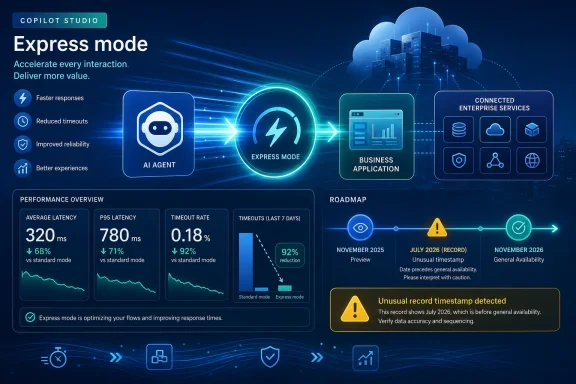
Microsoft is developing an opt-in Express mode for Copilot Studio flows called by agents or apps. Microsoft 365 Roadmap ID 566999 is marked In development for the web platform in the Worldwide Standard Multi-Tenant cloud, with Preview listed for November 2025 and General Availability listed for November 2026.
The roadmap record contains a significant chronology anomaly: its created and updated timestamp is July 10, 2026, which is later than the listed November 2025 preview month. That inconsistency does not establish when preview access actually began, and it means the roadmap entry should not be treated as a complete historical account of the rollout. Until Microsoft publishes definitive production documentation, availability, prerequisites, limits, configuration steps, and supported scenarios remain subject to confirmation.
The core idea is straightforward. Express mode is intended to accelerate eligible flows invoked by agents or apps and reduce failures associated with slow responses. For organizations building synchronous, user-facing experiences, the announcement is a reason to inventory latency-sensitive flows now—not a reason to enable an undocumented setting in production.
Copilot Studio agents can use flows to retrieve information, apply business rules, update connected systems, calculate results, and return data to a conversation or application. That integration is important to Microsoft’s low-code strategy because it allows organizations to connect agent experiences to existing automation investments.
It also makes flow performance part of the user experience. When an agent or app invokes a flow and expects an immediate result, any delay in the automation can delay or disrupt the interaction. A backend process may be logically correct while still being poorly suited to a synchronous, user-facing request.
Roadmap ID 566999 positions Express mode as an answer to that problem. Microsoft says the feature is intended to deliver faster execution and reduce timeout-related failures for flows invoked by agents or apps. The roadmap facts do not establish a specific response deadline, a guaranteed acceleration factor, or a universal performance target.
That distinction matters. Express mode should not be described as extending a documented deadline, eliminating latency, or guaranteeing that every existing flow will become fast enough. The verified roadmap information supports a narrower conclusion: Microsoft is developing an optional execution mode intended to improve speed and reliability for eligible agent- and app-invoked flows.
The practical significance is that interactive automation is judged differently from background automation. A delayed scheduled process may complete without disrupting a person’s work. A delayed flow inside an agent or application can interrupt an active task and weaken confidence in the overall experience.
The user generally sees one product interaction, not a chain of separate services. If the invoked automation does not return as expected, the visible outcome is a failed or incomplete agent action. Organizations therefore need to evaluate the complete path between the request, the flow, connected services, and the returned result.
That is the defensible takeaway from the roadmap item. The available facts do not support detailed claims about action limits, payload ceilings, supported control patterns, infrastructure requirements, licensing treatment, asynchronous callbacks, channel compatibility, or the exact user-interface path for enabling the feature.
This narrower interpretation is still important. Agent projects often move from demonstrations to operational workflows that retrieve or change business data. As that happens, flow latency becomes a product concern rather than a background implementation detail.
For read-only scenarios, a slow or failed response can frustrate the user. For actions that create, update, submit, approve, send, or delete, an unclear result can also create uncertainty about whether the requested work occurred. Express mode may help reduce response-related failures, but the roadmap does not say that it changes transaction handling, retry behavior, or duplicate-request protection.
Organizations should therefore continue designing consequential actions defensively. A faster execution mode would not remove the need to determine what happens if a user retries an instruction, closes an application, changes the conversation, or receives no confirmation. Those questions belong to the application and flow design even when the underlying runtime becomes faster.
Microsoft has not, however, published verified enablement steps in the roadmap facts available for this report. It would be premature to claim that makers can activate Express mode from a flow details page, a trigger, an environment setting, or any other particular interface.
The absence of verified steps is especially important because the item remains in development. Interface labels, permissions, rollout controls, and configuration paths may change before general availability. Even if some customers have encountered related preview interfaces, those observations should not be converted into universal deployment instructions without supporting Microsoft documentation.
It also does not provide verified numerical limits for actions, loops, variables, payloads, or connector responses. Any such limits should be omitted until they appear in authoritative Microsoft documentation applicable to the released feature.
Likewise, the roadmap facts do not confirm support or lack of support for delay actions, webhook actions, flow resubmission, callbacks, specific channels, or particular testing tools. Those details may eventually determine whether a flow is a good Express mode candidate, but they cannot be presented as settled capabilities today.
The safest planning assumption is that an execution mode designed for faster interactive responses may have a defined support boundary. That is an editorial inference based on the feature’s purpose, not a documented Microsoft requirement. Administrators should avoid turning that inference into policy until Microsoft describes the actual boundary.
This is also why organizations should not treat Express mode as a generic repair button for every slow automation. Some delays originate in connected services, authentication, data retrieval, application design, or the amount of work requested. The roadmap does not say Express mode changes those external conditions.
A flow that depends on an unpredictable downstream service may remain unpredictable. A flow that performs work poorly matched to an interactive request may still require redesign. Express mode should be evaluated as one possible runtime improvement, not as proof that architecture and workload choices no longer matter.
Those topics should therefore remain outside the feature description unless Microsoft connects them to Roadmap ID 566999 in authoritative documentation.
Administrators can still make a general design distinction between work that needs an immediate result and work that can finish later. That distinction is ordinary application architecture, not a claim about a particular Microsoft capability.
If a user must receive the answer during the current interaction, the flow belongs in the synchronous, user-facing category for assessment purposes. If the requested work can be acknowledged and completed later, the organization may consider a status-based or deferred design using capabilities that are separately documented and supported for its chosen product and channel.
Express mode is relevant primarily because Microsoft is targeting the first category: agent- or app-invoked flows for which faster execution and fewer timeout-related failures would improve the interactive experience.
Organizations should not infer from the roadmap item that Microsoft has guaranteed later callbacks, extended execution, universal channel coverage, or any particular fallback mechanism. Those questions require separate documentation.
The dates are unusual:
The roadmap record lists November 2025 as the preview month for Express mode.
July 10, 2026 — Roadmap record created and updated
The roadmap metadata gives July 10, 2026 as both the created and updated date. That timestamp is later than the listed preview month.
November 2026 — General Availability listed
Microsoft lists November 2026 as the target month for general availability.
The sequence creates an obvious historical inconsistency. A roadmap record created in July 2026 cannot, by itself, verify what customers could access in November 2025. The earlier preview month may reflect a release-plan history, a backfilled roadmap entry, a revised record, or another administrative explanation, but the supplied facts do not identify the cause.
WindowsForum therefore treats November 2025 as the preview month listed in the roadmap, not as proof that every eligible customer received the feature at that time. Similarly, November 2026 is a listed general-availability target rather than confirmation that deployment will occur on a particular day or reach every environment simultaneously.
The “In development” status reinforces the need for caution. Microsoft may revise roadmap dates, scope, or supporting documentation as work continues. Customers planning around the feature should monitor the roadmap while recognizing that the roadmap alone is not a deployment guide.
The Worldwide Standard Multi-Tenant designation defines the listed cloud scope, but it should not be expanded into unsupported assumptions about sovereign clouds, government environments, regional timing, individual tenants, or specific Power Platform environments. Those details require explicit confirmation from Microsoft.
That signal is enough to justify discovery work. It is not enough to establish production standards, eligibility rules, licensing assumptions, capacity plans, or support procedures.
Platform owners should begin by identifying where synchronous flow latency already affects users. Useful questions include:
Testing should focus on user outcomes rather than a single fast demonstration. A useful evaluation would consider whether the complete agent or app interaction becomes more dependable under representative conditions. The exact test method, supported telemetry, and diagnostic workflow should be based on Microsoft’s final documentation and the tools available in the customer’s environment.
Write operations need particular attention because a lost or delayed confirmation can leave the user unsure whether the requested change occurred. Express mode is intended to reduce timeout-related failures, but Microsoft has not said that it supplies transaction safeguards or duplicate detection. Those protections remain design responsibilities unless future documentation states otherwise.
Existing governance also remains relevant. Nothing in the verified roadmap facts says Express mode changes data-loss prevention controls, connector permissions, environment strategy, solution management, identity, audit obligations, or ownership requirements. Administrators should not assume that a faster runtime creates an exception to ordinary Power Platform governance.
Raw speed matters only when it improves the outcome. A flow can be faster without becoming sufficiently consistent for an important business process. Conversely, a modest improvement may be valuable if it prevents visible interruptions in a high-use interaction.
Organizations should therefore avoid reducing evaluation to a promotional before-and-after screenshot. A stronger assessment would ask whether representative users receive the expected result consistently and whether the system handles uncertainty safely when they do not.
This is particularly important as agent deployments expand from answering questions to performing actions. Informational errors and transaction ambiguity carry different risks. A user who does not receive a policy answer can ask again. A user who does not receive confirmation of a submitted action may repeat it, abandon it, or contact support.
Express mode may narrow that reliability gap for some flows. That is an editorial assessment based on the feature’s stated intent, not a Microsoft guarantee. The actual effect cannot be established until the feature is available in the relevant environment and tested under supported conditions.
The opt-in model could also make controlled evaluation easier because teams may be able to compare behavior without changing every flow at once. However, the roadmap does not define the scope of the opt-in control or the exact configuration experience, so deployment planning should wait for confirmed instructions.
Microsoft still needs to document the feature’s availability model, prerequisites, configuration process, supported flow patterns, constraints, licensing implications, monitoring options, failure behavior, and support boundaries. This is an editorial assessment of what enterprise customers will need, not a claim that Microsoft has promised a particular set of documents or management tools.
Performance evidence will also matter. The phrase “much faster” communicates direction but does not tell administrators what improvement to expect from a particular flow. Without a documented benchmark or service commitment, each organization will need to validate the feature against its own workloads.
Governance visibility may become another practical consideration. If Express mode changes how a flow executes, platform teams may want a way to identify where it is in use. That is a reasonable administrative requirement, but the roadmap facts do not confirm that Microsoft will provide a dedicated inventory view, report, policy, or diagnostic category.
The chronology anomaly makes authoritative documentation even more important. Because the roadmap’s July 10, 2026 creation timestamp comes after the listed November 2025 preview month, customers cannot reconstruct the rollout history from the roadmap record alone. Production decisions should rely on current Microsoft documentation rather than assumptions about what the earlier date means.
Roadmap ID 566999 remains in development. The listed scope is web and Worldwide Standard Multi-Tenant. Preview is listed for November 2025, while General Availability is listed for November 2026. The record’s July 10, 2026 creation and update timestamp is later than the preview month and must be acknowledged whenever the timeline is discussed.
Beyond those facts, caution is necessary. The roadmap does not verify a response deadline, eligibility formula, environment-upgrade process, licensing or metering treatment, numerical runtime limits, unsupported action list, callback model, channel matrix, resubmission behavior, diagnostics, or enablement path.
Teams can still prepare by classifying flows according to the user experience they support. A flow that supplies information needed immediately by an agent or app is a stronger candidate for future evaluation than a background process whose completion time is not visible to the user.
Administrators should also distinguish between performance symptoms and underlying design issues. Express mode may accelerate eligible execution, but the roadmap does not promise to fix slow external systems, excessive work, unsafe retries, unclear confirmations, or poorly designed transactions.
Availability, limits, prerequisites, licensing implications, supported scenarios, and configuration steps must be confirmed in Microsoft documentation before deployment.
The roadmap record contains a significant chronology anomaly: its created and updated timestamp is July 10, 2026, which is later than the listed November 2025 preview month. That inconsistency does not establish when preview access actually began, and it means the roadmap entry should not be treated as a complete historical account of the rollout. Until Microsoft publishes definitive production documentation, availability, prerequisites, limits, configuration steps, and supported scenarios remain subject to confirmation.
The core idea is straightforward. Express mode is intended to accelerate eligible flows invoked by agents or apps and reduce failures associated with slow responses. For organizations building synchronous, user-facing experiences, the announcement is a reason to inventory latency-sensitive flows now—not a reason to enable an undocumented setting in production.
 Microsoft Is Optimizing the Synchronous Path
Copilot Studio agents can use flows to retrieve information, apply business rules, update connected systems, calculate results, and return data to a conversation or application. That integration is important to Microsoft’s low-code strategy because it allows organizations to connect agent experiences to existing automation investments.It also makes flow performance part of the user experience. When an agent or app invokes a flow and expects an immediate result, any delay in the automation can delay or disrupt the interaction. A backend process may be logically correct while still being poorly suited to a synchronous, user-facing request.
Roadmap ID 566999 positions Express mode as an answer to that problem. Microsoft says the feature is intended to deliver faster execution and reduce timeout-related failures for flows invoked by agents or apps. The roadmap facts do not establish a specific response deadline, a guaranteed acceleration factor, or a universal performance target.
That distinction matters. Express mode should not be described as extending a documented deadline, eliminating latency, or guaranteeing that every existing flow will become fast enough. The verified roadmap information supports a narrower conclusion: Microsoft is developing an optional execution mode intended to improve speed and reliability for eligible agent- and app-invoked flows.
The practical significance is that interactive automation is judged differently from background automation. A delayed scheduled process may complete without disrupting a person’s work. A delayed flow inside an agent or application can interrupt an active task and weaken confidence in the overall experience.
The user generally sees one product interaction, not a chain of separate services. If the invoked automation does not return as expected, the visible outcome is a failed or incomplete agent action. Organizations therefore need to evaluate the complete path between the request, the flow, connected services, and the returned result.
WindowsForum Takeaway
Express mode is intended to speed eligible agent- or app-invoked flows and reduce timeout-related failures. Organizations should identify synchronous, user-facing flows now and validate the final constraints when Microsoft publishes production documentation.That is the defensible takeaway from the roadmap item. The available facts do not support detailed claims about action limits, payload ceilings, supported control patterns, infrastructure requirements, licensing treatment, asynchronous callbacks, channel compatibility, or the exact user-interface path for enabling the feature.
This narrower interpretation is still important. Agent projects often move from demonstrations to operational workflows that retrieve or change business data. As that happens, flow latency becomes a product concern rather than a background implementation detail.
For read-only scenarios, a slow or failed response can frustrate the user. For actions that create, update, submit, approve, send, or delete, an unclear result can also create uncertainty about whether the requested work occurred. Express mode may help reduce response-related failures, but the roadmap does not say that it changes transaction handling, retry behavior, or duplicate-request protection.
Organizations should therefore continue designing consequential actions defensively. A faster execution mode would not remove the need to determine what happens if a user retries an instruction, closes an application, changes the conversation, or receives no confirmation. Those questions belong to the application and flow design even when the underlying runtime becomes faster.
Express Mode Is an Opt-In Roadmap Capability
Microsoft describes Express mode as opt-in. That indicates organizations and makers will have a choice about whether to use it rather than receiving an unexplained performance change across all relevant flows.Microsoft has not, however, published verified enablement steps in the roadmap facts available for this report. It would be premature to claim that makers can activate Express mode from a flow details page, a trigger, an environment setting, or any other particular interface.
The absence of verified steps is especially important because the item remains in development. Interface labels, permissions, rollout controls, and configuration paths may change before general availability. Even if some customers have encountered related preview interfaces, those observations should not be converted into universal deployment instructions without supporting Microsoft documentation.
Readiness checklist — not enablement instructions
The following checklist is preparation for future evaluation. It is not a Microsoft-published procedure for turning on Express mode:- Inventory flows that are invoked by Copilot Studio agents or interactive applications.
- Identify which of those flows are expected to return a result during the current user interaction.
- Record current run durations and visible failure patterns where reliable telemetry is already available.
- Separate informational flows from flows that create or modify business records.
- Document the connected systems on which each candidate flow depends.
- Identify flows whose users frequently retry after receiving an incomplete or delayed result.
- Review whether write operations already protect against accidental duplicate requests.
- Select representative test cases using realistic data rather than demonstration-only inputs.
- Define what improvement would be meaningful for each user-facing scenario.
- Wait for Microsoft’s verified documentation before defining technical eligibility rules or deployment instructions.
- Confirm availability in each intended tenant and environment rather than assuming a worldwide designation means simultaneous access.
- Revalidate all preview findings when Microsoft publishes general-availability documentation.
Faster Does Not Mean Universally Applicable
The roadmap describes an intended outcome, not a complete architecture specification. It does not establish that every flow invoked by an agent or app will be eligible, that all connectors will behave identically, or that the same gains will appear across every workload.It also does not provide verified numerical limits for actions, loops, variables, payloads, or connector responses. Any such limits should be omitted until they appear in authoritative Microsoft documentation applicable to the released feature.
Likewise, the roadmap facts do not confirm support or lack of support for delay actions, webhook actions, flow resubmission, callbacks, specific channels, or particular testing tools. Those details may eventually determine whether a flow is a good Express mode candidate, but they cannot be presented as settled capabilities today.
The safest planning assumption is that an execution mode designed for faster interactive responses may have a defined support boundary. That is an editorial inference based on the feature’s purpose, not a documented Microsoft requirement. Administrators should avoid turning that inference into policy until Microsoft describes the actual boundary.
This is also why organizations should not treat Express mode as a generic repair button for every slow automation. Some delays originate in connected services, authentication, data retrieval, application design, or the amount of work requested. The roadmap does not say Express mode changes those external conditions.
A flow that depends on an unpredictable downstream service may remain unpredictable. A flow that performs work poorly matched to an interactive request may still require redesign. Express mode should be evaluated as one possible runtime improvement, not as proof that architecture and workload choices no longer matter.
The Roadmap Does Not Define an Asynchronous Alternative
The current roadmap facts concern Express mode for flows called by agents or apps. They do not provide verified details about asynchronous callback behavior, supported channels, delayed responses, or how a conversation behaves while a flow continues running.Those topics should therefore remain outside the feature description unless Microsoft connects them to Roadmap ID 566999 in authoritative documentation.
Administrators can still make a general design distinction between work that needs an immediate result and work that can finish later. That distinction is ordinary application architecture, not a claim about a particular Microsoft capability.
If a user must receive the answer during the current interaction, the flow belongs in the synchronous, user-facing category for assessment purposes. If the requested work can be acknowledged and completed later, the organization may consider a status-based or deferred design using capabilities that are separately documented and supported for its chosen product and channel.
Express mode is relevant primarily because Microsoft is targeting the first category: agent- or app-invoked flows for which faster execution and fewer timeout-related failures would improve the interactive experience.
Organizations should not infer from the roadmap item that Microsoft has guaranteed later callbacks, extended execution, universal channel coverage, or any particular fallback mechanism. Those questions require separate documentation.
The Roadmap Dates Tell an Unusually Messy Rollout Story
Microsoft 365 Roadmap ID 566999 is marked In development. It applies to the web platform and the Worldwide Standard Multi-Tenant cloud. The listed release phases are Preview and General Availability.The dates are unusual:
Timeline
November 2025 — Preview listedThe roadmap record lists November 2025 as the preview month for Express mode.
July 10, 2026 — Roadmap record created and updated
The roadmap metadata gives July 10, 2026 as both the created and updated date. That timestamp is later than the listed preview month.
November 2026 — General Availability listed
Microsoft lists November 2026 as the target month for general availability.
The sequence creates an obvious historical inconsistency. A roadmap record created in July 2026 cannot, by itself, verify what customers could access in November 2025. The earlier preview month may reflect a release-plan history, a backfilled roadmap entry, a revised record, or another administrative explanation, but the supplied facts do not identify the cause.
WindowsForum therefore treats November 2025 as the preview month listed in the roadmap, not as proof that every eligible customer received the feature at that time. Similarly, November 2026 is a listed general-availability target rather than confirmation that deployment will occur on a particular day or reach every environment simultaneously.
The “In development” status reinforces the need for caution. Microsoft may revise roadmap dates, scope, or supporting documentation as work continues. Customers planning around the feature should monitor the roadmap while recognizing that the roadmap alone is not a deployment guide.
The Worldwide Standard Multi-Tenant designation defines the listed cloud scope, but it should not be expanded into unsupported assumptions about sovereign clouds, government environments, regional timing, individual tenants, or specific Power Platform environments. Those details require explicit confirmation from Microsoft.
Enterprise IT Should Treat This as a Planning Signal
The announcement gives enterprise IT a useful planning signal: Microsoft is working on faster execution for flows that participate in interactive agent and application experiences.That signal is enough to justify discovery work. It is not enough to establish production standards, eligibility rules, licensing assumptions, capacity plans, or support procedures.
Platform owners should begin by identifying where synchronous flow latency already affects users. Useful questions include:
- Which agent or app actions depend on a flow result before the interaction can continue?
- Which flows are associated with visible delays or incomplete responses?
- Which scenarios involve changes to business records rather than information retrieval?
- Where might a user retry an action because confirmation was delayed or absent?
- Which downstream systems contribute most to variable response times?
- Which scenarios are important enough to justify controlled preview testing?
- What baseline information is available for comparing current and future behavior?
Testing should focus on user outcomes rather than a single fast demonstration. A useful evaluation would consider whether the complete agent or app interaction becomes more dependable under representative conditions. The exact test method, supported telemetry, and diagnostic workflow should be based on Microsoft’s final documentation and the tools available in the customer’s environment.
Write operations need particular attention because a lost or delayed confirmation can leave the user unsure whether the requested change occurred. Express mode is intended to reduce timeout-related failures, but Microsoft has not said that it supplies transaction safeguards or duplicate detection. Those protections remain design responsibilities unless future documentation states otherwise.
Existing governance also remains relevant. Nothing in the verified roadmap facts says Express mode changes data-loss prevention controls, connector permissions, environment strategy, solution management, identity, audit obligations, or ownership requirements. Administrators should not assume that a faster runtime creates an exception to ordinary Power Platform governance.
Editorial Assessment: Reliability Is the Practical Test
Microsoft frames Express mode around faster execution and fewer timeout-related failures. From an editorial perspective, the practical test will be whether those improvements make user-facing actions more dependable.Raw speed matters only when it improves the outcome. A flow can be faster without becoming sufficiently consistent for an important business process. Conversely, a modest improvement may be valuable if it prevents visible interruptions in a high-use interaction.
Organizations should therefore avoid reducing evaluation to a promotional before-and-after screenshot. A stronger assessment would ask whether representative users receive the expected result consistently and whether the system handles uncertainty safely when they do not.
This is particularly important as agent deployments expand from answering questions to performing actions. Informational errors and transaction ambiguity carry different risks. A user who does not receive a policy answer can ask again. A user who does not receive confirmation of a submitted action may repeat it, abandon it, or contact support.
Express mode may narrow that reliability gap for some flows. That is an editorial assessment based on the feature’s stated intent, not a Microsoft guarantee. The actual effect cannot be established until the feature is available in the relevant environment and tested under supported conditions.
The opt-in model could also make controlled evaluation easier because teams may be able to compare behavior without changing every flow at once. However, the roadmap does not define the scope of the opt-in control or the exact configuration experience, so deployment planning should wait for confirmed instructions.
Editorial Assessment: Microsoft Still Needs to Define the Operational Boundary
The roadmap gives customers a purpose, product context, development status, cloud scope, platform, and target months. It does not yet provide the operational detail required for production deployment.Microsoft still needs to document the feature’s availability model, prerequisites, configuration process, supported flow patterns, constraints, licensing implications, monitoring options, failure behavior, and support boundaries. This is an editorial assessment of what enterprise customers will need, not a claim that Microsoft has promised a particular set of documents or management tools.
Performance evidence will also matter. The phrase “much faster” communicates direction but does not tell administrators what improvement to expect from a particular flow. Without a documented benchmark or service commitment, each organization will need to validate the feature against its own workloads.
Governance visibility may become another practical consideration. If Express mode changes how a flow executes, platform teams may want a way to identify where it is in use. That is a reasonable administrative requirement, but the roadmap facts do not confirm that Microsoft will provide a dedicated inventory view, report, policy, or diagnostic category.
The chronology anomaly makes authoritative documentation even more important. Because the roadmap’s July 10, 2026 creation timestamp comes after the listed November 2025 preview month, customers cannot reconstruct the rollout history from the roadmap record alone. Production decisions should rely on current Microsoft documentation rather than assumptions about what the earlier date means.
The Decisions That Matter Before General Availability
The immediate task is not to deploy Express mode everywhere. It is to identify the interactions for which flow latency is already a meaningful user or operational problem.Roadmap ID 566999 remains in development. The listed scope is web and Worldwide Standard Multi-Tenant. Preview is listed for November 2025, while General Availability is listed for November 2026. The record’s July 10, 2026 creation and update timestamp is later than the preview month and must be acknowledged whenever the timeline is discussed.
Beyond those facts, caution is necessary. The roadmap does not verify a response deadline, eligibility formula, environment-upgrade process, licensing or metering treatment, numerical runtime limits, unsupported action list, callback model, channel matrix, resubmission behavior, diagnostics, or enablement path.
Teams can still prepare by classifying flows according to the user experience they support. A flow that supplies information needed immediately by an agent or app is a stronger candidate for future evaluation than a background process whose completion time is not visible to the user.
Administrators should also distinguish between performance symptoms and underlying design issues. Express mode may accelerate eligible execution, but the roadmap does not promise to fix slow external systems, excessive work, unsafe retries, unclear confirmations, or poorly designed transactions.
What Admins Should Do Now
- Record Roadmap ID 566999 in the organization’s Microsoft 365 and Power Platform change-tracking process.
- Note the verified scope: web, Worldwide Standard Multi-Tenant, and In development.
- Record Preview as listed for November 2025 and General Availability as listed for November 2026.
- Document the chronology anomaly: the roadmap entry’s created and updated timestamp is July 10, 2026, after the listed preview month.
- Inventory flows invoked by Copilot Studio agents or interactive applications.
- Prioritize flows that are synchronous, user-facing, and associated with visible delays or incomplete responses.
- Separate read-only scenarios from actions that create or change business data.
- Review consequential flows for safe retry and duplicate-request handling independently of Express mode.
- Establish current performance baselines where existing tools provide reliable information.
- Define representative business tests before evaluating any preview.
- Do not publish internal enablement instructions based on an assumed interface path.
- Do not treat unverified numerical limits, licensing claims, or architecture requirements as Microsoft policy.
- Monitor Microsoft’s roadmap and official product documentation for changes to status, dates, scope, and technical details.
- Recheck preview findings against general-availability documentation before production deployment.
- Require security, governance, support, and change-management review before broad adoption.
Availability, limits, prerequisites, licensing implications, supported scenarios, and configuration steps must be confirmed in Microsoft documentation before deployment.
References
- Primary source: Microsoft 365 Roadmap
Published: 2026-07-10T21:58:35.1674832Z
Microsoft 365 Roadmap | Microsoft 365
The Microsoft 365 Roadmap lists updates that are currently planned for applicable subscribers. Check here for more information on the status of new features and updates.www.microsoft.com
- Official source: learn.microsoft.com
Asynchronous response support for agent flows - Microsoft Copilot Studio | Microsoft Learn
Learn how to enable asynchronous responses for agent flows so that long-running flows can continue beyond the two-minute limit and still return a response.learn.microsoft.com - Official source: cdn-dynmedia-1.microsoft.com
- Official source: download.microsoft.com
Loading…
download.microsoft.com - Official source: adoption.microsoft.com
- Official source: microsoft.github.io
Combining Agent Flows with Agents: Gotchas, Errors, and Patterns
Best practices and common issues when deploying solutions that combine agent flows with agents in Copilot Studio — timeouts, credentials, schema mismatches, collaboration, and more.microsoft.github.io
- Related coverage: querynow.com
Copilot Studio Implementation Guide for Enterprise Tenants
How we build and run Copilot Studio agents: orchestration tradeoffs, the 100-second flow limit, zone governance, credit costs, and go-live checklists.www.querynow.com - Official source: techcommunity.microsoft.com
Computer-using agents in Microsoft Copilot Studio are now generally available | Microsoft Community Hub
The next chapter of enterprise AI isn't about chatting with assistants—it's about agents that actually do the work. techcommunity.microsoft.com
- Related coverage: it.nc.gov
- Related coverage: documentation.mindsphere.io
- Related coverage: techradar.com
50 Microsoft tools you can use for free just in time for Build 2026 | TechRadar
Free tools from across the Microsoft ecosystemwww.techradar.com