

The UK Treasury has designated Microsoft, Google Cloud, Amazon Web Services, and Oracle as Critical Third Parties to the UK financial sector. From July 13, 2026, specified critical services supplied by the designated entities will enter a new direct-intervention regime involving the Bank of England, Prudential Regulation Authority, and Financial Conduct Authority.
The verified significance is narrow but substantial: UK financial regulators will gain direct intervention powers in relation to services whose disruption could threaten financial-sector stability. The broader conclusion—that cloud concentration has become a financial-stability issue rather than merely a procurement concern—is analysis, but it follows from the dependence of banks, insurers, payment companies, and market infrastructure on a small number of technology platforms. Britain is not nationalizing the cloud, but it is beginning to regulate parts of it more like critical infrastructure.
The practical importance lies less in the new label than in where regulatory intervention can occur. Financial institutions remain accountable for their own operational resilience, but the new regime gives regulators a route to act closer to the source of a systemic technology dependency rather than addressing every concern solely through the firms that consume the service.
Financial regulation has traditionally followed the regulated institution. Banks, insurers, investment firms, payment companies, and financial market infrastructures are expected to understand their systems, control their risks, and remain accountable for outsourced operations.
Cloud computing strains that model because consequential technology can sit several contractual layers beyond the regulated firm. A bank can audit its own applications, review its configurations, and negotiate service commitments, but it cannot independently inspect every operational dependency inside Microsoft Azure, AWS, Google Cloud, or Oracle’s enterprise cloud environment.
That matters because many institutions depend on the same small group of providers. The overlap can include compute, storage, networking, identity, databases, security tooling, monitoring, analytics, backup, and recovery services.
An incident confined to one bank can be managed as an institutional failure. An incident inside a shared platform could affect multiple banks, payment companies, insurers, trading venues, and technology suppliers at the same time. Individually defensible purchasing decisions can therefore accumulate into a sector-wide concentration risk that no single customer is equipped to measure.
The designations recognize that disruption to particular third-party services can have consequences beyond the customer experiencing the immediate outage. Regulators are not simply asking whether one cloud contract is adequately governed; they are preparing to intervene where a designated service could affect the stability or confidence of the wider financial system.
That boundary is important. The designation concerns specified services supplied to the financial sector, not every product, customer relationship, or global operation of the four technology groups. Even so, the change is significant because it creates a direct regulatory relationship where financial institutions previously carried most of the visible accountability for their use of external platforms.
The inclusion of Microsoft Ireland Operations Ltd is especially relevant to Windows-focused enterprises. Azure is not simply a location for virtual machines. In many organizations, it is connected to identity, device management, security operations, databases, virtual desktops, development pipelines, backup systems, and hybrid Windows Server environments.
That integration delivers substantial operational benefits. It also means that a problem involving a shared control plane, identity dependency, regional service, or management layer can reach beyond the individual workload where administrators first notice it.
AWS represents a similarly broad dependency for institutions that have built internet-facing services, analytics platforms, data lakes, payment components, and development environments around its infrastructure. Google Cloud is relevant to data-intensive and cloud-native operations, while Oracle remains deeply embedded in enterprise database and financial-system estates whose importance may exceed their public visibility.
The table should not be read as a ranking of market share, security, reliability, or regulatory preference. Designation reflects the potential consequences of disruption to the relevant services. It does not establish that one provider is safer or more dangerous than another.
Nor does designation mean the platforms have suddenly become unsafe. Financial firms often adopt hyperscale cloud services because the providers can invest heavily in engineering, physical security, redundancy, threat detection, and specialist personnel.
The policy problem is concentration, not a presumption of incompetence. A platform can be highly resilient in isolation while the financial sector becomes collectively more exposed to the small number of services on which many institutions depend.
The new regime changes that relationship by creating direct intervention powers over specified critical services supplied by the designated entities. It therefore adds a provider-facing regulatory mechanism to the existing institution-facing model.
The verified facts do not support treating that mechanism as unlimited supervision of the four companies. They also do not establish every procedural tool that regulators may use in every circumstance. Claims about mandatory self-assessments, particular reporting categories, prescribed exercises, provider-specific technical rules, or detailed information requirements should be assessed against the final legal and regulatory instruments rather than inferred from the designation announcement alone.
What can safely be said is that intervention no longer has to stop at the financial institution’s contract boundary. The Bank of England, PRA, and FCA will have direct intervention powers concerning the designated critical services. The FCA and Bank of England are also identified as able to enforce structural rectifications.
That is a meaningful shift. A financial institution can review its supplier, but it cannot see the aggregate exposure of the entire sector. A regulator can potentially compare dependencies across firms and identify situations in which many institutions rely on the same provider, region, control plane, identity mechanism, or recovery assumption.
The distinction between the designated company and the designated services will nevertheless create difficult technical questions. Modern cloud platforms do not always divide neatly into “financial-sector infrastructure” and everything else. Identity systems, management interfaces, network components, deployment services, support operations, and upstream suppliers may serve regulated and unregulated customers simultaneously.
The effectiveness of the regime will depend partly on whether regulators can trace those shared dependencies without assuming that a contractual or logical service boundary is also an operational boundary.
The systemic concern is common-mode failure: one underlying event affecting multiple organizations or services at once. A cloud region, identity platform, management service, network dependency, security update, or software supply-chain component can become a common point beneath institutions that otherwise appear operationally independent.
Traditional availability measurements can obscure these relationships. Two banks may run different applications and maintain separate contracts while relying on the same provider, region, identity layer, telecommunications route, or managed service.
Even a multi-cloud design may preserve a common dependency. Separate production platforms may still rely on one identity system, one key-management process, one monitoring environment, one software-delivery pipeline, or one set of privileged administrators.
The designation gives UK regulators a basis for examining risk at the level where many individual dependencies converge. That wider view matters because no single bank can determine how many other institutions have made the same architecture choices or depend on the same recovery path.
The potential causes are not limited to hostile cyber activity. Service disruption can begin with a software defect, configuration error, failed update, capacity problem, human mistake, telecommunications outage, physical disruption, or failure at another supplier.
Cybersecurity asks how hostile activity can be prevented, detected, and contained. Operational resilience asks what happens when an important service is disrupted for any reason: which functions continue, how quickly recovery occurs, and what fallback remains available while engineers are still uncertain about the cause.
For customers, the distinction may be invisible. Someone unable to access funds, make a payment, receive wages, or complete a business transaction is unlikely to care whether the root cause sits inside a bank, its cloud provider, or another supplier in the chain.
The designation does not erase that division. A provider cannot prevent a financial institution from granting excessive privileges, deploying a fragile application, failing to test restoration, or placing all components of an important service in one failure domain.
At the same time, customers cannot independently validate every claim about a hyperscale platform’s internal resilience. The direct-intervention regime creates a regulatory counterweight without transferring each institution’s operational duties to the authorities.
For administrators, the practical lesson is to document responsibility at the level of individual dependencies. Teams should know which controls belong to the provider, which belong to the institution, which are shared, and which are owned by another supplier entirely.
Incident decisions also require more than a status-page update. Financial firms need clear provider escalation contacts and predetermined thresholds for waiting, failing over, restricting transactions, invoking manual processing, or moving to a fallback service.
The new regime may strengthen regulatory visibility, but it cannot guarantee immediate certainty during an outage. Institutions must still make time-sensitive decisions using the evidence available to them.
July 13, 2026 — The designations take effect. The Bank of England, PRA, and FCA gain direct intervention powers relating to the specified critical services. The FCA and Bank of England are identified as able to enforce structural rectifications.
The verified timeline supports July 2026 finalization and the July 13 intervention date. It does not establish a separate Friday, July 10 public-announcement date, so no more precise announcement timeline should be inferred.
Procurement teams should not treat designation as a substitute for understanding service architecture, failure modes, support arrangements, data portability, recovery objectives, subcontracting dependencies, and exit constraints.
For boards, the announcement should prompt better questions rather than automatic reassurance. Which important business services depend on each designated provider? Which dependencies are direct, and which are inherited through software vendors, managed service providers, payment processors, analytics platforms, or communications suppliers?
A bank may have no major direct Azure deployment while relying on a critical software provider hosted entirely on Azure. Another institution may avoid AWS for its primary applications while using an AWS-hosted fraud-detection, messaging, or customer-service platform.
The relevant inventory is therefore not a list of cloud invoices. It is a map connecting important business services to applications, applications to infrastructure, infrastructure to providers, and providers to the identity, networking, key-management, administrative, and recovery components necessary to operate.
No regulator can design each institution’s fallback strategy. Firms must decide how much disruption they can tolerate, which dependencies require duplication, and where a deliberately limited manual or offline capability is more credible than an expensive but untested duplicate platform.
An organization can distribute applications across multiple Azure regions while retaining a common identity or management dependency. It can maintain on-premises Windows Server systems while relying on cloud-hosted authentication, monitoring, backup, security analysis, privileged-access workflows, or administrative tooling.
Administrators must distinguish workload redundancy from administrative recoverability. If the primary cloud or identity service is impaired, can authorized staff still reach emergency systems, retrieve credentials, communicate securely, inspect logs, restore data, and approve high-risk changes?
They must also distinguish backup from recovery. A valid database copy is of limited use if the organization lacks accessible encryption keys, functioning infrastructure, current application dependencies, network connectivity, licensing, or tested procedures for using the data elsewhere.
Recovery exercises should therefore test the loss of a dependency rather than merely the failure of one customer-managed virtual machine. Useful scenarios include unavailable cloud identity, an inaccessible management portal, loss of a region, delayed provider support, restricted network connectivity, and inconsistent service-status information.
1. Identify the important services that could be affected.
Start with customer and market outcomes, not the cloud asset inventory. Determine which payment, account-access, trading, claims, settlement, reporting, and communications services rely on a designated provider directly or through another supplier.
2. Name accountable owners.
Assign one executive owner for the business service and one operational owner for its dependency map. Unowned diagrams become outdated quickly and provide little value during an incident.
3. Find the hidden common dependencies.
Review identity, DNS, certificates, encryption keys, network connectivity, monitoring, privileged access, source repositories, deployment pipelines, support portals, and communications channels. These are frequently required by both the primary and recovery environments.
4. Test administrative access without normal identity services.
Run an offline break-glass exercise. Confirm that credentials work, instructions are available, required devices can authenticate, and use of the account generates an independently accessible audit trail.
5. Prove recovery against a measurable target.
Record the RTO, RPO, or impact-tolerance target and compare it with the latest exercise. If the service cannot currently meet that target, document the gap, interim control, owner, and remediation deadline.
6. Rehearse provider escalation.
Confirm who contacts the provider, which support tier applies, what evidence must be supplied, and who escalates if the initial channel fails. Keep the required details outside the affected provider’s environment.
7. Decide what to do about each concentration risk.
For every common dependency, document whether the institution will accept, reduce, duplicate, replace, or work around it. “Multi-cloud later” is not a decision unless it has an owner, funded plan, tested scope, and delivery date.
8. Give senior management a concise readiness view.
Boards and risk committees need the important services affected, their recovery targets, latest test results, critical gaps, provider escalation readiness, and decisions requiring funding—not a raw export of cloud resources.
Applications built around proprietary managed services may require substantial redesign before they can operate on another provider. A nominal secondary environment that receives no production traffic, lacks current data, or is rarely tested may offer little protection during a real incident.
Active-active architectures can reduce certain outage risks but add cost and operational complexity. Data consistency, transaction ordering, access controls, software releases, monitoring, and incident management all become more difficult when a service spans separate platforms.
The correct response depends on the service’s impact tolerance and realistic recovery options. Some workloads may be adequately protected through multiple regions within one provider. Others may justify a second cloud, an on-premises recovery environment, offline processing, or a simplified fallback service.
The essential question is not whether an architecture can be described as multi-cloud. It is whether the organization has demonstrated that the important business service can continue or recover within its approved target when the relevant dependency is unavailable.
Hyperscale platforms are large, global, and continuously changing. Effective intervention will require close attention to distributed systems, identity, cryptography, networking, incident response, software supply chains, data-center operations, and organizational decision-making.
There is also a problem of scale. Regulators need sufficient evidence to understand systemic dependencies without allowing oversight to become an exercise in collecting paperwork that neither predicts failure nor improves recovery.
The FCA and Bank of England’s ability to enforce structural rectifications is therefore an important part of the verified announcement. Its significance will depend on how that power is used, what deficiencies trigger action, and whether required changes address operational risks rather than simply producing additional documentation.
The most credible interventions will be tied to decision-useful evidence: accurate identification of important services, understood dependencies, accessible escalation paths, realistic recovery targets, and recovery demonstrated under adverse conditions.
The regime will be less useful if providers and financial institutions can satisfy it through policy statements while untested identity, network, key-management, or administrative dependencies continue to block recovery.
For financial institutions, the immediate task is practical: identify the services that matter, map every direct and inherited dependency, assign owners, test offline administrative access, record recovery targets and last-tested dates, validate provider escalation contacts, and make an explicit decision about every common point of failure.
The regulatory perimeter is moving closer to the cloud platform, but accountability for keeping customer-facing financial services running still begins inside each financial firm.
The verified significance is narrow but substantial: UK financial regulators will gain direct intervention powers in relation to services whose disruption could threaten financial-sector stability. The broader conclusion—that cloud concentration has become a financial-stability issue rather than merely a procurement concern—is analysis, but it follows from the dependence of banks, insurers, payment companies, and market infrastructure on a small number of technology platforms. Britain is not nationalizing the cloud, but it is beginning to regulate parts of it more like critical infrastructure.
The practical importance lies less in the new label than in where regulatory intervention can occur. Financial institutions remain accountable for their own operational resilience, but the new regime gives regulators a route to act closer to the source of a systemic technology dependency rather than addressing every concern solely through the firms that consume the service.
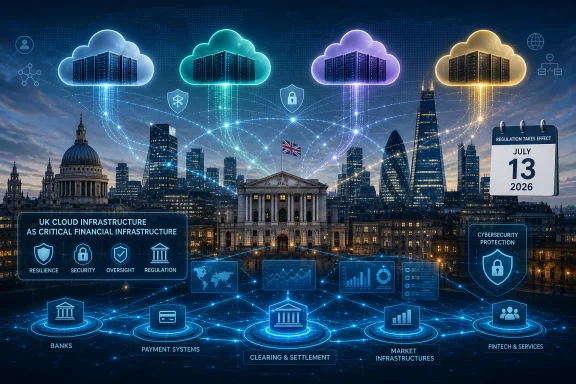 Britain Is Regulating the Dependency, Not Just the Bank
Financial regulation has traditionally followed the regulated institution. Banks, insurers, investment firms, payment companies, and financial market infrastructures are expected to understand their systems, control their risks, and remain accountable for outsourced operations.Cloud computing strains that model because consequential technology can sit several contractual layers beyond the regulated firm. A bank can audit its own applications, review its configurations, and negotiate service commitments, but it cannot independently inspect every operational dependency inside Microsoft Azure, AWS, Google Cloud, or Oracle’s enterprise cloud environment.
That matters because many institutions depend on the same small group of providers. The overlap can include compute, storage, networking, identity, databases, security tooling, monitoring, analytics, backup, and recovery services.
An incident confined to one bank can be managed as an institutional failure. An incident inside a shared platform could affect multiple banks, payment companies, insurers, trading venues, and technology suppliers at the same time. Individually defensible purchasing decisions can therefore accumulate into a sector-wide concentration risk that no single customer is equipped to measure.
The designations recognize that disruption to particular third-party services can have consequences beyond the customer experiencing the immediate outage. Regulators are not simply asking whether one cloud contract is adequately governed; they are preparing to intervene where a designated service could affect the stability or confidence of the wider financial system.
That boundary is important. The designation concerns specified services supplied to the financial sector, not every product, customer relationship, or global operation of the four technology groups. Even so, the change is significant because it creates a direct regulatory relationship where financial institutions previously carried most of the visible accountability for their use of external platforms.
Four Corporate Entities Now Sit Inside the Regulatory Perimeter
The designations apply to specific corporate entities rather than loosely to four consumer-facing brands. That distinction matters because the legal entity named in a designation determines where the new regime attaches.| Cloud group | Designated entity | Systemic environment identified |
|---|---|---|
| Microsoft | Microsoft Ireland Operations Ltd | Azure infrastructure |
| Amazon | Amazon Web Services EMEA SARL | AWS hosting |
| Google Cloud EMEA Ltd | Google’s enterprise cloud environment | |
| Oracle | Oracle Corporation UK Ltd | Oracle’s enterprise cloud environment |
That integration delivers substantial operational benefits. It also means that a problem involving a shared control plane, identity dependency, regional service, or management layer can reach beyond the individual workload where administrators first notice it.
AWS represents a similarly broad dependency for institutions that have built internet-facing services, analytics platforms, data lakes, payment components, and development environments around its infrastructure. Google Cloud is relevant to data-intensive and cloud-native operations, while Oracle remains deeply embedded in enterprise database and financial-system estates whose importance may exceed their public visibility.
The table should not be read as a ranking of market share, security, reliability, or regulatory preference. Designation reflects the potential consequences of disruption to the relevant services. It does not establish that one provider is safer or more dangerous than another.
Nor does designation mean the platforms have suddenly become unsafe. Financial firms often adopt hyperscale cloud services because the providers can invest heavily in engineering, physical security, redundancy, threat detection, and specialist personnel.
The policy problem is concentration, not a presumption of incompetence. A platform can be highly resilient in isolation while the financial sector becomes collectively more exposed to the small number of services on which many institutions depend.
The New Regime Reaches Beyond Contractual Promises
Before designation, regulators could address cloud risk primarily through the regulated financial firms using the services. They could challenge an institution’s architecture, governance, continuity planning, supplier management, and willingness to accept a particular dependency.The new regime changes that relationship by creating direct intervention powers over specified critical services supplied by the designated entities. It therefore adds a provider-facing regulatory mechanism to the existing institution-facing model.
The verified facts do not support treating that mechanism as unlimited supervision of the four companies. They also do not establish every procedural tool that regulators may use in every circumstance. Claims about mandatory self-assessments, particular reporting categories, prescribed exercises, provider-specific technical rules, or detailed information requirements should be assessed against the final legal and regulatory instruments rather than inferred from the designation announcement alone.
What can safely be said is that intervention no longer has to stop at the financial institution’s contract boundary. The Bank of England, PRA, and FCA will have direct intervention powers concerning the designated critical services. The FCA and Bank of England are also identified as able to enforce structural rectifications.
That is a meaningful shift. A financial institution can review its supplier, but it cannot see the aggregate exposure of the entire sector. A regulator can potentially compare dependencies across firms and identify situations in which many institutions rely on the same provider, region, control plane, identity mechanism, or recovery assumption.
The distinction between the designated company and the designated services will nevertheless create difficult technical questions. Modern cloud platforms do not always divide neatly into “financial-sector infrastructure” and everything else. Identity systems, management interfaces, network components, deployment services, support operations, and upstream suppliers may serve regulated and unregulated customers simultaneously.
The effectiveness of the regime will depend partly on whether regulators can trace those shared dependencies without assuming that a contractual or logical service boundary is also an operational boundary.
An Ordinary Cloud Failure Can Become an Extraordinary Financial Event
The central risk is not that cloud services sometimes fail. Every large technology environment experiences incidents, including privately operated data centers and on-premises systems.The systemic concern is common-mode failure: one underlying event affecting multiple organizations or services at once. A cloud region, identity platform, management service, network dependency, security update, or software supply-chain component can become a common point beneath institutions that otherwise appear operationally independent.
Traditional availability measurements can obscure these relationships. Two banks may run different applications and maintain separate contracts while relying on the same provider, region, identity layer, telecommunications route, or managed service.
Even a multi-cloud design may preserve a common dependency. Separate production platforms may still rely on one identity system, one key-management process, one monitoring environment, one software-delivery pipeline, or one set of privileged administrators.
The designation gives UK regulators a basis for examining risk at the level where many individual dependencies converge. That wider view matters because no single bank can determine how many other institutions have made the same architecture choices or depend on the same recovery path.
The potential causes are not limited to hostile cyber activity. Service disruption can begin with a software defect, configuration error, failed update, capacity problem, human mistake, telecommunications outage, physical disruption, or failure at another supplier.
Cybersecurity asks how hostile activity can be prevented, detected, and contained. Operational resilience asks what happens when an important service is disrupted for any reason: which functions continue, how quickly recovery occurs, and what fallback remains available while engineers are still uncertain about the cause.
For customers, the distinction may be invisible. Someone unable to access funds, make a payment, receive wages, or complete a business transaction is unlikely to care whether the root cause sits inside a bank, its cloud provider, or another supplier in the chain.
Shared Responsibility Still Applies
Cloud services operate through a shared-responsibility model. The provider operates defined portions of the platform, while the customer remains responsible for its architecture, configurations, identities, data, applications, access decisions, and resilience choices.The designation does not erase that division. A provider cannot prevent a financial institution from granting excessive privileges, deploying a fragile application, failing to test restoration, or placing all components of an important service in one failure domain.
At the same time, customers cannot independently validate every claim about a hyperscale platform’s internal resilience. The direct-intervention regime creates a regulatory counterweight without transferring each institution’s operational duties to the authorities.
For administrators, the practical lesson is to document responsibility at the level of individual dependencies. Teams should know which controls belong to the provider, which belong to the institution, which are shared, and which are owned by another supplier entirely.
Incident decisions also require more than a status-page update. Financial firms need clear provider escalation contacts and predetermined thresholds for waiting, failing over, restricting transactions, invoking manual processing, or moving to a fallback service.
The new regime may strengthen regulatory visibility, but it cannot guarantee immediate certainty during an outage. Institutions must still make time-sensitive decisions using the evidence available to them.
Timeline
July 2026 — The first designations were finalized, identifying Microsoft, Google Cloud, AWS, and Oracle entities as Critical Third Parties to the UK financial sector.July 13, 2026 — The designations take effect. The Bank of England, PRA, and FCA gain direct intervention powers relating to the specified critical services. The FCA and Bank of England are identified as able to enforce structural rectifications.
The verified timeline supports July 2026 finalization and the July 13 intervention date. It does not establish a separate Friday, July 10 public-announcement date, so no more precise announcement timeline should be inferred.
Financial Firms Do Not Get to Outsource Accountability
The most dangerous reading of the designations would be that banks and other financial institutions can now rely on regulators to validate their cloud suppliers. Direct intervention at the provider level does not make the customer’s architecture, access controls, continuity planning, or recovery execution someone else’s responsibility.Procurement teams should not treat designation as a substitute for understanding service architecture, failure modes, support arrangements, data portability, recovery objectives, subcontracting dependencies, and exit constraints.
For boards, the announcement should prompt better questions rather than automatic reassurance. Which important business services depend on each designated provider? Which dependencies are direct, and which are inherited through software vendors, managed service providers, payment processors, analytics platforms, or communications suppliers?
A bank may have no major direct Azure deployment while relying on a critical software provider hosted entirely on Azure. Another institution may avoid AWS for its primary applications while using an AWS-hosted fraud-detection, messaging, or customer-service platform.
The relevant inventory is therefore not a list of cloud invoices. It is a map connecting important business services to applications, applications to infrastructure, infrastructure to providers, and providers to the identity, networking, key-management, administrative, and recovery components necessary to operate.
No regulator can design each institution’s fallback strategy. Firms must decide how much disruption they can tolerate, which dependencies require duplication, and where a deliberately limited manual or offline capability is more credible than an expensive but untested duplicate platform.
Windows and Azure Teams Now Own a Financial-Risk Conversation
For Windows administrators, the designation of Microsoft Ireland Operations Ltd may initially sound like a matter for legal, compliance, or vendor-management teams. In practice, it reaches architecture decisions made by identity, endpoint, server, networking, security, database, and cloud-platform teams.An organization can distribute applications across multiple Azure regions while retaining a common identity or management dependency. It can maintain on-premises Windows Server systems while relying on cloud-hosted authentication, monitoring, backup, security analysis, privileged-access workflows, or administrative tooling.
Administrators must distinguish workload redundancy from administrative recoverability. If the primary cloud or identity service is impaired, can authorized staff still reach emergency systems, retrieve credentials, communicate securely, inspect logs, restore data, and approve high-risk changes?
They must also distinguish backup from recovery. A valid database copy is of limited use if the organization lacks accessible encryption keys, functioning infrastructure, current application dependencies, network connectivity, licensing, or tested procedures for using the data elsewhere.
Recovery exercises should therefore test the loss of a dependency rather than merely the failure of one customer-managed virtual machine. Useful scenarios include unavailable cloud identity, an inaccessible management portal, loss of a region, delayed provider support, restricted network connectivity, and inconsistent service-status information.
Action checklist for admins
- Assign a named dependency-map owner for every important business service.
- Map each service to its direct and indirect Azure, AWS, Google Cloud, and Oracle dependencies.
- Identify common identity, DNS, networking, key-management, monitoring, backup, software-delivery, and administrative dependencies.
- Record a documented decision for every common dependency: accept it, reduce it, duplicate it, replace it, or provide a manual fallback.
- Set an RTO, RPO, or applicable impact-tolerance target for each important service and record who approved it.
- Record the last-tested recovery date, test result, unresolved defects, and next scheduled exercise.
- Test at least one offline break-glass administrative account and verify that its credentials, device requirements, and instructions remain accessible during an identity outage.
- Confirm that emergency documentation and contact details are available outside the platform they are intended to recover.
- Maintain named provider escalation contacts, contractual support routes, internal incident commanders, and out-of-hours contact methods.
- Test restoration and failover procedures rather than relying on architecture diagrams or contractual recovery claims.
- Verify that backups can be restored into usable infrastructure and that required keys, configurations, applications, and network routes are available.
- Record where multi-region or multi-cloud designs still contain a shared point of failure.
- Define who can authorize manual processing, transaction restrictions, failover, or service suspension when provider information is incomplete.
- Prepare an evidence pack containing the dependency map, recovery target, last test result, break-glass test record, escalation contacts, and outstanding remediation decisions.
What UK Financial Firms Should Do Before July 13, 2026
Organizations should prioritize evidence and tested capability over broad policy rewrites.1. Identify the important services that could be affected.
Start with customer and market outcomes, not the cloud asset inventory. Determine which payment, account-access, trading, claims, settlement, reporting, and communications services rely on a designated provider directly or through another supplier.
2. Name accountable owners.
Assign one executive owner for the business service and one operational owner for its dependency map. Unowned diagrams become outdated quickly and provide little value during an incident.
3. Find the hidden common dependencies.
Review identity, DNS, certificates, encryption keys, network connectivity, monitoring, privileged access, source repositories, deployment pipelines, support portals, and communications channels. These are frequently required by both the primary and recovery environments.
4. Test administrative access without normal identity services.
Run an offline break-glass exercise. Confirm that credentials work, instructions are available, required devices can authenticate, and use of the account generates an independently accessible audit trail.
5. Prove recovery against a measurable target.
Record the RTO, RPO, or impact-tolerance target and compare it with the latest exercise. If the service cannot currently meet that target, document the gap, interim control, owner, and remediation deadline.
6. Rehearse provider escalation.
Confirm who contacts the provider, which support tier applies, what evidence must be supplied, and who escalates if the initial channel fails. Keep the required details outside the affected provider’s environment.
7. Decide what to do about each concentration risk.
For every common dependency, document whether the institution will accept, reduce, duplicate, replace, or work around it. “Multi-cloud later” is not a decision unless it has an owner, funded plan, tested scope, and delivery date.
8. Give senior management a concise readiness view.
Boards and risk committees need the important services affected, their recovery targets, latest test results, critical gaps, provider escalation readiness, and decisions requiring funding—not a raw export of cloud resources.
Multi-Cloud Is Not an Instant Escape Hatch
Distributing workloads across providers can reduce some concentration risks, but using more than one cloud is not automatically a resilience strategy.Applications built around proprietary managed services may require substantial redesign before they can operate on another provider. A nominal secondary environment that receives no production traffic, lacks current data, or is rarely tested may offer little protection during a real incident.
Active-active architectures can reduce certain outage risks but add cost and operational complexity. Data consistency, transaction ordering, access controls, software releases, monitoring, and incident management all become more difficult when a service spans separate platforms.
The correct response depends on the service’s impact tolerance and realistic recovery options. Some workloads may be adequately protected through multiple regions within one provider. Others may justify a second cloud, an on-premises recovery environment, offline processing, or a simplified fallback service.
The essential question is not whether an architecture can be described as multi-cloud. It is whether the organization has demonstrated that the important business service can continue or recover within its approved target when the relevant dependency is unavailable.
Enforcement Will Decide Whether the Designation Has Teeth
The designations are the beginning of the regime’s practical test, not proof of its effectiveness. Regulators will need enough technical understanding to distinguish genuine resilience from extensive documentation that does not demonstrate recoverability.Hyperscale platforms are large, global, and continuously changing. Effective intervention will require close attention to distributed systems, identity, cryptography, networking, incident response, software supply chains, data-center operations, and organizational decision-making.
There is also a problem of scale. Regulators need sufficient evidence to understand systemic dependencies without allowing oversight to become an exercise in collecting paperwork that neither predicts failure nor improves recovery.
The FCA and Bank of England’s ability to enforce structural rectifications is therefore an important part of the verified announcement. Its significance will depend on how that power is used, what deficiencies trigger action, and whether required changes address operational risks rather than simply producing additional documentation.
The most credible interventions will be tied to decision-useful evidence: accurate identification of important services, understood dependencies, accessible escalation paths, realistic recovery targets, and recovery demonstrated under adverse conditions.
The regime will be less useful if providers and financial institutions can satisfy it through policy statements while untested identity, network, key-management, or administrative dependencies continue to block recovery.
Bottom Line
The UK’s designation of Microsoft, AWS, Google Cloud, and Oracle entities puts specified critical financial-sector services into a direct-intervention regime from July 13, 2026. It does not make regulators responsible for each financial firm’s architecture, and it should not be read as proof that designated services are either unsafe or guaranteed resilient.For financial institutions, the immediate task is practical: identify the services that matter, map every direct and inherited dependency, assign owners, test offline administrative access, record recovery targets and last-tested dates, validate provider escalation contacts, and make an explicit decision about every common point of failure.
The regulatory perimeter is moving closer to the cloud platform, but accountability for keeping customer-facing financial services running still begins inside each financial firm.
References
- Primary source: streamlinefeed.co.ke
Published: 2026-07-10T12:30:10.276581
Loading…
streamlinefeed.co.ke - Related coverage: fca.org.uk
Loading…
www.fca.org.uk - Related coverage: bankofengland.co.uk
Loading…
www.bankofengland.co.uk - Related coverage: live.euronext.com
Loading…
live.euronext.com - Related coverage: pwc.co.uk
Loading…
www.pwc.co.uk - Related coverage: techradar.com
Loading…
www.techradar.com
- Related coverage: investing.com
Loading…
www.investing.com - Related coverage: zonebourse.com
Loading…
www.zonebourse.com - Related coverage: wifc.com
Loading…
wifc.com - Related coverage: devdiscourse.com
Loading…
www.devdiscourse.com - Related coverage: es.marketscreener.com
Loading…
es.marketscreener.com - Related coverage: contractsfinder.service.gov.uk
Loading…
www.contractsfinder.service.gov.uk
