

CVE-2026-14388 is a medium-severity Google Chrome vulnerability, fixed at version 150.0.7871.46, that lets a remote attacker use a crafted HTML page to read beyond an intended ANGLE memory boundary and potentially expose sensitive information held inside the browser process. The immediate remedy is routine—update Chrome and restart it—but the underlying issue is more consequential than the word medium suggests. It sits in the graphics translation layer that turns ordinary web content into GPU work, where complex inputs, native code, driver differences, and browser sandbox boundaries converge. For Windows users and administrators, this is primarily an information-disclosure bug, not a demonstrated system takeover, yet it deserves prompt deployment because memory disclosures can become valuable supporting components in broader exploit chains.
Google’s description of CVE-2026-14388 is concise: an out-of-bounds read in ANGLE allowed a remote attacker to obtain potentially sensitive information from process memory through a crafted HTML page. The affected range covers Google Chrome versions earlier than 150.0.7871.46, and the weakness is categorized as CWE-125, Out-of-bounds Read.
That description establishes both the attack surface and the limit of what is currently claimed. An attacker can deliver the triggering content over the network and does not need an existing account or privileges on the target computer, but a user must interact by opening or otherwise rendering the malicious page. The record does not say that the flaw writes memory, executes attacker-controlled code, escapes Chrome’s sandbox, or compromises Windows by itself.
The distinction matters because browser vulnerability reporting often collapses very different technical outcomes into the phrase “malicious webpage.” A crafted page may cause nothing more than a crash, may reveal fragments of process memory, may corrupt memory in a way that enables code execution, or may form one stage of a multi-vulnerability attack. CVE-2026-14388 is specifically documented as a read beyond an authorized boundary, with confidentiality impact rather than integrity or availability impact.
That still creates a meaningful security problem. Memory inside a browser-related process can contain data that was never intended to be returned to the webpage requesting graphics work. The public record does not identify what information can reliably be recovered, how much can be read, or whether the attacker can select the target data, so claims that the flaw directly steals passwords, cookies, encryption keys, or documents would go beyond the available evidence.
The defensible conclusion is narrower: specially constructed web content could cause Chrome’s ANGLE code to read data outside the expected memory region, potentially disclosing process information. That is enough to justify an update, but not enough to portray every vulnerable Chrome installation as already compromised.
On Windows, that translation role is particularly important. A webpage can request accelerated graphics through high-level browser interfaces without knowing the details of the installed GPU, driver, or native graphics API. ANGLE handles much of the translation and compatibility work that allows the same web application, visualization, game, design tool, or media interface to run across varied hardware.
That portability creates complexity. ANGLE must accept structured, attacker-influenced graphics input, validate it, transform it, manage resources, and communicate with lower layers of the graphics stack. A mistake in length calculation, object validation, indexing, format conversion, or buffer handling can leave native code operating on assumptions that a malicious input deliberately violates.
An out-of-bounds read occurs when software attempts to retrieve data beyond the memory region that it was supposed to access. The program may have allocated a buffer for a specific object, array, texture, command, or translated structure, yet faulty validation allows an operation to continue past that buffer’s legitimate end. What follows depends on the exact layout and protections: the browser may crash, return unintended bytes, expose adjacent state, or produce inconsistent behavior.
CVE-2026-14388 is therefore not merely a “graphics glitch.” The visual content is the delivery mechanism, while the security boundary is memory safety inside a component that processes untrusted web input. A page need not look suspicious, display an elaborate three-dimensional scene, or ask the user for a browser permission before attempting to reach vulnerable code.
The graphics path also complicates testing. Results can differ according to operating system, GPU vendor, driver behavior, enabled acceleration path, and the precise content rendered. Those variables do not change the official affected-product record, which names Google Chrome before the fixed threshold, but they may affect whether a particular proof of concept crashes, leaks useful data, or fails harmlessly.
“AV:N” means the vulnerable path can be reached over a network rather than requiring local access. “AC:L” indicates low attack complexity under the scoring model, while “PR:N” means the attacker does not need prior privileges. “UI:R” is the important constraint: exploitation requires user interaction, consistent with a victim loading a crafted HTML page.
The impact side is equally revealing. “C:H” assigns high potential confidentiality impact, but “I:N” and “A:N” assign no direct integrity or availability impact. The score therefore reflects a remotely reachable information-disclosure condition that requires user interaction—not documented code execution, data modification, or service destruction.
“Scope unchanged,” represented by “S:U,” means the scored vulnerability is not credited with crossing into a separate security authority. That does not make the flaw irrelevant to exploit developers; it means the published scoring does not treat it as a demonstrated boundary-crossing compromise.
The National Vulnerability Database had not supplied its own CVSS 3.x base assessment when the record was last modified on July 2, 2026. It also listed no NVD assessment under CVSS 4.0 or CVSS 2.0. The visible 6.5 score comes from the CISA-ADP contribution, not an independent NVD calculation.
That difference is easy to lose when vulnerability dashboards reduce several data providers to a single colored badge. CVE-2026-14388 is not “unscored,” because a CISA-ADP score is present, but neither should the 6.5 be described as NIST’s final judgment. The record explicitly says NVD’s own assessments had not yet been provided.
This is one reason organizations should not let a numeric threshold make the entire deployment decision. A score communicates standardized characteristics, not the importance of the affected application to a particular business. A remotely triggerable browser memory disclosure on thousands of internet-facing endpoints may deserve faster action than a numerically higher issue hidden behind several local prerequisites.
That does not elevate every Chrome vulnerability into an emergency. The CISA SSVC record for CVE-2026-14388 lists exploitation as “none,” automatable as “no,” and technical impact as “partial.” As of the SSVC timestamp on July 2, 2026, the record did not identify exploitation evidence.
But “none” in that field should be read as no exploitation identified in the assessment, not as proof that exploitation is impossible or that nobody has investigated the bug. Public bug details can remain restricted while users are still receiving an update, and the referenced Chromium issue requires permission. That restriction is standard defensive practice because publishing a detailed trigger too early could make exploitation easier before patch coverage is broad.
The absence of public technical detail also limits confident risk downgrades. Defenders do not yet have enough information to determine whether the read is tightly constrained, whether repeated requests can expose useful memory, whether the bug primarily produces crashes, or whether environmental differences materially change its reliability. Those unanswered questions argue against panic, but they also argue against complacency.
Information disclosures have a particular role in modern exploitation. Browser defenses often depend on attackers not knowing exact memory locations or internal state. A reliable leak can reportedly help another vulnerability bypass such uncertainty, even when the disclosure does not itself execute code. That is a general exploit-development concern, not a claim that CVE-2026-14388 has been chained in the wild.
The correct operational category is therefore straightforward: patch promptly, without treating the CVE as a confirmed zero-day takeover. Organizations should accelerate deployment where Chrome is used for sensitive administrative sessions or where browser updates are commonly delayed, while avoiding dramatic incident-response measures unsupported by evidence.
The JSON-style affected-software record can look awkward if read without context. It places 150.0.7871.46 inside a version object marked “affected” while also setting a “lessThan” boundary of 150.0.7871.46. The descriptive text and CPE range remove the ambiguity: the boundary value identifies the cutoff, while versions below it are vulnerable.
For administrators, the installed package version is not always the same thing as the currently running browser version. Chrome may download an update in the background but continue executing older browser processes until the application is restarted. A successful package deployment report is therefore necessary but not always sufficient evidence of remediation.
Long-lived sessions are the common failure mode. Users may leave dozens of tabs open for days, close the visible window while background activity continues, or postpone a prompted relaunch because the browser has become their working desktop. Managed environments should verify process turnover rather than assuming an update became active immediately after download.
The threshold also belongs specifically to Google Chrome. Administrators should not automatically apply that exact version test to Microsoft Edge, other Chromium-derived browsers, embedded runtimes, or operating-system Chromium packages. Those products can consume upstream Chromium fixes through their own build numbers, release channels, and vendor servicing schedules.
Snyk’s vulnerability database, for example, reproduces the upstream description while treating distribution packaging as a separate remediation question. That distinction is useful: an upstream Chrome cutoff establishes where Google fixed its product, but a downstream package maintainer may backport the code under a different package version. The vendor responsible for the deployed software remains the correct source for that product’s patched build.
July 1, 2026 — 10:16:25 PM: CISA-ADP modified the record by adding the CVSS 3.1 vector and the SSVC data.
July 2, 2026 — 00:33:22.848860Z: The SSVC record was timestamped with exploitation “none,” automatable “no,” and technical impact “partial,” under the CISA Coordinator role and SSVC version 2.0.3.
July 2, 2026 — 1:28:50 PM: NIST’s initial analysis added the Chrome CPE range ending before 150.0.7871.46 and classified the Chrome release page as release notes and a vendor advisory.
The NVD quick information lists July 1, 2026, as the publication date and July 2, 2026, as the last-modified date. The source is Chrome, which means the vulnerability description originated with the vendor rather than being independently authored by NVD.
The restricted Chromium issue is an important part of this chronology. Google has disclosed enough for organizations to identify vulnerable installations and deploy the fix, but not enough for the public to reconstruct the exact fault. Until that restriction changes, analysis should stay anchored to the disclosed impact instead of filling gaps with speculation.
Enterprise estates are more complicated because administrators may control update intervals, target versions, release channels, restart notifications, and rollback behavior. Policies designed to prevent unexpected browser changes can unintentionally extend exposure when they hold systems below a security threshold.
A version pin is especially dangerous when treated as permanent configuration rather than a temporary compatibility control. Pinning may stabilize a critical web application, but it also transfers responsibility for evaluating and admitting security releases from Google’s automated channel to the organization’s own change process. If that process moves slowly, the browser’s silent-update security model has effectively been disabled.
Staged deployment remains reasonable. The vulnerability is rated Medium, no exploitation is identified in the supplied SSVC assessment, and the record does not document a standalone code-execution path. Administrators can validate the update against browser extensions, authentication middleware, GPU-intensive applications, video workflows, and internal web tools before broad deployment—but the validation window should be measured in operationally useful time, not indefinite delay.
Telemetry should distinguish four states: a device that has not downloaded the update, one that has installed files but not restarted Chrome, one that is running the corrected build, and one that has fallen back or failed deployment. Dashboards that report only package installation can hide the second state, which is often where otherwise successful browser patching stalls.
The same logic applies to shared workstations, virtual desktops, kiosks, lab systems, and persistent remote sessions. Browsers in these environments may remain open for unusually long periods or be restored from an image that immediately reintroduces an old build. The remediation plan must cover the image, update service, active process, and future reprovisioning path.
Disabling JavaScript is similarly imprecise. The attack is delivered through crafted HTML, but the public description does not state that JavaScript is required. A broad script block may reduce exposure to many hostile pages while also breaking business applications, yet it should not be presented as a verified substitute for the fixed browser.
Network filtering can reduce the probability of users reaching known malicious sites, but it cannot reliably identify every newly registered domain, compromised legitimate page, malicious advertisement, or specially delivered document that causes browser content to load. Safe Browsing, DNS filtering, proxies, and endpoint detection are valuable layers; none changes the vulnerable code version.
The strongest control is the least inventive one: install the vendor’s corrected build and make sure it is running. Chrome’s security architecture is intentionally built around layered defenses and transparent updating. Administrators weaken that model when they replace a definitive code fix with assumptions about which websites users will visit or which rendering features an attacker will need.
Where immediate updating is genuinely impossible, reducing untrusted browsing on the affected endpoint is the defensible temporary measure. Sensitive administrative work can be moved to a patched device, access to arbitrary external sites can be constrained, and browser sessions can be isolated until the compatibility blocker is resolved. Those controls reduce opportunity; they do not repair the out-of-bounds read.
Those edge cases matter because exposure is driven by web content, not by whether Chrome is designated the corporate default. A secondary browser that is opened only for one legacy portal can still process an attacker-controlled link. An administrator who primarily uses another browser may launch Chrome from a troubleshooting guide, an email attachment, or an application that registers it as a handler.
Software inventory tools may also collapse browser channels or architectures into one product entry. A device can appear compliant at the package level while a separate user-scoped installation, portable copy, or stale image remains below the threshold. The CVE does not become more severe on those systems, but the organization’s confidence in remediation becomes less reliable.
Windows administrators should also resist turning this into a generic “Chromium vulnerability” deployment rule. Microsoft Edge and other Chromium-based products share substantial upstream code, but each vendor packages and services that code independently. The Chrome CPE and 150.0.7871.46 boundary provide direct evidence for Google Chrome only.
That distinction cuts both ways. It prevents admins from falsely declaring another browser safe because its version number looks higher, and it prevents them from declaring it vulnerable merely because its number looks lower. Product-specific advisories, not cross-product arithmetic, should determine whether a Chromium-derived browser has incorporated the relevant fix.
A Chrome or GPU-process crash is not evidence that CVE-2026-14388 was exploited. Browsers and graphics drivers crash for many unrelated reasons, and an out-of-bounds read may not produce a distinctive user-visible result. Conversely, the absence of crashes does not prove that vulnerable code was never reached.
Endpoint detection may still help identify broader malicious activity surrounding a browser attack, such as suspicious child processes, unexpected downloads, credential access, persistence, or abnormal network connections. Those signals would matter because of what they show independently, not because the CVE record claims that this vulnerability produces them.
Administrators should preserve relevant telemetry if they encounter a repeatable crash tied to a specific page on an affected build, especially if the behavior disappears after updating. The appropriate response would be to isolate the URL, avoid repeatedly testing it on production systems, retain logs where policy permits, and report the behavior through established vendor or security channels.
The practical detection objective is thus exposure management rather than exploit attribution. Find the old browser, understand why it is old, update it, verify the running process, and watch for later changes in vendor or government exploitation assessments.
It does not prove that passwords, cookies, session tokens, or personal files can be reliably extracted. Those are examples of data defenders care about, but the public materials do not establish the content, precision, repeatability, or reach of the read.
It does not prove active exploitation. CISA’s SSVC data explicitly records exploitation as “none” at its July 2 timestamp. That assessment may change if new evidence emerges, but the supplied record supports no zero-day claim.
Nor does the Medium rating prove that delaying is harmless. Severity scores are decision inputs, not deployment calendars. Browsers combine extensive exposure with high-value sessions, and a confidentiality primitive can be more useful to an attacker when paired with another flaw than its standalone description implies.
The most accurate framing lies between alarmism and minimization: CVE-2026-14388 is a remotely reachable Chrome memory-disclosure vulnerability requiring user interaction, with a clear fixed threshold, no identified exploitation in the supplied assessment, and insufficient public detail to make stronger claims.
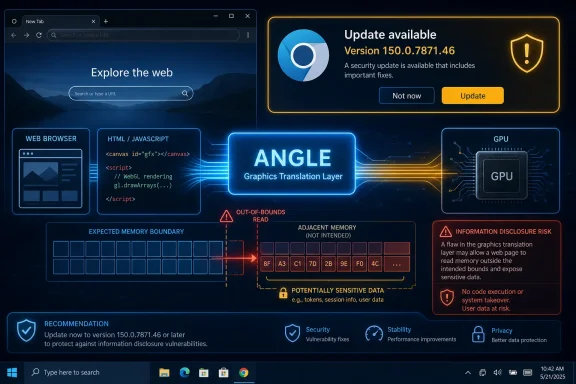 A Crafted Page Reaches Below the Browser’s Visual Surface
Google’s description of CVE-2026-14388 is concise: an out-of-bounds read in ANGLE allowed a remote attacker to obtain potentially sensitive information from process memory through a crafted HTML page. The affected range covers Google Chrome versions earlier than 150.0.7871.46, and the weakness is categorized as CWE-125, Out-of-bounds Read.That description establishes both the attack surface and the limit of what is currently claimed. An attacker can deliver the triggering content over the network and does not need an existing account or privileges on the target computer, but a user must interact by opening or otherwise rendering the malicious page. The record does not say that the flaw writes memory, executes attacker-controlled code, escapes Chrome’s sandbox, or compromises Windows by itself.
The distinction matters because browser vulnerability reporting often collapses very different technical outcomes into the phrase “malicious webpage.” A crafted page may cause nothing more than a crash, may reveal fragments of process memory, may corrupt memory in a way that enables code execution, or may form one stage of a multi-vulnerability attack. CVE-2026-14388 is specifically documented as a read beyond an authorized boundary, with confidentiality impact rather than integrity or availability impact.
That still creates a meaningful security problem. Memory inside a browser-related process can contain data that was never intended to be returned to the webpage requesting graphics work. The public record does not identify what information can reliably be recovered, how much can be read, or whether the attacker can select the target data, so claims that the flaw directly steals passwords, cookies, encryption keys, or documents would go beyond the available evidence.
The defensible conclusion is narrower: specially constructed web content could cause Chrome’s ANGLE code to read data outside the expected memory region, potentially disclosing process information. That is enough to justify an update, but not enough to portray every vulnerable Chrome installation as already compromised.
ANGLE Turns Web Graphics Into Native Attack Surface
ANGLE—the Almost Native Graphics Layer Engine—is not a decorative component bolted onto Chrome. Chromium’s own project documentation describes it as a translation layer that takes graphics calls used by web content and maps them to hardware-supported graphics interfaces across different operating systems and GPU environments.On Windows, that translation role is particularly important. A webpage can request accelerated graphics through high-level browser interfaces without knowing the details of the installed GPU, driver, or native graphics API. ANGLE handles much of the translation and compatibility work that allows the same web application, visualization, game, design tool, or media interface to run across varied hardware.
That portability creates complexity. ANGLE must accept structured, attacker-influenced graphics input, validate it, transform it, manage resources, and communicate with lower layers of the graphics stack. A mistake in length calculation, object validation, indexing, format conversion, or buffer handling can leave native code operating on assumptions that a malicious input deliberately violates.
An out-of-bounds read occurs when software attempts to retrieve data beyond the memory region that it was supposed to access. The program may have allocated a buffer for a specific object, array, texture, command, or translated structure, yet faulty validation allows an operation to continue past that buffer’s legitimate end. What follows depends on the exact layout and protections: the browser may crash, return unintended bytes, expose adjacent state, or produce inconsistent behavior.
CVE-2026-14388 is therefore not merely a “graphics glitch.” The visual content is the delivery mechanism, while the security boundary is memory safety inside a component that processes untrusted web input. A page need not look suspicious, display an elaborate three-dimensional scene, or ask the user for a browser permission before attempting to reach vulnerable code.
The graphics path also complicates testing. Results can differ according to operating system, GPU vendor, driver behavior, enabled acceleration path, and the precise content rendered. Those variables do not change the official affected-product record, which names Google Chrome before the fixed threshold, but they may affect whether a particular proof of concept crashes, leaks useful data, or fails harmlessly.
The 6.5 Score Measures Confidentiality, Not a Full Compromise
CISA-ADP assigned CVE-2026-14388 a CVSS 3.1 base score of 6.5, categorized as Medium. Its vector is CVSS:3.1/AV:N/AC:L/PR:N/UI:R/S:U/C:H/I:N/A:N, a compressed description that is more informative than the label alone.“AV:N” means the vulnerable path can be reached over a network rather than requiring local access. “AC:L” indicates low attack complexity under the scoring model, while “PR:N” means the attacker does not need prior privileges. “UI:R” is the important constraint: exploitation requires user interaction, consistent with a victim loading a crafted HTML page.
The impact side is equally revealing. “C:H” assigns high potential confidentiality impact, but “I:N” and “A:N” assign no direct integrity or availability impact. The score therefore reflects a remotely reachable information-disclosure condition that requires user interaction—not documented code execution, data modification, or service destruction.
“Scope unchanged,” represented by “S:U,” means the scored vulnerability is not credited with crossing into a separate security authority. That does not make the flaw irrelevant to exploit developers; it means the published scoring does not treat it as a demonstrated boundary-crossing compromise.
The National Vulnerability Database had not supplied its own CVSS 3.x base assessment when the record was last modified on July 2, 2026. It also listed no NVD assessment under CVSS 4.0 or CVSS 2.0. The visible 6.5 score comes from the CISA-ADP contribution, not an independent NVD calculation.
That difference is easy to lose when vulnerability dashboards reduce several data providers to a single colored badge. CVE-2026-14388 is not “unscored,” because a CISA-ADP score is present, but neither should the 6.5 be described as NIST’s final judgment. The record explicitly says NVD’s own assessments had not yet been provided.
This is one reason organizations should not let a numeric threshold make the entire deployment decision. A score communicates standardized characteristics, not the importance of the affected application to a particular business. A remotely triggerable browser memory disclosure on thousands of internet-facing endpoints may deserve faster action than a numerically higher issue hidden behind several local prerequisites.
“Medium” Does Not Mean “Wait Until the Next Convenient Quarter”
Chrome is an unusually exposed application. It routinely consumes content from outside the organization, runs active code, parses complex formats, maintains authenticated sessions, and serves as the access layer for email, collaboration, finance, identity, administration, and cloud-management systems.That does not elevate every Chrome vulnerability into an emergency. The CISA SSVC record for CVE-2026-14388 lists exploitation as “none,” automatable as “no,” and technical impact as “partial.” As of the SSVC timestamp on July 2, 2026, the record did not identify exploitation evidence.
But “none” in that field should be read as no exploitation identified in the assessment, not as proof that exploitation is impossible or that nobody has investigated the bug. Public bug details can remain restricted while users are still receiving an update, and the referenced Chromium issue requires permission. That restriction is standard defensive practice because publishing a detailed trigger too early could make exploitation easier before patch coverage is broad.
The absence of public technical detail also limits confident risk downgrades. Defenders do not yet have enough information to determine whether the read is tightly constrained, whether repeated requests can expose useful memory, whether the bug primarily produces crashes, or whether environmental differences materially change its reliability. Those unanswered questions argue against panic, but they also argue against complacency.
Information disclosures have a particular role in modern exploitation. Browser defenses often depend on attackers not knowing exact memory locations or internal state. A reliable leak can reportedly help another vulnerability bypass such uncertainty, even when the disclosure does not itself execute code. That is a general exploit-development concern, not a claim that CVE-2026-14388 has been chained in the wild.
The correct operational category is therefore straightforward: patch promptly, without treating the CVE as a confirmed zero-day takeover. Organizations should accelerate deployment where Chrome is used for sensitive administrative sessions or where browser updates are commonly delayed, while avoiding dramatic incident-response measures unsupported by evidence.
The Version Boundary Is Clearer Than the Raw Record Looks
The operative rule is simple: Google Chrome versions before 150.0.7871.46 are affected, and 150.0.7871.46 is the fixed threshold. NIST’s CPE configuration independently expresses the same boundary by including Chrome versions up to, but excluding, 150.0.7871.46.| Chrome version state | CVE status | Documented exposure | Practical interpretation |
|---|---|---|---|
| Earlier than 150.0.7871.46 | Affected | Crafted HTML may trigger an ANGLE out-of-bounds read | Update and restart Chrome |
| 150.0.7871.46 or later | Outside the affected range | Fixed threshold has been reached | Verify the running browser actually loaded the update |
For administrators, the installed package version is not always the same thing as the currently running browser version. Chrome may download an update in the background but continue executing older browser processes until the application is restarted. A successful package deployment report is therefore necessary but not always sufficient evidence of remediation.
Long-lived sessions are the common failure mode. Users may leave dozens of tabs open for days, close the visible window while background activity continues, or postpone a prompted relaunch because the browser has become their working desktop. Managed environments should verify process turnover rather than assuming an update became active immediately after download.
The threshold also belongs specifically to Google Chrome. Administrators should not automatically apply that exact version test to Microsoft Edge, other Chromium-derived browsers, embedded runtimes, or operating-system Chromium packages. Those products can consume upstream Chromium fixes through their own build numbers, release channels, and vendor servicing schedules.
Snyk’s vulnerability database, for example, reproduces the upstream description while treating distribution packaging as a separate remediation question. That distinction is useful: an upstream Chrome cutoff establishes where Google fixed its product, but a downstream package maintainer may backport the code under a different package version. The vendor responsible for the deployed software remains the correct source for that product’s patched build.
The Timeline Shows a Rapidly Enriched, Still-Incomplete Record
The vulnerability record developed over roughly a day, moving from Chrome’s initial submission to scoring, SSVC context, and NIST configuration data. That quick enrichment produced a usable remediation boundary, but it did not produce a complete public technical analysis.Timeline
July 1, 2026 — 7:16:47 PM: The CVE was received from Chrome with the ANGLE out-of-bounds-read description, CWE-125 classification, affected-software data, vendor advisory reference, and restricted Chromium issue reference.July 1, 2026 — 10:16:25 PM: CISA-ADP modified the record by adding the CVSS 3.1 vector and the SSVC data.
July 2, 2026 — 00:33:22.848860Z: The SSVC record was timestamped with exploitation “none,” automatable “no,” and technical impact “partial,” under the CISA Coordinator role and SSVC version 2.0.3.
July 2, 2026 — 1:28:50 PM: NIST’s initial analysis added the Chrome CPE range ending before 150.0.7871.46 and classified the Chrome release page as release notes and a vendor advisory.
The NVD quick information lists July 1, 2026, as the publication date and July 2, 2026, as the last-modified date. The source is Chrome, which means the vulnerability description originated with the vendor rather than being independently authored by NVD.
The restricted Chromium issue is an important part of this chronology. Google has disclosed enough for organizations to identify vulnerable installations and deploy the fix, but not enough for the public to reconstruct the exact fault. Until that restriction changes, analysis should stay anchored to the disclosed impact instead of filling gaps with speculation.
Browser Restart Discipline Is the Missing Half of Patch Management
For an unmanaged home user, remediation should be nearly invisible. Chrome’s updater retrieves new builds automatically, and the user completes the transition by relaunching the browser. The practical check is to open Chrome’s About page, allow any pending update to finish, and confirm that the running version is at least 150.0.7871.46.Enterprise estates are more complicated because administrators may control update intervals, target versions, release channels, restart notifications, and rollback behavior. Policies designed to prevent unexpected browser changes can unintentionally extend exposure when they hold systems below a security threshold.
A version pin is especially dangerous when treated as permanent configuration rather than a temporary compatibility control. Pinning may stabilize a critical web application, but it also transfers responsibility for evaluating and admitting security releases from Google’s automated channel to the organization’s own change process. If that process moves slowly, the browser’s silent-update security model has effectively been disabled.
Staged deployment remains reasonable. The vulnerability is rated Medium, no exploitation is identified in the supplied SSVC assessment, and the record does not document a standalone code-execution path. Administrators can validate the update against browser extensions, authentication middleware, GPU-intensive applications, video workflows, and internal web tools before broad deployment—but the validation window should be measured in operationally useful time, not indefinite delay.
Telemetry should distinguish four states: a device that has not downloaded the update, one that has installed files but not restarted Chrome, one that is running the corrected build, and one that has fallen back or failed deployment. Dashboards that report only package installation can hide the second state, which is often where otherwise successful browser patching stalls.
The same logic applies to shared workstations, virtual desktops, kiosks, lab systems, and persistent remote sessions. Browsers in these environments may remain open for unusually long periods or be restored from an image that immediately reintroduces an old build. The remediation plan must cover the image, update service, active process, and future reprovisioning path.
Action checklist for admins
- Inventory Google Chrome installations and identify versions earlier than 150.0.7871.46.
- Review update, version-targeting, rollback, and restart policies for anything blocking the fixed threshold.
- Deploy the corrected Chrome build through the organization’s normal managed channel.
- Require or schedule a browser relaunch so older Chrome processes are terminated.
- Re-query the running version after restart rather than relying only on package-installation status.
- Check persistent images, kiosks, virtual desktops, and offline devices that may escape routine rollout.
- Monitor Google’s advisory and the restricted Chromium issue for later technical or exploitation updates.
Workarounds Are Weaker Than Updating
Organizations sometimes respond to graphics vulnerabilities by disabling hardware acceleration. That may change which graphics paths are exercised, but the supplied CVE record does not identify disabling acceleration as a complete mitigation for CVE-2026-14388. Without public issue details, administrators cannot safely assume that one user-facing toggle removes every reachable ANGLE path.Disabling JavaScript is similarly imprecise. The attack is delivered through crafted HTML, but the public description does not state that JavaScript is required. A broad script block may reduce exposure to many hostile pages while also breaking business applications, yet it should not be presented as a verified substitute for the fixed browser.
Network filtering can reduce the probability of users reaching known malicious sites, but it cannot reliably identify every newly registered domain, compromised legitimate page, malicious advertisement, or specially delivered document that causes browser content to load. Safe Browsing, DNS filtering, proxies, and endpoint detection are valuable layers; none changes the vulnerable code version.
The strongest control is the least inventive one: install the vendor’s corrected build and make sure it is running. Chrome’s security architecture is intentionally built around layered defenses and transparent updating. Administrators weaken that model when they replace a definitive code fix with assumptions about which websites users will visit or which rendering features an attacker will need.
Where immediate updating is genuinely impossible, reducing untrusted browsing on the affected endpoint is the defensible temporary measure. Sensitive administrative work can be moved to a patched device, access to arbitrary external sites can be constrained, and browser sessions can be isolated until the compatibility blocker is resolved. Those controls reduce opportunity; they do not repair the out-of-bounds read.
The Real Enterprise Risk Is the Browser You Forgot to Count
Most organizations know they run Chrome, but fewer know every place it runs. The obvious fleet of employee laptops is only the beginning. Chrome may also exist on jump boxes, testing systems, contractor devices, pooled desktops, conference-room computers, application-publishing servers, development workstations, and machines that have not checked in since the previous update cycle.Those edge cases matter because exposure is driven by web content, not by whether Chrome is designated the corporate default. A secondary browser that is opened only for one legacy portal can still process an attacker-controlled link. An administrator who primarily uses another browser may launch Chrome from a troubleshooting guide, an email attachment, or an application that registers it as a handler.
Software inventory tools may also collapse browser channels or architectures into one product entry. A device can appear compliant at the package level while a separate user-scoped installation, portable copy, or stale image remains below the threshold. The CVE does not become more severe on those systems, but the organization’s confidence in remediation becomes less reliable.
Windows administrators should also resist turning this into a generic “Chromium vulnerability” deployment rule. Microsoft Edge and other Chromium-based products share substantial upstream code, but each vendor packages and services that code independently. The Chrome CPE and 150.0.7871.46 boundary provide direct evidence for Google Chrome only.
That distinction cuts both ways. It prevents admins from falsely declaring another browser safe because its version number looks higher, and it prevents them from declaring it vulnerable merely because its number looks lower. Product-specific advisories, not cross-product arithmetic, should determine whether a Chromium-derived browser has incorporated the relevant fix.
Detection Should Focus on Version Evidence, Not Hypothetical Indicators
The available record does not provide indicators of compromise, malicious domains, file hashes, exploit filenames, crash signatures, or a public proof of concept. It also does not identify observed exploitation. Security teams therefore have little basis for a CVE-specific threat hunt beyond verifying vulnerable versions and reviewing unusual browser behavior in the context of their existing telemetry.A Chrome or GPU-process crash is not evidence that CVE-2026-14388 was exploited. Browsers and graphics drivers crash for many unrelated reasons, and an out-of-bounds read may not produce a distinctive user-visible result. Conversely, the absence of crashes does not prove that vulnerable code was never reached.
Endpoint detection may still help identify broader malicious activity surrounding a browser attack, such as suspicious child processes, unexpected downloads, credential access, persistence, or abnormal network connections. Those signals would matter because of what they show independently, not because the CVE record claims that this vulnerability produces them.
Administrators should preserve relevant telemetry if they encounter a repeatable crash tied to a specific page on an affected build, especially if the behavior disappears after updating. The appropriate response would be to isolate the URL, avoid repeatedly testing it on production systems, retain logs where policy permits, and report the behavior through established vendor or security channels.
The practical detection objective is thus exposure management rather than exploit attribution. Find the old browser, understand why it is old, update it, verify the running process, and watch for later changes in vendor or government exploitation assessments.
What This Record Does Not Prove
CVE-2026-14388 does not prove that attackers can take control of a Windows PC simply by loading a page. The integrity and availability components of the published CVSS vector are both “none,” and the technical description is limited to potentially sensitive information disclosure from process memory.It does not prove that passwords, cookies, session tokens, or personal files can be reliably extracted. Those are examples of data defenders care about, but the public materials do not establish the content, precision, repeatability, or reach of the read.
It does not prove active exploitation. CISA’s SSVC data explicitly records exploitation as “none” at its July 2 timestamp. That assessment may change if new evidence emerges, but the supplied record supports no zero-day claim.
Nor does the Medium rating prove that delaying is harmless. Severity scores are decision inputs, not deployment calendars. Browsers combine extensive exposure with high-value sessions, and a confidentiality primitive can be more useful to an attacker when paired with another flaw than its standalone description implies.
The most accurate framing lies between alarmism and minimization: CVE-2026-14388 is a remotely reachable Chrome memory-disclosure vulnerability requiring user interaction, with a clear fixed threshold, no identified exploitation in the supplied assessment, and insufficient public detail to make stronger claims.
The Facts That Should Drive the Rollout
The technical record is incomplete, but the operational decision is not. Google has identified the affected component and version range, CISA-ADP has supplied a medium-severity vector, and NIST has mapped the vulnerable Chrome configuration.- CVE-2026-14388 is an ANGLE out-of-bounds read classified as CWE-125.
- Google Chrome versions earlier than 150.0.7871.46 are affected.
- A remote attacker can deliver the condition through crafted HTML, but user interaction is required.
- The documented impact is potential process-memory disclosure, not confirmed code execution or sandbox escape.
- CISA-ADP scored it 6.5 Medium and recorded no identified exploitation in its SSVC assessment.
- Updating is incomplete until Chrome has restarted and the corrected version is actually running.
References
- Primary source: NVD / Chromium
Published: 2026-07-11T15:39:22-07:00
NVD - CVE-2026-14388
 nvd.nist.gov
- Security advisory: MSRC
Published: 2026-07-11T15:39:22-07:00
Original feed URL
Security Update Guide - Microsoft Security Response Center
 msrc.microsoft.com
- Related coverage: security.snyk.io
Out-of-bounds Read in chromium | CVE-2026-14388 | Snyk
Out-of-bounds Read in chromium | CVE-2026-14388security.snyk.io - Related coverage: soc.cyber.wa.gov.au

ANGLE in Google Chrome - 20260708001 - WA Cyber Security Unit (DGOV Technical)
soc.cyber.wa.gov.au
- Related coverage: chromium.googlesource.com
- Related coverage: chromium.org
- Related coverage: issues.chromium.org
Chromium
issues.chromium.org
- Related coverage: blog.chromium.org
Chromium Blog: Introducing the ANGLE Project
We're happy to announce a new open source project called Almost Native Graphics Layer Engine, or ANGLE for short. The goal of ANGLE is to la...blog.chromium.org