

Google Chrome users running any version before 150.0.7871.46 are exposed to CVE-2026-14392, a high-severity out-of-bounds write in Tint that Google says can let a remote attacker potentially escape the browser sandbox when a victim opens a crafted HTML page on a vulnerable system. The flaw is serious because it targets a boundary Chrome relies on to contain hostile web content, not merely a feature that can crash without broader consequences. Yet the public record also requires restraint: CISA-ADP calculates a 9.6 Critical score, while Chromium labels the issue High and CISA’s decision model records no known exploitation.
The practical conclusion is less dramatic than the score and more urgent than the exploitation status: Chrome must be updated to 150.0.7871.46 or later. For enterprises, that means verifying the installed version rather than assuming an automatic update has finished. For everyone else, it means recognizing that a browser restart is part of the patch, not an optional final step.
CVE-2026-14392 is categorized as CWE-787, an out-of-bounds write. At the simplest level, that means software can be induced to write data outside the memory region it was supposed to modify, potentially corrupting adjacent data or control structures.
That description explains the programming error but not its strategic importance. Google’s vulnerability description says a remote attacker could potentially use a crafted HTML page to perform a sandbox escape, placing the defect in a more consequential category than an ordinary rendering crash.
Chrome’s sandbox is designed to restrict what processes handling untrusted web content can do. Chromium’s architecture separates the main browser process from renderer and supporting processes, then applies operating-system restrictions intended to prevent a compromised component from freely reaching files, devices, credentials, or other privileged resources.
A sandbox escape attacks that second line of defense. It matters because modern browser security assumes individual parsers, compilers, graphics components, and rendering engines will occasionally contain exploitable bugs. The architecture attempts to ensure that compromising one of those components does not automatically grant the attacker the same access as the user running the browser.
CVE-2026-14392 reportedly creates a route across that containment boundary. The wording remains important: Google says an attacker could potentially perform a sandbox escape. The public advisory does not establish that every malformed page produces reliable code execution, that a weaponized exploit is circulating, or that opening one particular page guarantees a system compromise.
It does establish enough to make delay difficult to justify. A memory-corruption flaw reachable through crafted web content and associated with sandbox escape potential is precisely the kind of browser defect for which exposure is difficult to control through user training alone.
The user interaction requirement does not mean someone must install software, approve a security warning, or deliberately run an executable. Under the CISA-ADP vector, interaction is required because the victim has to encounter the malicious web content. That encounter could reportedly begin with an ordinary navigation to a hostile or compromised page.
That context helps explain why an HTML page can reach code that sounds more like part of a graphics toolchain than a web browser. Modern browser pages are not limited to displaying documents and running modest scripts. They can request increasingly sophisticated graphics and computational workloads, which means the browser must parse, validate, translate, and execute complex inputs originating with a website.
A compiler that processes web-supplied shader material must handle untrusted structures without allowing malformed input to distort memory. If bounds calculations, indexing, object sizes, or transformation logic go wrong, an input that should have been rejected can instead become a memory-corruption primitive.
The public record does not disclose the exact defective operation in CVE-2026-14392. Google’s Chromium issue is classified as requiring permission, and the release notes provide only the vulnerability category, affected component, severity, and attribution. That access restriction is normal during the early life of a browser vulnerability, especially while a meaningful share of the installed base may still be unpatched.
Google explicitly warns in its Chrome release material that bug details may remain restricted until most users receive a fix. The company may also retain restrictions when vulnerable code is shared with third-party projects that have not completed their own remediation.
That policy trades immediate technical transparency for deployment safety. Researchers and administrators get enough information to identify the affected product and secure version, while would-be attackers receive fewer implementation details that could accelerate exploit development.
It also leaves a gap that secondary vulnerability databases are often tempted to fill with speculation. Some descriptions may call the issue remote code execution, while the authoritative Chrome and NVD wording is narrower: a remote attacker could potentially perform a sandbox escape through a crafted HTML page.
Those phrases are related, but they are not interchangeable. A sandbox escape can be an essential step toward executing code with access beyond the browser’s restricted environment, yet the available material does not document a complete attack chain, persistence mechanism, or confirmed host takeover.
The distinction is not semantic hair-splitting. Defenders need to know what has actually been established because vulnerability prioritization suffers when every serious memory bug is described as an instant, universal machine compromise.
At the same time, under-description can be just as misleading. Saying only that Tint contains an out-of-bounds write obscures the central risk: the flaw may undermine the security boundary intended to contain hostile web content.
NVD had not supplied its own CVSS 4.0, CVSS 3.x, or CVSS 2.0 base score in the provided record. The 9.6 score is contributed by CISA-ADP using CVSS 3.1.
That attribution matters. NVD displays externally contributed metrics alongside its own enrichment, and the presence of a score on an NVD page does not necessarily mean NIST calculated or endorsed it as the NVD assessment.
CISA-ADP’s vector is CVSS:3.1/AV:N/AC:L/PR:N/UI:R/S:C/C:H/I:H/A:H. In plain English, that model treats the issue as network-reachable, low complexity, requiring no prior privileges, but requiring user interaction.
The scope-change element is especially significant. It models successful exploitation as crossing from one security authority into another, consistent with the stated possibility of escaping a sandbox boundary.
The vector also assigns High potential impact to confidentiality, integrity, and availability. That is why the numeric result rises into Critical territory even though Chromium’s internal security classification is High.
Chromium’s rating is not necessarily a rebuttal to the CVSS result. Vendor severity classifications incorporate internal assumptions, exploitability judgments, component architecture, and program-specific criteria that do not always map directly onto a standardized scoring formula.
The two labels answer different questions. Chromium’s High rating communicates how the Chrome security team classifies the defect within its own ecosystem, while the CISA-ADP score estimates worst-case technical characteristics through CVSS 3.1.
For administrators, the disagreement should not become an excuse to defer patching while waiting for another score. The affected-version boundary is clear, the attack surface is remote web content, and the potential impact crosses Chrome’s sandbox.
CVSS is useful for sorting large vulnerability queues, but a browser is a near-universal interpreter for untrusted internet content. Its practical exposure can exceed what a flat numerical score communicates, particularly on endpoints used for email, collaboration, administration, and access to cloud applications.
“Exploitation: none” means the record did not identify exploitation at the time of assessment. It does not prove that no private exploit exists, that no researcher has demonstrated the bug, or that attackers will be unable to build an exploit after studying the patch.
“Automatable: no” also deserves care. It does not mean exploitation is impossible at scale or that a malicious page could never be distributed broadly. SSVC’s automation judgment evaluates whether the exploitation process can be reliably automated across vulnerable targets without significant customization or operational friction.
Browser exploitation often resists simplistic automation because memory layout, process state, platform differences, mitigations, timing, graphics configuration, and release variations can affect reliability. Those difficulties can lower immediate mass-exploitation potential without making a targeted attack unimportant.
“Technical impact: total” points in the other direction. CISA’s model considers the potential consequence to be comprehensive if exploitation succeeds, matching the CVSS vector’s High impact ratings across confidentiality, integrity, and availability.
Together, the SSVC fields say: there is no recorded exploitation, broad automation is not assumed, but a successful attack could be highly damaging. That is a classic patch-now vulnerability, not necessarily a disconnect-the-network emergency.
Organizations should therefore avoid both extremes. There is no evidence in the supplied record for declaring an active Chrome zero-day campaign, but there is also no sound basis for treating the flaw as a low-priority stability bug.
The absence of confirmed exploitation is most useful as a deployment advantage. It gives defenders an opportunity to reduce exposure before public technical analysis, patch comparison, or future disclosure makes exploit development easier.
That creates an awkward state in which management tools may observe update activity while users remain exposed through long-lived browser sessions. Employees who keep dozens of tabs open for days can postpone the security benefit without explicitly declining an update.
The definitive check is the running browser version. If Chrome reports a version earlier than 150.0.7871.46, the browser remains below the fixed threshold described by Chrome and NVD.
On managed Windows systems, administrators should examine more than the version displayed by a handful of cooperative test devices. They need fleet-level evidence covering active endpoints, stale devices, virtual desktops, shared workstations, privileged administration systems, and machines that have not recently checked in.
Update policy can also create accidental exposure. Organizations sometimes pin browser versions for application compatibility, delay major releases through a staged ring, or prevent users from restarting applications during working hours. Those practices can be reasonable, but a security threshold turns them into explicit risk decisions.
A phased deployment should not become an indefinite deployment. Canary groups and compatibility testing exist to find breakage quickly, not to leave production systems on a vulnerable version after the secure build has been validated.
Administrators should also distinguish between update installation and process replacement. If the patched files are present but an older Chrome process remains active, the endpoint should not be counted as remediated until the browser has restarted and the running version is verified.
That detail is particularly important for remote workers. A laptop may connect only briefly to corporate management infrastructure, receive the package, and then remain in a browser session that never closes.
Consumer users face the same issue in miniature. Opening Chrome’s About page usually triggers an update check, but the protection becomes effective only after relaunching into the patched version.
Chrome versions before 150.0.7871.46 are affected. Version 150.0.7871.46 is the fixed or threshold release identified in the NVD record.
That direct boundary is more valuable than a generic instruction to “install the latest updates.” It allows security teams to build a measurable compliance rule and avoids ambiguity when update channels or platform packaging produce adjacent build numbers.
The CPE configuration added during NIST’s initial analysis expresses the same boundary: the Google Chrome product is vulnerable up to, but excluding, 150.0.7871.46. This is the machine-readable statement that vulnerability scanners and asset-management systems may use to identify exposed installations.
The provided CVE history contains a slightly awkward affected-version representation in the original Chrome submission, pairing the threshold version with a less-than condition. NIST’s subsequent CPE enrichment clarifies the intended interpretation: anything below 150.0.7871.46 is vulnerable.
This is why administrators should validate scanner logic rather than trusting a dashboard color. If a product inventory ingests the original record incorrectly, it could misclassify the boundary build or fail to recognize earlier versions.
The authoritative practical rule remains straightforward: reject versions less than 150.0.7871.46 as noncompliant. Accept that version or later, subject to the organization’s normal validation that the update has been installed and the browser restarted.
This division of labor explains why early CVE pages can look contradictory or incomplete. A newly published entry may have a vendor severity but no NVD score, an external CVSS vector, and only later receive the CPE data needed by automated tools.
July 1, 2026, 8:16:41 PM — CISA-ADP added the CVSS 3.1 vector and 9.6 Critical score, along with SSVC values for exploitation, automation, and technical impact.
July 2, 2026, 2:11:26 PM — NIST’s initial analysis added the Chrome CPE configuration covering versions earlier than 150.0.7871.46 and classified the Chrome references.
July 3, 2026, 12:17:41 AM — CISA-ADP modified the SSVC record’s timestamp formatting without changing the substantive exploitation, automation, or impact values.
NVD lists the vulnerability as published on July 1, 2026, and last modified on July 3, 2026. Those dates describe the database record, not necessarily the moment the bug was discovered, fixed in source, or first delivered to every user.
That distinction matters when reconstructing exposure. A CVE’s publication date can follow private reporting, triage, remediation, testing, and release preparation. The public timeline therefore captures disclosure mechanics rather than the entire vulnerability lifecycle.
The Chromium issue remains permission-restricted, so the public cannot yet independently examine the root cause, proof of concept, patch mechanics, or exploitation prerequisites. Google’s release notes and the NVD entry are consequently the primary basis for defensive decisions.
When a vendor withholds bug details while distributing an update, the intention is usually to widen the defender’s lead. The patch itself may eventually reveal the vulnerable code through comparison, but restricting the original report removes shortcuts such as a ready-made reproducer, crash sample, or researcher analysis.
The appropriate defensive response is to use the version boundary while that advantage exists. Waiting until a proof of concept appears turns an orderly update into an incident-driven race.
The restricted issue also limits what can responsibly be claimed about exploit reliability. There is no public basis in the provided record for stating which operating systems, graphics adapters, WebGPU configurations, or process arrangements make exploitation more or less dependable.
Nor does the record say that disabling a particular browser feature is an approved mitigation. Tint’s role offers useful architectural context, but it should not be converted into an improvised hardening recommendation unsupported by Google’s advisory.
The vendor-backed remediation is the fixed Chrome version. Any organization considering feature restrictions as a temporary compensating control should treat them as supplemental and test them through its own change process, not as a substitute for updating.
That convergence raises the stakes of sandbox-escape vulnerabilities. An endpoint browser may operate at the intersection of untrusted internet content and highly trusted cloud credentials, even when the underlying Windows account lacks local administrator rights.
Least privilege still helps, but it does not neutralize the issue. A successful attack operating with the user’s accessible context may not need full machine administration to steal valuable data, interfere with work, or exploit authenticated sessions.
Privileged access workstations and administrative jump systems deserve particular attention. If those systems permit general web browsing, a browser defect capable of crossing a containment boundary weakens the very separation those systems are intended to enforce.
Application-control policies and endpoint detection can add friction, but they should not be used to rationalize running an affected browser. Memory-corruption exploitation can behave differently from conventional malware installation, and successful abuse may occur before a familiar executable appears on disk.
Telemetry remains useful for investigation. Browser crashes, unusual child processes, unexpected access to sensitive resources, or suspicious activity following visits to untrusted sites may justify review. None of those signals, in isolation, proves CVE-2026-14392 exploitation.
The best near-term detection strategy is therefore paired with remediation: patch the browser, verify the running version, and use endpoint and network evidence to investigate anomalies that predate the update.
CISA’s SSVC assessment explicitly records exploitation as none. The source material contains no statement that Google observed attacks in the wild, no emergency exploitation warning, and no evidence tying the flaw to a campaign.
Calling CVE-2026-14392 an actively exploited zero-day would therefore go beyond the verified facts. So would declaring that it offers guaranteed one-click system takeover.
But the correction should not swing into complacency. A vulnerability need not be exploited in the wild on publication day to become valuable to attackers later, especially when the affected product processes hostile content by design and the potential impact reaches beyond its sandbox.
The meaningful window is the period between patch availability and broad deployment. As more users update, disclosure can safely expand. As more technical material appears, attackers may gain a clearer path to reproducing the defect against the systems that remain behind.
That creates a familiar asymmetry: the users most disciplined about updates become harder targets, while unmanaged devices, pinned enterprise builds, forgotten virtual machines, and rarely restarted browsers retain the risk.
The practical conclusion is less dramatic than the score and more urgent than the exploitation status: Chrome must be updated to 150.0.7871.46 or later. For enterprises, that means verifying the installed version rather than assuming an automatic update has finished. For everyone else, it means recognizing that a browser restart is part of the patch, not an optional final step.
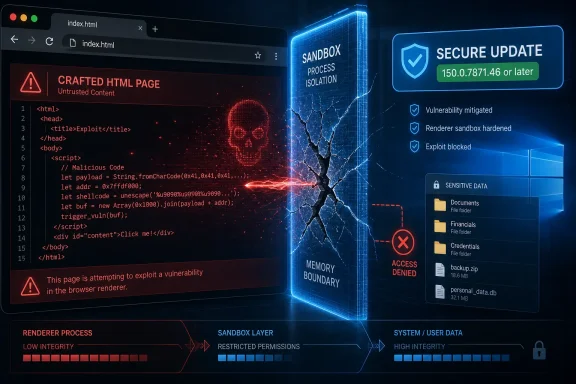 The Dangerous Part Is the Boundary the Bug Could Cross
CVE-2026-14392 is categorized as CWE-787, an out-of-bounds write. At the simplest level, that means software can be induced to write data outside the memory region it was supposed to modify, potentially corrupting adjacent data or control structures.That description explains the programming error but not its strategic importance. Google’s vulnerability description says a remote attacker could potentially use a crafted HTML page to perform a sandbox escape, placing the defect in a more consequential category than an ordinary rendering crash.
Chrome’s sandbox is designed to restrict what processes handling untrusted web content can do. Chromium’s architecture separates the main browser process from renderer and supporting processes, then applies operating-system restrictions intended to prevent a compromised component from freely reaching files, devices, credentials, or other privileged resources.
A sandbox escape attacks that second line of defense. It matters because modern browser security assumes individual parsers, compilers, graphics components, and rendering engines will occasionally contain exploitable bugs. The architecture attempts to ensure that compromising one of those components does not automatically grant the attacker the same access as the user running the browser.
CVE-2026-14392 reportedly creates a route across that containment boundary. The wording remains important: Google says an attacker could potentially perform a sandbox escape. The public advisory does not establish that every malformed page produces reliable code execution, that a weaponized exploit is circulating, or that opening one particular page guarantees a system compromise.
It does establish enough to make delay difficult to justify. A memory-corruption flaw reachable through crafted web content and associated with sandbox escape potential is precisely the kind of browser defect for which exposure is difficult to control through user training alone.
The user interaction requirement does not mean someone must install software, approve a security warning, or deliberately run an executable. Under the CISA-ADP vector, interaction is required because the victim has to encounter the malicious web content. That encounter could reportedly begin with an ordinary navigation to a hostile or compromised page.
Tint Turns Web Content Into a Memory-Safety Problem
The affected component, Tint, sits in Chrome’s graphics-related processing path. The official Tint project describes it as a compiler for the WebGPU Shading Language, commonly abbreviated WGSL.That context helps explain why an HTML page can reach code that sounds more like part of a graphics toolchain than a web browser. Modern browser pages are not limited to displaying documents and running modest scripts. They can request increasingly sophisticated graphics and computational workloads, which means the browser must parse, validate, translate, and execute complex inputs originating with a website.
A compiler that processes web-supplied shader material must handle untrusted structures without allowing malformed input to distort memory. If bounds calculations, indexing, object sizes, or transformation logic go wrong, an input that should have been rejected can instead become a memory-corruption primitive.
The public record does not disclose the exact defective operation in CVE-2026-14392. Google’s Chromium issue is classified as requiring permission, and the release notes provide only the vulnerability category, affected component, severity, and attribution. That access restriction is normal during the early life of a browser vulnerability, especially while a meaningful share of the installed base may still be unpatched.
Google explicitly warns in its Chrome release material that bug details may remain restricted until most users receive a fix. The company may also retain restrictions when vulnerable code is shared with third-party projects that have not completed their own remediation.
That policy trades immediate technical transparency for deployment safety. Researchers and administrators get enough information to identify the affected product and secure version, while would-be attackers receive fewer implementation details that could accelerate exploit development.
It also leaves a gap that secondary vulnerability databases are often tempted to fill with speculation. Some descriptions may call the issue remote code execution, while the authoritative Chrome and NVD wording is narrower: a remote attacker could potentially perform a sandbox escape through a crafted HTML page.
Those phrases are related, but they are not interchangeable. A sandbox escape can be an essential step toward executing code with access beyond the browser’s restricted environment, yet the available material does not document a complete attack chain, persistence mechanism, or confirmed host takeover.
The distinction is not semantic hair-splitting. Defenders need to know what has actually been established because vulnerability prioritization suffers when every serious memory bug is described as an instant, universal machine compromise.
At the same time, under-description can be just as misleading. Saying only that Tint contains an out-of-bounds write obscures the central risk: the flaw may undermine the security boundary intended to contain hostile web content.
One CVE, Two Severity Languages
The most confusing part of the record is the apparent disagreement between Chromium’s High rating and the CISA-ADP score of 9.6 Critical. Both appear on the NVD page, but they come from different assessment systems and should not be collapsed into a single claim that “NVD rated the flaw 9.6.”NVD had not supplied its own CVSS 4.0, CVSS 3.x, or CVSS 2.0 base score in the provided record. The 9.6 score is contributed by CISA-ADP using CVSS 3.1.
That attribution matters. NVD displays externally contributed metrics alongside its own enrichment, and the presence of a score on an NVD page does not necessarily mean NIST calculated or endorsed it as the NVD assessment.
CISA-ADP’s vector is CVSS:3.1/AV:N/AC:L/PR:N/UI:R/S:C/C:H/I:H/A:H. In plain English, that model treats the issue as network-reachable, low complexity, requiring no prior privileges, but requiring user interaction.
The scope-change element is especially significant. It models successful exploitation as crossing from one security authority into another, consistent with the stated possibility of escaping a sandbox boundary.
The vector also assigns High potential impact to confidentiality, integrity, and availability. That is why the numeric result rises into Critical territory even though Chromium’s internal security classification is High.
Chromium’s rating is not necessarily a rebuttal to the CVSS result. Vendor severity classifications incorporate internal assumptions, exploitability judgments, component architecture, and program-specific criteria that do not always map directly onto a standardized scoring formula.
The two labels answer different questions. Chromium’s High rating communicates how the Chrome security team classifies the defect within its own ecosystem, while the CISA-ADP score estimates worst-case technical characteristics through CVSS 3.1.
| Assessment or state | Source | Result | What it means |
|---|---|---|---|
| Chromium severity | Chrome | High | Vendor classification for the Chrome flaw |
| CVSS 3.1 contribution | CISA-ADP | 9.6 Critical | Standardized impact and exploitability model |
| CVSS 4.0 assessment | NVD | Not yet provided | NIST had not scored the flaw under CVSS 4.0 |
| CVSS 3.x assessment | NVD | Not yet provided | The displayed 9.6 is not an NVD base score |
| Affected threshold | NVD CPE analysis | Earlier than 150.0.7871.46 | These Chrome versions are considered vulnerable |
| Fixed threshold | Chrome/NVD record | 150.0.7871.46 | Minimum stated fixed version |
CVSS is useful for sorting large vulnerability queues, but a browser is a near-universal interpreter for untrusted internet content. Its practical exposure can exceed what a flat numerical score communicates, particularly on endpoints used for email, collaboration, administration, and access to cloud applications.
“No Exploitation” Is Reassuring, Not Exculpatory
CISA’s SSVC record lists exploitation as “none,” automatable as “no,” and technical impact as “total.” This combination captures the tension in CVE-2026-14392 better than either the word High or the number 9.6.“Exploitation: none” means the record did not identify exploitation at the time of assessment. It does not prove that no private exploit exists, that no researcher has demonstrated the bug, or that attackers will be unable to build an exploit after studying the patch.
“Automatable: no” also deserves care. It does not mean exploitation is impossible at scale or that a malicious page could never be distributed broadly. SSVC’s automation judgment evaluates whether the exploitation process can be reliably automated across vulnerable targets without significant customization or operational friction.
Browser exploitation often resists simplistic automation because memory layout, process state, platform differences, mitigations, timing, graphics configuration, and release variations can affect reliability. Those difficulties can lower immediate mass-exploitation potential without making a targeted attack unimportant.
“Technical impact: total” points in the other direction. CISA’s model considers the potential consequence to be comprehensive if exploitation succeeds, matching the CVSS vector’s High impact ratings across confidentiality, integrity, and availability.
Together, the SSVC fields say: there is no recorded exploitation, broad automation is not assumed, but a successful attack could be highly damaging. That is a classic patch-now vulnerability, not necessarily a disconnect-the-network emergency.
Organizations should therefore avoid both extremes. There is no evidence in the supplied record for declaring an active Chrome zero-day campaign, but there is also no sound basis for treating the flaw as a low-priority stability bug.
The absence of confirmed exploitation is most useful as a deployment advantage. It gives defenders an opportunity to reduce exposure before public technical analysis, patch comparison, or future disclosure makes exploit development easier.
Chrome’s Update Model Creates a Dangerous Half-Patched State
Chrome normally updates itself, but “automatic” does not mean “instantaneous” or “complete.” An update may download while the running browser process continues using the old code until Chrome is relaunched.That creates an awkward state in which management tools may observe update activity while users remain exposed through long-lived browser sessions. Employees who keep dozens of tabs open for days can postpone the security benefit without explicitly declining an update.
The definitive check is the running browser version. If Chrome reports a version earlier than 150.0.7871.46, the browser remains below the fixed threshold described by Chrome and NVD.
On managed Windows systems, administrators should examine more than the version displayed by a handful of cooperative test devices. They need fleet-level evidence covering active endpoints, stale devices, virtual desktops, shared workstations, privileged administration systems, and machines that have not recently checked in.
Update policy can also create accidental exposure. Organizations sometimes pin browser versions for application compatibility, delay major releases through a staged ring, or prevent users from restarting applications during working hours. Those practices can be reasonable, but a security threshold turns them into explicit risk decisions.
A phased deployment should not become an indefinite deployment. Canary groups and compatibility testing exist to find breakage quickly, not to leave production systems on a vulnerable version after the secure build has been validated.
Administrators should also distinguish between update installation and process replacement. If the patched files are present but an older Chrome process remains active, the endpoint should not be counted as remediated until the browser has restarted and the running version is verified.
That detail is particularly important for remote workers. A laptop may connect only briefly to corporate management infrastructure, receive the package, and then remain in a browser session that never closes.
Consumer users face the same issue in miniature. Opening Chrome’s About page usually triggers an update check, but the protection becomes effective only after relaunching into the patched version.
The Version Number Is the Control That Matters
Vulnerability advisories often surround a simple remediation with enough metadata to distract from it. CVE-2026-14392 has CVSS fields, SSVC fields, change-history events, a CPE string, a weakness category, and a restricted issue reference. Operationally, however, the decisive control is a version comparison.Chrome versions before 150.0.7871.46 are affected. Version 150.0.7871.46 is the fixed or threshold release identified in the NVD record.
That direct boundary is more valuable than a generic instruction to “install the latest updates.” It allows security teams to build a measurable compliance rule and avoids ambiguity when update channels or platform packaging produce adjacent build numbers.
The CPE configuration added during NIST’s initial analysis expresses the same boundary: the Google Chrome product is vulnerable up to, but excluding, 150.0.7871.46. This is the machine-readable statement that vulnerability scanners and asset-management systems may use to identify exposed installations.
The provided CVE history contains a slightly awkward affected-version representation in the original Chrome submission, pairing the threshold version with a less-than condition. NIST’s subsequent CPE enrichment clarifies the intended interpretation: anything below 150.0.7871.46 is vulnerable.
This is why administrators should validate scanner logic rather than trusting a dashboard color. If a product inventory ingests the original record incorrectly, it could misclassify the boundary build or fail to recognize earlier versions.
The authoritative practical rule remains straightforward: reject versions less than 150.0.7871.46 as noncompliant. Accept that version or later, subject to the organization’s normal validation that the update has been installed and the browser restarted.
Action checklist for admins
- Inventory all managed Chrome installations and identify versions below 150.0.7871.46.
- Accelerate deployment of 150.0.7871.46 or later through the organization’s normal Chrome management channel.
- Require or schedule a Chrome relaunch so patched files replace vulnerable running processes.
- Re-query endpoint versions after restart instead of treating package delivery as proof of remediation.
- Check version-pinning, rollback, and update-delay policies that could hold devices below the fixed threshold.
- Prioritize privileged workstations, shared systems, virtual desktops, and endpoints used to administer sensitive services.
- Review browser crash, endpoint detection, and web-proxy telemetry for unusual activity without claiming that crashes alone prove exploitation.
- Confirm vulnerability scanners interpret the affected range as every version earlier than 150.0.7871.46.
The Public Record Developed in Hours, Not Weeks
The change history shows how quickly a sparse vendor submission became a more operationally useful vulnerability record. Chrome supplied the core description, affected product, weakness category, and references; CISA-ADP then added scoring and decision-support information; NIST followed with product-range enrichment.This division of labor explains why early CVE pages can look contradictory or incomplete. A newly published entry may have a vendor severity but no NVD score, an external CVSS vector, and only later receive the CPE data needed by automated tools.
Timeline
July 1, 2026, 7:16:47 PM — Chrome’s new CVE record was received with the out-of-bounds write description, CWE-787 classification, affected-version data, release reference, and restricted Chromium issue.July 1, 2026, 8:16:41 PM — CISA-ADP added the CVSS 3.1 vector and 9.6 Critical score, along with SSVC values for exploitation, automation, and technical impact.
July 2, 2026, 2:11:26 PM — NIST’s initial analysis added the Chrome CPE configuration covering versions earlier than 150.0.7871.46 and classified the Chrome references.
July 3, 2026, 12:17:41 AM — CISA-ADP modified the SSVC record’s timestamp formatting without changing the substantive exploitation, automation, or impact values.
NVD lists the vulnerability as published on July 1, 2026, and last modified on July 3, 2026. Those dates describe the database record, not necessarily the moment the bug was discovered, fixed in source, or first delivered to every user.
That distinction matters when reconstructing exposure. A CVE’s publication date can follow private reporting, triage, remediation, testing, and release preparation. The public timeline therefore captures disclosure mechanics rather than the entire vulnerability lifecycle.
The Chromium issue remains permission-restricted, so the public cannot yet independently examine the root cause, proof of concept, patch mechanics, or exploitation prerequisites. Google’s release notes and the NVD entry are consequently the primary basis for defensive decisions.
Restricted Details Are a Signal to Patch Before the Anatomy Arrives
Security teams sometimes respond to limited technical disclosure by waiting for a detailed write-up before prioritizing a fix. That reverses the logic of coordinated browser disclosure.When a vendor withholds bug details while distributing an update, the intention is usually to widen the defender’s lead. The patch itself may eventually reveal the vulnerable code through comparison, but restricting the original report removes shortcuts such as a ready-made reproducer, crash sample, or researcher analysis.
The appropriate defensive response is to use the version boundary while that advantage exists. Waiting until a proof of concept appears turns an orderly update into an incident-driven race.
The restricted issue also limits what can responsibly be claimed about exploit reliability. There is no public basis in the provided record for stating which operating systems, graphics adapters, WebGPU configurations, or process arrangements make exploitation more or less dependable.
Nor does the record say that disabling a particular browser feature is an approved mitigation. Tint’s role offers useful architectural context, but it should not be converted into an improvised hardening recommendation unsupported by Google’s advisory.
The vendor-backed remediation is the fixed Chrome version. Any organization considering feature restrictions as a temporary compensating control should treat them as supplemental and test them through its own change process, not as a substitute for updating.
Windows Fleets Carry the Browser’s Risk Into Every Trust Zone
For Windows administrators, Chrome is often both a general-purpose internet client and an access portal to sensitive business systems. The same process that opens an external link may also hold authenticated sessions for email, identity management, source-code hosting, document storage, finance, or remote administration.That convergence raises the stakes of sandbox-escape vulnerabilities. An endpoint browser may operate at the intersection of untrusted internet content and highly trusted cloud credentials, even when the underlying Windows account lacks local administrator rights.
Least privilege still helps, but it does not neutralize the issue. A successful attack operating with the user’s accessible context may not need full machine administration to steal valuable data, interfere with work, or exploit authenticated sessions.
Privileged access workstations and administrative jump systems deserve particular attention. If those systems permit general web browsing, a browser defect capable of crossing a containment boundary weakens the very separation those systems are intended to enforce.
Application-control policies and endpoint detection can add friction, but they should not be used to rationalize running an affected browser. Memory-corruption exploitation can behave differently from conventional malware installation, and successful abuse may occur before a familiar executable appears on disk.
Telemetry remains useful for investigation. Browser crashes, unusual child processes, unexpected access to sensitive resources, or suspicious activity following visits to untrusted sites may justify review. None of those signals, in isolation, proves CVE-2026-14392 exploitation.
The best near-term detection strategy is therefore paired with remediation: patch the browser, verify the running version, and use endpoint and network evidence to investigate anomalies that predate the update.
This Is Not Evidence of an Active Zero-Day Campaign
The phrase “crafted HTML page” often triggers headlines implying that anyone can be silently hacked merely by seeing a web page. The actual record supports a serious remote web-content threat, but not every escalation attached to that phrase.CISA’s SSVC assessment explicitly records exploitation as none. The source material contains no statement that Google observed attacks in the wild, no emergency exploitation warning, and no evidence tying the flaw to a campaign.
Calling CVE-2026-14392 an actively exploited zero-day would therefore go beyond the verified facts. So would declaring that it offers guaranteed one-click system takeover.
But the correction should not swing into complacency. A vulnerability need not be exploited in the wild on publication day to become valuable to attackers later, especially when the affected product processes hostile content by design and the potential impact reaches beyond its sandbox.
The meaningful window is the period between patch availability and broad deployment. As more users update, disclosure can safely expand. As more technical material appears, attackers may gain a clearer path to reproducing the defect against the systems that remain behind.
That creates a familiar asymmetry: the users most disciplined about updates become harder targets, while unmanaged devices, pinned enterprise builds, forgotten virtual machines, and rarely restarted browsers retain the risk.
What Defenders Should Carry Forward
CVE-2026-14392 is best understood as a high-priority browser update with potentially critical consequences, not as proof of an ongoing internet-wide compromise. The record is unusually clear about the fixed threshold and unusually incomplete about the exploit’s internal mechanics.- Chrome versions earlier than 150.0.7871.46 are affected.
- The flaw is a CWE-787 out-of-bounds write in Tint.
- A crafted HTML page could potentially trigger a sandbox escape.
- Chromium rates the vulnerability High; CISA-ADP scores it 9.6 Critical.
- NVD had not issued its own CVSS assessment in the supplied record.
- CISA records no known exploitation, non-automatable exploitation, and total technical impact.
References
- Primary source: NVD / Chromium
Published: 2026-07-11T15:37:36-07:00
Loading…
nvd.nist.gov - Security advisory: MSRC
Published: 2026-07-11T15:37:36-07:00
Original feed URL
Loading…
msrc.microsoft.com - Related coverage: dawn.googlesource.com
Loading…
dawn.googlesource.com - Related coverage: chromium.org
Multi-process Architecture
www.chromium.org