

OpenAI has restored ChatGPT access through WhatsApp in the European Economic Area, allowing users in the 27 EU member states, Iceland, Liechtenstein, and Norway to message the verified 1-800-CHATGPT contact without creating an account. The service returned on July 13, 2026, six months after Meta’s business-platform rules removed ChatGPT, Microsoft Copilot, Perplexity, and other general-purpose AI assistants from WhatsApp.
As first reported by The Decoder, users can reach ChatGPT at +1-800-242-8478 from WhatsApp on Android, iOS, the web, and Windows PCs. The restored bot accepts text prompts, images, and voice messages, and it can generate images directly in the conversation.
The regional comeback is not a voluntary reversal of Meta’s platform strategy. It follows interim antitrust measures imposed by the European Commission on June 9, ordering Meta to reopen the WhatsApp Business API to competing AI assistants free of charge while the Commission completes its investigation.
The reinstated service works like a conventional WhatsApp business contact. Users add or open the verified 1-800-CHATGPT number and send a message, with no separate ChatGPT installation required.
That makes the service particularly accessible on Windows. Anyone already using the Microsoft Store version of WhatsApp or WhatsApp Web can move between phone and PC while keeping the same AI conversation inside the familiar WhatsApp interface.
Testing reported by The Decoder indicates that the bot supports multiple languages and can interpret uploaded images and recorded voice messages. It also generates images from text prompts, although users should not assume that every feature, limit, or model available in the full ChatGPT app is present in WhatsApp.
When questioned about its underlying model, the WhatsApp bot reportedly identifies itself as GPT-5.5. Its image-generation results appear consistent with OpenAI’s gpt-image-2 system, according to The Decoder, but OpenAI has not publicly documented that routing in the available support material. Model self-identification is not authoritative, so both details should be treated as observed behavior rather than a firm technical specification.
The no-account mode lowers the barrier to entry but is not the only option. Users can link their WhatsApp identity to an existing ChatGPT account, allowing the integration to access relevant ChatGPT context and synchronize conversations with account history.
That connection changes the privacy equation. A casual WhatsApp exchange with an isolated bot is different from attaching the contact to an account containing saved conversations, preferences, and memories. Users handling workplace data, customer records, source code, credentials, or confidential documents should apply the same controls they would use in the main ChatGPT app—and should not assume that a WhatsApp chat is covered by their organization’s Microsoft 365, Copilot, or enterprise AI policies.
The restriction took effect on January 15, 2026. OpenAI discontinued its WhatsApp integration on that date, while Microsoft’s Copilot and Perplexity also lost their direct route into the messaging platform. Meta AI remained available because it was Meta’s own integrated assistant rather than an outside provider using the business API.
Meta argued that the WhatsApp Business API was intended for companies communicating with customers, not as an unrestricted distribution channel for rival consumer chatbots. The practical result, however, was that Meta controlled both the messaging platform and the only general-purpose AI assistant permitted to operate inside it.
The European Commission opened a formal antitrust investigation in December 2025. In February 2026, it issued a statement of objections indicating that temporary intervention might be necessary to prevent serious and irreparable harm to competition; a supplementary statement followed in April.
Meta revised its policy on March 4, allowing third-party assistants to return under a fee structure. The Commission concluded that the cost was, in practice, equivalent to maintaining the original ban.
That finding led to the June 9 interim order. Meta was instructed to restore access under the same conditions that applied before October 15, 2025, when general-purpose AI assistants could use the WhatsApp Business API without charge.
The Commission gave Meta five working days to comply and ordered it to maintain those terms until the underlying antitrust case is resolved. The investigation remains open, meaning the order is a protective measure rather than a final ruling that Meta broke EU law.
WhatsApp is not simply competing with dedicated ChatGPT, Copilot, or Perplexity apps. It is an established communications layer already installed on hundreds of millions of phones and PCs, with notifications, contact discovery, synchronized conversations, and habits that standalone AI companies must otherwise build for themselves.
A chatbot that appears as an ordinary WhatsApp contact gains distribution without convincing users to download another application or maintain another browser tab. Blocking that route while preserving Meta AI could therefore shape which assistants people adopt before the market settles around a smaller number of major platforms.
The Commission described the WhatsApp Business API as infrastructure that Meta had developed for and previously opened to outside companies. Its interim decision relies on Article 102 of the Treaty on the Functioning of the European Union and Article 54 of the EEA Agreement, which prohibit abuse of a dominant position.
This is an unusually forceful procedural step. According to the Commission, it is only the second interim-measures decision under Regulation 1/2003, following a Broadcom case in 2009. Failure to comply can expose Meta to fines of up to 10% of its preceding annual turnover, alongside periodic penalties of up to 5% of average daily turnover.
OpenAI has also integrated ChatGPT-powered tools into Rakuten Viber. Depending on region and app availability, Viber users can translate messages, summarize links or unread group conversations, polish drafts, remix images, open a dedicated ChatGPT tab, and invoke the assistant with an @ChatGPT mention.
These integrations point toward messaging applications becoming distribution platforms for multiple AI systems. They also create new administrative complications: employees can reach powerful external models from software that an organization may regard primarily as a communications tool, potentially bypassing controls applied to browsers, approved Windows applications, or managed Microsoft 365 tenants.
For European users, the immediate effect is straightforward: ChatGPT is once again available as a WhatsApp contact, with richer input and image capabilities than the original text-focused service. For Meta and other messaging-platform owners, the larger consequence is that the European Commission is prepared to intervene before a dominant platform can make its own AI assistant the only practical choice.
Notebookcheck suggested that automated spam detection or contact-verification systems may be involved, but this remains unverified. There is currently no evidence that using 1-800-CHATGPT generally violates WhatsApp’s rules.
EEA users should confirm that they are messaging the verified +1-800-242-8478 contact and avoid rapidly sending repeated prompts while the issue is investigated. Anyone suspended should use WhatsApp’s in-app account-review process. Organizations considering the integration may also want to delay broad deployment until Meta or OpenAI clarifies whether the reported suspensions reflect an isolated moderation error or a wider compatibility problem.
As first reported by The Decoder, users can reach ChatGPT at +1-800-242-8478 from WhatsApp on Android, iOS, the web, and Windows PCs. The restored bot accepts text prompts, images, and voice messages, and it can generate images directly in the conversation.
The regional comeback is not a voluntary reversal of Meta’s platform strategy. It follows interim antitrust measures imposed by the European Commission on June 9, ordering Meta to reopen the WhatsApp Business API to competing AI assistants free of charge while the Commission completes its investigation.
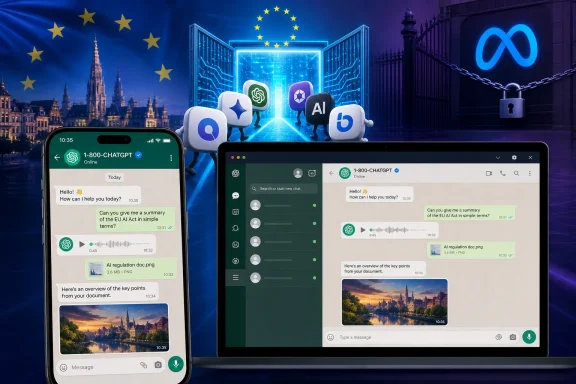 ChatGPT Returns as a Contact, Not a New WhatsApp Feature
The reinstated service works like a conventional WhatsApp business contact. Users add or open the verified 1-800-CHATGPT number and send a message, with no separate ChatGPT installation required.That makes the service particularly accessible on Windows. Anyone already using the Microsoft Store version of WhatsApp or WhatsApp Web can move between phone and PC while keeping the same AI conversation inside the familiar WhatsApp interface.
Testing reported by The Decoder indicates that the bot supports multiple languages and can interpret uploaded images and recorded voice messages. It also generates images from text prompts, although users should not assume that every feature, limit, or model available in the full ChatGPT app is present in WhatsApp.
When questioned about its underlying model, the WhatsApp bot reportedly identifies itself as GPT-5.5. Its image-generation results appear consistent with OpenAI’s gpt-image-2 system, according to The Decoder, but OpenAI has not publicly documented that routing in the available support material. Model self-identification is not authoritative, so both details should be treated as observed behavior rather than a firm technical specification.
The no-account mode lowers the barrier to entry but is not the only option. Users can link their WhatsApp identity to an existing ChatGPT account, allowing the integration to access relevant ChatGPT context and synchronize conversations with account history.
That connection changes the privacy equation. A casual WhatsApp exchange with an isolated bot is different from attaching the contact to an account containing saved conversations, preferences, and memories. Users handling workplace data, customer records, source code, credentials, or confidential documents should apply the same controls they would use in the main ChatGPT app—and should not assume that a WhatsApp chat is covered by their organization’s Microsoft 365, Copilot, or enterprise AI policies.
Meta’s Ban Left Meta AI as the Only General Assistant
The dispute began with WhatsApp Business Solution Terms announced by Meta on October 15, 2025. Those terms prohibited AI providers from using the WhatsApp Business API when a general-purpose AI assistant was the primary service being offered.The restriction took effect on January 15, 2026. OpenAI discontinued its WhatsApp integration on that date, while Microsoft’s Copilot and Perplexity also lost their direct route into the messaging platform. Meta AI remained available because it was Meta’s own integrated assistant rather than an outside provider using the business API.
Meta argued that the WhatsApp Business API was intended for companies communicating with customers, not as an unrestricted distribution channel for rival consumer chatbots. The practical result, however, was that Meta controlled both the messaging platform and the only general-purpose AI assistant permitted to operate inside it.
The European Commission opened a formal antitrust investigation in December 2025. In February 2026, it issued a statement of objections indicating that temporary intervention might be necessary to prevent serious and irreparable harm to competition; a supplementary statement followed in April.
Meta revised its policy on March 4, allowing third-party assistants to return under a fee structure. The Commission concluded that the cost was, in practice, equivalent to maintaining the original ban.
That finding led to the June 9 interim order. Meta was instructed to restore access under the same conditions that applied before October 15, 2025, when general-purpose AI assistants could use the WhatsApp Business API without charge.
The Commission gave Meta five working days to comply and ordered it to maintain those terms until the underlying antitrust case is resolved. The investigation remains open, meaning the order is a protective measure rather than a final ruling that Meta broke EU law.
Brussels Treats WhatsApp as AI Distribution Infrastructure
The significance extends beyond another place to ask ChatGPT for a summary or generate an image. The Commission’s preliminary position is that WhatsApp has held a dominant position in the EEA-wide consumer communications market since at least January 2023, making access to its users commercially important for emerging AI providers.WhatsApp is not simply competing with dedicated ChatGPT, Copilot, or Perplexity apps. It is an established communications layer already installed on hundreds of millions of phones and PCs, with notifications, contact discovery, synchronized conversations, and habits that standalone AI companies must otherwise build for themselves.
A chatbot that appears as an ordinary WhatsApp contact gains distribution without convincing users to download another application or maintain another browser tab. Blocking that route while preserving Meta AI could therefore shape which assistants people adopt before the market settles around a smaller number of major platforms.
The Commission described the WhatsApp Business API as infrastructure that Meta had developed for and previously opened to outside companies. Its interim decision relies on Article 102 of the Treaty on the Functioning of the European Union and Article 54 of the EEA Agreement, which prohibit abuse of a dominant position.
This is an unusually forceful procedural step. According to the Commission, it is only the second interim-measures decision under Regulation 1/2003, following a Broadcom case in 2009. Failure to comply can expose Meta to fines of up to 10% of its preceding annual turnover, alongside periodic penalties of up to 5% of average daily turnover.
OpenAI Is Moving ChatGPT Into Other Messengers
WhatsApp’s reinstatement fits a wider OpenAI push to place ChatGPT inside messaging services rather than relying exclusively on its own app and website. Kakao launched a ChatGPT chatbot inside KakaoTalk in South Korea on June 16, supporting text prompts and image generation from individual and group conversations.OpenAI has also integrated ChatGPT-powered tools into Rakuten Viber. Depending on region and app availability, Viber users can translate messages, summarize links or unread group conversations, polish drafts, remix images, open a dedicated ChatGPT tab, and invoke the assistant with an @ChatGPT mention.
These integrations point toward messaging applications becoming distribution platforms for multiple AI systems. They also create new administrative complications: employees can reach powerful external models from software that an organization may regard primarily as a communications tool, potentially bypassing controls applied to browsers, approved Windows applications, or managed Microsoft 365 tenants.
For European users, the immediate effect is straightforward: ChatGPT is once again available as a WhatsApp contact, with richer input and image capabilities than the original text-focused service. For Meta and other messaging-platform owners, the larger consequence is that the European Commission is prepared to intervene before a dominant platform can make its own AI assistant the only practical choice.
Update: Users Report WhatsApp Suspensions After ChatGPT Messages (July 14, 2026)
Technobezz reports that some users have experienced WhatsApp account suspensions after receiving messages from the restored ChatGPT contact. The number of affected accounts is unclear, and neither Meta nor OpenAI has confirmed the reports or identified a cause.Notebookcheck suggested that automated spam detection or contact-verification systems may be involved, but this remains unverified. There is currently no evidence that using 1-800-CHATGPT generally violates WhatsApp’s rules.
EEA users should confirm that they are messaging the verified +1-800-242-8478 contact and avoid rapidly sending repeated prompts while the issue is investigated. Anyone suspended should use WhatsApp’s in-app account-review process. Organizations considering the integration may also want to delay broad deployment until Meta or OpenAI clarifies whether the reported suspensions reflect an isolated moderation error or a wider compatibility problem.
References
- Primary source: the-decoder.com
Published: 2026-07-14T12:02:06+00:00
ChatGPT returns to WhatsApp in Europe after EU forces Meta to open the door to rival AI bots
OpenAI has re-enabled ChatGPT on WhatsApp, but only in the European Economic Area, covering the 27 EU member states plus Liechtenstein, Iceland, and Norway.the-decoder.com - Official source: openai.com
Continuing your ChatGPT experience beyond WhatsApp | OpenAI
ChatGPT will no longer be available on WhatsApp after January 15, 2026. Learn how to link your ChatGPT account and continue your conversations across devices.openai.com - Related coverage: germany.representation.ec.europa.eu
KI-Assistenten bei WhatsApp: Kommission verhängt einstweilige Maßnahmen gegen Meta
Die Europäische Kommission hat angeordnet, dass Meta konkurrierenden allgemeinen KI-Assistenten wieder freien Zugang zu WhatsApp gewähren und diesen Zugang bis zum Ende des Kartellverfahrens der Kommission aufrechterhalten muss.germany.representation.ec.europa.eu - Related coverage: support2.chatarchitect.com
New pricing policy for... | ChatArchitect.com for WhatsApp
New pricing policy for AI Providers leveraging the WhatsApp Business Platform Updated: Mar 4, 2026... support2.chatarchitect.com
- Related coverage: techradar.com
Meta will ban rival AI chatbots from WhatsApp | TechRadar
Third-party AI assistants are out in 2026www.techradar.com - Related coverage: cincodias.elpais.com
Last edited:

