

CVE-2026-49166 is a newly patched Windows Print Configuration vulnerability that allows an authenticated local attacker to elevate privileges by triggering a use-after-free condition in Microsoft printer drivers. Microsoft released the fix on July 14, 2026, as part of its monthly Windows security updates, and administrators should treat it as a workstation and server privilege-escalation risk rather than a remotely exploitable print-server flaw.
Microsoft’s Security Update Guide identifies the issue as an elevation-of-privilege vulnerability. The corresponding CVE record assigns it a CVSS 3.1 base score of 7.8, reflecting a high-impact local attack that requires prior access but no user interaction once the attacker is positioned to exploit it.
The vulnerability affects current Windows 11 releases and Windows Server 2025, including Server Core. Although CVE-2026-49166 has not been identified as one of the actively exploited zero-days highlighted in July’s Patch Tuesday release, the combination of low-complexity local exploitation and potential high-privilege code execution makes it relevant to endpoint-hardening and post-compromise planning.
Microsoft describes the root cause as a use-after-free error in Microsoft printer drivers. This class of memory-safety flaw occurs when software continues to reference memory after the associated object has been released, potentially allowing an attacker to influence what occupies that memory before the stale reference is used again.
In practical terms, CVE-2026-49166 is not a PrintNightmare-style scenario in which an unauthenticated attacker can simply reach a print service over the network and take control. The attacker must already be authorized to run code locally. The security boundary failure occurs when that low-privilege foothold can be converted into higher privileges through the Windows printing components.
That distinction matters for triage, but it does not make the vulnerability harmless. Local privilege escalation is a standard second stage in ransomware, credential theft, and hands-on-keyboard intrusions: phishing, a malicious installer, or a compromised user account supplies the initial access, while a vulnerability such as CVE-2026-49166 may provide the path out of the user context.
A successful exploit could give an attacker the ability to access data, modify system resources, disable protections, or establish persistence beyond what the compromised account normally permits. The CVSS score indicates potentially high impact to confidentiality, integrity, and availability.
The fixed build thresholds identified in the CVE data include:
Administrators should verify installed build numbers rather than assuming a device is protected because it completed an earlier July preview update. Preview releases may contain quality improvements later rolled into Patch Tuesday, but the July 14 security baseline is the relevant deployment milestone for CVE-2026-49166.
The affected list is also narrower than the long catalog often associated with Windows print vulnerabilities. The available CVE data names modern Windows 11 branches and Windows Server 2025, not every supported Windows generation. Organizations should still rely on Microsoft’s Security Update Guide and their update-management product’s applicability results, particularly if Microsoft revises the advisory after publication.
No user interaction is required during exploitation, however, and the attack complexity is assessed as low. Those characteristics raise its value after an attacker has compromised an account or persuaded a user to execute an initial payload.
This is why IT teams should not use “local” as shorthand for “low priority.” On shared workstations, virtual desktop infrastructure, Remote Desktop Session Hosts, developer machines, jump boxes, and servers where multiple operational accounts can sign in, the local attack requirement may represent a relatively modest barrier.
Server Core is explicitly included, which also shows that the exposure does not depend on a user opening the familiar Printers & scanners interface. The vulnerable functionality is part of the underlying Windows print configuration and driver stack, not merely the graphical settings experience.
Microsoft’s accompanying confidence language should likewise not be confused with the CVSS severity score. A confidence metric describes how firmly the vulnerability and its technical details have been established. Vendor acknowledgement and a released security correction provide strong confirmation that the flaw exists, while the public description still withholds enough implementation detail to avoid handing attackers a ready-made exploit guide.
Those controls should not be treated as a substitute for the July update. Microsoft has not published a CVE-specific workaround that provides the same assurance as installing the corrected Windows build, and a configuration change intended for an earlier Print Spooler vulnerability may not block this printer-driver memory flaw.
Windows protected print mode can also reduce reliance on legacy third-party driver behavior by using the modern IPP-based print stack and Microsoft’s Mopria-compatible driver. Microsoft has positioned that mode as a way to shrink the printing attack surface, including restrictions on module loading and legacy print configuration operations. CVE-2026-49166 nevertheless affects Microsoft printer-driver code, reinforcing that a more constrained print architecture complements rather than replaces monthly servicing.
For enterprise rollout, the sensible order is to test July’s cumulative updates on representative print-heavy endpoints, shared session hosts, and Windows Server 2025 systems, then expand deployment quickly. Testing should include line-of-business applications that generate print output, label and receipt printers, print-management agents, and any environment still dependent on vendor-supplied driver packages.
Security teams should also watch for unexpected processes interacting with printing components, privilege transitions originating from ordinary user sessions, and newly created services or scheduled tasks following print-related activity. Microsoft has not publicly classified CVE-2026-49166 as exploited in the wild, so such telemetry would be defensive monitoring rather than evidence of a known campaign.
The concrete protection point is the installed OS build: Windows 11 systems must reach their July 14, 2026 security level, and Windows Server 2025 must reach build 26100.33158 or newer. Until those builds are deployed, a low-privilege foothold can still encounter a high-impact route through Windows Print Configuration.
Microsoft’s Security Update Guide identifies the issue as an elevation-of-privilege vulnerability. The corresponding CVE record assigns it a CVSS 3.1 base score of 7.8, reflecting a high-impact local attack that requires prior access but no user interaction once the attacker is positioned to exploit it.
The vulnerability affects current Windows 11 releases and Windows Server 2025, including Server Core. Although CVE-2026-49166 has not been identified as one of the actively exploited zero-days highlighted in July’s Patch Tuesday release, the combination of low-complexity local exploitation and potential high-privilege code execution makes it relevant to endpoint-hardening and post-compromise planning.
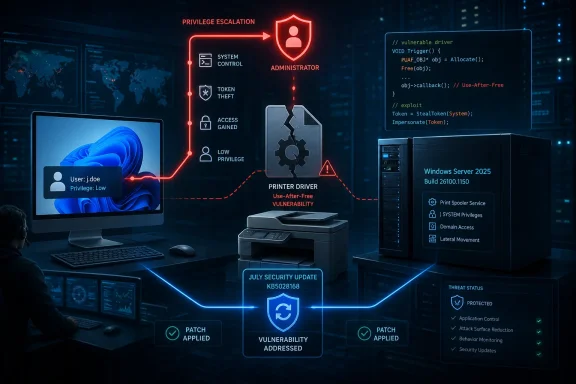 A Printer Driver Bug Becomes a Privilege Boundary Problem
Microsoft describes the root cause as a use-after-free error in Microsoft printer drivers. This class of memory-safety flaw occurs when software continues to reference memory after the associated object has been released, potentially allowing an attacker to influence what occupies that memory before the stale reference is used again.In practical terms, CVE-2026-49166 is not a PrintNightmare-style scenario in which an unauthenticated attacker can simply reach a print service over the network and take control. The attacker must already be authorized to run code locally. The security boundary failure occurs when that low-privilege foothold can be converted into higher privileges through the Windows printing components.
That distinction matters for triage, but it does not make the vulnerability harmless. Local privilege escalation is a standard second stage in ransomware, credential theft, and hands-on-keyboard intrusions: phishing, a malicious installer, or a compromised user account supplies the initial access, while a vulnerability such as CVE-2026-49166 may provide the path out of the user context.
A successful exploit could give an attacker the ability to access data, modify system resources, disable protections, or establish persistence beyond what the compromised account normally permits. The CVSS score indicates potentially high impact to confidentiality, integrity, and availability.
Windows 11 and Server 2025 Need July’s Updates
The published affected-product data covers Windows 11 versions 24H2, 25H2, and 26H1 on supported x64 and ARM64 systems. Windows Server 2025 is also affected in both Desktop Experience and Server Core installations.The fixed build thresholds identified in the CVE data include:
- Windows 11 version 24H2 is protected at OS build 26100.8875 or later.
- Windows 11 version 25H2 is protected at OS build 26200.8875 or later.
- Windows 11 version 26H1 receives the correction through the July 14 cumulative update, including KB5101649 and OS build 28000.2525.
- Windows Server 2025 is protected at OS build 26100.33158 or later, including Server Core installations.
Administrators should verify installed build numbers rather than assuming a device is protected because it completed an earlier July preview update. Preview releases may contain quality improvements later rolled into Patch Tuesday, but the July 14 security baseline is the relevant deployment milestone for CVE-2026-49166.
The affected list is also narrower than the long catalog often associated with Windows print vulnerabilities. The available CVE data names modern Windows 11 branches and Windows Server 2025, not every supported Windows generation. Organizations should still rely on Microsoft’s Security Update Guide and their update-management product’s applicability results, particularly if Microsoft revises the advisory after publication.
The CVSS Score Does Not Mean Remote Compromise
The 7.8 rating can look severe without its attack conditions. CVE-2026-49166 is a local elevation-of-privilege flaw: an attacker must first obtain a way to execute code on the target computer. It is not documented as an attack that can be launched anonymously against an Internet-facing print queue.No user interaction is required during exploitation, however, and the attack complexity is assessed as low. Those characteristics raise its value after an attacker has compromised an account or persuaded a user to execute an initial payload.
This is why IT teams should not use “local” as shorthand for “low priority.” On shared workstations, virtual desktop infrastructure, Remote Desktop Session Hosts, developer machines, jump boxes, and servers where multiple operational accounts can sign in, the local attack requirement may represent a relatively modest barrier.
Server Core is explicitly included, which also shows that the exposure does not depend on a user opening the familiar Printers & scanners interface. The vulnerable functionality is part of the underlying Windows print configuration and driver stack, not merely the graphical settings experience.
Microsoft’s accompanying confidence language should likewise not be confused with the CVSS severity score. A confidence metric describes how firmly the vulnerability and its technical details have been established. Vendor acknowledgement and a released security correction provide strong confirmation that the flaw exists, while the public description still withholds enough implementation detail to avoid handing attackers a ready-made exploit guide.
Print Hardening Helps, but Patching Closes This Bug
Organizations that do not require printing on particular servers should continue minimizing unnecessary print functionality. Disabling the Print Spooler where operationally feasible, restricting interactive sign-in, controlling printer-driver installation, and monitoring changes to print components can reduce the available attack surface.Those controls should not be treated as a substitute for the July update. Microsoft has not published a CVE-specific workaround that provides the same assurance as installing the corrected Windows build, and a configuration change intended for an earlier Print Spooler vulnerability may not block this printer-driver memory flaw.
Windows protected print mode can also reduce reliance on legacy third-party driver behavior by using the modern IPP-based print stack and Microsoft’s Mopria-compatible driver. Microsoft has positioned that mode as a way to shrink the printing attack surface, including restrictions on module loading and legacy print configuration operations. CVE-2026-49166 nevertheless affects Microsoft printer-driver code, reinforcing that a more constrained print architecture complements rather than replaces monthly servicing.
For enterprise rollout, the sensible order is to test July’s cumulative updates on representative print-heavy endpoints, shared session hosts, and Windows Server 2025 systems, then expand deployment quickly. Testing should include line-of-business applications that generate print output, label and receipt printers, print-management agents, and any environment still dependent on vendor-supplied driver packages.
Security teams should also watch for unexpected processes interacting with printing components, privilege transitions originating from ordinary user sessions, and newly created services or scheduled tasks following print-related activity. Microsoft has not publicly classified CVE-2026-49166 as exploited in the wild, so such telemetry would be defensive monitoring rather than evidence of a known campaign.
The concrete protection point is the installed OS build: Windows 11 systems must reach their July 14, 2026 security level, and Windows Server 2025 must reach build 26100.33158 or newer. Until those builds are deployed, a low-privilege foothold can still encounter a high-impact route through Windows Print Configuration.
References
- Primary source: MSRC
Published: 2026-07-14T07:00:00-07:00
Security Update Guide - Microsoft Security Response Center
 msrc.microsoft.com
- Official source: learn.microsoft.com
More information on Windows protected print mode for enterprises and developers | Microsoft Learn
More information on Windows protected print mode for enterprises and developerslearn.microsoft.com - Official source: microsoft.com
