

CVE-2026-50325 is a Windows Win32k elevation-of-privilege vulnerability that can let an authenticated local attacker gain higher permissions, potentially taking full control of an affected system. Microsoft disclosed the flaw on July 14, 2026, rated it High severity with a CVSS 3.1 score of 7.0, and addressed affected Windows releases through the applicable security updates.
Microsoft’s Security Response Center describes the underlying weakness as improper access control in Windows Win32k. The National Vulnerability Database, which received the record from Microsoft, classifies it as CWE-284 and was still awaiting its own enrichment analysis shortly after publication.
The immediate action is straightforward: install the July 2026 Windows security updates applicable to the device and verify that systems have reached the fixed build identified for their Windows branch. This is not a remotely exploitable entry point, but it is valuable to an attacker who already has a foothold through malware, a compromised account, or another vulnerability.
Win32k is a privileged Windows subsystem responsible for core graphical and window-management operations. Its position across the boundary between ordinary applications and the operating system kernel has historically made it a consequential target for local privilege-escalation research.
Microsoft’s short description does not identify the affected function, object type, or exact access-control failure. It confirms that an authorized attacker can exploit the flaw locally, meaning the attacker must first be able to execute code or otherwise interact with the target machine using an existing account.
That requirement reduces the immediate exposure compared with an unauthenticated network vulnerability. It does not make CVE-2026-50325 harmless. Local elevation-of-privilege bugs are frequently used as the second stage of an attack: an initial weakness gets code onto a PC, and the privilege-escalation flaw breaks out of the restricted user context.
A successful chain could allow an intruder to disable security controls, access data belonging to other users, install persistent services, manipulate protected system files, or create accounts with administrative rights. Microsoft’s CVSS vector assigns high potential impact to confidentiality, integrity, and availability.
The attack requires low privileges and no user interaction. Microsoft also assigns it high attack complexity, indicating that exploitation depends on conditions beyond simply running a readily available command or opening a file. Those conditions have not been publicly detailed.
The amount of public technical information remains limited, however. Microsoft has not published a proof of concept, exploitation walkthrough, root-cause analysis, or description of the specific Win32k interface involved. That distinction matters when interpreting vulnerability-confidence metrics: confidence that the flaw exists is high, while public knowledge of how to reproduce it remains comparatively low.
As of the July 14 record update, CISA’s Stakeholder-Specific Vulnerability Categorization data marked exploitation as “none” and the attack as not automatable. That reflects the information available at publication time, not a guarantee that exploit development will not follow.
The CISA assessment also assigns total technical impact, consistent with a successful elevation reaching a highly privileged Windows context. The combination is familiar to defenders: exploitation may be difficult and presently unobserved, but the result can be severe when an attacker satisfies the required conditions.
This is why the 7.0 CVSS score should not be read as a simple patch-priority ranking. High attack complexity pushes the numerical score down, while low required privileges, no user interaction, and high impact across all three security properties keep the vulnerability firmly in the High category.
For Windows 11 versions 24H2 and 25H2, Microsoft’s July cumulative update KB5101650 advances systems to OS builds 26100.8875 and 26200.8875 respectively. Because Windows cumulative updates supersede earlier packages, deploying the latest applicable cumulative update is preferable to searching for an isolated Win32k patch.
Windows 11 version 26H1 is an unusual case in the published version data: the vulnerable range ends before build 28000.2269, a build originally delivered with KB5095051 in June 2026. Devices already at that build or a later July build satisfy the recorded threshold, but administrators should still deploy the current cumulative update rather than treating an older servicing baseline as permanently sufficient.
The presence of Windows 10 versions 21H2 and 22H2 also requires context. Many mainstream consumer installations of those releases are already outside ordinary support, while some Enterprise, LTSC, embedded, or paid servicing configurations continue receiving updates. An update scanner must therefore consider edition and servicing entitlement, not just the visible Windows version.
Useful checks include
CVE-2026-50325 deserves particular attention on shared workstations, Remote Desktop Session Hosts, virtual desktop infrastructure, jump servers, and systems where untrusted or semi-trusted users can run applications. Those environments give attackers the local access that the vulnerability requires and place more valuable identities or sessions on the same machine.
Microsoft has confirmed the vulnerability but kept the exploit path private, leaving defenders with a clear operational conclusion rather than a detailed forensic signature: move affected Windows systems to the fixed build now. The unresolved question is whether researchers or attackers will independently reconstruct the Win32k access-control failure after comparing patched and unpatched binaries.
Microsoft’s Security Response Center describes the underlying weakness as improper access control in Windows Win32k. The National Vulnerability Database, which received the record from Microsoft, classifies it as CWE-284 and was still awaiting its own enrichment analysis shortly after publication.
The immediate action is straightforward: install the July 2026 Windows security updates applicable to the device and verify that systems have reached the fixed build identified for their Windows branch. This is not a remotely exploitable entry point, but it is valuable to an attacker who already has a foothold through malware, a compromised account, or another vulnerability.
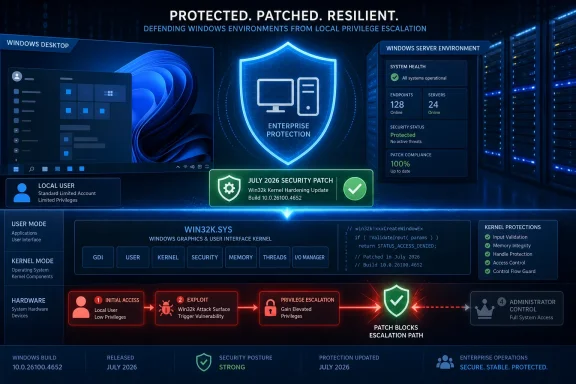 Win32k Turns Limited Access Into a Bigger Problem
Win32k is a privileged Windows subsystem responsible for core graphical and window-management operations. Its position across the boundary between ordinary applications and the operating system kernel has historically made it a consequential target for local privilege-escalation research.Microsoft’s short description does not identify the affected function, object type, or exact access-control failure. It confirms that an authorized attacker can exploit the flaw locally, meaning the attacker must first be able to execute code or otherwise interact with the target machine using an existing account.
That requirement reduces the immediate exposure compared with an unauthenticated network vulnerability. It does not make CVE-2026-50325 harmless. Local elevation-of-privilege bugs are frequently used as the second stage of an attack: an initial weakness gets code onto a PC, and the privilege-escalation flaw breaks out of the restricted user context.
A successful chain could allow an intruder to disable security controls, access data belonging to other users, install persistent services, manipulate protected system files, or create accounts with administrative rights. Microsoft’s CVSS vector assigns high potential impact to confidentiality, integrity, and availability.
The attack requires low privileges and no user interaction. Microsoft also assigns it high attack complexity, indicating that exploitation depends on conditions beyond simply running a readily available command or opening a file. Those conditions have not been publicly detailed.
Microsoft Confirms the Bug but Leaves Exploit Mechanics Private
The vulnerability record carries strong confidence because Microsoft, as the assigning CVE Numbering Authority, has acknowledged the flaw, classified its weakness, calculated its severity, and identified affected builds. In other words, the existence of CVE-2026-50325 is not based solely on an unverified researcher claim or speculative crash analysis.The amount of public technical information remains limited, however. Microsoft has not published a proof of concept, exploitation walkthrough, root-cause analysis, or description of the specific Win32k interface involved. That distinction matters when interpreting vulnerability-confidence metrics: confidence that the flaw exists is high, while public knowledge of how to reproduce it remains comparatively low.
As of the July 14 record update, CISA’s Stakeholder-Specific Vulnerability Categorization data marked exploitation as “none” and the attack as not automatable. That reflects the information available at publication time, not a guarantee that exploit development will not follow.
The CISA assessment also assigns total technical impact, consistent with a successful elevation reaching a highly privileged Windows context. The combination is familiar to defenders: exploitation may be difficult and presently unobserved, but the result can be severe when an attacker satisfies the required conditions.
This is why the 7.0 CVSS score should not be read as a simple patch-priority ranking. High attack complexity pushes the numerical score down, while low required privileges, no user interaction, and high impact across all three security properties keep the vulnerability firmly in the High category.
The Affected List Spans Client and Server Windows
Microsoft’s CVE record covers a broad range of Windows generations, including editions retained for enterprise and embedded servicing. The listed affected branches and their fixed build thresholds include:- Windows 10 version 1607 and Windows Server 2016 must reach build 14393.9339.
- Windows 10 version 1809 and Windows Server 2019 must reach build 17763.9020.
- Windows 10 version 21H2 must reach build 19044.7548.
- Windows 10 version 22H2 must reach build 19045.7548.
- Windows 11 version 24H2 must reach build 26100.8875.
- Windows 11 version 25H2 must reach build 26200.8875.
- Windows 11 version 26H1 must be at build 28000.2269 or later.
- Windows Server 2012 must reach build 9200.26226.
- Windows Server 2012 R2 must reach build 9600.23291.
- Windows Server 2022 must reach build 20348.5386.
- Windows Server 2025 must reach build 26100.33158.
For Windows 11 versions 24H2 and 25H2, Microsoft’s July cumulative update KB5101650 advances systems to OS builds 26100.8875 and 26200.8875 respectively. Because Windows cumulative updates supersede earlier packages, deploying the latest applicable cumulative update is preferable to searching for an isolated Win32k patch.
Windows 11 version 26H1 is an unusual case in the published version data: the vulnerable range ends before build 28000.2269, a build originally delivered with KB5095051 in June 2026. Devices already at that build or a later July build satisfy the recorded threshold, but administrators should still deploy the current cumulative update rather than treating an older servicing baseline as permanently sufficient.
The presence of Windows 10 versions 21H2 and 22H2 also requires context. Many mainstream consumer installations of those releases are already outside ordinary support, while some Enterprise, LTSC, embedded, or paid servicing configurations continue receiving updates. An update scanner must therefore consider edition and servicing entitlement, not just the visible Windows version.
Patch Verification Matters More Than the CVE Checkbox
Enterprise teams should verify remediation by OS build rather than relying only on a vulnerability-management console reporting that a KB was offered. A device can download an update without completing installation, remain pending a restart, or roll back after a servicing failure.Useful checks include
winver, the Settings app’s Windows Update history, PowerShell inventory, endpoint-management reports, and direct OS build collection. For large environments, compare each machine’s build against the fixed threshold for its exact Windows release and architecture.CVE-2026-50325 deserves particular attention on shared workstations, Remote Desktop Session Hosts, virtual desktop infrastructure, jump servers, and systems where untrusted or semi-trusted users can run applications. Those environments give attackers the local access that the vulnerability requires and place more valuable identities or sessions on the same machine.
Microsoft has confirmed the vulnerability but kept the exploit path private, leaving defenders with a clear operational conclusion rather than a detailed forensic signature: move affected Windows systems to the fixed build now. The unresolved question is whether researchers or attackers will independently reconstruct the Win32k access-control failure after comparing patched and unpatched binaries.
References
- Primary source: MSRC
Published: 2026-07-14T07:00:00-07:00
Security Update Guide - Microsoft Security Response Center
 msrc.microsoft.com
- Related coverage: aha.org
