

CVE-2026-50384, a Windows Clip Service elevation-of-privilege vulnerability, is fixed in Microsoft’s July 14, 2026 security updates for supported Windows 10, Windows 11, Windows Server 2019, Windows Server 2022, and Windows Server 2025 systems. The flaw carries a CVSS 3.1 score of 7.0 and could allow an attacker who already has low-level local access to gain substantially broader control of a vulnerable machine.
Microsoft classifies the vulnerability as Important rather than Critical. Detailed in the Microsoft Security Response Center’s Security Update Guide and corroborated by the National Vulnerability Database, CVE-2026-50384 is a race condition involving improper synchronization of a shared resource in Windows Clip Service.
The July updates are the only documented remedy. Microsoft lists no workaround or mitigation, making deployment of the relevant cumulative update the practical response for administrators.
Microsoft describes CVE-2026-50384 as a local privilege-escalation vulnerability caused by concurrent operations accessing a shared resource without proper synchronization. The record maps the weakness to CWE-362, Concurrent Execution Using Shared Resource with Improper Synchronization, and CWE-416, Use After Free.
A race condition occurs when the security or stability of an operation depends on the timing of two or more actions. If an attacker can manipulate that timing, an object may be accessed after it has been released or while it is in an unexpected state. In a privileged Windows service, that type of memory-management failure can become a route from an ordinary account into a more trusted execution context.
The CVSS vector is
Successful exploitation could have a high impact on confidentiality, integrity, and availability. Microsoft has not publicly documented the precise privilege level gained, the required timing sequence, or a proof-of-concept technique, so administrators should avoid assuming that every successful attempt necessarily produces SYSTEM access. The rating nevertheless indicates that Microsoft considers the potential post-exploitation impact severe.
This is not a vulnerability that can be triggered directly by sending packets to an exposed Windows host. It is more relevant as the second stage of an intrusion, after an attacker has obtained credentials, executed code through another flaw, or gained access through malware, phishing, a compromised application, or a poorly secured remote-management service.
That distinction matters because vulnerability records can appear before a vendor has fully determined the root cause. CVE-2026-50384 is not merely a suspected undesirable behavior: Microsoft has identified a race condition, associated it with a use-after-free condition, enumerated affected Windows builds, and shipped corrected builds.
At publication, Microsoft did not list CVE-2026-50384 as publicly disclosed or known to be exploited. SANS Internet Storm Center’s July 2026 Patch Tuesday tracking likewise recorded no public disclosure and no exploitation. It should therefore be treated as a confirmed vulnerability with substantial local impact, but not as a known zero-day under active attack based on the evidence currently available.
The lack of public exploitation lowers the immediate emergency level compared with the actively exploited vulnerabilities in the same July release. It does not remove the risk. Local privilege-escalation bugs are routinely useful to malware operators because they can turn limited execution into credential theft, security-control tampering, persistence, and access to data belonging to other users.
Windows 11 version 23H2 and Windows Server 2016 do not appear in Microsoft’s affected-product record for this specific CVE, even though both received separate July 2026 cumulative updates. Administrators should use the CVE’s product list rather than assuming that every supported Windows branch contains the vulnerable Clip Service code path.
A quick
Installing a KB is not sufficient evidence if the update remains pending a restart. Security teams should verify the resulting build number after reboot and watch for endpoints that have stopped reporting, repeatedly failed installation, or remained outside their normal servicing ring.
That does not mean administrators should bypass normal testing. Microsoft’s July release notes document broader servicing changes, including stricter requirements for third-party TDI transports. Applications using sockets over unregistered legacy TDI transports may stop working after the update, creating a compatibility concern for organizations with old networking, security, or line-of-business software.
Microsoft also warns that a limited set of managed systems with an unrecommended BitLocker PCR7 policy configuration could request the BitLocker recovery key during the first restart after installing certain July updates. Windows Server 2022 administrators, in particular, should review the applicable release notes, confirm that recovery keys are escrowed, and test representative hardware before a wide deployment.
Those concerns support staged rollout and validation, not indefinite delay. Systems used by developers, help-desk staff, server operators, and other users with access to valuable credentials deserve priority because compromising one low-privilege session on those machines can provide an attacker with a useful escalation path.
Organizations should also continue reducing the conditions required for exploitation. Removing unnecessary local accounts, limiting interactive server logons, enforcing application control, protecting administrative credentials, and investigating unexpected child processes or token changes can restrict an attacker’s ability to reach or capitalize on a local privilege-escalation flaw.
CVE-2026-50384 arrived as one of hundreds of vulnerabilities in Microsoft’s unusually large July 2026 Patch Tuesday release, and it is easy for an Important-rated local bug to disappear beneath the critical and actively exploited entries. The concrete finish line is straightforward: affected endpoints should report at least the fixed July build for their Windows branch, with completed restarts and no stranded devices left on an earlier cumulative update.
Microsoft classifies the vulnerability as Important rather than Critical. Detailed in the Microsoft Security Response Center’s Security Update Guide and corroborated by the National Vulnerability Database, CVE-2026-50384 is a race condition involving improper synchronization of a shared resource in Windows Clip Service.
The July updates are the only documented remedy. Microsoft lists no workaround or mitigation, making deployment of the relevant cumulative update the practical response for administrators.
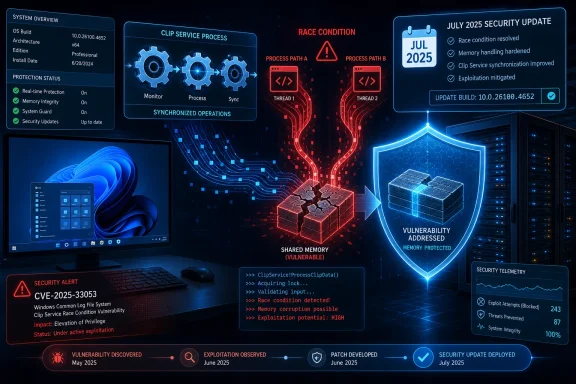 A Race Condition With High-Impact Consequences
Microsoft describes CVE-2026-50384 as a local privilege-escalation vulnerability caused by concurrent operations accessing a shared resource without proper synchronization. The record maps the weakness to CWE-362, Concurrent Execution Using Shared Resource with Improper Synchronization, and CWE-416, Use After Free.A race condition occurs when the security or stability of an operation depends on the timing of two or more actions. If an attacker can manipulate that timing, an object may be accessed after it has been released or while it is in an unexpected state. In a privileged Windows service, that type of memory-management failure can become a route from an ordinary account into a more trusted execution context.
The CVSS vector is
AV:L/AC:H/PR:L/UI:N/S:U/C:H/I:H/A:H. In operational terms, exploitation requires local access and an existing low-privilege account, involves high attack complexity, and does not require another user to click a file or approve a prompt.Successful exploitation could have a high impact on confidentiality, integrity, and availability. Microsoft has not publicly documented the precise privilege level gained, the required timing sequence, or a proof-of-concept technique, so administrators should avoid assuming that every successful attempt necessarily produces SYSTEM access. The rating nevertheless indicates that Microsoft considers the potential post-exploitation impact severe.
This is not a vulnerability that can be triggered directly by sending packets to an exposed Windows host. It is more relevant as the second stage of an intrusion, after an attacker has obtained credentials, executed code through another flaw, or gained access through malware, phishing, a compromised application, or a poorly secured remote-management service.
Microsoft Marks the Technical Details as Confirmed
The confidence metric attached to the advisory concerns how certain Microsoft is that the flaw exists and how credible the available technical details are. In this case, the CVSS temporal vector identifies the report confidence as confirmed and an official fix as available.That distinction matters because vulnerability records can appear before a vendor has fully determined the root cause. CVE-2026-50384 is not merely a suspected undesirable behavior: Microsoft has identified a race condition, associated it with a use-after-free condition, enumerated affected Windows builds, and shipped corrected builds.
At publication, Microsoft did not list CVE-2026-50384 as publicly disclosed or known to be exploited. SANS Internet Storm Center’s July 2026 Patch Tuesday tracking likewise recorded no public disclosure and no exploitation. It should therefore be treated as a confirmed vulnerability with substantial local impact, but not as a known zero-day under active attack based on the evidence currently available.
The lack of public exploitation lowers the immediate emergency level compared with the actively exploited vulnerabilities in the same July release. It does not remove the risk. Local privilege-escalation bugs are routinely useful to malware operators because they can turn limited execution into credential theft, security-control tampering, persistence, and access to data belonging to other users.
The Fixed Builds Define the Deployment Target
The affected-version data submitted by Microsoft identifies Windows installations below the following build levels as vulnerable:- Windows 10 versions 21H2 and 22H2 require builds 19044.7548 and 19045.7548, delivered through KB5099539.
- Windows 10 version 1809 and Windows Server 2019 require build 17763.9020, delivered through KB5099538.
- Windows 11 versions 24H2 and 25H2 require build 26100.8875 or 26200.8875, delivered through KB5101650.
- Windows 11 version 26H1 is covered by the July cumulative update KB5101649, which advances systems to build 28000.2525.
- Windows Server 2022 requires build 20348.5386, delivered through KB5099540.
- Windows Server 2025 requires build 26100.33158, delivered through KB5099536.
Windows 11 version 23H2 and Windows Server 2016 do not appear in Microsoft’s affected-product record for this specific CVE, even though both received separate July 2026 cumulative updates. Administrators should use the CVE’s product list rather than assuming that every supported Windows branch contains the vulnerable Clip Service code path.
A quick
winver check will show the installed OS build on an individual machine. At scale, Intune, Configuration Manager, Windows Update for Business reporting, PowerShell inventory, or an endpoint-management platform should be used to compare deployed builds with Microsoft’s fixed versions.Installing a KB is not sufficient evidence if the update remains pending a restart. Security teams should verify the resulting build number after reboot and watch for endpoints that have stopped reporting, repeatedly failed installation, or remained outside their normal servicing ring.
Patch Testing Must Account for July’s Wider Changes
CVE-2026-50384 is bundled into cumulative Windows updates rather than distributed as an isolated Clip Service patch. Deferring the package therefore leaves this flaw and the rest of July’s security fixes unaddressed.That does not mean administrators should bypass normal testing. Microsoft’s July release notes document broader servicing changes, including stricter requirements for third-party TDI transports. Applications using sockets over unregistered legacy TDI transports may stop working after the update, creating a compatibility concern for organizations with old networking, security, or line-of-business software.
Microsoft also warns that a limited set of managed systems with an unrecommended BitLocker PCR7 policy configuration could request the BitLocker recovery key during the first restart after installing certain July updates. Windows Server 2022 administrators, in particular, should review the applicable release notes, confirm that recovery keys are escrowed, and test representative hardware before a wide deployment.
Those concerns support staged rollout and validation, not indefinite delay. Systems used by developers, help-desk staff, server operators, and other users with access to valuable credentials deserve priority because compromising one low-privilege session on those machines can provide an attacker with a useful escalation path.
Organizations should also continue reducing the conditions required for exploitation. Removing unnecessary local accounts, limiting interactive server logons, enforcing application control, protecting administrative credentials, and investigating unexpected child processes or token changes can restrict an attacker’s ability to reach or capitalize on a local privilege-escalation flaw.
CVE-2026-50384 arrived as one of hundreds of vulnerabilities in Microsoft’s unusually large July 2026 Patch Tuesday release, and it is easy for an Important-rated local bug to disappear beneath the critical and actively exploited entries. The concrete finish line is straightforward: affected endpoints should report at least the fixed July build for their Windows branch, with completed restarts and no stranded devices left on an earlier cumulative update.
References
- Primary source: MSRC
Published: 2026-07-14T07:00:00-07:00
Security Update Guide - Microsoft Security Response Center
 msrc.microsoft.com
- Related coverage: aha.org
