

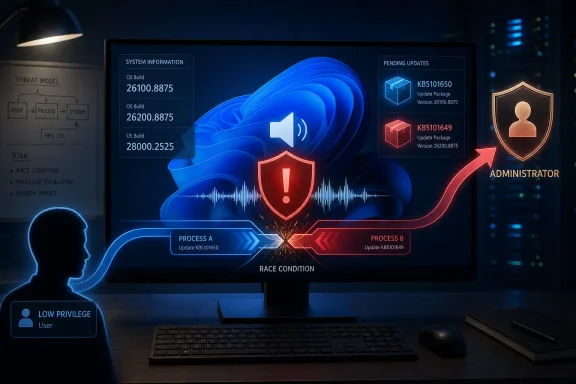
CVE-2026-50440 allows a locally authenticated attacker to exploit a race condition in the Windows Audio Service and elevate privileges on affected Windows 11 systems. Microsoft addressed the high-severity flaw in security updates covering Windows 11 versions 24H2, 25H2, and 26H1, making patch deployment the primary defense for administrators managing shared PCs, developer workstations, and other systems where untrusted users or code may obtain an initial foothold.
Published by the Microsoft Security Response Center on July 14, 2026, the vulnerability carries a CVSS 3.1 base score of 7.8. The National Vulnerability Database describes the underlying weaknesses as improper synchronization during concurrent access to a shared resource and a possible use-after-free condition.
This is not a drive-by or network-level compromise. Exploitation requires local access and low privileges, but Microsoft’s scoring indicates that no additional user interaction is needed and attack complexity is low once those conditions are met.
Microsoft’s CVSS vector for CVE-2026-50440 is
That requirement limits the vulnerability’s reach, but it does not make it harmless. Local elevation-of-privilege flaws are frequently used as the second stage of an attack: phishing, a malicious document, a compromised application, or stolen credentials provides initial access, and the privilege-escalation exploit removes the restrictions imposed on the compromised account.
A successful exploit could produce a total impact on confidentiality, integrity, and availability, according to Microsoft’s scoring. That can translate into access to protected information, modification of system files or security settings, installation of persistent malware, credential theft, and interference with endpoint protection.
The Windows Audio Service is also a standard operating-system component rather than an optional enterprise role. Administrators should not assume that machines are outside the risk area merely because they do not play audio or because speakers and microphones have been disabled. The vulnerable code is part of the Windows servicing footprint identified by Microsoft.
The attack is not considered automatable in CISA’s initial Stakeholder-Specific Vulnerability Categorization assessment. CISA also recorded no known exploitation at the time of publication, while assigning the flaw a potentially total technical impact.
Those details establish an important distinction: CVE-2026-50440 is serious, but it is not currently documented as an actively exploited zero-day. It should be handled through an accelerated normal patching process rather than treated as evidence of an ongoing remote compromise by itself.
Race conditions arise when two or more operations access or change the same resource without sufficient coordination. An attacker attempts to manipulate the timing so that the program reaches a state its developers did not intend, such as using an object after another operation has released it.
Use-after-free vulnerabilities can lead to crashes, memory corruption, or controlled execution depending on the object involved and how predictably an attacker can replace or influence the freed memory. Microsoft has not published exploit code or a detailed reproduction procedure for CVE-2026-50440, so the precise path from the Windows Audio Service race to elevated privileges remains restricted.
The low attack-complexity rating nevertheless indicates that Microsoft does not consider unusual environmental conditions necessary for successful exploitation. The lack of a user-interaction requirement also means an attacker who has reached the required local privilege level would not need to trick another signed-in user into approving a prompt, opening a file, or clicking a link during the privilege-escalation stage.
Microsoft marks the report-confidence metric as confirmed. That designation means the vendor has sufficient evidence to acknowledge the vulnerability’s existence, rather than relying on an uncorroborated report or a theoretical weakness. It does not mean technical exploit details are publicly available, nor does it establish that attackers are using the flaw in the wild.
For defenders, the confidence rating removes one reason to delay. The vulnerability is not speculative, and Microsoft has shipped an official remediation.
Windows 11 24H2 systems should reach OS Build 26100.8875. Microsoft’s July client-image documentation also lists Windows 11 25H2 at Build 26200.8875 under KB5101650, although some early update listings displayed a slightly different 25H2 revision number. Administrators should use Microsoft’s current servicing metadata and the installed KB rather than relying solely on copied build lists.
Windows 11 version 26H1 has a less straightforward boundary. Microsoft’s CVE data marks versions earlier than Build 28000.2269 as affected, which corresponds to the June 9, 2026 cumulative update KB5095051. The newer July 14 cumulative update is KB5101649, bringing 26H1 to Build 28000.2525 and incorporating the latest security fixes.
That chronology suggests Microsoft had already placed the relevant 26H1 correction into its June servicing branch before publicly assigning CVE-2026-50440 in July. Organizations running 26H1 should still deploy KB5101649 unless a tested operational issue requires a temporary delay, since cumulative updates replace prior security baselines and include fixes beyond this single CVE.
The published affected-product list does not identify Windows 11 23H2, Windows 10, or Windows Server as vulnerable to CVE-2026-50440. Administrators should avoid extending the affected scope beyond Microsoft’s record without supporting evidence, while continuing to install the separate July security updates applicable to those platforms.
Enterprise teams should verify installation through their normal Windows Update for Business, WSUS, Microsoft Intune, Configuration Manager, or equivalent endpoint-management reporting. A useful validation should check both the cumulative-update identity and the resulting OS build, particularly where update deferrals or paused deployments may leave devices on June preview builds.
Priority should go to systems where local execution by less-trusted users is expected. That includes shared workstations, training-room PCs, kiosks with escape paths, virtual desktop pools, build machines, help-desk endpoints, and developer devices that regularly execute third-party packages or test code.
Administrators also need to account for the broader operational state of KB5101650. Microsoft has acknowledged that the July update may be withheld from a limited number of Dell devices with Intel processors because of a reported incompatibility involving unexpected shutdowns, reduced performance, increased heat, and battery drain. Devices subject to that safeguard require closer tracking rather than an attempt to force the update blindly.
For unaffected hardware, the security calculus is simpler. CVE-2026-50440 cannot provide an attacker with the first connection to a PC, but it can make an existing low-privilege compromise substantially more damaging. Windows 11 24H2 and 25H2 fleets should therefore target KB5101650 and Build 26100.8875 or 26200.8875, while 26H1 systems should move to KB5101649 and Build 28000.2525 as the current cumulative baseline.
Published by the Microsoft Security Response Center on July 14, 2026, the vulnerability carries a CVSS 3.1 base score of 7.8. The National Vulnerability Database describes the underlying weaknesses as improper synchronization during concurrent access to a shared resource and a possible use-after-free condition.
This is not a drive-by or network-level compromise. Exploitation requires local access and low privileges, but Microsoft’s scoring indicates that no additional user interaction is needed and attack complexity is low once those conditions are met.
 A Local Foothold Can Become a Full Compromise
Microsoft’s CVSS vector for CVE-2026-50440 is AV:L/AC:L/PR:L/UI:N/S:U/C:H/I:H/A:H. In practical terms, an attacker must already be able to execute code or otherwise interact with the affected machine as a low-privileged user.That requirement limits the vulnerability’s reach, but it does not make it harmless. Local elevation-of-privilege flaws are frequently used as the second stage of an attack: phishing, a malicious document, a compromised application, or stolen credentials provides initial access, and the privilege-escalation exploit removes the restrictions imposed on the compromised account.
A successful exploit could produce a total impact on confidentiality, integrity, and availability, according to Microsoft’s scoring. That can translate into access to protected information, modification of system files or security settings, installation of persistent malware, credential theft, and interference with endpoint protection.
The Windows Audio Service is also a standard operating-system component rather than an optional enterprise role. Administrators should not assume that machines are outside the risk area merely because they do not play audio or because speakers and microphones have been disabled. The vulnerable code is part of the Windows servicing footprint identified by Microsoft.
The attack is not considered automatable in CISA’s initial Stakeholder-Specific Vulnerability Categorization assessment. CISA also recorded no known exploitation at the time of publication, while assigning the flaw a potentially total technical impact.
Those details establish an important distinction: CVE-2026-50440 is serious, but it is not currently documented as an actively exploited zero-day. It should be handled through an accelerated normal patching process rather than treated as evidence of an ongoing remote compromise by itself.
A Race Condition Hides Behind the Audio Label
The vulnerability’s Windows Audio Service name gives little indication of the underlying security problem. Microsoft’s CVE record identifies both CWE-362, covering concurrent execution with improper synchronization, and CWE-416, covering use after free.Race conditions arise when two or more operations access or change the same resource without sufficient coordination. An attacker attempts to manipulate the timing so that the program reaches a state its developers did not intend, such as using an object after another operation has released it.
Use-after-free vulnerabilities can lead to crashes, memory corruption, or controlled execution depending on the object involved and how predictably an attacker can replace or influence the freed memory. Microsoft has not published exploit code or a detailed reproduction procedure for CVE-2026-50440, so the precise path from the Windows Audio Service race to elevated privileges remains restricted.
The low attack-complexity rating nevertheless indicates that Microsoft does not consider unusual environmental conditions necessary for successful exploitation. The lack of a user-interaction requirement also means an attacker who has reached the required local privilege level would not need to trick another signed-in user into approving a prompt, opening a file, or clicking a link during the privilege-escalation stage.
Microsoft marks the report-confidence metric as confirmed. That designation means the vendor has sufficient evidence to acknowledge the vulnerability’s existence, rather than relying on an uncorroborated report or a theoretical weakness. It does not mean technical exploit details are publicly available, nor does it establish that attackers are using the flaw in the wild.
For defenders, the confidence rating removes one reason to delay. The vulnerability is not speculative, and Microsoft has shipped an official remediation.
Windows 11 Builds Define the Patch Boundary
The affected-version information submitted by Microsoft identifies Windows 11 24H2 and 25H2 on both x64 and Arm64 systems. July’s cumulative update, KB5101650, moves those releases to the corrected build line.Windows 11 24H2 systems should reach OS Build 26100.8875. Microsoft’s July client-image documentation also lists Windows 11 25H2 at Build 26200.8875 under KB5101650, although some early update listings displayed a slightly different 25H2 revision number. Administrators should use Microsoft’s current servicing metadata and the installed KB rather than relying solely on copied build lists.
Windows 11 version 26H1 has a less straightforward boundary. Microsoft’s CVE data marks versions earlier than Build 28000.2269 as affected, which corresponds to the June 9, 2026 cumulative update KB5095051. The newer July 14 cumulative update is KB5101649, bringing 26H1 to Build 28000.2525 and incorporating the latest security fixes.
That chronology suggests Microsoft had already placed the relevant 26H1 correction into its June servicing branch before publicly assigning CVE-2026-50440 in July. Organizations running 26H1 should still deploy KB5101649 unless a tested operational issue requires a temporary delay, since cumulative updates replace prior security baselines and include fixes beyond this single CVE.
The published affected-product list does not identify Windows 11 23H2, Windows 10, or Windows Server as vulnerable to CVE-2026-50440. Administrators should avoid extending the affected scope beyond Microsoft’s record without supporting evidence, while continuing to install the separate July security updates applicable to those platforms.
Patch Management Matters More Than Audio Workarounds
Microsoft has not documented a configuration-based mitigation or workaround for CVE-2026-50440. Disabling sound output, muting devices, or removing a vendor-specific audio application should not be treated as equivalent to updating the Windows Audio Service code.Enterprise teams should verify installation through their normal Windows Update for Business, WSUS, Microsoft Intune, Configuration Manager, or equivalent endpoint-management reporting. A useful validation should check both the cumulative-update identity and the resulting OS build, particularly where update deferrals or paused deployments may leave devices on June preview builds.
Priority should go to systems where local execution by less-trusted users is expected. That includes shared workstations, training-room PCs, kiosks with escape paths, virtual desktop pools, build machines, help-desk endpoints, and developer devices that regularly execute third-party packages or test code.
Administrators also need to account for the broader operational state of KB5101650. Microsoft has acknowledged that the July update may be withheld from a limited number of Dell devices with Intel processors because of a reported incompatibility involving unexpected shutdowns, reduced performance, increased heat, and battery drain. Devices subject to that safeguard require closer tracking rather than an attempt to force the update blindly.
For unaffected hardware, the security calculus is simpler. CVE-2026-50440 cannot provide an attacker with the first connection to a PC, but it can make an existing low-privilege compromise substantially more damaging. Windows 11 24H2 and 25H2 fleets should therefore target KB5101650 and Build 26100.8875 or 26200.8875, while 26H1 systems should move to KB5101649 and Build 28000.2525 as the current cumulative baseline.
References
- Primary source: MSRC
Published: 2026-07-14T07:00:00-07:00
Security Update Guide - Microsoft Security Response Center
 msrc.microsoft.com
- Related coverage: aha.org
