

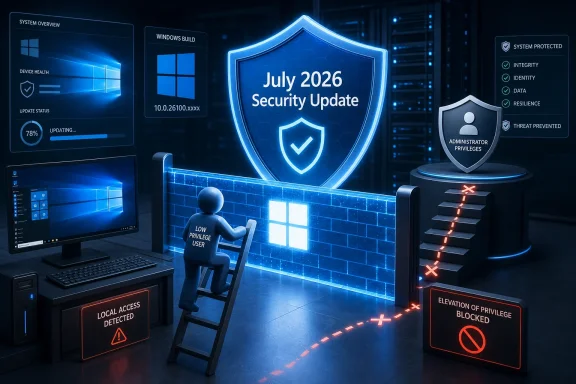
Microsoft classifies CVE-2026-50343 as Important, according to the Microsoft Security Response Center advisory published alongside July Patch Tuesday. The National Vulnerability Database describes the underlying weakness as improper privilege management, tracked under CWE-269.
This is not a remote, unauthenticated entry point. An attacker must first obtain authorization to access the target computer and run code with low privileges. Successful exploitation could nevertheless turn that limited foothold into a full compromise of the affected Windows installation.
Local Access Is the Barrier, Not the Prize
Microsoft’s CVSS vector is CVSS:3.1/AV:L/AC:L/PR:L/UI:N/S:U/C:H/I:H/A:H. In practical terms, the attack is local, requires low-level privileges, has low attack complexity, and needs no interaction from another user.
The flaw therefore fits the pattern of a post-compromise privilege escalation. It is unlikely to be the first step in an intrusion, but it could become a valuable second step after an attacker steals credentials, compromises a standard user account, executes malware through another vulnerability, or gains access through a malicious application.
The potential impact is broad. Microsoft’s scoring assigns a High rating to confidentiality, integrity, and availability, indicating that successful exploitation could let the attacker access protected information, alter system resources, and disrupt the computer.
The unchanged security scope in the CVSS vector means exploitation remains within the authority governed by the vulnerable Windows component. That does not make the outcome minor: moving from an ordinary user context to elevated privileges can expose credentials, security settings, services, application data, and other users’ files.
Microsoft has not publicly provided the root-cause detail, exploit procedure, or proof-of-concept code that would let defenders identify a distinctive attack pattern. The advisory’s title specifically names Microsoft Install Service; administrators should not assume that every Windows Installer policy or msiexec.exe event is directly connected to this CVE.
The Confirmed Rating Matters More Than the Missing Detail
The vulnerability record was published on July 14 with a temporal score of 6.8 and a report-confidence value of Confirmed. That confidence metric addresses whether the flaw and available technical assessment have been corroborated, rather than measuring how frequently attackers are using it.
CVE-2026-50343 was not listed as publicly disclosed or exploited at release, according to the July security-update data compiled by the SANS Internet Storm Center. Microsoft’s initial assessment therefore does not identify it as a zero-day under active attack.
That distinction should influence sequencing, but not become a reason to leave systems unpatched indefinitely. Local elevation vulnerabilities are commonly combined with phishing, browser flaws, document attacks, exposed remote-management tools, and stolen credentials. Their operational value rises once reliable exploit code becomes available because the prerequisite—a low-privilege foothold—is common in real intrusions.
The low-complexity rating is particularly relevant. It indicates that exploitation does not depend on unusual environmental conditions or a difficult race that attackers cannot reliably reproduce, although Microsoft has not disclosed enough technical information to determine the exact mechanism.
There is also no victim interaction requirement. Once an attacker has the necessary local access, another user does not need to open a file, approve a User Account Control prompt, or perform a separate action for the vulnerability to be attempted.
Supported Windows Generations Share the Exposure
The affected-product record spans current Windows clients and servers as well as older Windows 10 installations still receiving the applicable security servicing. Microsoft identifies vulnerable versions by the build installed before the relevant security update.
The corrected build thresholds include:
- Windows 10 versions 21H2 and 22H2 are protected at OS builds 19044.7548 and 19045.7548, delivered through KB5099539.
- Windows 11 version 24H2 is protected at build 26100.8875 through KB5101650.
- Windows 11 version 25H2 is protected at build 26200.8875 through KB5101650.
- Windows 11 version 26H1 is protected at build 28000.2269.
- Windows Server 2019 and Windows 10 version 1809 are protected at build 17763.9020.
- Windows Server 2022 is protected at build 20348.5386 through KB5099540.
- Windows Server 2025 is protected at build 26100.33158 through KB5099536.
Both the Desktop Experience and Server Core installations of Windows Server 2019 and Windows Server 2025 appear in the affected-product data. ARM64 Windows 11 devices are also included, while affected Windows 10 releases cover the architectures still serviced for each edition.
The presence of Windows 10 versions 21H2 and 22H2 in the vulnerability record does not mean every consumer installation has automatically returned to normal support. Eligibility for the July 2026 update still depends on edition, servicing channel, and participation in any applicable Extended Security Updates program.
Administrators should verify the installed OS build rather than relying only on the Windows marketing version. A device labeled Windows 11 24H2, for example, remains below the CVE’s fixed threshold if it has not reached build 26100.8875 or a later cumulative build containing the same correction.
Patch Deployment Beats Speculative Workarounds
Microsoft has not documented a standalone mitigation or registry workaround for CVE-2026-50343. The practical remedy is the July cumulative security update or a later update that supersedes it.
Enterprise teams should deploy through their normal Windows Update for Business, Windows Server Update Services, Microsoft Configuration Manager, or Intune rings. Internet-facing systems may not be directly exposed by this local-only flaw, but multi-user servers, jump hosts, virtual desktop infrastructure, developer workstations, and endpoints that permit untrusted applications deserve faster treatment.
Validation should include more than confirming that a deployment tool reported success. Administrators can compare winver, PowerShell inventory, Configuration Manager data, or endpoint-management telemetry against the corrected build numbers, then investigate machines that remain below the applicable threshold.
Security teams should continue watching for the broader signs of privilege escalation rather than expecting a CVE-specific detection rule immediately. Unexpected service creation, protected-file changes, new scheduled tasks, security-control tampering, unusual child processes launched by installation-related services, and activity crossing from a standard user into a highly privileged context all warrant review.
CVE-2026-50343 does not present the immediate exposure of a network-reachable remote-code-execution flaw, and Microsoft had not reported active exploitation as of July 15, 2026. Its combination of low attack complexity, no user interaction, and potentially complete system impact still makes installation of the July 2026 cumulative updates the decisive control, especially on shared Windows systems where low-privilege access is intentionally available.
References
- CVE-2026-50343 Microsoft Install Service Elevation of Privilege Vulnerability MSRC · 2026-07-14T07:00:00-07:00