

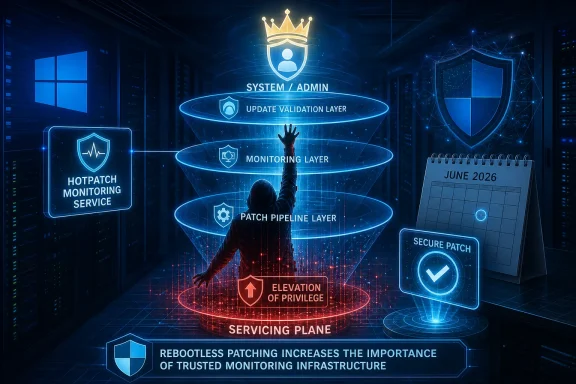
Microsoft’s Rebootless Future Now Has Its Own Security Debt
Hotpatching has always been sold as a bargain: fewer reboots, faster security uptake, less operational pain. That bargain is attractive because Windows administrators have spent decades negotiating with maintenance windows, uptime demands, and the simple fact that endpoints rarely patch on the calendar the security team wants. The Windows Hotpatch Monitoring Service sits in that new world, where patch state is not just a monthly event but a live operational signal.
That is why CVE-2026-42910 deserves more attention than its dry name suggests. Elevation-of-privilege vulnerabilities are often treated as second-tier issues because they usually require some prior foothold. But in real intrusions, that foothold is often the easy part: a phished user, a stolen token, a vulnerable app, a misconfigured remote management agent. The hard part is turning that initial access into durable, administrative control.
A flaw in a monitoring service tied to hotpatching is therefore not just a bug in a background component. It is a reminder that the systems designed to make patching smoother also run with enough authority to matter. If a local attacker can use that authority to climb the privilege ladder, the servicing stack becomes part of the post-exploitation story.
Microsoft has not publicly filled in every technical detail, and that restraint is normal for a newly serviced vulnerability. But the classification tells administrators enough to act. This is an elevation-of-privilege issue in a Windows service associated with hotpatch monitoring, and Microsoft has placed it in the regular security update channel.
The Most Important Word Is “Confirmed”
The user-facing language around this CVE points to a metric that is often overlooked: confidence in the existence of the vulnerability and the credibility of the known technical details. In vulnerability management, that is not a philosophical distinction. It changes how defenders prioritize scarce time.
There are security advisories that amount to smoke: a suspected impact, a broad product area, and little proof that the issue exists in a practical form. There are advisories backed by partial research, where the vulnerability appears real but the root cause or exploitability is still uncertain. Then there are vendor-confirmed vulnerabilities, where the affected product owner has acknowledged the flaw and shipped or directed users toward remediation.
CVE-2026-42910 belongs in that last bucket. Microsoft’s acknowledgement does not mean every possible exploit detail is public. It means the issue has cleared the bar for a vendor security update. For administrators, that is the difference between “track this” and “schedule this.”
That distinction matters because attackers read the same advisory ecosystem defenders do. A confirmed Windows elevation-of-privilege vulnerability becomes a candidate for patch diffing, reverse engineering, and exploit development. The absence of a public proof-of-concept today does not freeze the risk in place. It starts the clock.
Elevation of Privilege Is the Quiet Workhorse of Windows Intrusions
Remote code execution gets the headlines because it sounds like the whole attack in one phrase. Elevation of privilege is less glamorous, but it is the kind of vulnerability that turns an intrusion from noisy opportunism into serious compromise. A normal user context is inconvenient for an attacker; SYSTEM or administrative privilege is an operating position.
That is especially true on Windows, where service boundaries, token handling, scheduled tasks, named pipes, drivers, COM servers, and update-related components all form a dense local attack surface. Many enterprise compromises do not begin with a kernel zero-day. They begin with something ordinary and then chain into a local privilege escalation.
CVE-2026-42910 should be read in that light. The vulnerability is not advertised as a remote wormable flaw, and nothing in the public naming suggests unauthenticated internet exposure. But local privilege escalation is precisely the sort of bug that becomes valuable after an attacker lands through another path.
This is why dismissing EoP bugs as “not remotely exploitable” is a mistake. The modern endpoint is rarely defended by a single boundary. It is defended by layers, and local privilege escalation is the art of peeling those layers away after one of them fails.
Hotpatching Reduces One Risk While Creating Another Target
Microsoft’s hotpatching push is rational. Reboots are expensive in enterprises, especially on servers and specialized workloads. Anything that reduces downtime while keeping machines current has obvious value for cloud hosts, regulated environments, and organizations with sprawling Windows estates.
But every improvement in operational convenience tends to consolidate trust somewhere. If updates can be applied with fewer restarts, Windows needs mechanisms to validate patch state, monitor applicability, coordinate servicing behavior, and report whether the machine is in the expected security posture. Those mechanisms are infrastructure, and infrastructure with privilege is always security-sensitive.
That does not make hotpatching unsafe. It makes hotpatching mature enough to attract the same scrutiny as the rest of Windows servicing. The old servicing model had its own risks: delayed patching, reboot deferrals, broken maintenance calendars, and machines left exposed because downtime was politically difficult. The new model improves that equation, but it does not remove the need to harden the machinery behind it.
CVE-2026-42910 is best understood as an early warning about that tradeoff. The future of Windows patching is more continuous and less reboot-bound. That future requires defenders to care not only about whether patches are installed, but also about the health and integrity of the systems that observe, apply, and validate them.
The Advisory Gives Defenders Enough to Prioritize Without Feeding Attackers Everything
Security teams often complain, fairly, that vendor advisories are too sparse. A CVE title, severity, and affected product list can feel like a weather report without a map. But sparse advisories serve two audiences at once: defenders who need to patch and attackers who would love implementation clues.
For CVE-2026-42910, the lack of public root-cause detail means administrators should avoid inventing specificity. There is no reason to claim a particular race condition, permission problem, file operation, named pipe behavior, or service misconfiguration unless Microsoft or credible researchers disclose it. The responsible reading is narrower: this is a confirmed vulnerability in Windows Hotpatch Monitoring Service that can allow elevation of privilege under Microsoft’s assessed conditions.
That is still enough for action. Most defenders do not need exploit internals to know whether to deploy the June 2026 Windows security updates. They need to know whether the affected component exists in their estate, whether the update applies, whether compensating controls are realistic, and whether there are signs of exploitation. In most organizations, the answer will be simpler: patch.
The temptation to wait for exploit code is understandable but backwards. Once exploit code appears, the defender’s advantage has already shrunk. Vendor confirmation plus a privilege-escalation impact is enough to justify moving this into the normal accelerated lane, especially for systems participating in hotpatching or managed by modern Windows servicing workflows.
The Risk Is Highest Where Patch Infrastructure Is Treated as Background Noise
The systems most exposed to CVE-2026-42910 are not necessarily the most exotic machines. They are the ones administrators stop thinking about because servicing has become automated. That can include servers enrolled in hotpatch-capable programs, cloud-managed Windows instances, and endpoints whose update posture is monitored through centralized tooling.
Automation is a gift until it becomes invisibility. If a service is responsible for monitoring patch state, its failure mode is not just technical; it is operational. A compromised or abused servicing component can undermine confidence in what the management plane reports. Even when a particular CVE does not enable tampering with patch status, the strategic lesson remains: patch infrastructure deserves the same monitoring discipline as identity, EDR, and remote management.
This is particularly important for sysadmins who have spent the last few years moving from artisanal patching to policy-driven deployment. The more Windows Update for Business, Intune, Azure management, hotpatching, and cloud telemetry become the norm, the more attackers will care about those channels. They are the connective tissue of the fleet.
Security teams should therefore treat servicing components as part of privileged infrastructure. They should know which services exist, which accounts they run under, which logs they emit, and which machines deviate from expected update behavior. CVE-2026-42910 is one entry in a much larger argument: the patch pipeline is not outside the security perimeter. It is inside the blast radius.
Exploitability Is Not the Same as Exploitation
One of the recurring mistakes in Patch Tuesday triage is collapsing several different questions into one. Is the vulnerability real? Is it exploitable in theory? Is exploit code public? Is it being exploited in the wild? Is it relevant to my environment? Those are separate answers, and they move at different speeds.
The confidence metric discussed in the source material deals primarily with the first two questions. It asks how certain we are that the vulnerability exists and how credible the technical details are. A vendor-confirmed CVE with a security update carries a different weight from a rumor, a disputed bug report, or a theoretical weakness.
But confirmed existence does not automatically mean widespread exploitation. Publicly available information for CVE-2026-42910 does not require defenders to assume an active campaign unless Microsoft or another credible source says so. The proper posture is neither panic nor complacency. It is timely remediation.
This middle ground is where mature vulnerability management lives. Teams should not interrupt every business process for every local privilege escalation bug. They also should not bury confirmed Windows EoP flaws under cosmetic application updates. The right question is whether the vulnerability meaningfully helps an attacker already inside the environment. For CVE-2026-42910, the answer is plausibly yes.
Patch Diffing Turns Sparse Advisories Into Roadmaps
Even when Microsoft withholds exploit detail, the patch itself can become a source of intelligence. Researchers and attackers routinely compare pre-update and post-update binaries to infer what changed. In Windows, that process can reveal modified functions, permission checks, object-handling changes, service behavior, or input validation adjustments.
That does not mean every CVE becomes weaponized overnight. Windows internals are complex, and turning a patch diff into a reliable exploit can be difficult. But elevation-of-privilege bugs are attractive targets because they fit neatly into attack chains. A local bug does not need to breach the perimeter; it only needs to upgrade access after something else has.
This is where the confidence metric intersects with attacker economics. A vendor-confirmed vulnerability with a patch gives researchers a before-and-after comparison. That raises the credibility of the target and reduces uncertainty. The advisory may not publish the route, but it confirms that a route existed.
For defenders, the lesson is blunt: do not confuse missing details with missing risk. The most dangerous window is often the period after a patch ships but before it is broadly deployed. During that interval, defenders have announced the door and attackers have started studying the lock.
Windows Administrators Should Read This as a Servicing Hygiene Test
The practical response to CVE-2026-42910 begins with ordinary patch management, but it should not end there. Administrators should confirm that June 2026 Windows security updates are approved, deployed, and reporting correctly across affected systems. They should pay particular attention to machines that participate in hotpatching workflows or rely on automated servicing status.
The second step is validation. Patch dashboards can lie through omission: offline devices, stale check-ins, failed installs, supersedence confusion, and reboot-pending states can all make an environment look healthier than it is. Hotpatching reduces some reboot friction, but it does not eliminate the need to verify that the security baseline actually landed.
The third step is monitoring. Because this is an elevation-of-privilege issue, useful signals may include unexpected service starts, privilege changes, suspicious child processes from service contexts, anomalous local account activity, and endpoint detections involving post-exploitation tooling. Without public exploit details, defenders should avoid overly narrow detections and instead watch for abuse patterns around local privilege escalation.
Finally, administrators should document exceptions. If a machine cannot be patched promptly, that exception should have an owner, an expiration date, and a compensating-control story. “It might reboot” is not a long-term risk decision. It is a maintenance problem pretending to be security policy.
The Enterprise Impact Is Less About One CVE Than About Trust in the Update Plane
CVE-2026-42910 lands at an awkward moment for Microsoft’s servicing story. The company wants enterprises to accept more cloud-shaped Windows management: faster rings, policy-driven deployment, hotpatch eligibility, telemetry-backed compliance, and fewer old-fashioned maintenance rituals. That shift is necessary, but it asks administrators to move trust from manual control to platform automation.
A vulnerability in the Hotpatch Monitoring Service does not invalidate that model. Manual patching has never been a security utopia. In many environments, old-style patch governance produced long exposure windows and endless exceptions. But the bug does show that the update plane must be defended as deliberately as the workloads it protects.
For regulated organizations, this matters in audit language as well as technical language. If hotpatching becomes part of the compliance story, the integrity of hotpatch monitoring becomes part of the evidence chain. Security teams may need to prove not only that a system was patched, but that the reporting mechanism used to assert that fact was trustworthy.
That is the deeper enterprise implication. Windows servicing is no longer just an operating-system maintenance chore. It is a security control, an availability strategy, and a compliance signal. Vulnerabilities in that layer deserve scrutiny beyond their CVSS shorthand.
Microsoft’s Sparse Disclosure Leaves Room for Better Operational Guidance
Microsoft’s Security Update Guide has improved over the years, but it still often leaves administrators wanting more. For a vulnerability like CVE-2026-42910, defenders would benefit from clearer statements about affected Windows versions, hotpatch eligibility, required privileges, exploitation prerequisites, and whether the vulnerable service is present or active by default in common configurations. Some of that information may be available in the full advisory interface or update metadata, but it is not always presented in a way that matches how operations teams make decisions.
This is not a call for Microsoft to publish exploit recipes. It is a call for more defender-useful context. A sentence explaining whether the vulnerable component is broadly present, limited to hotpatch-enabled systems, or merely part of a servicing stack would materially change triage. So would a clear statement about whether exploitation requires local interactive access, a low-privileged account, or some more specialized condition.
The industry has become better at naming vulnerabilities than explaining them. CVE identifiers are essential, but they are not operational guidance. A vulnerability record tells you what to track; it does not always tell you what to do first on Tuesday afternoon when the change board, SOC, and endpoint team are all staring at the same spreadsheet.
In fairness, Microsoft is balancing disclosure risk, legal precision, and the complexity of Windows itself. But for services tied to patching and fleet compliance, the company should err toward explaining the administrative blast radius. The audience for this advisory is not only exploit developers. It is the people responsible for keeping Windows estates patched without breaking the business.
The Confidence Metric Is a Signal to Stop Waiting
The source text’s focus on confidence is useful because it cuts through one of the great evasions in vulnerability management: uncertainty as an excuse for delay. If a vulnerability is speculative, delay may be reasonable. If the root cause is unknown and the impact is disputed, further analysis may be warranted. If the vendor has confirmed the flaw and shipped remediation, the decision changes.
That does not mean every confirmed CVE deserves emergency treatment. Severity, exposure, exploitability, asset criticality, and compensating controls still matter. But confidence changes the default posture. A confirmed Windows privilege-escalation flaw is not a rumor to be watched from a distance. It is a serviced defect in a platform component.
This is especially true for organizations that already have an attacker-assume-breach model. In that model, local privilege escalation is not an edge case. It is part of the expected adversary path. If the vulnerability can help an attacker turn a limited foothold into broader control, then it belongs in the patch queue ahead of issues that merely clutter scanner reports.
The metric also warns defenders that attackers may have enough information to begin work. Public details may be sparse, but confirmation plus a patch is a meaningful technical starting point. The more confidence the ecosystem has in the vulnerability’s existence, the less time defenders should spend debating whether it is real.
The June Patch Queue Has a Hotpatch-Shaped Canary
For WindowsForum readers, the practical story is not that CVE-2026-42910 is the most dramatic vulnerability of the year. It is that Microsoft’s servicing future now has a named security blemish, and administrators should use it to test whether their update process is as resilient as they think. The patch itself matters; the operational lesson matters more.
- CVE-2026-42910 is a Microsoft-confirmed Windows Hotpatch Monitoring Service elevation-of-privilege vulnerability disclosed in the June 2026 Patch Tuesday cycle.
- The public information supports timely patching, but it does not justify speculation about a specific root cause unless Microsoft or credible researchers disclose more.
- The risk profile is most relevant after an attacker has already obtained local access and needs a way to gain higher privileges.
- Systems tied to hotpatching, automated servicing, or centralized update compliance deserve particular verification after the June updates are deployed.
- Security teams should treat Windows servicing components as privileged infrastructure rather than background plumbing.
- The confidence metric is a reminder that vendor confirmation and available remediation should move a CVE out of the “interesting” pile and into the “act on it” queue.
CVE-2026-42910 will probably not be remembered as the vulnerability that changed Windows security. Its importance is subtler: it shows that as Microsoft makes patching less disruptive, the patching machinery itself becomes more consequential. The next phase of Windows administration will not be won by choosing between speed and caution, but by building enough trust, telemetry, and discipline into the servicing plane that faster updates do not become a new blind spot.