

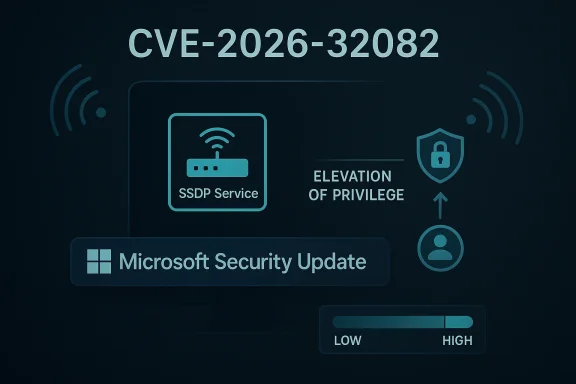
Microsoft’s CVE-2026-32082 is a reminder that the Windows Simple Search and Discovery Protocol (SSDP) Service remains an attractive target for local privilege escalation research. Even when a flaw requires local access, an elevation-of-privilege issue can be highly valuable because it turns a foothold into broader system control. In Microsoft’s own framing, the confidence metric attached to a vulnerability is meant to reflect how certain the flaw is and how much technical detail is known, which directly influences urgency. The broader signal here is clear: SSDP-class services keep showing up in Windows security advisories because they sit in a risky intersection of legacy networking, service privileges, and shared resource handling.
SSDP is one of those Windows components many users never think about until something goes wrong. It helps devices discover each other on a local network, which makes it useful in home and small-office environments, but also places it squarely in the category of services that can expose attack surface to nearby systems or low-privilege users. Microsoft has repeatedly treated SSDP-related flaws as elevation-of-privilege issues, and that pattern suggests the service’s internal trust boundaries are harder to harden than they should be.
The important nuance with a vulnerability like CVE-2026-32082 is that “local” does not mean “minor.” Local privilege escalation bugs are often the final step in a real-world intrusion chain. An attacker who has already gained a standard user session, or who can execute code on the machine by some other means, may use an EoP flaw to reach administrative control, disable security tools, or pivot deeper into an environment.
Microsoft’s update guide classification also matters because it reflects the confidence level in the technical details. When vendors publish a CVE with enough certainty to label it and patch it, defenders can plan around something concrete rather than a vague suspicion. That said, the public record visible through the MSRC page itself is sparse to the point of opacity, which is common early in the disclosure lifecycle for many Windows issues. The title tells us the component and impact category; it does not yet tell us the root cause.
This is also part of a broader pattern around Windows networking services. Microsoft has had to address multiple SSDP-related flaws over the past several years, including a string of 2025 disclosures affecting the same service family. That repetition is not proof of a single underlying design defect, but it does suggest that the service’s implementation still has brittle spots where memory safety, synchronization, and privilege boundaries intersect.
Over time, Windows security engineering has shifted toward reducing the blast radius of such components. Microsoft has removed or disabled features in response to exploitation risk, tightened service isolation, and increasingly documented vulnerabilities in terms of exploitability and confidence rather than just severity. Yet services like SSDP can linger because they support compatibility scenarios, small-business networking, and enterprise device discovery tools that still rely on them.
The update-guide page for CVE-2026-32082 exists inside Microsoft’s modern vulnerability disclosure system, which is built to provide structured severity, impact, affected products, and remediation data. However, the page itself requires JavaScript and is not readily machine-readable in its raw form. That is not unusual for contemporary MSRC pages, but it means defenders often depend on second-hand aggregators until Microsoft’s own data is surfaced in a more accessible format.
The historical lesson is straightforward: when Microsoft repeatedly classifies a service as a local elevation-of-privilege risk, defenders should assume the service’s attack surface is not theoretical. Even without a public exploit narrative, the recurring pattern signals that the service is security-significant and worthy of priority patching.
In practical terms, a higher-confidence CVE should be treated as an engineering reality, not an academic concern. Security teams can prioritize remediation, especially when the affected component is a Windows service that may be present across desktops, laptops, servers, and virtualized infrastructure. The confidence framing also hints at how much technical detail an attacker might infer from the advisory ecosystem, even if the exploit itself remains unpublished.
Microsoft’s more modern vulnerability communication practices have become increasingly transparent over time, including machine-readable advisory data and better cross-referencing in the Security Update Guide. That transparency helps defenders, but it can also tell sophisticated adversaries where to focus. The tradeoff is unavoidable: better patch guidance means better attacker reconnaissance too.
This is typical of legacy service families. The code evolves over years, often with compatibility requirements that limit how radically Microsoft can refactor the service or remove it outright. That makes a service like SSDP especially vulnerable to accumulated technical debt, where one bug may be fixed only for another, adjacent bug to emerge.
The significance for enterprises is not that SSDP is uniquely dangerous in every environment, but that it may be installed and enabled in far more places than security teams realize. A quiet service running on a server, VDI host, or IT admin workstation can become a privilege escalation target even when it is not actively used day to day.
The SSDP service is especially interesting because it sits in a class of Windows components that may run with substantial privileges and interact with network-facing inputs. That combination creates a tempting target for attackers who have already obtained a low-privilege session. Even where exploit reliability is uncertain, the potential payoff is large enough to justify research and weaponization attempts.
For consumer users, the practical risk is usually narrower but still real. If an attacker has already landed malware through another route, an SSDP EoP bug could help that malware survive, entrench, or disable security controls. On managed systems, that same bug can become a stepping stone to data theft or ransomware deployment.
The operational question is where the service is present and whether it is actually needed. Many organizations enable legacy discovery features by default or inherit them through imaging and configuration drift. A vulnerability in one of those default-on services creates a patching burden across the fleet, especially if the service exists on systems that are otherwise rarely touched.
That matters because consumer systems often contain the same credentials and browser sessions used for banking, email, and cloud accounts. A privilege escalation bug can make post-compromise cleanup much harder and can defeat some protections that rely on standard-user confinement. In short, the bug may not create the first infection, but it can make the infection stick.
Consumers should also remember that Windows Update is not just a convenience; it is the main way local privilege escalation issues get neutralized before they are abused. Delaying updates extends the window during which low-privilege malware can be transformed into something far more damaging.
What the title does not tell us is just as important. It does not reveal whether the bug is a use-after-free, double free, race condition, type confusion, or improper access control flaw. It also does not say whether the issue is exploitable reliably in the wild, whether a proof-of-concept exists, or whether active exploitation has been seen. In other words, the name is enough to prioritize work, but not enough to fully characterize attacker tradecraft.
This uncertainty is normal during disclosure, especially when the vendor is balancing speed, clarity, and safe release. Security teams should treat that ambiguity as a reason to patch rather than a reason to wait. Unknown root cause is not a comfortable state, but it is a familiar one in vulnerability management.
At the same time, that model still leaves gaps. Some update-guide pages are difficult to parse without JavaScript, and the public description may lag the internal understanding that drove the fix. That creates a familiar asymmetry: Microsoft and its incident responders know more than the public at disclosure time, while third-party aggregators race to fill in the missing details.
The value of this system is not perfect transparency; it is usable transparency. Even a sparse entry can tell defenders enough to patch, validate exposure, and plan compensating controls. For CVE-2026-32082, that is likely the most important immediate outcome.
Second, organizations should determine whether SSDP is needed at all. If it is not essential to business operations, reducing exposure by disabling or restricting the service is a sensible hardening measure. Even where the service must remain enabled, limiting who can log on locally and tightening administrative pathways can lower the value of the bug.
Third, defenders should review telemetry for suspicious privilege changes, service tampering, and unusual child processes emanating from low-privilege accounts. Local EoP bugs often leave subtle traces rather than loud alerts. That means the best detection is usually a combination of endpoint visibility, privilege monitoring, and disciplined baseline enforcement.
The second thing to watch is whether this CVE fits into a larger cluster of SSDP fixes. If more related issues appear, that would reinforce the case for deeper architectural scrutiny of the service and a tighter hardening posture across Windows fleets. Even if no cluster appears, the repeated appearance of SSDP in security bulletins is itself a warning sign.
The third thing to watch is whether exploitation research follows quickly. Local privilege escalation bugs often attract attention because they are valuable in post-compromise scenarios and can sometimes be made reliable across versions. If security researchers begin publishing deeper technical analysis, defenders will gain insight into detection and hardening, but attackers may gain better exploit engineering too.
Source: MSRC Security Update Guide - Microsoft Security Response Center
 Overview
SSDP is one of those Windows components many users never think about until something goes wrong. It helps devices discover each other on a local network, which makes it useful in home and small-office environments, but also places it squarely in the category of services that can expose attack surface to nearby systems or low-privilege users. Microsoft has repeatedly treated SSDP-related flaws as elevation-of-privilege issues, and that pattern suggests the service’s internal trust boundaries are harder to harden than they should be.The important nuance with a vulnerability like CVE-2026-32082 is that “local” does not mean “minor.” Local privilege escalation bugs are often the final step in a real-world intrusion chain. An attacker who has already gained a standard user session, or who can execute code on the machine by some other means, may use an EoP flaw to reach administrative control, disable security tools, or pivot deeper into an environment.
Microsoft’s update guide classification also matters because it reflects the confidence level in the technical details. When vendors publish a CVE with enough certainty to label it and patch it, defenders can plan around something concrete rather than a vague suspicion. That said, the public record visible through the MSRC page itself is sparse to the point of opacity, which is common early in the disclosure lifecycle for many Windows issues. The title tells us the component and impact category; it does not yet tell us the root cause.
This is also part of a broader pattern around Windows networking services. Microsoft has had to address multiple SSDP-related flaws over the past several years, including a string of 2025 disclosures affecting the same service family. That repetition is not proof of a single underlying design defect, but it does suggest that the service’s implementation still has brittle spots where memory safety, synchronization, and privilege boundaries intersect.
Why this matters now
The key question is not just whether the issue exists, but what kind of attacker would care. In most enterprise environments, an attacker who reaches the local machine already has a toehold worth protecting and expanding. A reliable EoP vulnerability can turn a limited compromise into a domain-scale problem if the host is a jump box, an administrator workstation, or a server with sensitive service credentials.- Local EoP flaws are often chained with phishing, malware, or token theft.
- Service vulnerabilities are attractive because they can be repeatable and stealthier than noisy exploits.
- Windows services with broad privileges can create high-value escalation paths.
- Patch speed matters because post-compromise exploitation often happens quietly.
Background
Windows has long included discovery and networking services that predate the modern zero-trust era. SSDP, originally associated with UPnP-style device discovery, belongs to a generation of technologies designed to make networks easier to use, not necessarily easier to secure. That design philosophy made sense in an earlier Windows ecosystem, but it also means the service model often assumes friendly local networks and cooperative devices.Over time, Windows security engineering has shifted toward reducing the blast radius of such components. Microsoft has removed or disabled features in response to exploitation risk, tightened service isolation, and increasingly documented vulnerabilities in terms of exploitability and confidence rather than just severity. Yet services like SSDP can linger because they support compatibility scenarios, small-business networking, and enterprise device discovery tools that still rely on them.
The update-guide page for CVE-2026-32082 exists inside Microsoft’s modern vulnerability disclosure system, which is built to provide structured severity, impact, affected products, and remediation data. However, the page itself requires JavaScript and is not readily machine-readable in its raw form. That is not unusual for contemporary MSRC pages, but it means defenders often depend on second-hand aggregators until Microsoft’s own data is surfaced in a more accessible format.
The historical lesson is straightforward: when Microsoft repeatedly classifies a service as a local elevation-of-privilege risk, defenders should assume the service’s attack surface is not theoretical. Even without a public exploit narrative, the recurring pattern signals that the service is security-significant and worthy of priority patching.
The SSDP problem in plain English
SSDP is not glamorous, but it is deeply relevant because it lives where network-facing code meets privileged Windows service code. That is exactly the kind of environment where small mistakes become serious vulnerabilities. If an unprivileged local user can trigger a race condition, memory corruption, or mishandled object lifecycle inside the service, the result may be privilege escalation.- Discovery protocols are often chatty and stateful.
- Stateful services are more likely to have race windows.
- Privileged services amplify the impact of small implementation bugs.
- Legacy compatibility pressure can slow down aggressive redesign.
What Microsoft’s confidence framing implies
Microsoft’s description of the confidence metric is more than a documentation note; it shapes how defenders should interpret the alert. A high-confidence disclosure generally means Microsoft believes the vulnerability exists with enough certainty to justify patching and public advisory treatment. That does not guarantee a public exploit or even a fully described root cause, but it does separate rumor from actionable risk.In practical terms, a higher-confidence CVE should be treated as an engineering reality, not an academic concern. Security teams can prioritize remediation, especially when the affected component is a Windows service that may be present across desktops, laptops, servers, and virtualized infrastructure. The confidence framing also hints at how much technical detail an attacker might infer from the advisory ecosystem, even if the exploit itself remains unpublished.
Microsoft’s more modern vulnerability communication practices have become increasingly transparent over time, including machine-readable advisory data and better cross-referencing in the Security Update Guide. That transparency helps defenders, but it can also tell sophisticated adversaries where to focus. The tradeoff is unavoidable: better patch guidance means better attacker reconnaissance too.
Confidence, certainty, and exploitability
A vulnerability with moderate or low confidence can be a rumor, a hypothesis, or a partially reproduced research result. A vulnerability with high confidence is something defenders should assume attackers will investigate quickly, even if no proof-of-concept is public yet. That matters for SSDP because local services are often fertile ground for exploitation research.- High confidence increases the likelihood that the issue is real and patch-worthy.
- Low attack surface visibility does not equal low risk.
- No public PoC does not mean no exploitation path exists.
- Delayed disclosure often buys time only if patching is quick.
Why SSDP keeps reappearing in Windows advisories
The recurring appearance of SSDP in Microsoft advisories is a strong signal that the service remains complex enough to produce exploitable bugs. In 2025, Microsoft disclosed multiple SSDP elevation-of-privilege issues, suggesting the service had become a repeated locus for security work. Whether those bugs were related at the code level or simply clustered because defenders and researchers were looking in the same place, the end result is the same: SSDP is on the security map.This is typical of legacy service families. The code evolves over years, often with compatibility requirements that limit how radically Microsoft can refactor the service or remove it outright. That makes a service like SSDP especially vulnerable to accumulated technical debt, where one bug may be fixed only for another, adjacent bug to emerge.
The significance for enterprises is not that SSDP is uniquely dangerous in every environment, but that it may be installed and enabled in far more places than security teams realize. A quiet service running on a server, VDI host, or IT admin workstation can become a privilege escalation target even when it is not actively used day to day.
Pattern recognition matters
Security teams should not look at CVE-2026-32082 in isolation. The fact that SSDP has produced multiple EoP advisories suggests a pattern worth treating as a strategic hardening problem. Even if each CVE is technically distinct, the operational lesson is consistent: legacy discovery services deserve aggressive patching and inventory.- Repeated advisories imply persistent attack surface.
- Persistent attack surface implies maintenance debt.
- Maintenance debt implies higher patch urgency.
- Higher patch urgency is especially true on privileged endpoints.
Likely attacker value
A local privilege escalation vulnerability is often more valuable than it looks because it can transform an otherwise contained incident into a full system compromise. Once an attacker gains elevated privileges, the host can be used to dump credentials, disable defenses, tamper with logs, and stage lateral movement. That is why local bugs often show up in real-world intrusion chains even when they are not the initial access vector.The SSDP service is especially interesting because it sits in a class of Windows components that may run with substantial privileges and interact with network-facing inputs. That combination creates a tempting target for attackers who have already obtained a low-privilege session. Even where exploit reliability is uncertain, the potential payoff is large enough to justify research and weaponization attempts.
For consumer users, the practical risk is usually narrower but still real. If an attacker has already landed malware through another route, an SSDP EoP bug could help that malware survive, entrench, or disable security controls. On managed systems, that same bug can become a stepping stone to data theft or ransomware deployment.
What attackers are probably thinking
Attackers rarely care whether a bug is elegant; they care whether it helps them move closer to control. A service-level EoP bug can be worth a lot if it is reachable from a standard user context and stable enough to use repeatedly. That is especially true on systems where multiple users log in, service accounts coexist, or administrators perform routine work from non-hardened endpoints.- A local exploit can become a post-phishing multiplier.
- Privilege escalation can enable credential theft.
- EoP can be used to neutralize endpoint defenses.
- It can also support persistence and tampering.
Enterprise impact
Enterprises should think about CVE-2026-32082 less as a single bug and more as a pressure test for endpoint hardening. If SSDP is enabled broadly, then any successful local foothold on an affected system can become much more dangerous. That is particularly relevant for shared workstations, administrative desktops, and server-class Windows systems where trust boundaries are already busy.The operational question is where the service is present and whether it is actually needed. Many organizations enable legacy discovery features by default or inherit them through imaging and configuration drift. A vulnerability in one of those default-on services creates a patching burden across the fleet, especially if the service exists on systems that are otherwise rarely touched.
Where enterprises are most exposed
The biggest danger is not just “Windows is vulnerable,” but “Windows is vulnerable in places defenders may not have mapped carefully.” That means asset inventory, service baselines, and configuration standards matter just as much as the security update itself.- Administrator workstations with broad access are high-value targets.
- VDI and multi-user systems can expose shared escalation opportunities.
- File servers and management hosts can amplify blast radius.
- Older images may retain legacy services longer than expected.
Mitigation posture
The first response is always patching, but mature enterprises should also validate whether SSDP is necessary in the first place. If the service is not needed for a business workflow, reducing its presence lowers future risk. In environments where the service must remain enabled, monitoring and least privilege become more important, especially on systems where standard users can log in interactively.- Patch quickly on internet-connected and user-facing endpoints.
- Review service baselines for SSDP exposure.
- Harden admin workstations to reduce local exploit value.
- Audit local privilege boundaries and service dependencies.
Consumer impact
For home users, SSDP vulnerabilities usually feel abstract until they are tied to malware or persistent compromise. Most consumers are not manually exploiting local Windows services, but that does not mean they are safe. If malware gets on the machine through a fake installer, malicious attachment, or drive-by download, a local EoP bug can help it jump from user-level execution to full control.That matters because consumer systems often contain the same credentials and browser sessions used for banking, email, and cloud accounts. A privilege escalation bug can make post-compromise cleanup much harder and can defeat some protections that rely on standard-user confinement. In short, the bug may not create the first infection, but it can make the infection stick.
Consumers should also remember that Windows Update is not just a convenience; it is the main way local privilege escalation issues get neutralized before they are abused. Delaying updates extends the window during which low-privilege malware can be transformed into something far more damaging.
Practical consumer takeaway
For most people, the advice is simple: keep Windows updated, reboot when asked, and avoid the temptation to postpone security patches because they seem boring. The most dangerous vulnerabilities are often the ones that do not make headlines until after they are chained into something bigger.- Update Windows promptly after Patch Tuesday releases.
- Reboot to complete servicing.
- Avoid running unknown software as a standard user.
- Treat repeated security prompts as signals, not annoyances.
Technical context and what the title tells us
The advisory title alone gives away three important pieces of information. First, the vulnerability affects the Windows Simple Search and Discovery Protocol (SSDP) Service rather than a browser, kernel component, or remote server stack. Second, the impact is Elevation of Privilege, which strongly suggests a local attack path rather than remote code execution. Third, the issue is recognized by Microsoft as sufficiently real to deserve a dedicated CVE and update-guide entry.What the title does not tell us is just as important. It does not reveal whether the bug is a use-after-free, double free, race condition, type confusion, or improper access control flaw. It also does not say whether the issue is exploitable reliably in the wild, whether a proof-of-concept exists, or whether active exploitation has been seen. In other words, the name is enough to prioritize work, but not enough to fully characterize attacker tradecraft.
This uncertainty is normal during disclosure, especially when the vendor is balancing speed, clarity, and safe release. Security teams should treat that ambiguity as a reason to patch rather than a reason to wait. Unknown root cause is not a comfortable state, but it is a familiar one in vulnerability management.
Reading between the lines
A title like this almost always means Microsoft sees enough internal evidence to classify the flaw and release a fix. It rarely means the flaw is harmless. Even if the public description is thin, the combination of a specific service, a local attack surface, and elevation of privilege is enough to warrant attention.- A service-name CVE usually means a real code path was affected.
- EoP almost always means local compromise chaining is possible.
- Limited public detail should be read as temporary opacity, not absence of risk.
- Patching is typically the safest response to thin advisory language.
Microsoft’s disclosure model and why it matters
Microsoft has steadily improved how it communicates vulnerability data, including the shift toward machine-readable advisory information and more structured release documentation. That is helpful for defenders trying to automate triage, but it also means the ecosystem is now faster at turning raw advisories into practical action. In a crowded Patch Tuesday, better data can mean faster mitigation decisions.At the same time, that model still leaves gaps. Some update-guide pages are difficult to parse without JavaScript, and the public description may lag the internal understanding that drove the fix. That creates a familiar asymmetry: Microsoft and its incident responders know more than the public at disclosure time, while third-party aggregators race to fill in the missing details.
The value of this system is not perfect transparency; it is usable transparency. Even a sparse entry can tell defenders enough to patch, validate exposure, and plan compensating controls. For CVE-2026-32082, that is likely the most important immediate outcome.
Disclosure as a defensive tool
The purpose of disclosure is not merely to satisfy curiosity. It is to help defenders make good decisions under uncertainty. When the advisory ecosystem works well, it compresses the gap between fix availability and real-world deployment.- Structured advisories support faster triage.
- Faster triage supports shorter exposure windows.
- Shorter exposure windows reduce post-compromise escalation.
- Better disclosure helps security operations more than marketing.
Mitigation strategy for security teams
The first mitigation is obvious: apply the Microsoft update that addresses CVE-2026-32082 as soon as your standard change process allows. For endpoint fleets, especially those with administrative use cases or multiple local users, the business case for rapid patching is strong. If the system is already compromised, however, patching alone is not enough; response teams should still assume local escalation may have been attempted.Second, organizations should determine whether SSDP is needed at all. If it is not essential to business operations, reducing exposure by disabling or restricting the service is a sensible hardening measure. Even where the service must remain enabled, limiting who can log on locally and tightening administrative pathways can lower the value of the bug.
Third, defenders should review telemetry for suspicious privilege changes, service tampering, and unusual child processes emanating from low-privilege accounts. Local EoP bugs often leave subtle traces rather than loud alerts. That means the best detection is usually a combination of endpoint visibility, privilege monitoring, and disciplined baseline enforcement.
Response checklist
A practical response plan should be staged, not improvised. The goal is to close the hole quickly while also checking whether the environment was already touched.- Patch affected systems through normal Windows servicing.
- Verify service presence and confirm whether SSDP is necessary.
- Audit local user activity around systems with elevated privilege value.
- Review endpoint alerts for unusual privilege transitions.
- Reassess hardening baselines for legacy discovery services.
- Keep admin workstations on the shortest patch cycle.
- Validate multi-user systems separately from standard desktops.
- Watch for post-exploitation indicators after patching.
- Use least privilege to reduce the value of local bugs.
Strengths and Opportunities
The existence of a dedicated CVE and update-guide entry is itself a strength of Microsoft’s disclosure process, because it gives defenders something concrete to act on. It also creates an opportunity to improve endpoint hygiene around legacy networking services that too often linger unnoticed.- Patch availability means defenders are not waiting on a future fix.
- Service-specific visibility helps teams inventory where SSDP is enabled.
- Local EoP bugs can be mitigated by stronger least-privilege policies.
- Legacy service review can uncover other dormant exposure points.
- Administrative workstation hardening yields benefits beyond this CVE.
- Telemetry improvements can strengthen detection of privilege abuse.
- Policy cleanup around discovery services may reduce long-term risk.
Risks and Concerns
The biggest concern is that local privilege escalation flaws are easy to underestimate, especially when the initial attack vector is not remote. If defenders mentally downgrade the issue because it requires local access, they may miss the fact that local access is exactly what many attackers obtain first.- Chained exploitation can turn a small foothold into full compromise.
- Sparse public detail limits immediate root-cause analysis.
- Legacy service exposure may be broader than inventory tools suggest.
- Patch lag can leave high-value systems exposed longer than intended.
- Admin endpoint compromise can have outsized enterprise impact.
- Repeated SSDP advisories suggest persistent complexity in the service.
- False confidence after patching can cause teams to ignore incident review.
Looking Ahead
The next thing to watch is how Microsoft expands the public record around CVE-2026-32082 as its advisory data propagates through the ecosystem. More detail may emerge through third-party feeds, security vendor write-ups, or Microsoft’s own update documentation, but defenders should not wait for that before patching. The advisory title already tells us enough to justify action.The second thing to watch is whether this CVE fits into a larger cluster of SSDP fixes. If more related issues appear, that would reinforce the case for deeper architectural scrutiny of the service and a tighter hardening posture across Windows fleets. Even if no cluster appears, the repeated appearance of SSDP in security bulletins is itself a warning sign.
The third thing to watch is whether exploitation research follows quickly. Local privilege escalation bugs often attract attention because they are valuable in post-compromise scenarios and can sometimes be made reliable across versions. If security researchers begin publishing deeper technical analysis, defenders will gain insight into detection and hardening, but attackers may gain better exploit engineering too.
- Monitor for additional Microsoft guidance and servicing updates.
- Check whether SSDP is enabled on systems where it is not needed.
- Look for signs of local privilege abuse in endpoint telemetry.
- Prioritize patching on administrative and multi-user systems.
- Reevaluate hardening baselines after the patch cycle completes.
Source: MSRC Security Update Guide - Microsoft Security Response Center
