

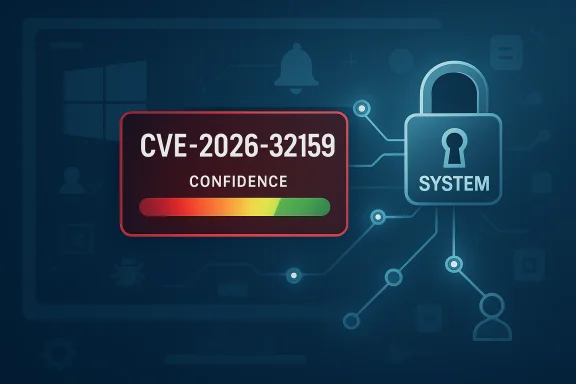
Microsoft’s CVE-2026-32159 entry for the Windows Push Notifications Elevation of Privilege Vulnerability is notable less for the mechanics it reveals than for the confidence signal it sends. The advisory’s metric description makes clear that Microsoft is rating the certainty of the flaw’s existence and the credibility of the technical detail behind it, which matters because a high-confidence local privilege escalation can become a fast-moving enterprise risk. In practical terms, this is the kind of Windows security issue that can turn a low-privilege foothold into a much more serious compromise if attackers can chain it with another entry point. The update-guide page is public, but the product details remain gated behind Microsoft’s JavaScript-based advisory interface, leaving the security community to read between the lines.
Windows push notifications are one of those background services most users never think about, which is exactly why vulnerabilities in this area deserve attention. Services that broker messaging, synchronization, and system integration often run with elevated privileges or interact with privileged components, creating opportunities for local attackers who can influence inputs or race service behavior. Microsoft’s long history of privilege-escalation issues in Windows shows that local EoP bugs are not theoretical edge cases; they are a recurring class of problems that attackers actively pursue because they are reliable, reusable, and highly valuable.
The phrase Elevation of Privilege is doing important work here. It means the attacker is not necessarily coming from the network or the browser; instead, the bug is typically useful after a foothold already exists, whether through phishing, malicious software, or a separate vulnerability. That makes these flaws especially relevant to defenders focused on post-compromise containment, because a local EoP can collapse the security boundary between a standard user and SYSTEM-level control. Microsoft has repeatedly framed such bugs as urgent because they are ideal for moving laterally inside an organization after initial access has been obtained.
The specific naming of Windows Push Notifications suggests attack surface in a client-service layer that may handle data flow, registration state, or inter-process coordination. Even when vendors do not disclose the exact root cause, product-area naming often hints at where defenders should look: privileged services, broker processes, or handlers that assume trustworthy local input. In Microsoft’s own security writing, the company has emphasized that vulnerabilities often arise when privileged components process paths, properties, or requests without fully accounting for attacker influence.
What makes this case especially interesting is the confidence metric itself. Microsoft is explicitly describing the degree of certainty about the vulnerability and the quality of the known technical details, which is a subtle but useful signal for prioritization. A more certain, better-understood flaw can be easier to weaponize, easier to validate in the lab, and easier for defenders to map to exposure. In other words, certainty is a risk multiplier, because it lowers the cost of turning public knowledge into operational abuse.
For enterprises, the concern is not just whether the vulnerability is exploitable in isolation. It is whether it can be paired with common initial-access techniques such as stolen credentials, malicious email attachments, drive-by payloads, or living-off-the-land execution. A push-notification component may sound benign, but the underlying service boundary can still be a powerful escalation point if the attacker can coerce it into performing privileged actions on their behalf. That is why local EoP issues are often treated as post-compromise accelerants rather than standalone threats.
The reason this keeps happening is structural. Windows contains many privileged components that must interact with user sessions, UI frameworks, messaging systems, file paths, and network state. Every one of those interactions can become a trust-boundary problem if a service assumes that a local user-controlled value is safe. Microsoft’s 2025 work on RedirectionGuard is a useful reminder that whole classes of Windows EoP bugs stem from privileged services following attacker-influenced filesystem paths or redirections.
That distinction matters because defenders often triage based on exploit visibility alone. Yet many of the most consequential Windows bugs are patched before widespread exploitation is observed. Microsoft’s own handling of prior EoP cases shows that a solid vendor confirmation can be enough to justify urgent patching, even when the public threat picture is incomplete. The key is that the vendor has a direct line of sight into the vulnerability class, its affected surface, and its remediation path.
The likely priority tiers are straightforward. High-value endpoints, developer workstations, admin jump boxes, and systems with broad software install rights should be first in line for validation. Those systems are the most likely to benefit an attacker using privilege escalation as the next step after initial access. In a managed environment, the real question is not whether to patch, but how fast the organization can do it without breaking operational workflows.
The consumer angle also matters because local EoP often relies on the user already having executed something malicious. That means the best defense is layered: safe downloading habits, SmartScreen, tamper protection, and timely patching. A vulnerability in a background Windows component can be invisible to the user, which is precisely why regular updates remain so important. Out of sight is not out of reach when an attacker is already on the machine.
That said, Windows EoP vulnerabilities frequently fall into a handful of recurring categories: insecure path handling, object spoofing, race conditions, memory corruption, and authorization mistakes. Microsoft’s own blog posts on path redirection and prior EoP incidents show that a surprisingly ordinary design assumption can be enough to create a serious flaw. So even without exact exploit details, defenders should think in terms of trust boundaries, not just component names.
Defense-in-depth still matters even after patching. Restrict local admin rights, enforce application control where feasible, and monitor for suspicious child processes from notification-related services or unusual token escalation patterns. If the vulnerability ends up being path- or object-related, Microsoft’s broader RedirectionGuard guidance shows how useful hardening against unsafe traversal can be as a supplementary control.
Competitively, this matters because enterprise buyers compare operating systems and management stacks partly on how well they handle inevitable flaws. No major platform is immune to privilege escalation bugs, but the quality of disclosure, patch speed, and mitigation guidance can influence perceived maturity. Microsoft’s move toward richer advisory formats and machine-readable security data is part of that trust story, even when the underlying vulnerability is unpleasant.
Another concern is that local EoP bugs are frequently underestimated until they are chained with real intrusion activity. Once an attacker has a foothold, privilege escalation becomes a practical necessity, not an academic possibility. If this vulnerability is reachable from a standard user context, the risk profile for managed Windows fleets rises quickly.
A second thing to watch is whether this CVE joins a broader pattern of service-broker or notification-related hardening in Windows. Microsoft has shown that it is willing to mitigate classes of redirection and trust-boundary issues, not just one-off bugs. If the company follows the same pattern here, the fix may influence adjacent services and not merely the named component.
Microsoft’s CVE-2026-32159 is a reminder that the Windows security story is often written in the unglamorous layers between services, permissions, and background plumbing. Those layers are easy to overlook until they become the shortest path from ordinary user access to full system control. For defenders, the lesson is familiar but enduring: treat confirmed privilege-escalation bugs as strategic risks, patch quickly, and assume that attackers are already studying the same trust boundaries you are.
Source: MSRC Security Update Guide - Microsoft Security Response Center
 Overview
Windows push notifications are one of those background services most users never think about, which is exactly why vulnerabilities in this area deserve attention. Services that broker messaging, synchronization, and system integration often run with elevated privileges or interact with privileged components, creating opportunities for local attackers who can influence inputs or race service behavior. Microsoft’s long history of privilege-escalation issues in Windows shows that local EoP bugs are not theoretical edge cases; they are a recurring class of problems that attackers actively pursue because they are reliable, reusable, and highly valuable.The phrase Elevation of Privilege is doing important work here. It means the attacker is not necessarily coming from the network or the browser; instead, the bug is typically useful after a foothold already exists, whether through phishing, malicious software, or a separate vulnerability. That makes these flaws especially relevant to defenders focused on post-compromise containment, because a local EoP can collapse the security boundary between a standard user and SYSTEM-level control. Microsoft has repeatedly framed such bugs as urgent because they are ideal for moving laterally inside an organization after initial access has been obtained.
The specific naming of Windows Push Notifications suggests attack surface in a client-service layer that may handle data flow, registration state, or inter-process coordination. Even when vendors do not disclose the exact root cause, product-area naming often hints at where defenders should look: privileged services, broker processes, or handlers that assume trustworthy local input. In Microsoft’s own security writing, the company has emphasized that vulnerabilities often arise when privileged components process paths, properties, or requests without fully accounting for attacker influence.
What makes this case especially interesting is the confidence metric itself. Microsoft is explicitly describing the degree of certainty about the vulnerability and the quality of the known technical details, which is a subtle but useful signal for prioritization. A more certain, better-understood flaw can be easier to weaponize, easier to validate in the lab, and easier for defenders to map to exposure. In other words, certainty is a risk multiplier, because it lowers the cost of turning public knowledge into operational abuse.
Why This Matters
Local privilege escalation bugs do not always make the loudest headlines, but they are often the most operationally useful. Once an attacker lands in a standard user context, a successful EoP can unlock credential theft, persistence, tampering, or malware deployment with far fewer constraints than before. That is why Microsoft’s historical guidance on exploitability and deployment priority has consistently treated some EoP issues as high-priority even when they require local access first.For enterprises, the concern is not just whether the vulnerability is exploitable in isolation. It is whether it can be paired with common initial-access techniques such as stolen credentials, malicious email attachments, drive-by payloads, or living-off-the-land execution. A push-notification component may sound benign, but the underlying service boundary can still be a powerful escalation point if the attacker can coerce it into performing privileged actions on their behalf. That is why local EoP issues are often treated as post-compromise accelerants rather than standalone threats.
The confidence metric is a practical clue
Microsoft’s description of the metric focuses on certainty and credibility, which tells defenders something beyond the usual severity label. It implies that the vendor believes the vulnerability is real enough to describe publicly, but the available technical detail may vary from complete root cause to a more limited corroboration. That matters because attackers also read advisories, and a well-defined bug often becomes a target for proof-of-concept development faster than a vague one.- High certainty usually shortens attacker research time.
- Clearer technical detail can improve exploit development.
- Lower certainty may slow weaponization, but not eliminate risk.
- Local EoP often becomes valuable after another compromise.
- Privileged Windows services remain common attack targets.
Historical Context
Windows has a long and well-documented history of local privilege escalation issues. Many of the most infamous cases have involved kernel-mode drivers, privileged service logic, or parsing code that trusted local inputs too much. Microsoft’s older bulletin write-ups repeatedly note that EoP bugs can provide SYSTEM-level access or administrative control, and those write-ups also show how quickly exploitability can become a real-world concern once a flaw is known.The reason this keeps happening is structural. Windows contains many privileged components that must interact with user sessions, UI frameworks, messaging systems, file paths, and network state. Every one of those interactions can become a trust-boundary problem if a service assumes that a local user-controlled value is safe. Microsoft’s 2025 work on RedirectionGuard is a useful reminder that whole classes of Windows EoP bugs stem from privileged services following attacker-influenced filesystem paths or redirections.
Push-notification services fit the pattern
A notification system has to accept events, queue work, synchronize state, and often bridge user and system contexts. That kind of plumbing is exactly where security assumptions can break down, especially if the service supports registration, app identity, path handling, or callback mechanics. The risk is not that notifications are inherently dangerous, but that complexity plus privilege tends to produce sharp edges.- Privileged services can become escalation targets.
- Background brokers often trust local state too much.
- File and object references are common weak points.
- Coordination layers are attractive to attackers.
- Low-visibility components can hide high-impact flaws.
What Microsoft Is Signaling
The most important thing Microsoft is signaling here is not the exploit path, but the confidence level. By using the metric language to describe the existence of the vulnerability and the credibility of the technical detail, the company is telling customers that this is more than a speculative theory. That does not mean public exploit code exists, but it does mean the issue has crossed the threshold from rumor to actionable security concern.That distinction matters because defenders often triage based on exploit visibility alone. Yet many of the most consequential Windows bugs are patched before widespread exploitation is observed. Microsoft’s own handling of prior EoP cases shows that a solid vendor confirmation can be enough to justify urgent patching, even when the public threat picture is incomplete. The key is that the vendor has a direct line of sight into the vulnerability class, its affected surface, and its remediation path.
Why advisory confidence matters more than headlines
Security teams should treat confidence as an operational variable, not a curiosity. A vague advisory can sometimes wait for more detail; a confirmed one should usually be treated as a live exposure. In a Windows estate, that often means prioritizing patch validation for endpoints with user interaction, app layering, and broad software diversity, because those are the systems most likely to encounter a local escalation chain.- Confirmed bugs deserve faster triage.
- Better technical detail helps defenders test exposure.
- Attackers benefit when a bug is easy to reproduce.
- Patch windows shrink when confidence is high.
- Endpoint heterogeneity increases validation burden.
Enterprise Impact
For enterprises, the biggest issue is not simply that a local privilege escalation exists. It is that enterprise environments routinely provide the very conditions an attacker needs to make EoP matter: a user population, a large software footprint, and remote access infrastructure that can be abused as a delivery channel. Once a standard user session is compromised, a Windows EoP can turn a contained incident into a domain-scale response.The likely priority tiers are straightforward. High-value endpoints, developer workstations, admin jump boxes, and systems with broad software install rights should be first in line for validation. Those systems are the most likely to benefit an attacker using privilege escalation as the next step after initial access. In a managed environment, the real question is not whether to patch, but how fast the organization can do it without breaking operational workflows.
Operational considerations for defenders
Patch management for EoP issues is rarely just a binary yes/no decision. It involves testing compatibility, reviewing whether exploit conditions require additional controls, and checking whether endpoint security tooling can detect suspicious exploitation attempts. Microsoft has repeatedly advised customers to use vulnerability guidance and exploitability context to prioritize rollout, especially when the issue can lead to SYSTEM-level access.- Prioritize user-facing Windows endpoints.
- Validate on systems with privileged local software.
- Check for suspicious service-child process behavior.
- Review local admin exposure and lateral movement paths.
- Ensure patch compliance reporting is current.
Consumer Impact
For consumers, the practical message is simpler: keep Windows updated and let Microsoft’s security cadence do the heavy lifting. Most home users are not going to manually investigate exploit chains or privilege boundaries, but they are still exposed to the downstream consequences of a successful local escalation. If malware lands on a system through a browser, document, or fake installer, an EoP like CVE-2026-32159 can be the difference between a nuisance and a full system compromise.The consumer angle also matters because local EoP often relies on the user already having executed something malicious. That means the best defense is layered: safe downloading habits, SmartScreen, tamper protection, and timely patching. A vulnerability in a background Windows component can be invisible to the user, which is precisely why regular updates remain so important. Out of sight is not out of reach when an attacker is already on the machine.
What consumers should assume
Home users should assume that Windows Update matters even if the flaw sounds technical or obscure. They should also assume that account separation still has value, because EoP bugs become much more damaging when the daily-use account is the same one used for installations and system changes. That is particularly important in families or small offices where one device may serve multiple roles.- Install security updates promptly.
- Avoid running daily tasks as an administrator.
- Treat unexpected downloads as hostile.
- Keep endpoint protection enabled.
- Reboot when updates require it.
Technical Interpretation
Because Microsoft has not publicly disclosed the detailed root cause in the accessible advisory view, the safest reading is that this is a Windows component flaw that likely affects a privileged service boundary. The naming points toward a subsystem that may manage notification state or inter-process communication, both of which can be sensitive if user-controlled input reaches privileged code. At this stage, any deeper explanation would be inference, not confirmed fact.That said, Windows EoP vulnerabilities frequently fall into a handful of recurring categories: insecure path handling, object spoofing, race conditions, memory corruption, and authorization mistakes. Microsoft’s own blog posts on path redirection and prior EoP incidents show that a surprisingly ordinary design assumption can be enough to create a serious flaw. So even without exact exploit details, defenders should think in terms of trust boundaries, not just component names.
Likely defender hypotheses
Security engineers reviewing this issue will probably ask whether the vulnerable component can be triggered by a standard user, whether it runs in a system context, and whether it trusts paths, handles, or callbacks originating from less privileged code. They will also want to know whether exploitation requires timing, whether it is reliable across builds, and whether sandbox or app-container restrictions matter. Those are the questions that separate a theoretical bug from a real-world escalation path.- Does the flaw require a user session?
- Is a privileged service involved?
- Can the attacker control paths or object names?
- Is code execution possible or only token manipulation?
- Are mitigations already present in newer builds?
Patch and Mitigation Strategy
The immediate response for organizations should be standard but disciplined: inventory affected Windows versions, confirm patch availability through Microsoft’s update guidance, and stage deployment based on business criticality. If the advisory later adds exploitability, known exploitation, or updated product scope, the priority may need to rise further. For now, the conservative assumption is that this is a meaningful local escalation issue that belongs near the top of the patch queue.Defense-in-depth still matters even after patching. Restrict local admin rights, enforce application control where feasible, and monitor for suspicious child processes from notification-related services or unusual token escalation patterns. If the vulnerability ends up being path- or object-related, Microsoft’s broader RedirectionGuard guidance shows how useful hardening against unsafe traversal can be as a supplementary control.
Practical response sequence
A sensible response sequence for administrators is to verify scope, test updates, deploy in phases, and then validate that the patch is present across the fleet. If the environment uses privileged automation, remote management tools, or local scripting with elevated rights, those should receive extra scrutiny. The goal is to avoid the common trap where an EoP is patched on paper but remains exploitable on the endpoints that matter most.- Confirm impacted Windows versions and servicing channels.
- Test the update on representative machines.
- Roll out to high-risk endpoints first.
- Recheck compliance after reboot cycles.
- Monitor for unusual privilege escalation activity.
Broader Market and Competitive Implications
Windows security issues like this one inevitably shape the broader platform conversation. Microsoft competes not just on features, but on trust, and each serious EoP advisory reinforces the idea that platform hardening is an ongoing arms race rather than a solved problem. At the same time, Microsoft’s transparency around CVEs, update guidance, and remediation artifacts has improved the ecosystem’s ability to respond quickly when these issues surface.Competitively, this matters because enterprise buyers compare operating systems and management stacks partly on how well they handle inevitable flaws. No major platform is immune to privilege escalation bugs, but the quality of disclosure, patch speed, and mitigation guidance can influence perceived maturity. Microsoft’s move toward richer advisory formats and machine-readable security data is part of that trust story, even when the underlying vulnerability is unpleasant.
The security messaging layer
How Microsoft communicates a vulnerability can be as important as the vulnerability itself. Clear advisories reduce panic, help defenders prioritize, and discourage rumor-driven overreaction. Ambiguous advisories, by contrast, can lead to either complacency or unnecessary disruption, both of which are bad outcomes in enterprise environments.- Better advisories shorten mean time to remediation.
- Machine-readable data helps at scale.
- Confidence signals support faster triage.
- Transparency builds trust with customers.
- Clear guidance reduces operational friction.
Strengths and Opportunities
The strongest aspect of Microsoft’s handling here is that the company is surfacing the issue through a formal vulnerability channel rather than letting it remain an obscure internal bug. That helps defenders triage, helps researchers reason about the class of flaw, and helps the ecosystem align on a response. It also gives organizations a concrete artifact to track in patch governance, which is more useful than vague “Windows issue” language.- Formal CVE tracking enables patch governance.
- Confidence metrics improve prioritization.
- Enterprises can map the issue to endpoint risk.
- Microsoft can refine guidance as details emerge.
- Security teams gain a concrete remediation target.
- Broader transparency supports ecosystem coordination.
- The issue may motivate harder Windows service boundaries.
Risks and Concerns
The biggest concern is that the advisory’s public-facing technical detail is limited, which makes it harder for administrators to understand exploit conditions precisely. That can create a dangerous gap between confirmation and comprehension: people know the issue exists, but not exactly how it is triggered. Attackers often thrive in that gap because they can experiment faster than defenders can model the impact.Another concern is that local EoP bugs are frequently underestimated until they are chained with real intrusion activity. Once an attacker has a foothold, privilege escalation becomes a practical necessity, not an academic possibility. If this vulnerability is reachable from a standard user context, the risk profile for managed Windows fleets rises quickly.
- Limited public detail slows precise exposure analysis.
- Local EoP can become a post-breach multiplier.
- Privileged services expand the attack surface.
- Attackers may chain this with other Windows bugs.
- Enterprise patch windows can be slow in practice.
- Users may not notice anything until it is too late.
- Similar bugs may exist elsewhere in the same subsystem.
Looking Ahead
The next meaningful signal will be whether Microsoft updates the advisory with additional technical detail, affected build information, or exploitability guidance. If that happens, organizations should reassess urgency immediately rather than waiting for the next Patch Tuesday cycle to do the talking. The same is true if third-party researchers publish analysis that clarifies the root cause or demonstrates a reliable exploit path.A second thing to watch is whether this CVE joins a broader pattern of service-broker or notification-related hardening in Windows. Microsoft has shown that it is willing to mitigate classes of redirection and trust-boundary issues, not just one-off bugs. If the company follows the same pattern here, the fix may influence adjacent services and not merely the named component.
Practical watch items
- Advisory updates with build and exploitability detail.
- Evidence of public proof-of-concept development.
- Enterprise patch-compliance reports after rollout.
- Any related hardening announcements from Microsoft.
- Research on nearby Windows service boundaries.
Microsoft’s CVE-2026-32159 is a reminder that the Windows security story is often written in the unglamorous layers between services, permissions, and background plumbing. Those layers are easy to overlook until they become the shortest path from ordinary user access to full system control. For defenders, the lesson is familiar but enduring: treat confirmed privilege-escalation bugs as strategic risks, patch quickly, and assume that attackers are already studying the same trust boundaries you are.
Source: MSRC Security Update Guide - Microsoft Security Response Center
Last edited:
