

 Overview
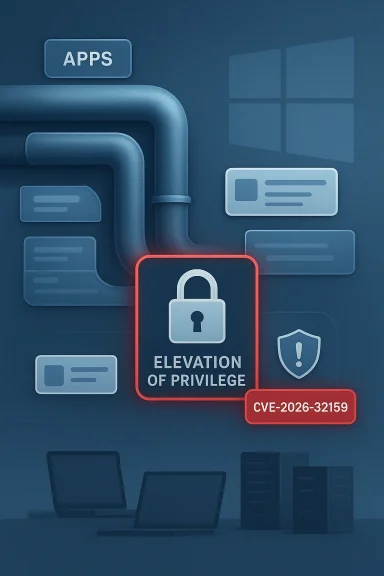
Microsoft’s CVE-2026-32159 is labeled a Windows Push Notifications Elevation of Privilege Vulnerability, and that alone tells security teams a great deal. It places the issue in the class of bugs that can let an attacker move from a lower-privilege context to something more powerful on a Windows system, which is often where real-world compromise becomes operationally useful. Microsoft’s Security Update Guide also defines this metric as a measure of confidence in both the vulnerability’s existence and the credibility of the technical details, which means the public signal here is not just about severity but about how much security researchers and defenders can trust what is known.At the same time, the public page for the CVE is not currently exposing rich technical detail in the search results, which is itself informative. When Microsoft names a vulnerability in the Security Update Guide and ties it to a platform component like Windows Push Notifications, defenders should assume the issue is meaningful even if the exploit chain is not yet laid out in public. In practice, that often means organizations need to treat the disclosure as a cue to inventory affected systems, watch for patch availability, and review any products or services that depend on the Windows notification stack.
The bigger story is that Windows push notifications sit inside a widely used platform service with both consumer and enterprise relevance. They support modern app workflows, Store apps, and Windows App SDK scenarios, and Microsoft documents that the platform can be used to send toast, tile, badge, and raw notifications through the Windows Push Notification Services architecture. That makes a security issue in this area noteworthy not just because of the CVE label, but because it touches a shared subsystem that many apps and environments rely on every day.
Background
Windows push notifications are part of a mature Windows service stack designed to let applications receive cloud-delivered updates efficiently. Microsoft’s documentation explains that a third-party app first requests a notification channel from WNS, receives a URI, and then passes that URI to its own cloud service, which later uses the channel to send a notification back through WNS. In other words, the system is a brokered service with authentication, routing, and per-app identity controls, rather than a simple message pipe.That architecture is powerful, but it also creates a large attack surface. A notification subsystem must process identities, channels, payloads, permissions, transport details, and interactions with local app processes. If a flaw exists anywhere in that chain, an attacker may be able to abuse trust boundaries between a low-privilege context and a privileged Windows component. That is why elevation-of-privilege bugs in system services remain a persistent concern in Windows security, even when the affected feature seems routine or user-facing.
Microsoft has also been steadily modernizing how it communicates vulnerability data. The company says the Security Update Guide now supports more transparent CVE publication and machine-readable CSAF data, alongside the historical CVRF feed. That matters here because it reflects Microsoft’s broader shift toward earlier and clearer disclosure channels, even when the full exploit story is still forming. For defenders, less mystery at the platform level usually means better patch planning, but it also means there may be a window where the CVE title is public before the technical explanation is fully mature.
The Windows notification subsystem is also central to the newer Windows App SDK experience. Microsoft notes that push notifications in the Windows App SDK use WNS and that elevated or self-contained apps may not support the feature in some scenarios. That detail may seem peripheral, but it reinforces an important security reality: this is not a niche legacy component. It is part of the modern Windows application ecosystem and therefore relevant to both consumer desktops and managed enterprise endpoints.
Why elevation of privilege matters here
An EoP bug is often more actionable than an information leak because it can convert an initial foothold into deeper control. That can mean the difference between a blocked intrusion and a full host compromise. If the vulnerable code lives in a notification broker or related component, the attacker may not need to invent a whole new delivery mechanism; they may only need a way to reach the vulnerable path from an app, service, or local user context.- Privilege boundaries are the key security issue.
- Shared platform services amplify impact across many applications.
- Local footholds are often enough to make EoP bugs dangerous.
- Patch latency matters because these issues can be chained quickly.
- The absence of public exploit details does not imply low risk.
What Microsoft’s labeling tells us
Microsoft’s naming convention is not accidental. The combination of a Windows feature name, an EoP classification, and a CVE identifier signals that the affected code is likely in a security-sensitive path and that Microsoft believes the issue is real enough to publish. The Security Update Guide’s own explanation of confidence underscores that this metric is meant to convey the certainty of the vulnerability’s existence as well as the quality of the technical understanding behind it.In practical terms, this means administrators should not treat the absence of a published exploit write-up as reassurance. Microsoft frequently ships advisories before researchers have published reverse-engineering details, proof-of-concept code, or exploit chaining guidance. Historically, that has been one of the most important patterns in Windows security: public vulnerability name first, full attacker tradecraft later.
Confidence and disclosure maturity
The confidence metric is useful because it helps separate two different kinds of uncertainty. One is whether the vulnerability really exists; the other is how complete the technical description is. Microsoft’s wording indicates that the CVE may be published with partial technical knowledge, and that the advisory is still intended to guide remediation even before every detail is public.That nuance matters for defenders who run large fleets. A CVE with high confidence but limited detail is still a patch priority, because the operational risk can be substantial even when the exploit path is not yet public. Conversely, a vague advisory with low confidence may warrant monitoring rather than emergency response. CVE-2026-32159 appears to sit closer to the first category.
- High-confidence advisories should be treated as actionable.
- Low-detail publication is common early in the disclosure cycle.
- Security teams should plan for the technical story to evolve.
- Do not wait for exploit code before starting mitigation work.
The Windows Push Notifications attack surface
Push notifications are easy to underestimate because they are usually associated with convenience features and user engagement. In reality, they are part of a larger orchestration layer involving app registration, channel creation, authentication, and payload delivery. Microsoft’s WNS overview shows that the service supports toast, tile, badge, and raw updates, with a structured workflow that begins when an app requests a channel from WNS and ends when notifications are routed back to the device.That chain creates multiple places where validation, state management, or privilege handling can go wrong. An EoP in this area might stem from how a local component processes notification metadata, how it handles a client app’s request, or how it transitions between user and system contexts. Even without source code, the architecture tells us the subsystem is exposed enough to deserve careful scrutiny.
How the service is used in the real world
Microsoft’s documentation for the Windows App SDK shows that push notifications are part of mainstream Windows development, not some rare enterprise-only extension. The SDK expects developers to register apps, request channels, and integrate the resulting push flow into desktop experiences. Microsoft also notes support limitations for elevated apps, which is a subtle reminder that privilege boundaries and notification delivery do not always mix cleanly.That matters because features used by many apps create a larger blast radius when vulnerabilities appear. If a flaw exists in a core notification path, then multiple classes of software may depend on it without being directly at fault. In security terms, that is exactly the kind of shared dependency that turns a single bug into a platform-wide issue.
- WNS is a brokered service, not a simple endpoint.
- App identity and channel handling are core to the design.
- Payload processing can create complex trust decisions.
- Modern Windows apps depend on the system in multiple ways.
- Shared dependencies increase the potential impact of a flaw.
Enterprise impact
For enterprises, the key question is not just whether the vulnerability can be exploited, but how readily it can be chained with an initial access vector. EoP flaws are often most useful after phishing, malicious software execution, or credential compromise, because they help attackers move from user-level access to broader system control. That makes enterprise patching discipline especially important, since a workstation foothold can become a launchpad for lateral movement.Windows push notification components are also likely to be present on a wide range of corporate endpoints, including desktops used for collaboration, productivity, and line-of-business applications. Even if the actual vulnerable code path is narrow, the feature’s ubiquity means security teams may need to assume exposure across standard Windows images. In managed environments, that turns CVE-2026-32159 into a fleet-management issue as much as a vulnerability issue.
Why defenders should care
- User workstations are common footholds for adversaries.
- Privilege escalation can break containment assumptions.
- Shared Windows components are hard to isolate surgically.
- Patch windows are critical in mixed-home-and-corp device fleets.
- Compensating controls matter when immediate patching is not possible.
Consumer impact
For consumers, the issue is likely to look less dramatic on the surface, but it should still be taken seriously. Most users experience Windows push notifications as harmless app alerts, calendar reminders, or live updates from the store and modern apps. Yet consumer endpoints are exactly where lower-friction attacker footholds often begin, especially when users run untrusted software or open malicious attachments.The practical difference is that consumers are less likely to notice a privilege-escalation bug until it is already being used against them. A notification-related flaw may not trigger the kind of visible disruption that forces immediate attention, which can give attackers room to maneuver. That is why automatic updates and rapid reboot behavior remain crucial on home systems.
The home-user angle
Home users generally rely on Windows Update and Microsoft Store integration to keep notification-related components current. That simplifies remediation, but it also means there is little manual visibility into which specific subsystem was updated. Users should therefore treat any critical or important Windows security update as necessary maintenance rather than as an optional quality-of-life fix.In security terms, the consumer path is often about reducing opportunity. Keep devices updated, avoid risky software, and minimize the number of accounts with local administrative rights. Those measures will not fix the vulnerability itself, but they can make exploitation harder to turn into persistent system-wide control.
- Automatic updates are the best first line of defense.
- Local admin misuse increases the value of an EoP bug.
- Untrusted software remains a common foothold.
- Routine alerts can mask security relevance.
- Simple hygiene still matters because it reduces chaining opportunities.
Why the technical detail matters even when it is sparse
The current public picture is incomplete, and that is normal early in the advisory cycle. Microsoft’s update guide often names the feature and the vulnerability class before the broader technical community publishes exploitation analysis. What matters is that the label already places the issue within a security-sensitive Windows subsystem that is used at scale.Security analysts should think of sparse technical detail as a temporary condition, not a reason to downgrade urgency. Once a CVE is public, researchers, red teams, and attackers all begin their own independent work. That means the gap between “named” and “explained” can be short, and it is often during that gap that patch adoption matters most.
What to infer, and what not to infer
It is reasonable to infer that Microsoft believes the vulnerability is real and relevant enough to publish under a Windows subsystem name. It is not reasonable to assume, without additional evidence, that the bug is remotely exploitable, wormable, or already in active exploitation. The right posture is measured urgency: act as though the issue matters, but do not overstate what is publicly proven.That balance is especially important for security operations teams that must prioritize hundreds of advisories each month. Strong patch candidates are often those that combine a trusted vendor publication, an EoP classification, and a component that is deployed broadly across endpoints. CVE-2026-32159 fits that profile even though its public technical footprint is currently thin.
- Do not equate sparse detail with low risk.
- Do not assume remote exploitability without evidence.
- Do assume the issue is real enough to plan around.
- Treat patching as proactive insurance.
- Monitor for follow-up advisories and technical write-ups.
Competitive and ecosystem implications
Microsoft’s notification stack is not just a Windows feature; it is part of the wider app ecosystem strategy around modern desktop experiences. The more central a platform service becomes, the more any security weakness in that service can affect the perceived reliability of the broader platform. In that sense, CVE-2026-32159 is also a reputation issue, because users and developers expect core notification plumbing to be safe by default.Vendors competing for enterprise desktops and developer mindshare will read this kind of disclosure carefully. Stability, update speed, and security transparency all influence whether organizations feel comfortable building on a platform. Microsoft’s expanded vulnerability disclosure practices, including CSAF publication, suggest the company knows that visibility itself is part of the product experience.
Broader platform effects
A vulnerability in a shared Windows service can have indirect effects beyond patching. It can push developers to re-evaluate how they use the service, encourage security teams to tighten privilege boundaries, and prompt IT departments to audit admin-rights practices. That is a healthy reaction, but it also shows how one CVE can influence design choices across the ecosystem.For rivals and alternative platforms, the lesson is familiar: security in shared system services is a product differentiator. Vendors that can demonstrate tighter compartmentalization, faster patching, or more transparent advisories may gain trust from enterprises that have been burned by platform-wide issues. Trust is cumulative, and recurring EoP bugs in core services tend to raise the bar for everyone.
- Platform trust is affected by shared-service vulnerabilities.
- Developer confidence depends on secure system APIs.
- Enterprise buyers watch update quality as closely as features.
- Disclosure transparency can soften reputational damage.
- Competitive pressure pushes security as a differentiator.
Strengths and Opportunities
The good news is that Microsoft’s modern disclosure and update infrastructure gives defenders a path to act quickly once fixes are available. The Security Update Guide, the newer CSAF channel, and the company’s ongoing documentation of Windows notification behavior make it easier for security teams to understand what the feature is supposed to do, even if the exploit mechanics are not yet public. That combination is helpful because good remediation depends on both patch availability and clear feature context.At a strategic level, incidents like CVE-2026-32159 also create an opportunity to harden adjacent controls. Organizations can use the event to revisit local admin practices, endpoint telemetry, update compliance, and application allow-listing. If the vulnerability turns out to be chainable with existing malware families or phishing activity, those controls will pay dividends well beyond this one CVE.
- Faster patch planning thanks to Microsoft’s update channels.
- Better documentation around the Windows notification stack.
- Opportunity to review admin rights on endpoints.
- Chance to test update compliance across the fleet.
- Improved detection posture for privilege-escalation activity.
- Security awareness can be refreshed using a concrete example.
- One CVE can justify broader hardening if used wisely.
Risks and Concerns
The main concern is that an EoP bug in a shared Windows service can be chained with very ordinary attacker behavior. If a user runs untrusted code, opens a malicious file, or executes a payload already delivered by another weakness, local privilege escalation may become the final step in a compromise. That makes the operational downside larger than the technical label alone might suggest.A second concern is visibility. Notification services are not usually the first component defenders think to monitor, so abuse may blend into normal app behavior. When a subsystem is designed to facilitate seamless user experiences, attackers often benefit from that same seamlessness unless logging, detection, and patching are already strong.
Key risk factors
- Chaining with initial access is the most likely abuse pattern.
- Wide deployment increases exposure across fleets.
- Low user awareness can delay response on consumer devices.
- Indirect dependencies make inventory difficult.
- Sparse public detail can slow third-party analysis.
- Delayed patching extends the attacker opportunity window.
Looking Ahead
The next meaningful milestone will be the appearance of full advisory data, including affected versions, severity scoring, and mitigation guidance in the Security Update Guide. Once that information is visible, defenders can move from broad concern to targeted response. That will also help determine whether the vulnerability is broadly exploitable, limited to certain workflows, or tied to a narrow implementation detail.Security researchers will likely focus on how the Windows notification subsystem enforces boundaries between applications and system services. If the bug ultimately sits in input validation, handle management, or privilege transition logic, there may be implications for other parts of the platform that use similar patterns. That is often how one bug becomes a lesson about a whole class of bugs.
What to watch
- Microsoft’s full advisory entry for affected products and severity.
- Patch release timing and whether it lands in a regular cumulative update.
- Any proof-of-concept analysis from security researchers.
- Signs of chaining with existing malware or post-exploitation tooling.
- Enterprise detection guidance for suspicious privilege escalation.
- Clarifications from Microsoft if the technical picture changes.
Windows security is increasingly shaped by shared services that ordinary users never think about until something breaks. CVE-2026-32159 is another reminder that the most important vulnerabilities are often not the loudest ones, but the ones buried in foundational plumbing that every app assumes will just work. For defenders, the answer is to stay current, patch quickly, and treat platform trust as a living asset rather than a permanent guarantee.
Source: MSRC Security Update Guide - Microsoft Security Response Center
Last edited:
