

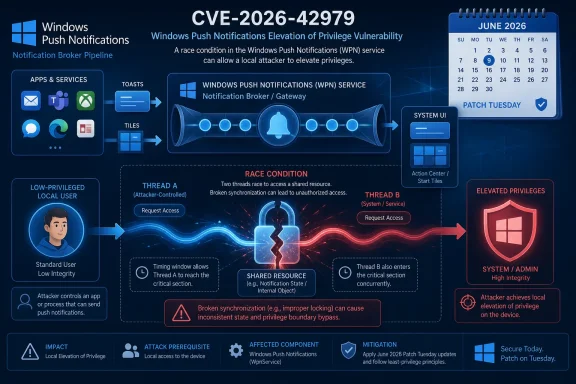
Microsoft Confirms the Bug, but Not the Exploit Playbook
CVE-2026-42979 is not one of those vague “security hardening” entries that leaves administrators guessing whether there is a real vulnerability underneath. The vulnerability has a CVE, a Microsoft advisory, a severity rating, a CVSS vector, affected Windows product families, and a described weakness class. In vulnerability-management terms, that puts its existence on firm ground.
The public details, however, stop short of a working exploit narrative. The advisory and mirrored vulnerability databases describe concurrent execution using a shared resource with improper synchronization, better known as a race condition. Some sources also associate the issue with use-after-free behavior, which is often what defenders expect when timing, object lifetime, and privilege boundaries collide inside a complex Windows service.
That distinction matters. A confirmed vulnerability is not the same thing as a public exploit. For defenders, the former is enough to patch; for attackers, the latter determines how quickly the bug becomes copy-paste tradecraft. CVE-2026-42979 currently sits in the uncomfortable middle: real enough to demand action, underdescribed enough that most organizations will be managing risk rather than responding to known exploitation.
The user-supplied definition of report confidence gets at exactly this point. Confidence is not merely whether Microsoft says “yes, a bug exists.” It is also how much of the technical path is known, who has corroborated it, and whether enough implementation detail exists for attackers to reproduce the issue without doing their own reverse engineering.
A Notification Service Is Still a Privilege Boundary
Windows Push Notifications does not sound like the kind of subsystem that should keep security teams awake. Notifications are the machinery behind toast alerts, tiles, badges, and raw app messages. They are supposed to make apps less noisy and more power-efficient by letting cloud services signal Windows when something needs attention.
But the bland name hides an important architectural fact: push notifications are brokered. Apps request channels, Windows talks to Microsoft’s notification infrastructure, cloud services authenticate and send payloads, and the operating system routes messages back to the right app identity. That makes the local Windows side of the notification stack part of a trust-negotiation system, not just a cosmetic user-interface feature.
Whenever Windows brokers anything on behalf of low-privileged apps, identity and privilege become part of the design. The OS must know which app owns a channel, which process may receive a payload, what can wake in the background, and how state is persisted across user sessions, network changes, battery policies, and app lifecycle events. That is exactly the kind of plumbing where concurrency bugs become security bugs.
A race condition is not inherently catastrophic. Many race conditions are merely reliability problems. But when the race occurs in code that maps app identity, notification state, object references, or permissions, the winning or losing thread can matter. A stale pointer, a confused object, or a check performed at the wrong moment can transform a timing bug into a privilege escalation.
That is why “Windows Push Notifications” should not be dismissed as a low-value target. Attackers love local elevation-of-privilege flaws precisely because they turn an initial foothold into control. A phishing payload, malicious document, browser escape, or stolen low-privilege account becomes much more dangerous when paired with a reliable local privilege escalation.
The CVSS Vector Tells a More Nuanced Story Than the Score
The headline score for CVE-2026-42979 is 7.8, rated high under CVSS 3.1. That number is familiar to anyone who tracks Windows local privilege escalation bugs; many of them cluster around the same severity because they require local access but can produce high impact once exploited. The score is serious, but it is not the most interesting part.
The vector is more revealing. CVE-2026-42979 is local, requires low privileges, needs no user interaction, has high attack complexity, changes scope, and carries high confidentiality, integrity, and availability impact. In plain English, an attacker already on the system with some level of account access may be able to jump to a more privileged context, but the path is not considered straightforward.
High attack complexity is the tempering factor. Race conditions can be fickle. They may depend on timing windows, scheduler behavior, machine load, process state, or the ability to trigger repeated operations until the vulnerable interleaving occurs. In a lab, an exploit may be reliable after careful tuning; in the field, reliability can vary dramatically across hardware, Windows builds, and security tooling.
That said, administrators should not over-read “high complexity” as “low urgency.” Local privilege escalation bugs often begin life as delicate proof-of-concept code and later mature into stable primitives. Once researchers or criminal groups reverse the patch, discover the vulnerable code path, and refine the timing, yesterday’s unreliable race can become tomorrow’s commodity exploit.
The “scope changed” element is also worth attention. In CVSS terms, it suggests that exploitation crosses a security authority boundary. That is consistent with the concern that a low-privileged actor could influence a component operating with different privileges or trust assumptions. For enterprise defenders, that is the part that turns this from “a local bug” into “a post-compromise accelerator.”
The Report Confidence Signal Is Stronger Than the Public Detail
The report-confidence metric described in the prompt is easy to misunderstand. It is not a popularity contest and not a count of blog posts. It asks whether the vulnerability’s existence and technical contours are credible.
For CVE-2026-42979, confidence in the existence of the vulnerability is high because Microsoft has acknowledged it through the Security Update Guide. The vendor of the affected technology is the strongest possible source for existence. The CVE record is published, the affected product families are identified, and the weakness class is named.
Confidence in the technical details is more limited. We know the flaw involves concurrent execution using a shared resource with improper synchronization. We know the affected component is Windows Push Notifications. We know the attack is local, requires low privileges, and is not described as remotely exploitable. We do not know the vulnerable API, service binary, object type, exploit trigger, post-exploitation privilege level, or whether practical exploitation has been observed.
That means the confidence profile is split. The vulnerability is real; the exploit mechanics remain opaque. This is typical for many Patch Tuesday entries, especially local elevation flaws where Microsoft gives enough information for risk scoring but not enough to hand attackers a recipe.
The practical outcome is simple: defenders should treat the advisory as authoritative for patching, but should resist inventing a more detailed story than the public facts support. There is no need to speculate that every notification toast is dangerous, that cloud push messages can remotely compromise machines, or that disabling notifications is a substitute for patching. The confirmed issue is local elevation of privilege in the Windows Push Notifications component.
Patch Tuesday Volume Makes This Bug Easier to Miss
CVE-2026-42979 landed inside an unusually heavy June 2026 patch cycle. Microsoft’s June release was widely reported as exceeding 200 Microsoft CVEs, with dozens rated critical and at least one vulnerability listed as exploited in the wild. In that kind of release, a high-severity local privilege escalation in Push Notifications can disappear behind louder remote-code-execution bugs.
That is not irrational. Wormable or unauthenticated remote-code-execution vulnerabilities should usually outrank local elevation flaws in first-day triage. If a Windows Kernel TCP/IP bug or HTTP.sys issue offers network-based SYSTEM execution, it gets the emergency meeting. A local race condition in a notification subsystem does not deserve the same initial panic.
But patch triage is not only about the first system attackers compromise. It is also about what happens next. Local elevation-of-privilege flaws are chain components. They are the second stage that turns a single low-privilege process into persistence, credential theft, security-tool tampering, lateral movement, and domain escalation.
That is why CVE-2026-42979 belongs in the early deployment wave for managed Windows fleets once the truly internet-facing criticals are under control. It is not the biggest fire in the June 2026 pile. It is the kindling attackers look for after the first door opens.
Windows 10’s Long Goodbye Raises the Stakes
The affected product list matters because Windows 10 remains a major installed base even as mainstream consumer support approaches its end. Organizations still carrying Windows 10 endpoints now have to think about CVE-2026-42979 in the context of a shrinking runway for standard servicing. For home users, small businesses, and lagging enterprises, the old “we’ll patch later” reflex is becoming more expensive.
Windows 11 is also affected, as are supported server versions including Windows Server 2019, Windows Server 2022, and Windows Server 2025. That breadth suggests the vulnerable code path is not a niche legacy corner. It is part of a notification platform shared across modern Windows releases.
Servers may seem less exposed because they are less likely to run consumer-style apps or rely on interactive notifications. That assumption should be handled carefully. Windows components often exist and run even when administrators do not think of a server as “using” a feature. The attack requirement is local access, so the relevant question is not whether a server pops toast notifications, but whether the vulnerable component is present and reachable in a way Microsoft considered affected.
For enterprises, the safest framing is boring but correct: inventory affected OS versions, deploy the cumulative updates, and verify installation. Feature avoidance is not mitigation unless Microsoft explicitly says so. In this case, patching is the control that matters.
Race Conditions Reward Reverse Engineers
Race-condition vulnerabilities have a particular lifecycle. At disclosure, they often look abstract. The advisory says shared resource, improper synchronization, local attacker, high complexity. Then the patch arrives, researchers diff binaries, identify changed locks or reference-counting behavior, and start building triggers around the updated code.
That process is not instant, but it is predictable. Windows local privilege escalation bugs are among the most studied classes of vulnerabilities because they are valuable to both offensive researchers and criminal operators. A reliable LPE can be reused across many campaigns, especially when organizations are slow to apply cumulative updates.
The “high complexity” label can also shrink over time. Attackers do not need a mathematically elegant exploit; they need one that works often enough. If a race can be attempted thousands of times quickly, or if the target service can be coerced into a favorable state, reliability improves. If the exploit only needs to run after malware already has user-level code execution, noisy retries may be acceptable.
Security teams should assume that patch-diffing interest will increase because this bug sits in a platform component rather than an obscure third-party app. Even without public exploit code today, the combination of confirmed vendor patch, high impact, and local privilege escalation makes it worth watching.
Disabling Notifications Is a Tempting but Weak Answer
When a vulnerability lands in a named Windows feature, administrators naturally ask whether turning the feature off can buy time. With CVE-2026-42979, that question is understandable but dangerous. Windows Push Notifications is not just a Settings toggle for user-visible popups. It is part of a platform service model used by apps and Windows components.
There may be policy choices that reduce notification behavior in some environments. Organizations can restrict background apps, harden app installation, limit Store apps, and apply standard endpoint controls. Those are good hygiene steps. They are not equivalent to applying Microsoft’s security update.
The problem is that vulnerability advisories are scoped to code, not to user perception. A user may see no notifications at all while the affected component remains installed, callable, or running under specific conditions. Conversely, breaking notification infrastructure can create operational side effects without removing the vulnerable path.
The stronger mitigation story is conventional Windows defense. Patch promptly, limit local account privileges, reduce untrusted code execution, enforce application control where feasible, monitor privilege escalation behavior, and treat endpoint compromise as a chain rather than a single event. CVE-2026-42979 is a reminder that least privilege still matters, because the bug starts from a low-privileged attacker.
The Real Risk Is the Second Stage
Most organizations are better at thinking about initial access than privilege escalation. They know to watch VPN appliances, mail gateways, exposed RDP, browser exploits, and phishing attachments. But once an attacker lands with ordinary user rights, the quality of local privilege boundaries determines whether the compromise remains contained.
That is where CVE-2026-42979 fits. It is not advertised as remote. It is not described as unauthenticated. It does not let an internet attacker simply send a push notification and own a Windows fleet. Its value is more subtle: it may help an attacker who is already inside cross from user context into a more powerful one.
That is often the decisive move. Administrative privileges allow dumping credentials, disabling protections, installing kernel drivers if other controls fail, tampering with logs, and staging lateral movement tools. Even when endpoint detection catches the first payload, privilege escalation can determine whether the attacker is boxed in or able to fight the defender on equal footing.
For security-minded Windows users, the lesson is not paranoia about every subsystem. It is humility about the attack surface of modern operating systems. Features built for battery life, app responsiveness, and user convenience still run inside a security model. When that model has a race, it can become part of an intrusion chain.
Enterprise IT Should Prioritize by Chains, Not Names
Patch teams should resist prioritizing CVE-2026-42979 based on whether “Push Notifications” sounds important. Component names are often misleading. A vulnerability in a print subsystem, font parser, thumbnail handler, cloud files driver, or notification service can matter because of where the code runs, not because of how glamorous the feature is.
The better question is where this bug fits into plausible attack chains. On a managed endpoint, a low-privileged attacker might arrive through phishing, malicious scripting, a browser exploit, a trojanized installer, or stolen credentials. If the attacker can then use CVE-2026-42979 to raise privileges, the organization’s blast radius changes.
That argues for deploying the June cumulative updates on endpoints with normal urgency and on high-risk systems sooner. Developer workstations, help-desk machines, administrator jump boxes, shared desktops, kiosk-adjacent systems, and VDI images deserve special attention. They combine user activity, broad software exposure, and credentials worth stealing.
Servers should not be ignored. A local privilege escalation on a server is useful after compromise through a web app, misconfigured service, leaked credential, or remote management channel. Even if a server has no obvious notification use, the affected Windows Server versions should be patched according to the same vulnerability-management discipline applied to other platform bugs.
Detection Will Be Indirect Until the Technique Is Known
One frustration with advisories like CVE-2026-42979 is that defenders want indicators, but the public record does not provide them. There is no documented exploit command line, malicious file name, registry artifact, event ID, or vulnerable API trigger. That limits what security teams can hunt for specifically.
The best detections will therefore be behavioral. Watch for low-privileged processes spawning elevated children unexpectedly. Watch for service abuse, token manipulation, unusual access to notification-related components, repeated crashing or restarting of Windows notification services, and privilege changes that follow suspicious user-context execution. These are imperfect signals, but they fit the class.
EDR vendors may add more specific detections as they reverse patches and observe exploit attempts. Until then, administrators should avoid writing brittle rules based on guesswork. A bad detection that assumes the wrong service name or path can create false confidence while missing the actual exploitation path.
Logging strategy should follow the broader post-exploitation model. If an endpoint shows suspicious initial access followed by sudden elevation, credential access, security-tool tampering, or lateral movement, treat CVE-2026-42979 as one possible mechanism among several. The absence of a named exploit indicator does not prove the bug was not used.
Microsoft’s Sparse Advisories Put More Weight on Patch Discipline
Microsoft’s modern Security Update Guide is efficient, but it often leaves practitioners wanting more. CVE-2026-42979 is a classic example. The advisory tells us the component, class, severity, attack vector, and affected products. It does not tell us the affected binary, vulnerable code path, exploitation preconditions beyond CVSS, or operational mitigations short of updating.
There are good reasons for restraint. Publishing too much detail can help attackers. Microsoft also has to communicate across hundreds of CVEs in a single monthly release. But sparse disclosure shifts work onto defenders, who must decide priority without knowing whether the bug is a curiosity or a near-future exploit staple.
That is where report confidence becomes useful. It lets teams separate uncertainty about existence from uncertainty about exploitation mechanics. CVE-2026-42979 is not rumor. It is a vendor-confirmed, patched vulnerability. The uncertainty is in exploit maturity and operational prevalence.
For a Windows administrator, that should be enough. The patch exists because Microsoft changed something. Attackers can study that change. Defenders who wait for public exploit code are volunteering to patch on the attacker’s schedule.
The June Patch Queue Has a Quiet Privilege-Escalation Problem
The concrete response to CVE-2026-42979 is not dramatic, but it is time-sensitive. It should be folded into June 2026 Windows patch deployment with the understanding that local elevation bugs become more dangerous when paired with initial-access flaws.
- Organizations should treat CVE-2026-42979 as a confirmed Windows vulnerability with limited public exploit detail, not as an unverified report.
- The bug requires local, low-privileged access, so it is most dangerous as part of a post-compromise chain rather than as a stand-alone internet threat.
- The high CVSS impact means successful exploitation could materially change attacker capability on an affected system.
- The high attack complexity should temper panic, but it should not justify deferring updates while attackers reverse the patch.
- Windows 10, Windows 11, and supported Windows Server versions should be inventoried and updated through the June 2026 cumulative update process.
- Disabling visible notifications should not be treated as a reliable mitigation unless Microsoft publishes explicit guidance saying it blocks the vulnerable path.
CVE-2026-42979 is the sort of Windows flaw that rarely wins the Patch Tuesday headline but often matters in the breach report months later. It lives in connective tissue, requires an attacker to already have a foothold, and depends on timing rather than a clean remote trigger. That makes it easy to underrate. The smarter reading is that Microsoft has confirmed a high-impact local privilege boundary failure in a ubiquitous Windows component, and the window between patch release and exploit refinement has already opened.