

Microsoft disclosed CVE-2026-42977 on June 9, 2026, as a high-severity Windows Push Notifications elevation-of-privilege vulnerability affecting supported Windows 10, Windows 11, and Windows Server releases, with Microsoft’s advisory describing a local race-condition flaw that requires an already authorized attacker. The interesting part is not that Windows has another local privilege escalation bug; Patch Tuesday is built on such bugs. The interesting part is that this one sits in the notification plumbing users barely think about, yet defenders must treat it as part of the operating system’s trusted attack surface. In a month crowded by louder remote-code-execution issues, CVE-2026-42977 is a reminder that Windows security often fails not at the front door, but in the background services that make the desktop feel modern.
Windows Push Notifications are easy to dismiss as user-interface machinery: badges, toasts, sync signals, and the background choreography that lets apps behave as if they are always awake. But Windows has spent more than a decade turning this kind of plumbing into a core platform service. Notifications touch identity, app containers, background tasks, cloud services, user sessions, and interprocess communication.
That makes a vulnerability in this area more consequential than the words “push notifications” might suggest. CVE-2026-42977 is not a remote takeover bug, and Microsoft has not described it as being exploited in the wild. Still, elevation-of-privilege vulnerabilities are the connective tissue of modern attacks. They are what turn an initial foothold into persistence, credential theft, lateral movement, and full system control.
Microsoft’s description points to concurrent execution using a shared resource with improper synchronization — in plainer English, a race condition. Two bits of code reach for the same state at the wrong time, and an attacker who can influence timing may be able to make Windows do something it should not. That category of bug is especially awkward for defenders because the exploit path often depends on precision, repetition, and local context rather than a simple malformed file or packet.
The advisory’s other practical signal is its scope. CVE-2026-42977 is local, requires low privileges, requires no user interaction, and has high confidentiality, integrity, and availability impact once successfully exploited. That combination is exactly why local privilege escalation bugs keep showing up in real incident chains: they are rarely the first click, but they can be the moment an intrusion stops being contained.
For CVE-2026-42977, the signal is strong. Microsoft is the vendor of the affected component and has published the advisory as part of its Security Update Guide. That is not the same thing as a full exploit write-up, but it is a formal acknowledgement that the vulnerability exists and that a security update is the appropriate remedy. In CVSS terms, that generally places the issue at the high end of confidence, even when Microsoft withholds root-cause details.
That distinction matters for administrators triaging hundreds of patches. A bug with thin third-party rumors, no vendor acknowledgement, and unclear affected versions deserves a different operational posture from a bug Microsoft has accepted into Patch Tuesday. CVE-2026-42977 belongs in the latter bucket. The exploit details may be limited, but the existence of the flaw is not speculative.
There is a second layer to the confidence story. Microsoft’s limited prose gives attackers less to copy directly, but it still tells them where to look: Windows Push Notifications, synchronization, shared resources, and privilege elevation. In 2026, that is not nothing. Patch diffing, symbol analysis, crash reproduction, and automated vulnerability research have compressed the gap between advisory publication and exploit experimentation.
The old bargain was that sparse advisories bought defenders time. That bargain is weaker now. A confirmed local privilege escalation bug in a Windows component, even without public proof-of-concept code, is enough to attract reverse engineers who specialize in turning patch metadata into working exploit hypotheses.
But CVSS is not a deployment calendar. A local privilege escalation bug with high impact can be operationally urgent in environments where users run untrusted code, where endpoint isolation is weak, or where adversaries routinely obtain low-privilege access through phishing, malicious documents, stolen credentials, or exposed remote access tools. In those settings, “local” is not a comfort; it is the second stage.
The high impact fields also deserve attention. Once the vulnerability is exploited successfully, the expected damage is not narrow. Confidentiality, integrity, and availability are all rated high, which implies the attacker can meaningfully break out of the limited position they started from. That is why privilege escalation vulnerabilities are so prized in ransomware and espionage playbooks.
Attack complexity appears to be the moderating factor. Race conditions are often more fragile than straightforward memory corruption bugs, and reliable exploitation may require repeated attempts or careful timing. But fragility is not immunity. Attackers are patient when the payoff is privilege, and local exploit code can loop until timing breaks its way.
For enterprise IT, the practical question is not whether the notification stack matters on a server. It is whether the vulnerable code exists, ships, and can be reached in a supported configuration. Server Core, desktop experience installations, VDI hosts, developer workstations, kiosk devices, and ordinary laptops all have different exposure stories. Microsoft’s servicing model collapses those differences into cumulative updates; administrators still have to understand where the risk is operationally meaningful.
Windows 10 also remains part of the story. Even as Microsoft continues pushing customers toward newer Windows 11 releases, Windows 10 systems are still present across fleets, industrial setups, point-of-sale environments, and conservative enterprises. A vulnerability that spans both generations is a reminder that migration does not erase the patching problem; it often duplicates it for years.
Server releases complicate the optics. A “push notifications” flaw sounds desktop-flavored, but Windows Server increasingly shares user-mode and system services with client Windows. Administrators who assume a server is safe because no one is clicking toast notifications are making the wrong inference. The relevant question is whether the vulnerable component is present and reachable by an authenticated local attacker or compromised workload.
That is why these flaws so often appear near privilege boundaries. Modern operating systems are full of brokered services, background workers, asynchronous callbacks, and queues designed to keep the user experience smooth. Every handoff is an opportunity for state to drift. Every optimization that avoids blocking can become a security liability if the code assumes the world has not changed.
The notification stack is especially plausible terrain for this class of bug. It must coordinate between apps, users, sessions, services, and the shell. It also has to manage asynchronous delivery, background execution, and policy decisions. If authorization and object lifetime are not synchronized cleanly, an attacker with local access may be able to win a timing window.
The advisory does not prove any particular exploit technique, and it would be irresponsible to pretend otherwise. But the categories attached to the CVE point toward a familiar family of Windows bugs: not a dramatic parsing failure, but a small ordering mistake in privileged plumbing. These are the bugs that look mundane in a table and maddening in a debugger.
In a smaller month, a high-severity Windows local privilege escalation bug in a broadly deployed component would receive more focused attention. In this release, it sits beside critical remote-code-execution issues, publicly known bugs, and at least one vulnerability reportedly under active exploitation. That does not make CVE-2026-42977 less real. It makes it easier to overlook.
This is the quiet danger of record-sized patch drops. Enterprises are trained to prioritize internet-facing RCEs first, and that instinct is rational. But attackers do not build campaigns out of a single CVE category. They chain whatever works: an Office lure, a browser escape, a credential theft trick, a local elevation bug, a persistence mechanism, and a lateral movement path.
A local elevation bug in Windows Push Notifications is therefore not necessarily the top patch of the month. It is more like a bolt in the bridge. You may not see it from the road, but if enough bolts are weak, the structure stops being trustworthy.
The bigger lesson is that local privilege escalation bugs assume an attacker has already crossed some boundary. That could mean malware running as the user, a malicious installer, a compromised account, or a payload delivered through a separate vulnerability. Keeping Windows updated matters, but so do the unglamorous basics: avoid running unknown executables, keep browsers and document readers patched, use standard user accounts where possible, and treat “allow this app to make changes” prompts as meaningful.
It is also worth resisting the notification-specific panic. There is no public indication that receiving a toast notification is itself the attack. Microsoft’s disclosed attack vector is local, not network. That means the attacker needs code or access on the machine first. The vulnerability is dangerous because of what it may allow after that point, not because every pop-up is suddenly a trap.
For power users, the right response is verification rather than tinkering. Check Windows Update history, confirm the relevant June cumulative update installed successfully, and make sure any paused updates are resumed. If you manage family machines, gaming rigs, or small-office PCs, the real risk is not the notification subsystem. It is the machine that quietly missed updates for three months.
The most exposed endpoints are the usual suspects: developer workstations, help-desk machines, shared desktops, VDI environments, jump boxes with imperfect controls, and any system where users can run code from email, browsers, package managers, scripts, or removable media. These are places where attackers are likelier to obtain a low-privilege foothold and then need a local bug to move upward.
Servers require a more nuanced analysis. A local privilege escalation vulnerability is less reachable on a well-managed server with no interactive users and tightly controlled workloads. But “less reachable” is not “irrelevant.” Web shells, compromised services, stolen operator accounts, misconfigured scheduled tasks, and vulnerable third-party software can all create the low-privilege position needed to exploit a local bug.
The operational response should be boring but disciplined. Test the June cumulative updates against representative workloads, deploy quickly to high-risk endpoints, monitor for failures, and verify completion. For isolated or update-controlled environments, the key is not to wait for public exploit code before acting. By then, the defensive advantage has already narrowed.
There are defensible reasons for that restraint. Detailed advisories can accelerate exploit development, especially for bugs in widely deployed operating system components. Microsoft must balance transparency with the reality that Patch Tuesday is read by defenders and attackers at the same time.
But the cost falls on administrators. Without richer context, they are left to infer risk from scoring fields and product names. That works reasonably well for obvious remote-code-execution bugs. It works less well for local race conditions, where exploitability may vary dramatically by configuration and where a single missing detail can change a patch’s priority.
CVE-2026-42977 is therefore a case study in modern vulnerability communication. Microsoft has said enough to confirm the bug and justify patching. It has not said enough to let defenders fully model exploitation. That is not unusual, but it does mean confidence in existence should not be mistaken for completeness of understanding.
Patch diffing is the obvious path. Once Microsoft ships fixes, researchers can compare vulnerable and fixed binaries, identify changed code paths, and work backward toward the flaw. Race conditions are harder to weaponize than many memory-safety bugs, but they are not immune to this process. The patch itself becomes a map.
The notification subsystem also has the advantage of being present on ordinary Windows machines. Researchers prefer bugs they can reproduce without exotic hardware or expensive enterprise setups. If the vulnerable behavior can be triggered from a standard user session, experimentation becomes easier.
That does not mean exploitation is inevitable or imminent. It means defenders should not confuse a quiet first day with a quiet lifecycle. Many Windows privilege escalation bugs become more actionable after the first wave of patch analysis, not at the moment the advisory lands.
Security then has to follow the complexity. Every brokered service needs careful authorization. Every shared resource needs correct synchronization. Every background component needs a threat model that assumes local attackers will try to confuse it, starve it, race it, and reuse its handles in unintended ways.
CVE-2026-42977 is not evidence that push notifications are uniquely broken. It is evidence that convenience layers are now security layers. The more Windows hides complexity from users, the more that complexity concentrates in services ordinary users never inspect and many administrators never inventory.
This is the long-term challenge for Microsoft. The company can continue improving memory safety, sandboxing, code signing, and exploit mitigations, but the operating system’s connective tissue remains a vast attack surface. Bugs like this do not need to be spectacular to matter. They only need to be reachable at the wrong moment.
For WindowsForum readers, the concrete read is simple:
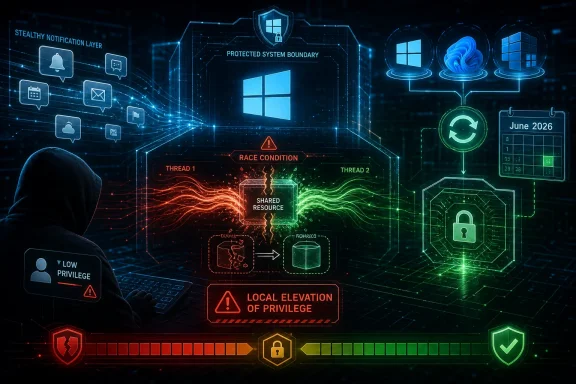 The Notification Layer Is Now Part of the Security Boundary
Windows Push Notifications are easy to dismiss as user-interface machinery: badges, toasts, sync signals, and the background choreography that lets apps behave as if they are always awake. But Windows has spent more than a decade turning this kind of plumbing into a core platform service. Notifications touch identity, app containers, background tasks, cloud services, user sessions, and interprocess communication.That makes a vulnerability in this area more consequential than the words “push notifications” might suggest. CVE-2026-42977 is not a remote takeover bug, and Microsoft has not described it as being exploited in the wild. Still, elevation-of-privilege vulnerabilities are the connective tissue of modern attacks. They are what turn an initial foothold into persistence, credential theft, lateral movement, and full system control.
Microsoft’s description points to concurrent execution using a shared resource with improper synchronization — in plainer English, a race condition. Two bits of code reach for the same state at the wrong time, and an attacker who can influence timing may be able to make Windows do something it should not. That category of bug is especially awkward for defenders because the exploit path often depends on precision, repetition, and local context rather than a simple malformed file or packet.
The advisory’s other practical signal is its scope. CVE-2026-42977 is local, requires low privileges, requires no user interaction, and has high confidentiality, integrity, and availability impact once successfully exploited. That combination is exactly why local privilege escalation bugs keep showing up in real incident chains: they are rarely the first click, but they can be the moment an intrusion stops being contained.
Microsoft’s Confidence Metric Matters More Than It Looks
The text accompanying the advisory highlights a metric that often gets skimmed: report confidence. This is the part of vulnerability scoring that tries to answer a deceptively simple question: how sure are we that this bug exists, and how credible are the technical details?For CVE-2026-42977, the signal is strong. Microsoft is the vendor of the affected component and has published the advisory as part of its Security Update Guide. That is not the same thing as a full exploit write-up, but it is a formal acknowledgement that the vulnerability exists and that a security update is the appropriate remedy. In CVSS terms, that generally places the issue at the high end of confidence, even when Microsoft withholds root-cause details.
That distinction matters for administrators triaging hundreds of patches. A bug with thin third-party rumors, no vendor acknowledgement, and unclear affected versions deserves a different operational posture from a bug Microsoft has accepted into Patch Tuesday. CVE-2026-42977 belongs in the latter bucket. The exploit details may be limited, but the existence of the flaw is not speculative.
There is a second layer to the confidence story. Microsoft’s limited prose gives attackers less to copy directly, but it still tells them where to look: Windows Push Notifications, synchronization, shared resources, and privilege elevation. In 2026, that is not nothing. Patch diffing, symbol analysis, crash reproduction, and automated vulnerability research have compressed the gap between advisory publication and exploit experimentation.
The old bargain was that sparse advisories bought defenders time. That bargain is weaker now. A confirmed local privilege escalation bug in a Windows component, even without public proof-of-concept code, is enough to attract reverse engineers who specialize in turning patch metadata into working exploit hypotheses.
High Severity Does Not Mean Internet Worm, and That Is the Point
CVE-2026-42977 carries a CVSS 3.1 base score of 7.8, which places it in the high-severity band. That number can be misleading if read in isolation. It is not a “drop everything, internet-facing server” score in the way a 9.8 remote-code-execution vulnerability in HTTP.sys or TCP/IP would be. The attack vector is local, the attacker needs some level of existing authorization, and Microsoft’s known public data does not point to active exploitation.But CVSS is not a deployment calendar. A local privilege escalation bug with high impact can be operationally urgent in environments where users run untrusted code, where endpoint isolation is weak, or where adversaries routinely obtain low-privilege access through phishing, malicious documents, stolen credentials, or exposed remote access tools. In those settings, “local” is not a comfort; it is the second stage.
The high impact fields also deserve attention. Once the vulnerability is exploited successfully, the expected damage is not narrow. Confidentiality, integrity, and availability are all rated high, which implies the attacker can meaningfully break out of the limited position they started from. That is why privilege escalation vulnerabilities are so prized in ransomware and espionage playbooks.
Attack complexity appears to be the moderating factor. Race conditions are often more fragile than straightforward memory corruption bugs, and reliable exploitation may require repeated attempts or careful timing. But fragility is not immunity. Attackers are patient when the payoff is privilege, and local exploit code can loop until timing breaks its way.
The Affected Windows Matrix Is a Familiar Kind of Sprawl
The public vulnerability data identifies Windows 10, Windows 11, Windows Server 2019, Windows Server 2022, and Windows Server 2025 among affected product families. That breadth is not surprising for a shared Windows component, but it is exactly what makes Patch Tuesday difficult in real shops. The bug is not confined to a niche SKU or a deprecated corner of the platform.For enterprise IT, the practical question is not whether the notification stack matters on a server. It is whether the vulnerable code exists, ships, and can be reached in a supported configuration. Server Core, desktop experience installations, VDI hosts, developer workstations, kiosk devices, and ordinary laptops all have different exposure stories. Microsoft’s servicing model collapses those differences into cumulative updates; administrators still have to understand where the risk is operationally meaningful.
Windows 10 also remains part of the story. Even as Microsoft continues pushing customers toward newer Windows 11 releases, Windows 10 systems are still present across fleets, industrial setups, point-of-sale environments, and conservative enterprises. A vulnerability that spans both generations is a reminder that migration does not erase the patching problem; it often duplicates it for years.
Server releases complicate the optics. A “push notifications” flaw sounds desktop-flavored, but Windows Server increasingly shares user-mode and system services with client Windows. Administrators who assume a server is safe because no one is clicking toast notifications are making the wrong inference. The relevant question is whether the vulnerable component is present and reachable by an authenticated local attacker or compromised workload.
The Race Condition Is the Clue Microsoft Chose to Leave
Microsoft’s description is sparse, but the phrase “concurrent execution using shared resource with improper synchronization” is useful. Race conditions happen when software assumes that state remains stable between a check and a use, or when multiple threads manipulate shared state without adequate locking. The result can be subtle: an object freed too early, a permission check bypassed, a handle reused, or a privileged operation performed under the wrong assumptions.That is why these flaws so often appear near privilege boundaries. Modern operating systems are full of brokered services, background workers, asynchronous callbacks, and queues designed to keep the user experience smooth. Every handoff is an opportunity for state to drift. Every optimization that avoids blocking can become a security liability if the code assumes the world has not changed.
The notification stack is especially plausible terrain for this class of bug. It must coordinate between apps, users, sessions, services, and the shell. It also has to manage asynchronous delivery, background execution, and policy decisions. If authorization and object lifetime are not synchronized cleanly, an attacker with local access may be able to win a timing window.
The advisory does not prove any particular exploit technique, and it would be irresponsible to pretend otherwise. But the categories attached to the CVE point toward a familiar family of Windows bugs: not a dramatic parsing failure, but a small ordering mistake in privileged plumbing. These are the bugs that look mundane in a table and maddening in a debugger.
Patch Tuesday’s Volume Problem Changes the Risk Calculation
CVE-2026-42977 arrived in a June 2026 Patch Tuesday that security researchers described as unusually large, with Microsoft addressing more than 200 CVEs across Windows, Office, Edge, Azure, Exchange, Defender, Hyper-V, BitLocker, and other products. That context matters because individual vulnerabilities no longer compete only on severity. They compete for testing windows, reboot slots, change-board attention, and administrator fatigue.In a smaller month, a high-severity Windows local privilege escalation bug in a broadly deployed component would receive more focused attention. In this release, it sits beside critical remote-code-execution issues, publicly known bugs, and at least one vulnerability reportedly under active exploitation. That does not make CVE-2026-42977 less real. It makes it easier to overlook.
This is the quiet danger of record-sized patch drops. Enterprises are trained to prioritize internet-facing RCEs first, and that instinct is rational. But attackers do not build campaigns out of a single CVE category. They chain whatever works: an Office lure, a browser escape, a credential theft trick, a local elevation bug, a persistence mechanism, and a lateral movement path.
A local elevation bug in Windows Push Notifications is therefore not necessarily the top patch of the month. It is more like a bolt in the bridge. You may not see it from the road, but if enough bolts are weak, the structure stops being trustworthy.
Home Users Should Not Overthink the Component Name
For ordinary Windows users, the advice is refreshingly boring: install the June 2026 cumulative update when it is offered, and do not try to disable random notification services as a substitute for patching. Windows components are intertwined enough that amateur hardening can cause more trouble than it prevents. The fix is the update.The bigger lesson is that local privilege escalation bugs assume an attacker has already crossed some boundary. That could mean malware running as the user, a malicious installer, a compromised account, or a payload delivered through a separate vulnerability. Keeping Windows updated matters, but so do the unglamorous basics: avoid running unknown executables, keep browsers and document readers patched, use standard user accounts where possible, and treat “allow this app to make changes” prompts as meaningful.
It is also worth resisting the notification-specific panic. There is no public indication that receiving a toast notification is itself the attack. Microsoft’s disclosed attack vector is local, not network. That means the attacker needs code or access on the machine first. The vulnerability is dangerous because of what it may allow after that point, not because every pop-up is suddenly a trap.
For power users, the right response is verification rather than tinkering. Check Windows Update history, confirm the relevant June cumulative update installed successfully, and make sure any paused updates are resumed. If you manage family machines, gaming rigs, or small-office PCs, the real risk is not the notification subsystem. It is the machine that quietly missed updates for three months.
Enterprise IT Has to Treat This as a Chain Component
In managed environments, CVE-2026-42977 belongs in the privilege-escalation queue, not the curiosity queue. It should be evaluated alongside endpoint compromise scenarios, not merely against the narrow question of remote exploitability. If a low-privilege user or process can elevate locally, then endpoint detection, application control, credential isolation, and least privilege all become more important.The most exposed endpoints are the usual suspects: developer workstations, help-desk machines, shared desktops, VDI environments, jump boxes with imperfect controls, and any system where users can run code from email, browsers, package managers, scripts, or removable media. These are places where attackers are likelier to obtain a low-privilege foothold and then need a local bug to move upward.
Servers require a more nuanced analysis. A local privilege escalation vulnerability is less reachable on a well-managed server with no interactive users and tightly controlled workloads. But “less reachable” is not “irrelevant.” Web shells, compromised services, stolen operator accounts, misconfigured scheduled tasks, and vulnerable third-party software can all create the low-privilege position needed to exploit a local bug.
The operational response should be boring but disciplined. Test the June cumulative updates against representative workloads, deploy quickly to high-risk endpoints, monitor for failures, and verify completion. For isolated or update-controlled environments, the key is not to wait for public exploit code before acting. By then, the defensive advantage has already narrowed.
The Confidence Is High, but the Public Story Is Incomplete
One of the more frustrating parts of Microsoft security advisories is the gap between machine-readable precision and human-readable context. We get a CVE number, severity, CVSS vector, affected products, and a one-sentence description. We do not get a narrative of how the bug was found, what privilege boundary is crossed, whether exploitation yields SYSTEM, which service is most directly involved, or what telemetry might reveal attempted exploitation.There are defensible reasons for that restraint. Detailed advisories can accelerate exploit development, especially for bugs in widely deployed operating system components. Microsoft must balance transparency with the reality that Patch Tuesday is read by defenders and attackers at the same time.
But the cost falls on administrators. Without richer context, they are left to infer risk from scoring fields and product names. That works reasonably well for obvious remote-code-execution bugs. It works less well for local race conditions, where exploitability may vary dramatically by configuration and where a single missing detail can change a patch’s priority.
CVE-2026-42977 is therefore a case study in modern vulnerability communication. Microsoft has said enough to confirm the bug and justify patching. It has not said enough to let defenders fully model exploitation. That is not unusual, but it does mean confidence in existence should not be mistaken for completeness of understanding.
Why This Bug Will Be Reverse-Engineered Anyway
Even if no public proof of concept exists today, CVE-2026-42977 is the sort of bug that attracts attention after release. Windows local privilege escalation vulnerabilities have a durable market because they are reusable across intrusion types. Criminal groups, red teams, exploit brokers, and independent researchers all care about the same thing: a reliable way to move from user context to something stronger.Patch diffing is the obvious path. Once Microsoft ships fixes, researchers can compare vulnerable and fixed binaries, identify changed code paths, and work backward toward the flaw. Race conditions are harder to weaponize than many memory-safety bugs, but they are not immune to this process. The patch itself becomes a map.
The notification subsystem also has the advantage of being present on ordinary Windows machines. Researchers prefer bugs they can reproduce without exotic hardware or expensive enterprise setups. If the vulnerable behavior can be triggered from a standard user session, experimentation becomes easier.
That does not mean exploitation is inevitable or imminent. It means defenders should not confuse a quiet first day with a quiet lifecycle. Many Windows privilege escalation bugs become more actionable after the first wave of patch analysis, not at the moment the advisory lands.
Microsoft’s Platform Convenience Keeps Creating Platform Risk
The deeper story is that Windows keeps absorbing more convenience features into privileged, always-on infrastructure. Notifications, cloud sync, identity brokers, widgets, app services, shell integrations, and background execution all exist to make Windows feel less like a static desktop and more like a connected platform. Users expect that. Developers depend on it. Microsoft competes on it.Security then has to follow the complexity. Every brokered service needs careful authorization. Every shared resource needs correct synchronization. Every background component needs a threat model that assumes local attackers will try to confuse it, starve it, race it, and reuse its handles in unintended ways.
CVE-2026-42977 is not evidence that push notifications are uniquely broken. It is evidence that convenience layers are now security layers. The more Windows hides complexity from users, the more that complexity concentrates in services ordinary users never inspect and many administrators never inventory.
This is the long-term challenge for Microsoft. The company can continue improving memory safety, sandboxing, code signing, and exploit mitigations, but the operating system’s connective tissue remains a vast attack surface. Bugs like this do not need to be spectacular to matter. They only need to be reachable at the wrong moment.
The Patch Queue Should Not Let This One Disappear
CVE-2026-42977 is not the June 2026 Patch Tuesday headliner, but it is exactly the kind of Windows bug that deserves a firm place in the deployment plan. It is vendor-confirmed, broadly relevant, locally exploitable, and high impact after successful exploitation. Its race-condition nature may raise the bar for reliable attacks, but it does not make the vulnerability academic.For WindowsForum readers, the concrete read is simple:
- Microsoft disclosed CVE-2026-42977 on June 9, 2026, as a Windows Push Notifications elevation-of-privilege vulnerability.
- The flaw is local rather than remote, and an attacker needs existing low-privilege access before it becomes useful.
- The vulnerability is tied to improper synchronization of a shared resource, which places it in the race-condition family of bugs.
- The CVSS 3.1 base score is 7.8, with high impact to confidentiality, integrity, and availability after successful exploitation.
- The affected product range spans major Windows client and server families, so administrators should not dismiss it as a desktop-only issue.
- The right mitigation is to deploy the relevant June 2026 Windows security updates, not to improvise around the notification subsystem.
References
- Primary source: MSRC
Published: 2026-06-09T07:00:00-07:00
Security Update Guide - Microsoft Security Response Center
 msrc.microsoft.com
- Related coverage: aha.org
